HEMATOXYLIN AND EOSIN
PREPARTION/STAINING
PROCEDURE
Dr Y L S
INTRODUCTION
• The histopathological sections that are prepared are colorless
and different components cannot be appreciated.
• Staining them with different color dyes having affinity od
special components of tissues helps in easy identification of
morphology.
• H & E staining is the most frequently used stain in histology.
HEMATOXYLIN
• It is extracted from bark of tree hematoylom campechianum.
• Hematoxylin itself is not a stain.
• It is a major oxidation product of hematin which is responsible for
natural color of dye.
• Hematin can be produced from hematoxylin from two ways:
• NATURAL OXIDATION
• By exposure to sunlight and air,but it is along process takes 3-4
months
• Solution retain the stain for longer time.
CHEMICAL OXIDATION
• Occur instantaneously with short half life
• Oxidation by sodium iodate most common ly used .eg –mayers
hematoxylin
• Oxidation by mercuric oxide eg harris hematoxylin.
• Hematin is a weak base dye having poor affinity dye for tissues and
inadequate as nuclear stain with mordant.
• MORDANT-Mordant is a substance which act as intermediate
between dye and tissue .it is a metal with valency of 2+.
• Examples are ammonium and potassium alum ferric salt.
PROPRTIES OF HEMATOXYLIN
• Hematoxylin has no staining property.
• Hematin with mordant such as ammonium or potassium alum forms
lake which function as cationic dye and stains anionic tissue
components.
• Hematin in aqueous solution can be acidic or alkaline dye
depending on PH.
Classification of hematoxylin solutions
• Alum hematoxylin-Harris and Mayers
• Iron hematoxylin –Weigerts and Verhoeffs
• Tungston hematoxylin
• Molybdenum hematoxylin
• Lead hematoxylin
• PROGRESSIVE STAINING
• When tissue is left in the stain just long enough to reach the
property end point. the slide have to be examined under
microscope at different intervals.
• REGRESSIVE STAINING
• The tissue is overstained and then restained until the end point is
reached.
• Harris hematoxylin is regressive stain the over stainig is removed by
acid alcohol .The removal of excess dye is called differentiation.
• The hematoxylin alum gives a reddish hue to the tissues because of
acidic ph.
• To convert the color to final blue alkaline ph is required.
• This process is called bluing.it is done either with tap water or
ammonium hydroxide.
PREPARATION OF HARRIS HEMATOXYLIN
INGREDIENTS
• Hematoxylin-5gm
• Absolut alcohol-50ml
• Ammonium alum-100gm
• Distilled water-1000ml
• Mercuric oxide-2.5gm
• Glacial acetic acid-40ml
METHOD
• Dissolve the hematoxylin in absolute alcohol and ammonium alum
in hot water.
• Mix the 2 solutions and heat to boiling.
• Remove from the flame and add mercuric oxide and cool rapidly.
• Glacial acetic acid if added gives brisk nuclear staining but life of the
solution is reduced.
• Hence if acetic acid is to be added it should be added in working
solutions.
EOSIN
• Eosin is the counter stain that stains the cytoplasm rose coloured.
• The most widely used eosin is eosin y( y-yellow).
• It is available in either water or alcohol soluble form.
• Most of the labs use the water soluble form of eosin y in an alcohol
water solution.
INGRIDIENTS
• Eosin y-1 gm
• Distilled water-80ml
• 95% alcohol-320ml
• Glacial acidic acid-0.4ml
PREPARATION
• Dissolve the eosin in water and then add to this 95% alcohol.
• To the final mixture add few drops of acetic acid which increase the
staining intensity of eosin.
• When ready to use the stain should be cloudy if clear add a few
drops of acetic acid.
• The solution should be standardized by stainig the control slide.
7/31/19
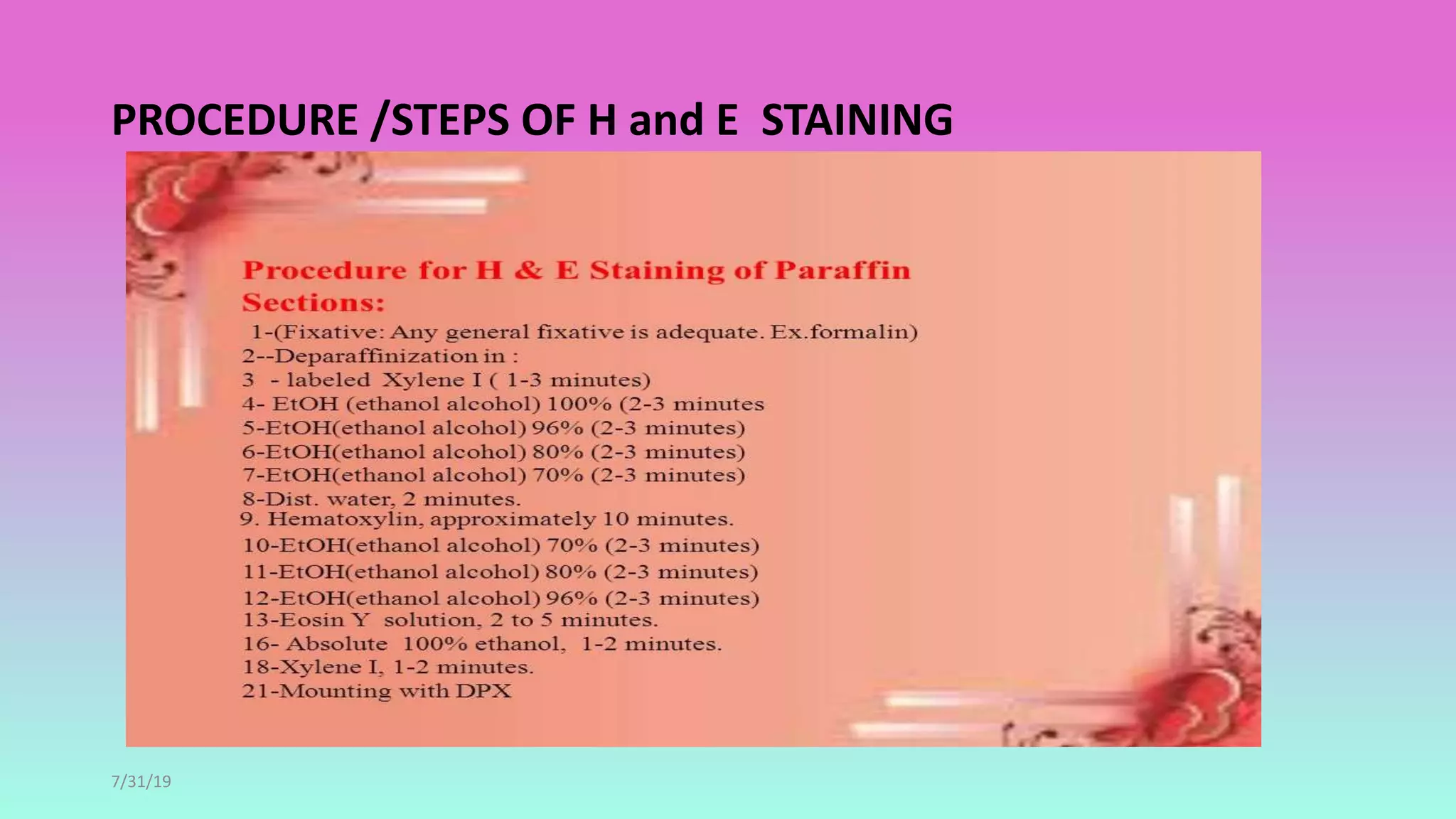
PROCEDURE /STEPS OF H and E STAINING
7/31/19
7/31/19

H & e preparation and staining

  • 1.
  • 2.
    INTRODUCTION • The histopathologicalsections that are prepared are colorless and different components cannot be appreciated. • Staining them with different color dyes having affinity od special components of tissues helps in easy identification of morphology. • H & E staining is the most frequently used stain in histology.
  • 3.
    HEMATOXYLIN • It isextracted from bark of tree hematoylom campechianum. • Hematoxylin itself is not a stain. • It is a major oxidation product of hematin which is responsible for natural color of dye.
  • 4.
    • Hematin canbe produced from hematoxylin from two ways: • NATURAL OXIDATION • By exposure to sunlight and air,but it is along process takes 3-4 months • Solution retain the stain for longer time.
  • 5.
    CHEMICAL OXIDATION • Occurinstantaneously with short half life • Oxidation by sodium iodate most common ly used .eg –mayers hematoxylin • Oxidation by mercuric oxide eg harris hematoxylin.
  • 6.
    • Hematin isa weak base dye having poor affinity dye for tissues and inadequate as nuclear stain with mordant. • MORDANT-Mordant is a substance which act as intermediate between dye and tissue .it is a metal with valency of 2+. • Examples are ammonium and potassium alum ferric salt.
  • 7.
    PROPRTIES OF HEMATOXYLIN •Hematoxylin has no staining property. • Hematin with mordant such as ammonium or potassium alum forms lake which function as cationic dye and stains anionic tissue components. • Hematin in aqueous solution can be acidic or alkaline dye depending on PH.
  • 8.
    Classification of hematoxylinsolutions • Alum hematoxylin-Harris and Mayers • Iron hematoxylin –Weigerts and Verhoeffs • Tungston hematoxylin • Molybdenum hematoxylin • Lead hematoxylin
  • 9.
    • PROGRESSIVE STAINING •When tissue is left in the stain just long enough to reach the property end point. the slide have to be examined under microscope at different intervals. • REGRESSIVE STAINING • The tissue is overstained and then restained until the end point is reached.
  • 10.
    • Harris hematoxylinis regressive stain the over stainig is removed by acid alcohol .The removal of excess dye is called differentiation. • The hematoxylin alum gives a reddish hue to the tissues because of acidic ph. • To convert the color to final blue alkaline ph is required. • This process is called bluing.it is done either with tap water or ammonium hydroxide.
  • 11.
    PREPARATION OF HARRISHEMATOXYLIN INGREDIENTS • Hematoxylin-5gm • Absolut alcohol-50ml • Ammonium alum-100gm • Distilled water-1000ml • Mercuric oxide-2.5gm • Glacial acetic acid-40ml
  • 12.
    METHOD • Dissolve thehematoxylin in absolute alcohol and ammonium alum in hot water. • Mix the 2 solutions and heat to boiling. • Remove from the flame and add mercuric oxide and cool rapidly. • Glacial acetic acid if added gives brisk nuclear staining but life of the solution is reduced. • Hence if acetic acid is to be added it should be added in working solutions.
  • 13.
    EOSIN • Eosin isthe counter stain that stains the cytoplasm rose coloured. • The most widely used eosin is eosin y( y-yellow). • It is available in either water or alcohol soluble form. • Most of the labs use the water soluble form of eosin y in an alcohol water solution.
  • 14.
    INGRIDIENTS • Eosin y-1gm • Distilled water-80ml • 95% alcohol-320ml • Glacial acidic acid-0.4ml
  • 15.
    PREPARATION • Dissolve theeosin in water and then add to this 95% alcohol. • To the final mixture add few drops of acetic acid which increase the staining intensity of eosin. • When ready to use the stain should be cloudy if clear add a few drops of acetic acid. • The solution should be standardized by stainig the control slide.
  • 16.
  • 17.
    PROCEDURE /STEPS OFH and E STAINING 7/31/19
  • 18.