CYTOCHEMICAL
STAINING
Department of Haematology
Post Graduate Institute of Medical Education And
Research Chandigarh
Moderators
Respected :- S.K.Bose Sir
Respected :- Ishwar Bihana Sir
Presented By
Poonam Rawat
B.sc. MLT Student
Part III
Types of Cytochemical stains
ENZYMATIC
1. Myeloperoxidase
2. Esterase
a) specific
b) non specific
3. Phosphatase
a) leucocyte alkaline phosphatase
b)acid phosphatase
NON-ENZYMATIC
4. Sudan black B
5. Periodic acid Schiff
6. Toluidine blue
7. Perl’ stain
MYELOPEROXIDASE (MPO)
 It is an enzyme present in primary and secondary granules of neutrophils
and their precursors.
 Also present in eosinophil granules and in azurophillic granules of
monocytes.
Purpose
 Differentiate between myelogenous and monocytic leukaemia from acute
lymphoblastic leukaemia(ALL).
 Diagnose congenital deficiency of neutrophil MPO.
Principle:-
Myeloperoxidase splits H2O2 in the presence of chromogenic
electron donor (e.g. DAB) and forms an insoluble reaction product.
The reaction product is stable, insoluble and non diffusible.
Method:-
Pseudo peroxidase or Lepehre reaction
Reagents:-
• Fixative:- Buffered Formal acetone (BFE)
Acetone - 40 ml
Buffer - 30 ml
Formalin- 25 ml
• Substrate:- 3,3’- DAB (Diaminobenzidine)
• Buffer:- Sorensen's phosphate buffer, PH-7.3
• Hydrogen peroxide(H2O2, 30% w/v)
• Counterstain:- Aqueous haematoxylin.
Procedure:-
1) Fix air dried smear in cold buffered acetone for 30 sec.
2) Rinse in running tap water and dry.
3) Incubate for 10 min. in working substrate solution.
Working substrate solution:- 30mg of DAB in 60ml buffer,
and add 120µl H2O2 just before use.
4) Wash, counter stain with haematoxylin for 3-5 min.
5) Rinse in running tap water and air dry.
Results:-
The reaction product is brown and granular.
All nuclei are blue.
Interpretation:-
• Early myeloblasts are negative, with granular positivity appearing
progressively as they mature.
• Dark brown granules in the cytoplasm of granulocytes and monocytes.
• Monocytes exhibit weaker and more scattered staining properties than
granulocytes.
• RBC’S will stain diffusely brown because haemoglobin has pseudo-
peroxidase activity. Hence, act as internal control.
• Eosinophil granules stain strongly and they are cyanide resistant MPO
positive.
• Auer rods stain well with DAB.
• Plasma cells and lymphoblast are negative.
• Peroxidase activity is present in basophil but not demonstrable by DAB.
red brown precipitate
MPO stains reveal strong granular cytoplasmic staining in many leukemic
blasts. MPO positive Auer rods are present .(Intensified Stain )
• MPO Stained positive •Myeloperoxidase staining of
neutrophil at left. The blast is negative.
SUDAN BLACK B (SBB)
Sudan black B is a lipophilic dye that stains intra cellular
phospholipids and other lipids.
Purpose:-
• Same significant as MPO i.e. to differentiate between ALL and AML.
• Done in old smears in witch MPO can not be performed.
Principle:-
The SBB is a lipophilic dye binds irreversibly to an unidentified /
undefined granule in granulocytes and eosinophils.
Method:- SHEEHAN AND STOREY
Reagents:-
• Fixative:- 40% formaldehyde vapours
• Stain:- 0.3% SBB in absolute alcohol
• Phenolic buffer:- 16gm crystalline phenol in 30ml of absolute
ethanol and final volume up to 100ml with buffer.
• Working stain solution:- add 40ml phenolic buffer to 60ml SBB
solution.
• Counter stain :- Leishman stain
Procedure:-
1) Fix air dried smear in in formalin vapours for 5-10 min.
2) Then air wash for 15 min.
3) Now stain with working solution of SBB stain solution for 1 hour.
4) Now give 3 washings of ethanol for 30 sec each.
5) Wash with water and air dry.
6) Now counter stain with Leishman stain.
Results:-
The reaction product is black and granular.
All nuclei are blue.
Interpretation:-
• The results are similar to MPO staining
both in normal and leukemic cells.
• The differences are:-
The eosinophil granules are SBB negative
• In rare cases (1-2%) of ALL shows non
granular smudgy positivity not seen in
MPO staining e.g. in Burkett's lymphoma.
Sudan Black B
• Positive sudan black B (SBB)
stain in a patient with AML ,
• Not the black staining
cytoplasmic granules in the
myeloblasts
SBB positive prominent Auer rods in bone
marrow smear
NEUTROPHIL ALKALINE PHOSPHATE
(NAP)
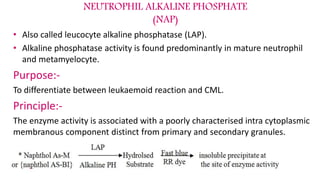
• Also called leucocyte alkaline phosphatase (LAP).
• Alkaline phosphatase activity is found predominantly in mature neutrophil
and metamyelocyte.
Purpose:-
To differentiate between leukaemoid reaction and CML.
Principle:-
The enzyme activity is associated with a poorly characterised intra cytoplasmic
membranous component distinct from primary and secondary granules.
Reagents:-
• Fixative :- 4% formalin methanol
• Substrate :- Napthol AS phosphate
• Buffer :- 0.2M Tris buffer, Ph. 9.0
• Stock substrate solution :- dissolve 30mg of napthol AS in o.5ml
dimethylformamide and make final volume up to 100ml with 0.2M
Tris buffer.
• Coupling azo-dye :- Fast blue BB salt
• Counterstain :- 0.02% aqueous neutral red
Procedure:-
1) Fix air dried blood films for 30 sec. in cold 4% formalin methanol.
2) Rinse with tap water and air dry.
3) Incubate slides with working substrate solution for 15 min. working
substrate solution:- to 40ml stock sol. Add 24mg of fast blue BB.
4) Wash in tap water and air dry.
5) Counterstain for 3min. in 0.02% aqueous neutral red , rinse with
water and air dry.
Results:-
• The reaction product is blue and granular.
• The intensity of reaction varies from negative to strongly positive.
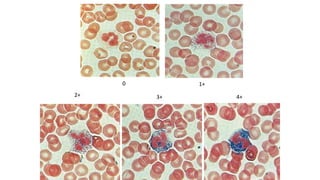
• Count 100 neutrophil and score them 0 to +4 then calculate the final score
by adding the total scores.
• GRADING:-
0 = negative, or no granules
+1 = occasional granules
+2 = moderate no. of granules
+3 = numerous no. of granules
+4 = heavy positivity, numerous
granules crowding cytoplasm
overlying nucleus.
• Normal NAP/ LAP score = 38 to 178
0 1+
2+ 3+ 4+
Interpretation:-
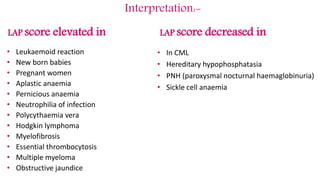
LAP score elevated in
• Leukaemoid reaction
• New born babies
• Pregnant women
• Aplastic anaemia
• Pernicious anaemia
• Neutrophilia of infection
• Polycythaemia vera
• Hodgkin lymphoma
• Myelofibrosis
• Essential thrombocytosis
• Multiple myeloma
• Obstructive jaundice
LAP score decreased in
• In CML
• Hereditary hypophosphatasia
• PNH (paroxysmal nocturnal haemaglobinuria)
• Sickle cell anaemia
• The overall possible score will range between 0 to 400.
• In normal individuals neutrophils with a score 3 or 4 should not be present.
• Fibroblast like reticulum cells and bone marrow macrophages are LAP positive.
• These disease will not effect LAP results
 untreated haemolytic anaemia
 lymphosarcoma
 viral hepatitis
 Secondary polycythemia
Note:-
• Always put control slides for high score
• Glass tube should be used for reagent preparation and storage
• EDTA decreases the LAP activity.
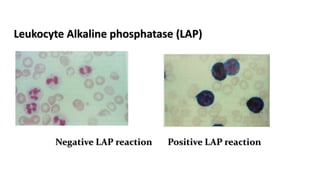
Leukocyte Alkaline phosphatase (LAP)
Positive LAP reactionNegative LAP reaction
NAP positivity 2+ , 3+ and 4+
2+
3+
4+
ACID PHOSPHATASE REACTION
• Cytochemically demonstrable acid phosphatase is ubiquitous in
haemoipoitic cells.
Purpose:-
For the diagnosis of T- cell ALL and Hairy cell leukaemia which is
tartrate resistant.
Principle:-
ACP enzyme present in myelocytic, lymphocytes, monocytic, plasma
cell, and platelets in these cells ACP activity will inhibited in the
presence of (L-tartrate) and give no color, while hairy cell ACP will not
inhibited and give (+ve).
• The pararosanilline method is recommended for positivity in T-
lymphoid cells i.e. modified Goldberg and Burka method.
• Use of Fast Garnet GBC as a coupler for the demonstration of tartrate
resistant acid phosphatase activity in hairy cell leukaemia.
Results:-
The reaction product is red with mixture of granular and diffuse
positivity.
ACID PHOSPHATASE REACTION
Interpretation:-
IN ACP WITHOUT TARTARIC ACID
• All acute and chronic T- lineage leukaemia show strong positivity (
polar positivity ).
• Granulocytes are strongly positive.
• Monocytes, eosinophils and platelets show variablepositivity.
• In bone marrow macrophages, plasma cells and megakaryocytes are
strongly positive.
IN ACP WITH TARTARIC ACID
• In hairy cell leukaemia the majority of leukaemic cells show
positivity in the presence of tartaric acid.
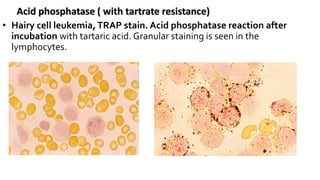
Acid phosphatase ( with tartrate resistance)
• Hairy cell leukemia,TRAP stain. Acid phosphatase reaction after
incubation with tartaric acid. Granular staining is seen in the
lymphocytes.
ACP Positive T-cell acute leukaemia
localised positivity
PERIODIC ACID SCHIFF (PAS)
Purpose:-
• Differentiate between AML(diffuse positivity) and ALL(block
positivity).
• Useful in AML and MDS to identify abnormal erythroblast an
dysplastic megakaryocytes.
• Confirm diagnosis of acute promyelocytic leukaemia.
Principle:-
Periodic acid specifically oxidizes 1-2 glycol groups of carbohydrates to
produce stable di aldehydes. These di aldehydes give a red reaction
product when exposed to Schiff’s reagent.
Reagents:-
• Fixative:- methanol
• 1% periodic acid (HIO4)
• Schiff’s reagent
• Counter stain :- aqueous haematoxylin
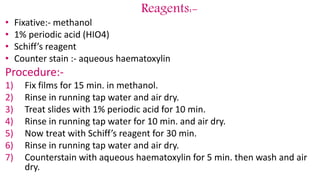
Procedure:-
1) Fix films for 15 min. in methanol.
2) Rinse in running tap water and air dry.
3) Treat slides with 1% periodic acid for 10 min.
4) Rinse in running tap water for 10 min. and air dry.
5) Now treat with Schiff’s reagent for 30 min.
6) Rinse in running tap water and air dry.
7) Counterstain with aqueous haematoxylin for 5 min. then wash and air
dry.
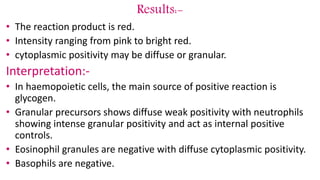
Results:-
• The reaction product is red.
• Intensity ranging from pink to bright red.
• cytoplasmic positivity may be diffuse or granular.
Interpretation:-
• In haemopoietic cells, the main source of positive reaction is
glycogen.
• Granular precursors shows diffuse weak positivity with neutrophils
showing intense granular positivity and act as internal positive
controls.
• Eosinophil granules are negative with diffuse cytoplasmic positivity.
• Basophils are negative.
• Monocytes and their precursors show variable diffuse positivity.
• Normal erythroid precursors and RBC’s are negative. But dysplastic
erythroblast are positive.
• Megakaryocytes and platelets are positive.
• Granular positivity is present in 10 – 40% of peripheral
lymphocytes.
• Lymphoblasts show PAS blocks or granules i.e. block positivity.
Diffuse PAS positivity Block PAS positivity
Positive PAS stain
acute megakaryocytic
leukemia AML, M7.
Positive PAS stain in ALL
PAS positivity in M6. Not the
intense staining of the large
abnormal erythroblast.
Periodic Acid – Schiff [PAS] Reaction
Giant multinucleate late normoblasts
(left). Granular PAS positivity in
proerythroblasts and homogeneous
positivity in the later normoblasts
TOLUIDINE BLUE
It is a basic thiazine metachromatic dye with high affinity to acidic
tissue components.
Purpose:-
• Useful for the enumeration of basophils and mast cells
Reagents:-
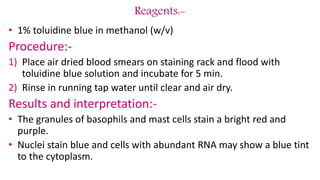
• 1% toluidine blue in methanol (w/v)
Procedure:-
1) Place air dried blood smears on staining rack and flood with
toluidine blue solution and incubate for 5 min.
2) Rinse in running tap water until clear and air dry.
Results and interpretation:-
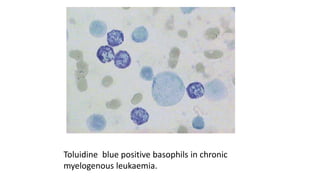
• The granules of basophils and mast cells stain a bright red and
purple.
• Nuclei stain blue and cells with abundant RNA may show a blue tint
to the cytoplasm.
Toluidine blue positive basophils in chronic
myelogenous leukaemia.
ESTERASES
• Leucocyte esterases are the group of enzymes that hydrolyse acyl
and chloroacyl esters of α-naphthol or naphthol AS.
• Nine esterase isoenzymes are identified and they are grouped in :-
SPECIFIC ESTERASE:- Isoenzymes 1, 2, 7, 8, and 9
because they stain specifically with naphthol AS-D chloro
acetate esterase (CAE).
 NON SPECIFIC ESTERASE:- Isoenzymes 3, 4, 5, and 6.
because they stain with α-naphthol acetate esterase(ANAE)
α-naphthyl butyrate esterase (ANBE).
• Non specific esterases are inhibitid by sodium fluoride(NaF).
• ANAE and CAE react with both specific and non specific esterase, but
only the reaction with the NSE is inhibited by esterase by NaF.
Principle:-
Esterase enzyme present in leucocyte hydrolyses the substrate esters
and the product formed react with a diazonium salt and form
brightly formed coloured compound.
Purpose:-
• Useful in differentiating myelocytic series from monocytic series.
• To distinguish between normal and leukemic cells of both series.
1) Naphthol AS-D chloroacetate esterase
useful as a marker of cytoplasmic maturation in myeloid
leukaemia.
Reagents:-
• Fixative :- buffered formal acetone
• Buffer :- 66mmol/l phosphate buffer,ph7.4
• Substrate :- Naphthol AS-D chloroacrtate in buffer
• Coupling reagent :- Hexazotized new fuchsin in 4% sodium nitrate
solution.
• Couterstain :- Aqueous haematoxylin
Procedure:-
1) Fix air dried smears in cold buffered formal acetone for 30sec.
2) Rinse gently in running tap water and air dry.
3) Treat the slides with substrate solution for 5- 10 min.
4) Rinse in running tap water and air dry.
5) Couterstain with aqueous haematoxylin for 1 min.
6) Blue in running tap water and air dry.
Results :-
• The reaction product is bright red.
Interpretation :-
• The positivity is confined to the neutrophil series and mast cells.
• Positivity in myeloblast but mature atages stains strongly.
• Auer rods are positive.
• CAE is robust and reliable stain.
• Alternative to new fuchsin is Fast blue BB.
α- naphthyl butyrate esterase
• Useful to identify monocytic component in AML.
• SUBSTRATE :- α – naphthyl butyrate
• COUPLING REAGENT :- Fast garnet GBC
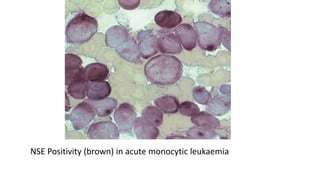
• The reaction product is brown and granular
Interpretation:-
• The majority of monocytes (>80%) stain strongly.
• Granulocytes and platelets are negative.
• B – lymphocytes are negative but T- lymphocytes are positive.
• In bone marrow monocytes, monocytes precursors and macrophages
stain strongly.
α- naphthyl acetate esterase
• SUBSTRATE :- α – naphthyl acetate
• COUPLING REAGENT :- hexazotized pararosaniline in 4% sodium nitrite
solution.
• The reaction product is diffuse red/ brown in colour.
Interpretation:-
• Leukaemic and normal monocyte stain strongly.
• Normal granulocytes are negative, but in MDS and AML may be
positive.
• T – lymphocytes show focal dot like positivity.
• Erythroblast show focal or diffuse positivity.
NSE Positivity (brown) in acute monocytic leukaemia
Combined ANAE and CAE
• Just to avoid the need to compare results from the separate slide.
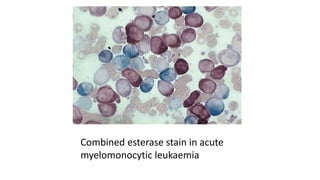
• To detect myelomonocytic leukaemia.
Combined CAE and NABE
• Useful to identify monocytic and granulocytic component in AML.
Combined esterase stain in acute
myelomonocytic leukaemia
Perl’s Iron stain
(Prussian Blue Reaction):
• Principle:
• Sidrotic granules are found in the cytoplasm of developing cells
in [BM] in the form of Ferric [Fe+3].
• Perls' reagent is formed of (Potassium Ferricyanide + HCL)
• Sidrotic granules are found in nRBCs, some reticulocytes
Sidrotic granules are found in nRBCs, some reticulocytes
Thank You

Cytochemical staining checked

  • 1.
    CYTOCHEMICAL STAINING Department of Haematology PostGraduate Institute of Medical Education And Research Chandigarh Moderators Respected :- S.K.Bose Sir Respected :- Ishwar Bihana Sir Presented By Poonam Rawat B.sc. MLT Student Part III
  • 6.
    Types of Cytochemicalstains ENZYMATIC 1. Myeloperoxidase 2. Esterase a) specific b) non specific 3. Phosphatase a) leucocyte alkaline phosphatase b)acid phosphatase NON-ENZYMATIC 4. Sudan black B 5. Periodic acid Schiff 6. Toluidine blue 7. Perl’ stain
  • 7.
    MYELOPEROXIDASE (MPO)  Itis an enzyme present in primary and secondary granules of neutrophils and their precursors.  Also present in eosinophil granules and in azurophillic granules of monocytes. Purpose  Differentiate between myelogenous and monocytic leukaemia from acute lymphoblastic leukaemia(ALL).  Diagnose congenital deficiency of neutrophil MPO.
  • 8.
    Principle:- Myeloperoxidase splits H2O2in the presence of chromogenic electron donor (e.g. DAB) and forms an insoluble reaction product. The reaction product is stable, insoluble and non diffusible. Method:- Pseudo peroxidase or Lepehre reaction
  • 9.
    Reagents:- • Fixative:- BufferedFormal acetone (BFE) Acetone - 40 ml Buffer - 30 ml Formalin- 25 ml • Substrate:- 3,3’- DAB (Diaminobenzidine) • Buffer:- Sorensen's phosphate buffer, PH-7.3 • Hydrogen peroxide(H2O2, 30% w/v) • Counterstain:- Aqueous haematoxylin.
  • 10.
    Procedure:- 1) Fix airdried smear in cold buffered acetone for 30 sec. 2) Rinse in running tap water and dry. 3) Incubate for 10 min. in working substrate solution. Working substrate solution:- 30mg of DAB in 60ml buffer, and add 120µl H2O2 just before use. 4) Wash, counter stain with haematoxylin for 3-5 min. 5) Rinse in running tap water and air dry. Results:- The reaction product is brown and granular. All nuclei are blue.
  • 11.
    Interpretation:- • Early myeloblastsare negative, with granular positivity appearing progressively as they mature. • Dark brown granules in the cytoplasm of granulocytes and monocytes. • Monocytes exhibit weaker and more scattered staining properties than granulocytes. • RBC’S will stain diffusely brown because haemoglobin has pseudo- peroxidase activity. Hence, act as internal control. • Eosinophil granules stain strongly and they are cyanide resistant MPO positive. • Auer rods stain well with DAB. • Plasma cells and lymphoblast are negative. • Peroxidase activity is present in basophil but not demonstrable by DAB.
  • 12.
  • 13.
    MPO stains revealstrong granular cytoplasmic staining in many leukemic blasts. MPO positive Auer rods are present .(Intensified Stain )
  • 14.
    • MPO Stainedpositive •Myeloperoxidase staining of neutrophil at left. The blast is negative.
  • 15.
    SUDAN BLACK B(SBB) Sudan black B is a lipophilic dye that stains intra cellular phospholipids and other lipids. Purpose:- • Same significant as MPO i.e. to differentiate between ALL and AML. • Done in old smears in witch MPO can not be performed. Principle:- The SBB is a lipophilic dye binds irreversibly to an unidentified / undefined granule in granulocytes and eosinophils.
  • 16.
    Method:- SHEEHAN ANDSTOREY Reagents:- • Fixative:- 40% formaldehyde vapours • Stain:- 0.3% SBB in absolute alcohol • Phenolic buffer:- 16gm crystalline phenol in 30ml of absolute ethanol and final volume up to 100ml with buffer. • Working stain solution:- add 40ml phenolic buffer to 60ml SBB solution. • Counter stain :- Leishman stain
  • 17.
    Procedure:- 1) Fix airdried smear in in formalin vapours for 5-10 min. 2) Then air wash for 15 min. 3) Now stain with working solution of SBB stain solution for 1 hour. 4) Now give 3 washings of ethanol for 30 sec each. 5) Wash with water and air dry. 6) Now counter stain with Leishman stain. Results:- The reaction product is black and granular. All nuclei are blue.
  • 18.
    Interpretation:- • The resultsare similar to MPO staining both in normal and leukemic cells. • The differences are:- The eosinophil granules are SBB negative • In rare cases (1-2%) of ALL shows non granular smudgy positivity not seen in MPO staining e.g. in Burkett's lymphoma.
  • 19.
    Sudan Black B •Positive sudan black B (SBB) stain in a patient with AML , • Not the black staining cytoplasmic granules in the myeloblasts SBB positive prominent Auer rods in bone marrow smear
  • 20.
    NEUTROPHIL ALKALINE PHOSPHATE (NAP) •Also called leucocyte alkaline phosphatase (LAP). • Alkaline phosphatase activity is found predominantly in mature neutrophil and metamyelocyte. Purpose:- To differentiate between leukaemoid reaction and CML. Principle:- The enzyme activity is associated with a poorly characterised intra cytoplasmic membranous component distinct from primary and secondary granules.
  • 21.
    Reagents:- • Fixative :-4% formalin methanol • Substrate :- Napthol AS phosphate • Buffer :- 0.2M Tris buffer, Ph. 9.0 • Stock substrate solution :- dissolve 30mg of napthol AS in o.5ml dimethylformamide and make final volume up to 100ml with 0.2M Tris buffer. • Coupling azo-dye :- Fast blue BB salt • Counterstain :- 0.02% aqueous neutral red
  • 22.
    Procedure:- 1) Fix airdried blood films for 30 sec. in cold 4% formalin methanol. 2) Rinse with tap water and air dry. 3) Incubate slides with working substrate solution for 15 min. working substrate solution:- to 40ml stock sol. Add 24mg of fast blue BB. 4) Wash in tap water and air dry. 5) Counterstain for 3min. in 0.02% aqueous neutral red , rinse with water and air dry. Results:- • The reaction product is blue and granular. • The intensity of reaction varies from negative to strongly positive.
  • 23.
    • Count 100neutrophil and score them 0 to +4 then calculate the final score by adding the total scores. • GRADING:- 0 = negative, or no granules +1 = occasional granules +2 = moderate no. of granules +3 = numerous no. of granules +4 = heavy positivity, numerous granules crowding cytoplasm overlying nucleus. • Normal NAP/ LAP score = 38 to 178
  • 24.
  • 25.
    Interpretation:- LAP score elevatedin • Leukaemoid reaction • New born babies • Pregnant women • Aplastic anaemia • Pernicious anaemia • Neutrophilia of infection • Polycythaemia vera • Hodgkin lymphoma • Myelofibrosis • Essential thrombocytosis • Multiple myeloma • Obstructive jaundice LAP score decreased in • In CML • Hereditary hypophosphatasia • PNH (paroxysmal nocturnal haemaglobinuria) • Sickle cell anaemia
  • 26.
    • The overallpossible score will range between 0 to 400. • In normal individuals neutrophils with a score 3 or 4 should not be present. • Fibroblast like reticulum cells and bone marrow macrophages are LAP positive. • These disease will not effect LAP results  untreated haemolytic anaemia  lymphosarcoma  viral hepatitis  Secondary polycythemia Note:- • Always put control slides for high score • Glass tube should be used for reagent preparation and storage • EDTA decreases the LAP activity.
  • 27.
    Leukocyte Alkaline phosphatase(LAP) Positive LAP reactionNegative LAP reaction
  • 28.
    NAP positivity 2+, 3+ and 4+ 2+ 3+ 4+
  • 29.
    ACID PHOSPHATASE REACTION •Cytochemically demonstrable acid phosphatase is ubiquitous in haemoipoitic cells. Purpose:- For the diagnosis of T- cell ALL and Hairy cell leukaemia which is tartrate resistant. Principle:- ACP enzyme present in myelocytic, lymphocytes, monocytic, plasma cell, and platelets in these cells ACP activity will inhibited in the presence of (L-tartrate) and give no color, while hairy cell ACP will not inhibited and give (+ve).
  • 30.
    • The pararosanillinemethod is recommended for positivity in T- lymphoid cells i.e. modified Goldberg and Burka method. • Use of Fast Garnet GBC as a coupler for the demonstration of tartrate resistant acid phosphatase activity in hairy cell leukaemia. Results:- The reaction product is red with mixture of granular and diffuse positivity. ACID PHOSPHATASE REACTION
  • 31.
    Interpretation:- IN ACP WITHOUTTARTARIC ACID • All acute and chronic T- lineage leukaemia show strong positivity ( polar positivity ). • Granulocytes are strongly positive. • Monocytes, eosinophils and platelets show variablepositivity. • In bone marrow macrophages, plasma cells and megakaryocytes are strongly positive. IN ACP WITH TARTARIC ACID • In hairy cell leukaemia the majority of leukaemic cells show positivity in the presence of tartaric acid.
  • 32.
    Acid phosphatase (with tartrate resistance) • Hairy cell leukemia,TRAP stain. Acid phosphatase reaction after incubation with tartaric acid. Granular staining is seen in the lymphocytes.
  • 33.
    ACP Positive T-cellacute leukaemia localised positivity
  • 34.
    PERIODIC ACID SCHIFF(PAS) Purpose:- • Differentiate between AML(diffuse positivity) and ALL(block positivity). • Useful in AML and MDS to identify abnormal erythroblast an dysplastic megakaryocytes. • Confirm diagnosis of acute promyelocytic leukaemia. Principle:- Periodic acid specifically oxidizes 1-2 glycol groups of carbohydrates to produce stable di aldehydes. These di aldehydes give a red reaction product when exposed to Schiff’s reagent.
  • 35.
    Reagents:- • Fixative:- methanol •1% periodic acid (HIO4) • Schiff’s reagent • Counter stain :- aqueous haematoxylin Procedure:- 1) Fix films for 15 min. in methanol. 2) Rinse in running tap water and air dry. 3) Treat slides with 1% periodic acid for 10 min. 4) Rinse in running tap water for 10 min. and air dry. 5) Now treat with Schiff’s reagent for 30 min. 6) Rinse in running tap water and air dry. 7) Counterstain with aqueous haematoxylin for 5 min. then wash and air dry.
  • 36.
    Results:- • The reactionproduct is red. • Intensity ranging from pink to bright red. • cytoplasmic positivity may be diffuse or granular. Interpretation:- • In haemopoietic cells, the main source of positive reaction is glycogen. • Granular precursors shows diffuse weak positivity with neutrophils showing intense granular positivity and act as internal positive controls. • Eosinophil granules are negative with diffuse cytoplasmic positivity. • Basophils are negative.
  • 37.
    • Monocytes andtheir precursors show variable diffuse positivity. • Normal erythroid precursors and RBC’s are negative. But dysplastic erythroblast are positive. • Megakaryocytes and platelets are positive. • Granular positivity is present in 10 – 40% of peripheral lymphocytes. • Lymphoblasts show PAS blocks or granules i.e. block positivity.
  • 38.
    Diffuse PAS positivityBlock PAS positivity
  • 39.
    Positive PAS stain acutemegakaryocytic leukemia AML, M7. Positive PAS stain in ALL PAS positivity in M6. Not the intense staining of the large abnormal erythroblast.
  • 40.
    Periodic Acid –Schiff [PAS] Reaction Giant multinucleate late normoblasts (left). Granular PAS positivity in proerythroblasts and homogeneous positivity in the later normoblasts
  • 41.
    TOLUIDINE BLUE It isa basic thiazine metachromatic dye with high affinity to acidic tissue components. Purpose:- • Useful for the enumeration of basophils and mast cells
  • 42.
    Reagents:- • 1% toluidineblue in methanol (w/v) Procedure:- 1) Place air dried blood smears on staining rack and flood with toluidine blue solution and incubate for 5 min. 2) Rinse in running tap water until clear and air dry. Results and interpretation:- • The granules of basophils and mast cells stain a bright red and purple. • Nuclei stain blue and cells with abundant RNA may show a blue tint to the cytoplasm.
  • 43.
    Toluidine blue positivebasophils in chronic myelogenous leukaemia.
  • 44.
    ESTERASES • Leucocyte esterasesare the group of enzymes that hydrolyse acyl and chloroacyl esters of α-naphthol or naphthol AS. • Nine esterase isoenzymes are identified and they are grouped in :- SPECIFIC ESTERASE:- Isoenzymes 1, 2, 7, 8, and 9 because they stain specifically with naphthol AS-D chloro acetate esterase (CAE).  NON SPECIFIC ESTERASE:- Isoenzymes 3, 4, 5, and 6. because they stain with α-naphthol acetate esterase(ANAE) α-naphthyl butyrate esterase (ANBE).
  • 45.
    • Non specificesterases are inhibitid by sodium fluoride(NaF). • ANAE and CAE react with both specific and non specific esterase, but only the reaction with the NSE is inhibited by esterase by NaF. Principle:- Esterase enzyme present in leucocyte hydrolyses the substrate esters and the product formed react with a diazonium salt and form brightly formed coloured compound.
  • 46.
    Purpose:- • Useful indifferentiating myelocytic series from monocytic series. • To distinguish between normal and leukemic cells of both series. 1) Naphthol AS-D chloroacetate esterase useful as a marker of cytoplasmic maturation in myeloid leukaemia. Reagents:- • Fixative :- buffered formal acetone • Buffer :- 66mmol/l phosphate buffer,ph7.4
  • 47.
    • Substrate :-Naphthol AS-D chloroacrtate in buffer • Coupling reagent :- Hexazotized new fuchsin in 4% sodium nitrate solution. • Couterstain :- Aqueous haematoxylin Procedure:- 1) Fix air dried smears in cold buffered formal acetone for 30sec. 2) Rinse gently in running tap water and air dry. 3) Treat the slides with substrate solution for 5- 10 min. 4) Rinse in running tap water and air dry. 5) Couterstain with aqueous haematoxylin for 1 min. 6) Blue in running tap water and air dry.
  • 48.
    Results :- • Thereaction product is bright red. Interpretation :- • The positivity is confined to the neutrophil series and mast cells. • Positivity in myeloblast but mature atages stains strongly. • Auer rods are positive. • CAE is robust and reliable stain. • Alternative to new fuchsin is Fast blue BB.
  • 49.
    α- naphthyl butyrateesterase • Useful to identify monocytic component in AML. • SUBSTRATE :- α – naphthyl butyrate • COUPLING REAGENT :- Fast garnet GBC • The reaction product is brown and granular Interpretation:- • The majority of monocytes (>80%) stain strongly. • Granulocytes and platelets are negative. • B – lymphocytes are negative but T- lymphocytes are positive. • In bone marrow monocytes, monocytes precursors and macrophages stain strongly.
  • 50.
    α- naphthyl acetateesterase • SUBSTRATE :- α – naphthyl acetate • COUPLING REAGENT :- hexazotized pararosaniline in 4% sodium nitrite solution. • The reaction product is diffuse red/ brown in colour. Interpretation:- • Leukaemic and normal monocyte stain strongly. • Normal granulocytes are negative, but in MDS and AML may be positive. • T – lymphocytes show focal dot like positivity. • Erythroblast show focal or diffuse positivity.
  • 51.
    NSE Positivity (brown)in acute monocytic leukaemia
  • 52.
    Combined ANAE andCAE • Just to avoid the need to compare results from the separate slide. • To detect myelomonocytic leukaemia. Combined CAE and NABE • Useful to identify monocytic and granulocytic component in AML.
  • 53.
    Combined esterase stainin acute myelomonocytic leukaemia
  • 54.
    Perl’s Iron stain (PrussianBlue Reaction): • Principle: • Sidrotic granules are found in the cytoplasm of developing cells in [BM] in the form of Ferric [Fe+3]. • Perls' reagent is formed of (Potassium Ferricyanide + HCL) • Sidrotic granules are found in nRBCs, some reticulocytes
  • 55.
    Sidrotic granules arefound in nRBCs, some reticulocytes
  • 56.