GROUP 6
MUTHUSI JOSHUA BMLS/024J/2014
ODHIAMBO GEOFFREY BMLS/032J/201
KOECH DENNIS BMLS/017J/2014
ODAWO SELPHER BMLS/030J/2014
MASAKA W. BRIAN BMLS/021J/2014
HISTOLOGICAL STAINING.
Staining; loosely defined as treating tissue or cells with reagent or series of
reagents so that it acquires a colour .usually no particles of dye are seen and the
stained element is transparent
Stains; Are chemical substances used to achieve visible colour contrast in the
microscopic feature of a prepared tissue.
• The hematoxylin and Eosin stains are the most widely used histological stains
• They are comparatively simple with ability to demonstrate enormous number of
different tissue structures.
• Hematoxylin stains cell nuclei blue/black
• Eosin stains cell cytoplasm and most connective tissue fibers
Theories of Staining
• Physical theories
Simple solubility; Fat stains are effective because the stain is more
soluble in fat than 70% alcohol
absorption; Property by which a large body attracts to itself minute
particles from a surrounding medium.
• Chemical theories;
Generally acid dyes stain basic elements
Types of stains
• Hematoxylin
• Eosin
• Mallory’s Trichrome stain
• Masson’s Trichrome stain
• Toluidine blue
• Wright stain
• Silver stain
• Weigert’s stain
• PAS
Hematoxylin and Eosin
Used for general staining.
Principle;
• H and E stains for demonstration of nucleus and cytoplasm.
• The cell differentiation is achieved by treating the tissue with acid
solution . The counter staining is performed using Eosin which imparts
colour to cytoplasm
• Hematoxylin binds to acidic structures(Nucleic acids) and stains them
blue/black
• Eosin binds to and stains basic structures(cytoplasm, muscle and
connective tissue, RBC) pink
PROCEDURE
• Deparaffinize the section: Flame the stain and burner and place it in the xylene
• Hydration: Hydrate the tissue section by passing through decreasing concentration of alcohol
baths and water (100%-70%)
• Stain in hematoxylin for 3-5minutes
• Wash in running tap water until section ‘blue’ for 5 minutes
• Differentiate in 1% acid alcohol for 5mins
• Wash in running tap water until sections are again blue by dipping in alkaline solution followed
by tap water wash
• Stain in 1% Eosin 10mins
• wash in tap water for 5min
• Dehydrate in decreasing concentration of alcohols and clear in Xylene
• Mount in mounting cc media and observe under microscope
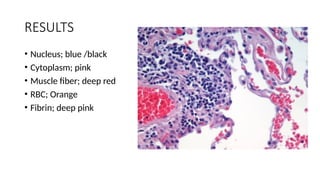
RESULTS
• Nucleus; blue /black
• Cytoplasm; pink
• Muscle fiber; deep red
• RBC; Orange
• Fibrin; deep pink
Masson Trichrome Stain
 Evolved from Claude L. Pierre Masson 1929
 Three colour staining protocol
 Used to stain connective tissues: distinguishes between muscle and collagen
tissue
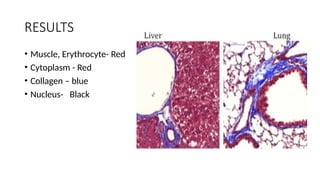
• Stains muscles, erythrocyte and cytoplasm red, collagen blue and nuclei black
Used in identification of fibrosis
Principles;
i. Trichrome produce three dyes
ii. Sections is first stained with acid dyes such as biebrich scarlet
iii. Acidophilic elements; cytoplasm, muscle and collagen will bind with acid dyes
RESULTS
• Muscle, Erythrocyte- Red
• Cytoplasm - Red
• Collagen – blue
• Nucleus- Black
PROCEDURE
• Deparaffinize and rehydrate through 100%-70% alcohol
• Wash in distilled water
• Rinse in running tap water for 5-10mins to remove the yellow colour
• Stain in weigert’s ion hematoxylin working solution for 10 mins
• Rinse in running warm tap water for 10minutes and wash in distilled water
• Stain in Biebrich scarlet acid fuchsin solution for 10mins
• Wash in distilled water
• Differentiate in phosphomolybbdic-phosphotungstic acid solution 10-15mins
• Transfer sections directly without rinsing to aniline blue solution and stain for 5-15mins. Rinse briefly in distilled
water and differentiate in 1% acetic acid solution for 2-5mins
• Wash in distilled water
• Dehydrate very quickly through 95% ethyl alcohol (These step will wipe off Biebrich scarlet acid fuchsin
solution) and clear xylene
• Mount in Resinous mounting media
MALLORY’S TRICHROME STAIN
• Reveals different macromolecules that make up the cell
• Uses three stains aniline blue, acid fuchsin and orange G
• Stains connective tissue.
• REAGENTS
Solution A
• Acid fuchsin
• Distilled water
Solution C
• Orange G
• Oxalic acid
• Methylene blue
• Distilled water
Solution B
Phosphomolybdic acid
Distilled water
PROCEDURE
1. Bring sections to water via Xylene and Ethanol
2. Place into Solution A for 2mins
3. Rinse with distilled water
4. Place into solution B for 2 mins
5. Rings quickly with distilled water
6. Place into solution C for 15 minutes
7. Wash with distilled water
8. Dehydrate and differentiate with Ethanol
9. Clear with Xylene and mount with a resinous medium
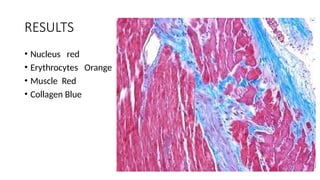
RESULTS
• Nucleus red
• Erythrocytes Orange
• Muscle Red
• Collagen Blue
SILVER STAINS
• Used to show Melanin and reticular fibers (argyrphilic tissue has an
affinity for silver salts hence silver salts will be seen argyriphilic
tissue
REAGENTS
Redundant - 200mg sodium thiosulfate
Silver stain -2g silver nitrate
Developer - 30 g sodium Carbonate
Stop sol - 5% acetic acid in water
water
Procedure
• Fix a tissue in a gel using a fixative for 20 minutes
• Wash the tissue 3 times in a wash solution
• Reduce in redundant for 1 minute
• Wash again 3 times in water (about 30 sec each)
• Stain with silver stains for 20 minutes
• Wash 3 times in water
• Develop in Developer solution until bands become visible
• Stop using a stop solution
• Observe under a microscope.
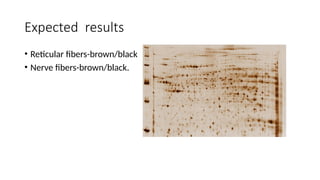
Expected results
• Reticular fibers-brown/black
• Nerve fibers-brown/black.
WRIGHT STAINS
• Based on blend of dyes such as methylene blue derivatives and
acids dyes such as eosin.
• Used for staining blood smears ,urine smears and bone marrow
smears.
• Named after James Wright.
Procedures
• Place 1 ml of liquid wright on the blood film for 1-9 minutes
depending upon its behavior
• Add 2ml of phosphate buffer solution adjusted to a ph 6.5
• Allow the mixture to react until the thin portions of the stained film
are pink
• Stand the slide on end to air dry or blot carefully.
• Make observations
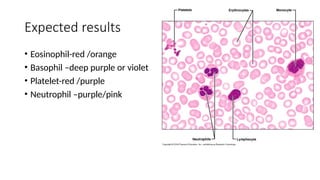
Expected results
• Eosinophil-red /orange
• Basophil –deep purple or violet
• Platelet-red /purple
• Neutrophil –purple/pink
weigert’s stain
• It is used to stain elastic fibers
• Is a sequence of 3 solutions; ferric chloride in dilute HCL,hematoxylin in 95% ethanol and potassium ferricyanide solution
Solutions/reagents
• Weigert’s iron hematoxylin
• Van Gieson’s picrofuchsin
• Ethanol and distilled water
PROCEDURE
I. Bring sections to water via xylene and ethanol
II. Place into Weigert’s solution for 20mins
III. Wash with 95% Ethanol to remove excess solution
IV. Differentiate with 1% acid alcohol
V. Wash in water
VI. Counterstain with iron hematoxylen and van Gieson
VII. Dehydrate with ethanol, clear with xylene and mount with Resinous medium
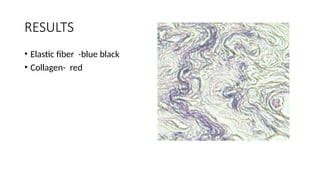
RESULTS
• Elastic fiber -blue black
• Collagen- red
TOLUIDINE
• Used to stain mast cells
• Is a thiazine metachromatic compound, usually an organic compound
Solution and reagents
 Toluidine blue
 Sodium chloride
 Distilled water
Procedure
1) Deparaffinize and hydrate the sections to distilled water
2) Stain sections in toluidine blue for 3mins
3) Wash in distilled water
4) Dehydrate through 95% alcohol
5) Clear in xylene for 3mins
6) Mount in resinous mounting medium
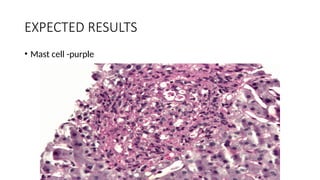
EXPECTED RESULTS
• Mast cell -purple
PAS
• Periodic Acid Schiff (PAS) staining is one of the most commonly
performed special staining technique in histopathology laboratory
which is used to highlight molecules with high percentage of
carbohydrate content such as; mucin, glycogen, fungi and basement
membrane in skin.
Procedure of PAS Staining
1. Bring sections to distilled water.
2. Treat with periodic acid for 5 minutes.
3. Rinse well in distilled water.
4. Cover with Schiff’s reagent for 5-15 minutes.
5. Wash in running tap water for 5-10 minutes
6. Counter stain with Herri’s hematoxylin for approximately 15 seconds.
7. Differentiate (if necessary) with acid alcohol and bluing as usual.
8. Wash in tap water.
9. Rinse in increasing concentration of alcohol (70,80, 95 and 100%)
10. Clear in xylene and mount as usual
.
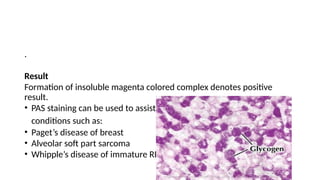
Result
Formation of insoluble magenta colored complex denotes positive
result.
• PAS staining can be used to assist in the diagnosis of several medical
conditions such as:
• Paget’s disease of breast
• Alveolar soft part sarcoma
• Whipple’s disease of immature RBCs

GROUP 6.pptxxxxxxxxxxxxxxxxxxxxxxxxxxxxxxxxxxxxxxxxxxxx

  • 1.
    GROUP 6 MUTHUSI JOSHUABMLS/024J/2014 ODHIAMBO GEOFFREY BMLS/032J/201 KOECH DENNIS BMLS/017J/2014 ODAWO SELPHER BMLS/030J/2014 MASAKA W. BRIAN BMLS/021J/2014
  • 2.
    HISTOLOGICAL STAINING. Staining; looselydefined as treating tissue or cells with reagent or series of reagents so that it acquires a colour .usually no particles of dye are seen and the stained element is transparent Stains; Are chemical substances used to achieve visible colour contrast in the microscopic feature of a prepared tissue. • The hematoxylin and Eosin stains are the most widely used histological stains • They are comparatively simple with ability to demonstrate enormous number of different tissue structures. • Hematoxylin stains cell nuclei blue/black • Eosin stains cell cytoplasm and most connective tissue fibers
  • 3.
    Theories of Staining •Physical theories Simple solubility; Fat stains are effective because the stain is more soluble in fat than 70% alcohol absorption; Property by which a large body attracts to itself minute particles from a surrounding medium. • Chemical theories; Generally acid dyes stain basic elements
  • 4.
    Types of stains •Hematoxylin • Eosin • Mallory’s Trichrome stain • Masson’s Trichrome stain • Toluidine blue • Wright stain • Silver stain • Weigert’s stain • PAS
  • 5.
    Hematoxylin and Eosin Usedfor general staining. Principle; • H and E stains for demonstration of nucleus and cytoplasm. • The cell differentiation is achieved by treating the tissue with acid solution . The counter staining is performed using Eosin which imparts colour to cytoplasm • Hematoxylin binds to acidic structures(Nucleic acids) and stains them blue/black • Eosin binds to and stains basic structures(cytoplasm, muscle and connective tissue, RBC) pink
  • 6.
    PROCEDURE • Deparaffinize thesection: Flame the stain and burner and place it in the xylene • Hydration: Hydrate the tissue section by passing through decreasing concentration of alcohol baths and water (100%-70%) • Stain in hematoxylin for 3-5minutes • Wash in running tap water until section ‘blue’ for 5 minutes • Differentiate in 1% acid alcohol for 5mins • Wash in running tap water until sections are again blue by dipping in alkaline solution followed by tap water wash • Stain in 1% Eosin 10mins • wash in tap water for 5min • Dehydrate in decreasing concentration of alcohols and clear in Xylene • Mount in mounting cc media and observe under microscope
  • 7.
    RESULTS • Nucleus; blue/black • Cytoplasm; pink • Muscle fiber; deep red • RBC; Orange • Fibrin; deep pink
  • 8.
    Masson Trichrome Stain Evolved from Claude L. Pierre Masson 1929  Three colour staining protocol  Used to stain connective tissues: distinguishes between muscle and collagen tissue • Stains muscles, erythrocyte and cytoplasm red, collagen blue and nuclei black Used in identification of fibrosis Principles; i. Trichrome produce three dyes ii. Sections is first stained with acid dyes such as biebrich scarlet iii. Acidophilic elements; cytoplasm, muscle and collagen will bind with acid dyes
  • 9.
    RESULTS • Muscle, Erythrocyte-Red • Cytoplasm - Red • Collagen – blue • Nucleus- Black
  • 10.
    PROCEDURE • Deparaffinize andrehydrate through 100%-70% alcohol • Wash in distilled water • Rinse in running tap water for 5-10mins to remove the yellow colour • Stain in weigert’s ion hematoxylin working solution for 10 mins • Rinse in running warm tap water for 10minutes and wash in distilled water • Stain in Biebrich scarlet acid fuchsin solution for 10mins • Wash in distilled water • Differentiate in phosphomolybbdic-phosphotungstic acid solution 10-15mins • Transfer sections directly without rinsing to aniline blue solution and stain for 5-15mins. Rinse briefly in distilled water and differentiate in 1% acetic acid solution for 2-5mins • Wash in distilled water • Dehydrate very quickly through 95% ethyl alcohol (These step will wipe off Biebrich scarlet acid fuchsin solution) and clear xylene • Mount in Resinous mounting media
  • 11.
    MALLORY’S TRICHROME STAIN •Reveals different macromolecules that make up the cell • Uses three stains aniline blue, acid fuchsin and orange G • Stains connective tissue. • REAGENTS Solution A • Acid fuchsin • Distilled water Solution C • Orange G • Oxalic acid • Methylene blue • Distilled water Solution B Phosphomolybdic acid Distilled water
  • 12.
    PROCEDURE 1. Bring sectionsto water via Xylene and Ethanol 2. Place into Solution A for 2mins 3. Rinse with distilled water 4. Place into solution B for 2 mins 5. Rings quickly with distilled water 6. Place into solution C for 15 minutes 7. Wash with distilled water 8. Dehydrate and differentiate with Ethanol 9. Clear with Xylene and mount with a resinous medium
  • 13.
    RESULTS • Nucleus red •Erythrocytes Orange • Muscle Red • Collagen Blue
  • 14.
    SILVER STAINS • Usedto show Melanin and reticular fibers (argyrphilic tissue has an affinity for silver salts hence silver salts will be seen argyriphilic tissue REAGENTS Redundant - 200mg sodium thiosulfate Silver stain -2g silver nitrate Developer - 30 g sodium Carbonate Stop sol - 5% acetic acid in water water
  • 15.
    Procedure • Fix atissue in a gel using a fixative for 20 minutes • Wash the tissue 3 times in a wash solution • Reduce in redundant for 1 minute • Wash again 3 times in water (about 30 sec each) • Stain with silver stains for 20 minutes • Wash 3 times in water • Develop in Developer solution until bands become visible • Stop using a stop solution • Observe under a microscope.
  • 16.
    Expected results • Reticularfibers-brown/black • Nerve fibers-brown/black.
  • 17.
    WRIGHT STAINS • Basedon blend of dyes such as methylene blue derivatives and acids dyes such as eosin. • Used for staining blood smears ,urine smears and bone marrow smears. • Named after James Wright.
  • 18.
    Procedures • Place 1ml of liquid wright on the blood film for 1-9 minutes depending upon its behavior • Add 2ml of phosphate buffer solution adjusted to a ph 6.5 • Allow the mixture to react until the thin portions of the stained film are pink • Stand the slide on end to air dry or blot carefully. • Make observations
  • 19.
    Expected results • Eosinophil-red/orange • Basophil –deep purple or violet • Platelet-red /purple • Neutrophil –purple/pink
  • 20.
    weigert’s stain • Itis used to stain elastic fibers • Is a sequence of 3 solutions; ferric chloride in dilute HCL,hematoxylin in 95% ethanol and potassium ferricyanide solution Solutions/reagents • Weigert’s iron hematoxylin • Van Gieson’s picrofuchsin • Ethanol and distilled water PROCEDURE I. Bring sections to water via xylene and ethanol II. Place into Weigert’s solution for 20mins III. Wash with 95% Ethanol to remove excess solution IV. Differentiate with 1% acid alcohol V. Wash in water VI. Counterstain with iron hematoxylen and van Gieson VII. Dehydrate with ethanol, clear with xylene and mount with Resinous medium
  • 21.
    RESULTS • Elastic fiber-blue black • Collagen- red
  • 22.
    TOLUIDINE • Used tostain mast cells • Is a thiazine metachromatic compound, usually an organic compound Solution and reagents  Toluidine blue  Sodium chloride  Distilled water Procedure 1) Deparaffinize and hydrate the sections to distilled water 2) Stain sections in toluidine blue for 3mins 3) Wash in distilled water 4) Dehydrate through 95% alcohol 5) Clear in xylene for 3mins 6) Mount in resinous mounting medium
  • 23.
  • 24.
    PAS • Periodic AcidSchiff (PAS) staining is one of the most commonly performed special staining technique in histopathology laboratory which is used to highlight molecules with high percentage of carbohydrate content such as; mucin, glycogen, fungi and basement membrane in skin.
  • 25.
    Procedure of PASStaining 1. Bring sections to distilled water. 2. Treat with periodic acid for 5 minutes. 3. Rinse well in distilled water. 4. Cover with Schiff’s reagent for 5-15 minutes. 5. Wash in running tap water for 5-10 minutes 6. Counter stain with Herri’s hematoxylin for approximately 15 seconds. 7. Differentiate (if necessary) with acid alcohol and bluing as usual. 8. Wash in tap water. 9. Rinse in increasing concentration of alcohol (70,80, 95 and 100%) 10. Clear in xylene and mount as usual
  • 26.
    . Result Formation of insolublemagenta colored complex denotes positive result. • PAS staining can be used to assist in the diagnosis of several medical conditions such as: • Paget’s disease of breast • Alveolar soft part sarcoma • Whipple’s disease of immature RBCs