INTRODUCTION
 The word hematoxlin is drived from old Greek word
Haimato(blood) and Xylon(wood), reffering to its dark red
color in natural state and to
its origin(wood).
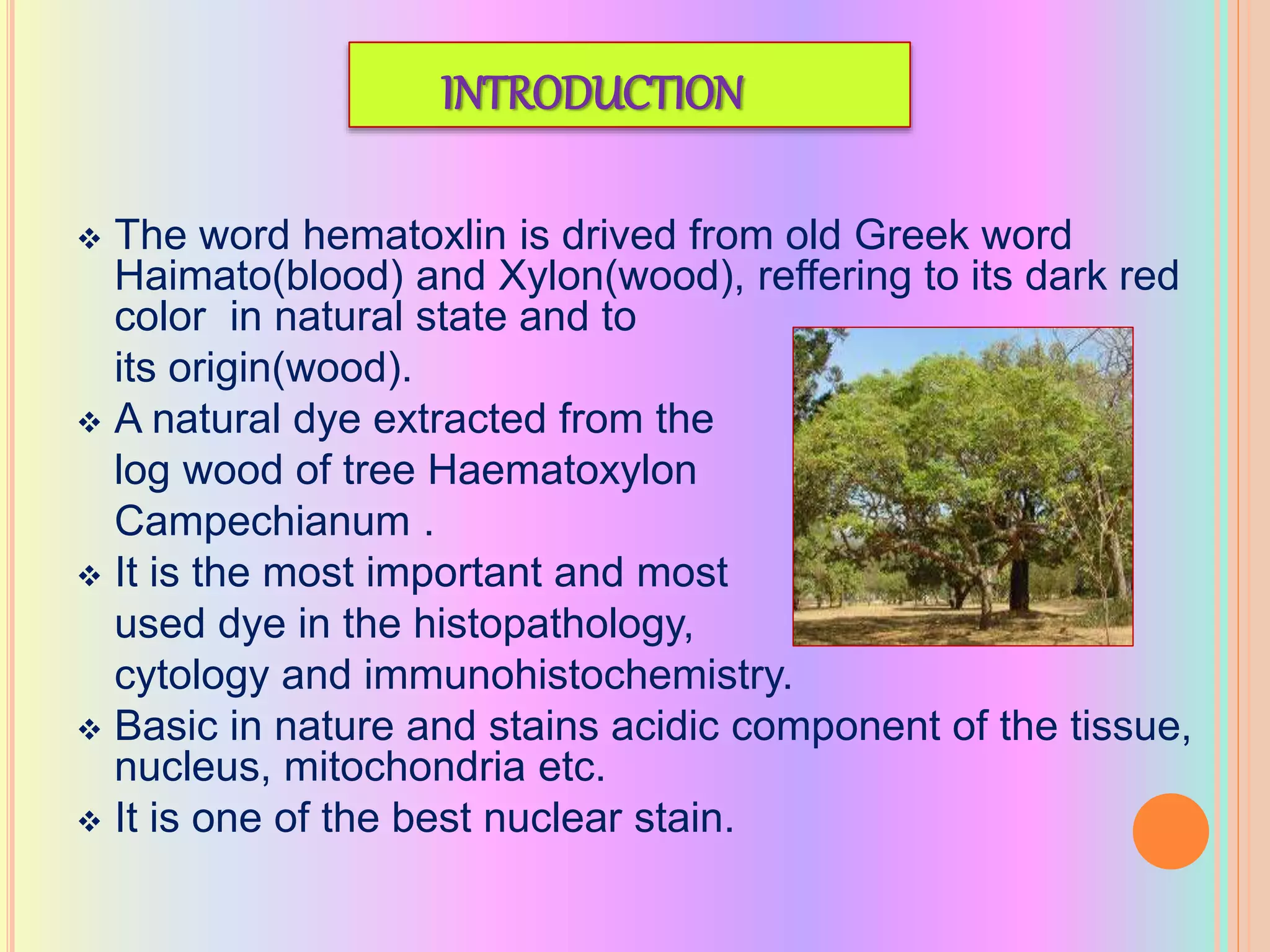
 A natural dye extracted from the
log wood of tree Haematoxylon
Campechianum .
 It is the most important and most
used dye in the histopathology,
cytology and immunohistochemistry.
 Basic in nature and stains acidic component of the tissue,
nucleus, mitochondria etc.
 It is one of the best nuclear stain.
■ Also use to stain metal ions e.g iron, lead etc.
■ Stains tissue components in various shades of blue, pink, red
etc, depending on the nature of the mordant used and the
second stain.
■ It is itself not an active dye, it is its oxidative product
Haematein(natural dye).
■ Haematein is a weak dye have poor affinity for tissue
and requires a mordant for adequate staining.
■ Mordant is a chemical substance that increases the
affinity of dye for tissue and its staining efficiency by
forming link between the stain and the tissue.
■ Mordants are the metallic salts e.g salts of aluminum
and iron etc.
Extraction:
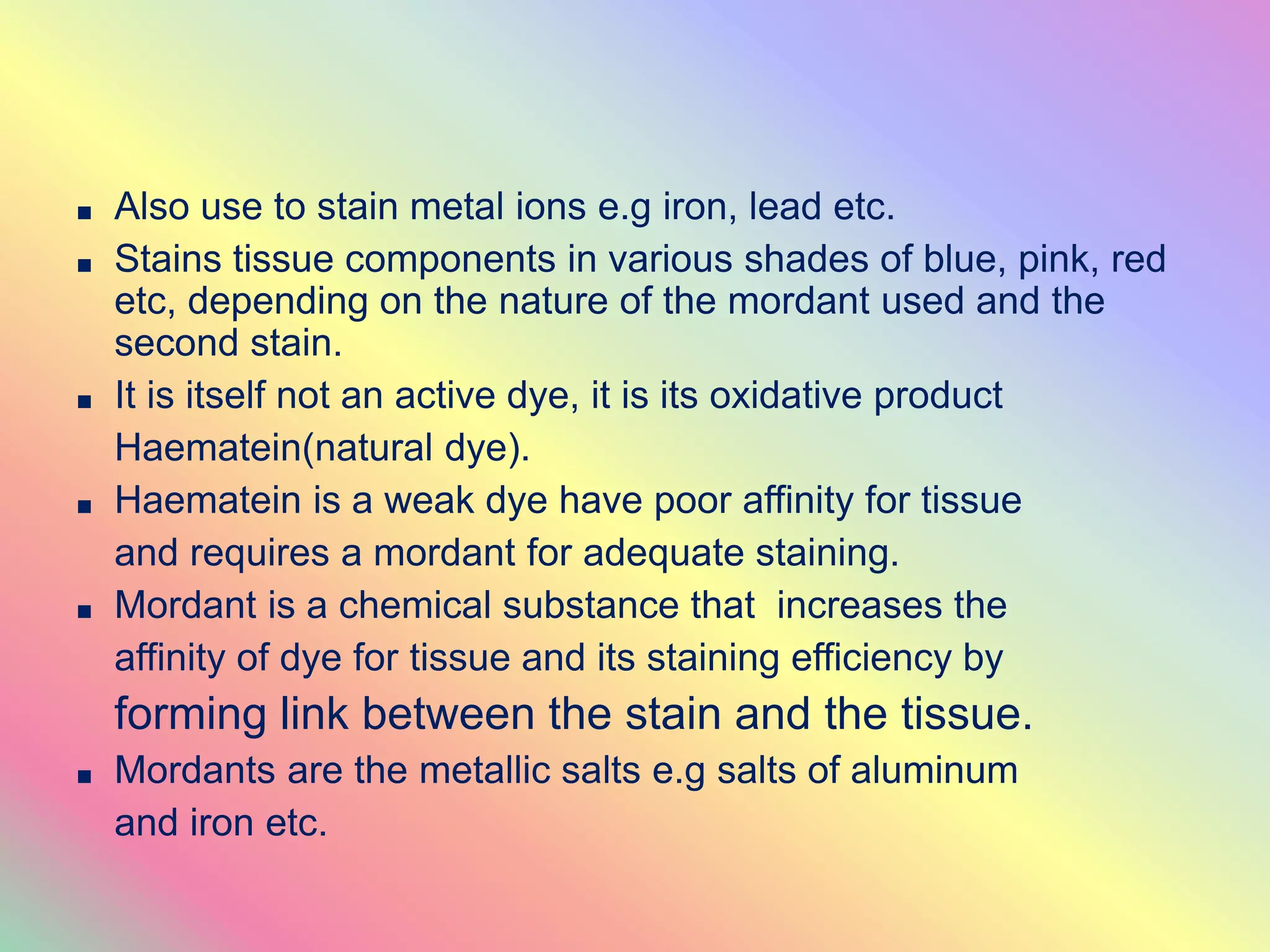
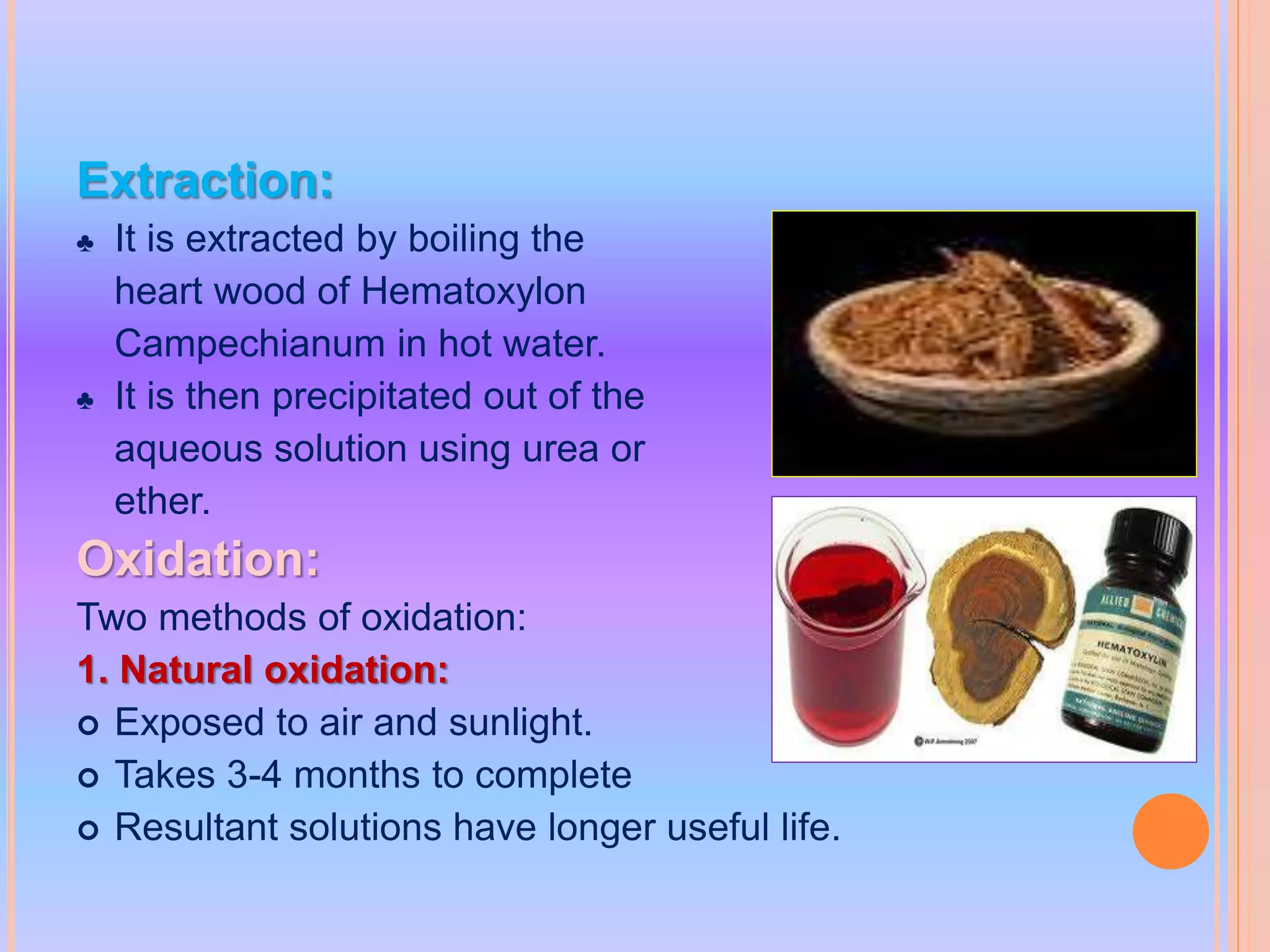
♣ It is extracted by boiling the
heart wood of Hematoxylon
Campechianum in hot water.
♣ It is then precipitated out of the
aqueous solution using urea or
ether.
Oxidation:
Two methods of oxidation:
1. Natural oxidation:
 Exposed to air and sunlight.
 Takes 3-4 months to complete
 Resultant solutions have longer useful life.
 Examples are Ehrlich’s and Delafield’s haematoxylin.
2. Chemical oxidation:
 Chemical oxidizing agents are used, e.g sodium iodate,
mercuric oxide, hydrogen peroxide, potassium
permanganate etc.
 Instant conversion of haematoxylin to haematein,
immediately ready for use.
 Resultant solutions have a shorter useful life.
 Examples are Mayer’s and Harris’s haematoxylins.
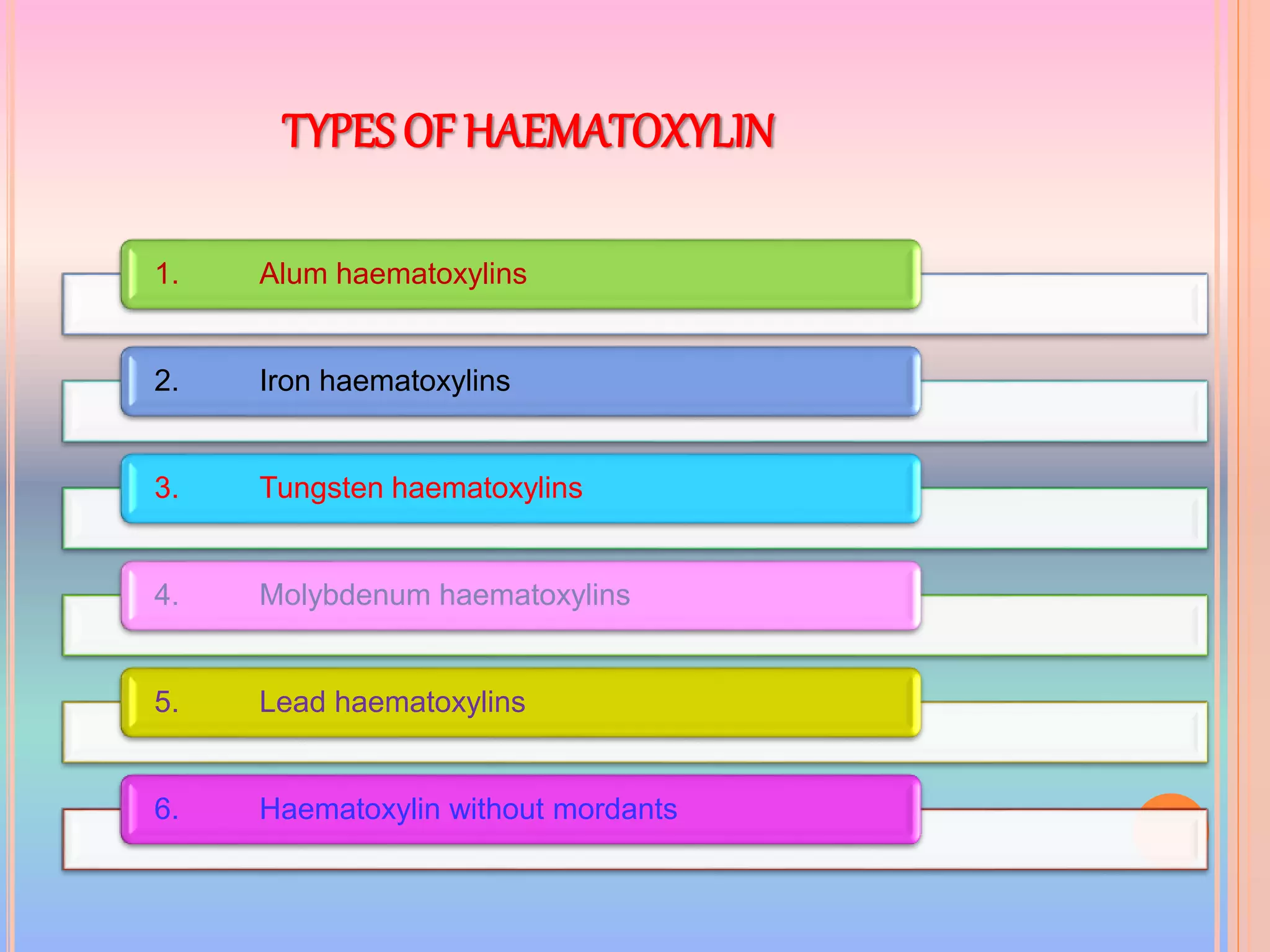
TYPES OF HAEMATOXYLIN
1. Alum haematoxylins
2. Iron haematoxylins
3. Tungsten haematoxylins
4. Molybdenum haematoxylins
5. Lead haematoxylins
6. Haematoxylin without mordants
ALUMHAEMATOXYLIN
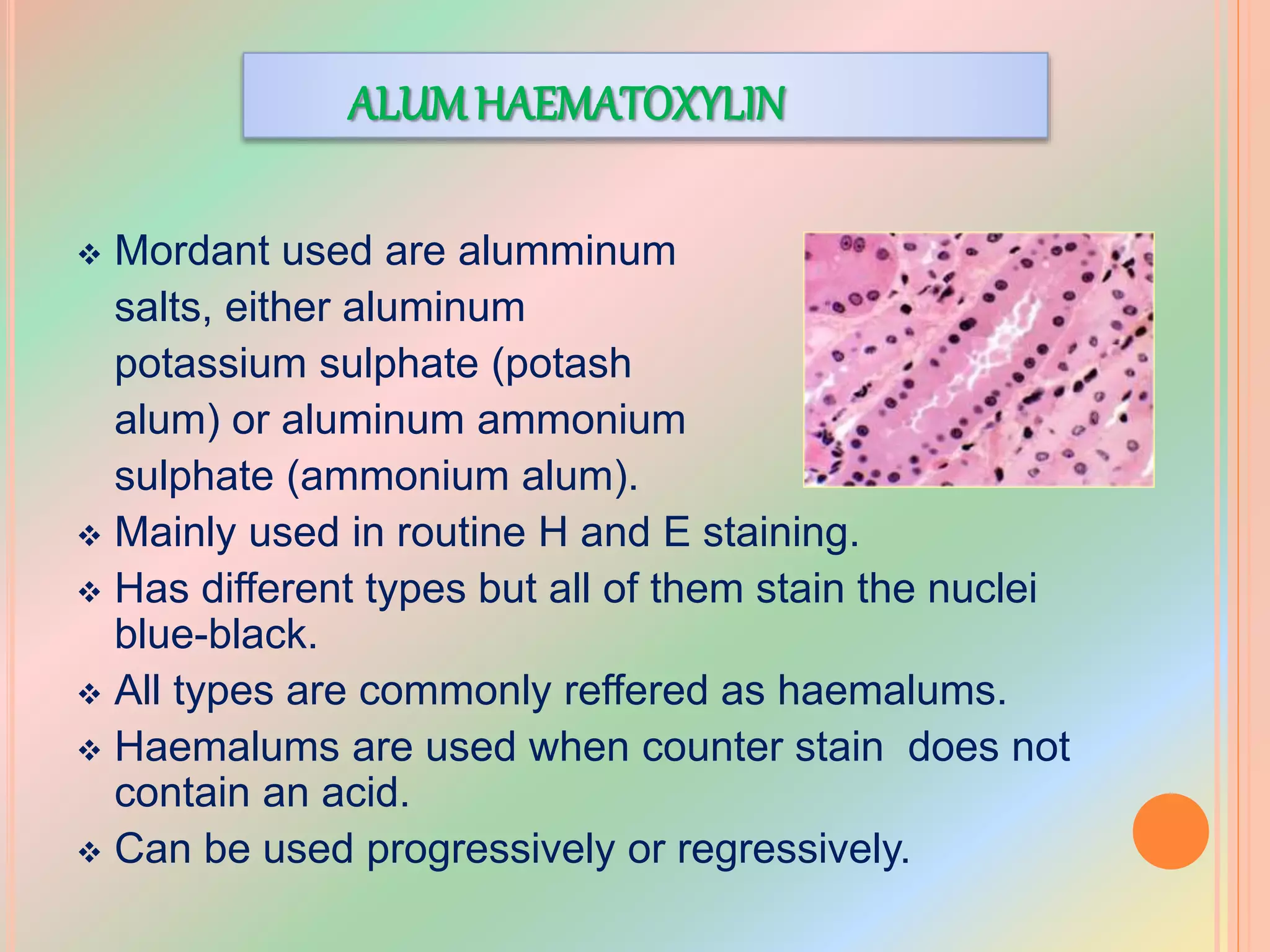
 Mordant used are alumminum
salts, either aluminum
potassium sulphate (potash
alum) or aluminum ammonium
sulphate (ammonium alum).
 Mainly used in routine H and E staining.
 Has different types but all of them stain the nuclei
blue-black.
 All types are commonly reffered as haemalums.
 Haemalums are used when counter stain does not
contain an acid.
 Can be used progressively or regressively.
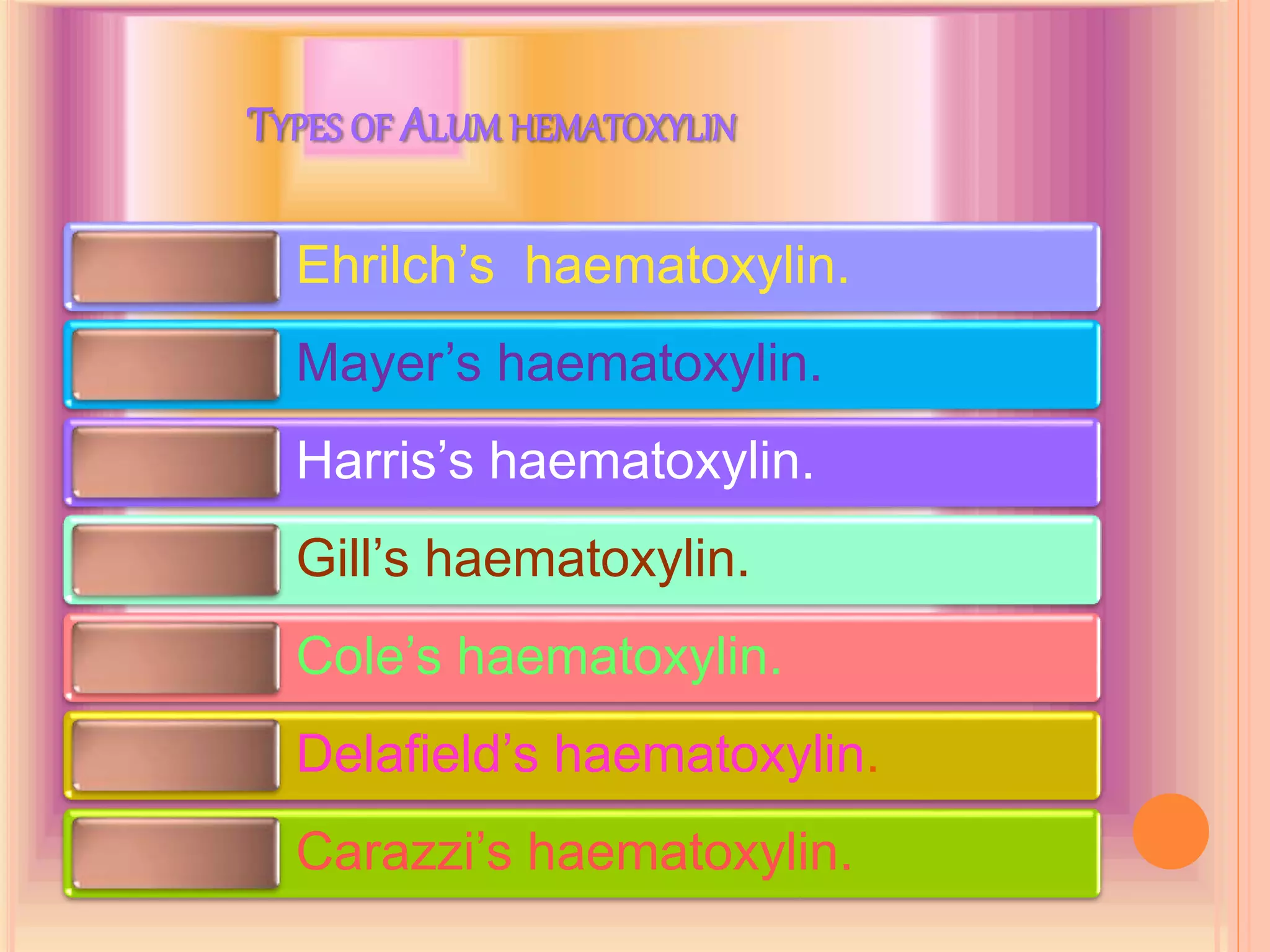
TYPES OF ALUM HEMATOXYLIN
Ehrilch’s haematoxylin.
Mayer’s haematoxylin.
Harris’s haematoxylin.
Gill’s haematoxylin.
Cole’s haematoxylin.
Delafield’s haematoxylin.
Carazzi’s haematoxylin.
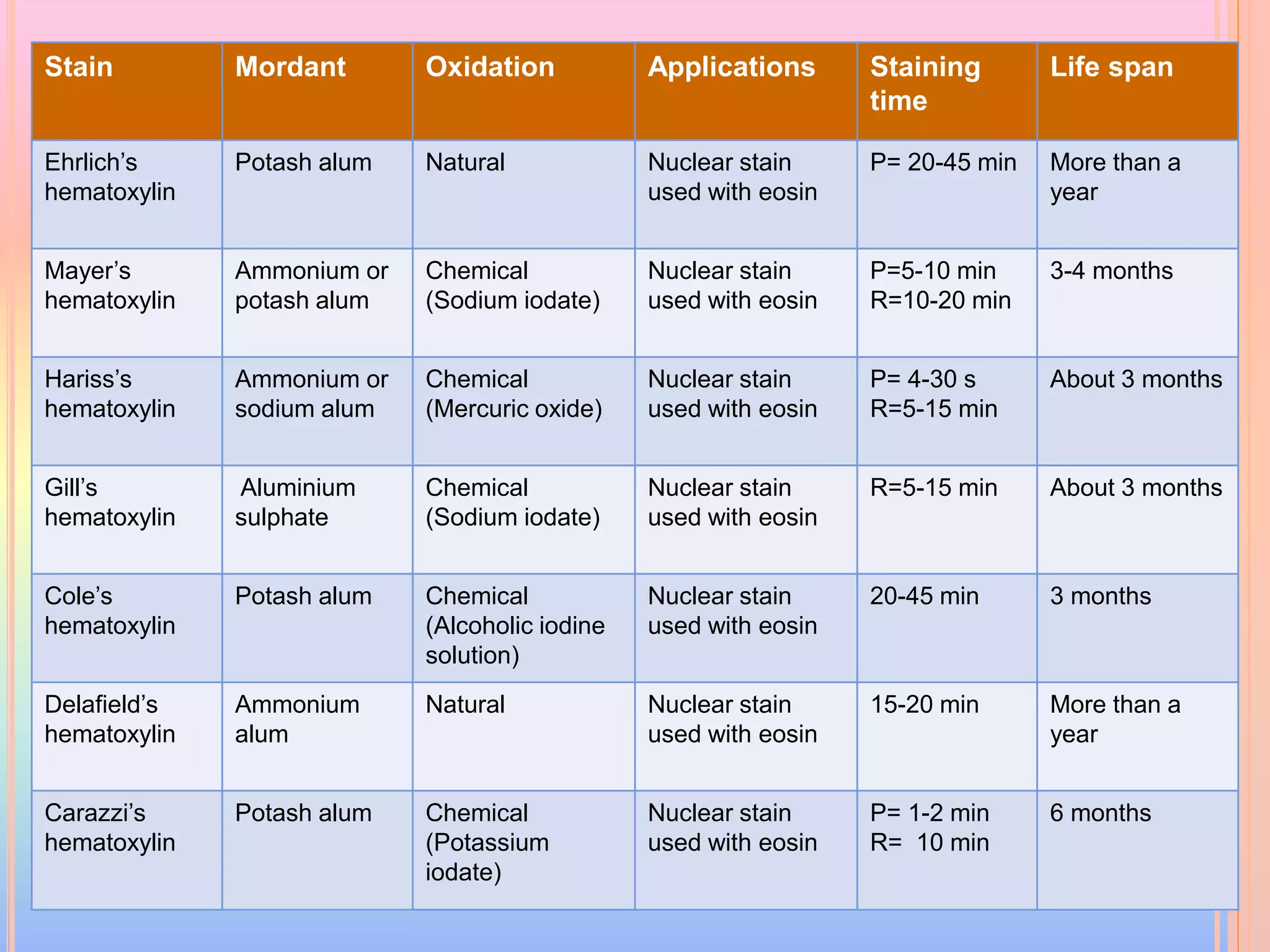
Stain Mordant Oxidation Applications Staining
time
Life span
Ehrlich’s
hematoxylin
Potash alum Natural Nuclear stain
used with eosin
P= 20-45 min More than a
year
Mayer’s
hematoxylin
Ammonium or
potash alum
Chemical
(Sodium iodate)
Nuclear stain
used with eosin
P=5-10 min
R=10-20 min
3-4 months
Hariss’s
hematoxylin
Ammonium or
sodium alum
Chemical
(Mercuric oxide)
Nuclear stain
used with eosin
P= 4-30 s
R=5-15 min
About 3 months
Gill’s
hematoxylin
Aluminium
sulphate
Chemical
(Sodium iodate)
Nuclear stain
used with eosin
R=5-15 min About 3 months
Cole’s
hematoxylin
Potash alum Chemical
(Alcoholic iodine
solution)
Nuclear stain
used with eosin
20-45 min 3 months
Delafield’s
hematoxylin
Ammonium
alum
Natural Nuclear stain
used with eosin
15-20 min More than a
year
Carazzi’s
hematoxylin
Potash alum Chemical
(Potassium
iodate)
Nuclear stain
used with eosin
P= 1-2 min
R= 10 min
6 months
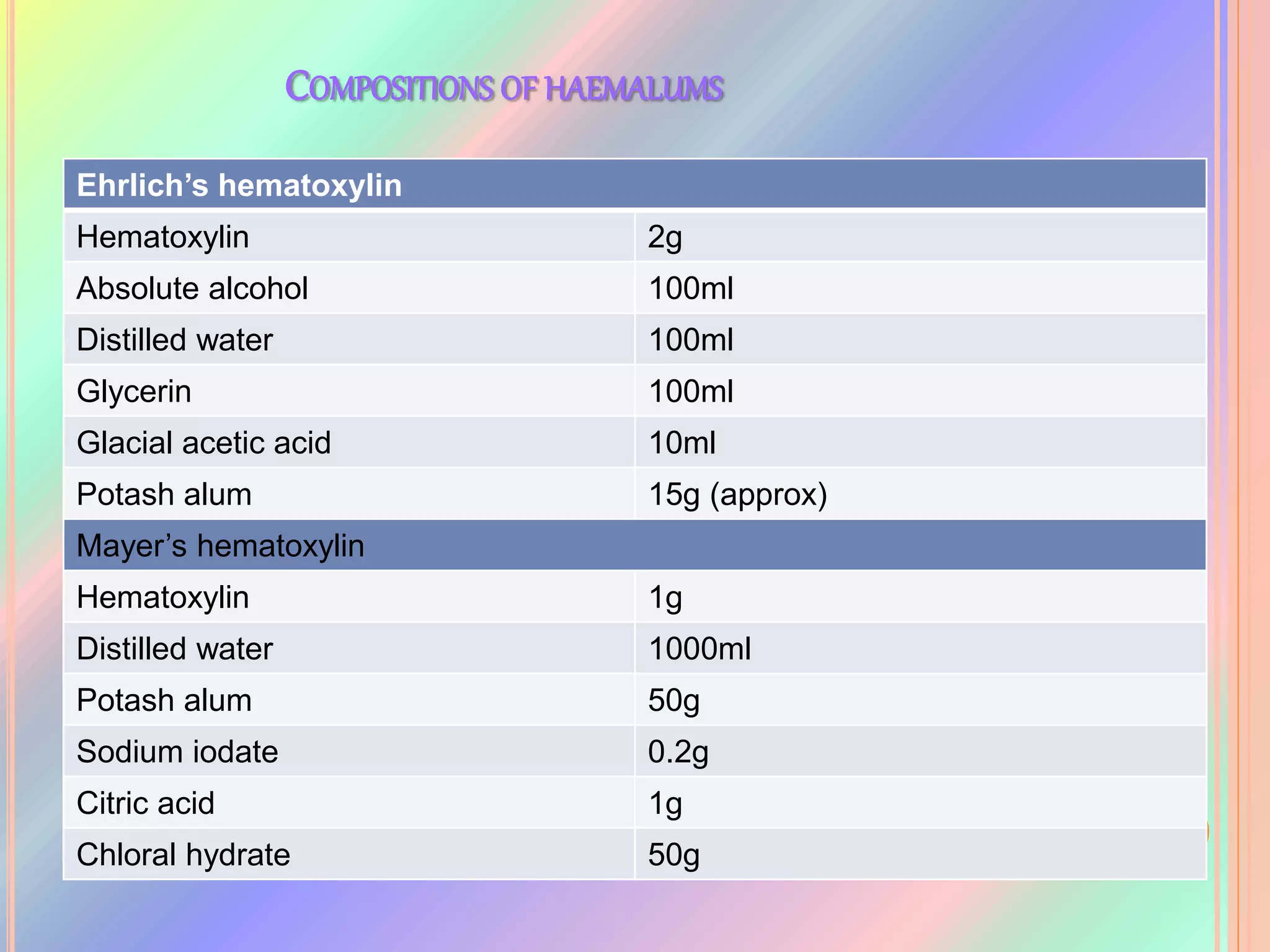
COMPOSITIONS OF HAEMALUMS
Ehrlich’s hematoxylin
Hematoxylin 2g
Absolute alcohol 100ml
Distilled water 100ml
Glycerin 100ml
Glacial acetic acid 10ml
Potash alum 15g (approx)
Mayer’s hematoxylin
Hematoxylin 1g
Distilled water 1000ml
Potash alum 50g
Sodium iodate 0.2g
Citric acid 1g
Chloral hydrate 50g
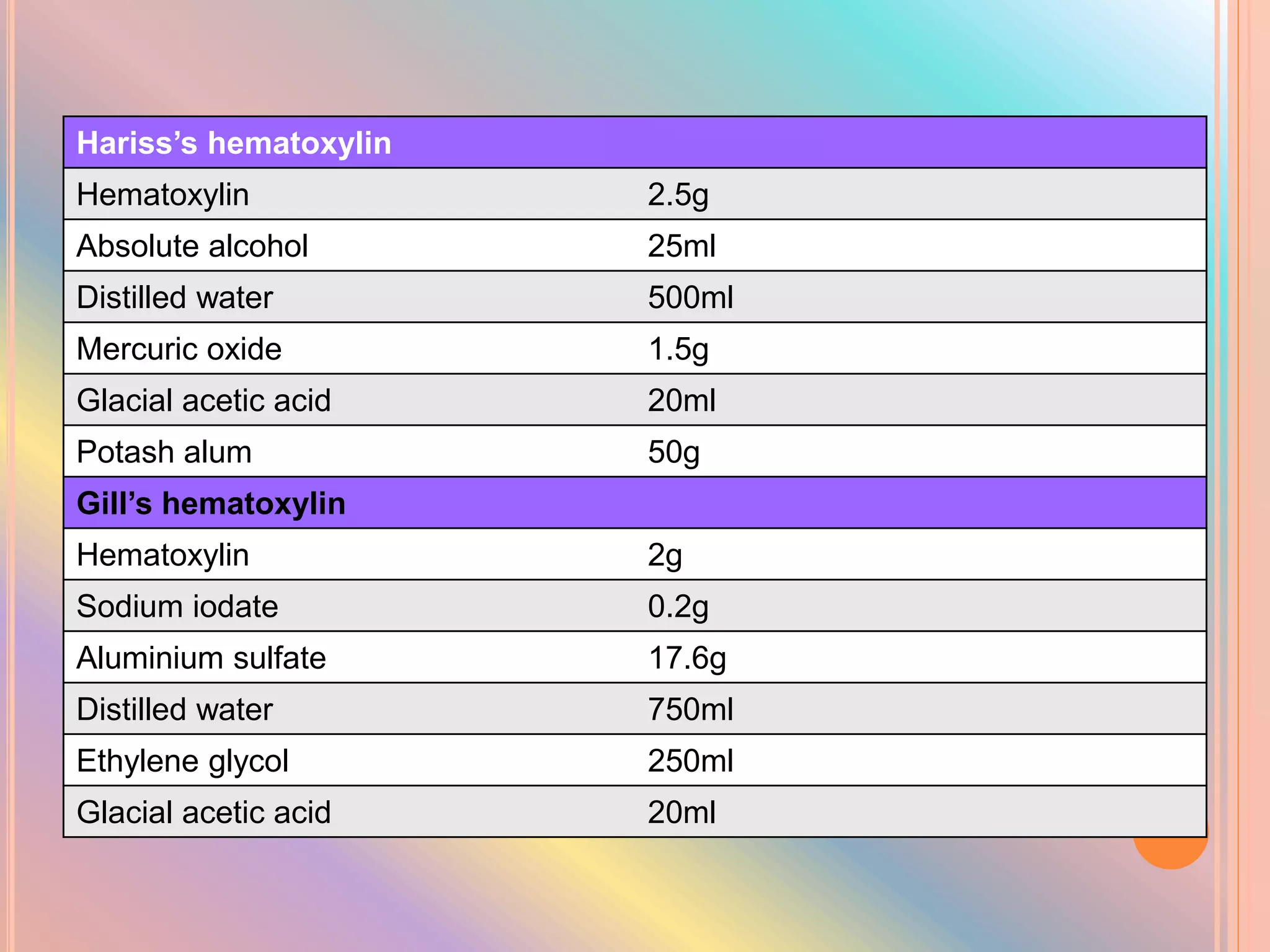
Hariss’s hematoxylin
Hematoxylin 2.5g
Absolute alcohol 25ml
Distilled water 500ml
Mercuric oxide 1.5g
Glacial acetic acid 20ml
Potash alum 50g
Gill’s hematoxylin
Hematoxylin 2g
Sodium iodate 0.2g
Aluminium sulfate 17.6g
Distilled water 750ml
Ethylene glycol 250ml
Glacial acetic acid 20ml
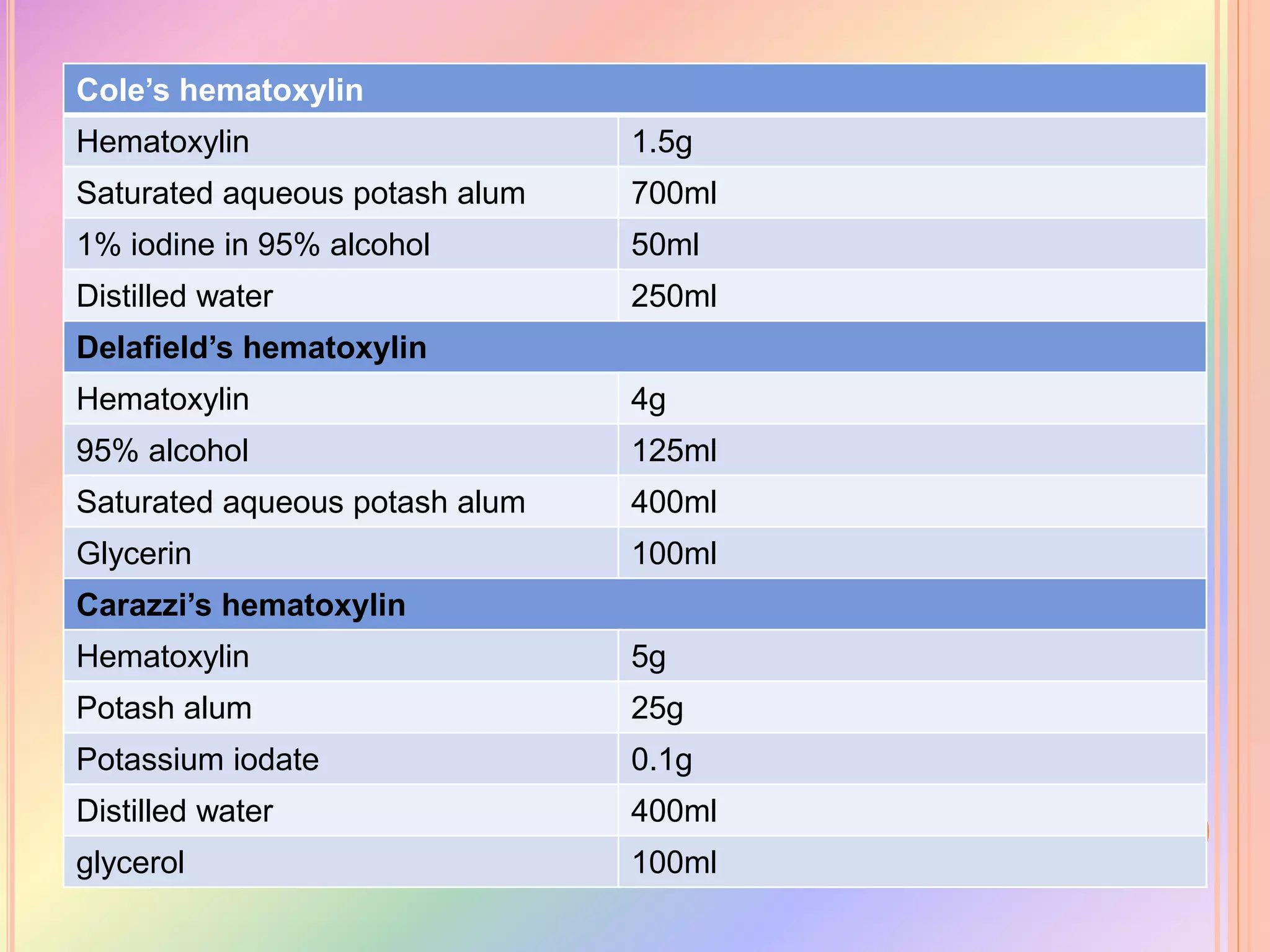
Cole’s hematoxylin
Hematoxylin 1.5g
Saturated aqueous potash alum 700ml
1% iodine in 95% alcohol 50ml
Distilled water 250ml
Delafield’s hematoxylin
Hematoxylin 4g
95% alcohol 125ml
Saturated aqueous potash alum 400ml
Glycerin 100ml
Carazzi’s hematoxylin
Hematoxylin 5g
Potash alum 25g
Potassium iodate 0.1g
Distilled water 400ml
glycerol 100ml
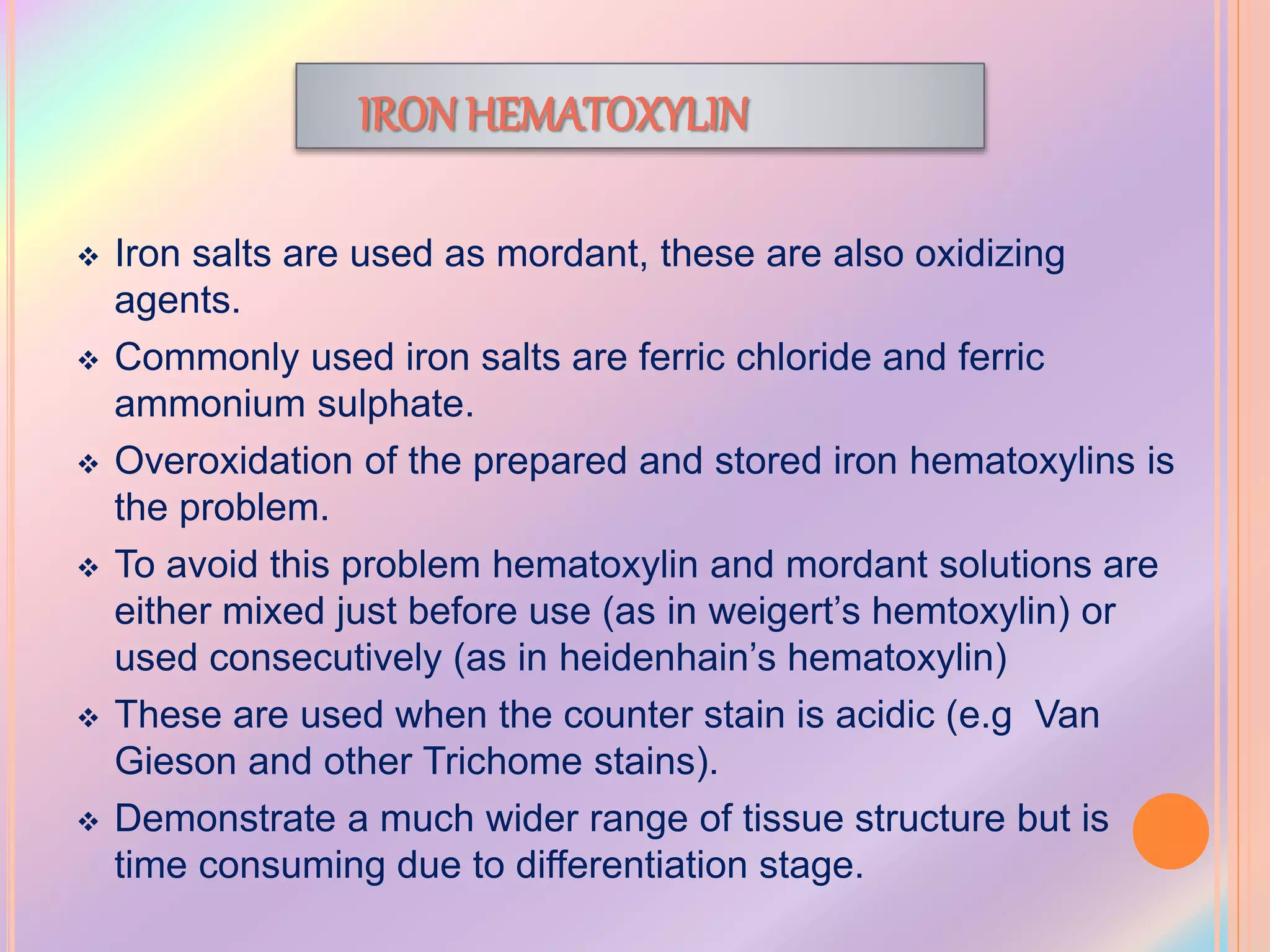
IRON HEMATOXYLIN
 Iron salts are used as mordant, these are also oxidizing
agents.
 Commonly used iron salts are ferric chloride and ferric
ammonium sulphate.
 Overoxidation of the prepared and stored iron hematoxylins is
the problem.
 To avoid this problem hematoxylin and mordant solutions are
either mixed just before use (as in weigert’s hemtoxylin) or
used consecutively (as in heidenhain’s hematoxylin)
 These are used when the counter stain is acidic (e.g Van
Gieson and other Trichome stains).
 Demonstrate a much wider range of tissue structure but is
time consuming due to differentiation stage.
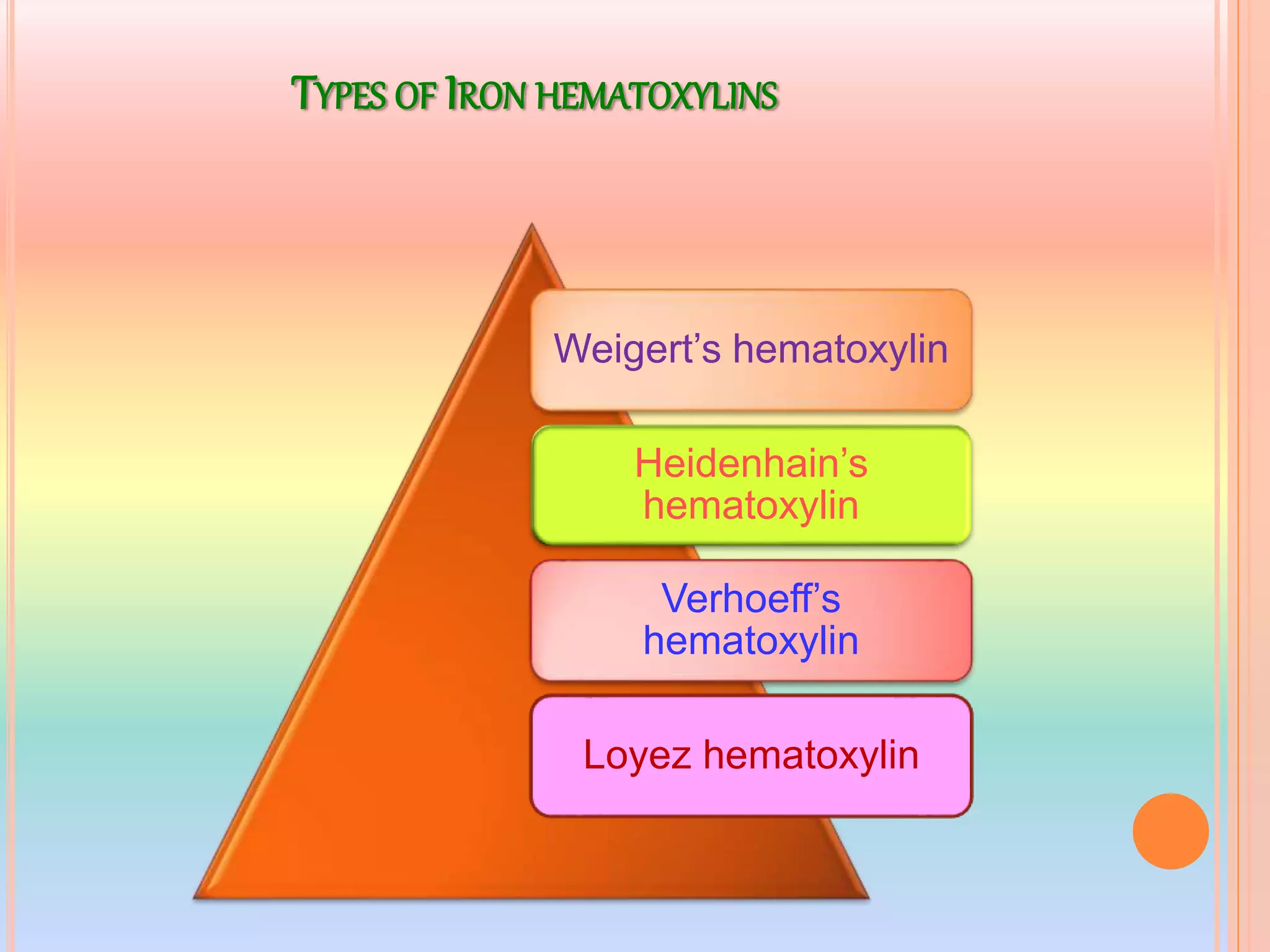
TYPES OF IRON HEMATOXYLINS
Weigert’s hematoxylin
Heidenhain’s
hematoxylin
Verhoeff’s
hematoxylin
Loyez hematoxylin
.
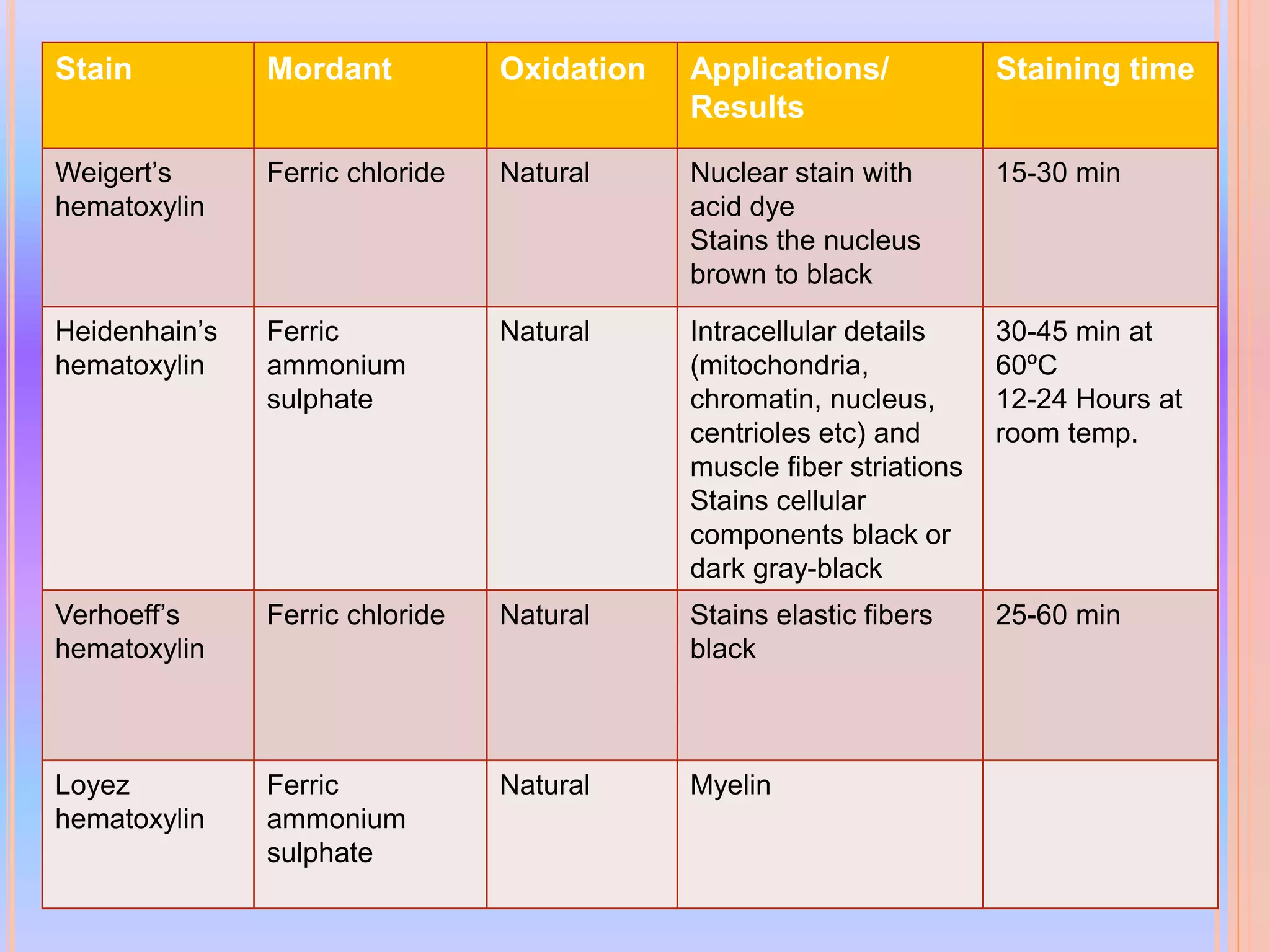
Stain Mordant Oxidation Applications/
Results
Staining time
Weigert’s
hematoxylin
Ferric chloride Natural Nuclear stain with
acid dye
Stains the nucleus
brown to black
15-30 min
Heidenhain’s
hematoxylin
Ferric
ammonium
sulphate
Natural Intracellular details
(mitochondria,
chromatin, nucleus,
centrioles etc) and
muscle fiber striations
Stains cellular
components black or
dark gray-black
30-45 min at
60ºC
12-24 Hours at
room temp.
Verhoeff’s
hematoxylin
Ferric chloride Natural Stains elastic fibers
black
25-60 min
Loyez
hematoxylin
Ferric
ammonium
sulphate
Natural Myelin
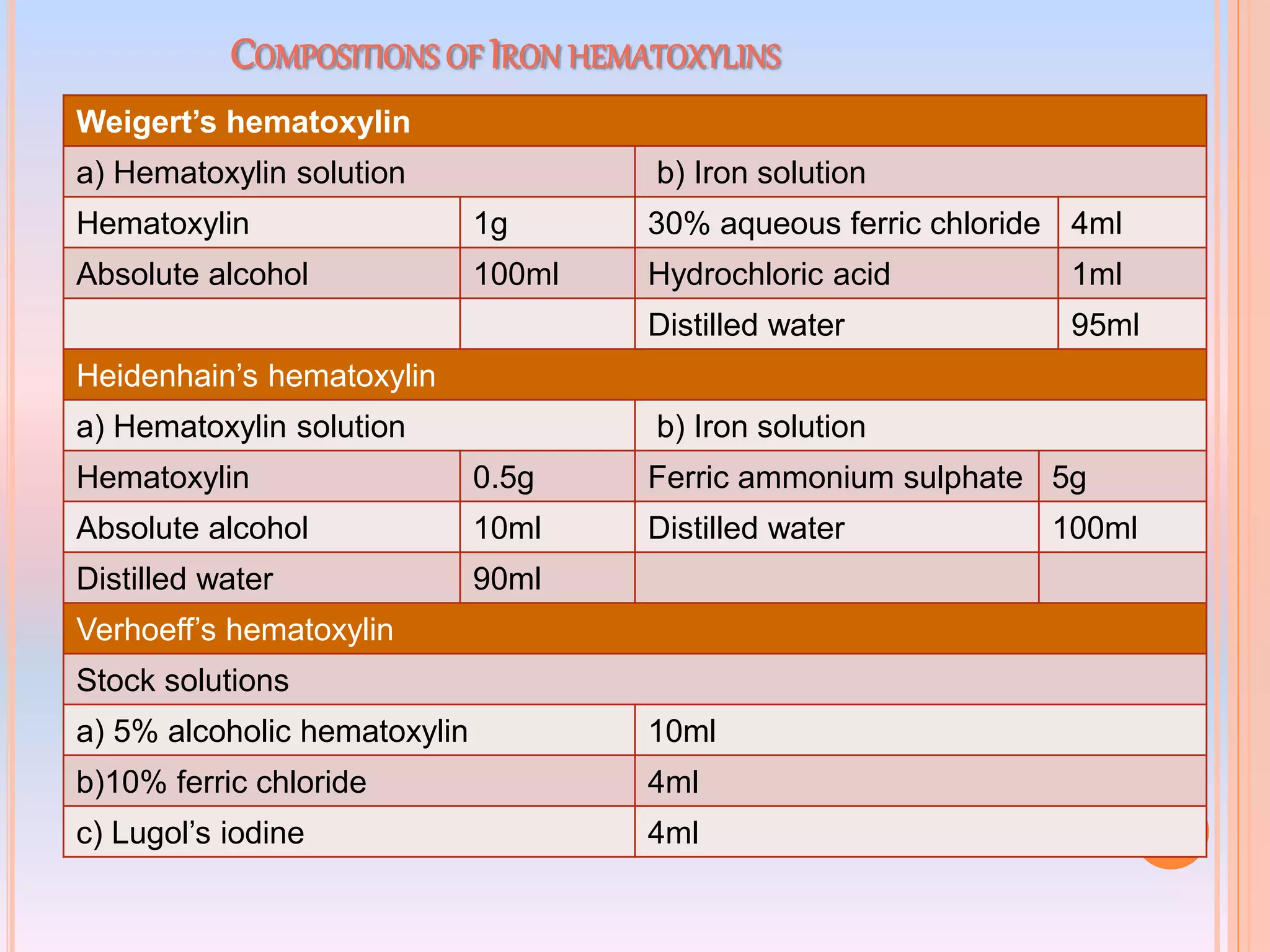
COMPOSITIONS OF IRON HEMATOXYLINS
Weigert’s hematoxylin
a) Hematoxylin solution b) Iron solution
Hematoxylin 1g 30% aqueous ferric chloride 4ml
Absolute alcohol 100ml Hydrochloric acid 1ml
Distilled water 95ml
Heidenhain’s hematoxylin
a) Hematoxylin solution b) Iron solution
Hematoxylin 0.5g Ferric ammonium sulphate 5g
Absolute alcohol 10ml Distilled water 100ml
Distilled water 90ml
Verhoeff’s hematoxylin
Stock solutions
a) 5% alcoholic hematoxylin 10ml
b)10% ferric chloride 4ml
c) Lugol’s iodine 4ml
TUNGSTUN HEMATOXYLIN
 Mallory phosphotungstic acid hematoxylin (PTAH)
is an example.
 Phosphotungstic acid is used as mordant.
 Hematoxylin is oxidized naturally, can also be
oxidized using potassium permanganate.
 Can be prepared using hematein, no oxidation
required.
 Routine stain for nervous tissue, also used to stain
muscle striations and fibrin.
 Stains in shades of blue and red.
 Regressive stain with staining time of 1-16 hours at
room temperature and 1-2 hours at 60ºC.
MOLYBDENUM HEMATOXYLIN
 Molybdic acid is used as mordant.
 Very rare, most accepted molybdenum hematoxylin
is Thomas hematoxylin.
 Hydrogen per oxide is used for oxidation.
 Used to stain chollagen and granules in endocrine
cells.
 Stains:
i. Chollagen - violet to black
ii. Argentaffin cells - black
iii. Nuclei - pale black
SOLCIA HEMATOXYLIN
 Lead salts are used as mordant
 No oxidation
 Used to demonstrate granules in endocrine cells.
MalloryHematoxylin
 No mordant required
 No oxidation
 Used to demonstrate various minerals in the tissue e.g
iron, copper, lead.
Haematoxylin and its types

Haematoxylin and its types

  • 3.
    INTRODUCTION  The wordhematoxlin is drived from old Greek word Haimato(blood) and Xylon(wood), reffering to its dark red color in natural state and to its origin(wood).  A natural dye extracted from the log wood of tree Haematoxylon Campechianum .  It is the most important and most used dye in the histopathology, cytology and immunohistochemistry.  Basic in nature and stains acidic component of the tissue, nucleus, mitochondria etc.  It is one of the best nuclear stain.
  • 4.
    ■ Also useto stain metal ions e.g iron, lead etc. ■ Stains tissue components in various shades of blue, pink, red etc, depending on the nature of the mordant used and the second stain. ■ It is itself not an active dye, it is its oxidative product Haematein(natural dye). ■ Haematein is a weak dye have poor affinity for tissue and requires a mordant for adequate staining. ■ Mordant is a chemical substance that increases the affinity of dye for tissue and its staining efficiency by forming link between the stain and the tissue. ■ Mordants are the metallic salts e.g salts of aluminum and iron etc.
  • 5.
    Extraction: ♣ It isextracted by boiling the heart wood of Hematoxylon Campechianum in hot water. ♣ It is then precipitated out of the aqueous solution using urea or ether. Oxidation: Two methods of oxidation: 1. Natural oxidation:  Exposed to air and sunlight.  Takes 3-4 months to complete  Resultant solutions have longer useful life.
  • 6.
     Examples areEhrlich’s and Delafield’s haematoxylin. 2. Chemical oxidation:  Chemical oxidizing agents are used, e.g sodium iodate, mercuric oxide, hydrogen peroxide, potassium permanganate etc.  Instant conversion of haematoxylin to haematein, immediately ready for use.  Resultant solutions have a shorter useful life.  Examples are Mayer’s and Harris’s haematoxylins.
  • 7.
    TYPES OF HAEMATOXYLIN 1.Alum haematoxylins 2. Iron haematoxylins 3. Tungsten haematoxylins 4. Molybdenum haematoxylins 5. Lead haematoxylins 6. Haematoxylin without mordants
  • 8.
    ALUMHAEMATOXYLIN  Mordant usedare alumminum salts, either aluminum potassium sulphate (potash alum) or aluminum ammonium sulphate (ammonium alum).  Mainly used in routine H and E staining.  Has different types but all of them stain the nuclei blue-black.  All types are commonly reffered as haemalums.  Haemalums are used when counter stain does not contain an acid.  Can be used progressively or regressively.
  • 9.
    TYPES OF ALUMHEMATOXYLIN Ehrilch’s haematoxylin. Mayer’s haematoxylin. Harris’s haematoxylin. Gill’s haematoxylin. Cole’s haematoxylin. Delafield’s haematoxylin. Carazzi’s haematoxylin.
  • 10.
    Stain Mordant OxidationApplications Staining time Life span Ehrlich’s hematoxylin Potash alum Natural Nuclear stain used with eosin P= 20-45 min More than a year Mayer’s hematoxylin Ammonium or potash alum Chemical (Sodium iodate) Nuclear stain used with eosin P=5-10 min R=10-20 min 3-4 months Hariss’s hematoxylin Ammonium or sodium alum Chemical (Mercuric oxide) Nuclear stain used with eosin P= 4-30 s R=5-15 min About 3 months Gill’s hematoxylin Aluminium sulphate Chemical (Sodium iodate) Nuclear stain used with eosin R=5-15 min About 3 months Cole’s hematoxylin Potash alum Chemical (Alcoholic iodine solution) Nuclear stain used with eosin 20-45 min 3 months Delafield’s hematoxylin Ammonium alum Natural Nuclear stain used with eosin 15-20 min More than a year Carazzi’s hematoxylin Potash alum Chemical (Potassium iodate) Nuclear stain used with eosin P= 1-2 min R= 10 min 6 months
  • 11.
    COMPOSITIONS OF HAEMALUMS Ehrlich’shematoxylin Hematoxylin 2g Absolute alcohol 100ml Distilled water 100ml Glycerin 100ml Glacial acetic acid 10ml Potash alum 15g (approx) Mayer’s hematoxylin Hematoxylin 1g Distilled water 1000ml Potash alum 50g Sodium iodate 0.2g Citric acid 1g Chloral hydrate 50g
  • 12.
    Hariss’s hematoxylin Hematoxylin 2.5g Absolutealcohol 25ml Distilled water 500ml Mercuric oxide 1.5g Glacial acetic acid 20ml Potash alum 50g Gill’s hematoxylin Hematoxylin 2g Sodium iodate 0.2g Aluminium sulfate 17.6g Distilled water 750ml Ethylene glycol 250ml Glacial acetic acid 20ml
  • 13.
    Cole’s hematoxylin Hematoxylin 1.5g Saturatedaqueous potash alum 700ml 1% iodine in 95% alcohol 50ml Distilled water 250ml Delafield’s hematoxylin Hematoxylin 4g 95% alcohol 125ml Saturated aqueous potash alum 400ml Glycerin 100ml Carazzi’s hematoxylin Hematoxylin 5g Potash alum 25g Potassium iodate 0.1g Distilled water 400ml glycerol 100ml
  • 14.
    IRON HEMATOXYLIN  Ironsalts are used as mordant, these are also oxidizing agents.  Commonly used iron salts are ferric chloride and ferric ammonium sulphate.  Overoxidation of the prepared and stored iron hematoxylins is the problem.  To avoid this problem hematoxylin and mordant solutions are either mixed just before use (as in weigert’s hemtoxylin) or used consecutively (as in heidenhain’s hematoxylin)  These are used when the counter stain is acidic (e.g Van Gieson and other Trichome stains).  Demonstrate a much wider range of tissue structure but is time consuming due to differentiation stage.
  • 15.
    TYPES OF IRONHEMATOXYLINS Weigert’s hematoxylin Heidenhain’s hematoxylin Verhoeff’s hematoxylin Loyez hematoxylin
  • 16.
    . Stain Mordant OxidationApplications/ Results Staining time Weigert’s hematoxylin Ferric chloride Natural Nuclear stain with acid dye Stains the nucleus brown to black 15-30 min Heidenhain’s hematoxylin Ferric ammonium sulphate Natural Intracellular details (mitochondria, chromatin, nucleus, centrioles etc) and muscle fiber striations Stains cellular components black or dark gray-black 30-45 min at 60ºC 12-24 Hours at room temp. Verhoeff’s hematoxylin Ferric chloride Natural Stains elastic fibers black 25-60 min Loyez hematoxylin Ferric ammonium sulphate Natural Myelin
  • 17.
    COMPOSITIONS OF IRONHEMATOXYLINS Weigert’s hematoxylin a) Hematoxylin solution b) Iron solution Hematoxylin 1g 30% aqueous ferric chloride 4ml Absolute alcohol 100ml Hydrochloric acid 1ml Distilled water 95ml Heidenhain’s hematoxylin a) Hematoxylin solution b) Iron solution Hematoxylin 0.5g Ferric ammonium sulphate 5g Absolute alcohol 10ml Distilled water 100ml Distilled water 90ml Verhoeff’s hematoxylin Stock solutions a) 5% alcoholic hematoxylin 10ml b)10% ferric chloride 4ml c) Lugol’s iodine 4ml
  • 18.
    TUNGSTUN HEMATOXYLIN  Malloryphosphotungstic acid hematoxylin (PTAH) is an example.  Phosphotungstic acid is used as mordant.  Hematoxylin is oxidized naturally, can also be oxidized using potassium permanganate.  Can be prepared using hematein, no oxidation required.  Routine stain for nervous tissue, also used to stain muscle striations and fibrin.  Stains in shades of blue and red.  Regressive stain with staining time of 1-16 hours at room temperature and 1-2 hours at 60ºC.
  • 19.
    MOLYBDENUM HEMATOXYLIN  Molybdicacid is used as mordant.  Very rare, most accepted molybdenum hematoxylin is Thomas hematoxylin.  Hydrogen per oxide is used for oxidation.  Used to stain chollagen and granules in endocrine cells.  Stains: i. Chollagen - violet to black ii. Argentaffin cells - black iii. Nuclei - pale black
  • 20.
    SOLCIA HEMATOXYLIN  Leadsalts are used as mordant  No oxidation  Used to demonstrate granules in endocrine cells. MalloryHematoxylin  No mordant required  No oxidation  Used to demonstrate various minerals in the tissue e.g iron, copper, lead.