The document discusses various histological staining techniques. It begins by explaining hematoxylin and eosin staining, which provides basic diagnostic information. It then covers special stains that highlight specific tissue components, categorized by the structures they identify such as carbohydrates, amyloid, lipids, nucleic acids, and microorganisms. Carbohydrate stains discussed include periodic acid Schiff, alcian blue, mucicarmine, and others. Amyloid identification using Congo red and methyl violet is explained. Lipid stains using Sudan dyes are also summarized. The document provides details on techniques for staining nucleic acids and identifying bacteria by Gram staining.
Overview of routine and special staining techniques, highlighting their importance in diagnostics.
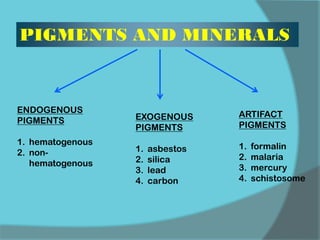
Classification of stains includes categories for carbohydrates, amyloid, nucleic acids, lipids, microorganisms, connective tissues, and pigments.
Details on simple carbohydrates (monosaccharides, oligosaccharides) and glycosaminoglycans (GAGs) with types listed.
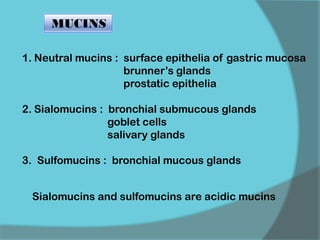
Different types of mucins: neutral, sialomucins, and sulfomucins found in various glands.
Importance of prompt fixation using specific fixatives to prevent autolytic reactions.
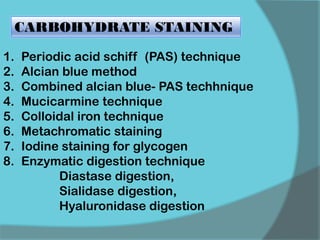
Different techniques such as PAS, Alcian blue for carbohydrate detection and their results are detailed.
Techniques to identify mucins and their significance in various medical conditions.
Discussion on DNA and RNA structural components, demonstration techniques like Feulgen and Methyl Green Pyronin.
Outlines methods for nucleic acid demonstration; discusses extraction techniques and special stains. Classification of lipids, their staining characteristics, and special techniques for their visualization.Staining methods for amyloid including Congo red, results interpretation, and differential techniques for AA and AL amyloid.
Various methods to stain bacteria such as Gram stain, Acid-fast staining for Mycobacteria, and their results.
Staining methods for fungi using methods like GMS stain and results indicating fungal invasion.
Miscellaneous stains for various special cases, including connective tissue stains and techniques for pigments and minerals.
Affirms the importance of special stains for tissue component detection but emphasizes H&E's continued role.
H&E stainis routine stain.
- It is the preliminary or the first stain applied to the tissue
sections
- Gives diagnostic information in most cases.
A special stain is a staining technique to highlight
various individual tissue component once we have
preliminary information from the H&E stain
3.
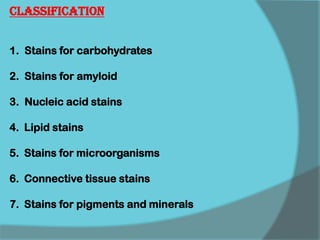
Classification
1. Stains forcarbohydrates
2. Stains for amyloid
3. Nucleic acid stains
4. Lipid stains
5. Stains for microorganisms
6. Connective tissue stains
7. Stains for pigments and minerals
4.
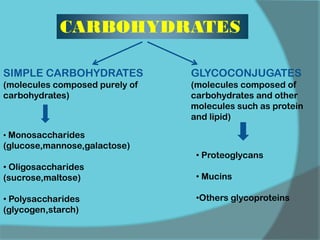
CARBOHYDRATES
SIMPLE CARBOHYDRATES
(molecules composedpurely of
carbohydrates)
• Monosaccharides
(glucose,mannose,galactose)
• Oligosaccharides
(sucrose,maltose)
• Polysaccharides
(glycogen,starch)
GLYCOCONJUGATES
(molecules composed of
carbohydrates and other
molecules such as protein
and lipid)
• Proteoglycans
• Mucins
•Others glycoproteins
5.
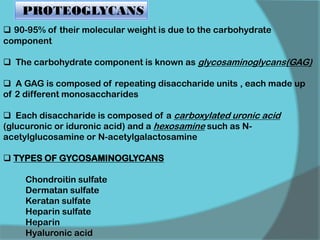
90-95% oftheir molecular weight is due to the carbohydrate
component
The carbohydrate component is known as glycosaminoglycans(GAG)
A GAG is composed of repeating disaccharide units , each made up
of 2 different monosaccharides
Each disaccharide is composed of a carboxylated uronic acid
(glucuronic or iduronic acid) and a hexosamine such as N-
acetylglucosamine or N-acetylgalactosamine
TYPES OF GYCOSAMINOGLYCANS
Chondroitin sulfate
Dermatan sulfate
Keratan sulfate
Heparin sulfate
Heparin
Hyaluronic acid
PROTEOGLYCANS
FIXATIVES
Tissue placedin fixative promptly after removal – capable
of autolytic reaction
If immediate fixation not possible, tissue refrigerated until
adequate fixation possible
Recommended fixatives : Rossman’s fluid
Alcoholic formalin with picric
acid
Glutaraldehyde fixatives avoidedfree aldehyde groups
are capable of undergoing schiff reaction – so increased
background staining
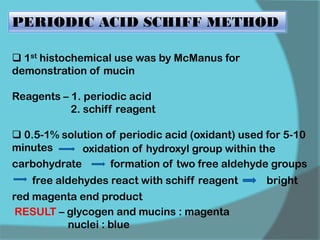
PERIODIC ACID SCHIFFMETHOD
1st histochemical use was by McManus for
demonstration of mucin
Reagents – 1. periodic acid
2. schiff reagent
0.5-1% solution of periodic acid (oxidant) used for 5-10
minutes oxidation of hydroxyl group within the
formation of two free aldehyde groups
free aldehydes react with schiff reagent
carbohydrate
bright
red magenta end product
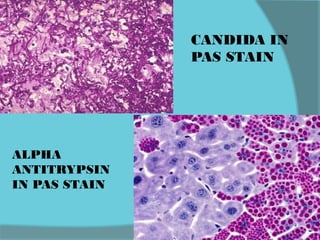
RESULT – glycogen and mucins : magenta
nuclei : blue
Other oxidantslike potassium permanganate/ chromic
acid not used – further oxidise aldehyde groups to
carboxylic groups – not reactive to schiff reagent
MILD PAS TECHNIQUE –
0.01% periodic acid used for shorter period for N-acetyl
sialic acid containing mucins as the hydroxyl groups are
highly susceptible to periodic acid oxidation
Diagnosis of severalmedical conditions:
Glycogen storage disorder
Staining macrophages in Whipple's disease
Mucins in adenocarcinoma of large intestine
Demonstration of fungi
Seminoma,rhabdomyosarcoma,ewing’s sarcoma
contain glycogen
15.
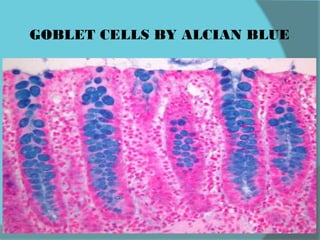
ALCIAN BLUE
Alcianblue 8 GX – recommended
Comprised of copper containing pthalocyanine ring
linked to 4 isothiouronium groups – strong bases -
account for cationic nature of the dye
Sulfate and carboxylate groups of proteoglycans
ionised at pH 2.5 and carry a negative charge
Sialo- and sulfo mucins also reactive at pH 2.5
So, they stain with alcian blue at pH 2.5
Neutral mucins are not reactive with alcian blue
16.
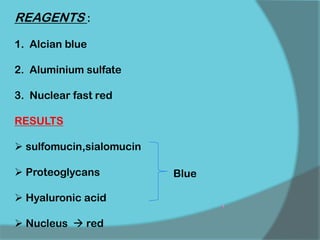
REAGENTS :
1. Alcianblue
2. Aluminium sulfate
3. Nuclear fast red
RESULTS
sulfomucin,sialomucin
Proteoglycans
Hyaluronic acid
Nucleus red
Blue
COMBINED ALCIAN BLUE-PAS TECHNIQUE
PRINCIPLE
Demonstrate presence of mucin
Differentiate acid mucin from neutral mucin
1st stain all acid mucin with alcian blue
(blue)
Those acid mucin which are PAS +ve will not
be stained on PAS reaction only neutral
mucin will be stained(magenta)
19.
ALCIAN BLUE WITHVARYING
ELECTROLYTE CONCENTRATIONS
This technique is based upon phenomenon known as
CRITICAL ELECTROLYTE CONCENTRATION (CEC)
CEC is defined as point at which amount of electrolyte
such as MgCl2 is sufficient to prevent staining from AB
Competition between cations of salt and dye occurs for
polyanionic sites within tissue
Different acidic carbohydrates have different CEC value
So can differentiate acidic mucins and proteoglycans
20.
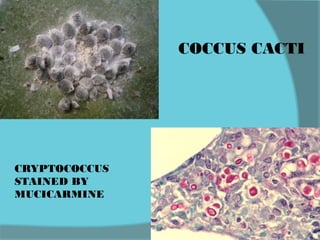
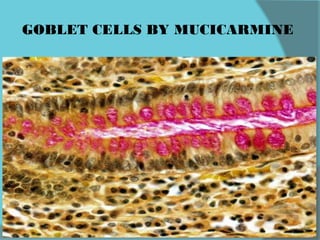
MUCICARMINE
Active dyemolecule is aluminium – carminic acid
complex known as CARMINE
carminic acid produced from dried bodies of female
Coccus Cacti insects
Carmine complex has a positive charge and so attracts
polyanions such as sialomucins and sulfomucins
Useful for identification of adenocarcinoma ( especially
of GIT)
Capsule of fungus – cryptococcus neoformans is also
detected
21.
REAGENTS :
1.Southgate’s mucicarminesolution
2.Alcoholic hematoxylin
3.Acidified ferric chloride solution
4.Weigert’s iron hematoxylin solution
5.Metanil yellow solution
RESULTS :
Acidic mucins – deep rose to red
Nuclei – black
Other tissue elements – light yellow
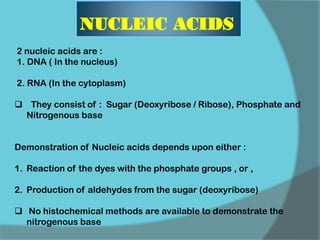
NUCLEIC ACIDS
2 nucleicacids are :
1. DNA ( In the nucleus)
2. RNA (In the cytoplasm)
They consist of : Sugar (Deoxyribose / Ribose), Phosphate and
Nitrogenous base
Demonstration of Nucleic acids depends upon either :
1. Reaction of the dyes with the phosphate groups , or ,
2. Production of aldehydes from the sugar (deoxyribose)
No histochemical methods are available to demonstrate the
nitrogenous base
25.
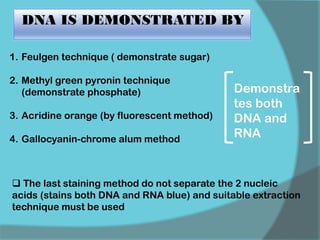
1. Feulgen technique( demonstrate sugar)
2. Methyl green pyronin technique
(demonstrate phosphate)
3. Acridine orange (by fluorescent method)
4. Gallocyanin-chrome alum method
Demonstra
tes both
DNA and
RNA
The last staining method do not separate the 2 nucleic
acids (stains both DNA and RNA blue) and suitable extraction
technique must be used
DNA IS DEMONSTRATED BY
26.
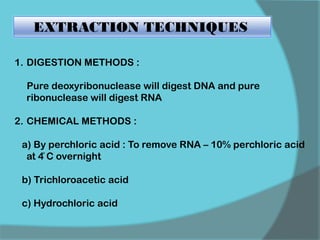
EXTRACTION TECHNIQUES
1. DIGESTIONMETHODS :
Pure deoxyribonuclease will digest DNA and pure
ribonuclease will digest RNA
2. CHEMICAL METHODS :
a) By perchloric acid : To remove RNA – 10% perchloric acid
at 4̊ C overnight
b) Trichloroacetic acid
c) Hydrochloric acid
27.
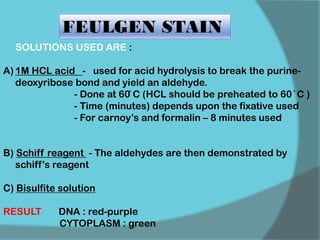
FEULGEN STAIN
SOLUTIONS USEDARE :
A) 1M HCL acid - used for acid hydrolysis to break the purine-
deoxyribose bond and yield an aldehyde.
- Done at 60̊ C (HCL should be preheated to 60 ̊ C )
- Time (minutes) depends upon the fixative used
- For carnoy’s and formalin – 8 minutes used
B) Schiff reagent - The aldehydes are then demonstrated by
schiff’s reagent
C) Bisulfite solution
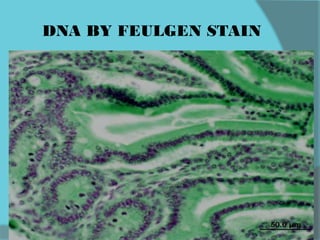
RESULT DNA : red-purple
CYTOPLASM : green
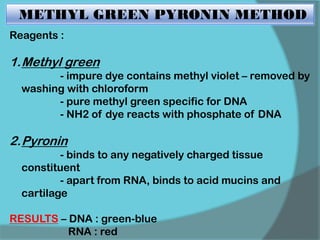
METHYL GREEN PYRONINMETHOD
Reagents :
1.Methyl green
- impure dye contains methyl violet – removed by
washing with chloroform
- pure methyl green specific for DNA
- NH2 of dye reacts with phosphate of DNA
2.Pyronin
- binds to any negatively charged tissue
constituent
- apart from RNA, binds to acid mucins and
cartilage
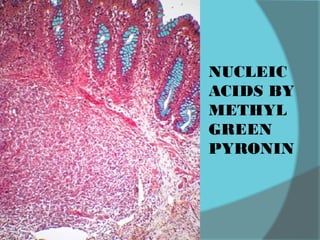
RESULTS – DNA : green-blue
RNA : red
1. Most suitabletechnique for identifying DNA is In-situ
hybridization
2. Bouin’s fixative is not suitable as it causes over hydrolysis of
the nucleic acid during fixation
3. RNA cannot be demonstrated by feulgen stain because ribose-
purine bond is unaffected by hydrolysis/ 1 M HCL
4. Control method for the standard feulgen technique is –
Naphthoic acid hydrazide (NAH) method – DNA is acid
hydrolysed by 1M HCL. Aldehydes are coupled with naphthoic
acid and then again coupled with diazonium salt, fast blue B.
results are identical to true feulgen reaction
5. Blue thionin-feulgen reaction – used for studying cancer cell
nuclear morphology and ploidy. Here DNA is stained blue and
cytoplasm remains unstained
POINTS TO REMEMBER
32.
LIPIDS
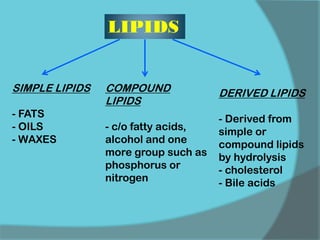
SIMPLE LIPIDS
- FATS
-OILS
- WAXES
COMPOUND
LIPIDS
- c/o fatty acids,
alcohol and one
more group such as
phosphorus or
nitrogen
DERIVED LIPIDS
- Derived from
simple or
compound lipids
by hydrolysis
- cholesterol
- Bile acids
33.
Lipids withmelting point below staining temperature
can be stained with fat stains
So only lipids which are liquid at staining temp. are
stained. Those in solid or crystalline state remains
unaffected
Melting point of a lipid is inversely related to its fatty
acid chain length
Simple lipid is best demonstrated with fresh frozen
sections
Best fixative – Formal calcium (2% calcium acetate +
10% formalin)
34.
1st Sudandye was Sudan 3
Most sensitive of all fat dyes is – Sudan black B
Sudans must be dissolved in organic solvents to
penetrate fats
Some organic solvents used are –
1. 70% ethanol
2. Isopropanol
3. Propylene glycol
4. Triethyl phosphate
SUDAN BLACK B
35.
Sudan blackb has 2 fractions –
1st stains neutral fats blue-black
2nd stains phospholipids gray
This gray reaction can be enhanced as a bronze
dichroism if section is viewed in polarised light
It fails to stain crystalline cholesterol, lecithin and free
fatty acids
Bromine pre treatment converts crystalline
cholesterol to oily derivatives and hence permeable to
Sudan dye
36.
AMYLOID
Extracellular ,amorphous , eosinophilic
material
Composed of protein in an antiparallel -
pleated sheet configuration
In H&E stain , can be confused with hyaline
and fibrinoid substances
Earliest special stain used for amyloid was
Iodine by Virchow
37.
CONGO RED STAIN
Acidic dye and composed of 2 identical halves
Each half has a phenyl ring bound to a naphthalene
moiety by a diazo group
2 phenyl groups bound by a diphenyl bond - gives a
linear dye molecule
It stains amyloid by hydrogen bonding and other tissue
components by electrochemical bonds
Electrochemical staining of other tissues can be
suppressed by –
using alkaline-alcoholic solvents
using competitive inhibition by salt solution
38.
2 factorsare important to the congo red-
amyloid reaction
1.Linearity of the dye molecule
2.-pleated sheet configuration of the amyloid
If the spatial configuration of either is altered,
the reaction fails
39.
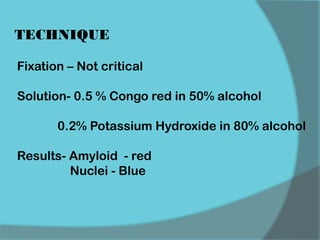
Fixation – Notcritical
Solution- 0.5 % Congo red in 50% alcohol
0.2% Potassium Hydroxide in 80% alcohol
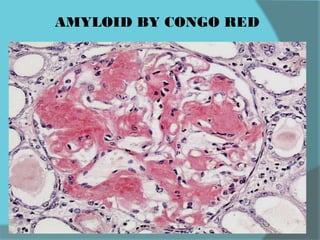
Results- Amyloid - red
Nuclei - Blue
TECHNIQUE
ALKALINE CONGO-RED TECHNIQUE
High concentration of NaCl is used
Background electrochemical staining is
reduced
hydrogen bonding of congo-red to amyloid is
enhanced
42.
POLARIZING MICROSCOPY AND
CONGO-RED
Under polarized light, congo red stained
amyloid exhibits apple-green birefringence
Most reliable diagnostic test for amyloid
currently
43.
POINTS TO REMEMBER
Thickness of section is critical – 8-10 micro meter is
ideal
Too thin section – show faint red color
Too thick section – show yellow birefringent
Other structures giving apple-green birefringence :
1. neurofibrillary tangles of alzheimer’s
2. intracellular inclusions seen in adrenal cortical cells
3. cellulose and chitin
4. dense collagen
Thioflavin T – flourescent method
44.
To differentiate AAand AL amyloid :
Section pretreatment with trypsin or
potassium permanganate done
AA amyloid lose their affinity for congo-red
but AL amyloid is resistant
45.
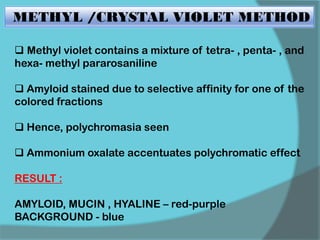
METHYL /CRYSTAL VIOLETMETHOD
Methyl violet contains a mixture of tetra- , penta- , and
hexa- methyl pararosaniline
Amyloid stained due to selective affinity for one of the
colored fractions
Hence, polychromasia seen
Ammonium oxalate accentuates polychromatic effect
RESULT :
AMYLOID, MUCIN , HYALINE – red-purple
BACKGROUND - blue
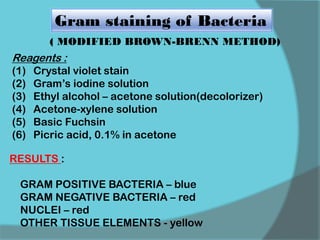
Gram staining ofBacteria
( MODIFIED BROWN-BRENN METHOD)
Reagents :
(1) Crystal violet stain
(2) Gram’s iodine solution
(3) Ethyl alcohol – acetone solution(decolorizer)
(4) Acetone-xylene solution
(5) Basic Fuchsin
(6) Picric acid, 0.1% in acetone
RESULTS :
GRAM POSITIVE BACTERIA – blue
GRAM NEGATIVE BACTERIA – red
NUCLEI – red
OTHER TISSUE ELEMENTS - yellow
48.
Dry picricacid is explosive – recommended to
purchase picric acid – acetone solution pre made
Do not allow sections to dry at any point in the
staining process – decolorization will be difficult
and uneven
49.
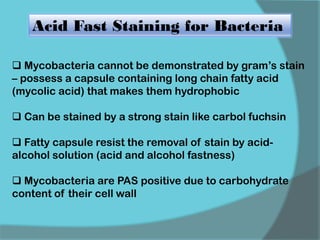
Acid Fast Stainingfor Bacteria
Mycobacteria cannot be demonstrated by gram’s stain
– possess a capsule containing long chain fatty acid
(mycolic acid) that makes them hydrophobic
Can be stained by a strong stain like carbol fuchsin
Fatty capsule resist the removal of stain by acid-
alcohol solution (acid and alcohol fastness)
Mycobacteria are PAS positive due to carbohydrate
content of their cell wall
50.
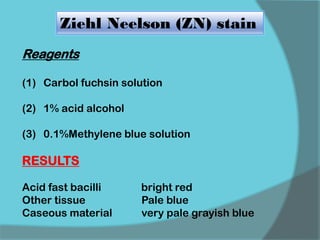
Ziehl Neelson (ZN)stain
Reagents
(1) Carbol fuchsin solution
(2) 1% acid alcohol
(3) 0.1%Methylene blue solution
RESULTS
Acid fast bacilli bright red
Other tissue Pale blue
Caseous material very pale grayish blue
51.
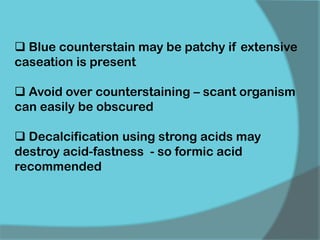
Blue counterstainmay be patchy if extensive
caseation is present
Avoid over counterstaining – scant organism
can easily be obscured
Decalcification using strong acids may
destroy acid-fastness - so formic acid
recommended
52.
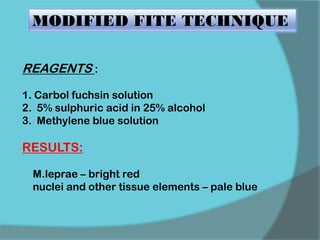
MODIFIED FITE TECHNIQUE
REAGENTS:
1. Carbol fuchsin solution
2. 5% sulphuric acid in 25% alcohol
3. Methylene blue solution
RESULTS:
M.leprae – bright red
nuclei and other tissue elements – pale blue
53.
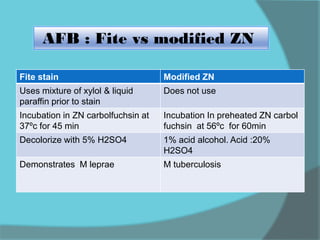
Fite stain ModifiedZN
Uses mixture of xylol & liquid
paraffin prior to stain
Does not use
Incubation in ZN carbolfuchsin at
37ºc for 45 min
Incubation In preheated ZN carbol
fuchsin at 56ºc for 60min
Decolorize with 5% H2SO4 1% acid alcohol. Acid :20%
H2SO4
Demonstrates M leprae M tuberculosis
AFB : Fite vs modified ZN
FUNGAL STAINS
Fungalcell walls are rich in polysaccharides
which can be converted by oxidation to
dialdehydes
Dialdehydes are then detected by silver
solution
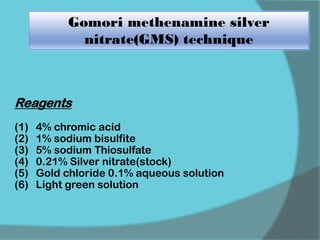
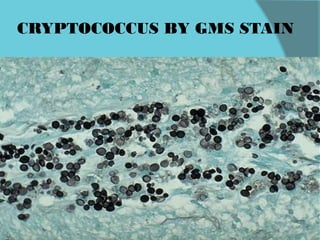
Results
Fungi , Pneumocystis,melanin - Black
Mucin & Glycogen - dark grey
Background - Pale green
Hyphae & yeast form - sharply delineated in black
against green background
MISCELLANEOUS STAINS
Cresylviolet acetate method for helicobacter
pylori
Macchiavello’s stain for rickettsia and viral
inclusions
Lendrum’s phloxine – tartrazine stain for viral
inclusions
Giemsa stain for parasites
61.
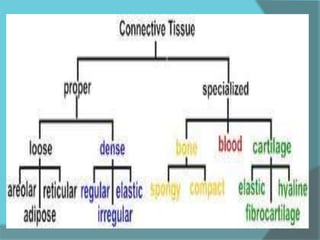
CONNECTIVE TISSUES
Providea matrix that connects and binds the
cells and organs and ultimately gives support
to the body.
Parent cell is embryonic mesenchyme
63.
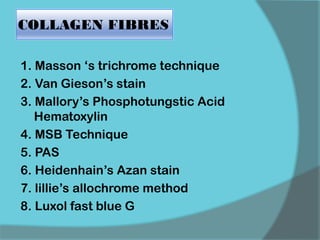
COLLAGEN FIBRES
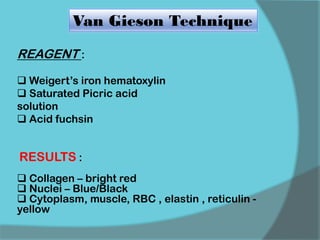
1. Masson‘s trichrome technique
2. Van Gieson’s stain
3. Mallory’s Phosphotungstic Acid
Hematoxylin
4. MSB Technique
5. PAS
6. Heidenhain’s Azan stain
7. lillie’s allochrome method
8. Luxol fast blue G
64.
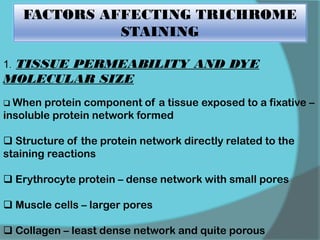
FACTORS AFFECTING TRICHROME
STAINING
1.TISSUE PERMEABILITY AND DYE
MOLECULAR SIZE
When protein component of a tissue exposed to a fixative –
insoluble protein network formed
Structure of the protein network directly related to the
staining reactions
Erythrocyte protein – dense network with small pores
Muscle cells – larger pores
Collagen – least dense network and quite porous
65.
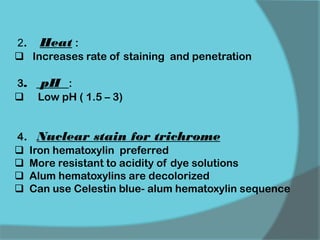
2. Heat :
Increases rate of staining and penetration
3. pH :
Low pH ( 1.5 – 3)
4. Nuclear stain for trichrome
Iron hematoxylin preferred
More resistant to acidity of dye solutions
Alum hematoxylins are decolorized
Can use Celestin blue- alum hematoxylin sequence
66.
EFFECT OF FIXATION
10% NBF will not yield optimal results
Treatment of formaldehyde fixed tissue with picric
acid /mercuric chloride solution enhances intensity
and radiance of trichrome
Recommended fixatives are: Bouin’s
Zenker’s,
Formal-mercury
Zinc formalin
67.
Demonstrate collagenand muscle in normal tissue
Differentiate collagen and Muscle in tumors
Identify an increase in collagenous tissue
Indicate fibrotic change in cirrhosis of liver
Indicate fibrotic change in pyelonephritis
Distinguish tumors that have arisen from muscle cells
and fibroblasts
Masson ‘s trichrome technique
68.
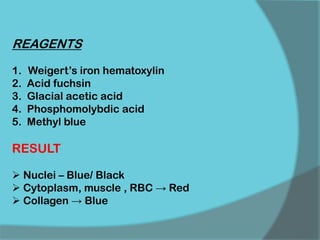
REAGENTS
1. Weigert’s ironhematoxylin
2. Acid fuchsin
3. Glacial acetic acid
4. Phosphomolybdic acid
5. Methyl blue
RESULT
Nuclei – Blue/ Black
Cytoplasm, muscle , RBC → Red
Collagen → Blue
Hemosiderin
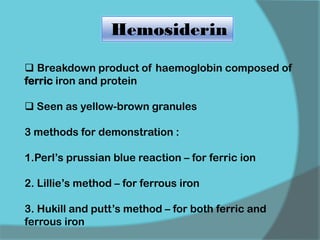
Breakdown productof haemoglobin composed of
ferric iron and protein
Seen as yellow-brown granules
3 methods for demonstration :
1.Perl’s prussian blue reaction – for ferric ion
2. Lillie’s method – for ferrous iron
3. Hukill and putt’s method – for both ferric and
ferrous iron
73.
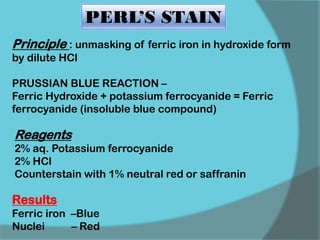
PERL’S STAIN
Principle :unmasking of ferric iron in hydroxide form
by dilute HCl
PRUSSIAN BLUE REACTION –
Ferric Hydroxide + potassium ferrocyanide = Ferric
ferrocyanide (insoluble blue compound)
Results
Ferric iron –Blue
Nuclei – Red
Reagents
2% aq. Potassium ferrocyanide
2% HCl
Counterstain with 1% neutral red or saffranin
74.
Best positivecontrol – postmortem lung tissue that
contains a reasonable amount of iron positive
macrophages (heart failure cells)
In Hb and myoglobin , iron bound tightly within protein
complex – cannot be demonstrated by traditional
technique
Treatment with hydrogen peroxide releases iron -
stained with perl’s stain
75.
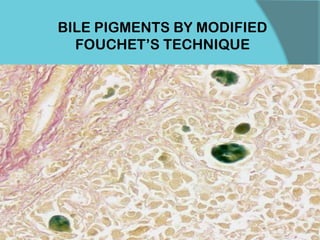
Modified Fouchet’s technique:bile
pigment
Demonstrates liver bile pigment
Most common routine method
Reagents
a)Fouchet ‘s reagent : 25% aq trichloracetic acid
10% aq ferric chloride
b)Van Gieson stain :acid Fuchsin + saturated aq picric
acid
RESULT
Bile pigment : emerald to blue green
Muscle :yellow
Collagen :red
MELANIN
Normally occuras light brown to black
granules in substantia nigra,hair , skin and
eye
Found Pathologically throughout the body
:benign nevus,malignant melanoma
78.
MELANIN DEMONSTRATED BY:
1. Reducing methods : a) Masson fontana silver
technique
b) Schmorl’s ferric-ferricyanide
reduction test
2. Enzyme methods – DOPA reaction
3. Solubility and bleaching characteristics
4. Fluorescent method
5. Immunohistochemistry
79.
MASSON FONTANA STAIN
ARGENTAFFIN REACTION – reduction of ammoniacal
silver solution to form metallic silver without the use of
extraneous reducer.
Masson’s method( using fontana’s silver solution) rely
on melanin’s argentaffin property
Melanins are blackened by acid silver nitrate solution
RESULT :
Melanin – black
Nuclei - red
80.
Schmorl’s ferric-ferricyanide
reduction test
Schmorl reaction – Melanin reduce ferricyanide to
ferrocyanide with production of prussian blue in the
presence of ferric salts
RESULT :
Melanin – dark blue
Nuclei - red
81.
Special stains enhancedetection &
localization of individual tissue component
But should not be substituted for routine H&E
CONCLUSION