Cellular Pathology
Lecture #10
Mounting Media
Ephraim Imhotep Zulu, BScBMS, MScPath
University of Zambia
School of Medicine
Department of Biomedical Sciences
Sunday, January 3, 2016 2
Mounting Media
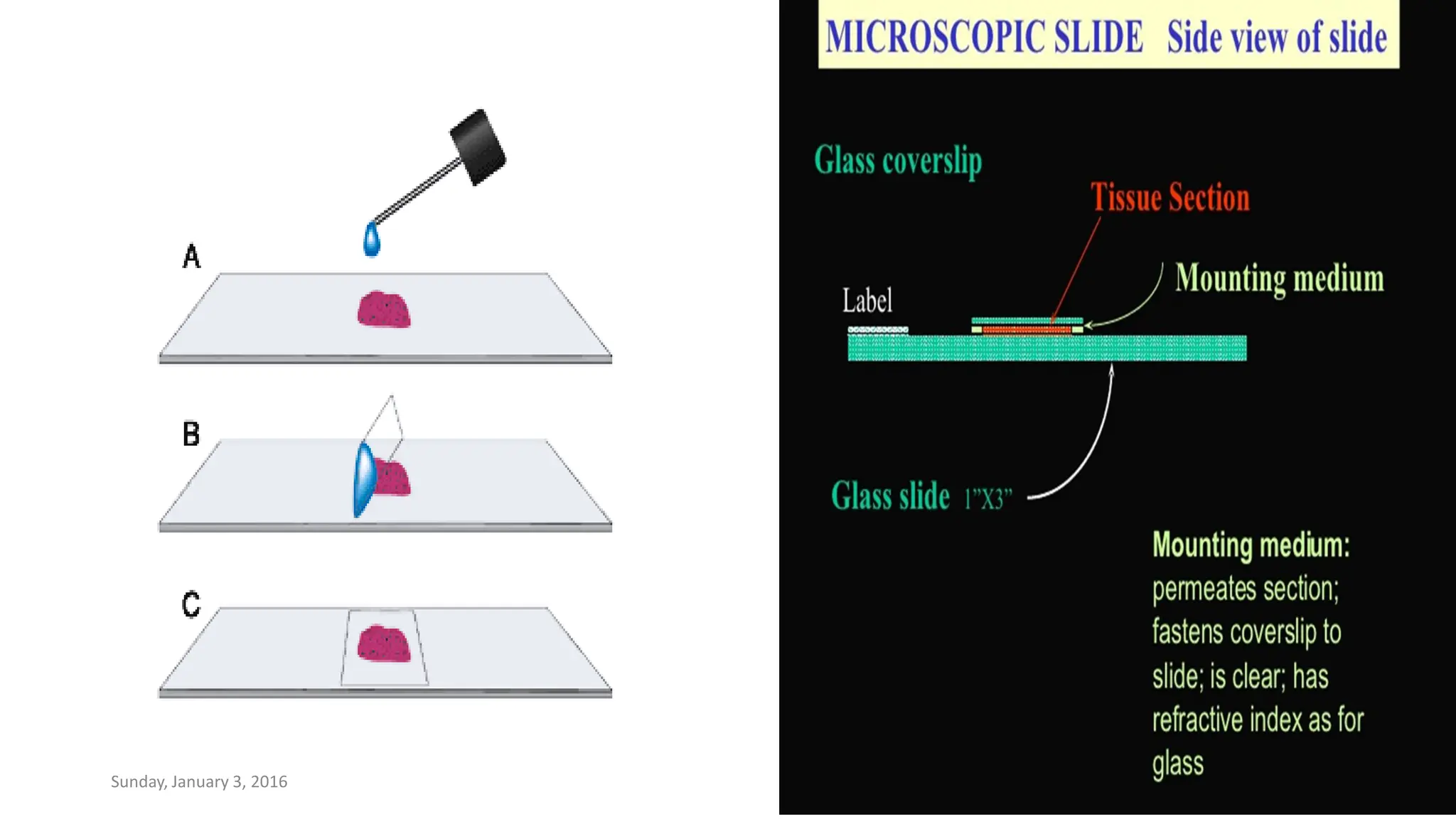
• Mounting of sections under a coverslip is essential
to get the best and clearest view of the specimen.
• Mounting media are needed for making permanent
slides.
• The mounting medium holds the specimens in place
between the cover slip and the slide.
Sunday, January 3, 2016 3
• The mounting medium should have a high refractive
index (RI).
• Most tissues have an RI of between 1.5 and 1.55, so a
mounting medium with an RI in this range will give
maximum clarity.
• There are two major types of mounting media used and
the difference is in the solvent.
• 1. Aqueous media - Used for material which is unstained,
stained for fat, or metachromatically stained.
• 2. Resinous media - For routine staining.
Sunday, January 3, 2016 4
Criteria Of Acceptable Mounting Media
• Refractive index (RI)
• Inability to cause stain to diffuse or fade
• Appearance on setting ie crack or granular appearance
• Ability to dry to a nonsticky consistency and harden
relatively quickly
• Inability to shrink back from edge of cover-glass
• It should be free flowing and free of bubbles
Sunday, January 3, 2016 5
Criteria Of Acceptable Mounting Media..,
1. Refractive Index
• Should be as close as possible to that of glass i.e. 1.5
• If the RI is much lower than 1.5, then tissues will not be
completely transparent and diffraction will occur.
• Lower RI reduces clarity and give some contrast to even
unstained tissues.
Sunday, January 3, 2016 6
Criteria Of Acceptable Mounting Media..,
2. Effects On The Stain Itself
• Some media will cause fading eg acidic mounting materials,
especially in the light.
• Some media may act as solvents for the dyes and as a
consequence the dye diffuses or leaches out into the
mountant.
• This will gradually obscure the tissues.
Sunday, January 3, 2016 7
Criteria Of Acceptable Mounting Media..,
3. Clarity
• Some media can become opaque as they dry out and are not
suitable for long-term preservation.
4. Fluorescence
• Critical for fluorescence microscopy
• it eliminates the need to use a special mountant when
fluorescence is being used.
Sunday, January 3, 2016 8
Criteria Of Acceptable Mounting Media..,
5. Setting
• The ability of a mountant to dry or set quickly and hold the
coverslip in place is very useful.
• Many aqueous-based media fail to harden sufficiently and
the coverslip will need ‘ringing’ to preserve the section.
• Ringing is the term used for sealing the edges of a coverslip
when the mounting medium does not set.
Sunday, January 3, 2016 9
Resinous Mounting Media
• Commonest types
• Are based on hydrophobic organic solvents, usually
xylene
• Need the section to be dehydrated and cleared
before mounting. eg
- Canada balsam - Natural resin (R.I. - 1.52)
- D.P.X. (R.I. 1.52)
- Eukitt
Sunday, January 3, 2016 10
Canada Balsam
• Natural resin
• It is used as 60% resin by weight in xylene.
• Slides take few months to dry.
• The yellow colour of the mountant hardly seems to matter
when viewed through the microscope
• Will cause fading, especially of basic dyes since its acidic
• Not very cheap to obtain.
• its optical properties do not deteriorate with age hence it
has the long storage ability of the slides.
Sunday, January 3, 2016 11
DPX
• A synthetic polystyrene resin that is dissolved in xylene and
has some plasticizer added.
• The initials come from the components: Distrene 80,
plasticizer and xylene.
• It is a water-white clear solution.
• It has very little tendency to fade dyes and hardens in about
24 hours.
• The specimens do not need ringing.
Sunday, January 3, 2016 12
Eukitt
• Is a very fast drying general-purpose resin-based
mounting medium.
• Will solidify within about 20 minutes.
• The specimens must be free of water and placed
first in alcohol and then in xylene prior to mounting.
Sunday, January 3, 2016 13
Euparal
• Contains sandarac, eucalyptol, paraldehyde, camphor,
and phenyl salicylate.
• Is commonly used to mount histological specimens and
insects.
• Do not embed specimens which contain water, this may
result in a clouding of the mounting medium.
• It has a relatively long drying time of a few days.
Sunday, January 3, 2016 14
Clear Nail Polish
• Can be used to seal the sides of the coverslip when
using aqueous mounting media.
• Can also be used directly as a mounting medium.
• The specimens must first be dehydrated in alcohol
and can then be directly mounted (without xylene) in
nail polish
• It is readily available and it avoids the use of toxic
organic solvents to treat the specimens.
• It seems to shrink a lot when making very thick
mounts (such as whole insects).
Sunday, January 3, 2016 15
Aqueous Mounting Media
• Used for mounting sections from distilled water
when the stains would be decolorized or removed by
alcohol and xylene.
• Require addition of bacteriostatic agents to prevent
the growth of fungi.
• Most are best considered as temporary mounts and
need ringing to hold the coverslip in place and
prevent drying out.
• Tissues do not need any treatment before mounting
and can be mounted directly from water or buffer.
Sunday, January 3, 2016 16
Glycerol
• A trihydric alcohol with a high RI.
• Is a useful medium for fluorescent staining, eg
immunofluorescent antibody techniques.
• It neither hardens nor dries out.
• The addition of p-phenylenediamine is said to retard
the fading of fluorescence.
Sunday, January 3, 2016 17
Glycerol Jelly
• May contain phenol which makes it hazardous for the use.
• The handling of this mounting medium, is also not too easy.
• Bubbles are a problem with this medium.
• It also does not shrink.
• The usual formulation has a lower RI (1.42) than most
mounting media.
• is commonly used to preserve pollen samples.
Sunday, January 3, 2016 18
Apathy’s Medium
• This uses a gum and sucrose to raise the RI.
• It has an RI of around 1.5, so it can give nicely
transparent preparations.
• It has a tendency to crystallize in storage and can
set by drying but this is quite slow.
Sunday, January 3, 2016 19
Polyvinyl Alcohol Media
• Are synthetic and less liable to bacterial
contamination than the organic-based mountants,
although the addition of phenol is still advisable.
• They dissolve in water or buffer but need constant
stirring.
• They solidify slowly by evaporation but specimens
can be ringed to prevent this.
• These are more permanent than the other water-
based mounting media, but are still not as good as a
resinous medium.
Sunday, January 3, 2016 20
Temporary Mounts Need Ringing
• Ringing is the term used for sealing the edges
of a coverslip when the mounting medium does
not set.
• Ringing was originally so called because the
coverslips were round and so there was a ring
of the sealant round the coverslip.
• Good temporary ringing can be achieved in a
number of ways using Ordinary nail varnish,
Many styrene-based cements, Paraffin wax,
etc.
Sunday, January 3, 2016 21
Use Of Coverslips
• Mounting of sections under a coverslip is essential to
get the best and clearest view of the specimen.
• The coverslip should have a thickness of 0.17 mm for
the best results.
• Thicker coverslips will interfere marginally with the
clarity and
• very thick coverslips may even prevent the oil-
immersion lens being used as they can have a greater
thickness than the normal working distance of the
oil-immersion lens.
Sunday, January 3, 2016 22
Storage of slides
• Mounted slides should always be carefully labelled
and stored horizontally until fully dry and set
when they can be stored on their edge or end.
• Stained slides should be stored away from light
as the dyes will fade even in the best mountant.
Sunday, January 3, 2016 23
References & Credits
• Cook, D.J (2006). Biomedical Sciences Explained:
Cellular Pathology. Butterworth Heinemann,
Oxford. ISBN: 10: 1948 42305
• Oliver Kim.(2013). An overview of mounting media
for microscopy. MicrobeHunter.com
Sunday, January 3, 2016 24
End Of Lecture
Sunday, January 3, 2016 25
Ephraim Imhotep Zulu – 2015/16

10 - Mounting Media.pdf

  • 1.
    Cellular Pathology Lecture #10 MountingMedia Ephraim Imhotep Zulu, BScBMS, MScPath University of Zambia School of Medicine Department of Biomedical Sciences
  • 2.
  • 3.
    Mounting Media • Mountingof sections under a coverslip is essential to get the best and clearest view of the specimen. • Mounting media are needed for making permanent slides. • The mounting medium holds the specimens in place between the cover slip and the slide. Sunday, January 3, 2016 3
  • 4.
    • The mountingmedium should have a high refractive index (RI). • Most tissues have an RI of between 1.5 and 1.55, so a mounting medium with an RI in this range will give maximum clarity. • There are two major types of mounting media used and the difference is in the solvent. • 1. Aqueous media - Used for material which is unstained, stained for fat, or metachromatically stained. • 2. Resinous media - For routine staining. Sunday, January 3, 2016 4
  • 5.
    Criteria Of AcceptableMounting Media • Refractive index (RI) • Inability to cause stain to diffuse or fade • Appearance on setting ie crack or granular appearance • Ability to dry to a nonsticky consistency and harden relatively quickly • Inability to shrink back from edge of cover-glass • It should be free flowing and free of bubbles Sunday, January 3, 2016 5
  • 6.
    Criteria Of AcceptableMounting Media.., 1. Refractive Index • Should be as close as possible to that of glass i.e. 1.5 • If the RI is much lower than 1.5, then tissues will not be completely transparent and diffraction will occur. • Lower RI reduces clarity and give some contrast to even unstained tissues. Sunday, January 3, 2016 6
  • 7.
    Criteria Of AcceptableMounting Media.., 2. Effects On The Stain Itself • Some media will cause fading eg acidic mounting materials, especially in the light. • Some media may act as solvents for the dyes and as a consequence the dye diffuses or leaches out into the mountant. • This will gradually obscure the tissues. Sunday, January 3, 2016 7
  • 8.
    Criteria Of AcceptableMounting Media.., 3. Clarity • Some media can become opaque as they dry out and are not suitable for long-term preservation. 4. Fluorescence • Critical for fluorescence microscopy • it eliminates the need to use a special mountant when fluorescence is being used. Sunday, January 3, 2016 8
  • 9.
    Criteria Of AcceptableMounting Media.., 5. Setting • The ability of a mountant to dry or set quickly and hold the coverslip in place is very useful. • Many aqueous-based media fail to harden sufficiently and the coverslip will need ‘ringing’ to preserve the section. • Ringing is the term used for sealing the edges of a coverslip when the mounting medium does not set. Sunday, January 3, 2016 9
  • 10.
    Resinous Mounting Media •Commonest types • Are based on hydrophobic organic solvents, usually xylene • Need the section to be dehydrated and cleared before mounting. eg - Canada balsam - Natural resin (R.I. - 1.52) - D.P.X. (R.I. 1.52) - Eukitt Sunday, January 3, 2016 10
  • 11.
    Canada Balsam • Naturalresin • It is used as 60% resin by weight in xylene. • Slides take few months to dry. • The yellow colour of the mountant hardly seems to matter when viewed through the microscope • Will cause fading, especially of basic dyes since its acidic • Not very cheap to obtain. • its optical properties do not deteriorate with age hence it has the long storage ability of the slides. Sunday, January 3, 2016 11
  • 12.
    DPX • A syntheticpolystyrene resin that is dissolved in xylene and has some plasticizer added. • The initials come from the components: Distrene 80, plasticizer and xylene. • It is a water-white clear solution. • It has very little tendency to fade dyes and hardens in about 24 hours. • The specimens do not need ringing. Sunday, January 3, 2016 12
  • 13.
    Eukitt • Is avery fast drying general-purpose resin-based mounting medium. • Will solidify within about 20 minutes. • The specimens must be free of water and placed first in alcohol and then in xylene prior to mounting. Sunday, January 3, 2016 13
  • 14.
    Euparal • Contains sandarac,eucalyptol, paraldehyde, camphor, and phenyl salicylate. • Is commonly used to mount histological specimens and insects. • Do not embed specimens which contain water, this may result in a clouding of the mounting medium. • It has a relatively long drying time of a few days. Sunday, January 3, 2016 14
  • 15.
    Clear Nail Polish •Can be used to seal the sides of the coverslip when using aqueous mounting media. • Can also be used directly as a mounting medium. • The specimens must first be dehydrated in alcohol and can then be directly mounted (without xylene) in nail polish • It is readily available and it avoids the use of toxic organic solvents to treat the specimens. • It seems to shrink a lot when making very thick mounts (such as whole insects). Sunday, January 3, 2016 15
  • 16.
    Aqueous Mounting Media •Used for mounting sections from distilled water when the stains would be decolorized or removed by alcohol and xylene. • Require addition of bacteriostatic agents to prevent the growth of fungi. • Most are best considered as temporary mounts and need ringing to hold the coverslip in place and prevent drying out. • Tissues do not need any treatment before mounting and can be mounted directly from water or buffer. Sunday, January 3, 2016 16
  • 17.
    Glycerol • A trihydricalcohol with a high RI. • Is a useful medium for fluorescent staining, eg immunofluorescent antibody techniques. • It neither hardens nor dries out. • The addition of p-phenylenediamine is said to retard the fading of fluorescence. Sunday, January 3, 2016 17
  • 18.
    Glycerol Jelly • Maycontain phenol which makes it hazardous for the use. • The handling of this mounting medium, is also not too easy. • Bubbles are a problem with this medium. • It also does not shrink. • The usual formulation has a lower RI (1.42) than most mounting media. • is commonly used to preserve pollen samples. Sunday, January 3, 2016 18
  • 19.
    Apathy’s Medium • Thisuses a gum and sucrose to raise the RI. • It has an RI of around 1.5, so it can give nicely transparent preparations. • It has a tendency to crystallize in storage and can set by drying but this is quite slow. Sunday, January 3, 2016 19
  • 20.
    Polyvinyl Alcohol Media •Are synthetic and less liable to bacterial contamination than the organic-based mountants, although the addition of phenol is still advisable. • They dissolve in water or buffer but need constant stirring. • They solidify slowly by evaporation but specimens can be ringed to prevent this. • These are more permanent than the other water- based mounting media, but are still not as good as a resinous medium. Sunday, January 3, 2016 20
  • 21.
    Temporary Mounts NeedRinging • Ringing is the term used for sealing the edges of a coverslip when the mounting medium does not set. • Ringing was originally so called because the coverslips were round and so there was a ring of the sealant round the coverslip. • Good temporary ringing can be achieved in a number of ways using Ordinary nail varnish, Many styrene-based cements, Paraffin wax, etc. Sunday, January 3, 2016 21
  • 22.
    Use Of Coverslips •Mounting of sections under a coverslip is essential to get the best and clearest view of the specimen. • The coverslip should have a thickness of 0.17 mm for the best results. • Thicker coverslips will interfere marginally with the clarity and • very thick coverslips may even prevent the oil- immersion lens being used as they can have a greater thickness than the normal working distance of the oil-immersion lens. Sunday, January 3, 2016 22
  • 23.
    Storage of slides •Mounted slides should always be carefully labelled and stored horizontally until fully dry and set when they can be stored on their edge or end. • Stained slides should be stored away from light as the dyes will fade even in the best mountant. Sunday, January 3, 2016 23
  • 24.
    References & Credits •Cook, D.J (2006). Biomedical Sciences Explained: Cellular Pathology. Butterworth Heinemann, Oxford. ISBN: 10: 1948 42305 • Oliver Kim.(2013). An overview of mounting media for microscopy. MicrobeHunter.com Sunday, January 3, 2016 24
  • 25.
    End Of Lecture Sunday,January 3, 2016 25 Ephraim Imhotep Zulu – 2015/16