MASONARY STRUCTURES
CAVITY WALLS
DEFINITION:
 Consist of two ‘skins’ separated by a hollow
space (cavity)
 The skins are commonly masonry such as
‘brick’ or ‘concrete block’.
 Masonry is an absorbent material, and
therefore will slowly draw rainwater or even
humidity into wall
INSTALLATION:
 A single skin of block work is built on top of
the foundation works.
 A layer of brickwork is constructed leaving a
cavity in between.
 Cavity ties ensure STABILITY.
 Insulation is fitted in between- the common
type is ‘mineral wood’.
CAVITY WALL
Insulation between two walls
COMPOSITE
STONE CLADDING:
 Applied to concrete and steel buildings as a
part of their original architectural design.
 Refers to light weight stimulated stone
products with a concrete-type base.
 Reduces material cost of construction.
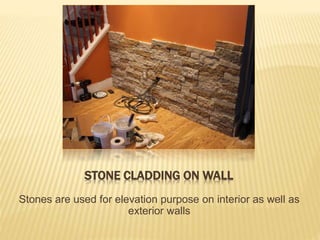
STONE CLADDING ON WALL
Stones are used for elevation purpose on interior as well as
exterior walls
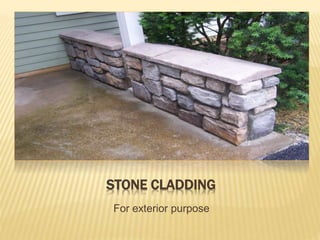
STONE CLADDING
For exterior purpose
APPLICATION:
 Affixed with wall using ‘mortar’ mix.
 Can be a normal stone that has been
quarried and then cut into thin pieces to
reduces weight.
LINTEL AND ARCHES:
3 METHODS OF SPANNING PASSAGEWAYS:
 Post and lintel.
 Corbelled arch.
 Round arch, already popular in near east.
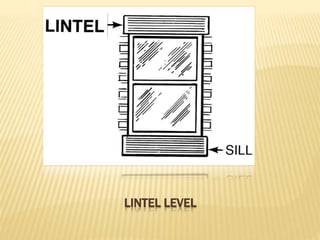
LINTEL:
 A horizontal load-bearing building
component.
 Often found over portals, doors, windows
and fireplaces.
LINTEL LEVEL
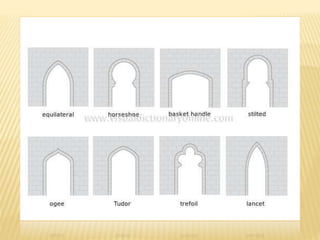
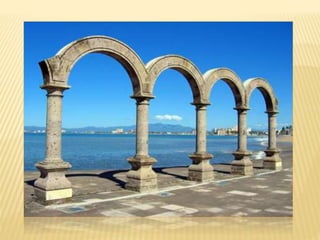
ARCHES:
 The structure constructed of wedge shaped
block of stones or bricks, joint together with
mortar and provided across the opening to
carry the weight of the structure above the
opening.
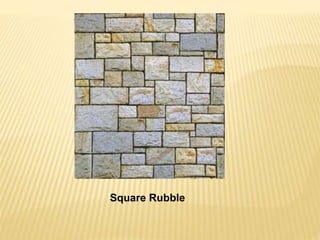
STONE MASONARY
 It is the craft of shaping rough piecies of rock
into accurate geometrical shapes,at times
simple,but some of considerable complexity,
and then arranging the resulting stones,often
togather with mortar,to form structures.
 The stones are arrange in different styles using
different size of stones in the stone masonary
but they are arranged in a way to avoid vertical
joints.
 They are joined using cement mortar.
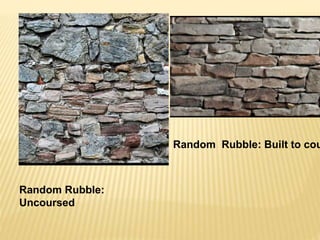
Random Rubble:
Uncoursed
Random Rubble: Built to cou
Square Rubble
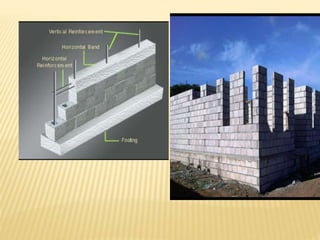
HOLLOW CEMENT BLOCK MASONARY
 It is a hollow cement rectangular unit called
block.
 It is light in weight hence construction carried
out with it reduces the weight of the building
to the footing.
 The hollow part in the block helps to join the
blocks properly with the mortar and it also
works as thermal and sound insulation.
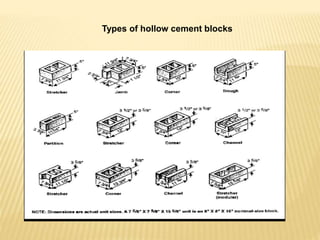
Types of hollow cement blocks
BRICK MASONARY
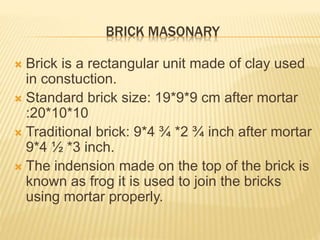
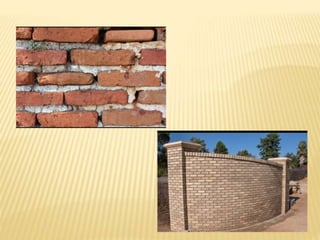
 Brick is a rectangular unit made of clay used
in constuction.
 Standard brick size: 19*9*9 cm after mortar
:20*10*10
 Traditional brick: 9*4 ¾ *2 ¾ inch after mortar
9*4 ½ *3 inch.
 The indension made on the top of the brick is
known as frog it is used to join the bricks
using mortar properly.
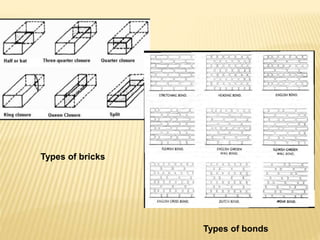
Types of bricks
Types of bonds
STRUCTURAL SYSTEMS
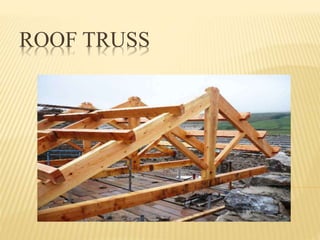
ROOF TRUSS
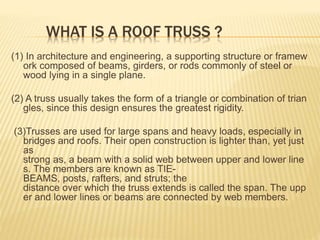
WHAT IS A ROOF TRUSS ?
(1) In architecture and engineering, a supporting structure or framew
ork composed of beams, girders, or rods commonly of steel or
wood lying in a single plane.
(2) A truss usually takes the form of a triangle or combination of trian
gles, since this design ensures the greatest rigidity.
(3)Trusses are used for large spans and heavy loads, especially in
bridges and roofs. Their open construction is lighter than, yet just
as
strong as, a beam with a solid web between upper and lower line
s. The members are known as TIE-
BEAMS, posts, rafters, and struts; the
distance over which the truss extends is called the span. The upp
er and lower lines or beams are connected by web members.
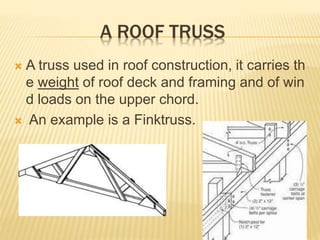
A ROOF TRUSS
 A truss used in roof construction, it carries th
e weight of roof deck and framing and of win
d loads on the upper chord.
 An example is a Finktruss.
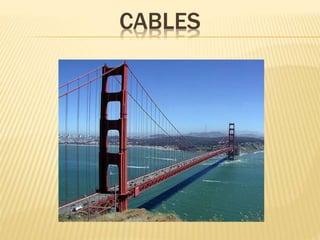
CABLES
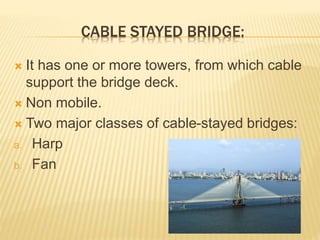
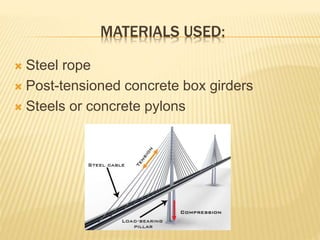
CABLE STAYED BRIDGE:
 It has one or more towers, from which cable
support the bridge deck.
 Non mobile.
 Two major classes of cable-stayed bridges:
a. Harp
b. Fan
MATERIALS USED:
 Steel rope
 Post-tensioned concrete box girders
 Steels or concrete pylons
CARRIERS:
 Pedestrains
 Bicycles
 Automobiles
 Trucks
 Light rail
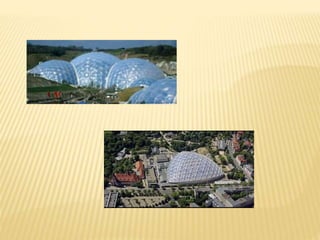
SURFACE STRUCTURES
 It is a membrane plate or shell type structure
with much less thickness as compared to
other dimensions.
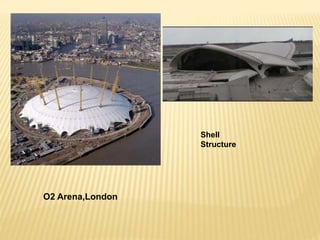
 Ex:O2 Arena ,London ,shell structure.
 The thin curved plate structure is shaped to
transmit applied compressive forces and
shear stresses thatact in the plane of the
surface.they are generally constructed with
concrete reinforced with steel.
O2 Arena,London
Shell
Structure
FRAMED STRUCTURE
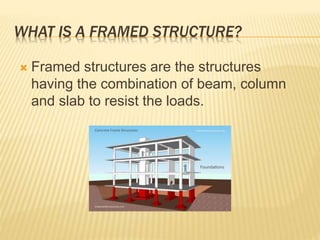
WHAT IS A FRAMED STRUCTURE?
 Framed structures are the structures
having the combination of beam, column
and slab to resist the loads.
ADVANTAGES
 Speedy construction.
 Very rigid and stable.
 Offers large unobstructed floor areas.
 Easy to design.
 Partition walls can be easily altered within
limits of frame.
Thank You

GROUP MEMBERS:
 Shweta Dhamanwala
 Prachi Shukla
 Zuena Saiyed
 Riddhi Chitalia
 Abhishek Mewada
 Dhaval Gajjar
 Mayank Patel

Masonary structures

  • 1.
  • 2.
  • 3.
    DEFINITION:  Consist oftwo ‘skins’ separated by a hollow space (cavity)  The skins are commonly masonry such as ‘brick’ or ‘concrete block’.  Masonry is an absorbent material, and therefore will slowly draw rainwater or even humidity into wall
  • 4.
    INSTALLATION:  A singleskin of block work is built on top of the foundation works.  A layer of brickwork is constructed leaving a cavity in between.  Cavity ties ensure STABILITY.  Insulation is fitted in between- the common type is ‘mineral wood’.
  • 5.
  • 6.
  • 7.
    STONE CLADDING:  Appliedto concrete and steel buildings as a part of their original architectural design.  Refers to light weight stimulated stone products with a concrete-type base.  Reduces material cost of construction.
  • 8.
    STONE CLADDING ONWALL Stones are used for elevation purpose on interior as well as exterior walls
  • 9.
  • 10.
    APPLICATION:  Affixed withwall using ‘mortar’ mix.  Can be a normal stone that has been quarried and then cut into thin pieces to reduces weight.
  • 11.
  • 12.
    3 METHODS OFSPANNING PASSAGEWAYS:  Post and lintel.  Corbelled arch.  Round arch, already popular in near east.
  • 13.
    LINTEL:  A horizontalload-bearing building component.  Often found over portals, doors, windows and fireplaces.
  • 14.
  • 15.
    ARCHES:  The structureconstructed of wedge shaped block of stones or bricks, joint together with mortar and provided across the opening to carry the weight of the structure above the opening.
  • 18.
    STONE MASONARY  Itis the craft of shaping rough piecies of rock into accurate geometrical shapes,at times simple,but some of considerable complexity, and then arranging the resulting stones,often togather with mortar,to form structures.  The stones are arrange in different styles using different size of stones in the stone masonary but they are arranged in a way to avoid vertical joints.  They are joined using cement mortar.
  • 19.
  • 20.
  • 21.
    HOLLOW CEMENT BLOCKMASONARY  It is a hollow cement rectangular unit called block.  It is light in weight hence construction carried out with it reduces the weight of the building to the footing.  The hollow part in the block helps to join the blocks properly with the mortar and it also works as thermal and sound insulation.
  • 22.
    Types of hollowcement blocks
  • 24.
    BRICK MASONARY  Brickis a rectangular unit made of clay used in constuction.  Standard brick size: 19*9*9 cm after mortar :20*10*10  Traditional brick: 9*4 ¾ *2 ¾ inch after mortar 9*4 ½ *3 inch.  The indension made on the top of the brick is known as frog it is used to join the bricks using mortar properly.
  • 25.
  • 27.
  • 28.
  • 29.
    WHAT IS AROOF TRUSS ? (1) In architecture and engineering, a supporting structure or framew ork composed of beams, girders, or rods commonly of steel or wood lying in a single plane. (2) A truss usually takes the form of a triangle or combination of trian gles, since this design ensures the greatest rigidity. (3)Trusses are used for large spans and heavy loads, especially in bridges and roofs. Their open construction is lighter than, yet just as strong as, a beam with a solid web between upper and lower line s. The members are known as TIE- BEAMS, posts, rafters, and struts; the distance over which the truss extends is called the span. The upp er and lower lines or beams are connected by web members.
  • 30.
    A ROOF TRUSS A truss used in roof construction, it carries th e weight of roof deck and framing and of win d loads on the upper chord.  An example is a Finktruss.
  • 31.
  • 32.
    CABLE STAYED BRIDGE: It has one or more towers, from which cable support the bridge deck.  Non mobile.  Two major classes of cable-stayed bridges: a. Harp b. Fan
  • 33.
    MATERIALS USED:  Steelrope  Post-tensioned concrete box girders  Steels or concrete pylons
  • 34.
    CARRIERS:  Pedestrains  Bicycles Automobiles  Trucks  Light rail
  • 35.
    SURFACE STRUCTURES  Itis a membrane plate or shell type structure with much less thickness as compared to other dimensions.  Ex:O2 Arena ,London ,shell structure.  The thin curved plate structure is shaped to transmit applied compressive forces and shear stresses thatact in the plane of the surface.they are generally constructed with concrete reinforced with steel.
  • 36.
  • 38.
  • 39.
    WHAT IS AFRAMED STRUCTURE?  Framed structures are the structures having the combination of beam, column and slab to resist the loads.
  • 40.
    ADVANTAGES  Speedy construction. Very rigid and stable.  Offers large unobstructed floor areas.  Easy to design.  Partition walls can be easily altered within limits of frame.
  • 41.
  • 42.
    GROUP MEMBERS:  ShwetaDhamanwala  Prachi Shukla  Zuena Saiyed  Riddhi Chitalia  Abhishek Mewada  Dhaval Gajjar  Mayank Patel