PASSIVE ARCHITECTURE 
SUBMITTED BY: 
ABHISHEK VALLABHANENI
INTRODUCTION 
• Passive Architecture involves blending 
conventional architectural principles with solar 
& wind energy and the inherent properties of 
building materials to ensure that the interiors 
remain warm in winter and cool in summer, 
thus creating a year-round comfortable 
environment.
PASSIVE ARCHITECTURE DESIGN 
SYSTEMS 
• • Thermal mass construction 
• • Wind towers 
• • Passive down draft evaporative cooling systems 
• • Earth tunnel cooling 
• • Roofing systems 
• • Roof gardens 
• • Trombe wall 
• • Solar chimney 
• • Light shelf
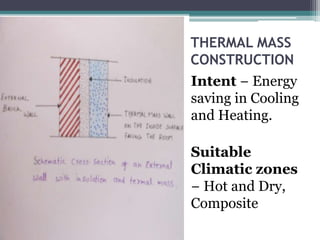
THERMAL MASS 
CONSTRUCTION 
Intent − Energy 
saving in Cooling 
and Heating. 
Suitable 
Climatic zones 
− Hot and Dry, 
Composite
PRINCIPLE 
• Thermal mass is the ability of a material to 
absorb heat energy, store it, and at a later time, 
release it in support of maintaining uniform 
temperature profiles. 
• Thermal mass acts as a 'thermal battery'. During 
summer, it absorbs heat, keeping the house 
relatively cool. 
• In winter, the same thermal mass can store the 
• heat from the sun to release it at night, helping 
the home stay warm.
APPLICATION 
• Correct use of thermal mass can delay heat flow 
through the building envelope by as much as 10 to 12 
hours, producing a warmer house at night in winter 
and a cooler house during the day in summer. 
• Walls - Insulated Masonry walls provide good 
thermal mass. Recycled materials such as concrete, 
gravel or re-used bricks can be used to build the 
thermal mass. Insulation improves the efficiency of 
the thermal mass, provided it is placed on the 
exterior. 
• Floor Slab - Floor slab in contact with the ground, 
can act as a good thermal mass 
• Roof – Thermal mass in the roof will greatly reduce 
the solar heat gain.
WIND 
TOWERS 
Intent − Energy 
saving in Cooling 
and Ventilation 
Suitable Climatic 
zones − Hot and 
Dry, Composite
PRINCIPLE 
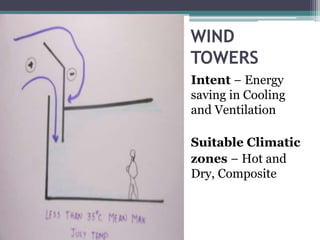
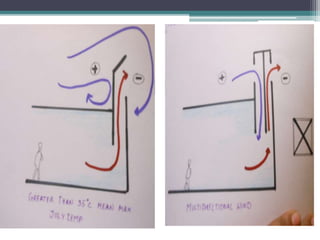
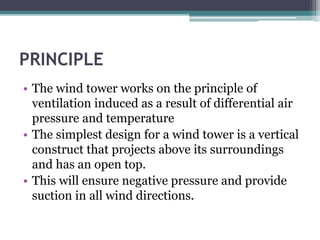
• The wind tower works on the principle of 
ventilation induced as a result of differential air 
pressure and temperature 
• The simplest design for a wind tower is a vertical 
construct that projects above its surroundings 
and has an open top. 
• This will ensure negative pressure and provide 
suction in all wind directions.
APPLICATION 
• The openings of the wind tower provided in the 
direction of the wind, and outlets on the leeward 
side take advantage of the pressure difference 
created by wind speed and direction. 
• Normally, the outlets have thrice the area of the 
inlet for better efficiency. 
• The inlet should be properly designed for 
uniform distribution.
PASSIVE DOWN 
DRAFT 
EVAPORATIVE 
COOLING SYSTEM 
(PDEC) 
Intent − Energy 
saving in Cooling 
and Ventilation 
Suitable Climatic 
zones − Hot and 
Dry, Composite
PRINCIPLE 
• This system relies on the principle of evaporative 
cooling. 
• Large amounts of heat are consumed by water as 
it evaporates. 
• This is called the latent heat of evaporation. 
• This heat is partially drawn from the 
surrounding air, causing cooling. 
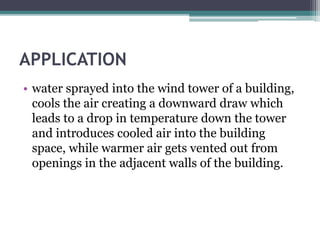
• The PDEC system consists of modified wind 
towers which guide outside breezes over a row of 
water filled porous pots, mist spray or waterfall. 
• As the air comes in contact with the water it 
cools and descends down the tower and is let into 
the interior space.
APPLICATION 
• water sprayed into the wind tower of a building, 
cools the air creating a downward draw which 
leads to a drop in temperature down the tower 
and introduces cooled air into the building 
space, while warmer air gets vented out from 

openings in the adjacent walls of the building.
EARTH 
TUNNEL 
COOLING 
Intent − Energy 
saving in Cooling 
and Ventilation 
Suitable Climatic 
zones − Hot and 
Dry, Composite, 
Moderate and 
Warm and humid
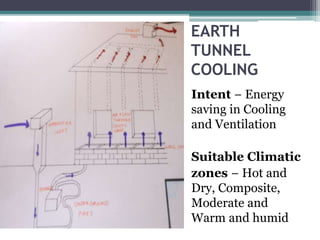
PRINCIPLE 
• The cooling process is based on the fact that the 
temperature a few meters below the ground is 
almost constant throughout the year. 
• Daily temperature variations hardly affect the 
earth’s temperature at a depth of more than one 
meter. 
• A tunnel in the form of pipes or otherwise will 
acquire the same temperature at its surface 
causing the ambient air ventilated through this 
tunnel to get cooled.
APPLICATION 
• Earth-air tunnels may be considered as special types 
of wind towers connected to an underground tunnel. 
• A wind tower is connected to the underground 
tunnel, which runs from the bottom of the wind 
tower to the basement of the building. 
• The wind tower catches the wind which is forced 
down the tower into the tunnel. 
• The temperature of the tunnel, being lower than that 
of the ambient temperature, cools the air before it is 
circulated into the living space. 
• In winter, the temperature of the air tunnel is higher 
than the ambient temperature and hence warms the 
air passing through it.
The roof of a building receives the maximum 
solar radiation and contributes greatly to 
internal heat gain. The roofing systems 
mentioned in this section include various 
techniques to minimize 
heat gain.
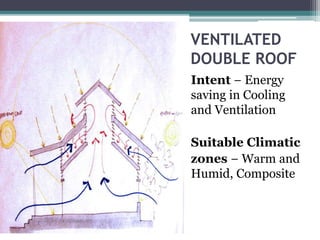
VENTILATED 
DOUBLE ROOF 
Intent − Energy 
saving in Cooling 
and Ventilation 
Suitable Climatic 
zones − Warm and 
Humid, Composite
PRINCIPLE 
• A ventilated double roof when used in a warm 
and humid climate helps to draw away warm air 
between the roof and the ceiling, thus preventing 
excessive heat gain from the roof. 
• The radiative heat transfer from the roof to the 
ceiling can be reduced by using low emissivity or 
high reflective 
• coating (e.g. aluminium foil) on either surface 
facing the cavity.
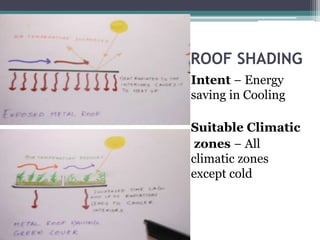
ROOF SHADING 
Intent − Energy 
saving in Cooling 
Suitable Climatic 
zones − All 
climatic zones 
except cold
PRINCIPLE 
• Shading the roof surface is an easy and cost– 
effective way of reducing solar heat gain. 
• Surface shading can be provided as an integral 
part of the building structure or as a separate 
cover. 
• Shading can be provided by white washed 
inverted earthen pots or a cover of deciduous 
plants or creepers.
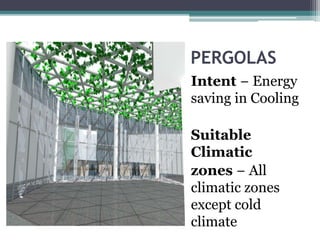
PERGOLAS 
Intent − Energy 
saving in Cooling 
Suitable 
Climatic 
zones − All 
climatic zones 
except cold 
climate
PRINCIPLE 
• Pergolas are framework-imitating walls and 
ceiling without obscuring the view. 
• Pergolas are often used in gardens to create 
vertical interest or to obscure or distract from 
unattractive underlying attributes. 
• But they can be used as alternate roofing system 
to obstruct direct heat gain from the sun; 
especially on open terraces.
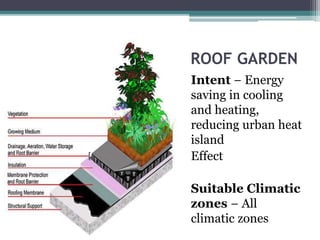
ROOF GARDEN 
Intent − Energy 
saving in cooling 
and heating, 
reducing urban heat 
island 
Effect 
Suitable Climatic 
zones − All 
climatic zones
PRINCIPLE 
• Green roofs also known as roof gardens or 
vegetated roof covers, play multiple roles as 
follows - 
• Reduce urban “heat island” effect 
• Reduce CO2 impact 
• Reduce energy consumption in cooling and 
heating. 
• Treat nitrogen pollution in rain 
• Negate acid rain effect 
• Aesthetically pleasing
APPLICATION 
• Roof Gardens are constructed of a lightweight 
soil media, underlain by a drainage layer, and a 
high quality impermeable membrane that 
protects the building structure from seepage. 
• The soil is planted with a specialized mix of 
plants that can thrive in the harsh, dry, high 
temperature conditions of the roof and tolerate 
short periods of inundation from heavy rains.
ROOF POND SYSTEM 
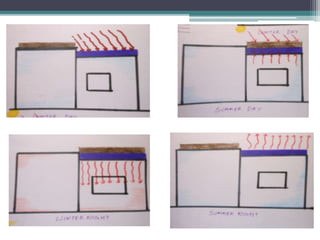
• This system consists of water filled polythene 
bags which are placed on a ribbed metal roof 
deck and covered with movable insulation 
panels. 
• In the summer months, during the day, these 
panels cover the roof and greatly reduce the 
radiative solar heat gain from the roof. 
• During the night, the insulating panels are slid 
off the roof to permit radiative cooling.
• In winter months or cold climates, the roof pond 
can be used for heating, by keeping the 
insulation off during the day time and covering 
the roof during the night time. 
• Because of its reliance on radiative cooling, roof 
pond systems are best suited to places of low 
humidity and clear nights. 
• Typical roof pond systems use a water mass 
from 100 mm to 250 mm (4 to 10 inches) in 
depth.
TROMBE 
WALL 
Intent − Energy 
saving in heating 
Suitable 
Climatic 
zones − Cold 
Climates
PRINCIPLE 
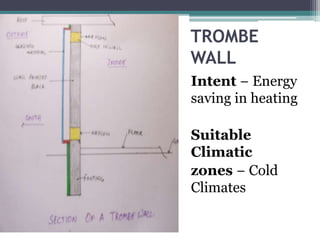
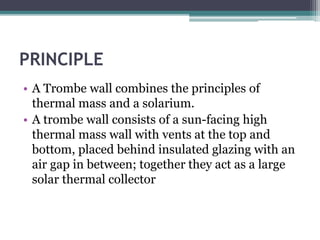
• A Trombe wall combines the principles of 
thermal mass and a solarium. 
• A trombe wall consists of a sun-facing high 
thermal mass wall with vents at the top and 
bottom, placed behind insulated glazing with an 
air gap in between; together they act as a large 
solar thermal collector
APPLICATION 
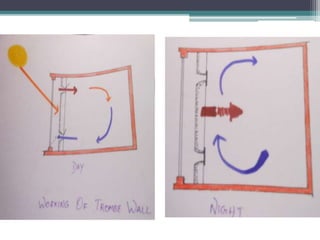
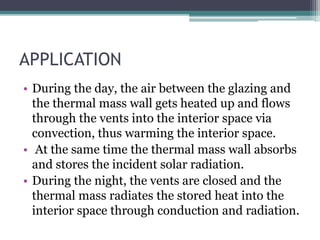
• During the day, the air between the glazing and 
the thermal mass wall gets heated up and flows 
through the vents into the interior space via 
convection, thus warming the interior space. 
• At the same time the thermal mass wall absorbs 
and stores the incident solar radiation. 
• During the night, the vents are closed and the 
thermal mass radiates the stored heat into the 
interior space through conduction and radiation.
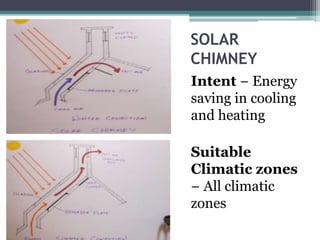
SOLAR 
CHIMNEY 
Intent − Energy 
saving in cooling 
and heating 
Suitable 
Climatic zones 
− All climatic 
zones
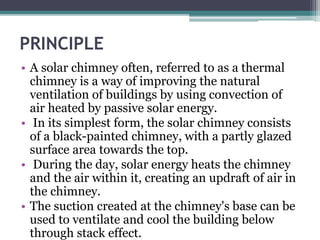
PRINCIPLE 
• A solar chimney often, referred to as a thermal 
chimney is a way of improving the natural 
ventilation of buildings by using convection of 
air heated by passive solar energy. 
• In its simplest form, the solar chimney consists 
of a black-painted chimney, with a partly glazed 
surface area towards the top. 
• During the day, solar energy heats the chimney 
and the air within it, creating an updraft of air in 
the chimney. 
• The suction created at the chimney's base can be 
used to ventilate and cool the building below 
through stack effect.
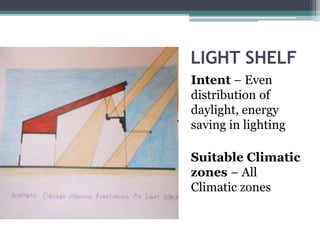
LIGHT SHELF 
Intent − Even 
distribution of 
daylight, energy 
saving in lighting 
Suitable Climatic 
zones − All 
Climatic zones
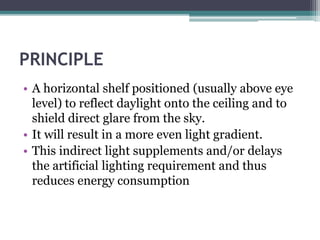
PRINCIPLE 
• A horizontal shelf positioned (usually above eye 
level) to reflect daylight onto the ceiling and to 
shield direct glare from the sky. 
• It will result in a more even light gradient. 
• This indirect light supplements and/or delays 
the artificial lighting requirement and thus 
reduces energy consumption
APPLICATION 
• A light shelf is a horizontal element installed within 
a window to divide it into two sections. 
• The light shelf is opaque, with a highly reflective 
upper surface and a diffusing white under surface. 
• Generally, the light shelf will split the window with 
one third of the glazing above and two thirds below. 
• This will allow reflection of both daylight and 
sunlight up on to the ceiling, whilst not obstructing 
the view through the window.
•THANK YOU

Passive architecture

  • 1.
    PASSIVE ARCHITECTURE SUBMITTEDBY: ABHISHEK VALLABHANENI
  • 2.
    INTRODUCTION • PassiveArchitecture involves blending conventional architectural principles with solar & wind energy and the inherent properties of building materials to ensure that the interiors remain warm in winter and cool in summer, thus creating a year-round comfortable environment.
  • 3.
    PASSIVE ARCHITECTURE DESIGN SYSTEMS • • Thermal mass construction • • Wind towers • • Passive down draft evaporative cooling systems • • Earth tunnel cooling • • Roofing systems • • Roof gardens • • Trombe wall • • Solar chimney • • Light shelf
  • 4.
    THERMAL MASS CONSTRUCTION Intent − Energy saving in Cooling and Heating. Suitable Climatic zones − Hot and Dry, Composite
  • 5.
    PRINCIPLE • Thermalmass is the ability of a material to absorb heat energy, store it, and at a later time, release it in support of maintaining uniform temperature profiles. • Thermal mass acts as a 'thermal battery'. During summer, it absorbs heat, keeping the house relatively cool. • In winter, the same thermal mass can store the • heat from the sun to release it at night, helping the home stay warm.
  • 6.
    APPLICATION • Correctuse of thermal mass can delay heat flow through the building envelope by as much as 10 to 12 hours, producing a warmer house at night in winter and a cooler house during the day in summer. • Walls - Insulated Masonry walls provide good thermal mass. Recycled materials such as concrete, gravel or re-used bricks can be used to build the thermal mass. Insulation improves the efficiency of the thermal mass, provided it is placed on the exterior. • Floor Slab - Floor slab in contact with the ground, can act as a good thermal mass • Roof – Thermal mass in the roof will greatly reduce the solar heat gain.
  • 7.
    WIND TOWERS Intent− Energy saving in Cooling and Ventilation Suitable Climatic zones − Hot and Dry, Composite
  • 9.
    PRINCIPLE • Thewind tower works on the principle of ventilation induced as a result of differential air pressure and temperature • The simplest design for a wind tower is a vertical construct that projects above its surroundings and has an open top. • This will ensure negative pressure and provide suction in all wind directions.
  • 10.
    APPLICATION • Theopenings of the wind tower provided in the direction of the wind, and outlets on the leeward side take advantage of the pressure difference created by wind speed and direction. • Normally, the outlets have thrice the area of the inlet for better efficiency. • The inlet should be properly designed for uniform distribution.
  • 11.
    PASSIVE DOWN DRAFT EVAPORATIVE COOLING SYSTEM (PDEC) Intent − Energy saving in Cooling and Ventilation Suitable Climatic zones − Hot and Dry, Composite
  • 12.
    PRINCIPLE • Thissystem relies on the principle of evaporative cooling. • Large amounts of heat are consumed by water as it evaporates. • This is called the latent heat of evaporation. • This heat is partially drawn from the surrounding air, causing cooling. • The PDEC system consists of modified wind towers which guide outside breezes over a row of water filled porous pots, mist spray or waterfall. • As the air comes in contact with the water it cools and descends down the tower and is let into the interior space.
  • 13.
    APPLICATION • watersprayed into the wind tower of a building, cools the air creating a downward draw which leads to a drop in temperature down the tower and introduces cooled air into the building space, while warmer air gets vented out from openings in the adjacent walls of the building.
  • 14.
    EARTH TUNNEL COOLING Intent − Energy saving in Cooling and Ventilation Suitable Climatic zones − Hot and Dry, Composite, Moderate and Warm and humid
  • 15.
    PRINCIPLE • Thecooling process is based on the fact that the temperature a few meters below the ground is almost constant throughout the year. • Daily temperature variations hardly affect the earth’s temperature at a depth of more than one meter. • A tunnel in the form of pipes or otherwise will acquire the same temperature at its surface causing the ambient air ventilated through this tunnel to get cooled.
  • 16.
    APPLICATION • Earth-airtunnels may be considered as special types of wind towers connected to an underground tunnel. • A wind tower is connected to the underground tunnel, which runs from the bottom of the wind tower to the basement of the building. • The wind tower catches the wind which is forced down the tower into the tunnel. • The temperature of the tunnel, being lower than that of the ambient temperature, cools the air before it is circulated into the living space. • In winter, the temperature of the air tunnel is higher than the ambient temperature and hence warms the air passing through it.
  • 17.
    The roof ofa building receives the maximum solar radiation and contributes greatly to internal heat gain. The roofing systems mentioned in this section include various techniques to minimize heat gain.
  • 18.
    VENTILATED DOUBLE ROOF Intent − Energy saving in Cooling and Ventilation Suitable Climatic zones − Warm and Humid, Composite
  • 19.
    PRINCIPLE • Aventilated double roof when used in a warm and humid climate helps to draw away warm air between the roof and the ceiling, thus preventing excessive heat gain from the roof. • The radiative heat transfer from the roof to the ceiling can be reduced by using low emissivity or high reflective • coating (e.g. aluminium foil) on either surface facing the cavity.
  • 20.
    ROOF SHADING Intent− Energy saving in Cooling Suitable Climatic zones − All climatic zones except cold
  • 21.
    PRINCIPLE • Shadingthe roof surface is an easy and cost– effective way of reducing solar heat gain. • Surface shading can be provided as an integral part of the building structure or as a separate cover. • Shading can be provided by white washed inverted earthen pots or a cover of deciduous plants or creepers.
  • 22.
    PERGOLAS Intent −Energy saving in Cooling Suitable Climatic zones − All climatic zones except cold climate
  • 23.
    PRINCIPLE • Pergolasare framework-imitating walls and ceiling without obscuring the view. • Pergolas are often used in gardens to create vertical interest or to obscure or distract from unattractive underlying attributes. • But they can be used as alternate roofing system to obstruct direct heat gain from the sun; especially on open terraces.
  • 24.
    ROOF GARDEN Intent− Energy saving in cooling and heating, reducing urban heat island Effect Suitable Climatic zones − All climatic zones
  • 25.
    PRINCIPLE • Greenroofs also known as roof gardens or vegetated roof covers, play multiple roles as follows - • Reduce urban “heat island” effect • Reduce CO2 impact • Reduce energy consumption in cooling and heating. • Treat nitrogen pollution in rain • Negate acid rain effect • Aesthetically pleasing
  • 26.
    APPLICATION • RoofGardens are constructed of a lightweight soil media, underlain by a drainage layer, and a high quality impermeable membrane that protects the building structure from seepage. • The soil is planted with a specialized mix of plants that can thrive in the harsh, dry, high temperature conditions of the roof and tolerate short periods of inundation from heavy rains.
  • 27.
    ROOF POND SYSTEM • This system consists of water filled polythene bags which are placed on a ribbed metal roof deck and covered with movable insulation panels. • In the summer months, during the day, these panels cover the roof and greatly reduce the radiative solar heat gain from the roof. • During the night, the insulating panels are slid off the roof to permit radiative cooling.
  • 28.
    • In wintermonths or cold climates, the roof pond can be used for heating, by keeping the insulation off during the day time and covering the roof during the night time. • Because of its reliance on radiative cooling, roof pond systems are best suited to places of low humidity and clear nights. • Typical roof pond systems use a water mass from 100 mm to 250 mm (4 to 10 inches) in depth.
  • 30.
    TROMBE WALL Intent− Energy saving in heating Suitable Climatic zones − Cold Climates
  • 32.
    PRINCIPLE • ATrombe wall combines the principles of thermal mass and a solarium. • A trombe wall consists of a sun-facing high thermal mass wall with vents at the top and bottom, placed behind insulated glazing with an air gap in between; together they act as a large solar thermal collector
  • 33.
    APPLICATION • Duringthe day, the air between the glazing and the thermal mass wall gets heated up and flows through the vents into the interior space via convection, thus warming the interior space. • At the same time the thermal mass wall absorbs and stores the incident solar radiation. • During the night, the vents are closed and the thermal mass radiates the stored heat into the interior space through conduction and radiation.
  • 34.
    SOLAR CHIMNEY Intent− Energy saving in cooling and heating Suitable Climatic zones − All climatic zones
  • 35.
    PRINCIPLE • Asolar chimney often, referred to as a thermal chimney is a way of improving the natural ventilation of buildings by using convection of air heated by passive solar energy. • In its simplest form, the solar chimney consists of a black-painted chimney, with a partly glazed surface area towards the top. • During the day, solar energy heats the chimney and the air within it, creating an updraft of air in the chimney. • The suction created at the chimney's base can be used to ventilate and cool the building below through stack effect.
  • 36.
    LIGHT SHELF Intent− Even distribution of daylight, energy saving in lighting Suitable Climatic zones − All Climatic zones
  • 37.
    PRINCIPLE • Ahorizontal shelf positioned (usually above eye level) to reflect daylight onto the ceiling and to shield direct glare from the sky. • It will result in a more even light gradient. • This indirect light supplements and/or delays the artificial lighting requirement and thus reduces energy consumption
  • 38.
    APPLICATION • Alight shelf is a horizontal element installed within a window to divide it into two sections. • The light shelf is opaque, with a highly reflective upper surface and a diffusing white under surface. • Generally, the light shelf will split the window with one third of the glazing above and two thirds below. • This will allow reflection of both daylight and sunlight up on to the ceiling, whilst not obstructing the view through the window.
  • 39.