University of sulaimany
college of engineering
architecture Dpt.
Reinforced concrete
slabs
Prepared by
Srwsh ahmad
Supervised by
L.Mayada
Content
 Slab
 One-way slab
 Two-way slab
 Flat slab
 Ribbed slab
 Waffled slab
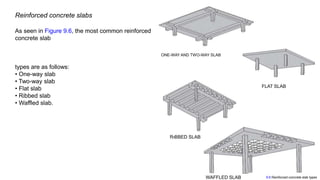
Reinforced concrete slabs
As seen in Figure 9.6, the most common reinforced
concrete slab
types are as follows:
• One-way slab
• Two-way slab
• Flat slab
• Ribbed slab
• Waffled slab.
RıBBED SLAB
FLAT SLAB
ONE-WAY AND TWO-WAY SLAB
WAFFLED SLAB 9.6 Reinforced concrete slab types
SLAB:
Slabs are constructed to provide flat surfaces, usually horizontal, in building floors, roofs, bridges,
and other types of structures. The slab may be supported by walls, by reinforced concrete beams
usually cast monolithically with the slab, by structural steel beams, by columns, or by the ground.
Slabs are classified into two types:
1.One Way Slab
2.Two Way Slab
1. One Way Slab:
One way slab is supported by beams on the two opposite sides to carry the load along one direction.
The ratio of longer span (l) to shorter span (b) is equal or greater than 2, considered as One-way slab.
In this type slab will bend in one direction i.e in the direction along its shorter span. However minimum
reinforcement known as distribution steel is provided along the longer span above the main
reinforcement to distribute the load uniformly and to resist temperature and shrinkage stresses.
In general length of the slab is 4m. But in one way slab one side length is 4m and another side length is
more than 4m. So it satisfies the above equation. Main reinforcement is provided in shorter span and
distribution reinforcement is provided in longer span. Distribution bars are cranked to resist the formation
of stresses.
Example: Generally all the Cantilever slabs are one Way slab. Chajjas and verandahs are a practical
example of one way slab
1. One Way Slab:
2. Two Way Slab:
Two way slab is supported by beams on all the four sides and the loads are carried by the
supports along both directions, it is known as two way slab. In two way slab, the ratio of
longer span (l) to shorter span (b) is less than 2. The slabs are likely to bend along both the
directions to the four supporting edges and hence distribution reinforcement is provided in
both the directions
In this kind of slab, the length and breadth of the slab are more than 4m. To resist the
formation of stresses distribution bars are provided at both the ends in two way slab.
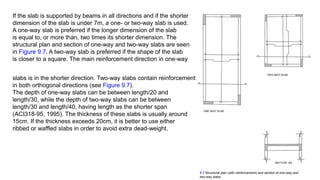
If the slab is supported by beams in all directions and if the shorter
dimension of the slab is under 7m, a one- or two-way slab is used.
A one-way slab is preferred if the longer dimension of the slab
is equal to, or more than, two times its shorter dimension. The
structural plan and section of one-way and two-way slabs are seen
in Figure 9.7. A two-way slab is preferred if the shape of the slab
is closer to a square. The main reinforcement direction in one-way
9.7 Structural plan (with reinforcement) and section of one-way and
two-way slabs
SECTıON AA
ONE-WAY SLAB
TWO-WAY SLAB
slabs is in the shorter direction. Two-way slabs contain reinforcement
in both orthogonal directions (see Figure 9.7).
The depth of one-way slabs can be between length/20 and
length/30, while the depth of two-way slabs can be between
length/30 and length/40, having length as the shorter span
(ACI318-95, 1995). The thickness of these slabs is usually around
15cm. If the thickness exceeds 20cm, it is better to use either
ribbed or waffled slabs in order to avoid extra dead-weight.
One Way Slab Two Way Slab
In one way slab, the ratio of longer span
panel (L) to shorter span panel (B) is
equal or greater than 2. Thus, L/B ≥ 2
In two way slab, the ratio of longer span
panel (L) to shorter span panel (B) is less
than 2. Thus, L/B < 2.
Slab panel is supported on two opposite
sides in short direction of one-way slab
Slab panel is supported on four sides
of two-way slab.
One way slab bends or deflect in a
direction perpendicular to the supporting
edges
Two way slab bend or deflect in both
directions.
Deflected shape of one way slab
is cylindrical.
Deflected shape of two way slab is dish-
shaped.
one way slab has structural strength in
shortest direction
Two way slab has structural strength in
the shortest direction
Main reinforcement is provided in only
one direction for one way slabs.
Main reinforcement is provided in both
the direction for two way slabs
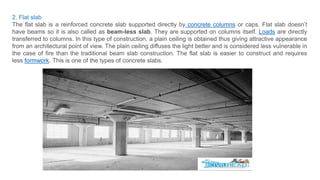
2. Flat slab
The flat slab is a reinforced concrete slab supported directly by concrete columns or caps. Flat slab doesn’t
have beams so it is also called as beam-less slab. They are supported on columns itself. Loads are directly
transferred to columns. In this type of construction, a plain ceiling is obtained thus giving attractive appearance
from an architectural point of view. The plain ceiling diffuses the light better and is considered less vulnerable in
the case of fire than the traditional beam slab construction. The flat slab is easier to construct and requires
less formwork. This is one of the types of concrete slabs.
Flat Slabs are used at:
1.To provide plain ceiling surface giving better diffusion of light
2.Easy constructability with the economy in the formwork
3.Larger headroom or shorter storey height & pleasing appearance.
4.This kind of slabs are provided in parking
5.Flat slabs are generally used in parking decks, commercial buildings, hotels or places where beam
projections are not desired.
Advantages of Flat Slab:
1.It minimizes floor-to-floor heights when there is no requirement for a deep false ceiling. Building height can
be reduced
2.Auto sprinkler is easier.
3.Less construction time.
4.It increases the shear strength of the slab.
5.Reduce the moment in the slab by reducing the clear or effective span.
Disadvantages of Flat slab:
1.In flat plate system, it is not possible to have large span.
2.Not suitable for supporting brittle (masonry) partitions.
3.Higher slab thickness.
There are four different types of concrete Flat Slabs:-
1.Slab without drop and column without column head(capital).
2.Slab with drop and column without column head.
3.Slab without drop and column with column head.
4.Slab with drop and column with column head.
If a slab is not supported by beams, it is called a flat slab. There
are no beams, but the reinforcement between the columns is more
than the other parts of the slab. Figure 9.8 shows different applications
of flat slabs. Since this type of slab is weaker than one-way
and two-way slabs, its span is usually kept at around 4m in earthquake
regions. However, according to the Cement and Concrete
it is economic to span 6–8m with
flat slabs. If they are pre-stressed, this span increases to 8–12m.
WıTH DROP PANELS
9.8 Different applications of a flat slab
WıTH DROP PANELS AND
COLUMN HEADS
WıTH COLUMN HEADS
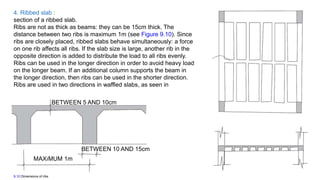
4. Ribbed slab :
section of a ribbed slab.
Ribs are not as thick as beams: they can be 15cm thick. The
distance between two ribs is maximum 1m (see Figure 9.10). Since
ribs are closely placed, ribbed slabs behave simultaneously: a force
on one rib affects all ribs. If the slab size is large, another rib in the
opposite direction is added to distribute the load to all ribs evenly.
Ribs can be used in the longer direction in order to avoid heavy load
on the longer beam. If an additional column supports the beam in
the longer direction, then ribs can be used in the shorter direction.
Ribs are used in two directions in waffled slabs, as seen in
9.10 Dimensions of ribs
MAXıMUM 1m
BETWEEN 10 AND 15cm
BETWEEN 5 AND 10cm
4. Ribbed slab
https://bsbgroup.com/blog/one-way-concrete-flooring-system/
4_tectonics_of_structural_systems
reference

slab concrete

  • 1.
    University of sulaimany collegeof engineering architecture Dpt. Reinforced concrete slabs Prepared by Srwsh ahmad Supervised by L.Mayada
  • 2.
    Content  Slab  One-wayslab  Two-way slab  Flat slab  Ribbed slab  Waffled slab
  • 3.
    Reinforced concrete slabs Asseen in Figure 9.6, the most common reinforced concrete slab types are as follows: • One-way slab • Two-way slab • Flat slab • Ribbed slab • Waffled slab. RıBBED SLAB FLAT SLAB ONE-WAY AND TWO-WAY SLAB WAFFLED SLAB 9.6 Reinforced concrete slab types
  • 4.
    SLAB: Slabs are constructedto provide flat surfaces, usually horizontal, in building floors, roofs, bridges, and other types of structures. The slab may be supported by walls, by reinforced concrete beams usually cast monolithically with the slab, by structural steel beams, by columns, or by the ground. Slabs are classified into two types: 1.One Way Slab 2.Two Way Slab 1. One Way Slab: One way slab is supported by beams on the two opposite sides to carry the load along one direction. The ratio of longer span (l) to shorter span (b) is equal or greater than 2, considered as One-way slab. In this type slab will bend in one direction i.e in the direction along its shorter span. However minimum reinforcement known as distribution steel is provided along the longer span above the main reinforcement to distribute the load uniformly and to resist temperature and shrinkage stresses.
  • 5.
    In general lengthof the slab is 4m. But in one way slab one side length is 4m and another side length is more than 4m. So it satisfies the above equation. Main reinforcement is provided in shorter span and distribution reinforcement is provided in longer span. Distribution bars are cranked to resist the formation of stresses. Example: Generally all the Cantilever slabs are one Way slab. Chajjas and verandahs are a practical example of one way slab 1. One Way Slab:
  • 6.
    2. Two WaySlab: Two way slab is supported by beams on all the four sides and the loads are carried by the supports along both directions, it is known as two way slab. In two way slab, the ratio of longer span (l) to shorter span (b) is less than 2. The slabs are likely to bend along both the directions to the four supporting edges and hence distribution reinforcement is provided in both the directions In this kind of slab, the length and breadth of the slab are more than 4m. To resist the formation of stresses distribution bars are provided at both the ends in two way slab.
  • 7.
    If the slabis supported by beams in all directions and if the shorter dimension of the slab is under 7m, a one- or two-way slab is used. A one-way slab is preferred if the longer dimension of the slab is equal to, or more than, two times its shorter dimension. The structural plan and section of one-way and two-way slabs are seen in Figure 9.7. A two-way slab is preferred if the shape of the slab is closer to a square. The main reinforcement direction in one-way 9.7 Structural plan (with reinforcement) and section of one-way and two-way slabs SECTıON AA ONE-WAY SLAB TWO-WAY SLAB slabs is in the shorter direction. Two-way slabs contain reinforcement in both orthogonal directions (see Figure 9.7). The depth of one-way slabs can be between length/20 and length/30, while the depth of two-way slabs can be between length/30 and length/40, having length as the shorter span (ACI318-95, 1995). The thickness of these slabs is usually around 15cm. If the thickness exceeds 20cm, it is better to use either ribbed or waffled slabs in order to avoid extra dead-weight.
  • 8.
    One Way SlabTwo Way Slab In one way slab, the ratio of longer span panel (L) to shorter span panel (B) is equal or greater than 2. Thus, L/B ≥ 2 In two way slab, the ratio of longer span panel (L) to shorter span panel (B) is less than 2. Thus, L/B < 2. Slab panel is supported on two opposite sides in short direction of one-way slab Slab panel is supported on four sides of two-way slab. One way slab bends or deflect in a direction perpendicular to the supporting edges Two way slab bend or deflect in both directions. Deflected shape of one way slab is cylindrical. Deflected shape of two way slab is dish- shaped. one way slab has structural strength in shortest direction Two way slab has structural strength in the shortest direction Main reinforcement is provided in only one direction for one way slabs. Main reinforcement is provided in both the direction for two way slabs
  • 9.
    2. Flat slab Theflat slab is a reinforced concrete slab supported directly by concrete columns or caps. Flat slab doesn’t have beams so it is also called as beam-less slab. They are supported on columns itself. Loads are directly transferred to columns. In this type of construction, a plain ceiling is obtained thus giving attractive appearance from an architectural point of view. The plain ceiling diffuses the light better and is considered less vulnerable in the case of fire than the traditional beam slab construction. The flat slab is easier to construct and requires less formwork. This is one of the types of concrete slabs.
  • 10.
    Flat Slabs areused at: 1.To provide plain ceiling surface giving better diffusion of light 2.Easy constructability with the economy in the formwork 3.Larger headroom or shorter storey height & pleasing appearance. 4.This kind of slabs are provided in parking 5.Flat slabs are generally used in parking decks, commercial buildings, hotels or places where beam projections are not desired. Advantages of Flat Slab: 1.It minimizes floor-to-floor heights when there is no requirement for a deep false ceiling. Building height can be reduced 2.Auto sprinkler is easier. 3.Less construction time. 4.It increases the shear strength of the slab. 5.Reduce the moment in the slab by reducing the clear or effective span. Disadvantages of Flat slab: 1.In flat plate system, it is not possible to have large span. 2.Not suitable for supporting brittle (masonry) partitions. 3.Higher slab thickness.
  • 11.
    There are fourdifferent types of concrete Flat Slabs:- 1.Slab without drop and column without column head(capital). 2.Slab with drop and column without column head. 3.Slab without drop and column with column head. 4.Slab with drop and column with column head.
  • 12.
    If a slabis not supported by beams, it is called a flat slab. There are no beams, but the reinforcement between the columns is more than the other parts of the slab. Figure 9.8 shows different applications of flat slabs. Since this type of slab is weaker than one-way and two-way slabs, its span is usually kept at around 4m in earthquake regions. However, according to the Cement and Concrete it is economic to span 6–8m with flat slabs. If they are pre-stressed, this span increases to 8–12m. WıTH DROP PANELS 9.8 Different applications of a flat slab WıTH DROP PANELS AND COLUMN HEADS WıTH COLUMN HEADS
  • 13.
    4. Ribbed slab: section of a ribbed slab. Ribs are not as thick as beams: they can be 15cm thick. The distance between two ribs is maximum 1m (see Figure 9.10). Since ribs are closely placed, ribbed slabs behave simultaneously: a force on one rib affects all ribs. If the slab size is large, another rib in the opposite direction is added to distribute the load to all ribs evenly. Ribs can be used in the longer direction in order to avoid heavy load on the longer beam. If an additional column supports the beam in the longer direction, then ribs can be used in the shorter direction. Ribs are used in two directions in waffled slabs, as seen in 9.10 Dimensions of ribs MAXıMUM 1m BETWEEN 10 AND 15cm BETWEEN 5 AND 10cm
  • 14.
  • 15.