IntroductionIntroduction
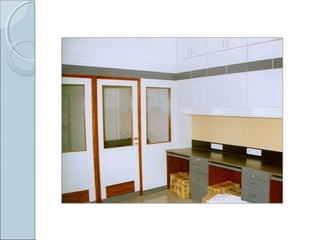
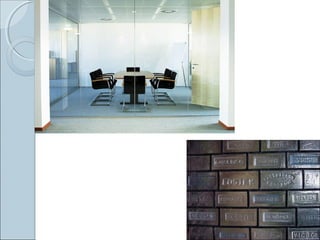
A partition wall may be defined as a wall or
division made up of bricks, studding, glass or
other such material and provided for the
purpose of dividing one room or portion of a
room from another.
Partition walls are designed as non-load
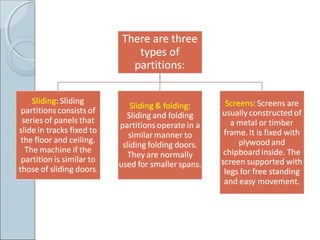
bearing walls. It may be of folding,
collapsible or fixed type.
If partition walls are load bearing then they
are called as ‘internal wall’.
Advantages of partition walls
Divide the whole area into a number of
rooms.
Provide privacy to the inmates from sight
and sound.
Are light in weight and cheaper in cost of
construction.
Occupy lesser area
Easily constructed in any position.
Requirements of a Good Partition Wall:Requirements of a Good Partition Wall:
Thin in cross-section so that maximum floor area can
be utilized.
Provide adequate privacy in rooms both in respect of
sight and sound.
Constructed from light, sound, uniform,
homogeneous, durable and sound insulated materials.
Simple in nature, easy and economical in
construction having proper coherence with the type
of building structure.
Offer sufficient resistance against fire, heat,
dampness, white ant or fungus, etc.
Rigid enough to take the vibrations caused due to
loads.
Strong enough to support sanitary fittings and heavy
fixtures.
Types of partition walls :Types of partition walls :
(Classification based on materials used)(Classification based on materials used)
Brick partitions,
Hollow block partitions,
Clay block partitions,
Concrete partitions,
Glass block partitions,
Wooden partitions,
Straw board partitions,
Plaster slab partitions,
Metal partitions,
Asbestos cement partitions,(BANNED)
Double glazed window.
Brick partitionBrick partition
Constructed with plain bricks, Reinforced
bricks, bricks-nogged or hollow bricks.
Plain brick partition of half brick thickness is
not more than 2m in height.
In reinforced brick partition of half brick
thickness, reinforcement in the form of wire
mesh or hoop iron or steel bars is provided.
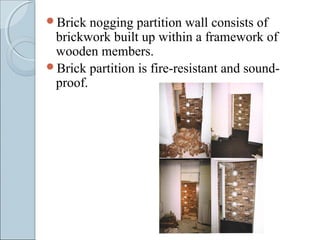
Brick nogging partition wall consists of
brickwork built up within a framework of
wooden members.
Brick partition is fire-resistant and sound-
proof.
Hollow Block and Clay Block PartitionsHollow Block and Clay Block Partitions
Hollow concrete block partitions are built of
individual units of concrete.
Clay blocks used are well prepared from clay
or terra-cotta, and they are either solids or
hollow.
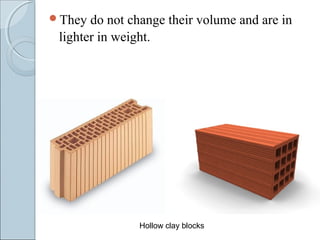
Hollow clay blocks of section 30*20 cm with
thickness varying from 5 cm to 15 cm can also
be used.
The blocks are provided with grooves on top,
bottom and sides, surfaces are kept glazed in
different colures.
They do not change their volume and are in
lighter in weight.
Hollow clay blocks
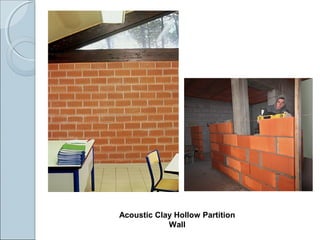
Acoustic Clay Hollow Partition
Wall
Concrete partitionConcrete partition
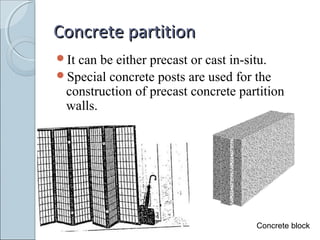
It can be either precast or cast in-situ.
Special concrete posts are used for the
construction of precast concrete partition
walls.
Concrete block
Glass partitionGlass partition
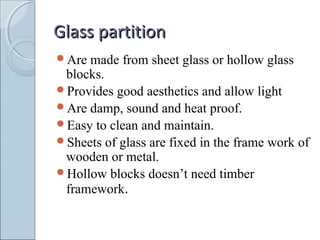
Are made from sheet glass or hollow glass
blocks.
Provides good aesthetics and allow light
Are damp, sound and heat proof.
Easy to clean and maintain.
Sheets of glass are fixed in the frame work of
wooden or metal.
Hollow blocks doesn’t need timber
framework.
Wooden partitionWooden partition
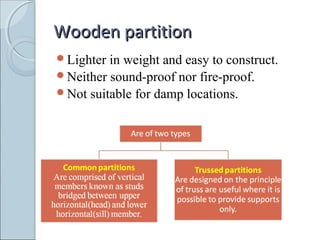
Lighter in weight and easy to construct.
Neither sound-proof nor fire-proof.
Not suitable for damp locations.
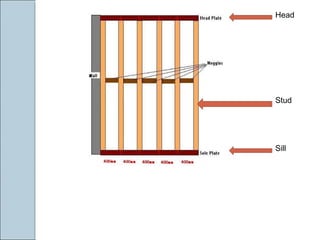
Head
Sill
Stud
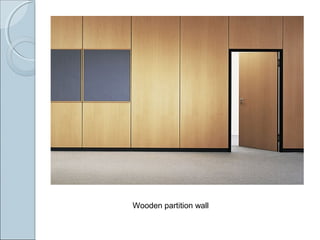
Wooden partition wall
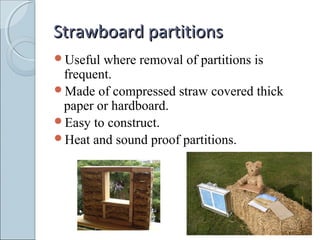
Strawboard partitionsStrawboard partitions
Useful where removal of partitions is
frequent.
Made of compressed straw covered thick
paper or hardboard.
Easy to construct.
Heat and sound proof partitions.
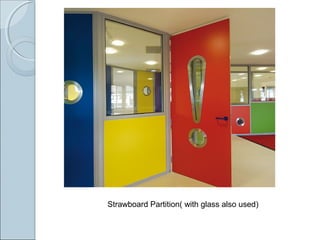
Strawboard Partition( with glass also used)
Plaster slab partitionsPlaster slab partitions
Are made of burnt gypsum or plaster of paris
mixed with sawdust.
5cm to 10cm thick slabs are prepared in iron
or timber moulds.
To form rigid joints suitable grooves are
provided in the plaster slabs.
Nails and screws can be easily driven into
these slabs.
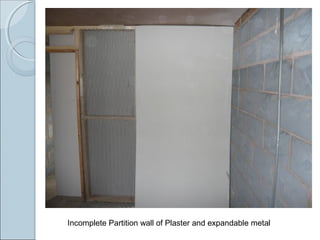
Incomplete Partition wall of Plaster and expandable metal
Metal partitionsMetal partitions
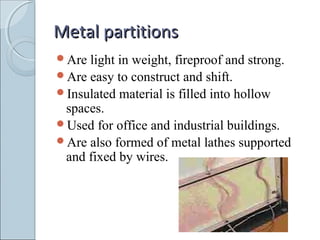
Are light in weight, fireproof and strong.
Are easy to construct and shift.
Insulated material is filled into hollow
spaces.
Used for office and industrial buildings.
Are also formed of metal lathes supported
and fixed by wires.
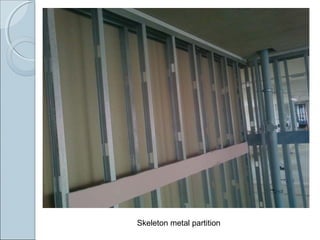
Skeleton metal partition
Asbestos Cement partitionsAsbestos Cement partitions
Light in weight, impervious, durable, water
tight and fire-proof.
Asbestos cement sheets are made of asbestos
cement sheets and fixed into timber
framework.
Sheets are placed in position and joined by
cement mortar.
Are mostly adopted in works of temporary
character.
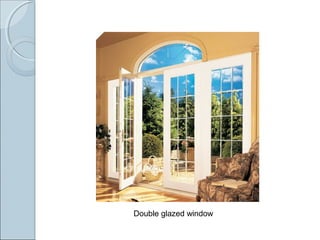
Double Glazed windowDouble Glazed window
Used for acoustic insulation.
Air space between two panes is kept 50mm
or more.
Air contained within narrow cavity is quite
‘stiff’
Transmits vibration at low frequencies.
Double glazed window
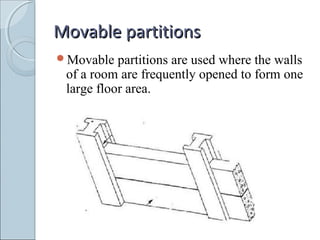
Movable partitionsMovable partitions
Movable partitions are used where the walls
of a room are frequently opened to form one
large floor area.
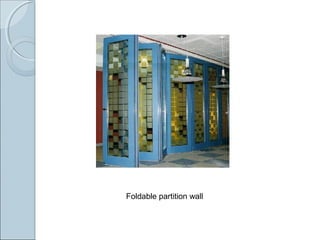
Foldable partition wall
Portable PartitionsPortable Partitions
Rolling mobile folding partitions which
provide temporary walls
The portable wall partition has two full panel
end members which provide support,
rigidity, privacy, and noise reduction.
They fold and are on wheels enabling
mobility and ease of storage.
Three common uses are:Three common uses are:
To divide space quickly where non-mobile
permanent room dividers may be unavailable
or unpractical.
As a cost effective way to create a classroom
or meeting room in existing space.
Convenient sight divider to conceal door
openings to restrooms, commercial kitchens,
and other backroom areas.
Portable Partitions are commonly used in:Portable Partitions are commonly used in:
Arena’s
Churches/Houses of Worship/Funeral Homes
Conference/Convention Centres
Government/Corporate offices
Hotels/Restaurants
Residences
Salons and Spas
Schools of all levels
Dry wallDry wall
also known as plasterboard, wallboard, gypsum
board is a panel made of gypsum
plaster pressed between two thick sheets of
paper.
It is used to make interior walls and ceilings.
Drywall construction became prevalent as a
speedier alternative to traditional lath and
plaster.
greenboardgreenboard
For Damp, But Not Wet, Applications
Used for rooms expected to have high humidity,
primarily kitchens, bathrooms and laundry rooms
This is a common misunderstanding. While
greenboard drywall's paper covering is water-
resistant, it is not waterproof.
CEMENT BOARDSCEMENT BOARDS
 A cement board is a combination of cement and
reinforcing fibers formed into 4 foot by 8 foot sheets (or
3 foot by 5 foot sheets), 1/4 to 1/2 inch thick that are
typically used as a tile backing board.
 Cement board can be nailed or screwed to wood or
steel studs to create a substrate for vertical tile and
attached horizontally to plywood for tile floors, kitchen
counters and backsplashes.
 It can be used on the exterior of buildings as a base for
exterior plaster (stucco) systems and sometimes as the
finish system itself.
 Cement board adds impact resistance and strength to the wall
surface as compared to water resistant gypsum boards. Cement
board is also fabricated in thin sheets with polymer modified
cements to allow bending for curved surfaces.
 As a tile backing board, cement board has better long-term
performance than paper-faced gypsum core products because it
will not mold, mildew or physically break down in the continued
presence of moisture or leaks.
 In areas continually exposed to water spray (i.e. showers) a
waterproofing barrier is usually recommended behind the boards
or as a trowel-applied product to the face of the boards behind the
finish system.
• One major disadvantage of cement board is the weight per square
foot.
• It is approximately twice that of gypsum board, making handling
by one person difficult. cement board is initially more expensive
than water resistant gypsum board but may provide better long
term value.
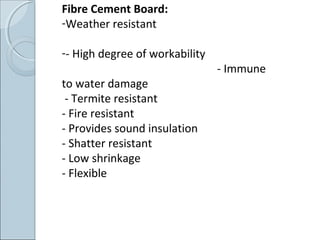
Fibre Cement Board:
-Weather resistant
-- High degree of workability
- Immune
to water damage
- Termite resistant
- Fire resistant
- Provides sound insulation
- Shatter resistant
- Low shrinkage
- Flexible
Portland cementPortland cement
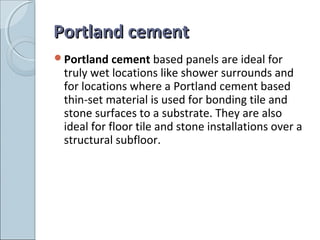
Portland cement based panels are ideal for
truly wet locations like shower surrounds and
for locations where a Portland cement based
thin-set material is used for bonding tile and
stone surfaces to a substrate. They are also
ideal for floor tile and stone installations over a
structural subfloor.
MATERIALS AND THEIRMATERIALS AND THEIR
PHYSICAL ANDPHYSICAL AND
CHEMICALCHEMICAL
PROPERTIESPROPERTIES
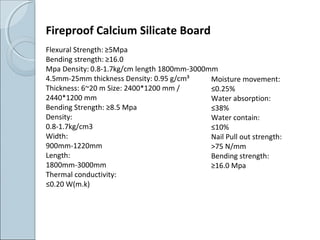
Fireproof Calcium Silicate Board
Flexural Strength: ≥5Mpa
Bending strength: ≥16.0
Mpa Density: 0.8-1.7kg/cm length 1800mm-3000mm
4.5mm-25mm thickness Density: 0.95 g/cm³
Thickness: 6~20 m Size: 2400*1200 mm /
2440*1200 mm
Bending Strength: ≥8.5 Mpa
Density:
0.8-1.7kg/cm3
Width:
900mm-1220mm
Length:
1800mm-3000mm
Thermal conductivity:
≤0.20 W(m.k)
Moisture movement:
≤0.25%
Water absorption:
≤38%
Water contain:
≤10%
Nail Pull out strength:
>75 N/mm
Bending strength:
≥16.0 Mpa
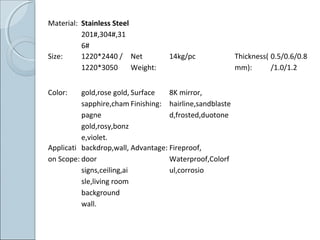
Material: Stainless Steel
201#,304#,31
6#
Size: 1220*2440 /
1220*3050
Net
Weight:
14kg/pc Thickness(
mm):
0.5/0.6/0.8
/1.0/1.2
Color: gold,rose gold,
sapphire,cham
pagne
gold,rosy,bonz
e,violet.
Surface
Finishing:
8K mirror,
hairline,sandblaste
d,frosted,duotone
Applicati
on Scope:
backdrop,wall,
door
signs,ceiling,ai
sle,living room
background
wall.
Advantage: Fireproof,
Waterproof,Colorf
ul,corrosio
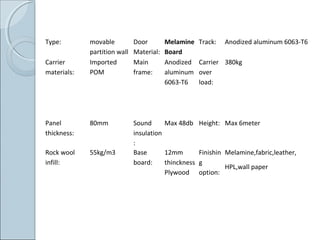
Type: movable
partition wall
Door
Material:
Melamine
Board
Track: Anodized aluminum 6063-T6
Carrier
materials:
Imported
POM
Main
frame:
Anodized
aluminum
6063-T6
Carrier
over
load:
380kg
Panel
thickness:
80mm Sound
insulation
:
Max 48db Height: Max 6meter
Rock wool
infill:
55kg/m3 Base
board:
12mm
thinckness
Plywood
Finishin
g
option:
Melamine,fabric,leather,
HPL,wall paper
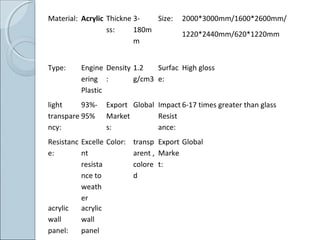
Material: Acrylic Thickne
ss:
3-
180m
m
Size: 2000*3000mm/1600*2600mm/
1220*2440mm/620*1220mm
Type: Engine
ering
Plastic
Density
:
1.2
g/cm3
Surfac
e:
High gloss
light
transpare
ncy:
93%-
95%
Export
Market
s:
Global Impact
Resist
ance:
6-17 times greater than glass
Resistanc
e:
Excelle
nt
resista
nce to
weath
er
Color: transp
arent ,
colore
d
Export
Marke
t:
Global
acrylic
wall
panel:
acrylic
wall
panel
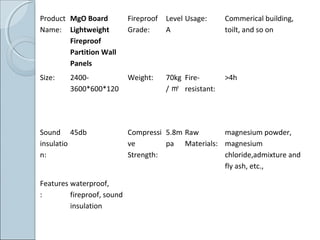
Product
Name:
MgO Board
Lightweight
Fireproof
Partition Wall
Panels
Fireproof
Grade:
Level
A
Usage: Commerical building,
toilt, and so on
Size: 2400-
3600*600*120
Weight: 70kg
/ ㎡
Fire-
resistant:
>4h
Sound
insulatio
n:
45db Compressi
ve
Strength:
5.8m
pa
Raw
Materials:
magnesium powder,
magnesium
chloride,admixture and
fly ash, etc.,
Features
:
waterproof,
fireproof, sound
insulation
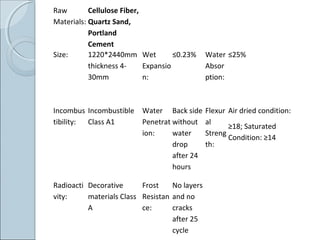
Raw
Materials:
Cellulose Fiber,
Quartz Sand,
Portland
Cement
Size: 1220*2440mm
thickness 4-
30mm
Wet
Expansio
n:
≤0.23% Water
Absor
ption:
≤25%
Incombus
tibility:
Incombustible
Class A1
Water
Penetrat
ion:
Back side
without
water
drop
after 24
hours
Flexur
al
Streng
th:
Air dried condition:
≥18; Saturated
Condition: ≥14
Radioacti
vity:
Decorative
materials Class
A
Frost
Resistan
ce:
No layers
and no
cracks
after 25
cycle
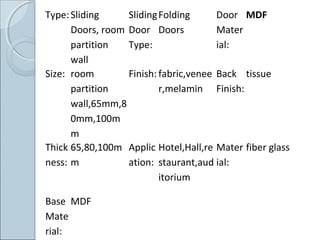
Type:Sliding
Doors, room
partition
wall
Sliding
Door
Type:
Folding
Doors
Door
Mater
ial:
MDF
Size: room
partition
wall,65mm,8
0mm,100m
m
Finish: fabric,venee
r,melamin
Back
Finish:
tissue
Thick
ness:
65,80,100m
m
Applic
ation:
Hotel,Hall,re
staurant,aud
itorium
Mater
ial:
fiber glass
Base
Mate
rial:
MDF
References:References:
Dr B.C.Punamia, Building Construction
S.P.Arora and S.P.Bindra, Building
Construction
Robert Jantschek, Portable wall partition with
full panel end members.
www.niceduniya.com,Principles of design of
partitions walls.
Images are taken from google image search

Partition walls

  • 1.
    IntroductionIntroduction A partition wallmay be defined as a wall or division made up of bricks, studding, glass or other such material and provided for the purpose of dividing one room or portion of a room from another. Partition walls are designed as non-load bearing walls. It may be of folding, collapsible or fixed type. If partition walls are load bearing then they are called as ‘internal wall’.
  • 3.
    Advantages of partitionwalls Divide the whole area into a number of rooms. Provide privacy to the inmates from sight and sound. Are light in weight and cheaper in cost of construction. Occupy lesser area Easily constructed in any position.
  • 4.
    Requirements of aGood Partition Wall:Requirements of a Good Partition Wall: Thin in cross-section so that maximum floor area can be utilized. Provide adequate privacy in rooms both in respect of sight and sound. Constructed from light, sound, uniform, homogeneous, durable and sound insulated materials. Simple in nature, easy and economical in construction having proper coherence with the type of building structure. Offer sufficient resistance against fire, heat, dampness, white ant or fungus, etc. Rigid enough to take the vibrations caused due to loads. Strong enough to support sanitary fittings and heavy fixtures.
  • 5.
    Types of partitionwalls :Types of partition walls : (Classification based on materials used)(Classification based on materials used) Brick partitions, Hollow block partitions, Clay block partitions, Concrete partitions, Glass block partitions, Wooden partitions, Straw board partitions, Plaster slab partitions, Metal partitions, Asbestos cement partitions,(BANNED) Double glazed window.
  • 6.
    Brick partitionBrick partition Constructedwith plain bricks, Reinforced bricks, bricks-nogged or hollow bricks. Plain brick partition of half brick thickness is not more than 2m in height. In reinforced brick partition of half brick thickness, reinforcement in the form of wire mesh or hoop iron or steel bars is provided.
  • 7.
    Brick nogging partitionwall consists of brickwork built up within a framework of wooden members. Brick partition is fire-resistant and sound- proof.
  • 8.
    Hollow Block andClay Block PartitionsHollow Block and Clay Block Partitions Hollow concrete block partitions are built of individual units of concrete. Clay blocks used are well prepared from clay or terra-cotta, and they are either solids or hollow. Hollow clay blocks of section 30*20 cm with thickness varying from 5 cm to 15 cm can also be used. The blocks are provided with grooves on top, bottom and sides, surfaces are kept glazed in different colures.
  • 9.
    They do notchange their volume and are in lighter in weight. Hollow clay blocks
  • 10.
    Acoustic Clay HollowPartition Wall
  • 11.
    Concrete partitionConcrete partition Itcan be either precast or cast in-situ. Special concrete posts are used for the construction of precast concrete partition walls. Concrete block
  • 12.
    Glass partitionGlass partition Aremade from sheet glass or hollow glass blocks. Provides good aesthetics and allow light Are damp, sound and heat proof. Easy to clean and maintain. Sheets of glass are fixed in the frame work of wooden or metal. Hollow blocks doesn’t need timber framework.
  • 14.
    Wooden partitionWooden partition Lighterin weight and easy to construct. Neither sound-proof nor fire-proof. Not suitable for damp locations.
  • 15.
  • 16.
  • 17.
    Strawboard partitionsStrawboard partitions Usefulwhere removal of partitions is frequent. Made of compressed straw covered thick paper or hardboard. Easy to construct. Heat and sound proof partitions.
  • 18.
  • 19.
    Plaster slab partitionsPlasterslab partitions Are made of burnt gypsum or plaster of paris mixed with sawdust. 5cm to 10cm thick slabs are prepared in iron or timber moulds. To form rigid joints suitable grooves are provided in the plaster slabs. Nails and screws can be easily driven into these slabs.
  • 20.
    Incomplete Partition wallof Plaster and expandable metal
  • 21.
    Metal partitionsMetal partitions Arelight in weight, fireproof and strong. Are easy to construct and shift. Insulated material is filled into hollow spaces. Used for office and industrial buildings. Are also formed of metal lathes supported and fixed by wires.
  • 22.
  • 23.
    Asbestos Cement partitionsAsbestosCement partitions Light in weight, impervious, durable, water tight and fire-proof. Asbestos cement sheets are made of asbestos cement sheets and fixed into timber framework. Sheets are placed in position and joined by cement mortar. Are mostly adopted in works of temporary character.
  • 24.
    Double Glazed windowDoubleGlazed window Used for acoustic insulation. Air space between two panes is kept 50mm or more. Air contained within narrow cavity is quite ‘stiff’ Transmits vibration at low frequencies.
  • 25.
  • 27.
    Movable partitionsMovable partitions Movablepartitions are used where the walls of a room are frequently opened to form one large floor area.
  • 28.
  • 29.
    Portable PartitionsPortable Partitions Rollingmobile folding partitions which provide temporary walls The portable wall partition has two full panel end members which provide support, rigidity, privacy, and noise reduction. They fold and are on wheels enabling mobility and ease of storage.
  • 30.
    Three common usesare:Three common uses are: To divide space quickly where non-mobile permanent room dividers may be unavailable or unpractical. As a cost effective way to create a classroom or meeting room in existing space. Convenient sight divider to conceal door openings to restrooms, commercial kitchens, and other backroom areas.
  • 31.
    Portable Partitions arecommonly used in:Portable Partitions are commonly used in: Arena’s Churches/Houses of Worship/Funeral Homes Conference/Convention Centres Government/Corporate offices Hotels/Restaurants Residences Salons and Spas Schools of all levels
  • 33.
    Dry wallDry wall alsoknown as plasterboard, wallboard, gypsum board is a panel made of gypsum plaster pressed between two thick sheets of paper. It is used to make interior walls and ceilings. Drywall construction became prevalent as a speedier alternative to traditional lath and plaster.
  • 34.
    greenboardgreenboard For Damp, ButNot Wet, Applications Used for rooms expected to have high humidity, primarily kitchens, bathrooms and laundry rooms This is a common misunderstanding. While greenboard drywall's paper covering is water- resistant, it is not waterproof.
  • 35.
    CEMENT BOARDSCEMENT BOARDS A cement board is a combination of cement and reinforcing fibers formed into 4 foot by 8 foot sheets (or 3 foot by 5 foot sheets), 1/4 to 1/2 inch thick that are typically used as a tile backing board.  Cement board can be nailed or screwed to wood or steel studs to create a substrate for vertical tile and attached horizontally to plywood for tile floors, kitchen counters and backsplashes.  It can be used on the exterior of buildings as a base for exterior plaster (stucco) systems and sometimes as the finish system itself.
  • 36.
     Cement boardadds impact resistance and strength to the wall surface as compared to water resistant gypsum boards. Cement board is also fabricated in thin sheets with polymer modified cements to allow bending for curved surfaces.  As a tile backing board, cement board has better long-term performance than paper-faced gypsum core products because it will not mold, mildew or physically break down in the continued presence of moisture or leaks.  In areas continually exposed to water spray (i.e. showers) a waterproofing barrier is usually recommended behind the boards or as a trowel-applied product to the face of the boards behind the finish system. • One major disadvantage of cement board is the weight per square foot. • It is approximately twice that of gypsum board, making handling by one person difficult. cement board is initially more expensive than water resistant gypsum board but may provide better long term value.
  • 37.
    Fibre Cement Board: -Weatherresistant -- High degree of workability - Immune to water damage - Termite resistant - Fire resistant - Provides sound insulation - Shatter resistant - Low shrinkage - Flexible
  • 38.
    Portland cementPortland cement Portlandcement based panels are ideal for truly wet locations like shower surrounds and for locations where a Portland cement based thin-set material is used for bonding tile and stone surfaces to a substrate. They are also ideal for floor tile and stone installations over a structural subfloor.
  • 39.
    MATERIALS AND THEIRMATERIALSAND THEIR PHYSICAL ANDPHYSICAL AND CHEMICALCHEMICAL PROPERTIESPROPERTIES
  • 40.
    Fireproof Calcium SilicateBoard Flexural Strength: ≥5Mpa Bending strength: ≥16.0 Mpa Density: 0.8-1.7kg/cm length 1800mm-3000mm 4.5mm-25mm thickness Density: 0.95 g/cm³ Thickness: 6~20 m Size: 2400*1200 mm / 2440*1200 mm Bending Strength: ≥8.5 Mpa Density: 0.8-1.7kg/cm3 Width: 900mm-1220mm Length: 1800mm-3000mm Thermal conductivity: ≤0.20 W(m.k) Moisture movement: ≤0.25% Water absorption: ≤38% Water contain: ≤10% Nail Pull out strength: >75 N/mm Bending strength: ≥16.0 Mpa
  • 41.
    Material: Stainless Steel 201#,304#,31 6# Size:1220*2440 / 1220*3050 Net Weight: 14kg/pc Thickness( mm): 0.5/0.6/0.8 /1.0/1.2 Color: gold,rose gold, sapphire,cham pagne gold,rosy,bonz e,violet. Surface Finishing: 8K mirror, hairline,sandblaste d,frosted,duotone Applicati on Scope: backdrop,wall, door signs,ceiling,ai sle,living room background wall. Advantage: Fireproof, Waterproof,Colorf ul,corrosio
  • 42.
    Type: movable partition wall Door Material: Melamine Board Track:Anodized aluminum 6063-T6 Carrier materials: Imported POM Main frame: Anodized aluminum 6063-T6 Carrier over load: 380kg Panel thickness: 80mm Sound insulation : Max 48db Height: Max 6meter Rock wool infill: 55kg/m3 Base board: 12mm thinckness Plywood Finishin g option: Melamine,fabric,leather, HPL,wall paper
  • 43.
    Material: Acrylic Thickne ss: 3- 180m m Size:2000*3000mm/1600*2600mm/ 1220*2440mm/620*1220mm Type: Engine ering Plastic Density : 1.2 g/cm3 Surfac e: High gloss light transpare ncy: 93%- 95% Export Market s: Global Impact Resist ance: 6-17 times greater than glass Resistanc e: Excelle nt resista nce to weath er Color: transp arent , colore d Export Marke t: Global acrylic wall panel: acrylic wall panel
  • 44.
    Product Name: MgO Board Lightweight Fireproof Partition Wall Panels Fireproof Grade: Level A Usage:Commerical building, toilt, and so on Size: 2400- 3600*600*120 Weight: 70kg / ㎡ Fire- resistant: >4h Sound insulatio n: 45db Compressi ve Strength: 5.8m pa Raw Materials: magnesium powder, magnesium chloride,admixture and fly ash, etc., Features : waterproof, fireproof, sound insulation
  • 45.
    Raw Materials: Cellulose Fiber, Quartz Sand, Portland Cement Size:1220*2440mm thickness 4- 30mm Wet Expansio n: ≤0.23% Water Absor ption: ≤25% Incombus tibility: Incombustible Class A1 Water Penetrat ion: Back side without water drop after 24 hours Flexur al Streng th: Air dried condition: ≥18; Saturated Condition: ≥14 Radioacti vity: Decorative materials Class A Frost Resistan ce: No layers and no cracks after 25 cycle
  • 46.
    Type:Sliding Doors, room partition wall Sliding Door Type: Folding Doors Door Mater ial: MDF Size: room partition wall,65mm,8 0mm,100m m Finish:fabric,venee r,melamin Back Finish: tissue Thick ness: 65,80,100m m Applic ation: Hotel,Hall,re staurant,aud itorium Mater ial: fiber glass Base Mate rial: MDF
  • 47.
    References:References: Dr B.C.Punamia, BuildingConstruction S.P.Arora and S.P.Bindra, Building Construction Robert Jantschek, Portable wall partition with full panel end members. www.niceduniya.com,Principles of design of partitions walls. Images are taken from google image search