Slabs and its types
What is a slab?
• Slab is a thin concreted flat structure mostly used for flooring purpose.
• It can be square, rectangular, circular in shape.
• Slabs can be used in making floors, ceilings and some sometimes paving too.
• Thickness of a slab varies from 4 to 6 inches.
• 4 inches thick slab will be used where there is light load on the floor (dead and live)
• Whereas 6 inches thick slab is used where there is quite heavy load on the floor
• Slabs are mostly known as RCC slabs that means Reinforcement Cement and
Concrete Slabs.
• Materials which are used to make RCC slabs are: Cement, Course aggregate, fine
aggregates and reinforcement bars.
Types of slabs
• One way slab
• Two way slab
• Joist slab (ribbed slab)
• Flat plate
• Flat slab
• Waffle slab
• Hollow core slab
• Hardy slab
• Bubble Deck slab
• Composite slab
• Precast slab
One way slab
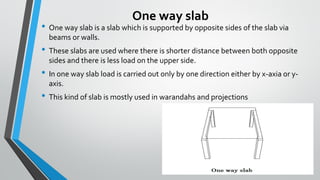
• One way slab is a slab which is supported by opposite sides of the slab via
beams or walls.
• These slabs are used where there is shorter distance between both opposite
sides and there is less load on the upper side.
• In one way slab load is carried out only by one direction either by x-axia or y-
axis.
• This kind of slab is mostly used in warandahs and projections
Two way slab
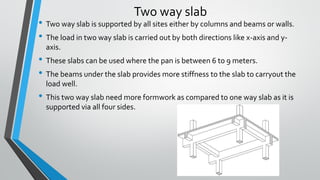
• Two way slab is supported by all sites either by columns and beams or walls.
• The load in two way slab is carried out by both directions like x-axis and y-
axis.
• These slabs can be used where the pan is between 6 to 9 meters.
• The beams under the slab provides more stiffness to the slab to carryout the
load well.
• This two way slab need more formwork as compared to one way slab as it is
supported via all four sides.
Joist slab (ribbed slab)
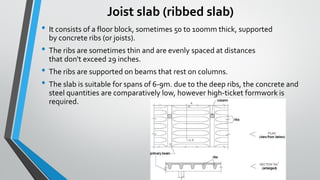
• It consists of a floor block, sometimes 50 to 100mm thick, supported
by concrete ribs (or joists).
• The ribs are sometimes thin and are evenly spaced at distances
that don't exceed 29 inches.
• The ribs are supported on beams that rest on columns.
• The slab is suitable for spans of 6-9m. due to the deep ribs, the concrete and
steel quantities are comparatively low, however high-ticket formwork is
required.
Flat plate
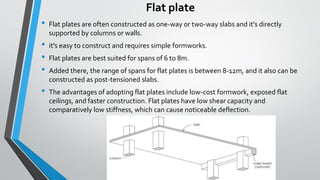
• Flat plates are often constructed as one-way or two-way slabs and it's directly
supported by columns or walls.
• it's easy to construct and requires simple formworks.
• Flat plates are best suited for spans of 6 to 8m.
• Added there, the range of spans for flat plates is between 8-12m, and it also can be
constructed as post-tensioned slabs.
• The advantages of adopting flat plates include low-cost formwork, exposed flat
ceilings, and faster construction. Flat plates have low shear capacity and
comparatively low stiffness, which can cause noticeable deflection.
Flat slab
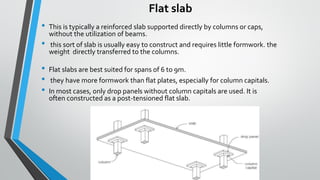
• This is typically a reinforced slab supported directly by columns or caps,
without the utilization of beams.
• this sort of slab is usually easy to construct and requires little formwork. the
weight directly transferred to the columns.
• Flat slabs are best suited for spans of 6 to 9m.
• they have more formwork than flat plates, especially for column capitals.
• In most cases, only drop panels without column capitals are used. It is
often constructed as a post-tensioned flat slab.
Waffle slab
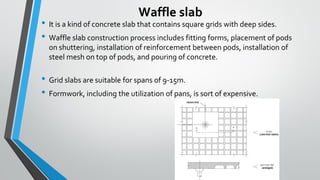
• It is a kind of concrete slab that contains square grids with deep sides.
• Waffle slab construction process includes fitting forms, placement of pods
on shuttering, installation of reinforcement between pods, installation of
steel mesh on top of pods, and pouring of concrete.
• Grid slabs are suitable for spans of 9-15m.
• Formwork, including the utilization of pans, is sort of expensive.
Hollow core slab
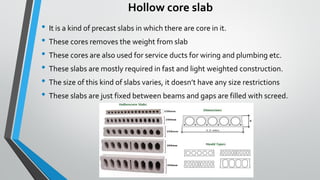
• It is a kind of precast slabs in which there are core in it.
• These cores removes the weight from slab
• These cores are also used for service ducts for wiring and plumbing etc.
• These slabs are mostly required in fast and light weighted construction.
• The size of this kind of slabs varies, it doesn’t have any size restrictions
• These slabs are just fixed between beams and gaps are filled with screed.
Hardy slab
• These are basically concreted bricks.
• It has hollow space in the middle that is why it is light weighed concreted brick
• Thickness of this brick is not more then 10 inches
• These bricks are installed in the reinforcement then it is filled with pouring cement
over it.
• It is fast in construction
• It is comparatively light weighted then ordinary slabs.
• These slabs are used where there in high temperature region.
Bubble Deck slab
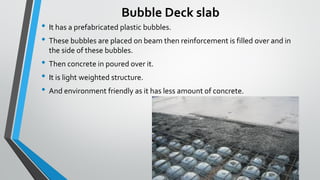
• It has a prefabricated plastic bubbles.
• These bubbles are placed on beam then reinforcement is filled over and in
the side of these bubbles.
• Then concrete in poured over it.
• It is light weighted structure.
• And environment friendly as it has less amount of concrete.
Composite slab
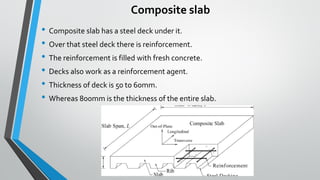
• Composite slab has a steel deck under it.
• Over that steel deck there is reinforcement.
• The reinforcement is filled with fresh concrete.
• Decks also work as a reinforcement agent.
• Thickness of deck is 50 to 60mm.
• Whereas 800mm is the thickness of the entire slab.
Precast slab
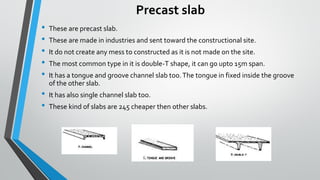
• These are precast slab.
• These are made in industries and sent toward the constructional site.
• It do not create any mess to constructed as it is not made on the site.
• The most common type in it is double-T shape, it can go upto 15m span.
• It has a tongue and groove channel slab too.The tongue in fixed inside the groove
of the other slab.
• It has also single channel slab too.
• These kind of slabs are 245 cheaper then other slabs.
END

Slabs and types

  • 1.
  • 2.
    What is aslab? • Slab is a thin concreted flat structure mostly used for flooring purpose. • It can be square, rectangular, circular in shape. • Slabs can be used in making floors, ceilings and some sometimes paving too. • Thickness of a slab varies from 4 to 6 inches. • 4 inches thick slab will be used where there is light load on the floor (dead and live) • Whereas 6 inches thick slab is used where there is quite heavy load on the floor • Slabs are mostly known as RCC slabs that means Reinforcement Cement and Concrete Slabs. • Materials which are used to make RCC slabs are: Cement, Course aggregate, fine aggregates and reinforcement bars.
  • 3.
    Types of slabs •One way slab • Two way slab • Joist slab (ribbed slab) • Flat plate • Flat slab • Waffle slab • Hollow core slab • Hardy slab • Bubble Deck slab • Composite slab • Precast slab
  • 4.
    One way slab •One way slab is a slab which is supported by opposite sides of the slab via beams or walls. • These slabs are used where there is shorter distance between both opposite sides and there is less load on the upper side. • In one way slab load is carried out only by one direction either by x-axia or y- axis. • This kind of slab is mostly used in warandahs and projections
  • 5.
    Two way slab •Two way slab is supported by all sites either by columns and beams or walls. • The load in two way slab is carried out by both directions like x-axis and y- axis. • These slabs can be used where the pan is between 6 to 9 meters. • The beams under the slab provides more stiffness to the slab to carryout the load well. • This two way slab need more formwork as compared to one way slab as it is supported via all four sides.
  • 6.
    Joist slab (ribbedslab) • It consists of a floor block, sometimes 50 to 100mm thick, supported by concrete ribs (or joists). • The ribs are sometimes thin and are evenly spaced at distances that don't exceed 29 inches. • The ribs are supported on beams that rest on columns. • The slab is suitable for spans of 6-9m. due to the deep ribs, the concrete and steel quantities are comparatively low, however high-ticket formwork is required.
  • 7.
    Flat plate • Flatplates are often constructed as one-way or two-way slabs and it's directly supported by columns or walls. • it's easy to construct and requires simple formworks. • Flat plates are best suited for spans of 6 to 8m. • Added there, the range of spans for flat plates is between 8-12m, and it also can be constructed as post-tensioned slabs. • The advantages of adopting flat plates include low-cost formwork, exposed flat ceilings, and faster construction. Flat plates have low shear capacity and comparatively low stiffness, which can cause noticeable deflection.
  • 8.
    Flat slab • Thisis typically a reinforced slab supported directly by columns or caps, without the utilization of beams. • this sort of slab is usually easy to construct and requires little formwork. the weight directly transferred to the columns. • Flat slabs are best suited for spans of 6 to 9m. • they have more formwork than flat plates, especially for column capitals. • In most cases, only drop panels without column capitals are used. It is often constructed as a post-tensioned flat slab.
  • 9.
    Waffle slab • Itis a kind of concrete slab that contains square grids with deep sides. • Waffle slab construction process includes fitting forms, placement of pods on shuttering, installation of reinforcement between pods, installation of steel mesh on top of pods, and pouring of concrete. • Grid slabs are suitable for spans of 9-15m. • Formwork, including the utilization of pans, is sort of expensive.
  • 10.
    Hollow core slab •It is a kind of precast slabs in which there are core in it. • These cores removes the weight from slab • These cores are also used for service ducts for wiring and plumbing etc. • These slabs are mostly required in fast and light weighted construction. • The size of this kind of slabs varies, it doesn’t have any size restrictions • These slabs are just fixed between beams and gaps are filled with screed.
  • 11.
    Hardy slab • Theseare basically concreted bricks. • It has hollow space in the middle that is why it is light weighed concreted brick • Thickness of this brick is not more then 10 inches • These bricks are installed in the reinforcement then it is filled with pouring cement over it. • It is fast in construction • It is comparatively light weighted then ordinary slabs. • These slabs are used where there in high temperature region.
  • 12.
    Bubble Deck slab •It has a prefabricated plastic bubbles. • These bubbles are placed on beam then reinforcement is filled over and in the side of these bubbles. • Then concrete in poured over it. • It is light weighted structure. • And environment friendly as it has less amount of concrete.
  • 13.
    Composite slab • Compositeslab has a steel deck under it. • Over that steel deck there is reinforcement. • The reinforcement is filled with fresh concrete. • Decks also work as a reinforcement agent. • Thickness of deck is 50 to 60mm. • Whereas 800mm is the thickness of the entire slab.
  • 14.
    Precast slab • Theseare precast slab. • These are made in industries and sent toward the constructional site. • It do not create any mess to constructed as it is not made on the site. • The most common type in it is double-T shape, it can go upto 15m span. • It has a tongue and groove channel slab too.The tongue in fixed inside the groove of the other slab. • It has also single channel slab too. • These kind of slabs are 245 cheaper then other slabs.
  • 15.