BRICK, STONE AND
BLOCK MASONRY
Seismic group UET LHR
1
BASIC DEFINITIONS
 BRICK MASONRY
 The art of building structures using bricks and binding
materials like cement is called brick masonry.
 STONE MASONRY
 The art of building structures using stones and binding
materials like cement is called stone masonry.
 BLOCK MASONRY
 The art of building structures using concrete blocks
with binding materials like cement is called block
masonry.
2
 British Specification
Recommends
 LENGTH (L)
 Minimum Length = 8-5/8”
 Maximum Length = 8-7/8 ”
 WIDTH (W)
 Minimum Width = 4-1/8 ”
 Maximum Width = 4-1/4 ”
 DEPTH (D)
 Minimum Depth = 1-15/16 ”
 Maximum Depth = 2-15/16 ”
L
W
D
3
BRICK MASONRY
4
 Brick Masonry
 1.Definitions
 2.Classification of Brick Masonry
 3.Bond in brick masonry
 4.Types of bonds
 5.Wall Junctions
 6.Masons tools in Brick masonry
 7.Reinforced brick Masonry
 8.Constructions of Brick Masonry
 9.General Principles and precautions in Brick Masonry
 10.TECHNIQUES TO MAKE A BOND BETWEEN OLD AND NEW
MASONRY
 11.Defects and Maintenance of Brick Masonry
5
1.DEFINITIONS
 Masonry & Masonry Units
 Arrises
 Frog or kick
 Course
 Header & Stretcher
 Quoins
 Perpends
 Closure and brick bats
 Facing Backing & Hearting
 Reveals, Jamb, Soffit & Sill
 Column, Pillar, Pier, Pilaster and Stanchion
 Mortar and Grout
 Lintel
 Copping
6
 Masonry
 It is used for the work of a mason.
 Mason is a person who built structures with construction
materials.
 Masonry Units
 It is an artificially prepared regular shape block used in the
masonry works.
Like ….
 Brick in brick masonry
 Stone block in stone masonry
 Concrete block in Block masonry
7
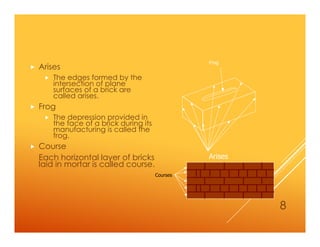
 Arises
 The edges formed by the
intersection of plane
surfaces of a brick are
called arises.
 Frog
 The depression provided in
the face of a brick during its
manufacturing is called the
frog.
 Course
Each horizontal layer of bricks
laid in mortar is called course.
Arises
Frog
Courses
8
 Quoins
 The external corners of a wall are
called Quoins. And the bricks
forming quoins are called quoin
bricks. e.g. quoin header or quoins
stretcher.
 Perpends
 The vertical joints of the bricks are
called Perpends. The perpends of
the alternate courses should be in
the same vertical line
Perpends
Quoin
Header
Quoin Stretcher
9
 Header
 Brick laid with its width in elevation is called header. In a course in
which all bricks are header is called heading or header course.
 Stretcher
 Brick laid with its length in elevation is called stretcher. In a course
in which all bricks are stretcher is called stretcher or stretching
course.
10
 Closure
 Closure bricks are prepared by cutting
standard brick across length or in different ways
to fulfill the requirements of bond in straight
walls, corners, junctions or crosses is called
closures.
They are of four types
 Queen closure
 King closure
 Bevelled closure
 Mitered closure
 Brick bats
 Brick bats are prepared by cutting standard
brick across width.
They are of four types
 Three quarter bat
 Half or square bat
 Quarter bat
 Bevelled bat
11
12
Facing
The external face of wall is called facing.
Backing
The unexposed or internal face of wall is
called backing.
Hearting
The interior portion between facing and
backing is called hearting.
13
Reveals
 It is the vertical brick face of sides of door or
window opening from exterior side is called
reveals.
Jambs
 It is the vertical sides of door or window opening
to which the door is or window frame is
attached.
Soffit
 The under surface of any structural member such
as a lintel, a slab is called Soffit.
Sill
 The horizontal surface at the bottom side of a
door or window opening is called sill.
14
 Column
 The vertical load bearing member whose cross sectional
dimensions are much lesser then its length is called column.
 Pillar
 The vertical member used for ornamental purpose or as
memorial is called pillar. (or) It is an Architectural term for a
column.
 Pier
 It is same as a column, but commonly this term is used for such
columns which are designed to withstand lateral water loads.
(or) the columns of a bridge are known as piers.
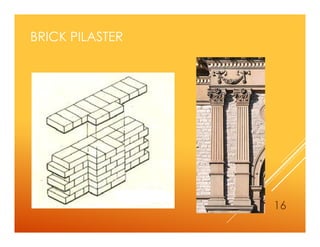
 Pilaster
 It is an architectural element used to give the appearance of
a supporting column with only an ornamental function.
 Stanchion
 The vertical load bearing member constructed of rolled steel
section is called stanchion.
15
BRICK PILASTER
16
 Mortar
 The mixture of binding material and fine aggregate
forming a workable past is called mortar.
 Grout or slurry
 The thin paste of cement is called grout or slurry. It is
used to fill the joints.
 Lintel
 A small horizontal member to span up small opening
is called lintel.
 Copping
 It is provided at the top of a wall to avoid dampness.
They are specially designed bricks to cover the tops
of brick parapet walls.
17
LINTEL AND LOAD DISTRIBUTION
18
2.CLASSIFICATION OF BRICK
MASONRY
 According to type of Mortar
 Pucca Masonry
 Pucca & Kutcha Masonry
 According to types of bricks
 First class brick Masonry
 Second class brick Masonry
 Third class brick Masonry
 Kutcha Masonry
19
3.BOND IN BRICK MASONRY
 It is the arrangement of bricks in each layer to avoid the continuity of
vertical joints in any two adjacent courses.
 NECESSITY OF BOND
 Bond in brickwork is provided for the following reasons
 To break the continuity of vertical joints in consecutive courses.
 To ensure longitudinal and lateral strength of the masonry work.
 To distribute the load uniformly over the structural mass.
 To ensure the quality of work.
 To ensure systematic work
 To provide good aesthetics
 To economize the work.
 REQUIRENMENTS OF GOOD BOND IN BRICK WORK
 Bricks should be uniform in size.
 Mortar thickness should be less than 10mm
 Vertical joints in alternate courses should be in a single plumb line.
 Header should be exactly in the middle of stretcher in two consecutive courses.
 Brick bats should be avoided.
20
4.TYPES OF BONDS
Following are the different types of bonds used in
brick masonry work.
BONDS IN MASONRY WALLS
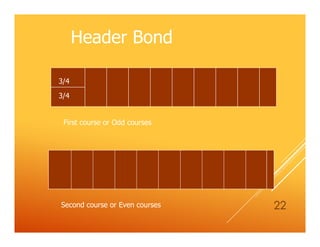
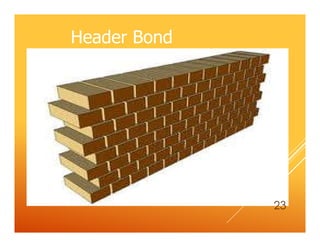
 Header bond
 Stretcher bond
 English bond
 Flemish bond
 Facing bond
 Dutch bond Monk bond
BONDS IN MASONRY COLUMNS
 English bond
 Flemish bond
21
3/4
3/4
Header Bond
First course or Odd courses
Second course or Even courses 22
Header Bond
23
HEADER BOND
24
HEADER BOND ISOMETRIC VIEW
25
Stretcher Bond
26
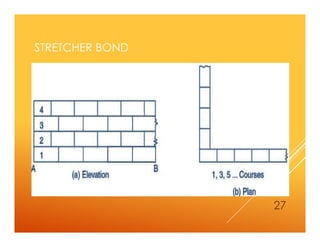
STRETCHER BOND
27
ENGLISH BOND
28
2 COURSES OF ENGLISH BOND
29
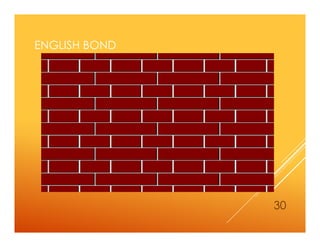
ENGLISH BOND
30
ENGLISH BOND (ISOMETRIC VIEW)
31
FLEMISH BOND
32
FLEMISH BOND
33
FLEMISH BOND
34
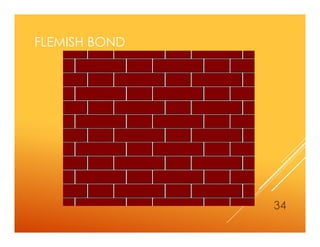
FLEMISH BOND
35
5.WALL JUNCTIONS
 The places where the walls of same or different widths meets or crosses
each other are called wall junctions.
TYPES OF WALL JUNCTIONS
 Two types
 Straight junctions
 Squint junctions
 Straight junctions
 The junctions formed when two walls crossing each other at right angle.
 Corner junctions
 Tee junctions
 Cross junctions
 Squint quoins
 The corner formed when two walls are meeting at some angle.
 Obtuse quoins
 Acute quoins
36
CORNER JUNCTIONS (FLEMISH AND ENGLISH BOND)
37
TEE JUNCTIONS (ENGLISH BOND & FLEMISH BOND)
38
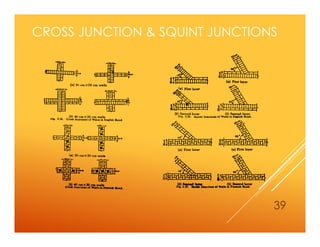
CROSS JUNCTION & SQUINT JUNCTIONS
39
SQUINT QUOINS (ENGLISH BOND)
40
6.MASON’S TOOLS IN BICK MASONRY
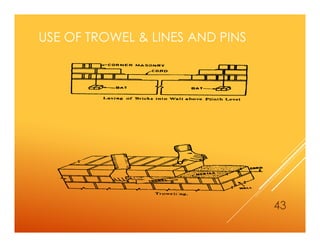
 Trowel
 Brick hammer
 Lines and pins
 Spirit level and water level
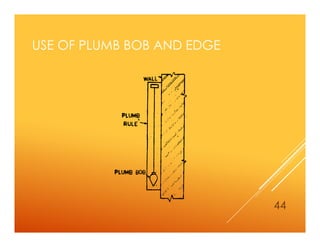
 Straight edge
 Plumb Line
 Mason’s square (guniya)
 Tape (steel)
41
MASON’S TOOLS
42
USE OF TROWEL & LINES AND PINS
43
USE OF PLUMB BOB AND EDGE
44
7.REINFORCED BRICK MASONRY
 The brick masonry done by embedding reinforcement in rich
cement mortar is called Reinforced brick masonry.
 Reinforcement used may be in the form of
 Steel bars
 Hoop iron
 Wire mesh
45
REINFORCED BRICK MASONRY
46
8.CONSTRUCTIONS OF BRICK MASONRY
 It is the art of laying bricks in a proper bond with
specified mortar to form a structure.
It involves the following activities…
 Selection of bricks
 Stacking of bricks
 Soaking of bricks
 Preparation of mortar (ASTM Specifications C 270, "Mortar for Unit
Masonry“)
 Laying of bricks
47
9.GENERAL PRINCIPLES AND
PRECAUTIONS IN BRICK MASONRY
 English bond should be used if not specified.
 Bricks used should be well burnt and should be uniform in
size, shape and color.
 For facing work selected bricks should be used.
 Curing of bricks should be done for at least 2 hours.
 Frogs can be pointed downward or upward or as
specified by the Engineer, but the important matter is to
fill the frog with mortar.
 Mortar used in brick masonry should be of good quality.
 In walls greater than 9” or 0.225 m width hearting joints
should be filled properly.
 Brick bats are avoided.
48
49
50
51
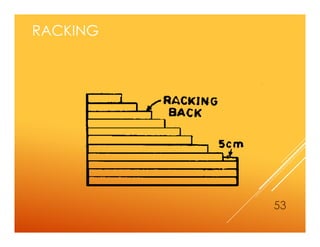
10.TECHNIQUES TO
MAKE A BOND BETWEEN
OLD AND NEW MASONRY
52
RACKING
53
TOOTHING
54
11.DEFECTS AND MAINTENANCE
OF BRICK MASONRY
DEFECTS
 Due to Substandard materials
 Due to effect of sulphates
 Due to frost action
 Due to efflorescence
MAINTENANCE
 Cleaning brick masonry
 Removing efflorescence
 Re-conditioning the brick masonry
 Repainting the brick masonry
55
STONE MASONRY
56
DEFINITIONS
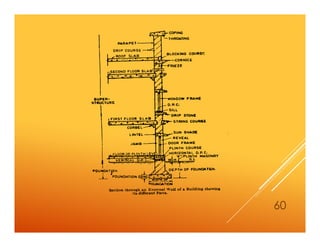
 Corbel
 Cornice
 Drip Stone
 Throating
 Coping
 Frieze
 Spalls
57
DEFINITIONS
 Corbel (Bracket)
 It is a piece of stone projected outside of a wall
to provide support to a structural member of the
Roof or Floor.
 Cornice
 It’s a large course of stone masonry provided at
the ceiling level of roof, projected outside of wall.
 Drip Stone
 A projected stone with toothing at undersurface.
It is provided to through the rain water off the
wall.
58
DEFINITIONS
 Throating
 The process of cutting groves in
 Soffits of sills
 Drip stones
 Coping
 String course etc.
 Its purpose is to avoid the dripping of rain water over
the walls.
 Coping
 It is a special course provided at the top of a wall to
avoid entry of rain water in wall.
 Frieze
 The stone course provided below the cornice is
called frieze
59
60
BLOCK MASONRY
61
62
THE END
63

2-_Types_of_Stone_Brick_and_block_masonry-Compatibility-Mode.pdf

  • 1.
    BRICK, STONE AND BLOCKMASONRY Seismic group UET LHR 1
  • 2.
    BASIC DEFINITIONS  BRICKMASONRY  The art of building structures using bricks and binding materials like cement is called brick masonry.  STONE MASONRY  The art of building structures using stones and binding materials like cement is called stone masonry.  BLOCK MASONRY  The art of building structures using concrete blocks with binding materials like cement is called block masonry. 2
  • 3.
     British Specification Recommends LENGTH (L)  Minimum Length = 8-5/8”  Maximum Length = 8-7/8 ”  WIDTH (W)  Minimum Width = 4-1/8 ”  Maximum Width = 4-1/4 ”  DEPTH (D)  Minimum Depth = 1-15/16 ”  Maximum Depth = 2-15/16 ” L W D 3
  • 4.
  • 5.
     Brick Masonry 1.Definitions  2.Classification of Brick Masonry  3.Bond in brick masonry  4.Types of bonds  5.Wall Junctions  6.Masons tools in Brick masonry  7.Reinforced brick Masonry  8.Constructions of Brick Masonry  9.General Principles and precautions in Brick Masonry  10.TECHNIQUES TO MAKE A BOND BETWEEN OLD AND NEW MASONRY  11.Defects and Maintenance of Brick Masonry 5
  • 6.
    1.DEFINITIONS  Masonry &Masonry Units  Arrises  Frog or kick  Course  Header & Stretcher  Quoins  Perpends  Closure and brick bats  Facing Backing & Hearting  Reveals, Jamb, Soffit & Sill  Column, Pillar, Pier, Pilaster and Stanchion  Mortar and Grout  Lintel  Copping 6
  • 7.
     Masonry  Itis used for the work of a mason.  Mason is a person who built structures with construction materials.  Masonry Units  It is an artificially prepared regular shape block used in the masonry works. Like ….  Brick in brick masonry  Stone block in stone masonry  Concrete block in Block masonry 7
  • 8.
     Arises  Theedges formed by the intersection of plane surfaces of a brick are called arises.  Frog  The depression provided in the face of a brick during its manufacturing is called the frog.  Course Each horizontal layer of bricks laid in mortar is called course. Arises Frog Courses 8
  • 9.
     Quoins  Theexternal corners of a wall are called Quoins. And the bricks forming quoins are called quoin bricks. e.g. quoin header or quoins stretcher.  Perpends  The vertical joints of the bricks are called Perpends. The perpends of the alternate courses should be in the same vertical line Perpends Quoin Header Quoin Stretcher 9
  • 10.
     Header  Bricklaid with its width in elevation is called header. In a course in which all bricks are header is called heading or header course.  Stretcher  Brick laid with its length in elevation is called stretcher. In a course in which all bricks are stretcher is called stretcher or stretching course. 10
  • 11.
     Closure  Closurebricks are prepared by cutting standard brick across length or in different ways to fulfill the requirements of bond in straight walls, corners, junctions or crosses is called closures. They are of four types  Queen closure  King closure  Bevelled closure  Mitered closure  Brick bats  Brick bats are prepared by cutting standard brick across width. They are of four types  Three quarter bat  Half or square bat  Quarter bat  Bevelled bat 11
  • 12.
  • 13.
    Facing The external faceof wall is called facing. Backing The unexposed or internal face of wall is called backing. Hearting The interior portion between facing and backing is called hearting. 13
  • 14.
    Reveals  It isthe vertical brick face of sides of door or window opening from exterior side is called reveals. Jambs  It is the vertical sides of door or window opening to which the door is or window frame is attached. Soffit  The under surface of any structural member such as a lintel, a slab is called Soffit. Sill  The horizontal surface at the bottom side of a door or window opening is called sill. 14
  • 15.
     Column  Thevertical load bearing member whose cross sectional dimensions are much lesser then its length is called column.  Pillar  The vertical member used for ornamental purpose or as memorial is called pillar. (or) It is an Architectural term for a column.  Pier  It is same as a column, but commonly this term is used for such columns which are designed to withstand lateral water loads. (or) the columns of a bridge are known as piers.  Pilaster  It is an architectural element used to give the appearance of a supporting column with only an ornamental function.  Stanchion  The vertical load bearing member constructed of rolled steel section is called stanchion. 15
  • 16.
  • 17.
     Mortar  Themixture of binding material and fine aggregate forming a workable past is called mortar.  Grout or slurry  The thin paste of cement is called grout or slurry. It is used to fill the joints.  Lintel  A small horizontal member to span up small opening is called lintel.  Copping  It is provided at the top of a wall to avoid dampness. They are specially designed bricks to cover the tops of brick parapet walls. 17
  • 18.
    LINTEL AND LOADDISTRIBUTION 18
  • 19.
    2.CLASSIFICATION OF BRICK MASONRY According to type of Mortar  Pucca Masonry  Pucca & Kutcha Masonry  According to types of bricks  First class brick Masonry  Second class brick Masonry  Third class brick Masonry  Kutcha Masonry 19
  • 20.
    3.BOND IN BRICKMASONRY  It is the arrangement of bricks in each layer to avoid the continuity of vertical joints in any two adjacent courses.  NECESSITY OF BOND  Bond in brickwork is provided for the following reasons  To break the continuity of vertical joints in consecutive courses.  To ensure longitudinal and lateral strength of the masonry work.  To distribute the load uniformly over the structural mass.  To ensure the quality of work.  To ensure systematic work  To provide good aesthetics  To economize the work.  REQUIRENMENTS OF GOOD BOND IN BRICK WORK  Bricks should be uniform in size.  Mortar thickness should be less than 10mm  Vertical joints in alternate courses should be in a single plumb line.  Header should be exactly in the middle of stretcher in two consecutive courses.  Brick bats should be avoided. 20
  • 21.
    4.TYPES OF BONDS Followingare the different types of bonds used in brick masonry work. BONDS IN MASONRY WALLS  Header bond  Stretcher bond  English bond  Flemish bond  Facing bond  Dutch bond Monk bond BONDS IN MASONRY COLUMNS  English bond  Flemish bond 21
  • 22.
    3/4 3/4 Header Bond First courseor Odd courses Second course or Even courses 22
  • 23.
  • 24.
  • 25.
  • 26.
  • 27.
  • 28.
  • 29.
    2 COURSES OFENGLISH BOND 29
  • 30.
  • 31.
  • 32.
  • 33.
  • 34.
  • 35.
  • 36.
    5.WALL JUNCTIONS  Theplaces where the walls of same or different widths meets or crosses each other are called wall junctions. TYPES OF WALL JUNCTIONS  Two types  Straight junctions  Squint junctions  Straight junctions  The junctions formed when two walls crossing each other at right angle.  Corner junctions  Tee junctions  Cross junctions  Squint quoins  The corner formed when two walls are meeting at some angle.  Obtuse quoins  Acute quoins 36
  • 37.
    CORNER JUNCTIONS (FLEMISHAND ENGLISH BOND) 37
  • 38.
    TEE JUNCTIONS (ENGLISHBOND & FLEMISH BOND) 38
  • 39.
    CROSS JUNCTION &SQUINT JUNCTIONS 39
  • 40.
  • 41.
    6.MASON’S TOOLS INBICK MASONRY  Trowel  Brick hammer  Lines and pins  Spirit level and water level  Straight edge  Plumb Line  Mason’s square (guniya)  Tape (steel) 41
  • 42.
  • 43.
    USE OF TROWEL& LINES AND PINS 43
  • 44.
    USE OF PLUMBBOB AND EDGE 44
  • 45.
    7.REINFORCED BRICK MASONRY The brick masonry done by embedding reinforcement in rich cement mortar is called Reinforced brick masonry.  Reinforcement used may be in the form of  Steel bars  Hoop iron  Wire mesh 45
  • 46.
  • 47.
    8.CONSTRUCTIONS OF BRICKMASONRY  It is the art of laying bricks in a proper bond with specified mortar to form a structure. It involves the following activities…  Selection of bricks  Stacking of bricks  Soaking of bricks  Preparation of mortar (ASTM Specifications C 270, "Mortar for Unit Masonry“)  Laying of bricks 47
  • 48.
    9.GENERAL PRINCIPLES AND PRECAUTIONSIN BRICK MASONRY  English bond should be used if not specified.  Bricks used should be well burnt and should be uniform in size, shape and color.  For facing work selected bricks should be used.  Curing of bricks should be done for at least 2 hours.  Frogs can be pointed downward or upward or as specified by the Engineer, but the important matter is to fill the frog with mortar.  Mortar used in brick masonry should be of good quality.  In walls greater than 9” or 0.225 m width hearting joints should be filled properly.  Brick bats are avoided. 48
  • 49.
  • 50.
  • 51.
  • 52.
    10.TECHNIQUES TO MAKE ABOND BETWEEN OLD AND NEW MASONRY 52
  • 53.
  • 54.
  • 55.
    11.DEFECTS AND MAINTENANCE OFBRICK MASONRY DEFECTS  Due to Substandard materials  Due to effect of sulphates  Due to frost action  Due to efflorescence MAINTENANCE  Cleaning brick masonry  Removing efflorescence  Re-conditioning the brick masonry  Repainting the brick masonry 55
  • 56.
  • 57.
    DEFINITIONS  Corbel  Cornice Drip Stone  Throating  Coping  Frieze  Spalls 57
  • 58.
    DEFINITIONS  Corbel (Bracket) It is a piece of stone projected outside of a wall to provide support to a structural member of the Roof or Floor.  Cornice  It’s a large course of stone masonry provided at the ceiling level of roof, projected outside of wall.  Drip Stone  A projected stone with toothing at undersurface. It is provided to through the rain water off the wall. 58
  • 59.
    DEFINITIONS  Throating  Theprocess of cutting groves in  Soffits of sills  Drip stones  Coping  String course etc.  Its purpose is to avoid the dripping of rain water over the walls.  Coping  It is a special course provided at the top of a wall to avoid entry of rain water in wall.  Frieze  The stone course provided below the cornice is called frieze 59
  • 60.
  • 61.
  • 62.
  • 63.