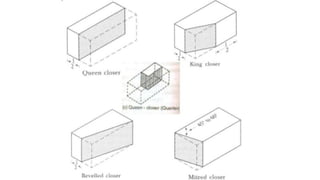
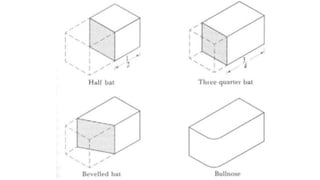
CHAPTER 6:
WALLS &PARTITIONS
• Stone
• Brick
• Hollow Blocks
• Composite
• Timber
• Metal
• Cavity Walls
• Partition of other Prefabricated materials
• Decorative Walls.
3.
WALLS:
• Wall isa structural element which divides the space (room) into two spaces (rooms) and
also provides safety and shelter.
• Generally, the walls are differentiated as a two types outer-walls and inner-walls.
• Outer-walls gives an enclosure to the house for shelter and inner-walls helps to partition
the enclosure into the required number of rooms.
• Inner walls are also called as Partition walls or Interior Walls and Outer walls are also
called as Exterior walls.
MASONRY :
4.
WALLS:
• Wall isa structural element which divides the space (room) into two spaces (rooms) and
also provides safety and shelter.
• Generally, the walls are differentiated as a two types outer-walls and inner-walls.
• Outer-walls gives an enclosure to the house for shelter and inner-walls helps to partition
the enclosure into the required number of rooms.
• Inner walls are also called as Partition walls or Interior Walls and Outer walls are also
called as Exterior walls.
MASONRY :
• Masonry means construction of building units bonded together with mortar.
• Building units/ Masonry units can be of stones, bricks or precast blocks of concrete.
5.
FUNCTION OF WALLS:
•To enclose an area for maintaining privacy. (External wall)
• To divide the building area into separate rooms. (Partition wall)
• To provide safety in case of fire.
• To provide stability.
• To act as a resisting component for heat & sound.
• To act as a protective device against the atmospheric agents.
6.
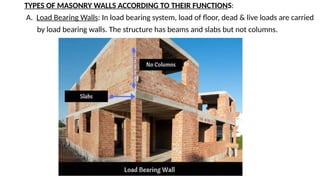
TYPES OF MASONRYWALLS ACCORDING TO THEIR FUNCTIONS:
A. Load Bearing Walls: In load bearing system, load of floor, dead & live loads are carried
by load bearing walls. The structure has beams and slabs but not columns.
7.
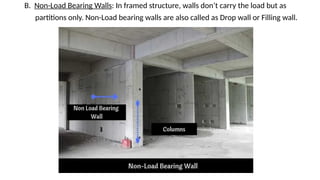
B. Non-Load BearingWalls: In framed structure, walls don’t carry the load but as
partitions only. Non-Load bearing walls are also called as Drop wall or Filling wall.
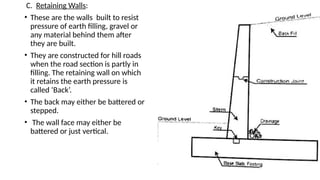
C. Retaining Walls:
•These are the walls built to resist
pressure of earth filling, gravel or
any material behind them after
they are built.
• They are constructed for hill roads
when the road section is partly in
filling. The retaining wall on which
it retains the earth pressure is
called ‘Back’.
• The back may either be battered or
stepped.
• The wall face may either be
battered or just vertical.
TYPES OF MASONRYWALLS ACCORDING TO THE MATERIALS USED:
A. Brick Masonry
B. Stone Masonry
C. Concrete Block Masonry
D. Composite Masonry
12.
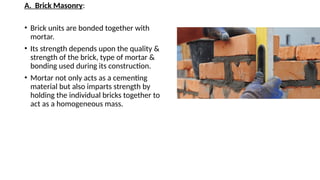
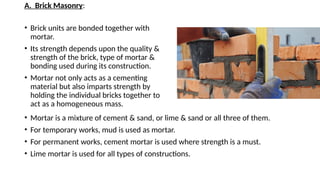
A. Brick Masonry:
•Brick units are bonded together with
mortar.
• Its strength depends upon the quality &
strength of the brick, type of mortar &
bonding used during its construction.
• Mortar not only acts as a cementing
material but also imparts strength by
holding the individual bricks together to
act as a homogeneous mass.
13.
A. Brick Masonry:
•Brick units are bonded together with
mortar.
• Its strength depends upon the quality &
strength of the brick, type of mortar &
bonding used during its construction.
• Mortar not only acts as a cementing
material but also imparts strength by
holding the individual bricks together to
act as a homogeneous mass.
• Mortar is a mixture of cement & sand, or lime & sand or all three of them.
• For temporary works, mud is used as mortar.
• For permanent works, cement mortar is used where strength is a must.
• Lime mortar is used for all types of constructions.
14.
General Principles forbrick masonry construction:
• Bricks used shall be sound, hard, burnt well with uniform
color, shape & size.
• Bricks should be immersed in fresh water for at least 2
hours before being used.
• Brick bats should be avoided.
• Thickness of joints should not exceed 13mm.
• Verticality of masonry walls should be checked with
plumb bob regularly.
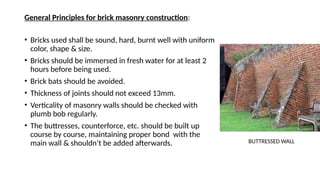
• The buttresses, counterforce, etc. should be built up
course by course, maintaining proper bond with the
main wall & shouldn’t be added afterwards. BUTTRESSED WALL
15.
• Iron fixtureslike pipes, hold-fasts of doors & windows, etc. which are to be fixed in the
brick walls should be embedded in cement mortar or cement concrete.
• All finished masonry work should be kept wet for at least 7 days.
• Suitable scaffoldings should be provided to carry out masonry at higher levels.
• Brick masonry walls should not be constructed more than 1.5 m a day.
• Provide 18mm wide expansion joints after every 30m to 45m length of wall as a brick
masonry wall expands by about 10mm in every 30m length of wall.
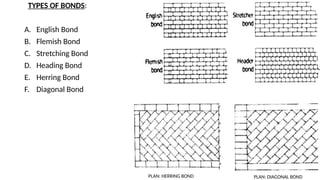
TYPES OF BONDS:
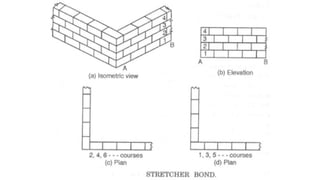
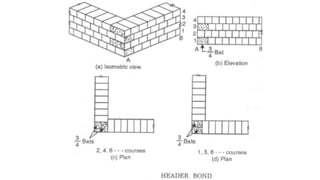
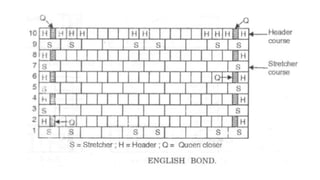
A.English Bond
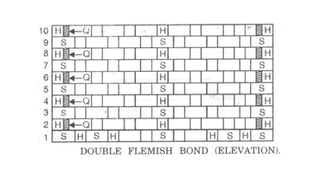
B. Flemish Bond
C. Stretching Bond
D. Heading Bond
E. Herring Bond
F. Diagonal Bond
PLAN: HERRING BOND PLAN: DIAGONAL BOND
24.
Bond at Junctions:
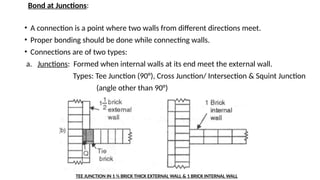
•A connection is a point where two walls from different directions meet.
• Proper bonding should be done while connecting walls.
• Connections are of two types:
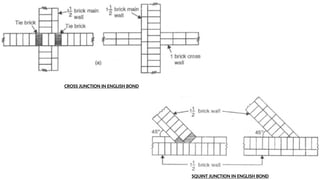
a. Junctions: Formed when internal walls at its end meet the external wall.
Types: Tee Junction (90°), Cross Junction/ Intersection & Squint Junction
(angle other than 90°)
TEE JUNCTION IN 1 ½ BRICK THICK EXTERNAL WALL & 1 BRICK INTERNAL WALL
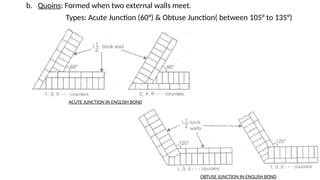
b. Quoins: Formedwhen two external walls meet.
Types: Acute Junction (60°) & Obtuse Junction( between 105° to 135°)
ACUTE JUNCTION IN ENGLISH BOND
OBTUSE JUNCTION IN ENGLISH BOND
27.
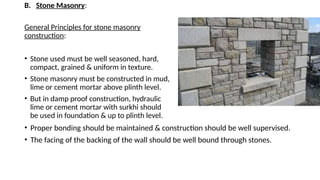
B. Stone Masonry:
GeneralPrinciples for stone masonry
construction:
• Stone used must be well seasoned, hard,
compact, grained & uniform in texture.
• Stone masonry must be constructed in mud,
lime or cement mortar above plinth level.
• But in damp proof construction, hydraulic
lime or cement mortar with surkhi should
be used in foundation & up to plinth level.
• Proper bonding should be maintained & construction should be well supervised.
• The facing of the backing of the wall should be well bound through stones.
28.
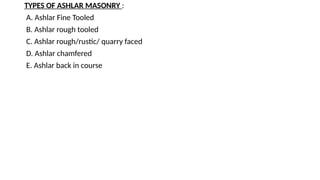
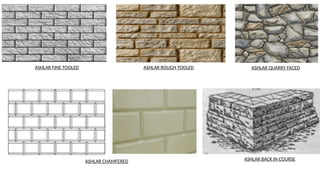
TYPES OF ASHLARMASONRY :
A. Ashlar Fine Tooled
B. Ashlar rough tooled
C. Ashlar rough/rustic/ quarry faced
D. Ashlar chamfered
E. Ashlar back in course
29.
ASHLAR FINE TOOLEDASHLAR ROUGH TOOLED ASHLAR QUARRY FACED
ASHLAR CHAMFERED ASHLAR BACK IN COURSE
30.
COMPARISON BETWEEN BRICKMASONRY & STONE MASONRY
Advantages of Brick Masonry:
• Can be constructed with less skilled mason in comparison with stone masonry.
• Easy to handle, can be done manually, lifting equipment are not required like in stone
masonry.
• Since bricks are of regular size & shape, proper bonding is maintained. Stones require
fine dressing for proper bonding.
• Thickness of plaster required is comparatively lesser hence, quantity of mortar required
is also lesser.
• Thinner walls can be constructed in brick masonry. Whereas in stone masonry, it is
difficult to construct walls less than 30 cm thick.
• Easier to form openings than in stone works (dressing is required).
31.
Advantages of StoneMasonry:
• Since stone has greater crushing strength, stone masonry is stronger than brick
masonry.
• If workmanship is good, external plaster is not needed.
• Where stones are abundantly available, stone masonry per unit volume is cheaper.
• Manufacturing of bricks involves large amount of fuel consumption.
• Stone work is more water tight than brick work. Bricks are porous in nature so it absorbs
moisture from atmosphere, due to this dampness enters in building.
32.
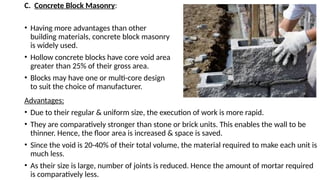
C. Concrete BlockMasonry:
• Having more advantages than other
building materials, concrete block masonry
is widely used.
• Hollow concrete blocks have core void area
greater than 25% of their gross area.
• Blocks may have one or multi-core design
to suit the choice of manufacturer.
Advantages:
• Due to their regular & uniform size, the execution of work is more rapid.
• They are comparatively stronger than stone or brick units. This enables the wall to be
thinner. Hence, the floor area is increased & space is saved.
• Since the void is 20-40% of their total volume, the material required to make each unit is
much less.
• As their size is large, number of joints is reduced. Hence the amount of mortar required
is comparatively less.
33.
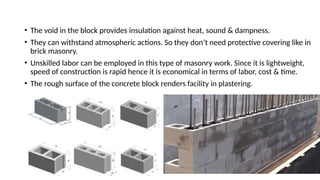
• The voidin the block provides insulation against heat, sound & dampness.
• They can withstand atmospheric actions. So they don’t need protective covering like in
brick masonry.
• Unskilled labor can be employed in this type of masonry work. Since it is lightweight,
speed of construction is rapid hence it is economical in terms of labor, cost & time.
• The rough surface of the concrete block renders facility in plastering.
34.
D. Composite Masonry:
•Composite masonry are those, in which more than one material such as brick & stone,
stone & concrete or brick & concrete are used.
• Their main purpose is:
- To improve the appearance of the structure by concealing the inferior material by a
superior one or,
- To reduce the cost of the structure by using superior material on the face & inferior
material on the back of the wall.
- To make the structure more durable & stronger.
• Types of Composite Masonry:
i. Stone facing with brick backing
ii. Brick facing concrete backing
iii. Tile facing brick backing
iv. Stone facing rubble backing
v. Stone facing concrete backing
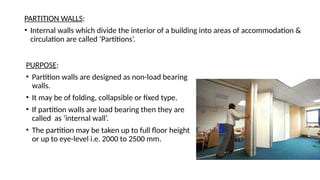
PARTITION WALLS:
• Internalwalls which divide the interior of a building into areas of accommodation &
circulation are called ‘Partitions’.
PURPOSE:
• Partition walls are designed as non-load bearing
walls.
• It may be of folding, collapsible or fixed type.
• If partition walls are load bearing then they are
called as ‘internal wall’.
• The partition may be taken up to full floor height
or up to eye-level i.e. 2000 to 2500 mm.
REQUIREMENTS OF PARTITIONWALLS:
• Should be strong enough to carry its own weight.
• Should be strong capable of resisting impact developed due to the use of building.
• Should act as a sound barrier especially when it divides a room into two units.
• Should possess enough strength to support some wall fixtures, sinks, wash basins,
etc.
• Should have the capacity to support suitable decorative surface.
39.
REQUIREMENTS OF PARTITONWALLS:
• Should be strong enough to carry its own weight.
• Should be strong capable of resisting impact developed due to the use of building.
• Should act as a sound barrier especially when it divides a room into two units.
• Should possess enough strength to support some wall fixtures, sinks, wash basins,
etc.
• Should have the capacity to support suitable decorative surface.
• Should be light, thin, cheap, fire-resistant and easy to construct.
• Should offer sufficient resistance against heat, dampness, white ant or
fungus etc.
• Should have thin cross-section so that maximum floor area can be utilized.
• Provide adequate privacy in rooms both in respect of sight and sound.
• Should possess proper coherence with the type of building structure.
• Rigid enough to take the vibrations caused due to loads.
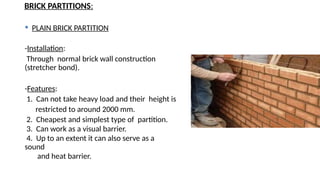
BRICK PARTITIONS:
PLAINBRICK PARTITION
-Installation:
Through normal brick wall construction
(stretcher bond).
-Features:
1. Can not take heavy load and their height is
restricted to around 2000 mm.
2. Cheapest and simplest type of partition.
3. Can work as a visual barrier.
4. Up to an extent it can also serve as a
sound
and heat barrier.
42.
BRICK PARTITIONS:
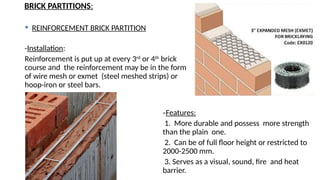
REINFORCEMENTBRICK PARTITION
-Installation:
Reinforcement is put up at every 3rd
or 4th
brick
course and the reinforcement may be in the form
of wire mesh or exmet (steel meshed strips) or
hoop-iron or steel bars.
-Features:
1. More durable and possess more strength
than the plain one.
2. Can be of full floor height or restricted to
2000-2500 mm.
3. Serves as a visual, sound, fire and heat
barrier.
43.
BRICK PARTITIONS:
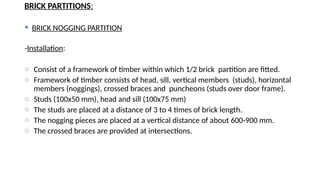
BRICKNOGGING PARTITION
-Installation:
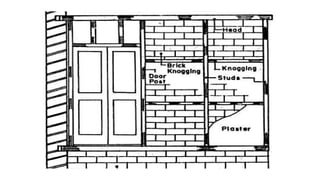
o Consist of a framework of timber within which 1/2 brick partition are fitted.
o Framework of timber consists of head, sill, vertical members (studs), horizontal
members (noggings), crossed braces and puncheons (studs over door frame).
o Studs (100x50 mm), head and sill (100x75 mm)
o The studs are placed at a distance of 3 to 4 times of brick length.
o The nogging pieces are placed at a vertical distance of about 600-900 mm.
o The crossed braces are provided at intersections.
45.
o The brickworkshould be carried out in cement mortar of 1:3.
o The surface of timber framework coming in contact with the masonry should be
coated with coal tar.
o To provide better stability a slight projection (50x25 mm) in the wooden studs and
a corresponding groove in the adjoining bricks are provided.
Features:
1. More durable and possess more strength than the other two.
2. Can be of full floor height or restricted to 2000-2500mm.
3. Serves as an efficient visual, sound, fire and heat barrier.
46.
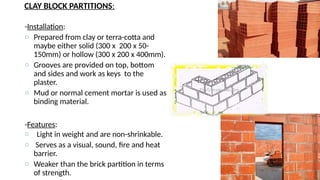
CLAY BLOCK PARTITIONS:
-Installation:
oPrepared from clay or terra-cotta and
maybe either solid (300 x 200 x 50-
150mm) or hollow (300 x 200 x 400mm).
o Grooves are provided on top, bottom
and sides and work as keys to the
plaster.
o Mud or normal cement mortar is used as
binding material.
-Features:
o Light in weight and are non-shrinkable.
o Serves as a visual, sound, fire and heat
barrier.
o Weaker than the brick partition in terms
of strength.
47.
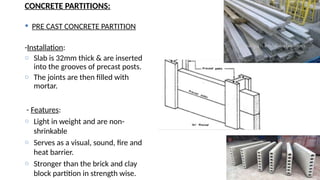
CONCRETE PARTITIONS:
PRECAST CONCRETE PARTITION
-Installation:
o Slab is 32mm thick & are inserted
into the grooves of precast posts.
o The joints are then filled with
mortar.
- Features:
o Light in weight and are non-
shrinkable
o Serves as a visual, sound, fire and
heat barrier.
o Stronger than the brick and clay
block partition in strength wise.
48.
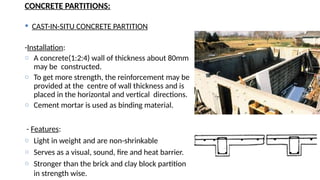
CONCRETE PARTITIONS:
CAST-IN-SITUCONCRETE PARTITION
-Installation:
o A concrete(1:2:4) wall of thickness about 80mm
may be constructed.
o To get more strength, the reinforcement may be
provided at the centre of wall thickness and is
placed in the horizontal and vertical directions.
o Cement mortar is used as binding material.
- Features:
o Light in weight and are non-shrinkable
o Serves as a visual, sound, fire and heat barrier.
o Stronger than the brick and clay block partition
in strength wise.
49.
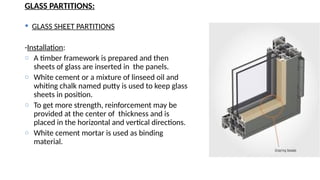
GLASS PARTITIONS:
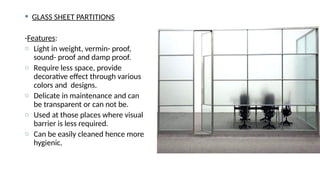
GLASSSHEET PARTITIONS
-Installation:
o A timber framework is prepared and then
sheets of glass are inserted in the panels.
o White cement or a mixture of linseed oil and
whiting chalk named putty is used to keep glass
sheets in position.
o To get more strength, reinforcement may be
provided at the center of thickness and is
placed in the horizontal and vertical directions.
o White cement mortar is used as binding
material.
50.
GLASS SHEETPARTITIONS
-Features:
o Light in weight, vermin- proof,
sound- proof and damp proof.
o Require less space, provide
decorative effect through various
colors and designs.
o Delicate in maintenance and can
be transparent or can not be.
o Used at those places where visual
barrier is less required.
o Can be easily cleaned hence more
hygienic.
51.
GLASS PARTITIONS:
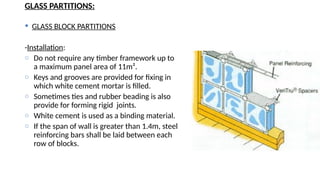
GLASSBLOCK PARTITIONS
-Installation:
o Do not require any timber framework up to
a maximum panel area of 11m².
o Keys and grooves are provided for fixing in
which white cement mortar is filled.
o Sometimes ties and rubber beading is also
provide for forming rigid joints.
o White cement is used as a binding material.
o If the span of wall is greater than 1.4m, steel
reinforcing bars shall be laid between each
row of blocks.
52.
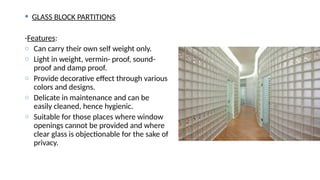
GLASS BLOCKPARTITIONS
-Features:
o Can carry their own self weight only.
o Light in weight, vermin- proof, sound-
proof and damp proof.
o Provide decorative effect through various
colors and designs.
o Delicate in maintenance and can be
easily cleaned, hence hygienic.
o Suitable for those places where window
openings cannot be provided and where
clear glass is objectionable for the sake of
privacy.
53.
TIMBER PARTITIONS:
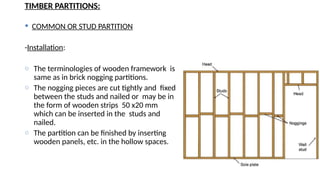
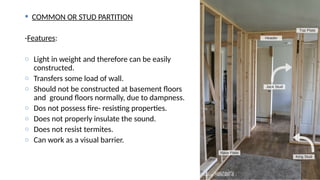
COMMONOR STUD PARTITION
-Installation:
o The terminologies of wooden framework is
same as in brick nogging partitions.
o The nogging pieces are cut tightly and fixed
between the studs and nailed or may be in
the form of wooden strips 50 x20 mm
which can be inserted in the studs and
nailed.
o The partition can be finished by inserting
wooden panels, etc. in the hollow spaces.
54.
COMMON ORSTUD PARTITION
-Features:
o Light in weight and therefore can be easily
constructed.
o Transfers some load of wall.
o Should not be constructed at basement floors
and ground floors normally, due to dampness.
o Dos not possess fire- resisting properties.
o Does not properly insulate the sound.
o Does not resist termites.
o Can work as a visual barrier.
55.
TIMBER PARTITIONS:
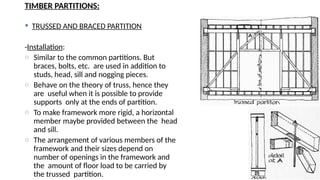
TRUSSEDAND BRACED PARTITION
-Installation:
o Similar to the common partitions. But
braces, bolts, etc. are used in addition to
studs, head, sill and nogging pieces.
o Behave on the theory of truss, hence they
are useful when it is possible to provide
supports only at the ends of partition.
o To make framework more rigid, a horizontal
member maybe provided between the head
and sill.
o The arrangement of various members of the
framework and their sizes depend on
number of openings in the framework and
the amount of floor load to be carried by
the trussed partition.
56.
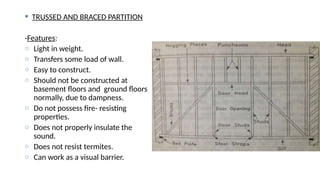
TRUSSED ANDBRACED PARTITION
-Features:
o Light in weight.
o Transfers some load of wall.
o Easy to construct.
o Should not be constructed at
basement floors and ground floors
normally, due to dampness.
o Do not possess fire- resisting
properties.
o Does not properly insulate the
sound.
o Does not resist termites.
o Can work as a visual barrier.
57.
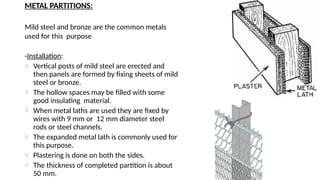
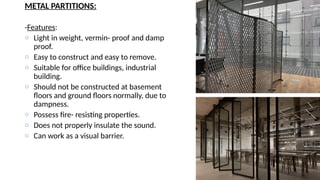
METAL PARTITIONS:
Mild steeland bronze are the common metals
used for this purpose
-Installation:
o Vertical posts of mild steel are erected and
then panels are formed by fixing sheets of mild
steel or bronze.
o The hollow spaces may be filled with some
good insulating material.
o When metal laths are used they are fixed by
wires with 9 mm or 12 mm diameter steel
rods or steel channels.
o The expanded metal lath is commonly used for
this purpose.
o Plastering is done on both the sides.
o The thickness of completed partition is about
50 mm.
58.
METAL PARTITIONS:
-Features:
o Lightin weight, vermin- proof and damp
proof.
o Easy to construct and easy to remove.
o Suitable for office buildings, industrial
building.
o Should not be constructed at basement
floors and ground floors normally, due to
dampness.
o Possess fire- resisting properties.
o Does not properly insulate the sound.
o Can work as a visual barrier.
59.
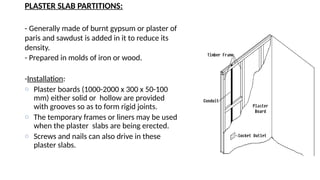
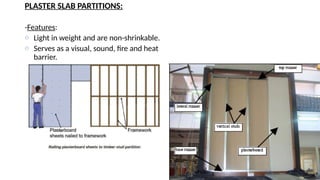
PLASTER SLAB PARTITIONS:
-Generally made of burnt gypsum or plaster of
paris and sawdust is added in it to reduce its
density.
- Prepared in molds of iron or wood.
-Installation:
o Plaster boards (1000-2000 x 300 x 50-100
mm) either solid or hollow are provided
with grooves so as to form rigid joints.
o The temporary frames or liners may be used
when the plaster slabs are being erected.
o Screws and nails can also drive in these
plaster slabs.
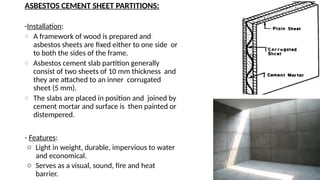
ASBESTOS CEMENT SHEETPARTITIONS:
-Installation:
o A framework of wood is prepared and
asbestos sheets are fixed either to one side or
to both the sides of the frame.
o Asbestos cement slab partition generally
consist of two sheets of 10 mm thickness and
they are attached to an inner corrugated
sheet (5 mm).
o The slabs are placed in position and joined by
cement mortar and surface is then painted or
distempered.
- Features:
o Light in weight, durable, impervious to water
and economical.
o Serves as a visual, sound, fire and heat
barrier.
62.
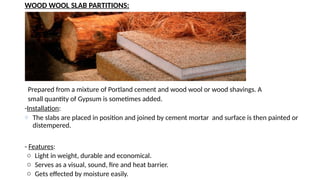
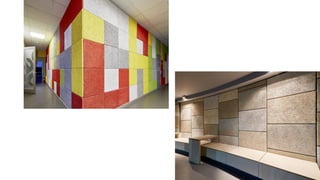
WOOD WOOL SLABPARTITIONS:
Prepared from a mixture of Portland cement and wood wool or wood shavings. A
small quantity of Gypsum is sometimes added.
-Installation:
o The slabs are placed in position and joined by cement mortar and surface is then painted or
distempered.
- Features:
o Light in weight, durable and economical.
o Serves as a visual, sound, fire and heat barrier.
o Gets effected by moisture easily.
64.
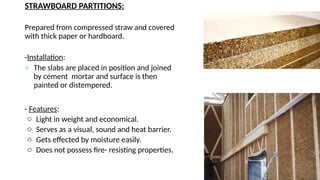
STRAWBOARD PARTITIONS:
Prepared fromcompressed straw and covered
with thick paper or hardboard.
-Installation:
o The slabs are placed in position and joined
by cement mortar and surface is then
painted or distempered.
- Features:
o Light in weight and economical.
o Serves as a visual, sound and heat barrier.
o Gets effected by moisture easily.
o Does not possess fire- resisting properties.
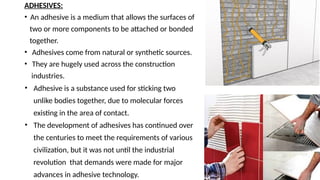
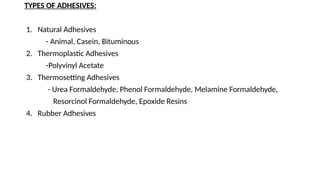
ADHESIVES:
• An adhesiveis a medium that allows the surfaces of
two or more components to be attached or bonded
together.
• Adhesives come from natural or synthetic sources.
• They are hugely used across the construction
industries.
• Adhesive is a substance used for sticking two
unlike bodies together, due to molecular forces
existing in the area of contact.
• The development of adhesives has continued over
the centuries to meet the requirements of various
civilization, but it was not until the industrial
revolution that demands were made for major
advances in adhesive technology.
69.
PROPERTIES OF ADHESIVES:
TheImportant Physical Properties Of Adhesives are:
• Cohesive Strength
• Adherence
• Fluidity
• Wettability
70.
• Cohesive strength:
-Adhesive should have more cohesive strength than either of the surfaces being held
together.
- Usually the adhesive becomes more brittle as its cohesive strength is increased.
• Adherence:
- For an adhesive to hold two surfaces together the former should form a strong bond
at
each of the interfaces between the surface and the adhesive, and the adhesive must
have strong cohesive strength.
71.
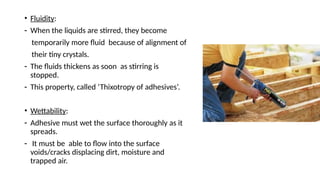
• Fluidity:
- Whenthe liquids are stirred, they become
temporarily more fluid because of alignment of
their tiny crystals.
- The fluids thickens as soon as stirring is
stopped.
- This property, called ‘Thixotropy of adhesives’.
• Wettability:
- Adhesive must wet the surface thoroughly as it
spreads.
- It must be able to flow into the surface
voids/cracks displacing dirt, moisture and
trapped air.
72.
Advantages:
•A wide varietyof combinations in joining is possible.
•It can be used for bonding the surfaces of glass, metal, plastics and wood.
•It creates a massive effect.
•It is possible to prevent corrosion between different metals joined by adhesive.
•It produces adequate strength.
•The permeable joint can be made impermeable for water and gas by the
application of adhesives.
•The process of applying adhesive is easy, economical and speedy.
73.
Disdvantages:
•It is notpossible to adopt any adhesive for all substances.
•Depending upon the properties of substances to be joined, suitable adhesive has to be
selected.
•The adhesive substance does not become strong immediately after its
application. It requires some time to attain the desired strength.
•The adhesive substance generally does not remain stable at high temperature.
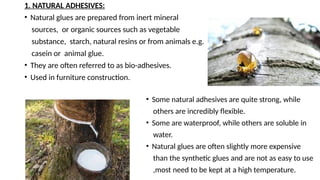
1. NATURAL ADHESIVES:
•Natural glues are prepared from inert mineral
sources, or organic sources such as vegetable
substance, starch, natural resins or from animals e.g.
casein or animal glue.
• They are often referred to as bio-adhesives.
• Used in furniture construction.
• Some natural adhesives are quite strong, while
others are incredibly flexible.
• Some are waterproof, while others are soluble in
water.
• Natural glues are often slightly more expensive
than the synthetic glues and are not as easy to use
,most need to be kept at a high temperature.
76.
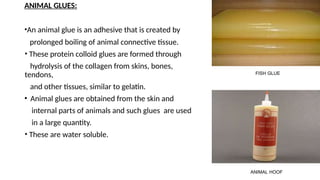
ANIMAL GLUES:
•An animalglue is an adhesive that is created by
prolonged boiling of animal connective tissue.
• These protein colloid glues are formed through
hydrolysis of the collagen from skins, bones,
tendons,
and other tissues, similar to gelatin.
• Animal glues are obtained from the skin and
internal parts of animals and such glues are used
in a large quantity.
• These are water soluble.
FISH GLUE
ANIMAL HOOF
77.
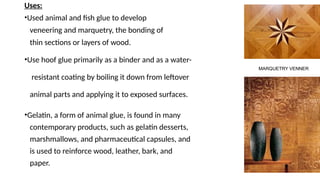
Uses:
•Used animal andfish glue to develop
veneering and marquetry, the bonding of
thin sections or layers of wood.
•Use hoof glue primarily as a binder and as a water-
resistant coating by boiling it down from leftover
animal parts and applying it to exposed surfaces.
•Gelatin, a form of animal glue, is found in many
contemporary products, such as gelatin desserts,
marshmallows, and pharmaceutical capsules, and
is used to reinforce wood, leather, bark, and
paper.
MARQUETRY VENNER
78.
•Rabbit-skin glue, anotherform of hide-glue, was used to coat canvasses to protect the
decay of the canvas fabric from the active components of linseed oil.
•Animal hoof glue, which is one of the oldest forms of glue still in use, can be used for
carpentry and delicate furniture decoration processes
79.
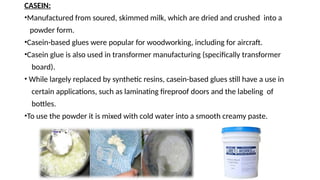
CASEIN:
•Manufactured from soured,skimmed milk, which are dried and crushed into a
powder form.
•Casein-based glues were popular for woodworking, including for aircraft.
•Casein glue is also used in transformer manufacturing (specifically transformer
board).
• While largely replaced by synthetic resins, casein-based glues still have a use in
certain applications, such as laminating fireproof doors and the labeling of
bottles.
•To use the powder it is mixed with cold water into a smooth creamy paste.
80.
BITUMINOUS:
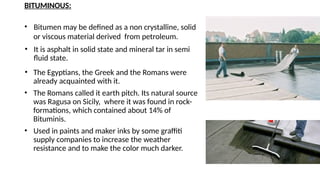
• Bitumen maybe defined as a non crystalline, solid
or viscous material derived from petroleum.
• It is asphalt in solid state and mineral tar in semi
fluid state.
• The Egyptians, the Greek and the Romans were
already acquainted with it.
• The Romans called it earth pitch. Its natural source
was Ragusa on Sicily, where it was found in rock-
formations, which contained about 14% of
Bituminis.
• Used in paints and maker inks by some graffiti
supply companies to increase the weather
resistance and to make the color much darker.
81.
2. THERMOPLASTIC ADHESIVES:
•Thermoplasticadhesives are fusible (easily melted), soluble and poor heat resistant.
•Thermoplastic adhesives have low/medium shear strength and suffer from creep (slow
deformation) at high loading.
•They have good resistance to oils but poor resistance to water.
•Thermoplastic adhesives include polyvinyl acetate (PVA), polyvinyl alcohol (PVA),
polyacrylates, polyester acrylics, acrylic solvent cement, cyanoacrylates (superglue),
silicone resins, polyamides and acrylic acid diesters.
•These types of adhesives may be in the form of a solid which softens when heated
and when cooled will regain their original form and strength.
82.
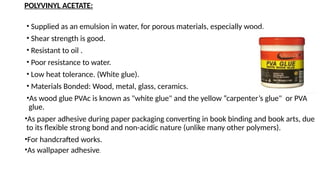
POLYVINYL ACETATE:
• Suppliedas an emulsion in water, for porous materials, especially wood.
• Shear strength is good.
• Resistant to oil .
• Poor resistance to water.
• Low heat tolerance. (White glue).
• Materials Bonded: Wood, metal, glass, ceramics.
•As wood glue PVAc is known as "white glue" and the yellow “carpenter’s glue" or PVA
glue.
•As paper adhesive during paper packaging converting in book binding and book arts, due
to its flexible strong bond and non-acidic nature (unlike many other polymers).
•For handcrafted works.
•As wallpaper adhesive.
83.
3. THERMOSETTING ADHESIVES:
•These are transformed into tough, heat-resistant solids by the addition of a
catalyst or the application of heat.
• Used in such structural functions as bonding metallic parts of aircraft and space
vehicles.
• Examples: Urea formaldehyde, phenol formaldehyde, melamine formaldehyde,
resorcinol resins, epoxide resins.
84.
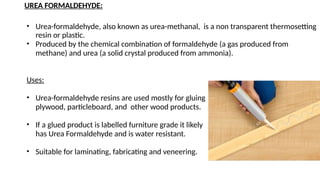
UREA FORMALDEHYDE:
• Urea-formaldehyde,also known as urea-methanal, is a non transparent thermosetting
resin or plastic.
• Produced by the chemical combination of formaldehyde (a gas produced from
methane) and urea (a solid crystal produced from ammonia).
Uses:
• Urea-formaldehyde resins are used mostly for gluing
plywood, particleboard, and other wood products.
• If a glued product is labelled furniture grade it likely
has Urea Formaldehyde and is water resistant.
• Suitable for laminating, fabricating and veneering.
85.
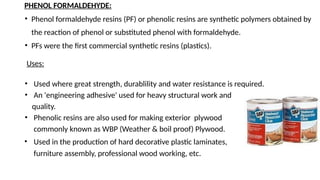
PHENOL FORMALDEHYDE:
• Phenolformaldehyde resins (PF) or phenolic resins are synthetic polymers obtained by
the reaction of phenol or substituted phenol with formaldehyde.
• PFs were the first commercial synthetic resins (plastics).
Uses:
• Used where great strength, durablility and water resistance is required.
• An 'engineering adhesive' used for heavy structural work and
quality.
• Phenolic resins are also used for making exterior plywood
commonly known as WBP (Weather & boil proof) Plywood.
• Used in the production of hard decorative plastic laminates,
furniture assembly, professional wood working, etc.
86.
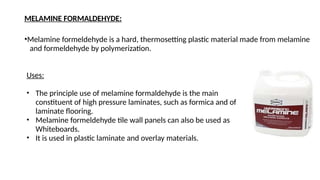
MELAMINE FORMALDEHYDE:
•Melamine formeldehydeis a hard, thermosetting plastic material made from melamine
and formeldehyde by polymerization.
Uses:
• The principle use of melamine formaldehyde is the main
constituent of high pressure laminates, such as formica and of
laminate flooring.
• Melamine formeldehyde tile wall panels can also be used as
Whiteboards.
• It is used in plastic laminate and overlay materials.
87.
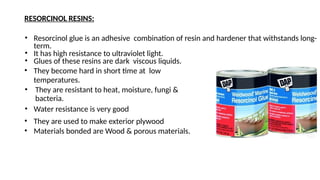
RESORCINOL RESINS:
• Resorcinolglue is an adhesive combination of resin and hardener that withstands long-
term.
• It has high resistance to ultraviolet light.
• Glues of these resins are dark viscous liquids.
• They become hard in short time at low
temperatures.
• They are resistant to heat, moisture, fungi &
bacteria.
• Water resistance is very good
• They are used to make exterior plywood
• Materials bonded are Wood & porous materials.
88.
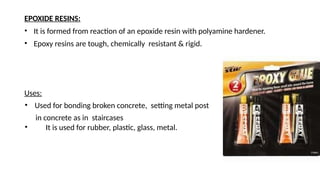
EPOXIDE RESINS:
• Itis formed from reaction of an epoxide resin with polyamine hardener.
• Epoxy resins are tough, chemically resistant & rigid.
Uses:
• Used for bonding broken concrete, setting metal post
in concrete as in staircases
• It is used for rubber, plastic, glass, metal.
89.
RUBBER ADHESIVES:
• Madeby dissolving rubber in benzene.
• Have excellent property of forming rigid bonds.
• This enable the adhesive the to flex and stretch under stress and recover to its
original position as soon as the load is removed.
• Have high bond strength and durability.
• Used in paper, fabric-backed PVC to hardboard, and floor coverings.
• Also in bonding metal, wood, leather, synthetic leather, etc.