High compressive strength
Lower tensile strength
Negligible change when temp changes
Develops cracks over time
Cement
Water
AggregatesReinforcement
Admixtures
 Used in mixing and curing.
 Potable water should be used.
 Sea water is not permitted.
 pH value of water should not be less than 6.
Disadvantages of using more water and
advantages of using less water
Disadvantages of using
more water
 Creates a diluted
paste.
 Excess water bleeds
out onto the surface.
 This affects the
compressive and
tensile strengths.
 Loss of cohesiveness
and homogeneity.
 Harmful to strength
and durability.
Advantages of using
less water
 Increased strength.
 Lower permeability.
 Increased resistance to
weathering.
 Better bond between
concrete and
reinforcement.
 Reduced shrinkage
and cracking.
 Less volume change
from wetting and
drying.
FINE AGGREGATE COARSE AGGREGATE
 Size more than 4.75mm.
 Includes gravels and
crushed stones.
 Obtained by crushing
various types of
granites, hard lime
stones and sand stones.
 Harsh concrete.
 Size less than 4.75mm.
 Includes natural sand or
crushed stone with
most particles passing
through a sieve.
 Obtained from pits,
lake, river or sea-shore.
 Thoroughly washed
before use.
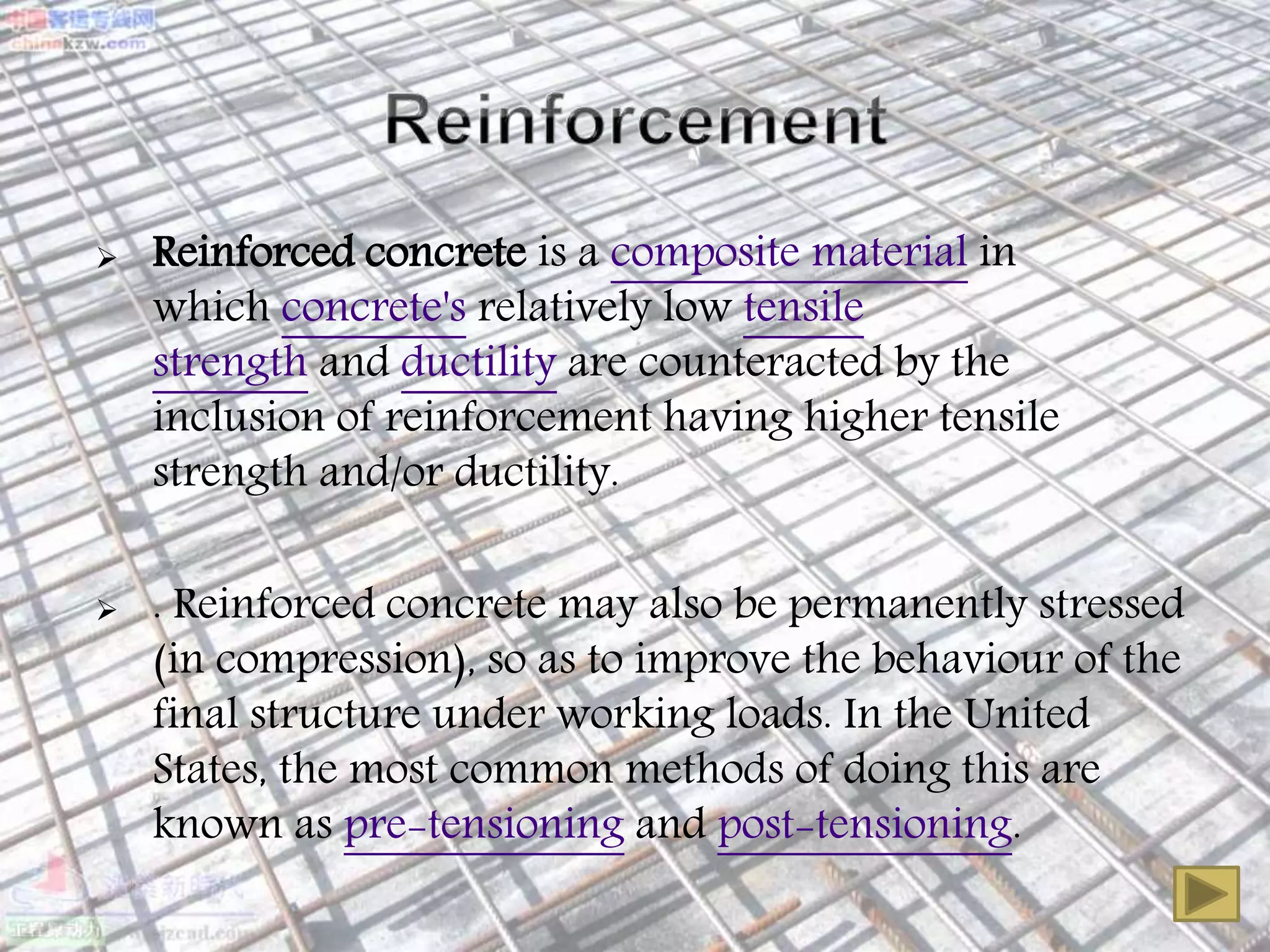
 Reinforced concrete is a composite material in
which concrete's relatively low tensile
strength and ductility are counteracted by the
inclusion of reinforcement having higher tensile
strength and/or ductility.
 . Reinforced concrete may also be permanently stressed
(in compression), so as to improve the behaviour of the
final structure under working loads. In the United
States, the most common methods of doing this are
known as pre-tensioning and post-tensioning.
For a strong, ductile and durable construction the
reinforcement needs to have the following properties at
least:
High relative strength.
High toleration of tensile strain.
Good bond to the concrete, irrespective of pH, moisture,
and similar factors.
Thermal compatibility, not causing unacceptable stresses
in response to changing temperatures.
Durability in the concrete environment, irrespective of
corrosion or sustained stress.
Two physical characteristics give reinforced concrete its
special properties:
 The coefficient of thermal expansion of concrete is
similar to that of steel, eliminating large internal
stresses due to differences in thermal expansion or
contraction.
 When the cement paste within the concrete hardens,
this conforms to the surface details of the steel,
permitting any stress to be transmitted efficiently
between the different materials. Usually steel bars are
roughened or corrugated to further improve
the bond or cohesion between the concrete and steel
Common failure modes of steel reinforced concrete:
Mechanical failure
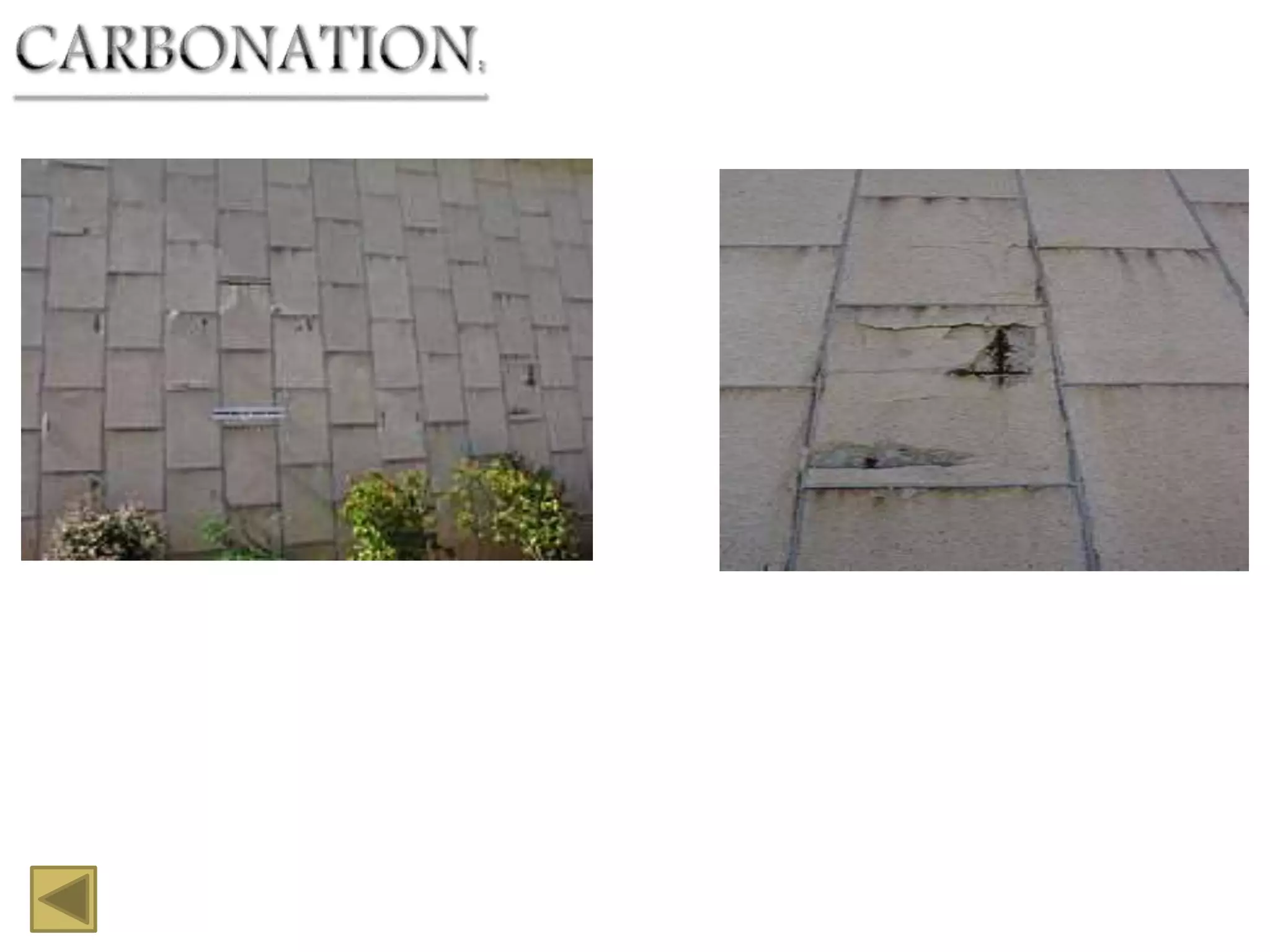
Carbonation
Chlorides
Alkali silica reaction
Conversion of high alumina cement
Sulphates
12
Production, Composition
&
Types
13
1. Acquisition of raw materials.
2. Preparation of raw materials.
3. Burning.
4. Addition of Gypsum and Distribution.
14
15
 General Purpose
 Ordinary Portland Cement
 Sulphate Resisting Cement
High Early Strength
Low Heat Cement
Air Entraining Cement
White Cement
16
 Variety of artificial cement.
On hardening , its color resembles to the
rocks near Portland in England.
Main constituents : Lime , Silica , Alumina.
17
Lime 63%
Silica 22%
Alumina 06%
Iron Oxide 03%
Gypsum 01-04%
18
 Lime : Sufficient quantity forms di-
calcium silicate and tri-calcium silicate.
 Silica : Gives strength.
 Alumina : Sets cement quickly ; lowers
clinkering temperature.
19
 Iron Oxide : gives color to cement.
 Magnesia : helps in giving color to cement.
 Gypsum : added to increase the setting of
the cement.
20
 Modified form of O.P.C.
Used when O.P.C. is liable to
disintergrate.
 Uses : Hydraulic structures , canals.
21
 Provides strength at early stage.
 Reason : finer grinding , burning at high
temperature , increased lime content.
 Strength by Rapid Hardening Cement in 4
days = strength by O.P.C. in 14 days.
 Uses : Highway Slabs.
Suitable in Cold weather areas.
22
 Heat of hydration is reduced by tri-
calcium aluminate.
 Less % of Lime.
 Uses : Mass Concrete Works : Damns.
23
 Produced by grinding minute air
entraining materials with clinker.
 Improves workability , durability.
 Uses : Natural raisins , fats , oils.
24
 Keeps the content of Iron Oxide as low as
possible.
 Costlier than O.P.C.
 Uses : Architectural finishing in buildings.
25
 Proportion of sand and cement decides the
strength of mortar.
 Richer mixture than 1:3 proportion is prone
to shrinkage.
 When water is added to initiate the cement
and sand mixture , hydration starts and binds
sand particle and surface of masonry and
concrete.
26
ADVANTAGES
 Strong.
 Creates large structures
easily.
 Has high thermal mass.
DISADVANTAGES
 Subjected to cracking.
 Difficult to provide
idoneous curing
conditions.
 Not ideal when
settlement is expected.
27
CONCRETE MIXTURES:
Concrete admixtures are used to improve the behavior of
concrete under a variety of conditions.
There are two main types of Admixtures:
1. Chemical admixture
2. Mineral admixture
CHEMICAL ADMIXTUES:
reduce the cost of construction,
 modify properties of hardened concrete,
used to improve the quality of concrete during mixing,
transporting, placement and curing.
They fall into the following categories:
Air entrainers
Water reducers
Set retarders
Set accelerators
Super plasticizers
Specialty admixtures: which include corrosion inhibitors, shrinkage control, alkali-
silica reactivity inhibitors, and coloring.
MINERAL ADMIXTURES:
Mineral admixtures affect the nature of the hardened
concrete through hydraulic or Pozzolanic activity.
Pozzolans are cementations materials and include natural
Pozzolans (such as the volcanic ash used in Roman concrete),
fly ash and silica fume.
They can be used with Portland cement, or blended cement
either individually or in combinations.
Properties of mineral admixtures:
make mixtures more economical,
reduce permeability,
increase strength,
influence other concrete properties
CONCLUSIONS:
Plasticizers, super plasticizers , & Air-entraining
admixtures is mostly used.
Super plasticizers is widely used all over the world .
India is catching up with the use of super plasticizer in
the construction of high rise buildings, long span
brides because it reduced cement content, increased
workability, & increased strength.

CEMENT CONCRETE

  • 2.
    High compressive strength Lowertensile strength Negligible change when temp changes Develops cracks over time
  • 3.
  • 4.
     Used inmixing and curing.  Potable water should be used.  Sea water is not permitted.  pH value of water should not be less than 6. Disadvantages of using more water and advantages of using less water
  • 5.
    Disadvantages of using morewater  Creates a diluted paste.  Excess water bleeds out onto the surface.  This affects the compressive and tensile strengths.  Loss of cohesiveness and homogeneity.  Harmful to strength and durability. Advantages of using less water  Increased strength.  Lower permeability.  Increased resistance to weathering.  Better bond between concrete and reinforcement.  Reduced shrinkage and cracking.  Less volume change from wetting and drying.
  • 6.
    FINE AGGREGATE COARSEAGGREGATE  Size more than 4.75mm.  Includes gravels and crushed stones.  Obtained by crushing various types of granites, hard lime stones and sand stones.  Harsh concrete.  Size less than 4.75mm.  Includes natural sand or crushed stone with most particles passing through a sieve.  Obtained from pits, lake, river or sea-shore.  Thoroughly washed before use.
  • 7.
     Reinforced concreteis a composite material in which concrete's relatively low tensile strength and ductility are counteracted by the inclusion of reinforcement having higher tensile strength and/or ductility.  . Reinforced concrete may also be permanently stressed (in compression), so as to improve the behaviour of the final structure under working loads. In the United States, the most common methods of doing this are known as pre-tensioning and post-tensioning.
  • 8.
    For a strong,ductile and durable construction the reinforcement needs to have the following properties at least: High relative strength. High toleration of tensile strain. Good bond to the concrete, irrespective of pH, moisture, and similar factors. Thermal compatibility, not causing unacceptable stresses in response to changing temperatures. Durability in the concrete environment, irrespective of corrosion or sustained stress.
  • 9.
    Two physical characteristicsgive reinforced concrete its special properties:  The coefficient of thermal expansion of concrete is similar to that of steel, eliminating large internal stresses due to differences in thermal expansion or contraction.  When the cement paste within the concrete hardens, this conforms to the surface details of the steel, permitting any stress to be transmitted efficiently between the different materials. Usually steel bars are roughened or corrugated to further improve the bond or cohesion between the concrete and steel
  • 10.
    Common failure modesof steel reinforced concrete: Mechanical failure Carbonation Chlorides Alkali silica reaction Conversion of high alumina cement Sulphates
  • 12.
  • 13.
  • 14.
    1. Acquisition ofraw materials. 2. Preparation of raw materials. 3. Burning. 4. Addition of Gypsum and Distribution. 14
  • 15.
  • 16.
     General Purpose Ordinary Portland Cement  Sulphate Resisting Cement High Early Strength Low Heat Cement Air Entraining Cement White Cement 16
  • 17.
     Variety ofartificial cement. On hardening , its color resembles to the rocks near Portland in England. Main constituents : Lime , Silica , Alumina. 17
  • 18.
    Lime 63% Silica 22% Alumina06% Iron Oxide 03% Gypsum 01-04% 18
  • 19.
     Lime :Sufficient quantity forms di- calcium silicate and tri-calcium silicate.  Silica : Gives strength.  Alumina : Sets cement quickly ; lowers clinkering temperature. 19
  • 20.
     Iron Oxide: gives color to cement.  Magnesia : helps in giving color to cement.  Gypsum : added to increase the setting of the cement. 20
  • 21.
     Modified formof O.P.C. Used when O.P.C. is liable to disintergrate.  Uses : Hydraulic structures , canals. 21
  • 22.
     Provides strengthat early stage.  Reason : finer grinding , burning at high temperature , increased lime content.  Strength by Rapid Hardening Cement in 4 days = strength by O.P.C. in 14 days.  Uses : Highway Slabs. Suitable in Cold weather areas. 22
  • 23.
     Heat ofhydration is reduced by tri- calcium aluminate.  Less % of Lime.  Uses : Mass Concrete Works : Damns. 23
  • 24.
     Produced bygrinding minute air entraining materials with clinker.  Improves workability , durability.  Uses : Natural raisins , fats , oils. 24
  • 25.
     Keeps thecontent of Iron Oxide as low as possible.  Costlier than O.P.C.  Uses : Architectural finishing in buildings. 25
  • 26.
     Proportion ofsand and cement decides the strength of mortar.  Richer mixture than 1:3 proportion is prone to shrinkage.  When water is added to initiate the cement and sand mixture , hydration starts and binds sand particle and surface of masonry and concrete. 26
  • 27.
    ADVANTAGES  Strong.  Createslarge structures easily.  Has high thermal mass. DISADVANTAGES  Subjected to cracking.  Difficult to provide idoneous curing conditions.  Not ideal when settlement is expected. 27
  • 29.
    CONCRETE MIXTURES: Concrete admixturesare used to improve the behavior of concrete under a variety of conditions. There are two main types of Admixtures: 1. Chemical admixture 2. Mineral admixture
  • 30.
    CHEMICAL ADMIXTUES: reduce thecost of construction,  modify properties of hardened concrete, used to improve the quality of concrete during mixing, transporting, placement and curing.
  • 31.
    They fall intothe following categories: Air entrainers Water reducers Set retarders Set accelerators Super plasticizers Specialty admixtures: which include corrosion inhibitors, shrinkage control, alkali- silica reactivity inhibitors, and coloring.
  • 32.
    MINERAL ADMIXTURES: Mineral admixturesaffect the nature of the hardened concrete through hydraulic or Pozzolanic activity. Pozzolans are cementations materials and include natural Pozzolans (such as the volcanic ash used in Roman concrete), fly ash and silica fume. They can be used with Portland cement, or blended cement either individually or in combinations.
  • 33.
    Properties of mineraladmixtures: make mixtures more economical, reduce permeability, increase strength, influence other concrete properties
  • 34.
    CONCLUSIONS: Plasticizers, super plasticizers, & Air-entraining admixtures is mostly used. Super plasticizers is widely used all over the world . India is catching up with the use of super plasticizer in the construction of high rise buildings, long span brides because it reduced cement content, increased workability, & increased strength.

Editor's Notes

  • #7 SURFACE TEXTURE OF AGGREGATE : SMOOTH – INCREASE WORKABILITY. ROUGH – STRONGER BOND BETWEEN THE PASTE AND THE AGGREGATE CREATING HIGHER STRENGTH.
  • #15 Burning : heating , formation of new compounds , producing CLINKER. Clinker + gypsum = cement.
  • #20 Lime : forms two third of cement. In exces , causes cement to expand and disintegrate. Silica : in excess , causes cement to set slowly.
  • #21 Magnesia : in excess , makes cement unsound.
  • #23 Also known as rapid hardening cement.
  • #25 Used as a.e.c. agents.
  • #26 Known as snowcrete. Iron oxide gives grey color to cement , .’. W.c has to keep IO content low.