The Marketing Communication
                   Process
                    Overview
Communication
 •  Defined as passing of information, the
    exchange of ideas, or the process of
    establishing a commonness or oneness of
    thought between senders and receiver.
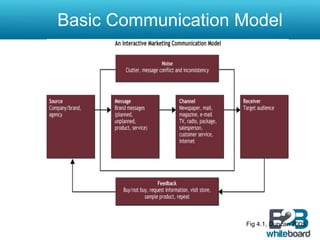
Basic Communication Model


                    Fig 4.1, Duncan 2005
Communication Feedback Models

 Source/Encoder
   Ø  Is the person or organisation that has
       information to share with another person or
       group.

 Encoding
   Ø  Leads to development of a message that
       contains the information of meaning the source
       hopes to convey.
Communication Feedback Models
Channel/Message
  Ø Is the method which communication travels from the
     source or sender to the receiver
     Ø Personal channels – direct interpersonal
     Ø Non-personal channels – mass communications


Decoding
  Ø Process of transforming the sender’s message back into
     thought
  Ø Influenced greatly by the receivers frame of reference
     (perceptions, attitudes and values)
Communication Feedback Models
 Receiver
   Ø Is the person(s) with whom the sender shares
      thoughts of information.
 Noise
   Ø External factors that create unplanned distortion


 Feedback
   Ø Receivers respond by hearing, seeing or
      reading
   Ø Feedback is sent back to the sender
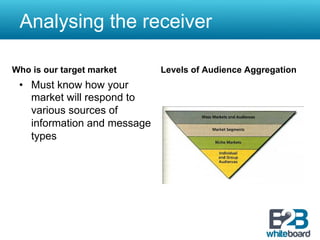
Analysing the receiver

Who is our target market      Levels of Audience Aggregation
 •  Must know how your
    market will respond to
    various sources of
    information and message
    types
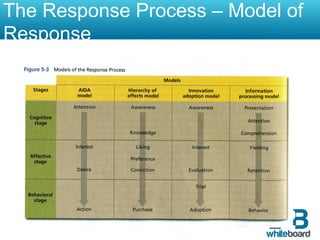
The Response Process – Model of
Response
Implications
 1.  Delineate the series of steps potenial
     purchasers must be taken through
 2.  Potenial buyers may be in different stages
     of the hierarchy creating problems.
 3.  Useful for promotional planners
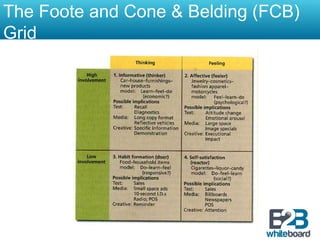
The FCB Planning Model
Aim: to improve the way your brand is positioned in the
  consumer’s mind thereby giving you a better return
  on your advertising dollar by:
1 Decide on the degree of involvement
2 Decide on the degree of thinking/feeling experienced
  by the consumer prior to purchasing
3 Place your brand on the Grid
4 Plot your competitors (cluster or not?)
5 Is current strategy right or need improving?
6 Player with the best position wins!!
The Foote and Cone & Belding (FCB)
Grid
The Cognitive Response Approach
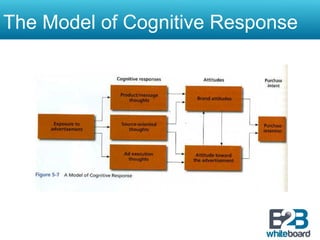
 •  Cognitive responses are the thoughts that
    occur to audience when they read, view
    and / or hear communication
 •  Looks at the type of responses evoked
    advertising messages
 •  Three types of cognitive responses
The Model of Cognitive Response
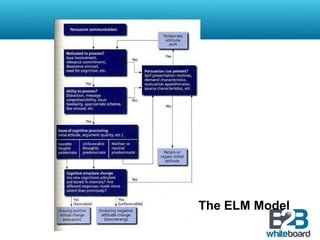
The Elaboration Likelihood Model
(ELM)
 •  Addresses the differences in the way
    consumers process and respond to
    persuasive messages.
 •  High and Low elaboration when it comes to
    information processing
The ELM Model
Summarising the response process
 •  Individual responses to advertising are
    mediated or filtered by factors such as
   Ø  motivation
   Ø ability to process information
 •  Advertising should be evaluated using
    three dimensions
   Ø    Product category
   Ø    Stage of life-cycle
   Ø    Target audience
   Ø    Competition
   Ø    Impact of marketing mix components
Value of Objectives
 •  Communication
   –  Objectives facilitate coordination of various
      groups working on the campaign
 •  Planning and Decision Making
   –  Specific promotional objectives also guide the
      development of IMC plan.
 •  Measurement and Evaluation of Results
   –  Objectives act as a benchmark for success or
      failure of the campaign and can be measured
Comparison of Marketing And
Communication Objectives

Marketing         Communication
•  Sales volume   •  Market segments the
•  Market share      company wants to target
•  ROI            •  The products FAB
•  Profit         •  The companies and
                     competitors brands.
                  •  Ideas on how the brand
                     should be positioned
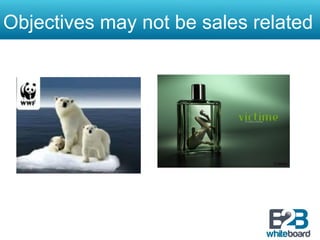
Objectives may not be sales related
Oral Care – Sales Focus
Sales versus Communication Objectives

 •  To many companies the goal is SALES
 •  Companies have increased pressure to
    make agencies more accountable for their
    performance.
 •  Some have developed ROI information
 •  Sales decline is not attributed to less
    advertising spend
 •  May be due to other marketing mix variables
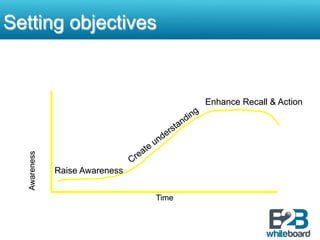
Setting objectives


                                       Enhance Recall & Action
  Awareness


              Raise Awareness


                                Time
DAGMAR: Defining Advertising Goals for Measured
Advertising Results

 1.  Awareness – making the consumer aware
     of the existence of the brand
 2.  Comprehension – developing and
     understanding of what the product is and
     what it will doe for the consumer
 3.  Conviction – developing a mental
     disposition in the consumer to buy the
     product.
 4.  Action – getting the consumer to purchase
     product
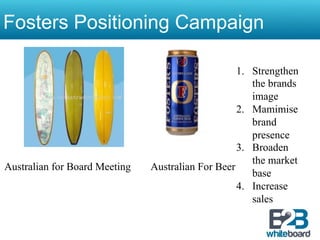
Fosters Positioning Campaign

                                                   1.  Strengthen
                                                       the brands
                                                       image
                                                   2.  Mamimise
                                                       brand
                                                       presence
                                                   3.  Broaden
                                                       the market
Australian for Board Meeting   Australian For Beer
                                                       base
                                                   4.  Increase
                                                       sales
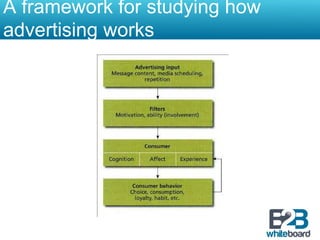
A framework for studying how
advertising works
Summary

 •  IMC is based on basic (persuasive)
    communication theory
 •  Understanding consumer response
 •  Allows communication objectives to be set
    by considering response models.
You are welcome to contact Nigel Bairstow at B2B
Whiteboard your source of B2B Asia / Pacific
marketing advice

http://www.linkedin.com/pub/nigel-bairstow/6/41b/726

http://twitter.com/#!/b2bwhiteboard

Marketing Communication Process

  • 1.
  • 2.
    Communication •  Definedas passing of information, the exchange of ideas, or the process of establishing a commonness or oneness of thought between senders and receiver.
  • 3.
    Basic Communication Model Fig 4.1, Duncan 2005
  • 4.
    Communication Feedback Models Source/Encoder Ø  Is the person or organisation that has information to share with another person or group. Encoding Ø  Leads to development of a message that contains the information of meaning the source hopes to convey.
  • 5.
    Communication Feedback Models Channel/Message Ø Is the method which communication travels from the source or sender to the receiver Ø Personal channels – direct interpersonal Ø Non-personal channels – mass communications Decoding Ø Process of transforming the sender’s message back into thought Ø Influenced greatly by the receivers frame of reference (perceptions, attitudes and values)
  • 6.
    Communication Feedback Models Receiver Ø Is the person(s) with whom the sender shares thoughts of information. Noise Ø External factors that create unplanned distortion Feedback Ø Receivers respond by hearing, seeing or reading Ø Feedback is sent back to the sender
  • 7.
    Analysing the receiver Whois our target market Levels of Audience Aggregation •  Must know how your market will respond to various sources of information and message types
  • 8.
    The Response Process– Model of Response
  • 9.
    Implications 1.  Delineatethe series of steps potenial purchasers must be taken through 2.  Potenial buyers may be in different stages of the hierarchy creating problems. 3.  Useful for promotional planners
  • 10.
    The FCB PlanningModel Aim: to improve the way your brand is positioned in the consumer’s mind thereby giving you a better return on your advertising dollar by: 1 Decide on the degree of involvement 2 Decide on the degree of thinking/feeling experienced by the consumer prior to purchasing 3 Place your brand on the Grid 4 Plot your competitors (cluster or not?) 5 Is current strategy right or need improving? 6 Player with the best position wins!!
  • 11.
    The Foote andCone & Belding (FCB) Grid
  • 12.
    The Cognitive ResponseApproach •  Cognitive responses are the thoughts that occur to audience when they read, view and / or hear communication •  Looks at the type of responses evoked advertising messages •  Three types of cognitive responses
  • 13.
    The Model ofCognitive Response
  • 14.
    The Elaboration LikelihoodModel (ELM) •  Addresses the differences in the way consumers process and respond to persuasive messages. •  High and Low elaboration when it comes to information processing
  • 15.
  • 16.
    Summarising the responseprocess •  Individual responses to advertising are mediated or filtered by factors such as Ø  motivation Ø ability to process information •  Advertising should be evaluated using three dimensions Ø  Product category Ø  Stage of life-cycle Ø  Target audience Ø  Competition Ø  Impact of marketing mix components
  • 17.
    Value of Objectives •  Communication –  Objectives facilitate coordination of various groups working on the campaign •  Planning and Decision Making –  Specific promotional objectives also guide the development of IMC plan. •  Measurement and Evaluation of Results –  Objectives act as a benchmark for success or failure of the campaign and can be measured
  • 18.
    Comparison of MarketingAnd Communication Objectives Marketing Communication •  Sales volume •  Market segments the •  Market share company wants to target •  ROI •  The products FAB •  Profit •  The companies and competitors brands. •  Ideas on how the brand should be positioned
  • 19.
    Objectives may notbe sales related
  • 20.
    Oral Care –Sales Focus
  • 21.
    Sales versus CommunicationObjectives •  To many companies the goal is SALES •  Companies have increased pressure to make agencies more accountable for their performance. •  Some have developed ROI information •  Sales decline is not attributed to less advertising spend •  May be due to other marketing mix variables
  • 22.
    Setting objectives Enhance Recall & Action Awareness Raise Awareness Time
  • 23.
    DAGMAR: Defining AdvertisingGoals for Measured Advertising Results 1.  Awareness – making the consumer aware of the existence of the brand 2.  Comprehension – developing and understanding of what the product is and what it will doe for the consumer 3.  Conviction – developing a mental disposition in the consumer to buy the product. 4.  Action – getting the consumer to purchase product
  • 24.
    Fosters Positioning Campaign 1.  Strengthen the brands image 2.  Mamimise brand presence 3.  Broaden the market Australian for Board Meeting Australian For Beer base 4.  Increase sales
  • 25.
    A framework forstudying how advertising works
  • 26.
    Summary •  IMCis based on basic (persuasive) communication theory •  Understanding consumer response •  Allows communication objectives to be set by considering response models.
  • 27.
    You are welcometo contact Nigel Bairstow at B2B Whiteboard your source of B2B Asia / Pacific marketing advice http://www.linkedin.com/pub/nigel-bairstow/6/41b/726 http://twitter.com/#!/b2bwhiteboard