Advertising as a communication tool
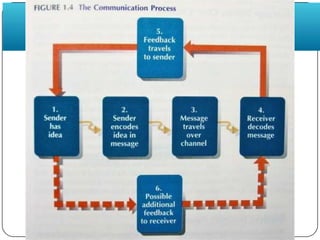
CommunicationDefined as passing of information, theexchange of ideas, or the process ofestablishing a commonness or oneness ofthought between senders and receiver.
Communication Feedback ModelsChannel/MessageIs the method which communication travels from the source or sender to the receiverPersonal channels – direct interpersonalNon-personalchannels – mass communicationsDecodingProcess of transforming the sender’s message back into thoughtInfluenced greatly by the receivers frame of reference (perceptions, attitudes and values)
Communication Feedback ModelsSource/EncoderIs the person or organisation that hasinformation to share with another person orgroup.EncodingLeads to development of a message thatcontains the information of meaning the sourcehopes to convey.
Communication Feedback ModelsReceiverIs the person(s) with whom the sender shares thoughts of information.NoiseExternal factors that create unplanned distortionFeedbackReceivers respond by hearing, seeing orn readingFeedback is sent back to the sender
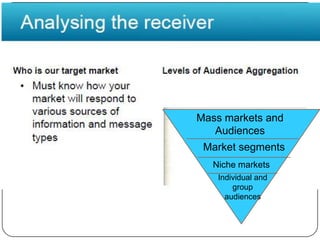
Mass markets and AudiencesMarket segmentsNiche marketsIndividual and group audiences
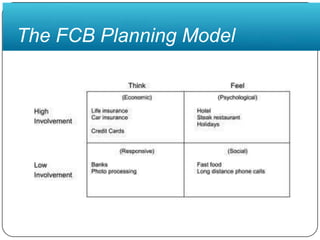
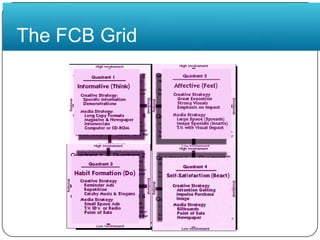
The FCB Planning Model
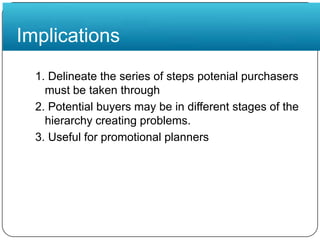
Implications1. Delineate the series of steps potenial purchasers must be taken through2. Potential buyers may be in different stages of the hierarchy creating problems.3. Useful for promotional planners
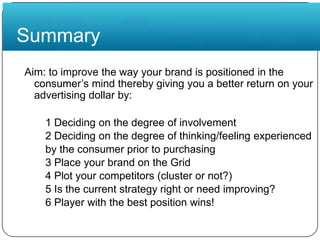
SummaryAim: to improve the way your brand is positioned in the consumer’s mind thereby giving you a better return on your advertising dollar by:1 Deciding on the degree of involvement2 Deciding on the degree of thinking/feeling experiencedby the consumer prior to purchasing3 Place your brand on the Grid4 Plot your competitors (cluster or not?)5 Is the current strategy right or need improving?6 Player with the best position wins!
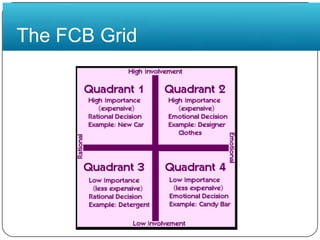
The FCB Grid
The FCB Grid
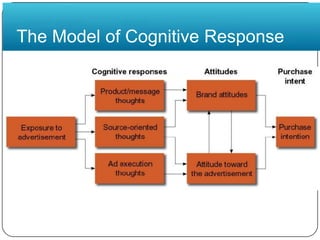
The Model of Cognitive Response
The IMC ModelThe theory of Integrated Marketing Communications (IMC) elegantly explains the relationships of marketing and branding (Schultz et al., 1996)
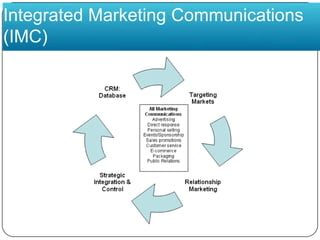
Integrated Marketing Communications (IMC)IMC is the organization, planning, and monitoring of marketing components and data to control and influence brand information, associations, and experiences. The goal is to incubate profitable relationships and dialog with patients and other groups. This is typically measured by internal and external surveys, focus groups, managerial accounting, trend analyses, referral indices, etc.
Marketing Communications (MC)This is an umbrella term for all communication avenues available for conveying marketing messages. These include advertising, public relations, sales promotions, direct response marketing, events, sponsorships, point-of-purchase materials, packaging, trade shows, customer service, and personal sales. MC is measured as the proportion of marketing dollars assigned to each avenue and the marketing return on investment (MROI) for each.
Integrated Marketing Communications (IMC)
The IMC ModelThe IMC Model“IMC builds the relationships that build brands.” (Duncan, 2002). It is impossible to talk about IMC without talking about brand. That is because brand building relies on creation and nurturing of profitable relationships to meet objectives, which is the goal of all IMC processes. IMC devises strategies to use MCs to create and build brandTo over come the shortcomings of the Hierarchy of Effects model, professors, Shultz, Tannerbaum and Lauterborn devised the IMC model.
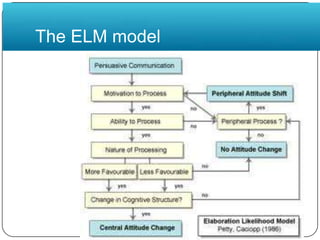
The Elaboration Likelihood Model(ELM)Addresses the differences in the way consumers process and respond to persuasive messages.High and Low elaboration when it comes to information processing
The ELM model
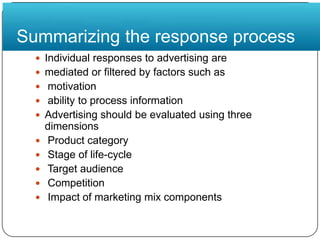
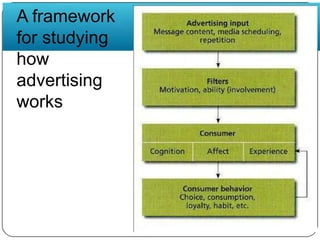
Summarizing the response processIndividual responses to advertising aremediated or filtered by factors such as motivation ability to process informationAdvertising should be evaluated using three dimensions Product category Stage of life-cycle Target audience Competition Impact of marketing mix components
SummaryIMC is based on basic (persuasive) communication theoryUnderstanding consumer responseAllows communication objectives to be setby considering response models.
Value of ObjectivesCommunication– Objectives facilitate coordination of variousgroups working on the campaign Planning and Decision Making– Specific promotional objectives also guide thedevelopment of IMC plan.Measurement and Evaluation of Results– Objectives act as a benchmark for success orfailure of the campaign and can be measured
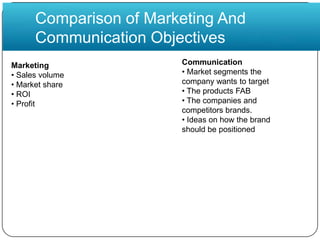
Comparison of Marketing AndCommunication ObjectivesCommunication• Market segments thecompany wants to target• The products FAB• The companies andcompetitors brands.• Ideas on how the brandshould be positionedMarketing• Sales volume• Market share• ROI• Profit
A framework for studying howadvertising works
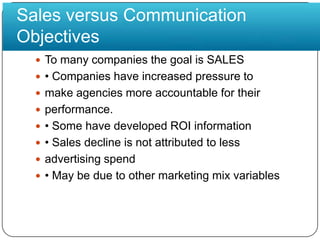
Sales versus Communication ObjectivesTo many companies the goal is SALES• Companies have increased pressure tomake agencies more accountable for theirperformance.• Some have developed ROI information• Sales decline is not attributed to lessadvertising spend• May be due to other marketing mix variables
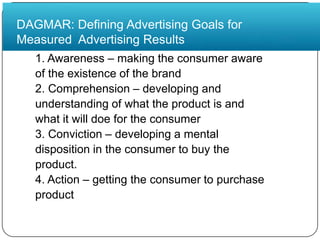
DAGMAR: Defining Advertising Goals for Measured  Advertising Results1. Awareness – making the consumer awareof the existence of the brand2. Comprehension – developing andunderstanding of what the product is andwhat it will doe for the consumer3. Conviction – developing a mentaldisposition in the consumer to buy theproduct.4. Action – getting the consumer to purchaseproduct
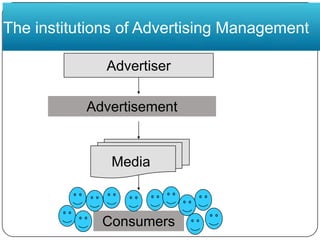
The institutions of Advertising ManagementAdvertiserAdvertisementMediaConsumers
Thankyou

Advertising as a communication tool final

  • 1.
    Advertising as acommunication tool
  • 2.
    CommunicationDefined as passingof information, theexchange of ideas, or the process ofestablishing a commonness or oneness ofthought between senders and receiver.
  • 4.
    Communication Feedback ModelsChannel/MessageIsthe method which communication travels from the source or sender to the receiverPersonal channels – direct interpersonalNon-personalchannels – mass communicationsDecodingProcess of transforming the sender’s message back into thoughtInfluenced greatly by the receivers frame of reference (perceptions, attitudes and values)
  • 5.
    Communication Feedback ModelsSource/EncoderIsthe person or organisation that hasinformation to share with another person orgroup.EncodingLeads to development of a message thatcontains the information of meaning the sourcehopes to convey.
  • 6.
    Communication Feedback ModelsReceiverIsthe person(s) with whom the sender shares thoughts of information.NoiseExternal factors that create unplanned distortionFeedbackReceivers respond by hearing, seeing orn readingFeedback is sent back to the sender
  • 7.
    Mass markets andAudiencesMarket segmentsNiche marketsIndividual and group audiences
  • 9.
  • 10.
    Implications1. Delineate theseries of steps potenial purchasers must be taken through2. Potential buyers may be in different stages of the hierarchy creating problems.3. Useful for promotional planners
  • 11.
    SummaryAim: to improvethe way your brand is positioned in the consumer’s mind thereby giving you a better return on your advertising dollar by:1 Deciding on the degree of involvement2 Deciding on the degree of thinking/feeling experiencedby the consumer prior to purchasing3 Place your brand on the Grid4 Plot your competitors (cluster or not?)5 Is the current strategy right or need improving?6 Player with the best position wins!
  • 12.
  • 13.
  • 14.
    The Model ofCognitive Response
  • 15.
    The IMC ModelThetheory of Integrated Marketing Communications (IMC) elegantly explains the relationships of marketing and branding (Schultz et al., 1996)
  • 16.
    Integrated Marketing Communications(IMC)IMC is the organization, planning, and monitoring of marketing components and data to control and influence brand information, associations, and experiences. The goal is to incubate profitable relationships and dialog with patients and other groups. This is typically measured by internal and external surveys, focus groups, managerial accounting, trend analyses, referral indices, etc.
  • 17.
    Marketing Communications (MC)Thisis an umbrella term for all communication avenues available for conveying marketing messages. These include advertising, public relations, sales promotions, direct response marketing, events, sponsorships, point-of-purchase materials, packaging, trade shows, customer service, and personal sales. MC is measured as the proportion of marketing dollars assigned to each avenue and the marketing return on investment (MROI) for each.
  • 18.
  • 19.
    The IMC ModelTheIMC Model“IMC builds the relationships that build brands.” (Duncan, 2002). It is impossible to talk about IMC without talking about brand. That is because brand building relies on creation and nurturing of profitable relationships to meet objectives, which is the goal of all IMC processes. IMC devises strategies to use MCs to create and build brandTo over come the shortcomings of the Hierarchy of Effects model, professors, Shultz, Tannerbaum and Lauterborn devised the IMC model.
  • 20.
    The Elaboration LikelihoodModel(ELM)Addresses the differences in the way consumers process and respond to persuasive messages.High and Low elaboration when it comes to information processing
  • 21.
  • 22.
    Summarizing the responseprocessIndividual responses to advertising aremediated or filtered by factors such as motivation ability to process informationAdvertising should be evaluated using three dimensions Product category Stage of life-cycle Target audience Competition Impact of marketing mix components
  • 23.
    SummaryIMC is basedon basic (persuasive) communication theoryUnderstanding consumer responseAllows communication objectives to be setby considering response models.
  • 24.
    Value of ObjectivesCommunication–Objectives facilitate coordination of variousgroups working on the campaign Planning and Decision Making– Specific promotional objectives also guide thedevelopment of IMC plan.Measurement and Evaluation of Results– Objectives act as a benchmark for success orfailure of the campaign and can be measured
  • 25.
    Comparison of MarketingAndCommunication ObjectivesCommunication• Market segments thecompany wants to target• The products FAB• The companies andcompetitors brands.• Ideas on how the brandshould be positionedMarketing• Sales volume• Market share• ROI• Profit
  • 26.
    A framework forstudying howadvertising works
  • 27.
    Sales versus CommunicationObjectivesTo many companies the goal is SALES• Companies have increased pressure tomake agencies more accountable for theirperformance.• Some have developed ROI information• Sales decline is not attributed to lessadvertising spend• May be due to other marketing mix variables
  • 28.
    DAGMAR: Defining AdvertisingGoals for Measured Advertising Results1. Awareness – making the consumer awareof the existence of the brand2. Comprehension – developing andunderstanding of what the product is andwhat it will doe for the consumer3. Conviction – developing a mentaldisposition in the consumer to buy theproduct.4. Action – getting the consumer to purchaseproduct
  • 29.
    The institutions ofAdvertising ManagementAdvertiserAdvertisementMediaConsumers
  • 30.

Editor's Notes

  • #13 "FCB grid,” is suggested by Dave Berger and Richard Vaughn. This model combines high and low involvement, and left and right brain specialization. It shows a visually coherent matrix which has four quadrants with two factors—high and low involvement, and feeling and thinking. The communication response would certainly be different for high versus low involvement products and those which required mainly thinking (left brain) and feeling (right brain) information processing. To define involvement and think / feel, eight scales are used: High Involvement:Very important decision Lot to lose if you choose the wrong brand Decision requires lot Low involvement :Unimportant decision.Little to lose if you choose the wrong brand.Decision requires little thoughtThink or rational approachDecision is / is not mainly logical or objective Decision is / is not based mainly on functional factsFeel or emotional approachDecision is / is not based on a lot of feeling Decision does / does not express one’s personality Decision is / is not based on looks, tastes, touch, smell, or sound (sensory effects)
  • #14 "FCB grid,” is suggested by Dave Berger and Richard Vaughn. This model combines high and low involvement, and left and right brain specialization. It shows a visually coherent matrix which has four quadrants with two factors—high and low involvement, and feeling and thinking. The communication response would certainly be different for high versus low involvement products and those which required mainly thinking (left brain) and feeling (right brain) information processing. To define involvement and think / feel, eight scales are used: High Involvement:Very important decision Lot to lose if you choose the wrong brand Decision requires lot Low involvement :Unimportant decision.Little to lose if you choose the wrong brand.Decision requires little thoughtThink or rational approachDecision is / is not mainly logical or objective Decision is / is not based mainly on functional factsFeel or emotional approachDecision is / is not based on a lot of feeling Decision does / does not express one’s personality Decision is / is not based on looks, tastes, touch, smell, or sound (sensory effects)
  • #15 General Information:A cognitive response is a thought generated in response to persuasive communication (Petty, 1981) and therefore, triggers an attitude change. The way in which a cognitive response effects attitude, after being exposed to persuasive communication, has to do with the way the recipient of the communication manipulates, elaborates and integrates the information (Greenwald, 1968). When people are exposed to information, they relate it to pre-existing thoughts that they already have on the subject. People are of course more likely to be persuaded by messages to which they have previously thought optimistically. The cognitive response theory attempts to understand the link between the initial response to communication and the attitude change that results. The theory says that a cognitive response influences final attitude and therefore may effect behavior. There are four characteristics of the cognitive response theory that makes it different from other research about attitude; the model uses production tasks, it is multidimensional, it is a qualitative theory and it is a memory-based theory. Production tasks refer to the fact that the subject who is being exposed to the text has an opportunity to express thoughts as s/he experiences them. THis is contradictory to previous studies when the subject's thoughts had to be expressed by rating their experience on a scale. Other studies about attitude ignored the fact that attitude is multidimensional and only attempted to "explain people's responses in a single dimension" (Kyu-Wu Oh, 1997). This theory is qualitative as apposed to previous quantitative theories. The qualitative approach accounts for qualitative differences among thoughts. As a memory-based theory, "it tells us what thoughts people generate when they are confronted with unexpected circumstances and are asked to make decisions toward attitude objects" (Kyu-Wu Oh, 1997). This is in opposition to information-based theories, which primarily concern acceptance or rejection of new information. This theory addresses the problem with many other commnunication theories in that it acknowledges that the reciever of information from a text is active and not passive.
  • #17 To begin, it is helpful to define some of the terms related to the quantitative evaluation of IMC:Market: A group of people or organizations with needs and wants who are willing to spend their resources (time and money) to satisfy those needs and wants (Etzel et al., 2004).Marketing: It is a process. We use the marketing process whenever we create and make available what people with hearing and balance problems want in exchange for what they are willing to pay and do for it. We measure the results of the process by number of customers, sales, amount of profit generated, etc.Marketing Communications (MC): This is an umbrella term for all communication avenues available for conveying marketing messages. These include advertising, public relations, sales promotions, direct response marketing, events, sponsorships, point-of-purchase materials, packaging, trade shows, customer service, and personal sales. MC is measured as the proportion of marketing dollars assigned to each avenue and the marketing return on investment (MROI) for each.Marketing Mix: The MC elements used by a particular audiology practice, measured in marketing dollars and MROI.Brand: It is the total collection of perceptions and associations (good, bad, and indifferent) that differentiate an audiology practice from its competitors. Brand is measured according to the equation:Brand Equity = Practice Value – physical net assets Accountants and the IRS refer to Brand Equity as “Good Will.” Integrated Marketing Communications (IMC): Another process. IMC is the organization, planning, and monitoring of marketing components and data to control and influence brand information, associations, and experiences. The goal is to incubate profitable relationships and dialog with patients and other groups. This is typically measured by internal and external surveys, focus groups, managerial accounting, trend analyses, referral indices, etc. The IMC Model“IMC builds the relationships that build brands.” (Duncan, 2002).It is impossible to talk about IMC without talking about brand. That is because brand building relies on creation and nurturing of profitable relationships to meet objectives, which is the goal of all IMC processes. IMC devises strategies to use MCs to create and build brand for individual audiology practices. IMC has important characteristics (Figure 1), the discussion of which constitutes the body of this and other articles in the four-part IMC series. IMC is:continuous and circular, with no beginning or end as long as the practice is alive.data-driven, using information collection and feedback from Customer Relationship Management (CRM) technology to develop messages and dialog with target markets.customer-centric, focusing on target market needs and wants rather than on specific products and technologies. strategic, creating a consistent meaning in all messages and dialog. nurturing, “growing” customers by finding new ways to increase their satisfaction.profitable, focusing on lucrative relationships to make them more worthwhile.integrated, ensuring that all messages and all personnel work together to speak with one voice. accountable, viewing marketing expenditures as short and long-term investments to meet objectives (MROI) rather than expenses to be minimized (Etzel et al., 2004). independent of any specific marketing mix, recognizing that each practice is unique.
  • #19 To begin, it is helpful to define some of the terms related to the quantitative evaluation of IMC:Market: A group of people or organizations with needs and wants who are willing to spend their resources (time and money) to satisfy those needs and wants (Etzel et al., 2004).Marketing: It is a process. We use the marketing process whenever we create and make available what people with hearing and balance problems want in exchange for what they are willing to pay and do for it. We measure the results of the process by number of customers, sales, amount of profit generated, etc.Marketing Communications (MC): This is an umbrella term for all communication avenues available for conveying marketing messages. These include advertising, public relations, sales promotions, direct response marketing, events, sponsorships, point-of-purchase materials, packaging, trade shows, customer service, and personal sales. MC is measured as the proportion of marketing dollars assigned to each avenue and the marketing return on investment (MROI) for each.Marketing Mix: The MC elements used by a particular audiology practice, measured in marketing dollars and MROI.Brand: It is the total collection of perceptions and associations (good, bad, and indifferent) that differentiate an audiology practice from its competitors. Brand is measured according to the equation:Brand Equity = Practice Value – physical net assetsAccountants and the IRS refer to Brand Equity as “Good Will.” Integrated Marketing Communications (IMC): Another process. IMC is the organization, planning, and monitoring of marketing components and data to control and influence brand information, associations, and experiences. The goal is to incubate profitable relationships and dialog with patients and other groups. This is typically measured by internal and external surveys, focus groups, managerial accounting, trend analyses, referral indices, etc. The IMC Model“IMC builds the relationships that build brands.” (Duncan, 2002).It is impossible to talk about IMC without talking about brand. That is because brand building relies on creation and nurturing of profitable relationships to meet objectives, which is the goal of all IMC processes. IMC devises strategies to use MCs to create and build brand for individual audiology practices. IMC has important characteristics (Figure 1), the discussion of which constitutes the body of this and other articles in the four-part IMC series. IMC is:continuous and circular, with no beginning or end as long as the practice is alive.data-driven, using information collection and feedback from Customer Relationship Management (CRM) technology to develop messages and dialog with target markets.customer-centric, focusing on target market needs and wants rather than on specific products and technologies. strategic, creating a consistent meaning in all messages and dialog. nurturing, “growing” customers by finding new ways to increase their satisfaction.profitable, focusing on lucrative relationships to make them more worthwhile.integrated, ensuring that all messages and all personnel work together to speak with one voice. accountable, viewing marketing expenditures as short and long-term investments to meet objectives (MROI) rather than expenses to be minimized (Etzel et al., 2004). independent of any specific marketing mix, recognizing that each practice is unique.
  • #23 The elaboration likelihood model (ELM) of persuasion[1] is a model of how attitudes are formed and changed that was developed by R. E. Petty and J. T. Cacioppo in the early 1980s (see also attitude change). Central to this model is the "elaboration continuum", which ranges from low elaboration (low thought) to high elaboration (high thought). The ELM distinguishes between two routes to persuasion: the "central route," where a subject considers an idea logically, and the "peripheral route," in which the audience uses preexisting ideas and superficial qualities to be persuaded.