Marketing – Module 6
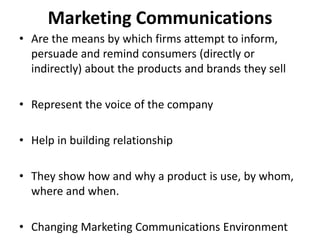
Marketing Communications
• Are the means by which firms attempt to inform,
persuade and remind consumers (directly or
indirectly) about the products and brands they sell
• Represent the voice of the company
• Help in building relationship
• They show how and why a product is use, by whom,
where and when.
• Changing Marketing Communications Environment
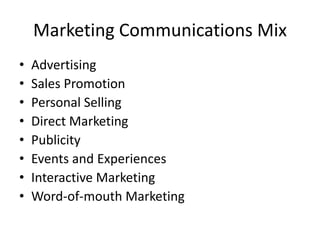
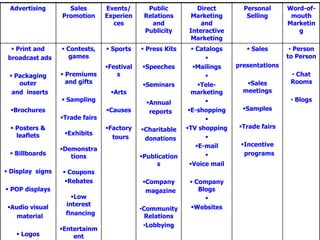
Marketing Communications Mix
• Advertising
• Sales Promotion
• Personal Selling
• Direct Marketing
• Publicity
• Events and Experiences
• Interactive Marketing
• Word-of-mouth Marketing
Advertising Sales
Promotion
Events/
Experien
ces
Public
Relations
and
Publicity
Direct
Marketing
and
Interactive
Marketing
Personal
Selling
Word-of-
mouth
Marketin
g
 Print and
broadcast ads
 Packaging
outer
and inserts
Brochures
 Posters &
leaflets
 Billboards
 Display signs
 POP displays
Audio visual
material
 Logos
 Contests,
games
 Premiums
and gifts
 Sampling
Trade fairs
Exhibits
Demonstra
tions
 Coupons
Rebates
Low
interest
financing
Entertainm
ent
 Sports
Festival
s
Arts
Causes
Factory
tours
 Press Kits
Speeches
Seminars
Annual
reports
Charitable
donations
Publication
s
Company
magazine
•Community
Relations
•Lobbying
 Catalogs

Mailings

Tele-
marketing

E-shopping

TV shopping

E-mail

Voice mail
 Company
Blogs

Websites
 Sales
presentations
Sales
meetings
Samples
Trade fairs
Incentive
programs
• Person
to Person
• Chat
Rooms
• Blogs
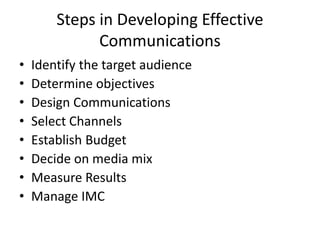
Steps in Developing Effective
Communications
• Identify the target audience
• Determine objectives
• Design Communications
• Select Channels
• Establish Budget
• Decide on media mix
• Measure Results
• Manage IMC
Identify the Target Audience
• Potential Buyers of the products
• Users, Deciders, influencers
• Target audience is critical for deciding on
– What will be said (message content)
– How it will be said (message structure, format)
– When it will be said
– Where it will be said
– Who will say it (source)
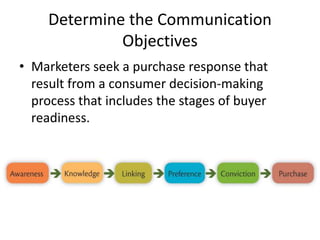
Determine the Communication
Objectives
• Marketers seek a purchase response that
result from a consumer decision-making
process that includes the stages of buyer
readiness.
Design Communications
• What to say (Message Strategy)
• How to say (Creative Strategy)
• Who should say it (Message Source)
Design Communications
• Message Strategy
– Search for appeals, themes or ideas that will tie in
to the brand positioning
– It helps establish POP and POD
– Some relate to performance
– Some relate to extrinsic considerations
Design Communications
• Creative Strategy
– Translate the messages into specific
communication
– Informational Appeal
• Elaborates on product or service attributes
• Saridon
• Domino’s
– Transformational Appeal
• Non Product Related Benefit or image
Design Communications
• Message Source
– Messages delivered by attractive or popular
sources can achieve higher attention and recall
– Celebrities
– Expertise – specialized knowledge on the subject
– Trustworthiness – objective and honest the source
– Likability – source’s attractiveness
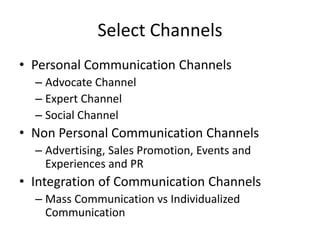
Select Channels
• Personal Communication Channels
– Advocate Channel
– Expert Channel
– Social Channel
• Non Personal Communication Channels
– Advertising, Sales Promotion, Events and
Experiences and PR
• Integration of Communication Channels
– Mass Communication vs Individualized
Communication
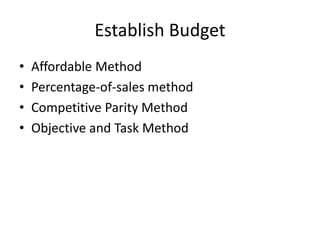
Establish Budget
• Affordable Method
• Percentage-of-sales method
• Competitive Parity Method
• Objective and Task Method
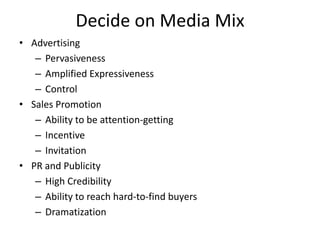
Decide on Media Mix
• Advertising
– Pervasiveness
– Amplified Expressiveness
– Control
• Sales Promotion
– Ability to be attention-getting
– Incentive
– Invitation
• PR and Publicity
– High Credibility
– Ability to reach hard-to-find buyers
– Dramatization
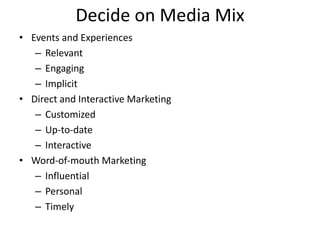
Decide on Media Mix
• Events and Experiences
– Relevant
– Engaging
– Implicit
• Direct and Interactive Marketing
– Customized
– Up-to-date
– Interactive
• Word-of-mouth Marketing
– Influential
– Personal
– Timely
Decide on Media Mix
• Personal Selling
– Personal Interaction
– Cultivation
– Response
Factors in Setting Communications Mix
• Type of Product Market
– Consumer vs Business Market
– Consumer – Sales Promotion, Advertising
– Business – Personal Selling
• Buyer Readiness Stage
– Awareness, Comprehension, Order, Reorder
• Product Life Cycle Stage
Measure Results
• Measurement must for knowing the impact
• Recall, Remember, Points they recall, previous
and current attitudes etc.
• Total Market, Awareness, Brand Trial,
Satisfaction
Managing The IMC Process
• A planning process designed to assure that all
brand contacts received by a customer or
prospect for a product, service or organization
are relevant to that person and consistent
over time
• Coordinating Media
– Multiple Vehicle, Multiple Stage
• Implementing IMC
ADVERTISING
• Cost effective way to disseminate messages
• Build brand preference or educate people
• Five M’s
– Mission: Objectives
– Money: Spending
– Message: What Message to Send
– Media: What to use?
– Measurement: How to evaluate?
Setting Objectives
• Advertising objectives must flow from prior
decisions on target market, brand positioning
and the marketing program
• To increase among 30 million homemakers
who own automatic washers the number who
identify brand X as a low-sudsing detergent,
and who are persuaded that it gets clothes
cleaner from 10% to 40% in one year
Setting Objectives
• Informative Advertising
• Persuasive Advertising
• Reminder Advertising
• Reinforcement Advertising
Deciding Budget
• Although an expense, part of spending is an
investment in brand equity and customer
loyalty
• Factors affecting budget decisions:
– Stage in the product life cycle
– Market Share and consumer base
– Competition and clutter
– Advertising Frequency
– Product Substitutability
Developing The Advertising Campaign
• Message Generation and Evaluation
– Which appeal?
– Creative Brief
– Positioning Statement
– Alternate ad themes
• Creative Development and Execution
– TV Ads
– Print Ads
– Radio Ads
– Film Ads
Legal and Social Issues
• Laws and regulations govern advertising
• No ads for Alcoholic and Tobacco products,
however surrogate advertising is permitted
• Infant food advertising was not permitted
• Advertisement of Medicines prohibited
• ASCI
Deciding Media
• Deciding Reach, Frequency and Impact
– Reach – The number of different persons or
households exposed to a particular media schedule at
least once during a specified time period
– Frequency – The number of times within the specified
time period that an average person or household is
exposed to the message
– Impact – The qualitative value of an exposure through
a given medium (Food Ad in Bon Apetit vs Fortune
magazine)
Choosing among major media types
• News Papers
• Television
• Direct Mail
• Radio
• Magazines
• Outdoor
• Yellow Pages
• Newsletters
• Brochures
• Telephone
• Internet
Alternate Advertising Options
• Place Advertising
– Bill Boards
– Public Spaces
– Product Placement
– Point of Purchase
Deciding Media Timing and Allocation
• Continuity
• Concentration
• Flighting
• Pulsing
Evaluating Advertising Effectiveness
• Communication Effect Research
• Sales Effect Research
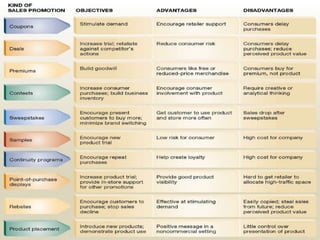
Sales Promotion
• Consists of a collection of incentives tools, mostly
short term, designed to stimulate quicker or
greater purchase
• Advertising offers a reason to buy, sales
promotion offers an incentive
• Promotion includes tools for
– Consumer Promotion – Samples, Coupons, Cash Backs
etc.
– Trade Promotion – Prices off, advertising and display
allowances
– Sales force promotion – Trade shows, contents for sale
reps, specialty advertising
Sales Promotion
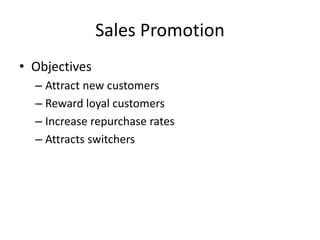
• Objectives
– Attract new customers
– Reward loyal customers
– Increase repurchase rates
– Attracts switchers
Sales Promotion
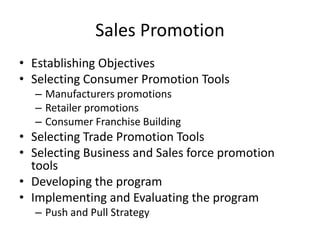
• Establishing Objectives
• Selecting Consumer Promotion Tools
– Manufacturers promotions
– Retailer promotions
– Consumer Franchise Building
• Selecting Trade Promotion Tools
• Selecting Business and Sales force promotion
tools
• Developing the program
• Implementing and Evaluating the program
– Push and Pull Strategy
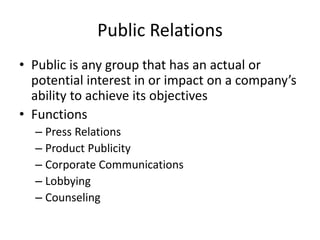
Public Relations
• Public is any group that has an actual or
potential interest in or impact on a company’s
ability to achieve its objectives
• Functions
– Press Relations
– Product Publicity
– Corporate Communications
– Lobbying
– Counseling
Publicity
• Securing editorial space
• Launching New products
• Repositioning a mature product
• Building interest in a product category
• Influencing specific target group
• Defending products that have problems
• Building corporate image
Direct Marketing
• Use of consumer direct channels to reach and
deliver goods and services to customers
without using middlemen
• Can use number of channels to reach
individual prospects: Direct Mail, catalog
Marketing, Telemarketing, Interactive TV,
Kiosks, websites and mobile devices
Benefits of Direct Marketing
• Market Demassification
• Consumer short of time and stressed
appreciate toll free numbers, websites, next
day delivery
• Direct Marketers can buy mailing list
containing the names and addresses of
prospects
• Direct reach to customers
Direct Mail
• Selective mailing list
• Permits target market selectivity
• Personalized
• Early testing and response measurement
Catalogue Marketing
• Full line merchandize catalogues
• Specialty consumer catalogues
• E-Catalogues
Telemarketing
• Outbound Telemarketing
• Inbound Telemarketing
Issues in Direct Marketing
• Irritation
• Unfairness
• Deception or fraud
• Invasion of privacy
E- Commerce
• Websites
• Search Ads
• Display Ads
• Email
• Mobile Marketing
E-Business
• E business, or e-business, is the application of
information and communication technologies
(ICT) in support of all the activities
of business. Commerce constitutes the
exchange of products and services
between businesses, groups and individuals
and can be seen as one of the essential
activities of any business.
Personal Selling
• Prospecting and qualifying
• Pre Approach
• Presentation and Demonstration
• Overcoming Objections
• Closing
• Follow up
LA FIN

Mm aug 2014 module 6

  • 1.
  • 2.
    Marketing Communications • Arethe means by which firms attempt to inform, persuade and remind consumers (directly or indirectly) about the products and brands they sell • Represent the voice of the company • Help in building relationship • They show how and why a product is use, by whom, where and when. • Changing Marketing Communications Environment
  • 3.
    Marketing Communications Mix •Advertising • Sales Promotion • Personal Selling • Direct Marketing • Publicity • Events and Experiences • Interactive Marketing • Word-of-mouth Marketing
  • 4.
    Advertising Sales Promotion Events/ Experien ces Public Relations and Publicity Direct Marketing and Interactive Marketing Personal Selling Word-of- mouth Marketin g  Printand broadcast ads  Packaging outer and inserts Brochures  Posters & leaflets  Billboards  Display signs  POP displays Audio visual material  Logos  Contests, games  Premiums and gifts  Sampling Trade fairs Exhibits Demonstra tions  Coupons Rebates Low interest financing Entertainm ent  Sports Festival s Arts Causes Factory tours  Press Kits Speeches Seminars Annual reports Charitable donations Publication s Company magazine •Community Relations •Lobbying  Catalogs  Mailings  Tele- marketing  E-shopping  TV shopping  E-mail  Voice mail  Company Blogs  Websites  Sales presentations Sales meetings Samples Trade fairs Incentive programs • Person to Person • Chat Rooms • Blogs
  • 5.
    Steps in DevelopingEffective Communications • Identify the target audience • Determine objectives • Design Communications • Select Channels • Establish Budget • Decide on media mix • Measure Results • Manage IMC
  • 6.
    Identify the TargetAudience • Potential Buyers of the products • Users, Deciders, influencers • Target audience is critical for deciding on – What will be said (message content) – How it will be said (message structure, format) – When it will be said – Where it will be said – Who will say it (source)
  • 7.
    Determine the Communication Objectives •Marketers seek a purchase response that result from a consumer decision-making process that includes the stages of buyer readiness.
  • 8.
    Design Communications • Whatto say (Message Strategy) • How to say (Creative Strategy) • Who should say it (Message Source)
  • 9.
    Design Communications • MessageStrategy – Search for appeals, themes or ideas that will tie in to the brand positioning – It helps establish POP and POD – Some relate to performance – Some relate to extrinsic considerations
  • 10.
    Design Communications • CreativeStrategy – Translate the messages into specific communication – Informational Appeal • Elaborates on product or service attributes • Saridon • Domino’s – Transformational Appeal • Non Product Related Benefit or image
  • 11.
    Design Communications • MessageSource – Messages delivered by attractive or popular sources can achieve higher attention and recall – Celebrities – Expertise – specialized knowledge on the subject – Trustworthiness – objective and honest the source – Likability – source’s attractiveness
  • 12.
    Select Channels • PersonalCommunication Channels – Advocate Channel – Expert Channel – Social Channel • Non Personal Communication Channels – Advertising, Sales Promotion, Events and Experiences and PR • Integration of Communication Channels – Mass Communication vs Individualized Communication
  • 13.
    Establish Budget • AffordableMethod • Percentage-of-sales method • Competitive Parity Method • Objective and Task Method
  • 14.
    Decide on MediaMix • Advertising – Pervasiveness – Amplified Expressiveness – Control • Sales Promotion – Ability to be attention-getting – Incentive – Invitation • PR and Publicity – High Credibility – Ability to reach hard-to-find buyers – Dramatization
  • 15.
    Decide on MediaMix • Events and Experiences – Relevant – Engaging – Implicit • Direct and Interactive Marketing – Customized – Up-to-date – Interactive • Word-of-mouth Marketing – Influential – Personal – Timely
  • 16.
    Decide on MediaMix • Personal Selling – Personal Interaction – Cultivation – Response
  • 17.
    Factors in SettingCommunications Mix • Type of Product Market – Consumer vs Business Market – Consumer – Sales Promotion, Advertising – Business – Personal Selling • Buyer Readiness Stage – Awareness, Comprehension, Order, Reorder • Product Life Cycle Stage
  • 18.
    Measure Results • Measurementmust for knowing the impact • Recall, Remember, Points they recall, previous and current attitudes etc. • Total Market, Awareness, Brand Trial, Satisfaction
  • 19.
    Managing The IMCProcess • A planning process designed to assure that all brand contacts received by a customer or prospect for a product, service or organization are relevant to that person and consistent over time • Coordinating Media – Multiple Vehicle, Multiple Stage • Implementing IMC
  • 20.
    ADVERTISING • Cost effectiveway to disseminate messages • Build brand preference or educate people • Five M’s – Mission: Objectives – Money: Spending – Message: What Message to Send – Media: What to use? – Measurement: How to evaluate?
  • 21.
    Setting Objectives • Advertisingobjectives must flow from prior decisions on target market, brand positioning and the marketing program • To increase among 30 million homemakers who own automatic washers the number who identify brand X as a low-sudsing detergent, and who are persuaded that it gets clothes cleaner from 10% to 40% in one year
  • 22.
    Setting Objectives • InformativeAdvertising • Persuasive Advertising • Reminder Advertising • Reinforcement Advertising
  • 23.
    Deciding Budget • Althoughan expense, part of spending is an investment in brand equity and customer loyalty • Factors affecting budget decisions: – Stage in the product life cycle – Market Share and consumer base – Competition and clutter – Advertising Frequency – Product Substitutability
  • 24.
    Developing The AdvertisingCampaign • Message Generation and Evaluation – Which appeal? – Creative Brief – Positioning Statement – Alternate ad themes • Creative Development and Execution – TV Ads – Print Ads – Radio Ads – Film Ads
  • 25.
    Legal and SocialIssues • Laws and regulations govern advertising • No ads for Alcoholic and Tobacco products, however surrogate advertising is permitted • Infant food advertising was not permitted • Advertisement of Medicines prohibited • ASCI
  • 26.
    Deciding Media • DecidingReach, Frequency and Impact – Reach – The number of different persons or households exposed to a particular media schedule at least once during a specified time period – Frequency – The number of times within the specified time period that an average person or household is exposed to the message – Impact – The qualitative value of an exposure through a given medium (Food Ad in Bon Apetit vs Fortune magazine)
  • 27.
    Choosing among majormedia types • News Papers • Television • Direct Mail • Radio • Magazines • Outdoor • Yellow Pages • Newsletters • Brochures • Telephone • Internet
  • 28.
    Alternate Advertising Options •Place Advertising – Bill Boards – Public Spaces – Product Placement – Point of Purchase
  • 29.
    Deciding Media Timingand Allocation • Continuity • Concentration • Flighting • Pulsing
  • 30.
    Evaluating Advertising Effectiveness •Communication Effect Research • Sales Effect Research
  • 31.
    Sales Promotion • Consistsof a collection of incentives tools, mostly short term, designed to stimulate quicker or greater purchase • Advertising offers a reason to buy, sales promotion offers an incentive • Promotion includes tools for – Consumer Promotion – Samples, Coupons, Cash Backs etc. – Trade Promotion – Prices off, advertising and display allowances – Sales force promotion – Trade shows, contents for sale reps, specialty advertising
  • 32.
    Sales Promotion • Objectives –Attract new customers – Reward loyal customers – Increase repurchase rates – Attracts switchers
  • 33.
    Sales Promotion • EstablishingObjectives • Selecting Consumer Promotion Tools – Manufacturers promotions – Retailer promotions – Consumer Franchise Building • Selecting Trade Promotion Tools • Selecting Business and Sales force promotion tools • Developing the program • Implementing and Evaluating the program – Push and Pull Strategy
  • 35.
    Public Relations • Publicis any group that has an actual or potential interest in or impact on a company’s ability to achieve its objectives • Functions – Press Relations – Product Publicity – Corporate Communications – Lobbying – Counseling
  • 36.
    Publicity • Securing editorialspace • Launching New products • Repositioning a mature product • Building interest in a product category • Influencing specific target group • Defending products that have problems • Building corporate image
  • 37.
    Direct Marketing • Useof consumer direct channels to reach and deliver goods and services to customers without using middlemen • Can use number of channels to reach individual prospects: Direct Mail, catalog Marketing, Telemarketing, Interactive TV, Kiosks, websites and mobile devices
  • 38.
    Benefits of DirectMarketing • Market Demassification • Consumer short of time and stressed appreciate toll free numbers, websites, next day delivery • Direct Marketers can buy mailing list containing the names and addresses of prospects • Direct reach to customers
  • 39.
    Direct Mail • Selectivemailing list • Permits target market selectivity • Personalized • Early testing and response measurement
  • 40.
    Catalogue Marketing • Fullline merchandize catalogues • Specialty consumer catalogues • E-Catalogues
  • 41.
  • 42.
    Issues in DirectMarketing • Irritation • Unfairness • Deception or fraud • Invasion of privacy
  • 43.
    E- Commerce • Websites •Search Ads • Display Ads • Email • Mobile Marketing
  • 44.
    E-Business • E business,or e-business, is the application of information and communication technologies (ICT) in support of all the activities of business. Commerce constitutes the exchange of products and services between businesses, groups and individuals and can be seen as one of the essential activities of any business.
  • 45.
    Personal Selling • Prospectingand qualifying • Pre Approach • Presentation and Demonstration • Overcoming Objections • Closing • Follow up
  • 46.