Integrated Service Marketing
Communications
Objectives
Role of marketing communications in services
Challenges of service communications
Marketing communications planning
Marketing communications mix
Role of the internet, and other electronic media in

service marketing communications

Role of corporate design
Integrated marketing communications
Role of Marketing communications
 Position and differentiate the service
 Helps Customers to evaluate Service Offerings
 Promote the Contribution of the Service Personnel
 Add Value through Communication Content
 Facilitate Customer Involvement in Production
 Stimulate or Dampen Demand to match Capacity
Challenges of Service
Communications
Problems of Intangibility
 Intangibility creates 4 problems:
 Generality

 Items that comprise a class of objects, persons, or events
 Non-searchability

 Cannot be searched or inspected before purchase
 Abstractness

 No one-to-one correspondence with physical objects
 Mental impalpability

 Customers find it hard to grasp benefits of complex,

multidimensional new offerings
Overcoming Intangibility
 To overcome intangibility

Use tangible cues in advertising
Use metaphors to communicate

benefits of service offerings
Marketing Communications
Planning
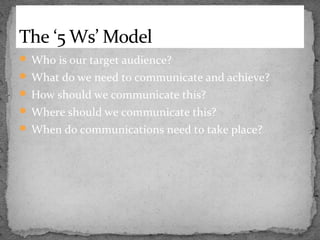
The ‘5 Ws’ Model
 Who is our target audience?
 What do we need to communicate and achieve?
 How should we communicate this?
 Where should we communicate this?
 When do communications need to take place?
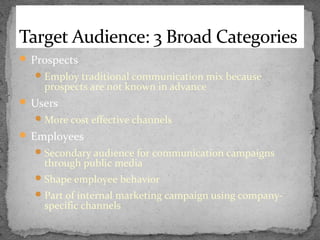
Target Audience: 3 Broad Categories
 Prospects
 Employ traditional communication mix because

prospects are not known in advance

 Users
 More cost effective channels

 Employees
 Secondary audience for communication campaigns

through public media

 Shape employee behavior
 Part of internal marketing campaign using company-

specific channels
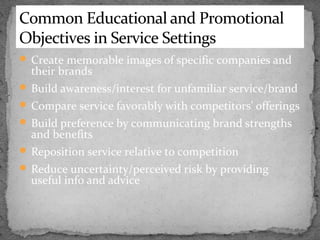
Common Educational and Promotional
Objectives in Service Settings
 Create memorable images of specific companies and

their brands

 Build awareness/interest for unfamiliar service/brand
 Compare service favorably with competitors’ offerings
 Build preference by communicating brand strengths

and benefits

 Reposition service relative to competition
 Reduce uncertainty/perceived risk by providing

useful info and advice
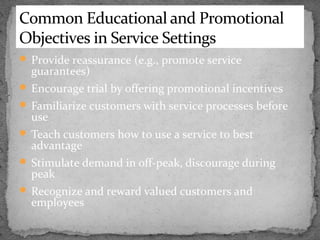
Common Educational and Promotional
Objectives in Service Settings
 Provide reassurance (e.g., promote service

guarantees)

 Encourage trial by offering promotional incentives
 Familiarize customers with service processes before

use

 Teach customers how to use a service to best

advantage

 Stimulate demand in off-peak, discourage during

peak

 Recognize and reward valued customers and

employees
Messages through Marketing Channels:
Advertising
 Build awareness, inform, persuade, and remind
 Challenge: How stand out from the crowd?
 Effectiveness remains controversial
 Research suggests that less than half of all ads

generate a positive return on their investment
Messages through Marketing Channels:
Public Relations
 PR/Publicity involves efforts to stimulate positive

interest in an organization and its products through
third parties



e.g., press conferences, news releases, sponsorships

 Corporate PR specialists teach senior managers how

to present themselves well at public events, especially
when faced with hostile questioning

 Unusual activities can present an opportunity to

promote company’s expertise
Messages through Marketing Channels:
Direct Marketing
 Mailings, recorded telephone messages, faxes, email
 Potential to send personalized messages to highly

targeted micro segments

 Need detailed database of information about customers

and prospects
Messages through Marketing Channels:
Direct Marketing
 Advance in on-demand technologies empower

consumers to decide how and when they prefer to be
reached, and by whom
 e.g. email spam filters, pop-up blockers, podcasting

 Permission Marketing goal is to persuade customers

to volunteer their attention

 Enables firms to build strong relationships with

customers

 e.g., People invited to register at a firm’s website and

specify what type of information they like to receive via
email
Messages through Marketing Channels:
Sales Promotion
 Defined as “Communication that comes with an

incentive”

 Should be specific to a time period, price, or customer

group

 Motivates customers to use a specific service sooner, in

greater volume with each purchase, or more frequently
Messages through Marketing Channels:
Personal Selling
 Interpersonal encounters educate customers and promote

preferences for particular brand or product
 Common in B2B and infrequently purchased services
 Many B2B firms have dedicated sales force to do personal selling
Customer assigned to a designated account manager
 For services that are bought less often, firm’s representative acts as
consultant to help buyers make selection
 Face-to-face selling of new products is expensive— telemarketing is
lower cost alternative
Messages through Marketing Channels:
Trade Shows
 Popular in B2B marketplace
 Stimulate extensive media coverage
 Many prospective buyers come to shows
 Opportunity to learn about latest offerings from wide

variety of suppliers

 Sales representative who usually reaches four to five

potential customer per day may be able to get five
qualified leads per hour at a show
Messages through Internet:
Company’s Website
The web is used for a variety of communication tasks
 Creating consumer awareness and interest
 Providing information and consultation
 Allowing two-way communication with customers through email

and chat rooms

 Encouraging product trial
 Allowing customers to place orders
 Measuring effectiveness of advertising or promotional campaigns

Innovative companies look for ways to improve the appeal and

usefulness of their sites
Messages through Internet:
Online Advertising
 Banner advertising
 Placing advertising banners and buttons on portals

such as Yahoo, Netscape and other firms’ websites

 Draw online traffic to the advertiser’s own site
 Web sites often include advertisements of other

related, but non competing services
Messages through Internet:
Online Advertising
 Search engine advertising
 Reverse broadcast network: search engines let

advertisers know exactly what consumer wants
through their keyword search

 Can target relevant messages directly to desired

consumers

 Several advertising options:
 Pay for targeted placement of ads to relevant keyword searches
 Sponsor a short text message with a click-through link
 Buy top rankings in the display of search results
Moving from Impersonal to Personal
Communications
 There used to be a difference between personal and

impersonal communication

 Technology has created a gray area between the two
 Direct mail and email can be personalized
 Electronic recommendation agents can also

personalize communications

 With advances of on-demand technologies, consumer

are increasingly empowered to decide how and when
they like to be reached
Messages through Service Delivery
Channels
Frontline employees
 Communication from frontline staff can be for the core

service or supplementary elements

 New customers in particular need help from service

personnel

Service outlets
 Can be through banners, posters, signage, brochures,

video screens, audio etc.

Self-service delivery points
 ATMs, vending machines and websites are examples

Customer Training
Messages Originating from Outside the
Organization
 Word of Mouth (WOM)
 Recommendations from other customers viewed as more

credible

 Strategies to stimulate positive WOM:
 Having satisfied customers providing comments
 Using other purchasers and knowledgeable individuals as

reference

 Creating exciting promotions that get people talking
 Offering promotions that encourage customers to persuade

their friend to purchase

 Developing referral incentive schemes
Messages Originating from Outside the
Organization
Blogs – A new type of online WOM
 Becoming increasingly popular
 Communications about customer experiences

influence opinions of brands and products

 Some firm have started to monitor blogs as form of

market research and feedback

Media Coverage
 Compares, contrasts service offerings from competing

organizations

 Advice on “best buys”
Ethical Issues in Communication
 Advertising, selling, and sales promotion all lend themselves easily to

misuse

 Communication messages often include promises about benefits and

quality of service delivery. Customers are sometimes disappointed

 Why were their expectations not met?
 Poor internal communications between operations and marketing personnel

concerning level of service performance

 Over promise to get sales
 Deceptive promotions

 Unwanted intrusion by aggressive marketers into people’s personal

lives
The Role of
Corporate Design
Strategies for Corporate Design
 Many service firms employ a unified and distinctive

visual appearance for all tangible elements
 e.g. Logos, uniforms, physical facilities

 Provide recognition and strengthen brand image
 Especially useful in competitive markets to stand out

from the crowd and be instantly recognizable in
different locations
Integrating Marketing Communications
IMC ties together and reinforces all communications

to deliver strong brand identity

Ownership of IMC can be given to a single

department (e.g. marketing) or by appointing a
marketing communications director
Thank You

Prepared by
Srikant Sharma
Rakesh Thakur
Abhishek Dutta
Ankesh Kumar Group – 2, AIIM
Batch-5, 2013-14

Integrated service marketing communication

  • 1.
  • 2.
    Objectives Role of marketingcommunications in services Challenges of service communications Marketing communications planning Marketing communications mix Role of the internet, and other electronic media in service marketing communications Role of corporate design Integrated marketing communications
  • 3.
    Role of Marketingcommunications  Position and differentiate the service  Helps Customers to evaluate Service Offerings  Promote the Contribution of the Service Personnel  Add Value through Communication Content  Facilitate Customer Involvement in Production  Stimulate or Dampen Demand to match Capacity
  • 4.
  • 5.
    Problems of Intangibility Intangibility creates 4 problems:  Generality  Items that comprise a class of objects, persons, or events  Non-searchability  Cannot be searched or inspected before purchase  Abstractness  No one-to-one correspondence with physical objects  Mental impalpability  Customers find it hard to grasp benefits of complex, multidimensional new offerings
  • 6.
    Overcoming Intangibility  Toovercome intangibility Use tangible cues in advertising Use metaphors to communicate benefits of service offerings
  • 7.
  • 8.
    The ‘5 Ws’Model  Who is our target audience?  What do we need to communicate and achieve?  How should we communicate this?  Where should we communicate this?  When do communications need to take place?
  • 9.
    Target Audience: 3Broad Categories  Prospects  Employ traditional communication mix because prospects are not known in advance  Users  More cost effective channels  Employees  Secondary audience for communication campaigns through public media  Shape employee behavior  Part of internal marketing campaign using company- specific channels
  • 10.
    Common Educational andPromotional Objectives in Service Settings  Create memorable images of specific companies and their brands  Build awareness/interest for unfamiliar service/brand  Compare service favorably with competitors’ offerings  Build preference by communicating brand strengths and benefits  Reposition service relative to competition  Reduce uncertainty/perceived risk by providing useful info and advice
  • 11.
    Common Educational andPromotional Objectives in Service Settings  Provide reassurance (e.g., promote service guarantees)  Encourage trial by offering promotional incentives  Familiarize customers with service processes before use  Teach customers how to use a service to best advantage  Stimulate demand in off-peak, discourage during peak  Recognize and reward valued customers and employees
  • 12.
    Messages through MarketingChannels: Advertising  Build awareness, inform, persuade, and remind  Challenge: How stand out from the crowd?  Effectiveness remains controversial  Research suggests that less than half of all ads generate a positive return on their investment
  • 13.
    Messages through MarketingChannels: Public Relations  PR/Publicity involves efforts to stimulate positive interest in an organization and its products through third parties  e.g., press conferences, news releases, sponsorships  Corporate PR specialists teach senior managers how to present themselves well at public events, especially when faced with hostile questioning  Unusual activities can present an opportunity to promote company’s expertise
  • 14.
    Messages through MarketingChannels: Direct Marketing  Mailings, recorded telephone messages, faxes, email  Potential to send personalized messages to highly targeted micro segments  Need detailed database of information about customers and prospects
  • 15.
    Messages through MarketingChannels: Direct Marketing  Advance in on-demand technologies empower consumers to decide how and when they prefer to be reached, and by whom  e.g. email spam filters, pop-up blockers, podcasting  Permission Marketing goal is to persuade customers to volunteer their attention  Enables firms to build strong relationships with customers  e.g., People invited to register at a firm’s website and specify what type of information they like to receive via email
  • 16.
    Messages through MarketingChannels: Sales Promotion  Defined as “Communication that comes with an incentive”  Should be specific to a time period, price, or customer group  Motivates customers to use a specific service sooner, in greater volume with each purchase, or more frequently
  • 17.
    Messages through MarketingChannels: Personal Selling  Interpersonal encounters educate customers and promote preferences for particular brand or product  Common in B2B and infrequently purchased services  Many B2B firms have dedicated sales force to do personal selling Customer assigned to a designated account manager  For services that are bought less often, firm’s representative acts as consultant to help buyers make selection  Face-to-face selling of new products is expensive— telemarketing is lower cost alternative
  • 18.
    Messages through MarketingChannels: Trade Shows  Popular in B2B marketplace  Stimulate extensive media coverage  Many prospective buyers come to shows  Opportunity to learn about latest offerings from wide variety of suppliers  Sales representative who usually reaches four to five potential customer per day may be able to get five qualified leads per hour at a show
  • 19.
    Messages through Internet: Company’sWebsite The web is used for a variety of communication tasks  Creating consumer awareness and interest  Providing information and consultation  Allowing two-way communication with customers through email and chat rooms  Encouraging product trial  Allowing customers to place orders  Measuring effectiveness of advertising or promotional campaigns Innovative companies look for ways to improve the appeal and usefulness of their sites
  • 20.
    Messages through Internet: OnlineAdvertising  Banner advertising  Placing advertising banners and buttons on portals such as Yahoo, Netscape and other firms’ websites  Draw online traffic to the advertiser’s own site  Web sites often include advertisements of other related, but non competing services
  • 21.
    Messages through Internet: OnlineAdvertising  Search engine advertising  Reverse broadcast network: search engines let advertisers know exactly what consumer wants through their keyword search  Can target relevant messages directly to desired consumers  Several advertising options:  Pay for targeted placement of ads to relevant keyword searches  Sponsor a short text message with a click-through link  Buy top rankings in the display of search results
  • 22.
    Moving from Impersonalto Personal Communications  There used to be a difference between personal and impersonal communication  Technology has created a gray area between the two  Direct mail and email can be personalized  Electronic recommendation agents can also personalize communications  With advances of on-demand technologies, consumer are increasingly empowered to decide how and when they like to be reached
  • 23.
    Messages through ServiceDelivery Channels Frontline employees  Communication from frontline staff can be for the core service or supplementary elements  New customers in particular need help from service personnel Service outlets  Can be through banners, posters, signage, brochures, video screens, audio etc. Self-service delivery points  ATMs, vending machines and websites are examples Customer Training
  • 24.
    Messages Originating fromOutside the Organization  Word of Mouth (WOM)  Recommendations from other customers viewed as more credible  Strategies to stimulate positive WOM:  Having satisfied customers providing comments  Using other purchasers and knowledgeable individuals as reference  Creating exciting promotions that get people talking  Offering promotions that encourage customers to persuade their friend to purchase  Developing referral incentive schemes
  • 25.
    Messages Originating fromOutside the Organization Blogs – A new type of online WOM  Becoming increasingly popular  Communications about customer experiences influence opinions of brands and products  Some firm have started to monitor blogs as form of market research and feedback Media Coverage  Compares, contrasts service offerings from competing organizations  Advice on “best buys”
  • 26.
    Ethical Issues inCommunication  Advertising, selling, and sales promotion all lend themselves easily to misuse  Communication messages often include promises about benefits and quality of service delivery. Customers are sometimes disappointed  Why were their expectations not met?  Poor internal communications between operations and marketing personnel concerning level of service performance  Over promise to get sales  Deceptive promotions  Unwanted intrusion by aggressive marketers into people’s personal lives
  • 27.
  • 28.
    Strategies for CorporateDesign  Many service firms employ a unified and distinctive visual appearance for all tangible elements  e.g. Logos, uniforms, physical facilities  Provide recognition and strengthen brand image  Especially useful in competitive markets to stand out from the crowd and be instantly recognizable in different locations
  • 29.
    Integrating Marketing Communications IMCties together and reinforces all communications to deliver strong brand identity Ownership of IMC can be given to a single department (e.g. marketing) or by appointing a marketing communications director
  • 30.
    Thank You Prepared by SrikantSharma Rakesh Thakur Abhishek Dutta Ankesh Kumar Group – 2, AIIM Batch-5, 2013-14

Editor's Notes