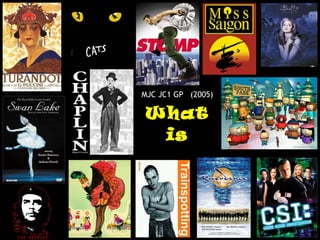
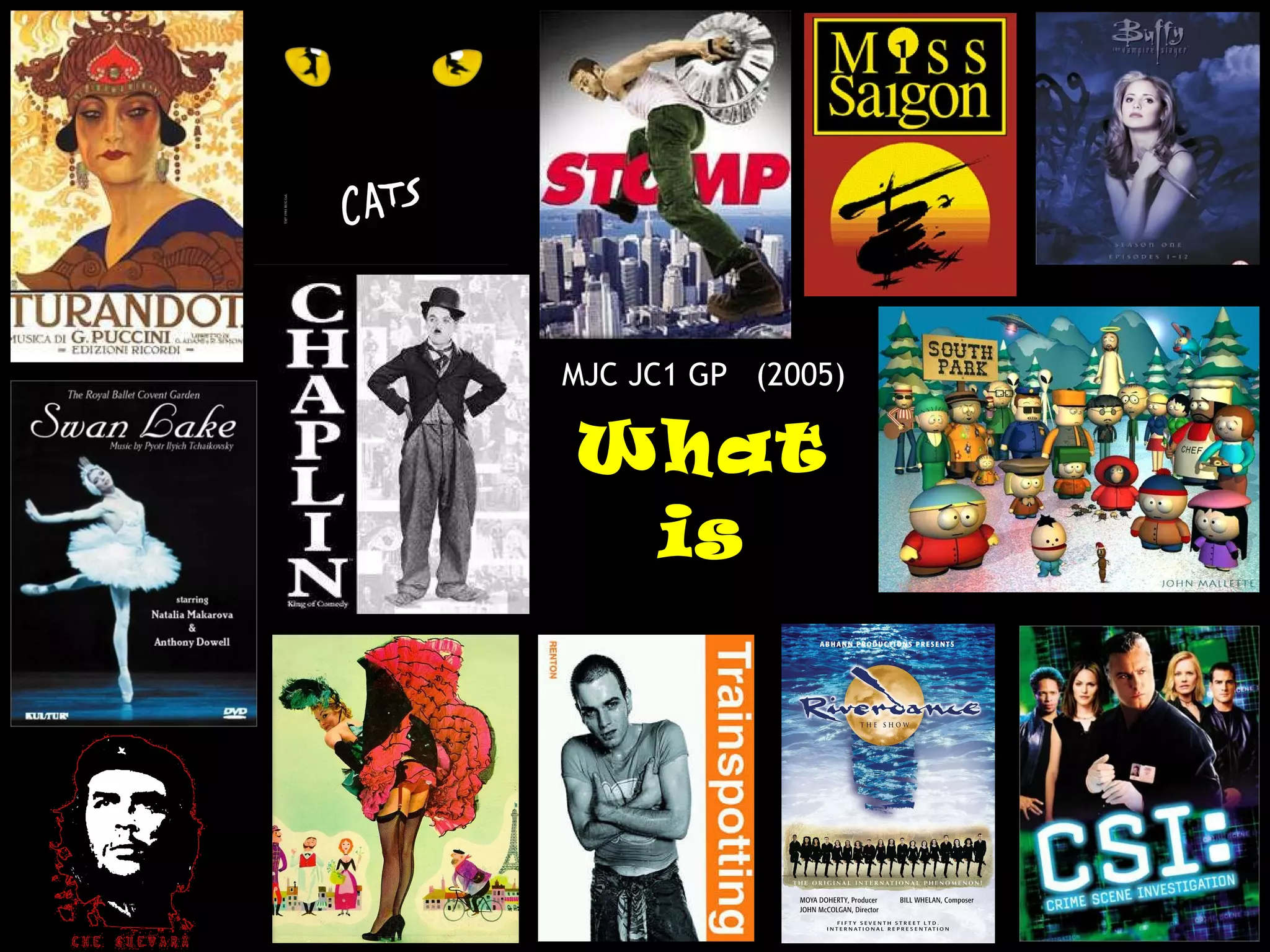
What is Culture ? MJC JC1 GP  (2005)
What is   culture Distinguishes man from beast, one human group from another. Patterns of behaviour & thinking  that people living in social groups learn, create & share. Symbolic ,  learned ,  shared  &  adaptive . People who  share a common   culture  - especially common rules of behaviour & social organisation – can  constitutes a society .
Categorising   culture Edward B. Tylor (1871): Culture includes socially acquired knowledge, beliefs, art, law, morals, customs & habits. George P. Murdock (1930): 637 major subdivisions of culture. Human Relation Area Files to identify & sort distinctive cultural variations. Later anthropologists: 3 broad categories:  material ,  social  &  ideological . 4 th  category:  the arts  (has characteristics of material & ideological culture)
Material   culture Products of human manufacture. Raise your own examples. The  economy . Methods by which people obtain or produce food (pattern of subsistence) Technologies & objects people make and use. Ways in which people exchange goods & services Effects of economic activities & products on natural environment.
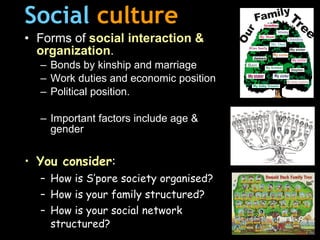
Social   culture Forms of  social interaction & organization . Bonds by kinship and marriage Work duties and economic position Political position. Important factors include age & gender You consider : How is S’pore society organised? How is your family structured? How is your social network structured?
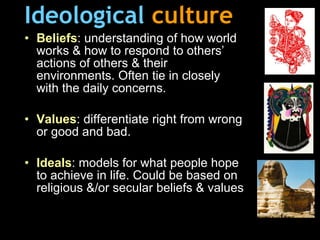
Ideological   culture Beliefs : understanding of how world works & how to respond to others’ actions of others & their environments. Often tie in closely with the daily concerns. Values : differentiate right from wrong or good and bad. Ideals : models for what people hope to achieve in life. Could be based on religious &/or secular beliefs & values
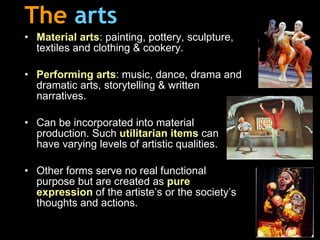
The   arts Material arts : painting, pottery, sculpture, textiles and clothing & cookery. Performing arts : music, dance, drama and dramatic arts, storytelling & written narratives. Can be incorporated into material production. Such  utilitarian items  can have varying levels of artistic qualities. Other forms serve no real functional purpose but are created as  pure expression  of the artiste’s or the society’s thoughts and actions.
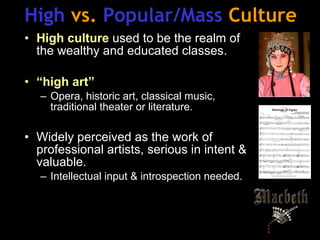
High  vs.  Popular/Mass  Culture High culture  used to be the realm of the wealthy and educated classes. “ high art” Opera, historic art, classical music, traditional theater or literature. Widely perceived as the work of professional artists, serious in intent & valuable. Intellectual input & introspection needed.
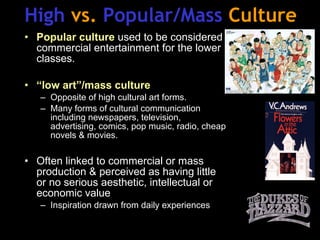
High  vs.  Popular/Mass  Culture Popular culture  used to be considered commercial entertainment for the lower classes. “ low art”/mass culture Opposite of high cultural art forms. Many forms of cultural communication including newspapers, television, advertising, comics, pop music, radio, cheap novels & movies. Often linked to commercial or mass production & perceived as having little or no serious aesthetic, intellectual or economic value Inspiration drawn from daily experiences
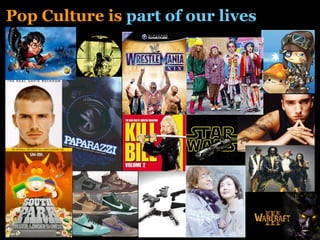
Pop Culture is  part of our lives
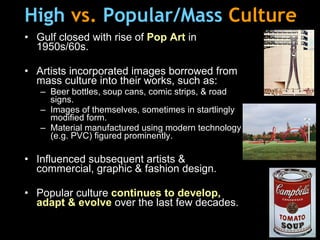
High   vs.  Popular/Mass   Culture Gulf closed with rise of  Pop Art  in 1950s/60s. Artists incorporated i mages borrowed from mass culture into their works, such as: Beer bottles, soup cans, comic strips, & road signs. Images of themselves, sometimes in startlingly modified form. Material manufactured using modern technology (e.g. PVC) figured prominently. Influenced subsequent artists &  commercial, graphic & fashion design.   Popular culture  continues to develop, adapt & evolve  over the last few decades.
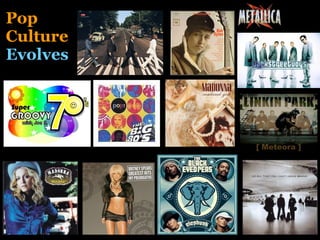
Pop Culture Evolves
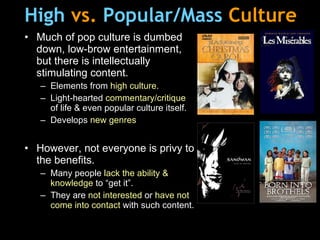
High   vs.  Popular/Mass   Culture Much of pop culture is dumbed down, low-brow entertainment, but there is intellectually stimulating content. Elements from  high culture . Light-hearted  commentary/critique  of life & even popular culture itself. Develops  new   genres However, not everyone is privy to the benefits. Many people  lack the ability & knowledge  to “get it”. They are  not interested  or  have not come into contact  with such content.
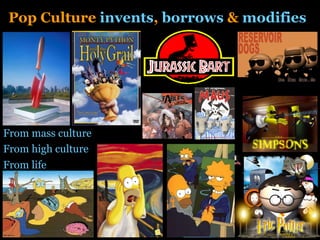
Pop Culture  invents ,  borrows  &  modifies From mass culture From high culture From life
Culture is   symbolic Based on   symbols . Dependent on man’s  ability to communicate with symbols . Enables people to  create, explain & record new ideas and information . Human language Sign language R ed, white & blue on the American flag Green to Muslims
Culture is   learned Culture is captured as  knowledge . Scientific discoveries Objects such as works of art Traditions such as observance of holidays. Socially  inherited from other people  in a society, at home and in school.  Taught “ Caught”
Culture is   learned Enculturation / cultural transmission   begins in the family & continue throughout a person’s life. Older members -> younger ones Respect for elders because of the knowledge & skills they have accumulated over a lifetime.
Culture is   shared People  in a society  share common behaviours & ways of thinking. Different   societies  can also exchange & share culture. Culture is shared when these take place: Migration, tourism, trade Conquest, change of political &/or religious systems Aided by improving information & communication technologies
Culture is   shared Cultural exchange led to the rise of an increasingly  globalised culture : With increasing globalisation, it has become difficult to find culture that is shared within only a single society. Benefits Exchange of: Ideas People Manufactured goods Natural resources . Adopted  &/or  adapted Develop the 4 categories Correct undesirable aspects
Culture is   shared Drawbacks Acculturation   -   members of one culture adopt features of another   - can disrupt original lifestyle. Problems : Cultural dilution or loss (although there are cases of the cultures being enriched) Indigenous peoples adopted Spanish language & customs of Spain when South and Central America were colonised in the 1500s. Culture shock  - immersion in a very different culture can cause confusion & disorientation. Can happen when one migrates. Can happen within multicultural societies. Problems : misunderstandings & intolerance
Culture is   shared Rise of  subcultures  -  groups of people in a larger society share distinct cultural traits. Can co-exist or clash with the  mainstream culture .   Mennonite communities  in the US/Canada Drug culture, clubbing culture among the young Ethnocentrism  - members of a society who share culture often share some feelings of notion that one’s culture is more sensible/superior to that of other societies .  At its worst:  Ethnocide: destruction of cultures Genocide: destruction of entire populations
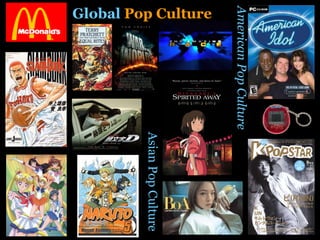
Culture   is   shared Cultural imperialism Americanisation of the world Influx of J-pop & K-pop culture into Asia Criticism : much of what is exported reflects questionable morals or is dumbed down, low-brow content. You evaluate : How have YOU been affected? Are you sure you are immune? For better or worse?
Global  Pop Culture American Pop Culture Asian Pop Culture
Culture is   adaptive People use culture to flexibly & quickly adjust to changes in to the  natural environment  & the  manmade world . End of the last Ice Age in N. America (beginning about 15,000 years ago) Large game animals disappeared. Many land areas submerged. People developed new technologies Learned to subsist on new plant & animal species. Some settled into permanent villages.
Culture is  adaptive Cultural adaptation make mankind one of the  most successful  species. History, major developments in technology, medicine & nutrition have allowed people to reproduce & survive in ever-increasing numbers. Rise of consumer culture/throwaway society  has created devastating problems. Depletion of natural resources & fossil fuels. Material & chemical wastes. Process of burning fuels and producing wastes altering the global climate.
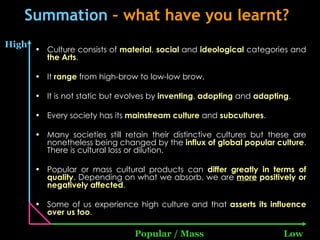
Summation  – what have you learnt? Culture consists of  material ,  social  and  ideological  categories and  the Arts . It  range  from high-brow to low-low brow. It is not static but evolves by  inventing ,  adopting  and  adapting . Every society has its  mainstream   culture  and  subcultures . Many societies still retain their distinctive cultures but these are nonetheless being changed by the  influx of global popular culture . There is cultural loss or dilution. Popular or mass cultural products can  differ greatly in terms of quality . Depending on what we absorb, we are  more  positively or negatively affected . Some of us experience high culture and that  asserts its influence over us too . High Popular / Mass Low
Preparing for  P1  S’pore-based questions /  P2  AQs You describe : What makes up Singaporean culture? What makes up global culture? You evaluate : Do Singaporeans experience more of high or popular culture? What are the gains and losses? Do young people in the world experience more of high or popular culture?  What are the gains and losses?

What is culture?

  • 1.
    What is Culture? MJC JC1 GP (2005)
  • 2.
    What is culture Distinguishes man from beast, one human group from another. Patterns of behaviour & thinking that people living in social groups learn, create & share. Symbolic , learned , shared & adaptive . People who share a common culture - especially common rules of behaviour & social organisation – can constitutes a society .
  • 3.
    Categorising culture Edward B. Tylor (1871): Culture includes socially acquired knowledge, beliefs, art, law, morals, customs & habits. George P. Murdock (1930): 637 major subdivisions of culture. Human Relation Area Files to identify & sort distinctive cultural variations. Later anthropologists: 3 broad categories: material , social & ideological . 4 th category: the arts (has characteristics of material & ideological culture)
  • 4.
    Material culture Products of human manufacture. Raise your own examples. The economy . Methods by which people obtain or produce food (pattern of subsistence) Technologies & objects people make and use. Ways in which people exchange goods & services Effects of economic activities & products on natural environment.
  • 5.
    Social culture Forms of social interaction & organization . Bonds by kinship and marriage Work duties and economic position Political position. Important factors include age & gender You consider : How is S’pore society organised? How is your family structured? How is your social network structured?
  • 6.
    Ideological culture Beliefs : understanding of how world works & how to respond to others’ actions of others & their environments. Often tie in closely with the daily concerns. Values : differentiate right from wrong or good and bad. Ideals : models for what people hope to achieve in life. Could be based on religious &/or secular beliefs & values
  • 7.
    The arts Material arts : painting, pottery, sculpture, textiles and clothing & cookery. Performing arts : music, dance, drama and dramatic arts, storytelling & written narratives. Can be incorporated into material production. Such utilitarian items can have varying levels of artistic qualities. Other forms serve no real functional purpose but are created as pure expression of the artiste’s or the society’s thoughts and actions.
  • 8.
    High vs. Popular/Mass Culture High culture used to be the realm of the wealthy and educated classes. “ high art” Opera, historic art, classical music, traditional theater or literature. Widely perceived as the work of professional artists, serious in intent & valuable. Intellectual input & introspection needed.
  • 9.
    High vs. Popular/Mass Culture Popular culture used to be considered commercial entertainment for the lower classes. “ low art”/mass culture Opposite of high cultural art forms. Many forms of cultural communication including newspapers, television, advertising, comics, pop music, radio, cheap novels & movies. Often linked to commercial or mass production & perceived as having little or no serious aesthetic, intellectual or economic value Inspiration drawn from daily experiences
  • 10.
    Pop Culture is part of our lives
  • 11.
    High vs. Popular/Mass Culture Gulf closed with rise of Pop Art in 1950s/60s. Artists incorporated i mages borrowed from mass culture into their works, such as: Beer bottles, soup cans, comic strips, & road signs. Images of themselves, sometimes in startlingly modified form. Material manufactured using modern technology (e.g. PVC) figured prominently. Influenced subsequent artists & commercial, graphic & fashion design. Popular culture continues to develop, adapt & evolve over the last few decades.
  • 12.
  • 13.
    High vs. Popular/Mass Culture Much of pop culture is dumbed down, low-brow entertainment, but there is intellectually stimulating content. Elements from high culture . Light-hearted commentary/critique of life & even popular culture itself. Develops new genres However, not everyone is privy to the benefits. Many people lack the ability & knowledge to “get it”. They are not interested or have not come into contact with such content.
  • 14.
    Pop Culture invents , borrows & modifies From mass culture From high culture From life
  • 15.
    Culture is symbolic Based on symbols . Dependent on man’s ability to communicate with symbols . Enables people to create, explain & record new ideas and information . Human language Sign language R ed, white & blue on the American flag Green to Muslims
  • 16.
    Culture is learned Culture is captured as knowledge . Scientific discoveries Objects such as works of art Traditions such as observance of holidays. Socially inherited from other people in a society, at home and in school. Taught “ Caught”
  • 17.
    Culture is learned Enculturation / cultural transmission begins in the family & continue throughout a person’s life. Older members -> younger ones Respect for elders because of the knowledge & skills they have accumulated over a lifetime.
  • 18.
    Culture is shared People in a society share common behaviours & ways of thinking. Different societies can also exchange & share culture. Culture is shared when these take place: Migration, tourism, trade Conquest, change of political &/or religious systems Aided by improving information & communication technologies
  • 19.
    Culture is shared Cultural exchange led to the rise of an increasingly globalised culture : With increasing globalisation, it has become difficult to find culture that is shared within only a single society. Benefits Exchange of: Ideas People Manufactured goods Natural resources . Adopted &/or adapted Develop the 4 categories Correct undesirable aspects
  • 20.
    Culture is shared Drawbacks Acculturation - members of one culture adopt features of another - can disrupt original lifestyle. Problems : Cultural dilution or loss (although there are cases of the cultures being enriched) Indigenous peoples adopted Spanish language & customs of Spain when South and Central America were colonised in the 1500s. Culture shock - immersion in a very different culture can cause confusion & disorientation. Can happen when one migrates. Can happen within multicultural societies. Problems : misunderstandings & intolerance
  • 21.
    Culture is shared Rise of subcultures - groups of people in a larger society share distinct cultural traits. Can co-exist or clash with the mainstream culture . Mennonite communities in the US/Canada Drug culture, clubbing culture among the young Ethnocentrism - members of a society who share culture often share some feelings of notion that one’s culture is more sensible/superior to that of other societies . At its worst: Ethnocide: destruction of cultures Genocide: destruction of entire populations
  • 22.
    Culture is shared Cultural imperialism Americanisation of the world Influx of J-pop & K-pop culture into Asia Criticism : much of what is exported reflects questionable morals or is dumbed down, low-brow content. You evaluate : How have YOU been affected? Are you sure you are immune? For better or worse?
  • 23.
    Global PopCulture American Pop Culture Asian Pop Culture
  • 24.
    Culture is adaptive People use culture to flexibly & quickly adjust to changes in to the natural environment & the manmade world . End of the last Ice Age in N. America (beginning about 15,000 years ago) Large game animals disappeared. Many land areas submerged. People developed new technologies Learned to subsist on new plant & animal species. Some settled into permanent villages.
  • 25.
    Culture is adaptive Cultural adaptation make mankind one of the most successful species. History, major developments in technology, medicine & nutrition have allowed people to reproduce & survive in ever-increasing numbers. Rise of consumer culture/throwaway society has created devastating problems. Depletion of natural resources & fossil fuels. Material & chemical wastes. Process of burning fuels and producing wastes altering the global climate.
  • 26.
    Summation –what have you learnt? Culture consists of material , social and ideological categories and the Arts . It range from high-brow to low-low brow. It is not static but evolves by inventing , adopting and adapting . Every society has its mainstream culture and subcultures . Many societies still retain their distinctive cultures but these are nonetheless being changed by the influx of global popular culture . There is cultural loss or dilution. Popular or mass cultural products can differ greatly in terms of quality . Depending on what we absorb, we are more positively or negatively affected . Some of us experience high culture and that asserts its influence over us too . High Popular / Mass Low
  • 27.
    Preparing for P1 S’pore-based questions / P2 AQs You describe : What makes up Singaporean culture? What makes up global culture? You evaluate : Do Singaporeans experience more of high or popular culture? What are the gains and losses? Do young people in the world experience more of high or popular culture? What are the gains and losses?