MARCHANTIA
MARCHANTIA
SYSTEMATIC POSITION
• Division - Bryophyta
• Class - Hepaticopsida
• Order - Marchantiales
• Family - Marchantiaceae
• Genus - Marchantia
HABITAT AND DISTRIBUTION
• Genus has about 65species.
• Grows best in cool, moist and shady places.
• Marchantia polymorpha grows as pioneer in burnt forest soil.
• 11 species occurs in India mainly western Himalayas.
MORPHOLOGY
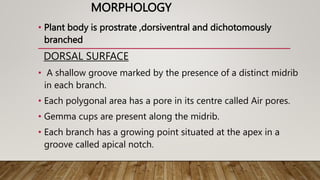
• Plant body is prostrate ,dorsiventral and dichotomously
branched
DORSAL SURFACE
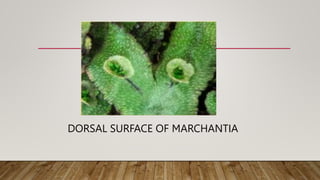
• A shallow groove marked by the presence of a distinct midrib
in each branch.
• Each polygonal area has a pore in its centre called Air pores.
• Gemma cups are present along the midrib.
• Each branch has a growing point situated at the apex in a
groove called apical notch.
DORSAL SURFACE OF MARCHANTIA
VENTRAL SURFACE
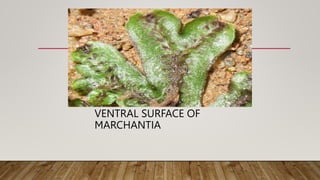
• The central surface of thallus bears rhizoids and scales along the
midrib.
Rhizoids
• Unicellular and colorless.
• 2 types :- smooth walled and tuberculosis
• In smooth walled rhizoids both the inner and outer layers are fully
stretched.
• In tuberculate rhizoids the inner wall layer modifies into peg like
ingrowths which projects into the cell lumen.
• FUNCTION : Anchorage and absorption of water and minerals.
VENTRAL SURFACE OF
MARCHANTIA
SCALES
• Multicellular and violet coloured due to the presence of anthrocyanin
pigments.
• 2types :- Appendiculae and simple or ligulate
• Appendiculate scales forms the Inner row of the scale close with
midrib.
• Ligulate scales forms the outer or marginal row and are smaller than
the appendiculate scales.
• FUNCTION :- Protection of growing point and retention of water by
capillary action.
AIR PORES
• Barrel shaped
• Each pore has 4-8 superimposed tiers of cells.
• Each tier consists of a ring 4-5 cells.
• Half of tier projects inwards and half projects outwards.
ANATOMY
PHOTOSYNTHETIC REGION
• Lies below upper epidermis
• Many photosynthetic filament arise from foot of each chamber.
• The filaments are made up of chloroplast Containing cell
STORAGE REGION
• Lies below photosynthetic region
• Compact zone of several layer of Polygonal parenchymatous cells.
• Cells contain starch and protein granules.
• Mucilage and oil containing cell are also present.
REPRODUCTION
Vegetative Reproduction
1 ) Gemma Cups :- Specialized multicellular bodies on the
dorsal surface along the midrib.
• Cresent shaped Structures with smooth , spiny and
fimbriate margins.
• they bear many small , stalked ,discoid, binconvex
Gemma.
• All the cells of the Gemma contains chloroplast except
rhizoidal cells and oil cells. Rhizoidal cells and colorless
and large in size.
• After falling on suitable Subtratum Gemma germinate.
• The rhizoidal cells divide into rhizoids and 2 lateral notches from
thalli in opposite direction .
2) By Progressive death and decay of thalli :-
• The basal parts of the thallus rots and disintegrates.
• The lobes of the thallus gets separated . The detached lobes or
fragments develop into independent thalli by apical growth.
3) By Adventutious branches :- the adventitious branches develop
from any part of the thallus or the central surface of the thallus.
Eg :- M.palmata
SEXUAL REPRODUCTION
• Sexual reproduction in Marchantia is oogamous.
• Marchantia is heterothallic or dioecious .
• Male reproductive bodies known as antheridia and female as archegonia.
• Antheridia and archegonia produced an special ,erect modified lateral
branches called antheridiophore and archegoniophore respectively.
Antheriodiophore and Antheridia
• Antheridiophore is usually 8 lobed peltate disc but in
M.geminata it is 4 loved.
• Antheridial chambers are present on the dorsal surface of disc
which contains single antheridum that opens externally
through ostiole.
• Antheridia arise in acropetal succession i.e, the older near the centre
and youngest at the margins.
MATURE ANTHERIDUM
• A mature antheridium is globular in shape and differentiated into
stalk and body.
• Stalk is short multicellular and attaches the body to the base of the
antheridial chamber.
• A single layered sterile jacket encloses the mass of androcyte
mother cells which metamorphosis into antherozoids.
• The antherozoid is a minute rod likh biglagellate structure.
ARCHEGONIOPHORE
• Consist of a 8 lobed terminal disc and a stalk.
• In young archegoniophore archegonia are borne on upper surface of the
disc but later due to the excessive growth of dorsal surface archegonia are
pushed downward and remain inverted with their neck downwards and
hanging .
• The archegonia development is acropetal I.e, the oldest archegonium near
the centre and the youngest archegonium near the apex of the disc.
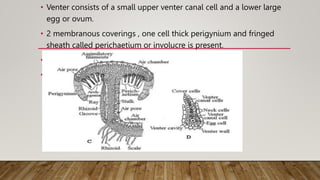
MATURE ARCHEGONIA
• Inverted flask shaped with basal swollen venter surrounded
sterile jacket and having a large egg.
• Neck consists of 6 row of neck cells surrounding neck canal
cells.4 cover cells from the tip of the neck.
• Venter consists of a small upper venter canal cell and a lower large
egg or ovum.
• 2 membranous coverings , one cell thick perigynium and fringed
sheath called perichaetium or involucre is present.
•
•
FERTILIZATION
• Fertilization takes place in archegonium when it is upright.
• In nature achegonium the venter canal cell and neck canal cells
disintegrates and forms a mucilaginous mass.
• The antherozoids swim in female receptacle and many antgerozoids
enter the archegonial neck by chemotactic response and reach up
to egg.
• One of the antherozoids Penetrates the egg and fusion of male and
female nuclei results in zygote or onshore.
• Fertilization ends the gametophytic phase.
SPOROPHYTE
• The diploma zygote is the mother cell of the sporophyte.
• Zygote first division is transverse forming outer epidural and inner
hypobasal cell .
• The epibasal cell forms the capsule and hypothalamus cells form the
foot and seta.
• Next 2 division is at the right angle to the first division and vertical
forming a quadrant embryo and later 8 called stage or octane stage.
• Now the division are irregular and globular embryo is formed.
• In upper region of capsule periclinal division occurs and it
differentiates it into outer single layered amphithecium and inner
multi layered endothecium.
• The cells of the amphithecium divide only by anticlinal division to
form a single layered sterile jacket or capsule wall.
• The endothecium forms the archesporium.Its cells divide and
redivide to form a mass of sporogenous cells .
• Half of the sporogenous cells become narrow and elongate to form
the elated mother cells.
• The spore mother cell divides meiotically to form 4 haploid stored
which remain arranged tetrahedrally for quite some time.
MATURE SPOROPHYTE
• Mature sporophye is differentiated into foot ,seta and
capsule.
• Basal bulbous part is foot which is attached to the gametophyte.
• In between foot and capsule is seta.
• Apical part is capsule, it has single layered sterile jacket.
• Capsule contains numerous spores and elaters.
• Spored are rounded and elaters elongated
• Capsule is covered by 3 layers ,calyptra ,perigynium and
perichaetium.
• Elaters being hygroscopic helps in dehiscence of the spores.
DEVELOPMENT OF GAMETOPHYTE
• Before germination spore divides by transverse division to form 2
cells.
• The lower cells is small in size ,poor in cell contents, achlorophyllous
and form rhizoid.
• The large cell is chlorophyllous and undergoes divisions to form a 6-
8 cell protonema.
• The apex is cut off from the rest of the sporelling by a division.It
behaves as apical cell.The apical cell cuts off 5 to 7 cells alternately
to the left and right form a plate like structure.
• A marginal row of cells appear in this plate .By the activity of these
marginal cells ,the expansion of the plate takes place into the
thallus.
LIFE CYCLE AND ALTERNATION OF GENERATION
• The lifecycle of Marchantia shows regular alternation of 2 morphological
distinct phases .one of the generation Is haplophase and the other is
diplophase.
1) HAPLOPHASE OR GAMETOPHTIC PHASE
• In Marchantia this phase is dominant and produce the sex organs .Sex
organs produce gamete to form a diploma zygote.
2) DIPLOID PHASE OR SPOROPHYTIC PHASE
• Zygote develops into sporophyte.
• In Marchantia sprouted is represented by foot ,seta and capsule.The
sporophyte produces the spores in the capsule. The spores on
germination produce the gametophyte.
• So ,in Marchantia 2 morphologically distinct phases constitute the
lifecycle.
• The lifecycle of this type which is characterized by alternation of
generation and sporogenic meiosis is known as heteromorphic and
diplohaplontic.
Marchantia .pptx

Marchantia .pptx

  • 1.
  • 2.
    MARCHANTIA SYSTEMATIC POSITION • Division- Bryophyta • Class - Hepaticopsida • Order - Marchantiales • Family - Marchantiaceae • Genus - Marchantia
  • 3.
    HABITAT AND DISTRIBUTION •Genus has about 65species. • Grows best in cool, moist and shady places. • Marchantia polymorpha grows as pioneer in burnt forest soil. • 11 species occurs in India mainly western Himalayas.
  • 4.
    MORPHOLOGY • Plant bodyis prostrate ,dorsiventral and dichotomously branched DORSAL SURFACE • A shallow groove marked by the presence of a distinct midrib in each branch. • Each polygonal area has a pore in its centre called Air pores. • Gemma cups are present along the midrib. • Each branch has a growing point situated at the apex in a groove called apical notch.
  • 5.
  • 6.
    VENTRAL SURFACE • Thecentral surface of thallus bears rhizoids and scales along the midrib. Rhizoids • Unicellular and colorless. • 2 types :- smooth walled and tuberculosis • In smooth walled rhizoids both the inner and outer layers are fully stretched. • In tuberculate rhizoids the inner wall layer modifies into peg like ingrowths which projects into the cell lumen. • FUNCTION : Anchorage and absorption of water and minerals.
  • 7.
  • 8.
    SCALES • Multicellular andviolet coloured due to the presence of anthrocyanin pigments. • 2types :- Appendiculae and simple or ligulate • Appendiculate scales forms the Inner row of the scale close with midrib. • Ligulate scales forms the outer or marginal row and are smaller than the appendiculate scales. • FUNCTION :- Protection of growing point and retention of water by capillary action.
  • 10.
    AIR PORES • Barrelshaped • Each pore has 4-8 superimposed tiers of cells. • Each tier consists of a ring 4-5 cells. • Half of tier projects inwards and half projects outwards. ANATOMY PHOTOSYNTHETIC REGION • Lies below upper epidermis • Many photosynthetic filament arise from foot of each chamber. • The filaments are made up of chloroplast Containing cell
  • 11.
    STORAGE REGION • Liesbelow photosynthetic region • Compact zone of several layer of Polygonal parenchymatous cells. • Cells contain starch and protein granules. • Mucilage and oil containing cell are also present.
  • 13.
    REPRODUCTION Vegetative Reproduction 1 )Gemma Cups :- Specialized multicellular bodies on the dorsal surface along the midrib. • Cresent shaped Structures with smooth , spiny and fimbriate margins. • they bear many small , stalked ,discoid, binconvex Gemma. • All the cells of the Gemma contains chloroplast except rhizoidal cells and oil cells. Rhizoidal cells and colorless and large in size.
  • 15.
    • After fallingon suitable Subtratum Gemma germinate. • The rhizoidal cells divide into rhizoids and 2 lateral notches from thalli in opposite direction . 2) By Progressive death and decay of thalli :- • The basal parts of the thallus rots and disintegrates. • The lobes of the thallus gets separated . The detached lobes or fragments develop into independent thalli by apical growth. 3) By Adventutious branches :- the adventitious branches develop from any part of the thallus or the central surface of the thallus. Eg :- M.palmata
  • 16.
    SEXUAL REPRODUCTION • Sexualreproduction in Marchantia is oogamous. • Marchantia is heterothallic or dioecious . • Male reproductive bodies known as antheridia and female as archegonia. • Antheridia and archegonia produced an special ,erect modified lateral branches called antheridiophore and archegoniophore respectively. Antheriodiophore and Antheridia • Antheridiophore is usually 8 lobed peltate disc but in M.geminata it is 4 loved. • Antheridial chambers are present on the dorsal surface of disc which contains single antheridum that opens externally through ostiole.
  • 17.
    • Antheridia arisein acropetal succession i.e, the older near the centre and youngest at the margins. MATURE ANTHERIDUM • A mature antheridium is globular in shape and differentiated into stalk and body. • Stalk is short multicellular and attaches the body to the base of the antheridial chamber. • A single layered sterile jacket encloses the mass of androcyte mother cells which metamorphosis into antherozoids. • The antherozoid is a minute rod likh biglagellate structure.
  • 19.
    ARCHEGONIOPHORE • Consist ofa 8 lobed terminal disc and a stalk. • In young archegoniophore archegonia are borne on upper surface of the disc but later due to the excessive growth of dorsal surface archegonia are pushed downward and remain inverted with their neck downwards and hanging . • The archegonia development is acropetal I.e, the oldest archegonium near the centre and the youngest archegonium near the apex of the disc. MATURE ARCHEGONIA • Inverted flask shaped with basal swollen venter surrounded sterile jacket and having a large egg. • Neck consists of 6 row of neck cells surrounding neck canal cells.4 cover cells from the tip of the neck.
  • 20.
    • Venter consistsof a small upper venter canal cell and a lower large egg or ovum. • 2 membranous coverings , one cell thick perigynium and fringed sheath called perichaetium or involucre is present. • •
  • 21.
    FERTILIZATION • Fertilization takesplace in archegonium when it is upright. • In nature achegonium the venter canal cell and neck canal cells disintegrates and forms a mucilaginous mass. • The antherozoids swim in female receptacle and many antgerozoids enter the archegonial neck by chemotactic response and reach up to egg. • One of the antherozoids Penetrates the egg and fusion of male and female nuclei results in zygote or onshore. • Fertilization ends the gametophytic phase.
  • 22.
    SPOROPHYTE • The diplomazygote is the mother cell of the sporophyte. • Zygote first division is transverse forming outer epidural and inner hypobasal cell . • The epibasal cell forms the capsule and hypothalamus cells form the foot and seta. • Next 2 division is at the right angle to the first division and vertical forming a quadrant embryo and later 8 called stage or octane stage. • Now the division are irregular and globular embryo is formed. • In upper region of capsule periclinal division occurs and it differentiates it into outer single layered amphithecium and inner multi layered endothecium.
  • 23.
    • The cellsof the amphithecium divide only by anticlinal division to form a single layered sterile jacket or capsule wall. • The endothecium forms the archesporium.Its cells divide and redivide to form a mass of sporogenous cells . • Half of the sporogenous cells become narrow and elongate to form the elated mother cells. • The spore mother cell divides meiotically to form 4 haploid stored which remain arranged tetrahedrally for quite some time. MATURE SPOROPHYTE • Mature sporophye is differentiated into foot ,seta and capsule.
  • 24.
    • Basal bulbouspart is foot which is attached to the gametophyte. • In between foot and capsule is seta. • Apical part is capsule, it has single layered sterile jacket. • Capsule contains numerous spores and elaters. • Spored are rounded and elaters elongated • Capsule is covered by 3 layers ,calyptra ,perigynium and perichaetium. • Elaters being hygroscopic helps in dehiscence of the spores.
  • 26.
    DEVELOPMENT OF GAMETOPHYTE •Before germination spore divides by transverse division to form 2 cells. • The lower cells is small in size ,poor in cell contents, achlorophyllous and form rhizoid. • The large cell is chlorophyllous and undergoes divisions to form a 6- 8 cell protonema. • The apex is cut off from the rest of the sporelling by a division.It behaves as apical cell.The apical cell cuts off 5 to 7 cells alternately to the left and right form a plate like structure. • A marginal row of cells appear in this plate .By the activity of these marginal cells ,the expansion of the plate takes place into the thallus.
  • 27.
    LIFE CYCLE ANDALTERNATION OF GENERATION • The lifecycle of Marchantia shows regular alternation of 2 morphological distinct phases .one of the generation Is haplophase and the other is diplophase. 1) HAPLOPHASE OR GAMETOPHTIC PHASE • In Marchantia this phase is dominant and produce the sex organs .Sex organs produce gamete to form a diploma zygote. 2) DIPLOID PHASE OR SPOROPHYTIC PHASE • Zygote develops into sporophyte. • In Marchantia sprouted is represented by foot ,seta and capsule.The sporophyte produces the spores in the capsule. The spores on germination produce the gametophyte.
  • 28.
    • So ,inMarchantia 2 morphologically distinct phases constitute the lifecycle. • The lifecycle of this type which is characterized by alternation of generation and sporogenic meiosis is known as heteromorphic and diplohaplontic.