Riccia
Presented by : Sumita,
Assistant Professor,
Botany Department,
PGGC-11, Chandigarh.
Systematic Position
Division : Bryophyta
Class : Hepaticopsida
Order : Marchantiales
Family : Ricciaceae
Genus : Riccia
OCCURENCE
- The genus was named after an Italian botanist F.
F. Ricci
- All the species grow as terrestrial plants on damp
soils except Riccia fluitans which grows in water
- The common Indian species are : R. discolor, R.
gangetica, R. frostii, R. melanospora, R.
crystallina, R. fluitans
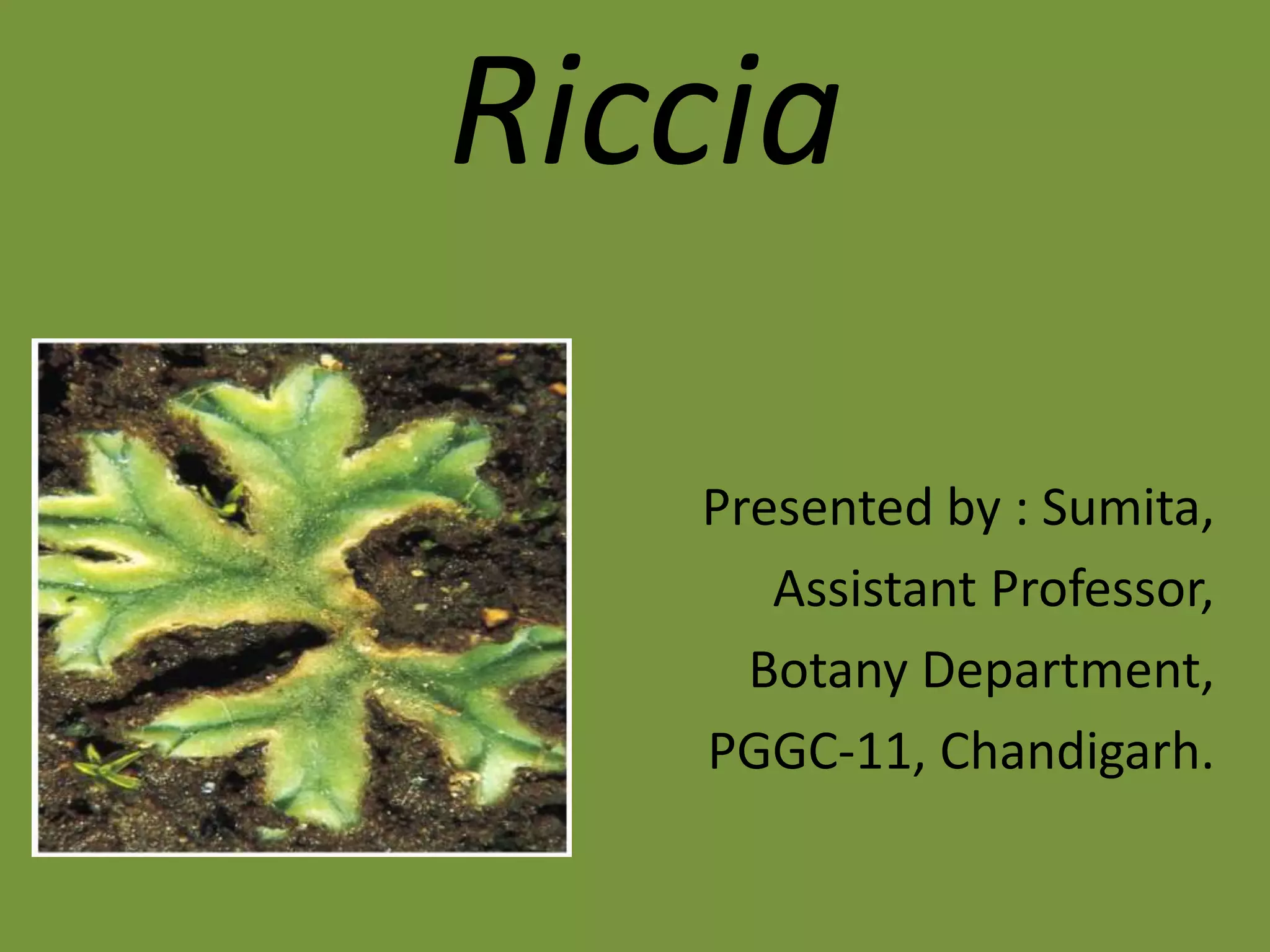
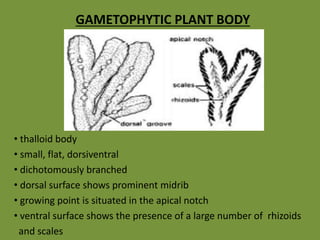
GAMETOPHYTIC PLANT BODY
• thalloid body
• small, flat, dorsiventral
• dichotomously branched
• dorsal surface shows prominent midrib
• growing point is situated in the apical notch
• ventral surface shows the presence of a large number of rhizoids
and scales
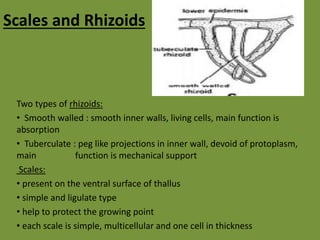
Scales and Rhizoids
Two types of rhizoids:
• Smooth walled : smooth inner walls, living cells, main function is
absorption
• Tuberculate : peg like projections in inner wall, devoid of protoplasm,
main function is mechanical support
Scales:
• present on the ventral surface of thallus
• simple and ligulate type
• help to protect the growing point
• each scale is simple, multicellular and one cell in thickness
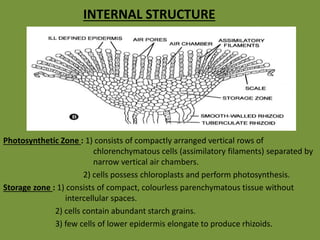
INTERNAL STRUCTURE
Photosynthetic Zone : 1) consists of compactly arranged vertical rows of
chlorenchymatous cells (assimilatory filaments) separated by
narrow vertical air chambers.
2) cells possess chloroplasts and perform photosynthesis.
Storage zone : 1) consists of compact, colourless parenchymatous tissue without
intercellular spaces.
2) cells contain abundant starch grains.
3) few cells of lower epidermis elongate to produce rhizoids.
REPRODUCTION
• Vegetative Reproduction :
1) Fragmentation
2) Formation of adventitious branches
3) Persistent growing apices
4) Formation of tubers
• Sexual Reproduction :
- oogamous
- male sex organs are antheridia (borne in antheridial chambers)and
female sex organs are archegonia (borne in antheridial chambers)
- some of the species are monoecious and some are dioecious
- sex organs arise singly in acropetal succession (youngest at the apex
and oldest at the base)
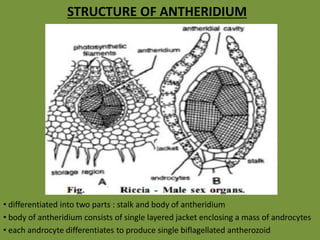
STRUCTURE OF ANTHERIDIUM
• differentiated into two parts : stalk and body of antheridium
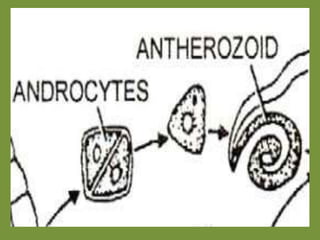
• body of antheridium consists of single layered jacket enclosing a mass of androcytes
• each androcyte differentiates to produce single biflagellated antherozoid
DEHISCENCE OF ANTHERIDIUM
• At maturity, the pore of antheridial chamber becomes wide
open
• antherozoids float in a viscous fluid formed by dissolution of
cell walls of androcytes
• sterile jacket of antheridium imbibes water, become softned
and disorganises
• antherozoids ooze out in mass through an opening
• antherozoids escape and come to dorsal surface of thallus
• where they swim in the film of water present on the dorsal
surface of thallus due to rain or dew
• the presence of water is essential for the liberation of
antherozoids
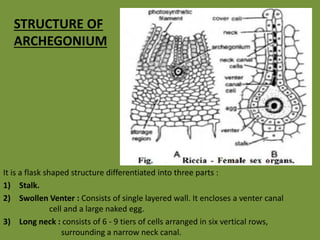
STRUCTURE OF
ARCHEGONIUM
It is a flask shaped structure differentiated into three parts :
1) Stalk.
2) Swollen Venter : Consists of single layered wall. It encloses a venter canal
cell and a large naked egg.
3) Long neck : consists of 6 - 9 tiers of cells arranged in six vertical rows,
surrounding a narrow neck canal.
FERTILIZATION
- occurs in the presence of water provided by rain or dew.
- water is needed for dehiscence of antheridia, liberation of antherozoids,
opening of archegonial neck, movement of antherozoids to archegonia.
- at maturity, the neck canal cells and venter canal cell disintegrates and become
mucilaginous.
- the mucilaginous substance, when hydrated, exerts a pressure so that the cover
cells spread apart.
- a passage is created at the opening of archegonial neck through which some of
the mucilaginous substance oozes out.
- antherozoids are attracted chemotactically towards some chemical substances
present in mucilage.
- some of them enter into the neck canal.
- a single antherozoid which reaches first, fuses with the egg.
- fusion results in the formation of diploid zygote.
- the gametophytic phase of the life cycle ends with the formation of zygote.
SPOROPHYTIC
GENERATION
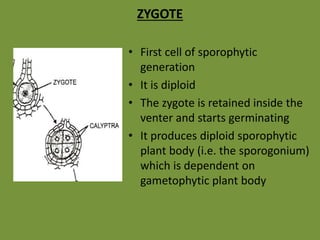
ZYGOTE
• First cell of sporophytic
generation
• It is diploid
• The zygote is retained inside the
venter and starts germinating
• It produces diploid sporophytic
plant body (i.e. the sporogonium)
which is dependent on
gametophytic plant body
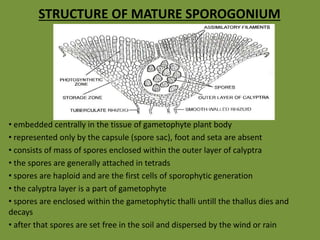
STRUCTURE OF MATURE SPOROGONIUM
• embedded centrally in the tissue of gametophyte plant body
• represented only by the capsule (spore sac), foot and seta are absent
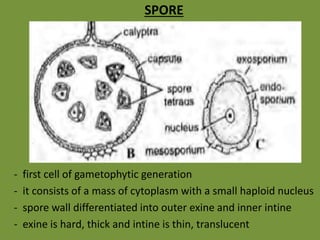
• consists of mass of spores enclosed within the outer layer of calyptra
• the spores are generally attached in tetrads
• spores are haploid and are the first cells of sporophytic generation
• the calyptra layer is a part of gametophyte
• spores are enclosed within the gametophytic thalli untill the thallus dies and
decays
• after that spores are set free in the soil and dispersed by the wind or rain
SPORE
- first cell of gametophytic generation
- it consists of a mass of cytoplasm with a small haploid nucleus
- spore wall differentiated into outer exine and inner intine
- exine is hard, thick and intine is thin, translucent
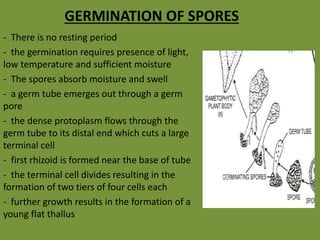
GERMINATION OF SPORES
- There is no resting period
- the germination requires presence of light,
low temperature and sufficient moisture
- The spores absorb moisture and swell
- a germ tube emerges out through a germ
pore
- the dense protoplasm flows through the
germ tube to its distal end which cuts a large
terminal cell
- first rhizoid is formed near the base of tube
- the terminal cell divides resulting in the
formation of two tiers of four cells each
- further growth results in the formation of a
young flat thallus
LIFE CYCLE SHOWING ALTERNATION OF GENERATIONS
• Life cycle is diplohaplontic.
• Alternation of generations is heteromorphic type since the plant bodies of two
generations are morphologically dissimilar.
THANKS

Riccia ppt

  • 1.
    Riccia Presented by :Sumita, Assistant Professor, Botany Department, PGGC-11, Chandigarh.
  • 2.
    Systematic Position Division :Bryophyta Class : Hepaticopsida Order : Marchantiales Family : Ricciaceae Genus : Riccia
  • 3.
    OCCURENCE - The genuswas named after an Italian botanist F. F. Ricci - All the species grow as terrestrial plants on damp soils except Riccia fluitans which grows in water - The common Indian species are : R. discolor, R. gangetica, R. frostii, R. melanospora, R. crystallina, R. fluitans
  • 5.
    GAMETOPHYTIC PLANT BODY •thalloid body • small, flat, dorsiventral • dichotomously branched • dorsal surface shows prominent midrib • growing point is situated in the apical notch • ventral surface shows the presence of a large number of rhizoids and scales
  • 6.
    Scales and Rhizoids Twotypes of rhizoids: • Smooth walled : smooth inner walls, living cells, main function is absorption • Tuberculate : peg like projections in inner wall, devoid of protoplasm, main function is mechanical support Scales: • present on the ventral surface of thallus • simple and ligulate type • help to protect the growing point • each scale is simple, multicellular and one cell in thickness
  • 7.
    INTERNAL STRUCTURE Photosynthetic Zone: 1) consists of compactly arranged vertical rows of chlorenchymatous cells (assimilatory filaments) separated by narrow vertical air chambers. 2) cells possess chloroplasts and perform photosynthesis. Storage zone : 1) consists of compact, colourless parenchymatous tissue without intercellular spaces. 2) cells contain abundant starch grains. 3) few cells of lower epidermis elongate to produce rhizoids.
  • 8.
    REPRODUCTION • Vegetative Reproduction: 1) Fragmentation 2) Formation of adventitious branches 3) Persistent growing apices 4) Formation of tubers • Sexual Reproduction : - oogamous - male sex organs are antheridia (borne in antheridial chambers)and female sex organs are archegonia (borne in antheridial chambers) - some of the species are monoecious and some are dioecious - sex organs arise singly in acropetal succession (youngest at the apex and oldest at the base)
  • 9.
    STRUCTURE OF ANTHERIDIUM •differentiated into two parts : stalk and body of antheridium • body of antheridium consists of single layered jacket enclosing a mass of androcytes • each androcyte differentiates to produce single biflagellated antherozoid
  • 11.
    DEHISCENCE OF ANTHERIDIUM •At maturity, the pore of antheridial chamber becomes wide open • antherozoids float in a viscous fluid formed by dissolution of cell walls of androcytes • sterile jacket of antheridium imbibes water, become softned and disorganises • antherozoids ooze out in mass through an opening • antherozoids escape and come to dorsal surface of thallus • where they swim in the film of water present on the dorsal surface of thallus due to rain or dew • the presence of water is essential for the liberation of antherozoids
  • 12.
    STRUCTURE OF ARCHEGONIUM It isa flask shaped structure differentiated into three parts : 1) Stalk. 2) Swollen Venter : Consists of single layered wall. It encloses a venter canal cell and a large naked egg. 3) Long neck : consists of 6 - 9 tiers of cells arranged in six vertical rows, surrounding a narrow neck canal.
  • 13.
    FERTILIZATION - occurs inthe presence of water provided by rain or dew. - water is needed for dehiscence of antheridia, liberation of antherozoids, opening of archegonial neck, movement of antherozoids to archegonia. - at maturity, the neck canal cells and venter canal cell disintegrates and become mucilaginous. - the mucilaginous substance, when hydrated, exerts a pressure so that the cover cells spread apart. - a passage is created at the opening of archegonial neck through which some of the mucilaginous substance oozes out. - antherozoids are attracted chemotactically towards some chemical substances present in mucilage. - some of them enter into the neck canal. - a single antherozoid which reaches first, fuses with the egg. - fusion results in the formation of diploid zygote. - the gametophytic phase of the life cycle ends with the formation of zygote.
  • 14.
  • 15.
    ZYGOTE • First cellof sporophytic generation • It is diploid • The zygote is retained inside the venter and starts germinating • It produces diploid sporophytic plant body (i.e. the sporogonium) which is dependent on gametophytic plant body
  • 16.
    STRUCTURE OF MATURESPOROGONIUM • embedded centrally in the tissue of gametophyte plant body • represented only by the capsule (spore sac), foot and seta are absent • consists of mass of spores enclosed within the outer layer of calyptra • the spores are generally attached in tetrads • spores are haploid and are the first cells of sporophytic generation • the calyptra layer is a part of gametophyte • spores are enclosed within the gametophytic thalli untill the thallus dies and decays • after that spores are set free in the soil and dispersed by the wind or rain
  • 17.
    SPORE - first cellof gametophytic generation - it consists of a mass of cytoplasm with a small haploid nucleus - spore wall differentiated into outer exine and inner intine - exine is hard, thick and intine is thin, translucent
  • 18.
    GERMINATION OF SPORES -There is no resting period - the germination requires presence of light, low temperature and sufficient moisture - The spores absorb moisture and swell - a germ tube emerges out through a germ pore - the dense protoplasm flows through the germ tube to its distal end which cuts a large terminal cell - first rhizoid is formed near the base of tube - the terminal cell divides resulting in the formation of two tiers of four cells each - further growth results in the formation of a young flat thallus
  • 19.
    LIFE CYCLE SHOWINGALTERNATION OF GENERATIONS • Life cycle is diplohaplontic. • Alternation of generations is heteromorphic type since the plant bodies of two generations are morphologically dissimilar.
  • 20.