
Life cycle of Sphagnum (Peat Moss)
  (Division: Bryophyta, Class: Bryopsida, Order: Sphagnales, Family: Sphagnaceae, Genus: Spahgnum)

 Occurrence: Aquatic, in margins of small lakes, ponds on dripping rocky banks. They grow closely
 matted together forming a spongy cover on the water. The dead plants are slow to decay due to acidic
 water and they aggregate to form a brown spongy mass called peat.

 Vegetative morphology (Structure of Gametophyte): Sphagnum is a perennial plant. Gametophyte is
 erect and leafy with stem, branches and leaves. Stem is weak and fragile. It is divided into nodes and
 internodes. A tuft of branches is found at each node.
 Branches are of 2 types: short and stout branches are called divergent branches. Long, slender,
 descending branches called drooping branches. At the tip of the gametophyte, a dense crown of short
 branches called coma is present.
 Stem and branches are covered with small leaves. Leaves are without midrib. Mature gametophytes do
 not have rhizoids.
 Anatomy of stem: T.S. of stem shows 3 regions. The outer cortex or hyalodermis is about 3-6 layers of
 compactly arranged cells, in older stems. It stores water.
 The middle region is hadrome. It comprises of prosenchymatous cells. It provides mechanical support.
 The inner most region is medulla, made up of colourless parenchymatous cells.
 Anatomy of leaf: Leaves of sphagnum are unique in structure. They have a single layer of cells in
 thickness. The cells are of two types: Narrow, chlorophyll containing cells are called assimilatory cells
 Large, rhomboidal dead cells are called hyaline cells. These two types of cells are arranged alternatingly
 in the leaf , to form a net-like structure.


Stem
Leaf


                                        Diverging
                                                                                    T.S. of stem
                                        branches


                     Drooping branch


            Structure of Gametophyte
                                                                                      Leaf
 Vegetative Reproduction:
 By innovations: one of the vegetative branch becomes upright, grows vigorously like the main stem. This
 branch is called innovation. It separates from the main stem and grows into an independent plant.
 By gemmae: some species produce gemmae.
 By protonemal branches: some protonemal branches become meristematic and develop into additional
 gametophytes.
Sexual reproduction: It is advanced oogamous type. Antheridia and archegonia are produced in special
 branches called antheridial or male and archegonial or female branches, in same (monoecious) or
 different (dioecious) plants. These branches occur at the tip of the stem (in the coma) or at the lower
 nodes.
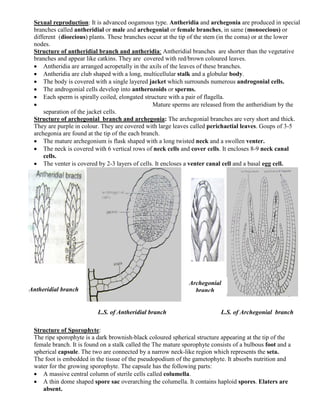
 Structure of antheridial branch and antheridia: Antheridial branches are shorter than the vegetative
 branches and appear like catkins. They are covered with red/brown coloured leaves.
 • Antheridia are arranged acropetally in the axils of the leaves of these branches.
 • Antheridia are club shaped with a long, multicellular stalk and a globular body.
 • The body is covered with a single layered jacket which surrounds numerous androgonial cells.
 • The androgonial cells develop into antherozoids or sperms.
 • Each sperm is spirally coiled, elongated structure with a pair of flagella.
 •                                               Mature sperms are released from the antheridium by the
     separation of the jacket cells.
 Structure of archegonial branch and archegonia: The archegonial branches are very short and thick.
 They are purple in colour. They are covered with large leaves called perichaetial leaves. Goups of 3-5
 archegonia are found at the tip of the each branch.
 • The mature archegonium is flask shaped with a long twisted neck and a swollen venter.
 • The neck is covered with 6 vertical rows of neck cells and cover cells. It encloses 8-9 neck canal
     cells.
 • The venter is covered by 2-3 layers of cells. It encloses a venter canal cell and a basal egg cell.


                                                               Archegonial
Antheridial branch                                               branch


                          L.S. of Antheridial branch                        L.S. of Archegonial branch

 Structure of Sporophyte:
 The ripe sporophyte is a dark brownish-black coloured spherical structure appearing at the tip of the
 female branch. It is found on a stalk called the The mature sporophyte consists of a bulbous foot and a
 spherical capsule. The two are connected by a narrow neck-like region which represents the seta.
 The foot is embedded in the tissue of the pseudopodium of the gametophyte. It absorbs nutrition and
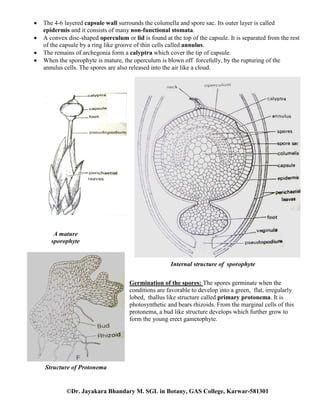
 water for the growing sporophyte. The capsule has the following parts:
 • A massive central column of sterile cells called columella.
 • A thin dome shaped spore sac overarching the columella. It contains haploid spores. Elaters are
    absent.
•   The 4-6 layered capsule wall surrounds the columella and spore sac. Its outer layer is called
    epidermis and it consists of many non-functional stomata.
•   A convex disc-shaped operculum or lid is found at the top of the capsule. It is separated from the rest
    of the capsule by a ring like groove of thin cells called annulus.
•   The remains of archegonia form a calyptra which cover the tip of capsule.
•   When the sporophyte is mature, the operculum is blown off forcefully, by the rupturing of the
    annulus cells. The spores are also released into the air like a cloud.


        A mature
       sporophyte


                                                       Internal structure of sporophyte

                                      Germination of the spores: The spores germinate when the
                                      conditions are favorable to develop into a green, flat, irregularly
                                      lobed, thallus like structure called primary protonema. It is
                                      photosynthetic and bears rhizoids. From the marginal cells of this
                                      protonema, a bud like structure develops which further grow to
                                      form the young erect gametophyte.


    Structure of Protonema


             ©Dr. Jayakara Bhandary M. SGL in Botany, GAS College, Karwar-581301
Life cycle of_sphagnum