Adaptations of Bryophytes to
Land Habit:
 First land plants.
 Evolved from Algae.
 During the process of origin
they developed certain
adaptations to land habit.
1. Development of compact,
Multicellular plant body
covered with epidermis
for conservation of water.
2. Development of organs for
attachment and
absorption e.g., rhizoids.
3. Development of
photosynthetic tissues into
special chambers for the
absorption of carbon dioxide
without losing much water
and exposure to light. e.g.,
airpores.
4. Protection of reproductive
cells
i.e., jacketed sex organs.

5. Heterogamy: was evolved,
forming non-motile egg
containing stored food
and motile sperms.
6. Retention of zygote
within the archegonium.
7. Multicellular embryo was
formed which was
retained inside the female
reproductive body
during its development
8.Production of large
number of thick walled
spores.
9. Dissemination of spores
by wind.
10. Alternation generation
Enabled the plant to produce
and test the best genetic
combinations for adapting to
the versatile terrestrial
conditions.
Range of thallus
organization In
Bryophytes
Gametophyte
(dominant generation)
In simplest form of bryophytes
gametophyte is green,
Independent, one to several layer
thick, without any internal
differentiation of tissue, e.g.
Sphaerocarpus, Pellia and other
Hepaticae
Two divergent line of descents
Range of gametophyte in
thalloid form e.g Marchantials
Range of gametophyte in leafy
form, e.g. Musci (Gametophyte
reaches to highest
development, the erect leafy
shoot with its radial symmetry,
showing differentiation in
form and structure
Range of gametophyte
in thalloid form
•Plant body simple thallus
•Flat, prostrate,
dorsiventral,
•Usually dichotomously
branched
Sphaerocarpos,
Anthoceros,
Pellia ,
Riccia,
Marchantia
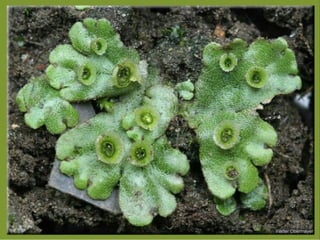
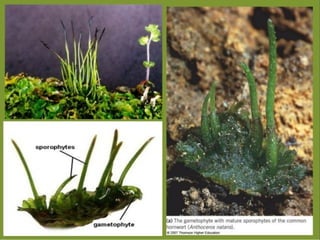
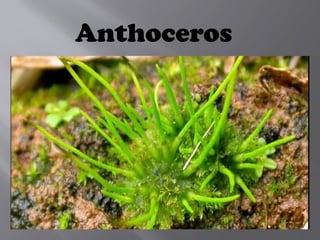
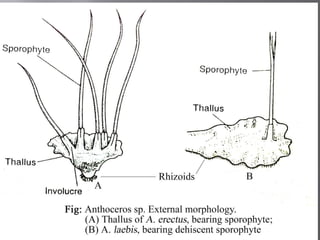
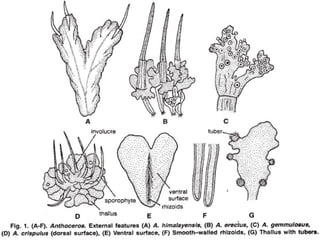
Anthoceros
•Most simple thallus
•Thallus is prostrate,
dorsiventrally differentiated,
rarely dichotomously
branched and also has a dark-
green colour.
•Thallus variously lobed
without a sharply defined
midrib.
•Air-chambers and scales are
absent,
•Slit-like pores and smooth
rhizoids are present on the
under surface of the thallus.
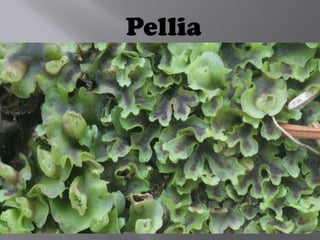
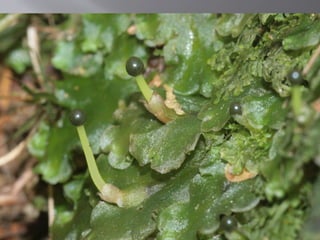
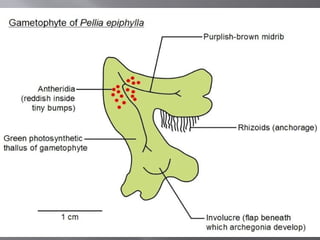
Pellia
•Plant body is thin,
dorsiventral, prostrate,
dichotomously branched,
with somewhat wavy
margin.
•Apical portion is notched,
in which growing point
(Apical cell ) is located
•The dorsal surface is almost
smooth and a median
midrib is prominent.
•Numerous smooth,
unicellular rhizoids under
the midrib.
•Scales absent
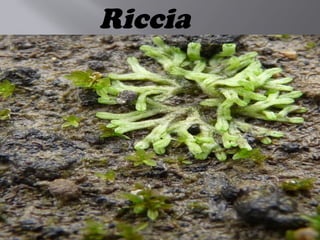
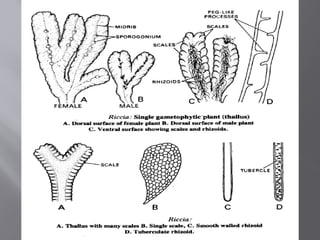
Riccia
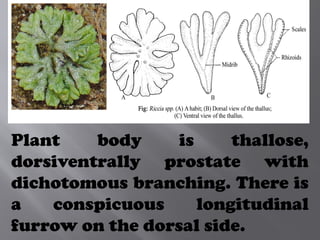
Plant body is thallose,
dorsiventrally prostate with
dichotomous branching. There is
a conspicuous longitudinal
furrow on the dorsal side.
•The ventral surface bears a
corresponding ridge and a
transverse row of scales,
•Scales one cell in thickness,
which are more crowded
near the apex and overlap
the growing point.
Lower down, the scales are
in two marginal rows, violet
in colour.
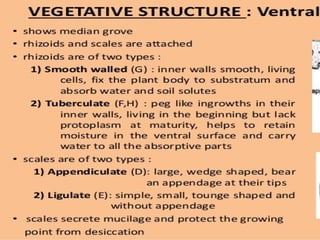
Two types of rhizoids –
smooth walled and
tuberculate, being on the
ventral ridge of the thallus.
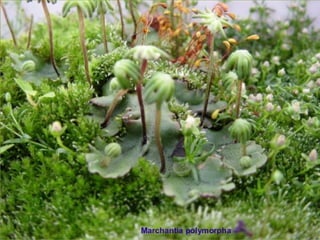
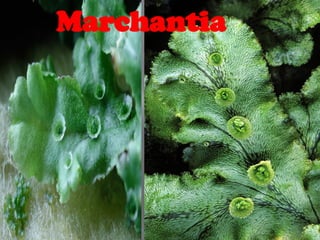
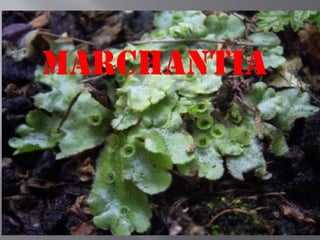
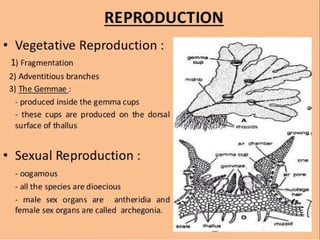
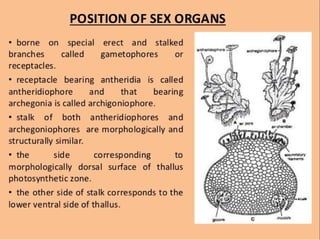
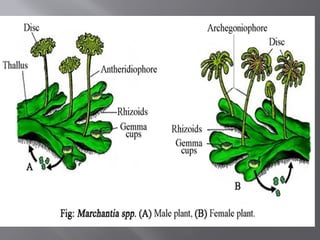
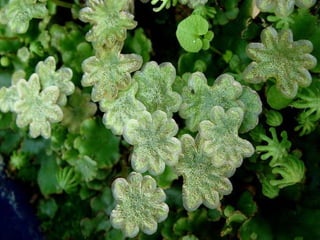
Marchantia
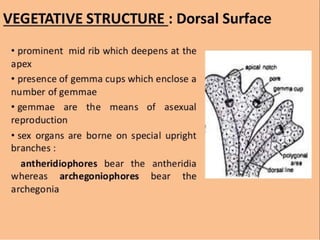
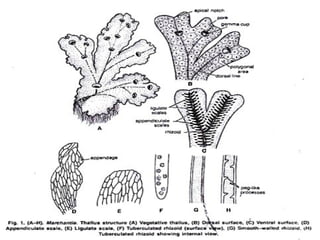
•Dorsal surface of the
thallus shows regular
rhomboidal or polygonal
areas with elevated pores at
the centre of these areas
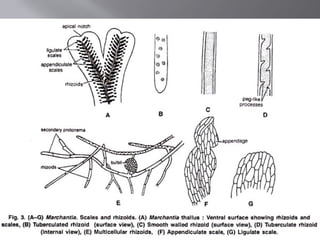
•Ventral surface bears 3-4
rows of scales on each side
of the ridge.
•There are two types of
rhizoids in between the
scales – smooth-walled and
tuberculate.
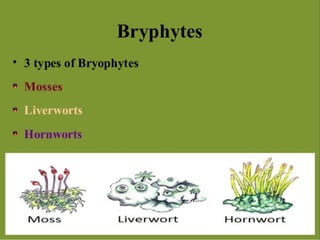
•Range of gametophyte in
leafy form
•Leafy Jungermanniales
(Porella) and in Bryopsida
( Sphagnum, Funaria,
Polytrichum, Pogonatum)
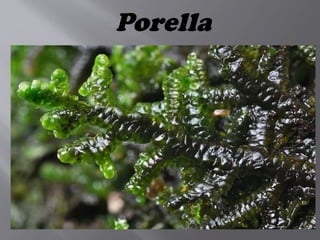
Porella
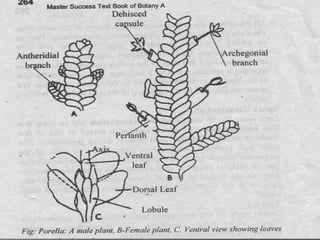
Plant body is flat,
dorsiventral with a bi- or
tripinnately branched leafy
axis with no rhizoids in
mature plants.
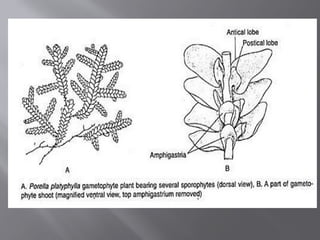
•There are 3 rows of leaves –
2 lateral and one smaller
row on the ventral side
termed amphigastria
•Leaves are thin without
midrib and one cell in
thickness.
•Lateral leaves are two-lobed
•Upper larger lobe is antical
lobe
•Lower smaller lobe is the
postical lobe or lobule.
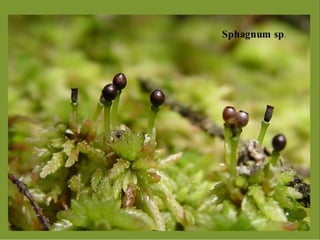
Sphagnum
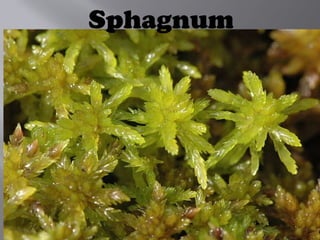
•Bog Moss or Peat Moss
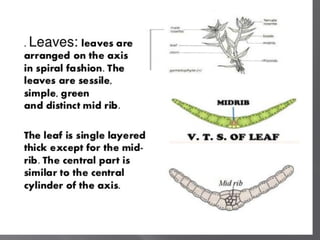
•Plant body is erect, leafy,
and bears rhizoids at the
base (when young).
•The stem has whorls of
lateral branches at
intervals.
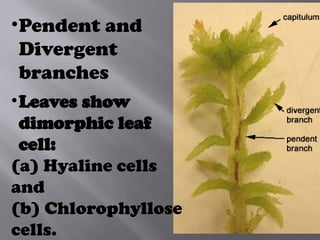
•Pendent and
Divergent
branches
•Leaves show
dimorphic leaf
cell:
(a) Hyaline cells
and
(b) Chlo­
rophyllose
cells.
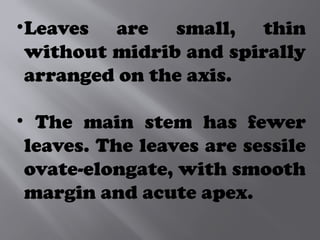
•Leaves are small, thin
without midrib and spirally
arranged on the axis.
• The main stem has fewer
leaves. The leaves are sessile
ovate-elongate, with smooth
margin and acute apex.
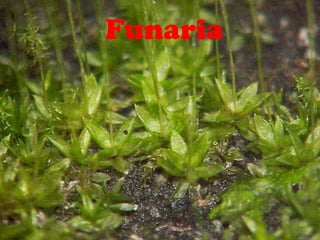
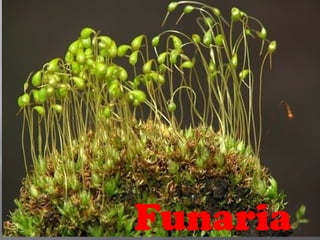
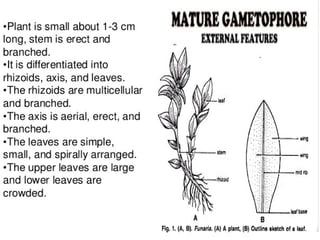
Funaria
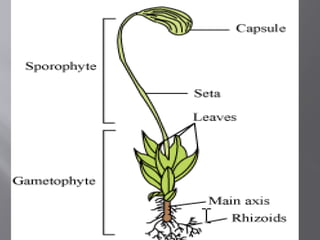
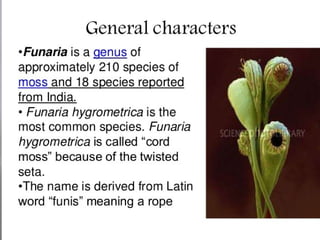
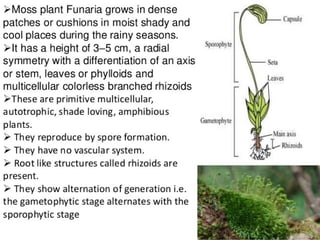
•The plant body is erect,
branched with spirally
arranged leaves.
•The leaves are more crowded
near the apex like a rosette
• Arranged in three rows.
•Leaves are sessile, attached
to the stem by a broad base,
ovate-elongate, pointed at
the apex and with a smooth
margin and midrib.
•The plant bears rhizoids at
the base.
•Rhizoids are multicellular
with oblique cross walls.
•Brown and form tangled
mass
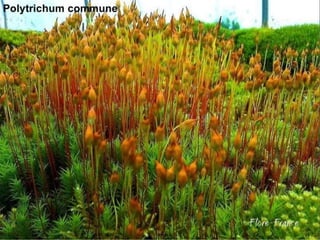
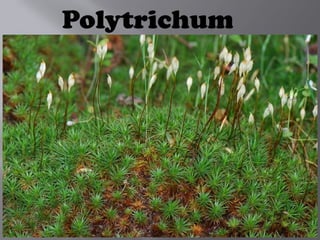
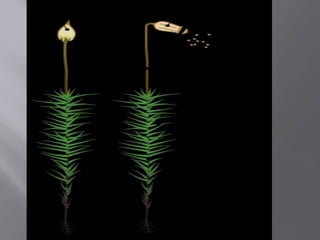
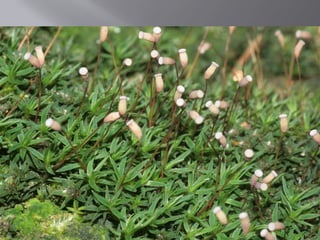
Polytrichum
•Underground rhizome and
erect leafy shoot
•Rhizome bear numerous
multicellular rhizoid
•Plants body is erect, leafy
and dioecious.
•Presence of specialized stem
core tissue – leptoids and
hydroids,
•Peristome teeth 32 in
number and arranged in a
ring
•Capsule round
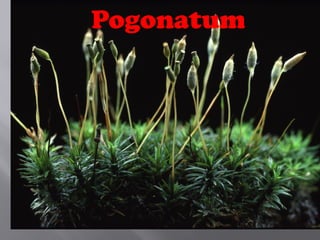
Pogonatum
•Plant body is erect,
somewhat rhizomatous
and stem is covered by
spirally arranged leaves.
•Numerous rhizoids develop
from the base of the stem.
•The rhizoids are
multicellular with
oblique cross walls.
•Leaves are spirally arranged,
more crowded and larger
near the apex.
•The base of the leaf is broad,
partly sheathing and pale.
•Leaves are gradually
tapering, with serrate
margin, acute apex and a
midrib.
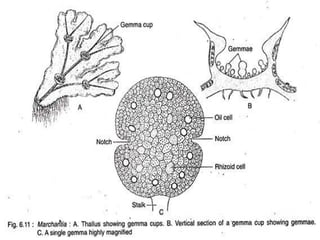
Marchantia
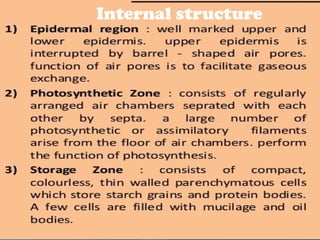
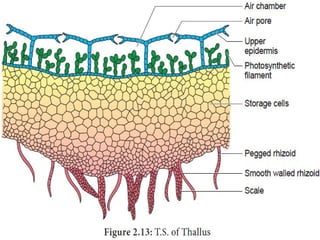
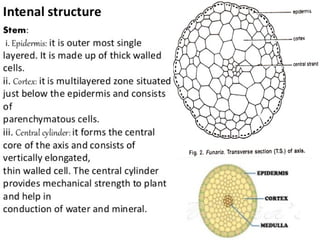
Internal structure
Funaria
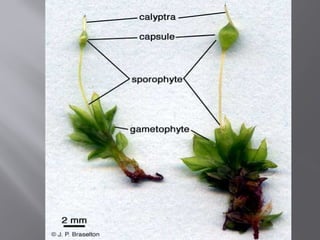
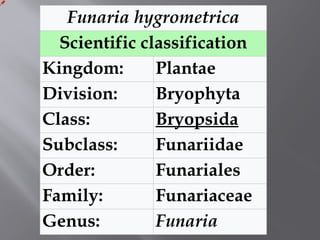
Funaria hygrometrica
Scientific classification
Kingdom: Plantae
Division: Bryophyta
Class: Bryopsida
Subclass: Funariidae
Order: Funariales
Family: Funariaceae
Genus: Funaria
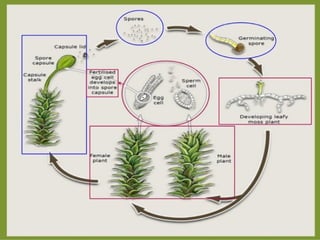
Gametophytic Phase of
Funaria:
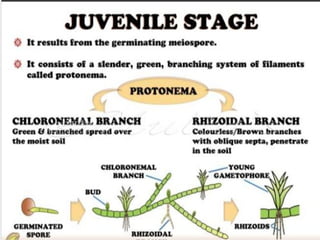
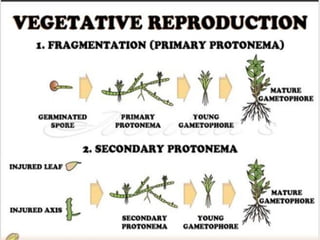
(i) Juvenile stage
represented by primary
protonema and
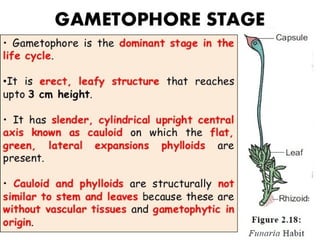
(ii) The leafy gametophore
which represents the adult
form
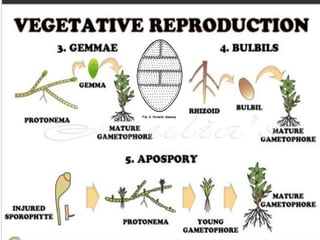
Apospory:
Development of gametophyte from
sporophyte without the formation
of spores
Any vegetative cell of the
sporophyte may form green
protonemal filaments which bear
lateral buds. These buds later
develop into leafy gametophores.
•The gametophores thus formed
are diploid.
•Sexual reproduction in such
gametophores results in the
formation of tetraploid (4n)
zygote.
•The sporophytes from tetraploid
are sterile because they are not
capable of bearing spores.
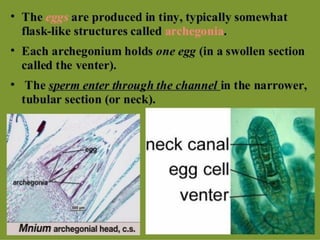
Sexual Reproduction in Funaria:
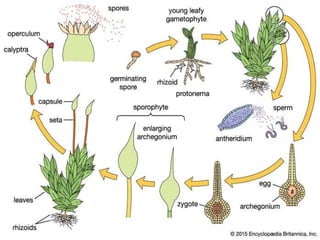
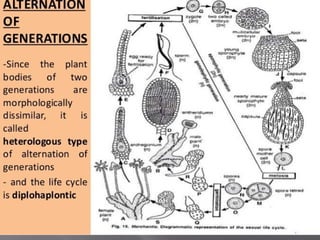
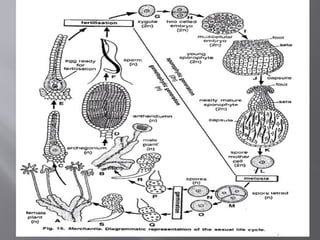
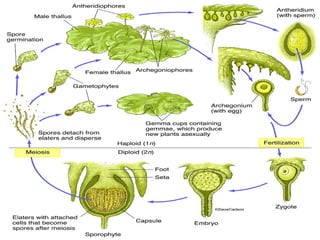
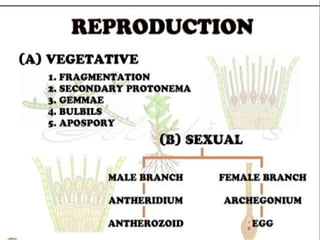
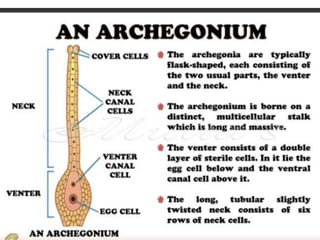
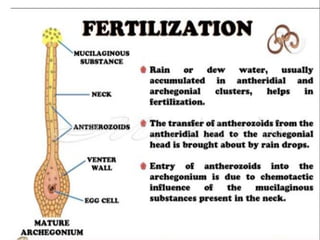
Sexual reproduction is oogamous.
Male reproductive structure is
known as antheridium and female
as archegonium.
•Monoecious (having male and
female sex organs on the same
thallus)
• Autoicous (antheridia and
archegonia develop on separate
branches of the same thallus).
•Sex organs are borne on leafy
gametophores in terminal
clusters.
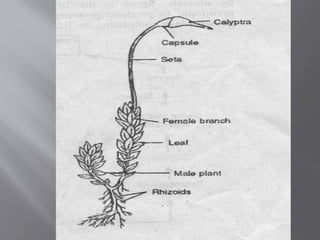
•The main shoot of the leafy
gametophore bears antheridia
and act as male branch.
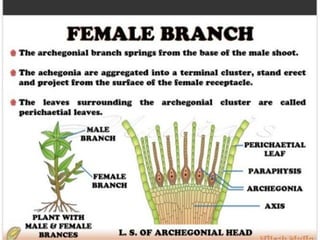
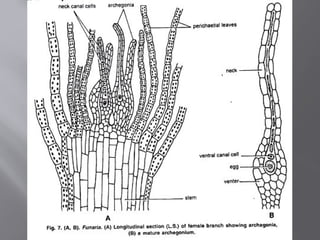
• Female branch develops as a
lateral outgrowth from the base
of the male branch and bears
archegonia. It grows higher than
the male branch..
•Funaria is protandrous
(antheridia mature before the
archegonia).
•It ensures the cross fertilization
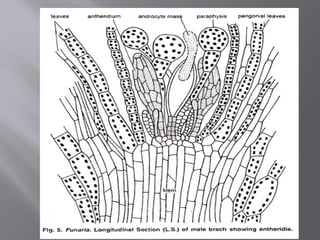
Male Branch or Antheridiophore:
Apex expanded and convex shaped.
It bears large number of reddish
brown or orange antheridia in
different stages of development.
Antheridia are surrounded by a
rosette of spreading leaves called
perigonial leaves.
•The antheridial cluster with
surrounding perigonial leaves is
called perigonium.
•The antheridia are intermingled
with large number of sterile hair
like club shaped structures called
paraphyses .
Paraphyses
•Store water,
•Protect developing antheridia,
•Help in photosynthesis
•Dehiscence of antheridia.
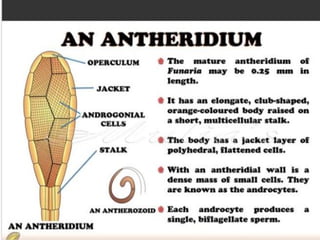
At maturity the distal end of
the antheridium bears one or
two thick walled, colourless
cells called operculum.
•These cells become mucilaginous,
absorb water and swell, break
connections with the
neighbouring cells and form a
narrow pore.
•Androcytes ooze out in the form
of a viscous fluid through this
pore.
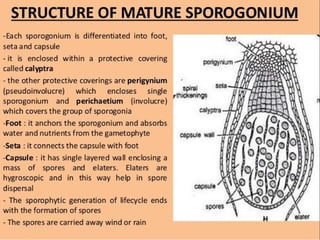
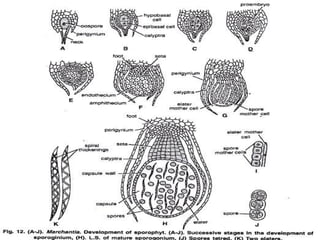
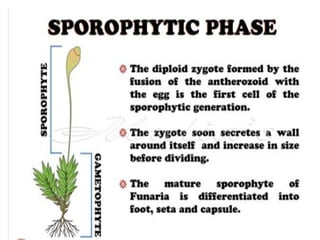
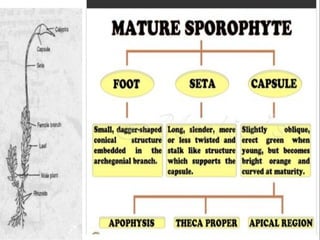
(i) Foot
• It is the basal portion of the
sporogonium.
• It is small dagger like conical
structure embedded in the
apex of female branch
• anchoring and absorbing
organ.
(ii) Seta
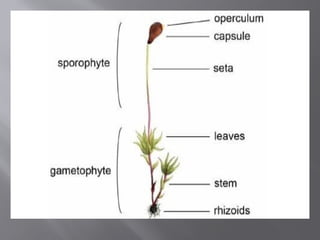
•It is long, slender, stalk like
hygroscopic structure.
•It bears the capsule at its tip.
•It raises the capsule above the
apex of leafy gametophore.
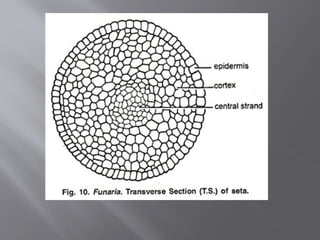
•The epidermis is followed by
thick walled cortex which
surrounds the central
cylinder.
•Central cylinder is mechanical
in function and also conducts
the water and nutrients to the
developing capsule
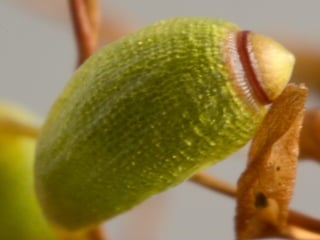
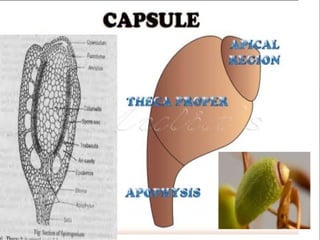
(iii) Capsule
•Terminal part of the
sporophyte and developed at
the apex of the seta
•Green in colour when young
but on maturity it becomes
bright orange coloured.
Apophysis
• Basal sterile part
• Bounded by the single
layered epidermis
interrupted by stomata
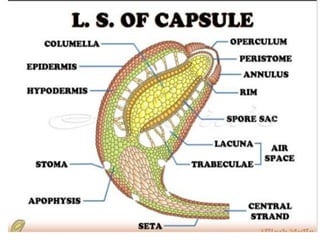
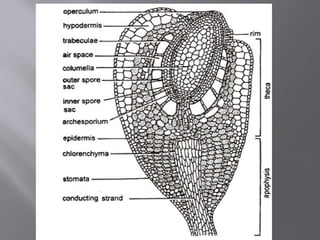
•Below the epidermis is
spongy parenchyma
(photosynthetic region and
connects seta with capsule).
•The central part of the
apophysis is made up of
elongated thin walled cells
forming a conducting strand.
(b) Theca:
•It is the middle, slightly bent
spore bearing region of the
capsule.
•It lies between the apophysis
and operculum.
(i) Epidermis
It is the outer most layer.
It is single layered with or
without stomata.
(ii) Hypodermis
It is present below the
epidermis.
It consists two to three layers
of compactly arranged
colourless cells.
(iii) Spongy parenchyma
•It consists two to three layers
of loosely arranged
chlorophyllous cells.
•It is present inner to
hypodermis.
(iv) Air spaces
•Present just below the spongy
parenchyma and outside the
spore sacs.
•Air spaces are traversed by
chlorenchymatous cells called
trabeculae
•These cells are capable to
manufacture their own food
but dependent on
gametophyte for water and
mineral nutrients.
• Therefore, the sporophyte of
Funaria is partially dependent
on gametophyte.
(v) Spore sac
•These are present below the
air spaces on either side of the
columella.
•It has an outer wall (3-4 cells
thick) and an inner wall
(single cell in thickness).
•Between the outer wall and
inner wall is spore sac cavity
•When young, the cavity of the
spore sac is filled with many
spore mother cells (SMC)
•At maturity the SMC divide by
meiotic divisions and form
many haploid spores
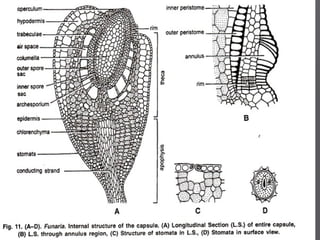
(vi) Columella
•Central part of the theca
•Made up of compactly
arranged colourless
parenchymatous cells.
•It is wide above and narrow
below, connecting the central
strand of apophysis
• It helps in conduction of
water and mineral nutrients
(c) Operculum:
•It is the upper region of the
capsule.
•It is dome shaped and consists
four to five layers of cells.
•The outermost layer is thick
walled and called epidermis.
•Operculum is differentiated
from theca by a well-marked
constriction.
•Just below the constriction
there is a diaphragm (rim).
•It is composed of two to three
layers of radially elongated
pitted cells.
•Immediately above the rim is
annulus which consists of 5-6
superimposed layers of cells.
• Its upper cells are thick but
two lowermost layers of cells
are thin.
•Annulus separates the theca
from the operculum. Below
the operculum lies the
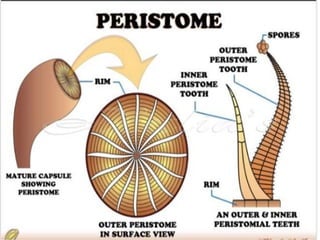
peristome
•The peristome consists of two
rings of radially arranged
peristomial teeth. In each ring
there are sixteen teeth.
•The teeth are not cellular but
they are simply the strips of
the cuticle.
•The teeth of the outer ring
(exostome) are conspicuous,
red with thick transverse
bands while the teeth of the
inner ring (endostome) are
small, delicate, colourless and
without transverse bands.
•Inner to peristome teeth lies a
mass of thin walled
parenchymatous cells.
Funaria is a
stegocarpous
moss (dehisce
along a pre-
determined
line)
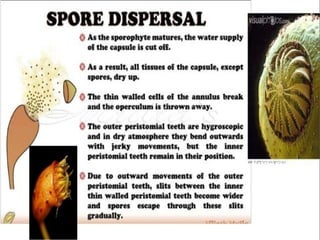
•At maturity the seta also
shows jerky movements.
•Twisting and swinging of seta
in dry weather further aids in
the dispersal of spores.
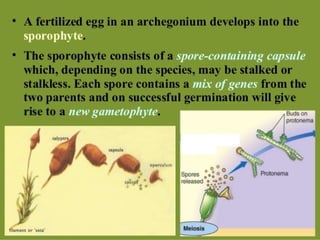
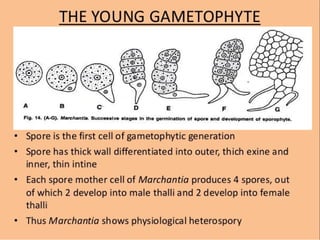
Structure of Spore
•Spore is the first cell of the
gametophytic phase.
•Each spore is spherical 12-20 µ
in diameter and surrounded by
two wall layers.
•The outer wall is thick, smooth,
brown and known as
exosporium, while the inner
wall is thin, hyaline and called
endosporium.
• Spore wall encloses single
nucleus, chloroplasts and many
oil globules.
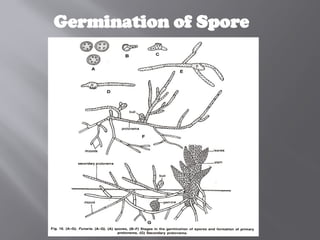
Germination of Spore
bryophytes.pptxforbotany [Autosaved].pptx

bryophytes.pptxforbotany [Autosaved].pptx

  • 31.
    Adaptations of Bryophytesto Land Habit:  First land plants.  Evolved from Algae.  During the process of origin they developed certain adaptations to land habit.
  • 32.
    1. Development ofcompact, Multicellular plant body covered with epidermis for conservation of water. 2. Development of organs for attachment and absorption e.g., rhizoids.
  • 33.
    3. Development of photosynthetictissues into special chambers for the absorption of carbon dioxide without losing much water and exposure to light. e.g., airpores.
  • 34.
    4. Protection ofreproductive cells i.e., jacketed sex organs. 5. Heterogamy: was evolved, forming non-motile egg containing stored food and motile sperms.
  • 35.
    6. Retention ofzygote within the archegonium. 7. Multicellular embryo was formed which was retained inside the female reproductive body during its development
  • 36.
    8.Production of large numberof thick walled spores. 9. Dissemination of spores by wind.
  • 37.
    10. Alternation generation Enabledthe plant to produce and test the best genetic combinations for adapting to the versatile terrestrial conditions.
  • 38.
  • 39.
    Gametophyte (dominant generation) In simplestform of bryophytes gametophyte is green, Independent, one to several layer thick, without any internal differentiation of tissue, e.g. Sphaerocarpus, Pellia and other Hepaticae Two divergent line of descents
  • 40.
    Range of gametophytein thalloid form e.g Marchantials Range of gametophyte in leafy form, e.g. Musci (Gametophyte reaches to highest development, the erect leafy shoot with its radial symmetry, showing differentiation in form and structure
  • 41.
    Range of gametophyte inthalloid form •Plant body simple thallus •Flat, prostrate, dorsiventral, •Usually dichotomously branched
  • 42.
  • 43.
  • 44.
    •Most simple thallus •Thallusis prostrate, dorsiventrally differentiated, rarely dichotomously branched and also has a dark- green colour.
  • 45.
    •Thallus variously lobed withouta sharply defined midrib. •Air-chambers and scales are absent, •Slit-like pores and smooth rhizoids are present on the under surface of the thallus.
  • 48.
  • 50.
    •Plant body isthin, dorsiventral, prostrate, dichotomously branched, with somewhat wavy margin. •Apical portion is notched, in which growing point (Apical cell ) is located
  • 51.
    •The dorsal surfaceis almost smooth and a median midrib is prominent. •Numerous smooth, unicellular rhizoids under the midrib. •Scales absent
  • 53.
  • 54.
    Plant body isthallose, dorsiventrally prostate with dichotomous branching. There is a conspicuous longitudinal furrow on the dorsal side.
  • 55.
    •The ventral surfacebears a corresponding ridge and a transverse row of scales, •Scales one cell in thickness, which are more crowded near the apex and overlap the growing point.
  • 56.
    Lower down, thescales are in two marginal rows, violet in colour. Two types of rhizoids – smooth walled and tuberculate, being on the ventral ridge of the thallus.
  • 58.
  • 59.
    •Dorsal surface ofthe thallus shows regular rhomboidal or polygonal areas with elevated pores at the centre of these areas
  • 60.
    •Ventral surface bears3-4 rows of scales on each side of the ridge. •There are two types of rhizoids in between the scales – smooth-walled and tuberculate.
  • 62.
    •Range of gametophytein leafy form •Leafy Jungermanniales (Porella) and in Bryopsida ( Sphagnum, Funaria, Polytrichum, Pogonatum)
  • 63.
  • 65.
    Plant body isflat, dorsiventral with a bi- or tripinnately branched leafy axis with no rhizoids in mature plants.
  • 66.
    •There are 3rows of leaves – 2 lateral and one smaller row on the ventral side termed amphigastria •Leaves are thin without midrib and one cell in thickness.
  • 67.
    •Lateral leaves aretwo-lobed •Upper larger lobe is antical lobe •Lower smaller lobe is the postical lobe or lobule.
  • 69.
  • 71.
    •Bog Moss orPeat Moss •Plant body is erect, leafy, and bears rhizoids at the base (when young). •The stem has whorls of lateral branches at intervals.
  • 72.
    •Pendent and Divergent branches •Leaves show dimorphicleaf cell: (a) Hyaline cells and (b) Chlo­ rophyllose cells.
  • 73.
    •Leaves are small,thin without midrib and spirally arranged on the axis. • The main stem has fewer leaves. The leaves are sessile ovate-elongate, with smooth margin and acute apex.
  • 74.
  • 76.
    •The plant bodyis erect, branched with spirally arranged leaves. •The leaves are more crowded near the apex like a rosette • Arranged in three rows.
  • 78.
    •Leaves are sessile,attached to the stem by a broad base, ovate-elongate, pointed at the apex and with a smooth margin and midrib. •The plant bears rhizoids at the base.
  • 79.
    •Rhizoids are multicellular withoblique cross walls. •Brown and form tangled mass
  • 80.
  • 82.
    •Underground rhizome and erectleafy shoot •Rhizome bear numerous multicellular rhizoid
  • 83.
    •Plants body iserect, leafy and dioecious. •Presence of specialized stem core tissue – leptoids and hydroids,
  • 84.
    •Peristome teeth 32in number and arranged in a ring •Capsule round
  • 86.
  • 88.
    •Plant body iserect, somewhat rhizomatous and stem is covered by spirally arranged leaves. •Numerous rhizoids develop from the base of the stem.
  • 89.
    •The rhizoids are multicellularwith oblique cross walls.
  • 90.
    •Leaves are spirallyarranged, more crowded and larger near the apex. •The base of the leaf is broad, partly sheathing and pale.
  • 91.
    •Leaves are gradually tapering,with serrate margin, acute apex and a midrib.
  • 92.
  • 100.
  • 126.
  • 127.
    Funaria hygrometrica Scientific classification Kingdom:Plantae Division: Bryophyta Class: Bryopsida Subclass: Funariidae Order: Funariales Family: Funariaceae Genus: Funaria
  • 130.
    Gametophytic Phase of Funaria: (i)Juvenile stage represented by primary protonema and (ii) The leafy gametophore which represents the adult form
  • 139.
    Apospory: Development of gametophytefrom sporophyte without the formation of spores Any vegetative cell of the sporophyte may form green protonemal filaments which bear lateral buds. These buds later develop into leafy gametophores.
  • 140.
    •The gametophores thusformed are diploid. •Sexual reproduction in such gametophores results in the formation of tetraploid (4n) zygote. •The sporophytes from tetraploid are sterile because they are not capable of bearing spores.
  • 141.
    Sexual Reproduction inFunaria: Sexual reproduction is oogamous. Male reproductive structure is known as antheridium and female as archegonium.
  • 142.
    •Monoecious (having maleand female sex organs on the same thallus) • Autoicous (antheridia and archegonia develop on separate branches of the same thallus). •Sex organs are borne on leafy gametophores in terminal clusters.
  • 143.
    •The main shootof the leafy gametophore bears antheridia and act as male branch. • Female branch develops as a lateral outgrowth from the base of the male branch and bears archegonia. It grows higher than the male branch..
  • 145.
    •Funaria is protandrous (antheridiamature before the archegonia). •It ensures the cross fertilization
  • 146.
    Male Branch orAntheridiophore: Apex expanded and convex shaped. It bears large number of reddish brown or orange antheridia in different stages of development. Antheridia are surrounded by a rosette of spreading leaves called perigonial leaves.
  • 148.
    •The antheridial clusterwith surrounding perigonial leaves is called perigonium. •The antheridia are intermingled with large number of sterile hair like club shaped structures called paraphyses .
  • 149.
    Paraphyses •Store water, •Protect developingantheridia, •Help in photosynthesis •Dehiscence of antheridia.
  • 151.
    At maturity thedistal end of the antheridium bears one or two thick walled, colourless cells called operculum.
  • 152.
    •These cells becomemucilaginous, absorb water and swell, break connections with the neighbouring cells and form a narrow pore. •Androcytes ooze out in the form of a viscous fluid through this pore.
  • 159.
    (i) Foot • Itis the basal portion of the sporogonium. • It is small dagger like conical structure embedded in the apex of female branch • anchoring and absorbing organ.
  • 160.
    (ii) Seta •It islong, slender, stalk like hygroscopic structure. •It bears the capsule at its tip. •It raises the capsule above the apex of leafy gametophore.
  • 161.
    •The epidermis isfollowed by thick walled cortex which surrounds the central cylinder. •Central cylinder is mechanical in function and also conducts the water and nutrients to the developing capsule
  • 163.
    (iii) Capsule •Terminal partof the sporophyte and developed at the apex of the seta •Green in colour when young but on maturity it becomes bright orange coloured.
  • 166.
    Apophysis • Basal sterilepart • Bounded by the single layered epidermis interrupted by stomata
  • 167.
    •Below the epidermisis spongy parenchyma (photosynthetic region and connects seta with capsule). •The central part of the apophysis is made up of elongated thin walled cells forming a conducting strand.
  • 168.
    (b) Theca: •It isthe middle, slightly bent spore bearing region of the capsule. •It lies between the apophysis and operculum.
  • 171.
    (i) Epidermis It isthe outer most layer. It is single layered with or without stomata.
  • 172.
    (ii) Hypodermis It ispresent below the epidermis. It consists two to three layers of compactly arranged colourless cells.
  • 173.
    (iii) Spongy parenchyma •Itconsists two to three layers of loosely arranged chlorophyllous cells. •It is present inner to hypodermis.
  • 174.
    (iv) Air spaces •Presentjust below the spongy parenchyma and outside the spore sacs. •Air spaces are traversed by chlorenchymatous cells called trabeculae
  • 175.
    •These cells arecapable to manufacture their own food but dependent on gametophyte for water and mineral nutrients. • Therefore, the sporophyte of Funaria is partially dependent on gametophyte.
  • 176.
    (v) Spore sac •Theseare present below the air spaces on either side of the columella. •It has an outer wall (3-4 cells thick) and an inner wall (single cell in thickness).
  • 177.
    •Between the outerwall and inner wall is spore sac cavity •When young, the cavity of the spore sac is filled with many spore mother cells (SMC) •At maturity the SMC divide by meiotic divisions and form many haploid spores
  • 178.
    (vi) Columella •Central partof the theca •Made up of compactly arranged colourless parenchymatous cells.
  • 179.
    •It is wideabove and narrow below, connecting the central strand of apophysis • It helps in conduction of water and mineral nutrients
  • 180.
    (c) Operculum: •It isthe upper region of the capsule. •It is dome shaped and consists four to five layers of cells. •The outermost layer is thick walled and called epidermis.
  • 182.
    •Operculum is differentiated fromtheca by a well-marked constriction. •Just below the constriction there is a diaphragm (rim). •It is composed of two to three layers of radially elongated pitted cells.
  • 183.
    •Immediately above therim is annulus which consists of 5-6 superimposed layers of cells. • Its upper cells are thick but two lowermost layers of cells are thin.
  • 184.
    •Annulus separates thetheca from the operculum. Below the operculum lies the peristome •The peristome consists of two rings of radially arranged peristomial teeth. In each ring there are sixteen teeth.
  • 185.
    •The teeth arenot cellular but they are simply the strips of the cuticle. •The teeth of the outer ring (exostome) are conspicuous, red with thick transverse bands while the teeth of the inner ring (endostome) are small, delicate, colourless and without transverse bands.
  • 186.
    •Inner to peristometeeth lies a mass of thin walled parenchymatous cells.
  • 188.
    Funaria is a stegocarpous moss(dehisce along a pre- determined line)
  • 189.
    •At maturity theseta also shows jerky movements. •Twisting and swinging of seta in dry weather further aids in the dispersal of spores.
  • 190.
    Structure of Spore •Sporeis the first cell of the gametophytic phase. •Each spore is spherical 12-20 µ in diameter and surrounded by two wall layers.
  • 191.
    •The outer wallis thick, smooth, brown and known as exosporium, while the inner wall is thin, hyaline and called endosporium. • Spore wall encloses single nucleus, chloroplasts and many oil globules.
  • 192.

Editor's Notes

  • #32 Multicellular plant body and conservation of water: A compact multicellular plant body was formed which helped in the conservation of water by reducing cell surface are exposed to dry land conditions.
  • #33 Protection of reproductive cells from drying and mechanical injury i.e., jacketed sex organs.
  • #35 Embryo formation: Multicellular embryo was formed which was retained inside the female reproductive body during its development.
  • #37 Alternation of spore-producing generation (sporophyte) with gamete producing generation (gametophyte) enabled the plant to produce and test the best genetic combinations for adapting to the versatile terrestrial conditions.
  • #46 The gametophytic plant body is a small greasy dark-brown prostrate, dorsiventral thallus. The thallus is usually dichotomously lobed (e.g. A. fusiformis, Fig.6.29B) or sub-orbicular (e.g. A. crispulus, Fig. 6.29 A). The thallus is often raised on a thick ascending stalk-like structure (A. erec­tus, Fig. 6.29C & D). Sometimes the thallus is long and pinnately divided (A. hallii) or bilobed (A. himalayensis) (Fig. 6.29E & F). The middle part of the thallus is always with­out a definite midrib, although the thallus is thick. The upper dorsal surface of the thallus may be smooth (A. laevis), velvety (A. crispulus) or rough (A. fusiformis) with ridges. The lower ven­tral surface bears numerous unicellular, smooth walled rhizoids along the median line. Tuberculate rhizoids, scales or mucilage hairs are absent in Anthoceros.