General characteristics of Pteridophytes
Sankrita Gaonkar
Assistant Professor in Botany
sankrita002@gmail.com
Contents
• General characteristics of Pteridophytes
• References
Pteridophytes
• Vascular cryptogams – well developed vascular (conducting) system
• Word pteridophyte – Greek origin – Pteron – feather
• Feather like fronds
• Seedless vascular plants that have successfully invaded land and reproduced
by means of spores
• Dominant vegetation in historic past – 230-280 mya
• Terrestrial and aquatic
• 500 spp. in India
• Have long fossil history
• First traces recognized in Silurian period of late paleozoic era – 400 mya
• Flourished well during Devonion period – ‘age of pteridophyte’
• Majority are terrestrial - grow in cool, moist and shady places e.g., ferns.
Some aquatic (e.g., Marsilea, Azolla), xerophytic (e.g., Selaginella rupestris,
Equisetum) or epiphytic (e.g., Lycopodium squarrosum)
• Majority are herbaceous, few perennial and tree like (e.g., Angiopteris).
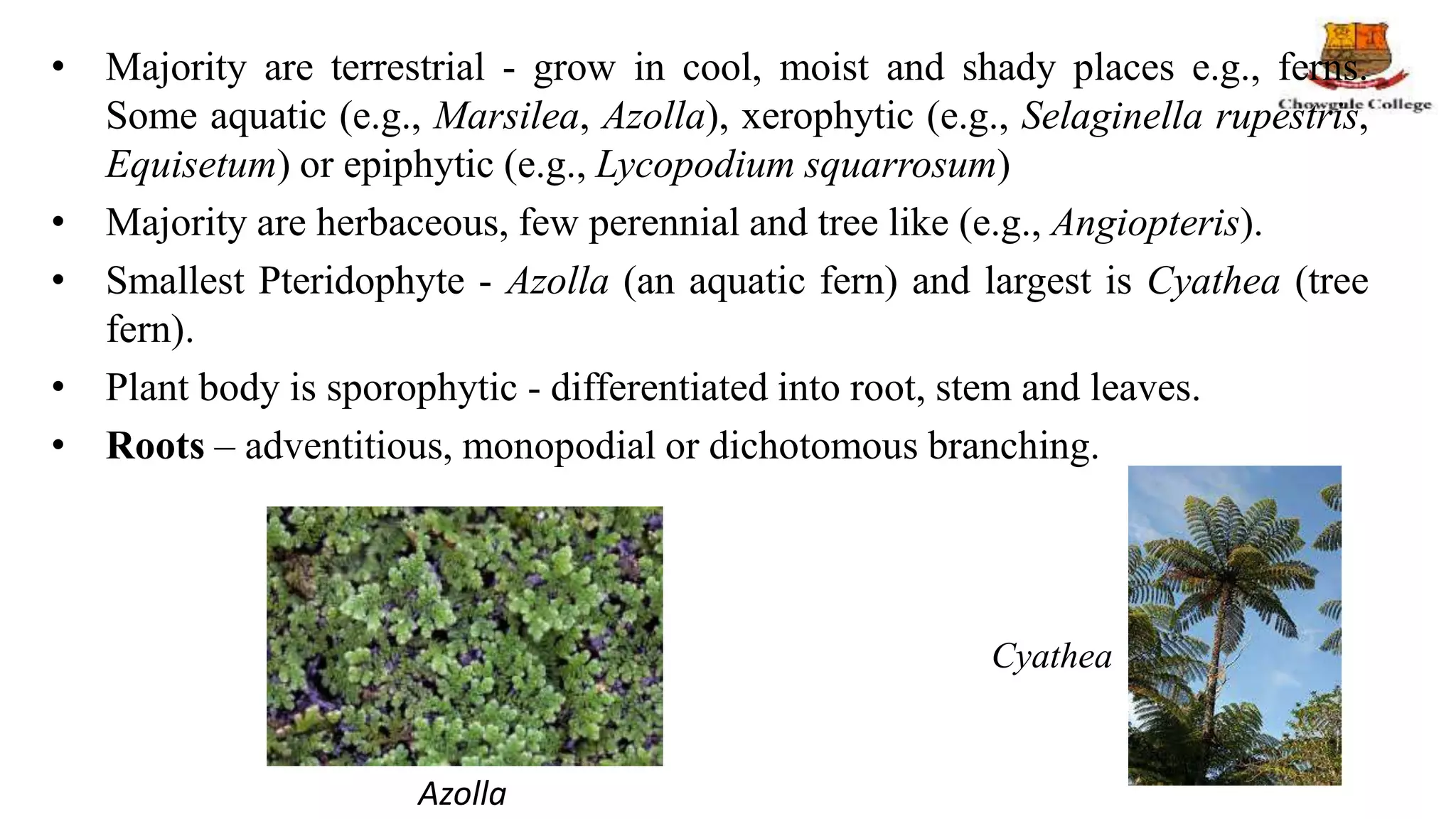
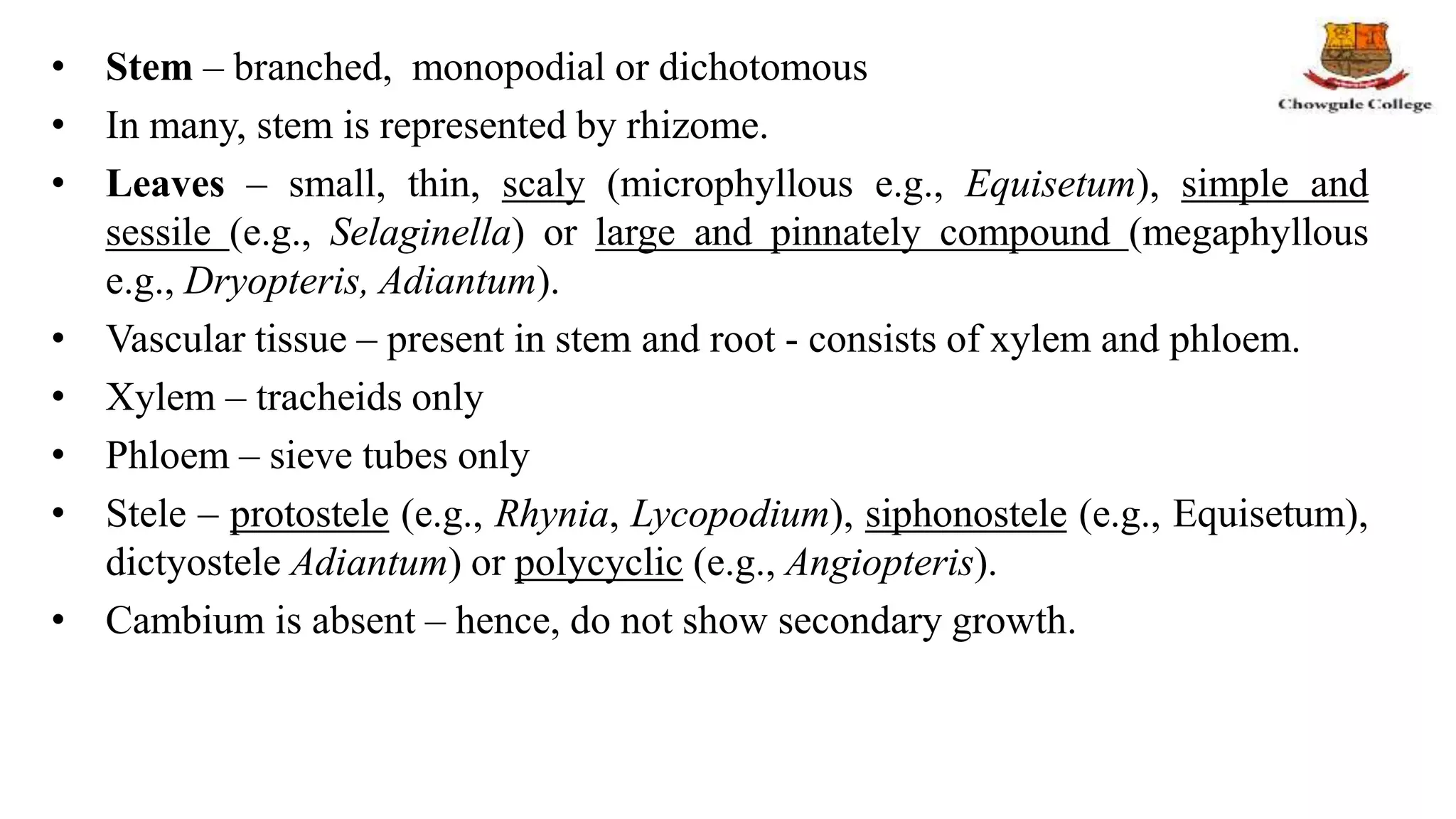
• Smallest Pteridophyte - Azolla (an aquatic fern) and largest is Cyathea (tree
fern).
• Plant body is sporophytic - differentiated into root, stem and leaves.
• Roots – adventitious, monopodial or dichotomous branching.
Azolla
Cyathea
• Stem – branched, monopodial or dichotomous
• In many, stem is represented by rhizome.
• Leaves – small, thin, scaly (microphyllous e.g., Equisetum), simple and
sessile (e.g., Selaginella) or large and pinnately compound (megaphyllous
e.g., Dryopteris, Adiantum).
• Vascular tissue – present in stem and root - consists of xylem and phloem.
• Xylem – tracheids only
• Phloem – sieve tubes only
• Stele – protostele (e.g., Rhynia, Lycopodium), siphonostele (e.g., Equisetum),
dictyostele Adiantum) or polycyclic (e.g., Angiopteris).
• Cambium is absent – hence, do not show secondary growth.
Reproduction in Pteridophytes:
• Reproduction - by means of spores - produced inside sporangia.
• Development of sporangium - leptosporangiate (sporangium originates from a
single cell) or eusporangiate (sporangium develops from a group of cells).
• Sporangia may be borne either on stem or leaves. On the stem they may be
terminal (e.g., Rhynia) or lateral (e.g., Lycopodium). On the leaves (sporophylls)
they may be ventral, marginal (Pteris, Adiantum) or dorsal (e.g., Polypodiceae).
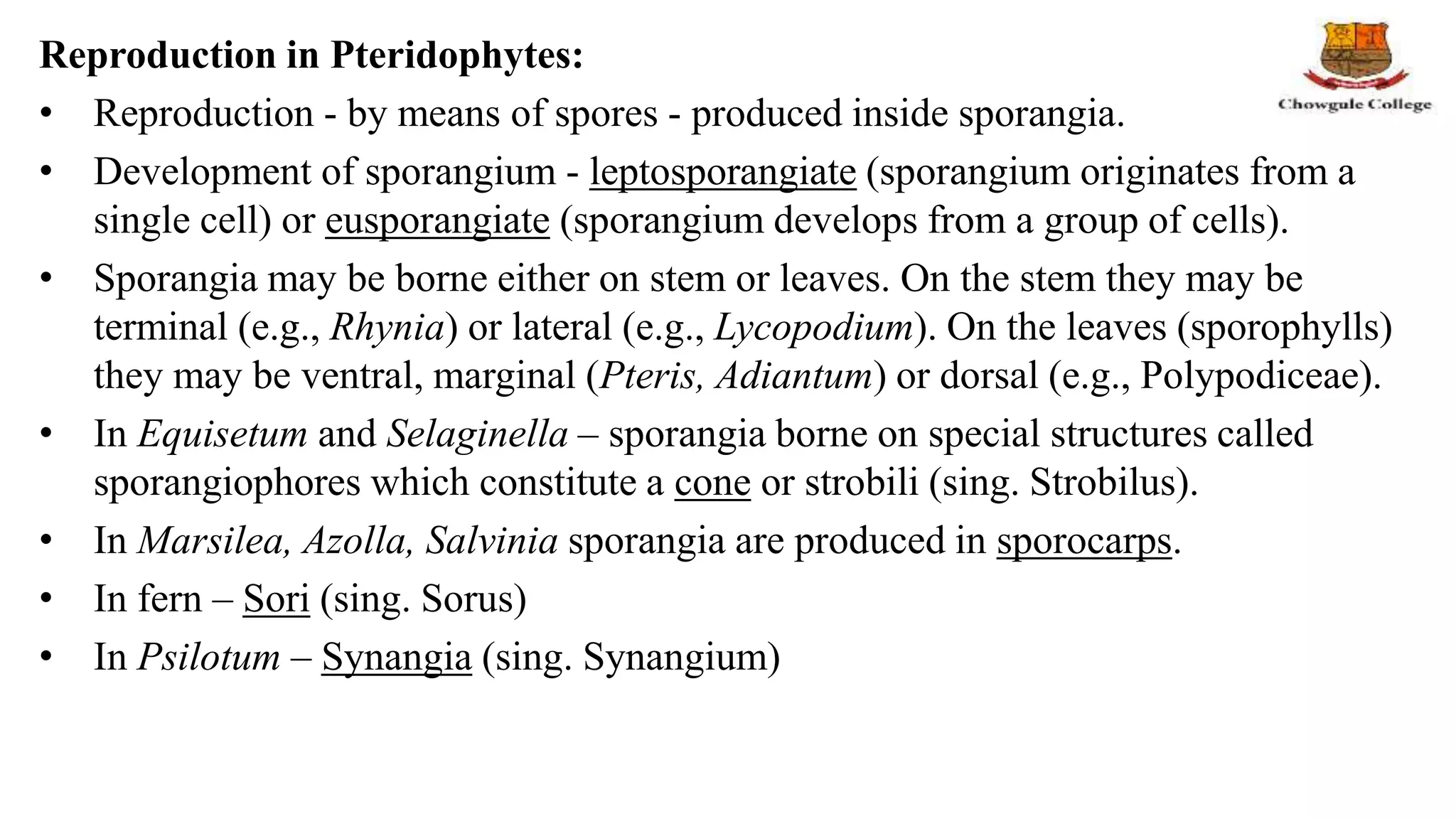
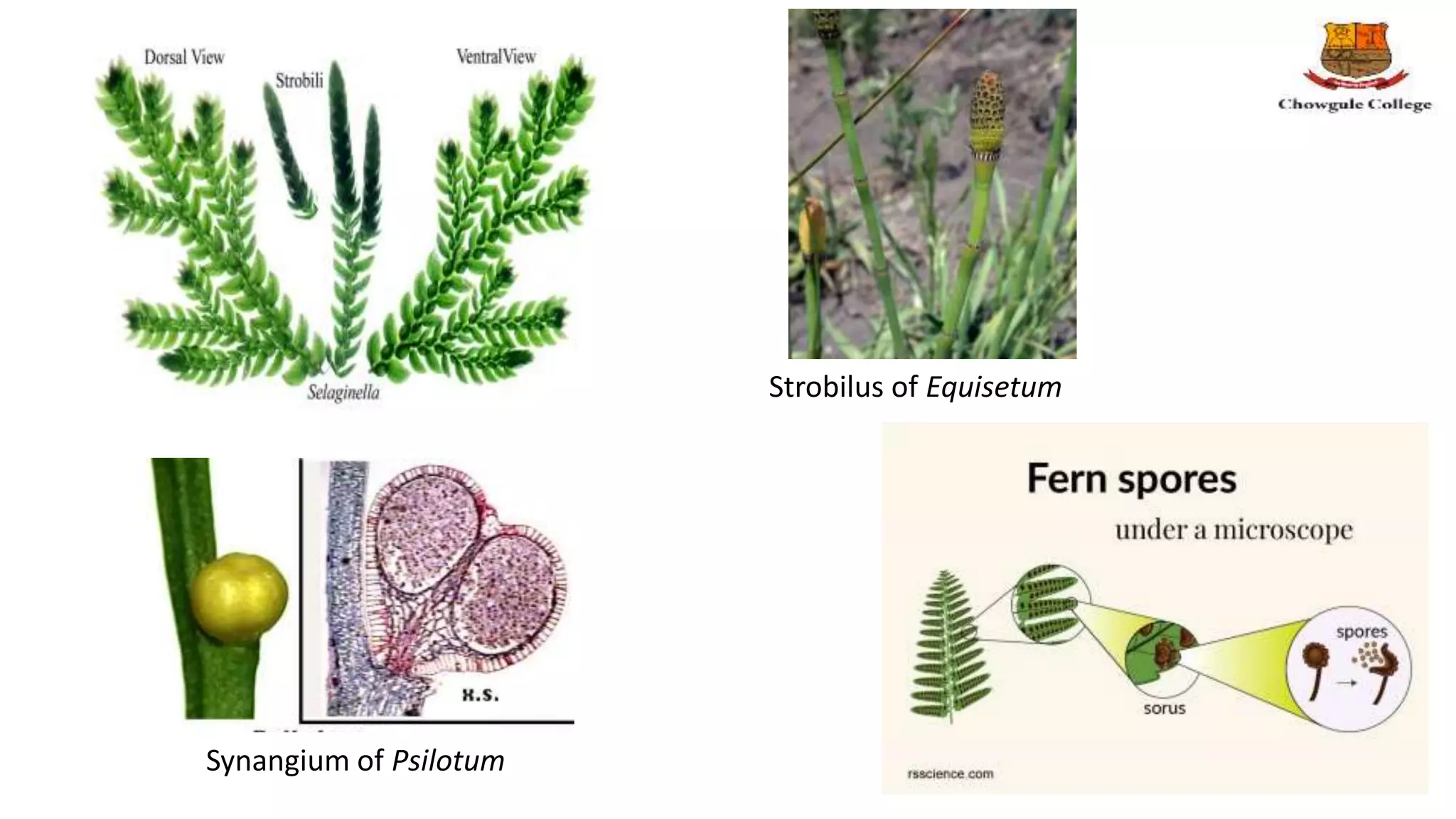
• In Equisetum and Selaginella – sporangia borne on special structures called
sporangiophores which constitute a cone or strobili (sing. Strobilus).
• In Marsilea, Azolla, Salvinia sporangia are produced in sporocarps.
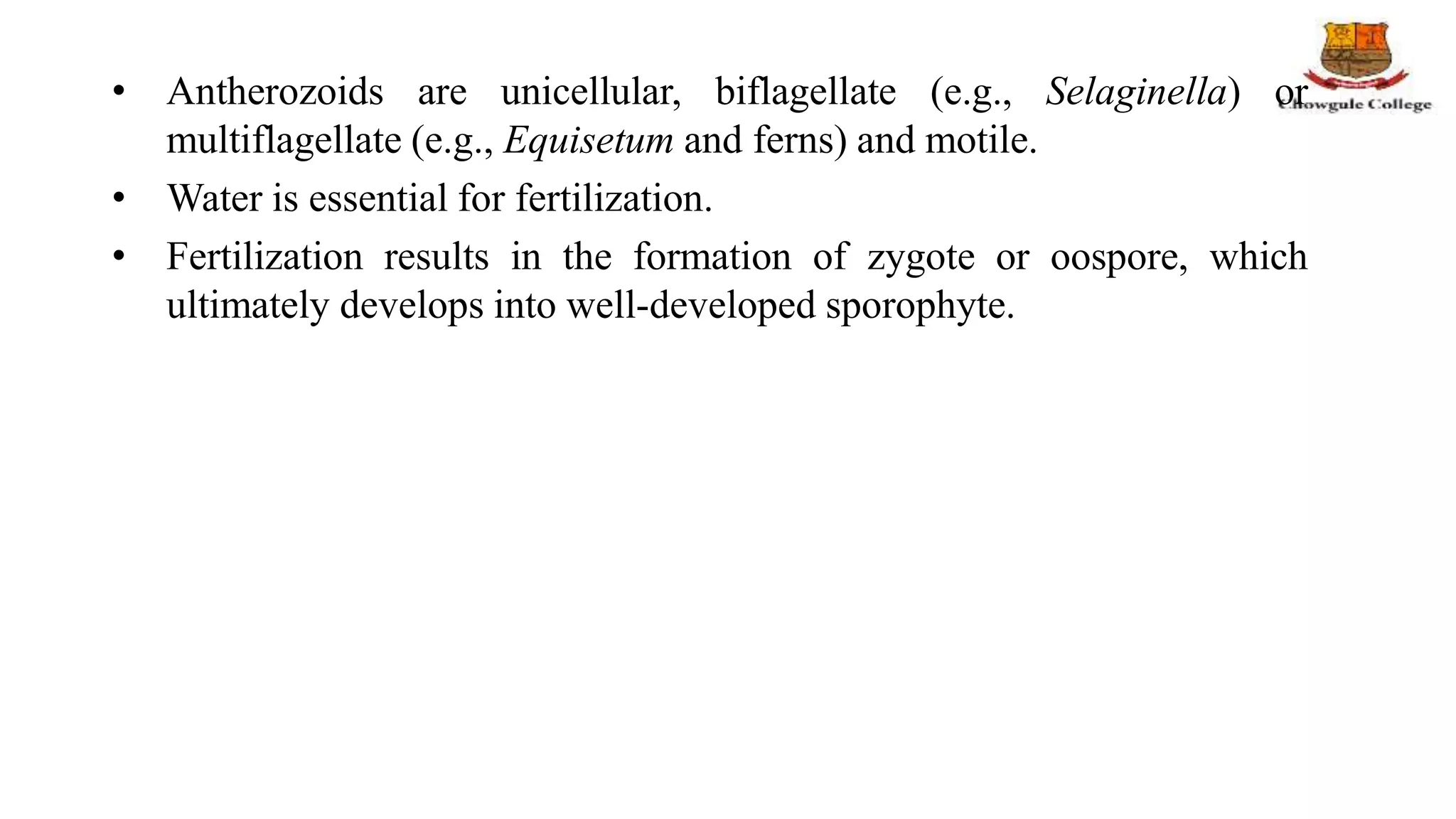
• In fern – Sori (sing. Sorus)
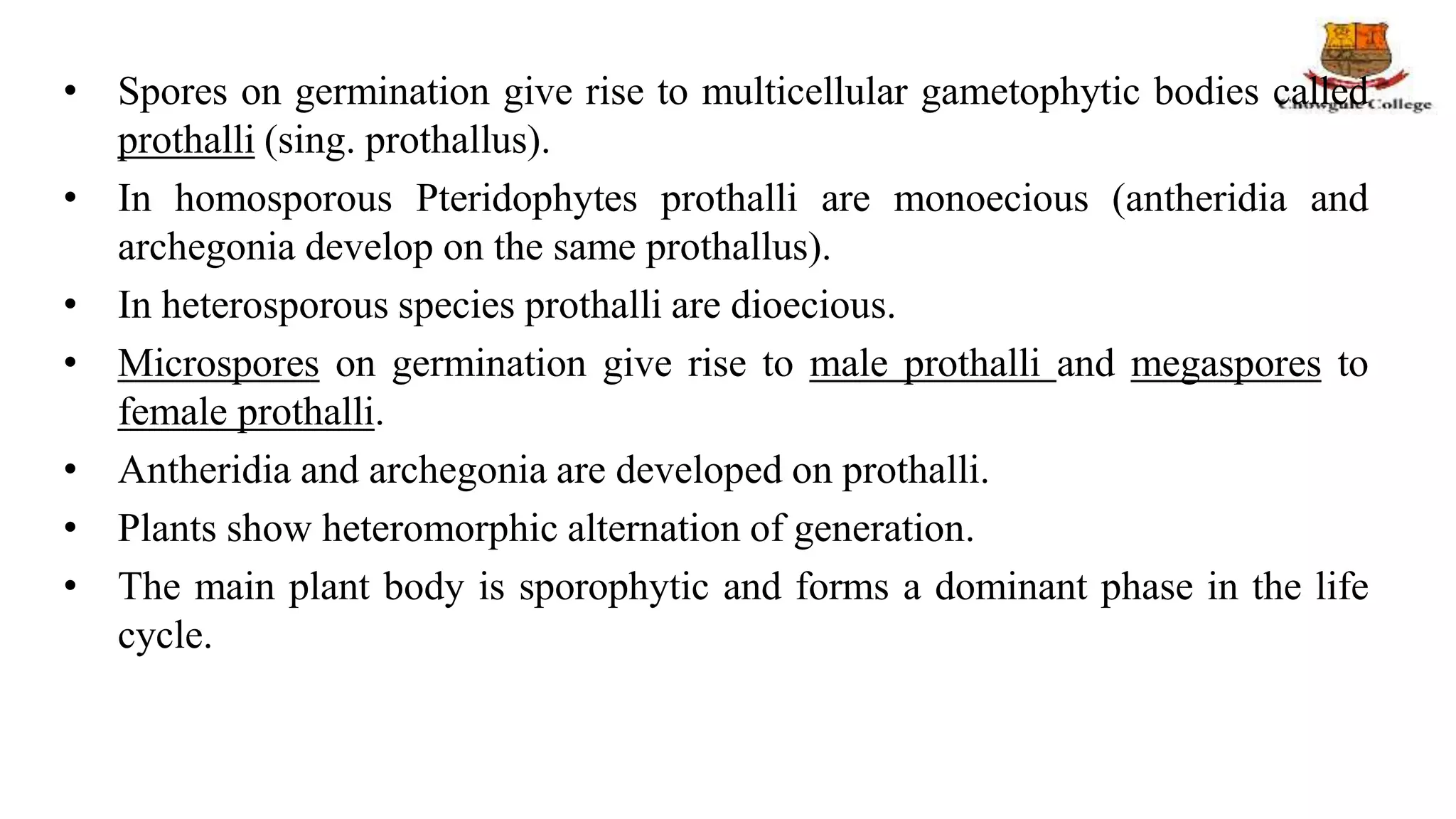
• In Psilotum – Synangia (sing. Synangium)
Synangium of Psilotum
Strobilus of Equisetum
• Spores on germination give rise to multicellular gametophytic bodies called
prothalli (sing. prothallus).
• In homosporous Pteridophytes prothalli are monoecious (antheridia and
archegonia develop on the same prothallus).
• In heterosporous species prothalli are dioecious.
• Microspores on germination give rise to male prothalli and megaspores to
female prothalli.
• Antheridia and archegonia are developed on prothalli.
• Plants show heteromorphic alternation of generation.
• The main plant body is sporophytic and forms a dominant phase in the life
cycle.
• Antherozoids are unicellular, biflagellate (e.g., Selaginella) or
multiflagellate (e.g., Equisetum and ferns) and motile.
• Water is essential for fertilization.
• Fertilization results in the formation of zygote or oospore, which
ultimately develops into well-developed sporophyte.
References
• Pandey B.P. (2009). Botany for degree students: B.Sc. First
Year. S. Chand & Company Ltd. New Delhi.
• Vashishta BR. 2010. Botany for degree students:
Pteridophytes. S. Chand & company ltd.

General characteristics of pteridophytes

  • 1.
    General characteristics ofPteridophytes Sankrita Gaonkar Assistant Professor in Botany sankrita002@gmail.com
  • 2.
    Contents • General characteristicsof Pteridophytes • References
  • 3.
    Pteridophytes • Vascular cryptogams– well developed vascular (conducting) system • Word pteridophyte – Greek origin – Pteron – feather • Feather like fronds • Seedless vascular plants that have successfully invaded land and reproduced by means of spores • Dominant vegetation in historic past – 230-280 mya • Terrestrial and aquatic • 500 spp. in India • Have long fossil history • First traces recognized in Silurian period of late paleozoic era – 400 mya • Flourished well during Devonion period – ‘age of pteridophyte’
  • 4.
    • Majority areterrestrial - grow in cool, moist and shady places e.g., ferns. Some aquatic (e.g., Marsilea, Azolla), xerophytic (e.g., Selaginella rupestris, Equisetum) or epiphytic (e.g., Lycopodium squarrosum) • Majority are herbaceous, few perennial and tree like (e.g., Angiopteris). • Smallest Pteridophyte - Azolla (an aquatic fern) and largest is Cyathea (tree fern). • Plant body is sporophytic - differentiated into root, stem and leaves. • Roots – adventitious, monopodial or dichotomous branching. Azolla Cyathea
  • 5.
    • Stem –branched, monopodial or dichotomous • In many, stem is represented by rhizome. • Leaves – small, thin, scaly (microphyllous e.g., Equisetum), simple and sessile (e.g., Selaginella) or large and pinnately compound (megaphyllous e.g., Dryopteris, Adiantum). • Vascular tissue – present in stem and root - consists of xylem and phloem. • Xylem – tracheids only • Phloem – sieve tubes only • Stele – protostele (e.g., Rhynia, Lycopodium), siphonostele (e.g., Equisetum), dictyostele Adiantum) or polycyclic (e.g., Angiopteris). • Cambium is absent – hence, do not show secondary growth.
  • 6.
    Reproduction in Pteridophytes: •Reproduction - by means of spores - produced inside sporangia. • Development of sporangium - leptosporangiate (sporangium originates from a single cell) or eusporangiate (sporangium develops from a group of cells). • Sporangia may be borne either on stem or leaves. On the stem they may be terminal (e.g., Rhynia) or lateral (e.g., Lycopodium). On the leaves (sporophylls) they may be ventral, marginal (Pteris, Adiantum) or dorsal (e.g., Polypodiceae). • In Equisetum and Selaginella – sporangia borne on special structures called sporangiophores which constitute a cone or strobili (sing. Strobilus). • In Marsilea, Azolla, Salvinia sporangia are produced in sporocarps. • In fern – Sori (sing. Sorus) • In Psilotum – Synangia (sing. Synangium)
  • 7.
  • 8.
    • Spores ongermination give rise to multicellular gametophytic bodies called prothalli (sing. prothallus). • In homosporous Pteridophytes prothalli are monoecious (antheridia and archegonia develop on the same prothallus). • In heterosporous species prothalli are dioecious. • Microspores on germination give rise to male prothalli and megaspores to female prothalli. • Antheridia and archegonia are developed on prothalli. • Plants show heteromorphic alternation of generation. • The main plant body is sporophytic and forms a dominant phase in the life cycle.
  • 9.
    • Antherozoids areunicellular, biflagellate (e.g., Selaginella) or multiflagellate (e.g., Equisetum and ferns) and motile. • Water is essential for fertilization. • Fertilization results in the formation of zygote or oospore, which ultimately develops into well-developed sporophyte.
  • 10.
    References • Pandey B.P.(2009). Botany for degree students: B.Sc. First Year. S. Chand & Company Ltd. New Delhi. • Vashishta BR. 2010. Botany for degree students: Pteridophytes. S. Chand & company ltd.