Koch's Postulate –Principals &
Method
Vaishali S.Patil
Professor, Department of Botany
Shri Shivaji College of Arts, Commerce & Science Akola
Introduction
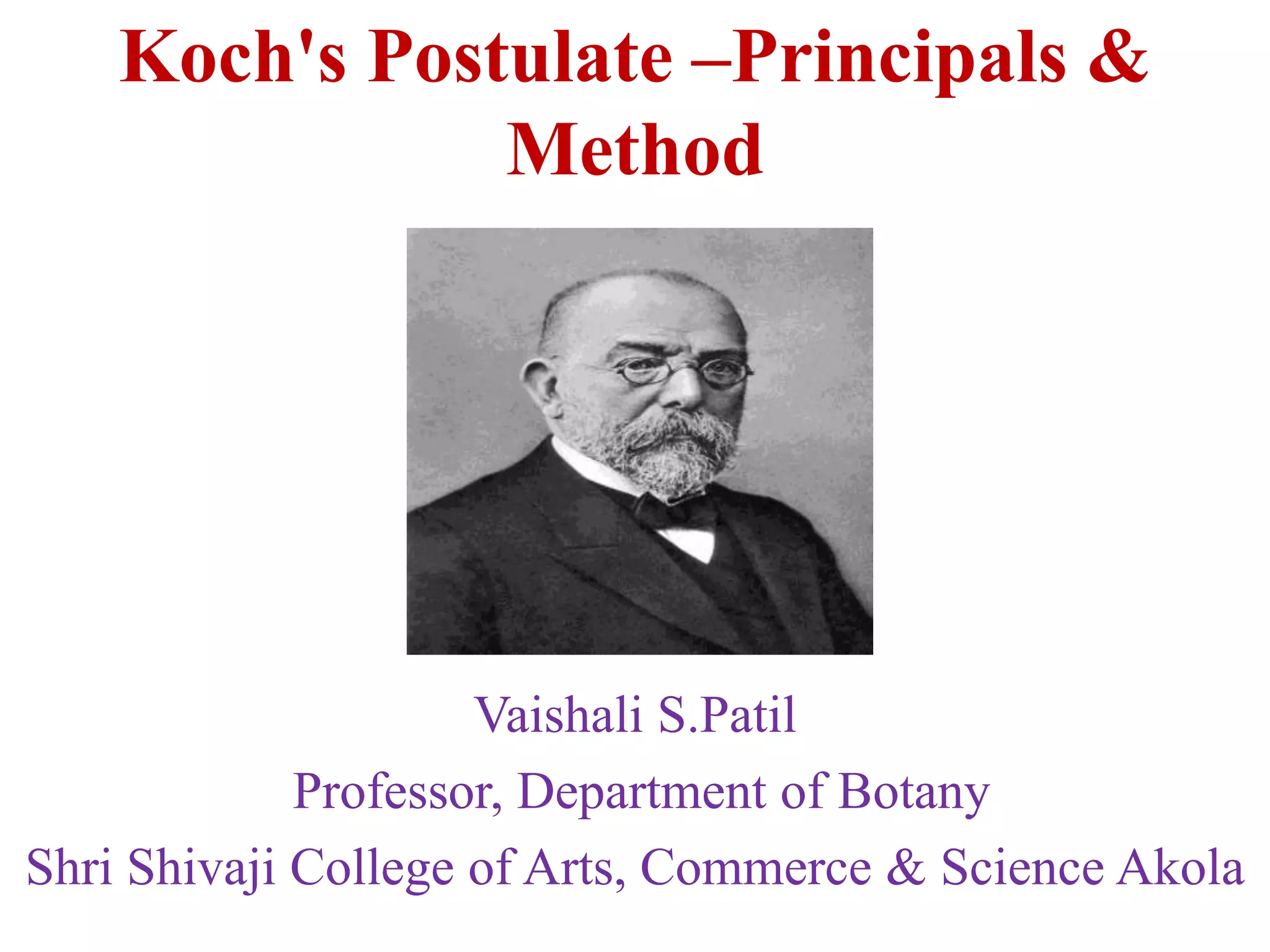
•Heinrich Hermann Robert Koch was a Jewish born
German physician and microbiologist.
•Koch's postulates are four criteria designed to establish
a causative relationship between a microbe and
a disease.
•Koch's postulates were developed in the 19th century as
general guidelines to identify pathogens that could be
isolated with the techniques of the day.
•The postulates were formulated by Robert Koch (Father
of pathogenic microbiology ) and Friedrich Loeffler in
1884 and refined and published by Koch in 1890.
•Koch applied the postulates to describe
the etiology of cholera and tuberculosis, but they have
been controversially generalized to other diseases.
•Koch's postulates have played an important role
in microbiology.
•Viral diseases were not discovered when Koch formulated
his postulates.
•Koch's postulates are also of limited effectiveness when
evaluating biofilms (a thin layer of mucilage containing
microorganisms), Somni cells (sleeping cells) and viruses.
•The actual cause of many diseases is difficult to determine.
Although many organisms can be isolated from a diseased
tissue, their presence does not prove that any or all of them
caused the disease due to the fact that the isolated microbe
may be part of the normal flora or transient flora of that area
or a secondary invader.
•He establish that a particular organism is the causative agent
of a particular disease.
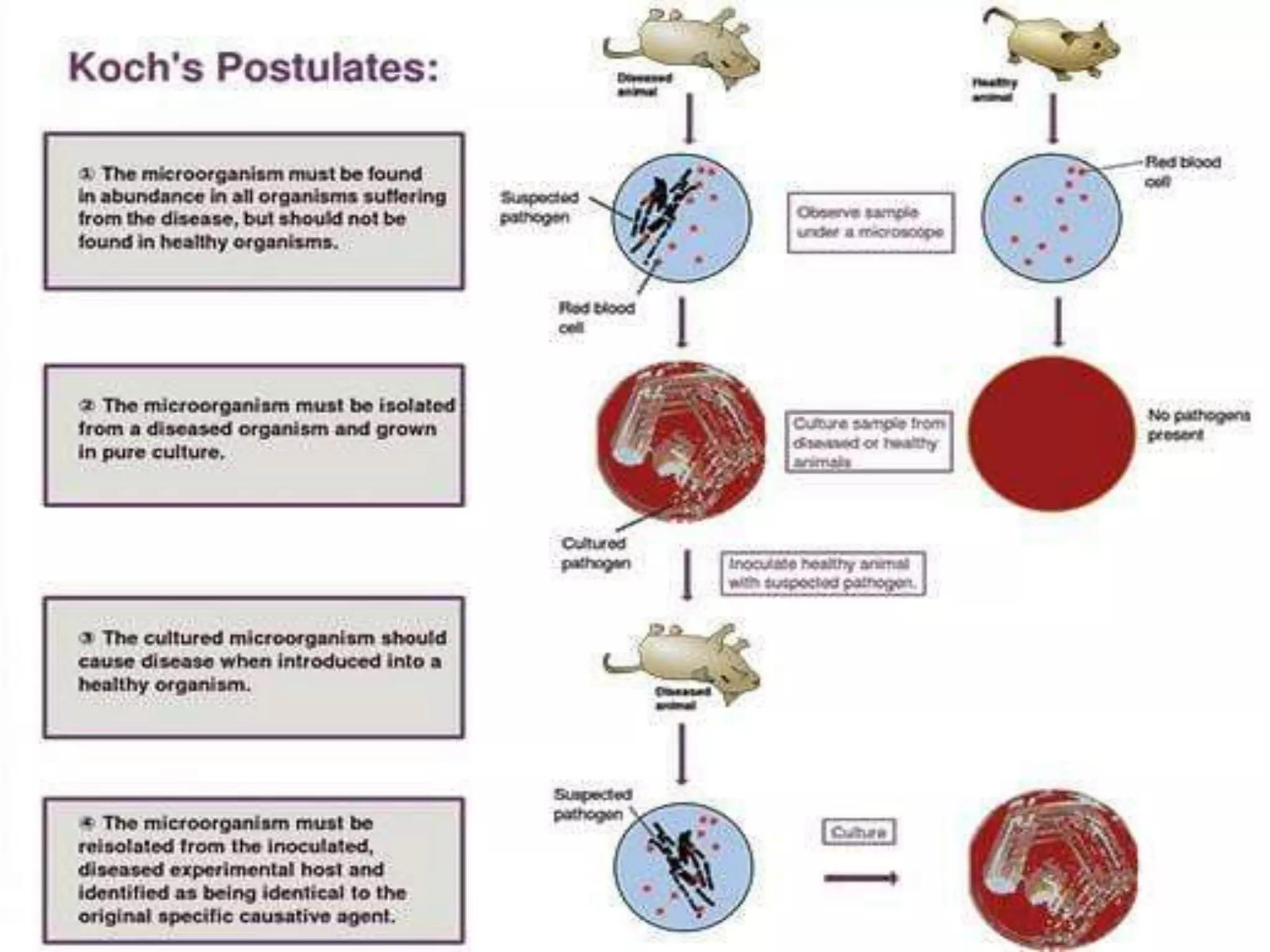
Koch's postulates are the following
1.The microorganism must be found in abundance in
all organisms suffering from the disease, but should
not be found in healthy organisms.
2.The microorganism must be isolated from a diseased
organism and grown in pure culture.
3.The cultured microorganism should cause disease
when introduced into a healthy organism.
4.The microorganism must be reisolated from the
inoculated, diseased experimental host and
identified as being identical to the original specific
causative agent.
Limitations
• The particular bacteria (such as the one that
causes leprosy),viruses, cannot be “grown in pure culture”
in the laboratory.
• There is no animal model of infection with that particular
bacteria.
• Multiple causes
• Chronic or minor condition
• Long incubation period
• https://www.youtube.com/watch?v=GlJNNSSR6WU
• https://www.youtube.com/watch?v=-LtApkEunw4&t=3s
• https://www.youtube.com/watch?v=ipsw28kET-I
• https://www.youtube.com/watch?v=fCUNlz-SAeU
Koch's postulate –principals & method

Koch's postulate –principals & method

  • 1.
    Koch's Postulate –Principals& Method Vaishali S.Patil Professor, Department of Botany Shri Shivaji College of Arts, Commerce & Science Akola
  • 2.
    Introduction •Heinrich Hermann RobertKoch was a Jewish born German physician and microbiologist. •Koch's postulates are four criteria designed to establish a causative relationship between a microbe and a disease. •Koch's postulates were developed in the 19th century as general guidelines to identify pathogens that could be isolated with the techniques of the day. •The postulates were formulated by Robert Koch (Father of pathogenic microbiology ) and Friedrich Loeffler in 1884 and refined and published by Koch in 1890. •Koch applied the postulates to describe the etiology of cholera and tuberculosis, but they have been controversially generalized to other diseases.
  • 3.
    •Koch's postulates haveplayed an important role in microbiology. •Viral diseases were not discovered when Koch formulated his postulates. •Koch's postulates are also of limited effectiveness when evaluating biofilms (a thin layer of mucilage containing microorganisms), Somni cells (sleeping cells) and viruses. •The actual cause of many diseases is difficult to determine. Although many organisms can be isolated from a diseased tissue, their presence does not prove that any or all of them caused the disease due to the fact that the isolated microbe may be part of the normal flora or transient flora of that area or a secondary invader. •He establish that a particular organism is the causative agent of a particular disease.
  • 4.
    Koch's postulates arethe following 1.The microorganism must be found in abundance in all organisms suffering from the disease, but should not be found in healthy organisms. 2.The microorganism must be isolated from a diseased organism and grown in pure culture. 3.The cultured microorganism should cause disease when introduced into a healthy organism. 4.The microorganism must be reisolated from the inoculated, diseased experimental host and identified as being identical to the original specific causative agent.
  • 6.
    Limitations • The particularbacteria (such as the one that causes leprosy),viruses, cannot be “grown in pure culture” in the laboratory. • There is no animal model of infection with that particular bacteria. • Multiple causes • Chronic or minor condition • Long incubation period • https://www.youtube.com/watch?v=GlJNNSSR6WU • https://www.youtube.com/watch?v=-LtApkEunw4&t=3s • https://www.youtube.com/watch?v=ipsw28kET-I • https://www.youtube.com/watch?v=fCUNlz-SAeU