MAP PROJECTION: Basic Concepts
Dr. Lila Mahato
Post Graduate Department of Geography,
Krishnagar Govt. College, Nadia, West Bengal
MAP PROJECTIONS
Characteristics of maps
Definition of map projection
Generating Globe
Projection Plane (nature and Aspect),
Developable Surface
Properties of Projection
Classification of Map Projection
MAP – Nature and characteristics
 Graphic representation of the geographical setting i.e. Communicate geographical
information graphically
 Printed depiction of the Earth’s surface as a whole or part of it on a plane sheet of
paper.
So,
• All geographical maps are reductions. --Scale.
• All maps involve geometrical transformations. -- Map projection.
• All maps are abstractions of reality.
• All maps use signs to stand for elements of reality.
Cartography is the making and study of maps in all their aspects. It is an efficient way of
manipulating, analysing and expressing ideas, forms and relationships that occur in
two- and three-dimensional space.
Processes in Cartography
• Collecting and selecting the data for mapping
• Manipulating and generalising the data, designing and constructing the map
• Reading or view the map
• Responding to or interpreting the information
GENERATING GLOBE
It is a Globe from which the projections are to be
developed.
It is looked upon as a glass or wire skeleton Globe on
which the meridians and parallels are marked.
N
S
EW O
PROJECTION – Imposition of an object on any other surface with a particular
viewpoint or perspective.
MAP PROJECTION :
 is a means of drawing of Earth’s surface on a plain sheet of paper
 drawing of Graticules ( net of lines of Latitudes and meridians of Longitudes)
 transformation of 3 dimensional Globe on a 2 dimensional plane.
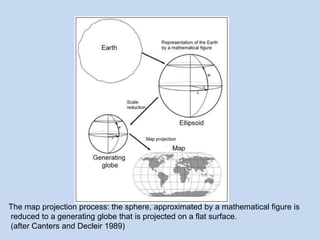
The map projection process: the sphere, approximated by a mathematical figure is
reduced to a generating globe that is projected on a flat surface.
(after Canters and Decleir 1989)
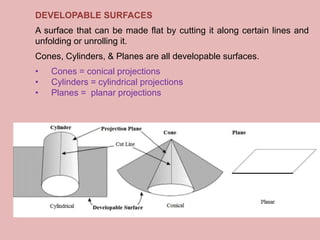
DEVELOPABLE SURFACES
A surface that can be made flat by cutting it along certain lines and
unfolding or unrolling it.
Cones, Cylinders, & Planes are all developable surfaces.
• Cones = conical projections
• Cylinders = cylindrical projections
• Planes = planar projections
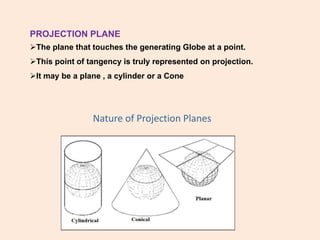
Nature of Projection Planes
PROJECTION PLANE
The plane that touches the generating Globe at a point.
This point of tangency is truly represented on projection.
It may be a plane , a cylinder or a Cone
Map Projection: Characteristics
The following properties would be present on map projection
•Areas are everywhere correctly represented
•All distances are correctly represented.
•All directions on the map are the same as on Earth
•All angles are correctly represented.
•The shape of any area is correctly represented
It is, unfortunately, impossible to have all these properties together in one
map projection.
Classification of Projections
A. On the basis of Viewpoint of Map Projection- 1. Perspective
2. Non- Perspective
B. On the basis of Nature Projection plane - 1. Planar
2. Cylindrical
3. Conical
4. Conventional
(Mathematical)
C. On the basis of properties maintained in the Projection –
1. Equidistant
2. Equal Area
3. Orthomorphic
4. Azimuthal
5. Aphylactic
Contd..--
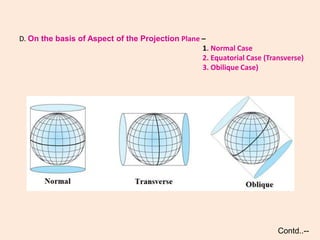
D. On the basis of Aspect of the Projection Plane –
1. Normal Case
2. Equatorial Case (Transverse)
3. Obilique Case)
Contd..--
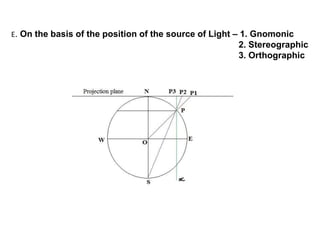
E. On the basis of the position of the source of Light – 1. Gnomonic
2. Stereographic
3. Orthographic
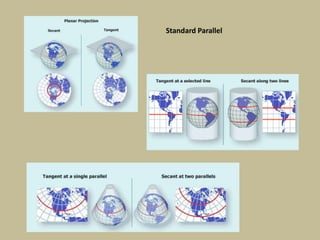
Standard Parallel
Map Projection in Common Use
Several hundreds of map projections have been described in several
books. But, most commonly used map projections are:
A. Universal Transverse Mercator (UTM)- The UTM is a secant,
cylindrical projection in a transverse position
B. Polyconic- early maps in the International Map of the World
(1:1,000,000 scale) series and for topographic mapping in some
countries.
C. Lambert Confomal Conic
D. Stereographic projection.

Map projection

  • 1.
    MAP PROJECTION: BasicConcepts Dr. Lila Mahato Post Graduate Department of Geography, Krishnagar Govt. College, Nadia, West Bengal
  • 2.
    MAP PROJECTIONS Characteristics ofmaps Definition of map projection Generating Globe Projection Plane (nature and Aspect), Developable Surface Properties of Projection Classification of Map Projection
  • 3.
    MAP – Natureand characteristics  Graphic representation of the geographical setting i.e. Communicate geographical information graphically  Printed depiction of the Earth’s surface as a whole or part of it on a plane sheet of paper. So, • All geographical maps are reductions. --Scale. • All maps involve geometrical transformations. -- Map projection. • All maps are abstractions of reality. • All maps use signs to stand for elements of reality. Cartography is the making and study of maps in all their aspects. It is an efficient way of manipulating, analysing and expressing ideas, forms and relationships that occur in two- and three-dimensional space. Processes in Cartography • Collecting and selecting the data for mapping • Manipulating and generalising the data, designing and constructing the map • Reading or view the map • Responding to or interpreting the information
  • 4.
    GENERATING GLOBE It isa Globe from which the projections are to be developed. It is looked upon as a glass or wire skeleton Globe on which the meridians and parallels are marked. N S EW O PROJECTION – Imposition of an object on any other surface with a particular viewpoint or perspective. MAP PROJECTION :  is a means of drawing of Earth’s surface on a plain sheet of paper  drawing of Graticules ( net of lines of Latitudes and meridians of Longitudes)  transformation of 3 dimensional Globe on a 2 dimensional plane.
  • 5.
    The map projectionprocess: the sphere, approximated by a mathematical figure is reduced to a generating globe that is projected on a flat surface. (after Canters and Decleir 1989)
  • 6.
    DEVELOPABLE SURFACES A surfacethat can be made flat by cutting it along certain lines and unfolding or unrolling it. Cones, Cylinders, & Planes are all developable surfaces. • Cones = conical projections • Cylinders = cylindrical projections • Planes = planar projections
  • 7.
    Nature of ProjectionPlanes PROJECTION PLANE The plane that touches the generating Globe at a point. This point of tangency is truly represented on projection. It may be a plane , a cylinder or a Cone
  • 8.
    Map Projection: Characteristics Thefollowing properties would be present on map projection •Areas are everywhere correctly represented •All distances are correctly represented. •All directions on the map are the same as on Earth •All angles are correctly represented. •The shape of any area is correctly represented It is, unfortunately, impossible to have all these properties together in one map projection.
  • 9.
    Classification of Projections A.On the basis of Viewpoint of Map Projection- 1. Perspective 2. Non- Perspective B. On the basis of Nature Projection plane - 1. Planar 2. Cylindrical 3. Conical 4. Conventional (Mathematical) C. On the basis of properties maintained in the Projection – 1. Equidistant 2. Equal Area 3. Orthomorphic 4. Azimuthal 5. Aphylactic Contd..--
  • 10.
    D. On thebasis of Aspect of the Projection Plane – 1. Normal Case 2. Equatorial Case (Transverse) 3. Obilique Case) Contd..--
  • 11.
    E. On thebasis of the position of the source of Light – 1. Gnomonic 2. Stereographic 3. Orthographic
  • 12.
  • 13.
    Map Projection inCommon Use Several hundreds of map projections have been described in several books. But, most commonly used map projections are: A. Universal Transverse Mercator (UTM)- The UTM is a secant, cylindrical projection in a transverse position B. Polyconic- early maps in the International Map of the World (1:1,000,000 scale) series and for topographic mapping in some countries. C. Lambert Confomal Conic D. Stereographic projection.