Concepts and Functions of Geographic Information Systems (3/5) MSc GIS - Alexander Mogollon Diaz Department of Agronomy 2009
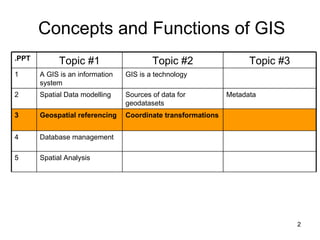
Concepts and Functions of GIS .PPT Topic #1 Topic #2 Topic #3 1 A GIS is an information system GIS is a technology 2 Spatial Data modelling Sources of data for geodatasets Metadata 3 Geospatial referencing Coordinate transformations 4 Database management 5 Spatial Analysis
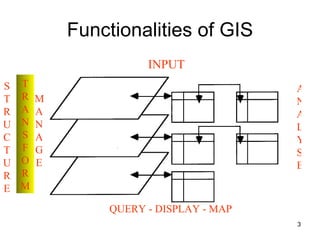
Functionalities of GIS INPUT  QUERY - DISPLAY - MAP ANALYSE STRUCTURE MANAGE TRANSFORM
Transformations for building a spatial model / gDB Of the geometric data (coordinates, cell definition) Of the attribute data change of units combination of attributes:  e.g. time = distance/speed ...
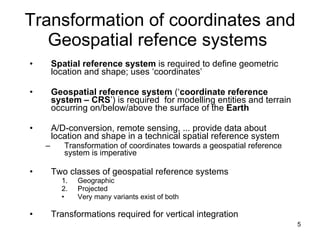
Transformation of coordinates and Geospatial refence systems  Spatial reference system  is required to define geometric location and shape; uses ‘coordinates’ Geospatial   reference system  (‘ coordinate reference system – CRS ’) is required  for modelling entities and terrain occurring on/below/above the surface of the  Earth  A/D-conversion, remote sensing, ... provide data about location and shape in a technical spatial reference system Transformation of coordinates towards a geospatial reference system is imperative Two classes of geospatial reference systems Geographic Projected Very many variants exist of both Transformations required for vertical integration
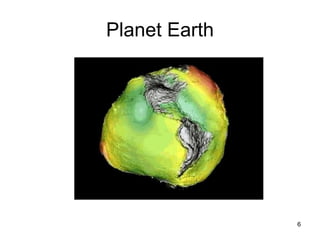
Planet Earth
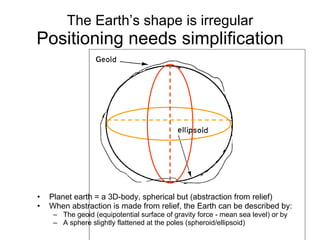
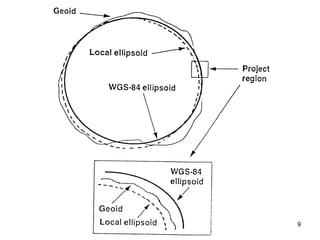
The Earth’s shape is irregular Positioning needs simplification Planet earth = a 3D-body, spherical but (abstraction from relief) When abstraction is made from relief, the Earth can be described by: The geoid (equipotential surface of gravity force - mean sea level) or by  A sphere slightly flattened at the poles (spheroid/ellipsoid)
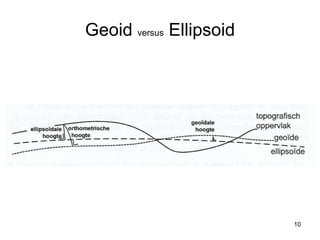
Geoid   versus   Ellipsoid Geoid 3D-physical datamodel of the Earth’s surface, based on measurements of the gravity force Local and Global Ellipsoids  Mathematical 3D-models of the Earth’s surface Global ellipsoids are defined to represent the full Earth with acceptable accuracy Local ellipsoids are defined to represent a part of the Earth’s surface only, with high accuracy
Geoid  versus  Ellipsoid
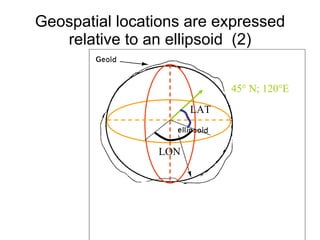
Geospatial locations are expressed relative to an ellipsoid  (1)   Geographic coordinates: Expressed as angles with respect to 2 of 3 axes through the gravity point of the ellipsoid  LONGITUDE: 0° (Greenwich) to 180° East and 0° to 180° West measured in the horizontal plane  LATITUDE: 0° (Equator) to 90 North and 0° to 90° South) measured in the vertical plane Degrees-Minutes-Seconds or Decimal Degrees:  20° 15’ 15” = 20,2525
Geospatial locations are expressed relative to an ellipsoid  (2) LON LAT 45° N; 120°E
Geospatial locations are expressed relative to an ellipsoid  (3) Several ellipsoids are in use ! Major radius or major semi-axis  a Minor radius or minor semi-axis  b Flattening f of the ellipsoid: a-b/a = 1/f
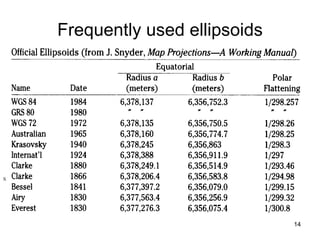
Frequently used ellipsoids S
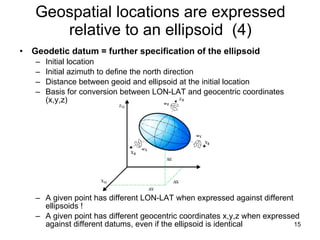
Geospatial locations are expressed relative to an ellipsoid  (4) Geodetic datum = further specification of the ellipsoid Initial location Initial azimuth to define the north direction Distance between geoid and ellipsoid at the initial location Basis for conversion between LON-LAT and geocentric coordinates (x,y,z) A given point has different LON-LAT when expressed against different ellipsoids ! A given point has different geocentric coordinates x,y,z when expressed against different datums, even if the ellipsoid is identical
From geographic coordinates to projected coordinates Common GIS-systems model the geographic reality in planimetric 2D  traditional map view Carthesian X-Y coordinates, meters LON-LAT (angles, 3D) need to be transformed into X-Y (2D) Such a transformation = a projection Projected coordinates = map coordinates
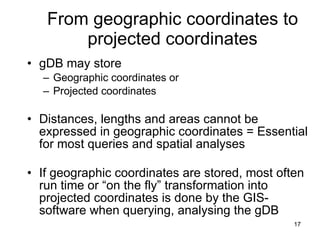
From geographic coordinates to projected coordinates gDB may store Geographic coordinates or Projected coordinates Distances, lengths and areas cannot be expressed in geographic coordinates = Essential for most queries and spatial analyses  If geographic coordinates are stored, most often run time or “on the fly” transformation into projected coordinates is done by the GIS-software when querying, analysing the gDB
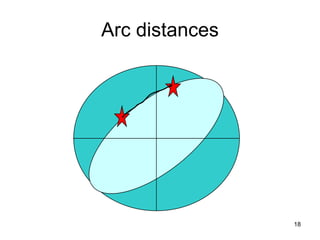
Arc distances
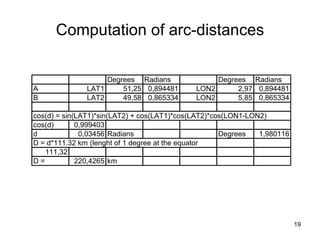
Computation of arc-distances
From geographic coordinates to projected coordinates From LON-LAT to X-Y = mathematical, analytical operation 1. Shape of earth needs to be parameterised by means of a geodetic datum global or local approximation of the geoid
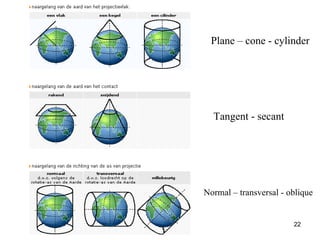
From geographic coordinates to projected coordinates From LON-LAT to X-Y = mathematical, analytical operation 2. One of very many projection functions needs to be choosen Cylinder, plane or cone as projection surface Tangent or secant at selected locations Normal, transversal, arbitrary False easting, false northing
Plane – cone - cylinder Tangent - secant Normal – transversal - oblique
Choice of the projection function From 3D to 2D => deformation cannot be avoided shape direction area distance Local datum and projection function are choosen in order to minimise deformation for the study area position and shape of study area conditioned by objective of cartography (density mapping requires ‘true’ areas) and type of analysis
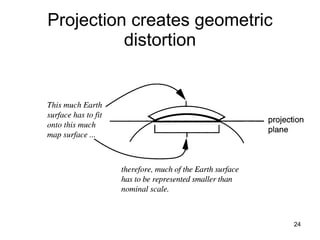
Projection creates geometric distortion
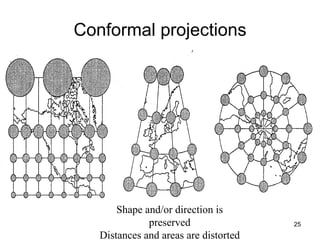
Conformal projections Shape and/or direction is preserved Distances and areas are distorted
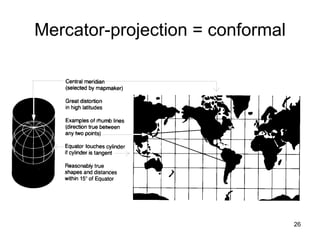
Mercator-projection = conformal
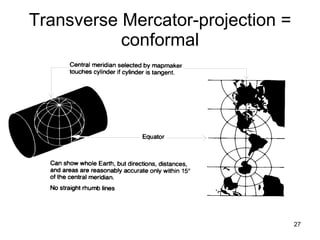
Transverse Mercator-projection = conformal
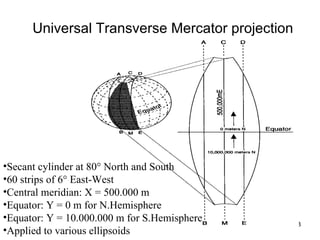
Universal Transverse Mercator projection Secant cylinder at 80° North and South 60 strips of 6° East-West Central meridian: X = 500.000 m Equator: Y = 0 m for N.Hemisphere Equator: Y = 10.000.000 m for S.Hemisphere Applied to various ellipsoids
Standard projected coordinate system for the Philippines Ellipsoid: Clark’s spheroid of 1866 Semi-major axis = 6.378.206,4 m Semi-minor axis = 6.356.583,8 m Projection: Philippines Transverse Mercator UTM Zone 50 (114 – 120 °East) Zone 51 (120 – 126 °East) Further subdivided in 6 subzones with central meridian 117 °East 119 °East 121 °East 123 °East 125 °East False northing = 0; False easting = 500.000 meters
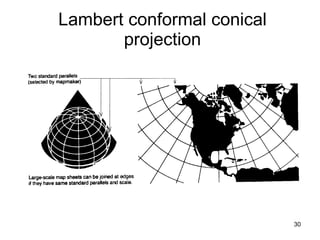
Lambert conformal conical projection
Standard projected coordinate system for Belgium Belgian Datum  = local orientation of Hayford’s ellipsoid of 1909, recommended as International ellipsoid in 1924 Projection function : Lambert 72/50 Conformal conical projection with 2 secant parallels 49°50’0.0204” and 51°10’0.0204” Longitude of central meridian: 4°22’2.952” Latitude of origin: 90° Fase easting: 150.000,013 meter False northing: 5.400.088,4398 meter Vertical reference system  = TAW (average low tide level in Oostende (North Sea Channel )
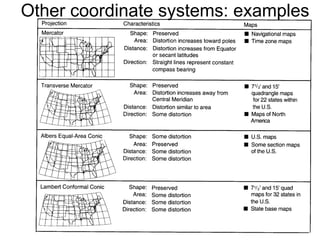
Other coordinate systems: examples
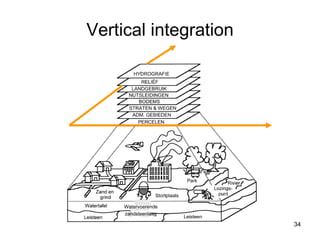
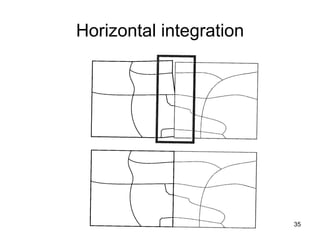
A gDB  Can have one coordinate reference system only (effective or virtual) The coordinates in all geodatasets must be expressed according to that system Vertical integration Horizontal integration Most commonly, the choosen coordinate system is Geographic coordinates (LON-LAT) or National coordinate system (from the National Mapping Agency, used for printing topographic / military maps)
Vertical integration
Horizontal integration
Transformation of coordinates for vertical/horizontal integration Analytical  conversion between geographic coordinates expressed according to different geodetic datums = datum conversion Analytical  conversion of geographic coordinates (e.g. from GPS) in projected coordinates and vice versa = (inverse) projection Analytical  conversion between different types of projected coordinates (e.g. between Philippine and Belgian system) Numerical  coordinate transformation (e.g. geo-referencing, using control points)
Numeric coordinate transformation Numeric coordinate shifts, based on control points, for vertical and horizontal integration of geodatasets in a gDB systematic shifts (e.g. conversion of digitiser/scan coordinates in projected coordinates) non-systematic shifts: rubber sheeting, edge matching
Geo-referencing When coordinates are expressed according to an analytical reference system, the term ‘georeferenced data’ is used. A/D conversion using tablet digitising or scanning provide digitiser and scan coordinates. Also raw satellite images are not georeferenced.  Transformation of « technical » coordinates into geographical or projected coordinates = georeferencing .
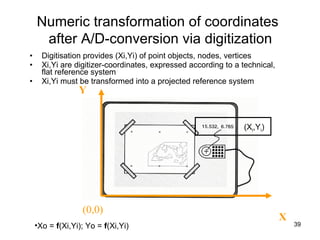
Numeric transformation of coordinates   after A/D-conversion via digitization Digitisation provides (Xi,Yi) of point objects, nodes, vertices Xi,Yi are digitizer-coordinates, expressed according to a technical, flat reference system Xi,Yi must be transformed into a projected reference system  X Y (0,0) Xo =  f (Xi,Yi); Yo =  f (Xi,Yi) (X i ,Y i )
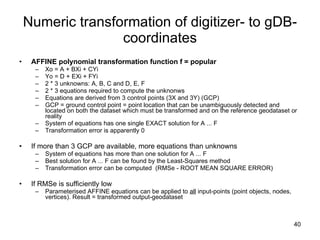
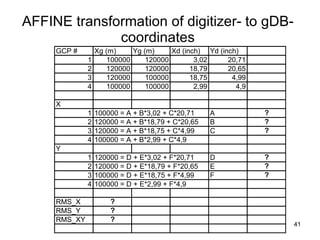
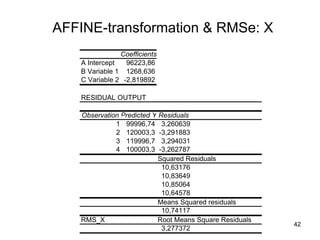
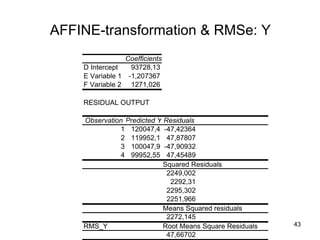
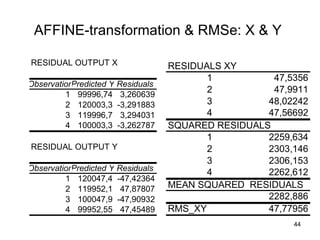
Numeric transformation of digitizer- to gDB-coordinates AFFINE polynomial transformation function f = popular Xo = A + BXi + CYi  Yo = D + EXi + FYi 2 * 3 unknowns: A, B, C and D, E, F 2 * 3 equations required to compute the unknonws  Equations are derived from 3 control points (3X and 3Y) (GCP) GCP = ground control point = point location that can be unambiguously detected and located on both the dataset which must be transformed and on the reference geodataset or reality System of equations has one single EXACT solution for A ... F Transformation error is apparently 0 If more than 3 GCP are available, more equations than unknowns System of equations has more than one solution for A ... F Best solution for A ... F can be found by the Least-Squares method Transformation error can be computed  (RMSe - ROOT MEAN SQUARE ERROR)  If RMSe is sufficiently low Parameterised AFFINE equations can be applied to  all  input-points (point objects, nodes, vertices). Result = transformed output-geodataset
AFFINE transformation of digitizer- to gDB-coordinates
AFFINE-transformation & RMSe: X
AFFINE-transformation & RMSe: Y
AFFINE-transformation & RMSe: X & Y
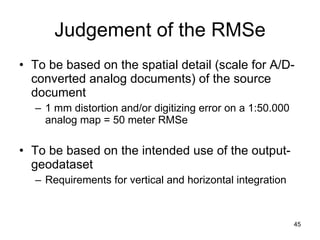
Judgement of the RMSe To be based on the spatial detail (scale for A/D-converted analog documents) of the source document 1 mm distortion and/or digitizing error on a 1:50.000 analog map = 50 meter RMSe To be based on the intended use of the output-geodataset Requirements for vertical and horizontal integration
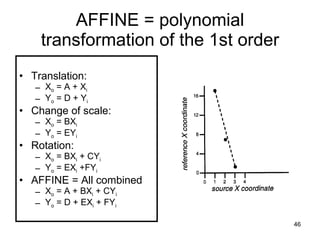
Translation:  X o  = A + X i Y o  = D + Y i Change of scale:  X o  = BX i Y o  = EY i Rotation:  X o  = BX i  + CY i Y o  = EX i  +FY i AFFINE = All combined X o  = A + BX i  + CY i Y o  = D + EX i  + FY i AFFINE = polynomial transformation of the 1st order
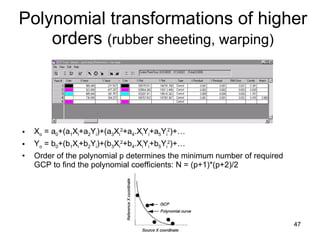
X o  = a 0 +(a 1 X i +a 2 Y i )+(a 3 X i 2 +a 4 .X i Y i +a 5 Y i 2 )+… Y o  = b 0 +(b 1 X i +b 2 Y i )+(b 3 X i 2 +b 4 .X i Y i +b 5 Y i 2 )+… Order of the polynomial p determines the minimum number of required  GCP to find the polynomial coefficients: N = (p+1)*(p+2)/2 Polynomial transformations of higher orders  (rubber sheeting, warping)
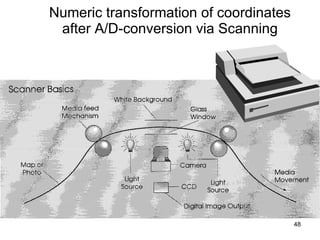
Numeric transformation of coordinates after A/D-conversion via Scanning
Numeric transformation of scan- to gDB-coordinates A scanned document is not georeferenced Scan-coordinates are relative to the reference system of the scan-device Transformation of the scan-coordinates is necessary, using GCP Regular cell-raster is distorted A new ‘empty’ cell-raster is created according to the output-reference system Based on the established transformation function, cell values are resampled from the input raster to compute the values for the cells in the output raster  Neirest neighbour Other algorithms Also valid for remotely sensed images !
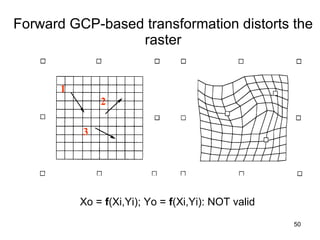
Forward GCP-based transformation distorts the raster 1 2 3 Xo =  f (Xi,Yi); Yo =  f (Xi,Yi): NOT valid
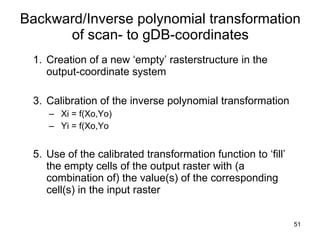
Backward/Inverse polynomial transformation of scan- to gDB-coordinates Creation of a new ‘empty’ rasterstructure in the output-coordinate system Calibration of the inverse polynomial transformation Xi = f(Xo,Yo) Yi = f(Xo,Yo Use of the calibrated transformation function to ‘fill’ the empty cells of the output raster with (a combination of) the value(s) of the corresponding cell(s) in the input raster
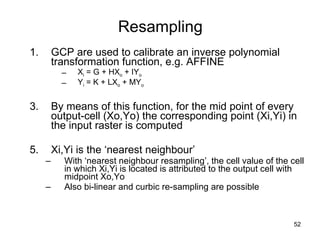
Resampling GCP are used to calibrate an inverse polynomial transformation function, e.g. AFFINE X i  = G + HX o  + IY o Y i  = K + LX o  + MY o By means of this function, for the mid point of every  output-cell (Xo,Yo) the corresponding point (Xi,Yi) in the input raster is computed  Xi,Yi is the ‘nearest neighbour’ With ‘nearest neighbour resampling’, the cell value of the cell in which Xi,Yi is located is attributed to the output cell with midpoint Xo,Yo Also bi-linear and curbic re-sampling are possible
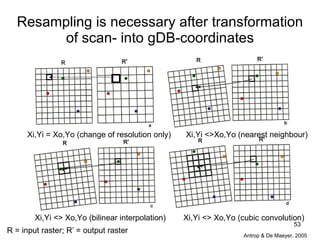
Resampling is necessary after transformation of scan- into gDB-coordinates R = input raster; R’ = output raster Antrop & De Maeyer, 2005 Xi,Yi = Xo,Yo (change of resolution only) Xi,Yi <>Xo,Yo (nearest neighbour) Xi,Yi <> Xo,Yo (bilinear interpolation) Xi,Yi <> Xo,Yo (cubic convolution)
Numeric coordinate transformation Similar systematic numeric transformation is applicable to coordinates coming from other data sources  Remotely sensed images Theodolites, tachymeters with digital reading Global Positioning Systems (GPS)
(Non-)systematic numeric coordinate-transformations Previous numeric polynomial coordinate transformations are based on GCP  One  set of coefficients A, B, C, … is computed and applied to  all  input-points to obtain the output-coordinates Such transformations are  systematic
Non-systematic transformations   for further improvement of the positional quality of the georeferenced geodatasets First step in georeferencing is most often a  systematic  transformation of coordinates  Polynomial function of low order The result is often not of sufficient quality or not sufficiently fit for use (vertical/horizontal integration in the gDB)  In a next step,  non-systematic  transformation can be performed to make the geodataset geometrically more conformal to the reference geodataset
Non-systematic coordinate transformations Edge-matching Rubber-sheeting
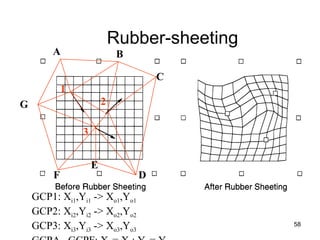
Rubber-sheeting 1 2 3 GCP1: X i1 ,Y i1  -> X o1 ,Y o1 GCP2: X i2 ,Y i2  -> X o2 ,Y o2 GCP3: X i3 ,Y i3  -> X o3 ,Y o3 GCPA...GCPF: X i  = X o ; Y i  = Y o A B D E F G C
Rubber-sheeting Point-by-point correction of the location and shape of objects or of resampling of cell attributes Based on 2 linear “piece wise” TIN-interpolations (7.PPT), 1 for X and 1 for Y Z-value to interpolate = X o  resp. Y o Result = not-constant translation/rotation/change of scale  Shifts decrease with increasing distance Both forward (for vectorial geodatasets) and backward (for raster datasets)
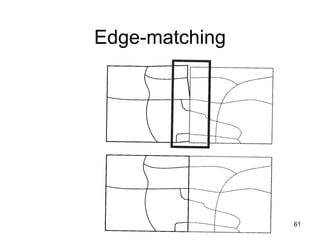
Edge-matching Special case of rubber sheeting Applied for horizontal integration of adjacent (A/D converted) map sheets or images (mosaicking) Definition of links between coinciding points on two map sheets Differential displacement of points based on (mostly inverse distance; TIN) interpolation
Edge-matching
Summary of important items Geospatial reference systems Based on a geodetic datum (LON-LAT) and (possibly) a projection function to convert LON-LAT (angles - 3D) into planimetric coordinates (X,Y – 2D) Projection leads to distortion of one or more of shape, direction, area, distance If the national standards are not used, a rational, functional choice of datum and projection function is required  The datum for elevation is most often the geoid (approximated by mean sea level) Transformation of coordinates Between parameterised geographic and/or projected coordinate systems is an analytical operation which does not need external ground truth Between  technical coordinates and projected coordinates is a numeric operation based on ground truth (GCP) There are systematic and non-systematic numeric transformation functions Systematic transformation is most often based on a polynomial function Non-systematic transformation (rubber sheeting and edge-matching) is based on TIN-interpolation The latter is also valid for projected coordinates which need correction
Questions or remarks ? Thank you …

Gis Concepts 3/5

  • 1.
    Concepts and Functionsof Geographic Information Systems (3/5) MSc GIS - Alexander Mogollon Diaz Department of Agronomy 2009
  • 2.
    Concepts and Functionsof GIS .PPT Topic #1 Topic #2 Topic #3 1 A GIS is an information system GIS is a technology 2 Spatial Data modelling Sources of data for geodatasets Metadata 3 Geospatial referencing Coordinate transformations 4 Database management 5 Spatial Analysis
  • 3.
    Functionalities of GISINPUT QUERY - DISPLAY - MAP ANALYSE STRUCTURE MANAGE TRANSFORM
  • 4.
    Transformations for buildinga spatial model / gDB Of the geometric data (coordinates, cell definition) Of the attribute data change of units combination of attributes: e.g. time = distance/speed ...
  • 5.
    Transformation of coordinatesand Geospatial refence systems Spatial reference system is required to define geometric location and shape; uses ‘coordinates’ Geospatial reference system (‘ coordinate reference system – CRS ’) is required for modelling entities and terrain occurring on/below/above the surface of the Earth A/D-conversion, remote sensing, ... provide data about location and shape in a technical spatial reference system Transformation of coordinates towards a geospatial reference system is imperative Two classes of geospatial reference systems Geographic Projected Very many variants exist of both Transformations required for vertical integration
  • 6.
  • 7.
    The Earth’s shapeis irregular Positioning needs simplification Planet earth = a 3D-body, spherical but (abstraction from relief) When abstraction is made from relief, the Earth can be described by: The geoid (equipotential surface of gravity force - mean sea level) or by A sphere slightly flattened at the poles (spheroid/ellipsoid)
  • 8.
    Geoid versus Ellipsoid Geoid 3D-physical datamodel of the Earth’s surface, based on measurements of the gravity force Local and Global Ellipsoids Mathematical 3D-models of the Earth’s surface Global ellipsoids are defined to represent the full Earth with acceptable accuracy Local ellipsoids are defined to represent a part of the Earth’s surface only, with high accuracy
  • 10.
    Geoid versus Ellipsoid
  • 11.
    Geospatial locations areexpressed relative to an ellipsoid (1) Geographic coordinates: Expressed as angles with respect to 2 of 3 axes through the gravity point of the ellipsoid LONGITUDE: 0° (Greenwich) to 180° East and 0° to 180° West measured in the horizontal plane LATITUDE: 0° (Equator) to 90 North and 0° to 90° South) measured in the vertical plane Degrees-Minutes-Seconds or Decimal Degrees: 20° 15’ 15” = 20,2525
  • 12.
    Geospatial locations areexpressed relative to an ellipsoid (2) LON LAT 45° N; 120°E
  • 13.
    Geospatial locations areexpressed relative to an ellipsoid (3) Several ellipsoids are in use ! Major radius or major semi-axis a Minor radius or minor semi-axis b Flattening f of the ellipsoid: a-b/a = 1/f
  • 14.
  • 15.
    Geospatial locations areexpressed relative to an ellipsoid (4) Geodetic datum = further specification of the ellipsoid Initial location Initial azimuth to define the north direction Distance between geoid and ellipsoid at the initial location Basis for conversion between LON-LAT and geocentric coordinates (x,y,z) A given point has different LON-LAT when expressed against different ellipsoids ! A given point has different geocentric coordinates x,y,z when expressed against different datums, even if the ellipsoid is identical
  • 16.
    From geographic coordinatesto projected coordinates Common GIS-systems model the geographic reality in planimetric 2D traditional map view Carthesian X-Y coordinates, meters LON-LAT (angles, 3D) need to be transformed into X-Y (2D) Such a transformation = a projection Projected coordinates = map coordinates
  • 17.
    From geographic coordinatesto projected coordinates gDB may store Geographic coordinates or Projected coordinates Distances, lengths and areas cannot be expressed in geographic coordinates = Essential for most queries and spatial analyses If geographic coordinates are stored, most often run time or “on the fly” transformation into projected coordinates is done by the GIS-software when querying, analysing the gDB
  • 18.
  • 19.
  • 20.
    From geographic coordinatesto projected coordinates From LON-LAT to X-Y = mathematical, analytical operation 1. Shape of earth needs to be parameterised by means of a geodetic datum global or local approximation of the geoid
  • 21.
    From geographic coordinatesto projected coordinates From LON-LAT to X-Y = mathematical, analytical operation 2. One of very many projection functions needs to be choosen Cylinder, plane or cone as projection surface Tangent or secant at selected locations Normal, transversal, arbitrary False easting, false northing
  • 22.
    Plane – cone- cylinder Tangent - secant Normal – transversal - oblique
  • 23.
    Choice of theprojection function From 3D to 2D => deformation cannot be avoided shape direction area distance Local datum and projection function are choosen in order to minimise deformation for the study area position and shape of study area conditioned by objective of cartography (density mapping requires ‘true’ areas) and type of analysis
  • 24.
  • 25.
    Conformal projections Shapeand/or direction is preserved Distances and areas are distorted
  • 26.
  • 27.
  • 28.
    Universal Transverse Mercatorprojection Secant cylinder at 80° North and South 60 strips of 6° East-West Central meridian: X = 500.000 m Equator: Y = 0 m for N.Hemisphere Equator: Y = 10.000.000 m for S.Hemisphere Applied to various ellipsoids
  • 29.
    Standard projected coordinatesystem for the Philippines Ellipsoid: Clark’s spheroid of 1866 Semi-major axis = 6.378.206,4 m Semi-minor axis = 6.356.583,8 m Projection: Philippines Transverse Mercator UTM Zone 50 (114 – 120 °East) Zone 51 (120 – 126 °East) Further subdivided in 6 subzones with central meridian 117 °East 119 °East 121 °East 123 °East 125 °East False northing = 0; False easting = 500.000 meters
  • 30.
  • 31.
    Standard projected coordinatesystem for Belgium Belgian Datum = local orientation of Hayford’s ellipsoid of 1909, recommended as International ellipsoid in 1924 Projection function : Lambert 72/50 Conformal conical projection with 2 secant parallels 49°50’0.0204” and 51°10’0.0204” Longitude of central meridian: 4°22’2.952” Latitude of origin: 90° Fase easting: 150.000,013 meter False northing: 5.400.088,4398 meter Vertical reference system = TAW (average low tide level in Oostende (North Sea Channel )
  • 32.
  • 33.
    A gDB Can have one coordinate reference system only (effective or virtual) The coordinates in all geodatasets must be expressed according to that system Vertical integration Horizontal integration Most commonly, the choosen coordinate system is Geographic coordinates (LON-LAT) or National coordinate system (from the National Mapping Agency, used for printing topographic / military maps)
  • 34.
  • 35.
  • 36.
    Transformation of coordinatesfor vertical/horizontal integration Analytical conversion between geographic coordinates expressed according to different geodetic datums = datum conversion Analytical conversion of geographic coordinates (e.g. from GPS) in projected coordinates and vice versa = (inverse) projection Analytical conversion between different types of projected coordinates (e.g. between Philippine and Belgian system) Numerical coordinate transformation (e.g. geo-referencing, using control points)
  • 37.
    Numeric coordinate transformationNumeric coordinate shifts, based on control points, for vertical and horizontal integration of geodatasets in a gDB systematic shifts (e.g. conversion of digitiser/scan coordinates in projected coordinates) non-systematic shifts: rubber sheeting, edge matching
  • 38.
    Geo-referencing When coordinatesare expressed according to an analytical reference system, the term ‘georeferenced data’ is used. A/D conversion using tablet digitising or scanning provide digitiser and scan coordinates. Also raw satellite images are not georeferenced. Transformation of « technical » coordinates into geographical or projected coordinates = georeferencing .
  • 39.
    Numeric transformation ofcoordinates after A/D-conversion via digitization Digitisation provides (Xi,Yi) of point objects, nodes, vertices Xi,Yi are digitizer-coordinates, expressed according to a technical, flat reference system Xi,Yi must be transformed into a projected reference system X Y (0,0) Xo = f (Xi,Yi); Yo = f (Xi,Yi) (X i ,Y i )
  • 40.
    Numeric transformation ofdigitizer- to gDB-coordinates AFFINE polynomial transformation function f = popular Xo = A + BXi + CYi Yo = D + EXi + FYi 2 * 3 unknowns: A, B, C and D, E, F 2 * 3 equations required to compute the unknonws Equations are derived from 3 control points (3X and 3Y) (GCP) GCP = ground control point = point location that can be unambiguously detected and located on both the dataset which must be transformed and on the reference geodataset or reality System of equations has one single EXACT solution for A ... F Transformation error is apparently 0 If more than 3 GCP are available, more equations than unknowns System of equations has more than one solution for A ... F Best solution for A ... F can be found by the Least-Squares method Transformation error can be computed (RMSe - ROOT MEAN SQUARE ERROR) If RMSe is sufficiently low Parameterised AFFINE equations can be applied to all input-points (point objects, nodes, vertices). Result = transformed output-geodataset
  • 41.
    AFFINE transformation ofdigitizer- to gDB-coordinates
  • 42.
  • 43.
  • 44.
  • 45.
    Judgement of theRMSe To be based on the spatial detail (scale for A/D-converted analog documents) of the source document 1 mm distortion and/or digitizing error on a 1:50.000 analog map = 50 meter RMSe To be based on the intended use of the output-geodataset Requirements for vertical and horizontal integration
  • 46.
    Translation: Xo = A + X i Y o = D + Y i Change of scale: X o = BX i Y o = EY i Rotation: X o = BX i + CY i Y o = EX i +FY i AFFINE = All combined X o = A + BX i + CY i Y o = D + EX i + FY i AFFINE = polynomial transformation of the 1st order
  • 47.
    X o = a 0 +(a 1 X i +a 2 Y i )+(a 3 X i 2 +a 4 .X i Y i +a 5 Y i 2 )+… Y o = b 0 +(b 1 X i +b 2 Y i )+(b 3 X i 2 +b 4 .X i Y i +b 5 Y i 2 )+… Order of the polynomial p determines the minimum number of required GCP to find the polynomial coefficients: N = (p+1)*(p+2)/2 Polynomial transformations of higher orders (rubber sheeting, warping)
  • 48.
    Numeric transformation ofcoordinates after A/D-conversion via Scanning
  • 49.
    Numeric transformation ofscan- to gDB-coordinates A scanned document is not georeferenced Scan-coordinates are relative to the reference system of the scan-device Transformation of the scan-coordinates is necessary, using GCP Regular cell-raster is distorted A new ‘empty’ cell-raster is created according to the output-reference system Based on the established transformation function, cell values are resampled from the input raster to compute the values for the cells in the output raster Neirest neighbour Other algorithms Also valid for remotely sensed images !
  • 50.
    Forward GCP-based transformationdistorts the raster 1 2 3 Xo = f (Xi,Yi); Yo = f (Xi,Yi): NOT valid
  • 51.
    Backward/Inverse polynomial transformationof scan- to gDB-coordinates Creation of a new ‘empty’ rasterstructure in the output-coordinate system Calibration of the inverse polynomial transformation Xi = f(Xo,Yo) Yi = f(Xo,Yo Use of the calibrated transformation function to ‘fill’ the empty cells of the output raster with (a combination of) the value(s) of the corresponding cell(s) in the input raster
  • 52.
    Resampling GCP areused to calibrate an inverse polynomial transformation function, e.g. AFFINE X i = G + HX o + IY o Y i = K + LX o + MY o By means of this function, for the mid point of every output-cell (Xo,Yo) the corresponding point (Xi,Yi) in the input raster is computed Xi,Yi is the ‘nearest neighbour’ With ‘nearest neighbour resampling’, the cell value of the cell in which Xi,Yi is located is attributed to the output cell with midpoint Xo,Yo Also bi-linear and curbic re-sampling are possible
  • 53.
    Resampling is necessaryafter transformation of scan- into gDB-coordinates R = input raster; R’ = output raster Antrop & De Maeyer, 2005 Xi,Yi = Xo,Yo (change of resolution only) Xi,Yi <>Xo,Yo (nearest neighbour) Xi,Yi <> Xo,Yo (bilinear interpolation) Xi,Yi <> Xo,Yo (cubic convolution)
  • 54.
    Numeric coordinate transformationSimilar systematic numeric transformation is applicable to coordinates coming from other data sources Remotely sensed images Theodolites, tachymeters with digital reading Global Positioning Systems (GPS)
  • 55.
    (Non-)systematic numeric coordinate-transformationsPrevious numeric polynomial coordinate transformations are based on GCP One set of coefficients A, B, C, … is computed and applied to all input-points to obtain the output-coordinates Such transformations are systematic
  • 56.
    Non-systematic transformations for further improvement of the positional quality of the georeferenced geodatasets First step in georeferencing is most often a systematic transformation of coordinates Polynomial function of low order The result is often not of sufficient quality or not sufficiently fit for use (vertical/horizontal integration in the gDB) In a next step, non-systematic transformation can be performed to make the geodataset geometrically more conformal to the reference geodataset
  • 57.
    Non-systematic coordinate transformationsEdge-matching Rubber-sheeting
  • 58.
    Rubber-sheeting 1 23 GCP1: X i1 ,Y i1 -> X o1 ,Y o1 GCP2: X i2 ,Y i2 -> X o2 ,Y o2 GCP3: X i3 ,Y i3 -> X o3 ,Y o3 GCPA...GCPF: X i = X o ; Y i = Y o A B D E F G C
  • 59.
    Rubber-sheeting Point-by-point correctionof the location and shape of objects or of resampling of cell attributes Based on 2 linear “piece wise” TIN-interpolations (7.PPT), 1 for X and 1 for Y Z-value to interpolate = X o resp. Y o Result = not-constant translation/rotation/change of scale Shifts decrease with increasing distance Both forward (for vectorial geodatasets) and backward (for raster datasets)
  • 60.
    Edge-matching Special caseof rubber sheeting Applied for horizontal integration of adjacent (A/D converted) map sheets or images (mosaicking) Definition of links between coinciding points on two map sheets Differential displacement of points based on (mostly inverse distance; TIN) interpolation
  • 61.
  • 62.
    Summary of importantitems Geospatial reference systems Based on a geodetic datum (LON-LAT) and (possibly) a projection function to convert LON-LAT (angles - 3D) into planimetric coordinates (X,Y – 2D) Projection leads to distortion of one or more of shape, direction, area, distance If the national standards are not used, a rational, functional choice of datum and projection function is required The datum for elevation is most often the geoid (approximated by mean sea level) Transformation of coordinates Between parameterised geographic and/or projected coordinate systems is an analytical operation which does not need external ground truth Between technical coordinates and projected coordinates is a numeric operation based on ground truth (GCP) There are systematic and non-systematic numeric transformation functions Systematic transformation is most often based on a polynomial function Non-systematic transformation (rubber sheeting and edge-matching) is based on TIN-interpolation The latter is also valid for projected coordinates which need correction
  • 63.
    Questions or remarks? Thank you …