MAP PROJECTION
Submitted by Submitted to
Hadi tt Dr A Balasubramanian
3rd sem geology Professor
GE316010 Dos in earth science
Contents
• Introduction
• Important types of map
• Map projection
Cylindrical
Conic
Azimuthal
Other projection
• Conclusion
• Reference
INTRODUCTION
• A map is a visual representation of an entire area or a part of
an area, typically represented on a flat surface
• Maps attempt to represent various things, like political
boundaries, physical features, roads, topography, population,
climates, natural resources and economic activities
• The method of representing the surface of a globe or any
three dimensional body on a flat surface is known as
projection .Map projection is important for creating maps
• The basic problem in any map projection is that there is
always some distortion. It could be in distance, shape, area or
direction.
Important types of map
 political map
Topographic map
Physical map
Thematic map
Geographic map
Economic resource map
Map projection
• The method of representing the surface of a
globe or any three dimensional body on a flat
surface is known as projection
• The type of map projection depends on their
purpose
1. Cylindrical
2.Conic
3.Azimuthal
4.Other projection
Cylindrical projection
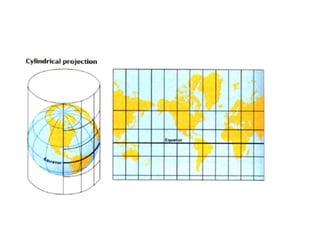
• Cylindrical map projections are one way of portraying the
Earth. This kind of map projection has straight coordinate
lines with horizontal parallels crossing meridians at right
angles. All meridians are equally spaced and the scale is
consistent along each parallel
• Cylindrical map projections are rectangles, but are called
cylindrical because they can be rolled up and their edges
mapped in a tube, or cylinder.
• The only factor that distinguishes different cylindrical map
projections from one another is the scale used when
spacing the parallel lines on the map
• The most famous cylindrical projection is Mercator
• Are rectangular or oval shaped – but this
projection technique is very variable in its shape
• have lines of longitude and latitude at right-
angles to each other
• Distortions increasing away from the central
circular line (the ‘touch point of the paper’)
• Have very small distortions along the central
circular line (the ‘touch point of the paper’)
• show shapes correctly, but size is distorted
Conical projection
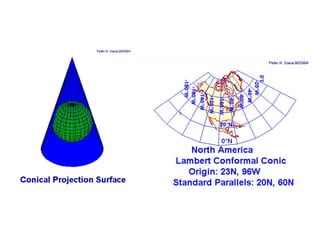
• The projection of a globe onto a cone .to visualise
a conic projection , imagine a paper cone with its
open end resting over part of an illuminated
globe
• Conic map projections are best suited for use as
regional or hemispheric maps, but rarely for a
complete world map. The distortion in a conic
map makes it inappropriate for use as a visual of
the entire Earth but does make it great for use
visualizing temperature region ,weather map
,climate projection and morek
• Are fan shaped when used to map large areas
• Distortions increasing away from the central circular
line (the ‘touch point of the paper’)
• Have very small distortions along the central circular
line (the ‘touch point of the paper’)
• usually have lines of longitude fanning out from each
other and have lines of latitude as open concentric
circles.
• shapes are shown correctly, but size is distorted
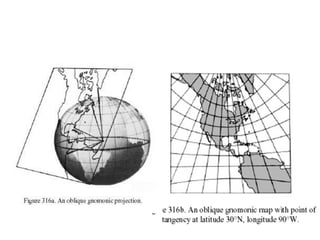
Azimuthal projection
• The azimuthal map projection is angular- given three points on a map (A,
B, and C) the azimuth from Point B to Point C dictates the angle someone
would have to look or travel in order to get to A. These angular
relationships are more commonly known as great circle arcs or geodesic
arcs
• The main features of azimuthal map projections are straight meridian
lines, radiating out from a central point, parallels that are circular around
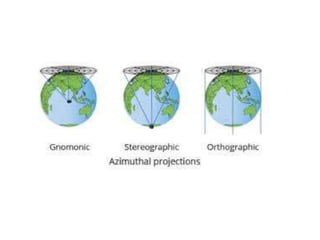
the central point, and equidistant parallel spacing. Light paths in three
different categories (orthographic, stereographic, and gnomonic) can also
be used
• Azimuthal maps are beneficial for finding direction from any point on the
Earth using the central point as a reference.
• The shortest distance between any two points on the as straight line .this
distance is non as Great circle route
• The distortions increasing away from the central
point
• Have very small distortions near the centre point
(the ’touch point of the paper‘)
• Compass direction is only correct from the centre
point to another feature – not between other
features are not usually used near the Equator,
because other projections better represent the
features in this area.
Other types of projection
Mercator
The Mercator projection has straight meridians and
parallels that intersects at right angles. Scale is true
at the equator or at two standard parallels
equidistant from the equator
 Miller cylindrical
it has straight meridians and parallels that meet at
right angles ,but straight lines are not of constant
azimuth .shapes and areas are distorted
Transverse Mercator
It results from projecting the sphere onto a
cylindrical tangent to a central meridian ,this maps
are often used to portray areas with larger N-S than
E-W extent
The Universal Transvers Mercator (UTM) projection
is used to define horizontal ,positions world wide by
dividing the surface of the earth into 6 degree zone
,each maped by TM projection with a central
meridian in the centre of the zone
Robinson projection
It is based on table of coordinates not
mathematical formulas. The projection distorts
shape ,area ,scale ,and the distant in an attempt
to balance the error of projection properties
Polyconic
It was most used for earlier topographic USGS
quadrangles .The projection is based on an
infinite number of cones tangent to an infinite
number of parallels .the central meridian is
straight and other are complex curves
Lambert azimuthal equal area
It is sometimes used to map large ocean areas ,
the central meridian is a straight line ,other are
curved . A straight line drawn through the center
point is on a great circle
Conclusion
• A map is a visual representation of an entire
area or a part of an area, typically represented
on a flat surface
• The preparation of various kinds of maps
based on their purpose includes political map
,geographical ,thematic etc.
• The mostly used projection is Mercator type
projection and the selection map projection
depends on the purpose
Reference
• brilliantmaps.com
• www.icsm.gov.au/mapping/about_projections
.html
• https://www.slideshare.net/jvdkwast/projecti
ons-53057891

MAP PROJECTION

  • 1.
    MAP PROJECTION Submitted bySubmitted to Hadi tt Dr A Balasubramanian 3rd sem geology Professor GE316010 Dos in earth science
  • 2.
    Contents • Introduction • Importanttypes of map • Map projection Cylindrical Conic Azimuthal Other projection • Conclusion • Reference
  • 3.
    INTRODUCTION • A mapis a visual representation of an entire area or a part of an area, typically represented on a flat surface • Maps attempt to represent various things, like political boundaries, physical features, roads, topography, population, climates, natural resources and economic activities • The method of representing the surface of a globe or any three dimensional body on a flat surface is known as projection .Map projection is important for creating maps • The basic problem in any map projection is that there is always some distortion. It could be in distance, shape, area or direction.
  • 4.
    Important types ofmap  political map Topographic map Physical map Thematic map Geographic map Economic resource map
  • 5.
    Map projection • Themethod of representing the surface of a globe or any three dimensional body on a flat surface is known as projection • The type of map projection depends on their purpose 1. Cylindrical 2.Conic 3.Azimuthal 4.Other projection
  • 6.
    Cylindrical projection • Cylindricalmap projections are one way of portraying the Earth. This kind of map projection has straight coordinate lines with horizontal parallels crossing meridians at right angles. All meridians are equally spaced and the scale is consistent along each parallel • Cylindrical map projections are rectangles, but are called cylindrical because they can be rolled up and their edges mapped in a tube, or cylinder. • The only factor that distinguishes different cylindrical map projections from one another is the scale used when spacing the parallel lines on the map • The most famous cylindrical projection is Mercator
  • 7.
    • Are rectangularor oval shaped – but this projection technique is very variable in its shape • have lines of longitude and latitude at right- angles to each other • Distortions increasing away from the central circular line (the ‘touch point of the paper’) • Have very small distortions along the central circular line (the ‘touch point of the paper’) • show shapes correctly, but size is distorted
  • 9.
    Conical projection • Theprojection of a globe onto a cone .to visualise a conic projection , imagine a paper cone with its open end resting over part of an illuminated globe • Conic map projections are best suited for use as regional or hemispheric maps, but rarely for a complete world map. The distortion in a conic map makes it inappropriate for use as a visual of the entire Earth but does make it great for use visualizing temperature region ,weather map ,climate projection and morek
  • 10.
    • Are fanshaped when used to map large areas • Distortions increasing away from the central circular line (the ‘touch point of the paper’) • Have very small distortions along the central circular line (the ‘touch point of the paper’) • usually have lines of longitude fanning out from each other and have lines of latitude as open concentric circles. • shapes are shown correctly, but size is distorted
  • 12.
    Azimuthal projection • Theazimuthal map projection is angular- given three points on a map (A, B, and C) the azimuth from Point B to Point C dictates the angle someone would have to look or travel in order to get to A. These angular relationships are more commonly known as great circle arcs or geodesic arcs • The main features of azimuthal map projections are straight meridian lines, radiating out from a central point, parallels that are circular around the central point, and equidistant parallel spacing. Light paths in three different categories (orthographic, stereographic, and gnomonic) can also be used • Azimuthal maps are beneficial for finding direction from any point on the Earth using the central point as a reference. • The shortest distance between any two points on the as straight line .this distance is non as Great circle route
  • 14.
    • The distortionsincreasing away from the central point • Have very small distortions near the centre point (the ’touch point of the paper‘) • Compass direction is only correct from the centre point to another feature – not between other features are not usually used near the Equator, because other projections better represent the features in this area.
  • 16.
    Other types ofprojection Mercator The Mercator projection has straight meridians and parallels that intersects at right angles. Scale is true at the equator or at two standard parallels equidistant from the equator  Miller cylindrical it has straight meridians and parallels that meet at right angles ,but straight lines are not of constant azimuth .shapes and areas are distorted
  • 17.
    Transverse Mercator It resultsfrom projecting the sphere onto a cylindrical tangent to a central meridian ,this maps are often used to portray areas with larger N-S than E-W extent The Universal Transvers Mercator (UTM) projection is used to define horizontal ,positions world wide by dividing the surface of the earth into 6 degree zone ,each maped by TM projection with a central meridian in the centre of the zone
  • 18.
    Robinson projection It isbased on table of coordinates not mathematical formulas. The projection distorts shape ,area ,scale ,and the distant in an attempt to balance the error of projection properties
  • 19.
    Polyconic It was mostused for earlier topographic USGS quadrangles .The projection is based on an infinite number of cones tangent to an infinite number of parallels .the central meridian is straight and other are complex curves
  • 20.
    Lambert azimuthal equalarea It is sometimes used to map large ocean areas , the central meridian is a straight line ,other are curved . A straight line drawn through the center point is on a great circle
  • 21.
    Conclusion • A mapis a visual representation of an entire area or a part of an area, typically represented on a flat surface • The preparation of various kinds of maps based on their purpose includes political map ,geographical ,thematic etc. • The mostly used projection is Mercator type projection and the selection map projection depends on the purpose
  • 22.
    Reference • brilliantmaps.com • www.icsm.gov.au/mapping/about_projections .html •https://www.slideshare.net/jvdkwast/projecti ons-53057891