Management of
Hydronephrosis
BRAJESH LAHRI
FINAL PROFESSIONAL MBBS
ALL INDIA INSTITUTE OF MEDICAL SCIENCES
(AIIMS),BHOPAL
Definition
 Hydronephrosis is defined as aseptic
dilatation of the whole or a part of the
pelvi-calyceal system of the kidney due
to partial or intermittent interruption to the
outflow of urine.
Aetiology of Hydronephrosis
Hydronephrosis
Congenital
Hydronephrosis (due
to pelvi-ureteric
junction dysfunction)
Hydronephrosis due
to a secondary
cause
Treatment of Hydronephrosis secondary to
a cause
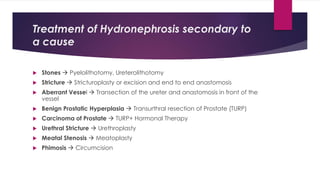
 Stones  Pyelolithotomy, Ureterolithotomy
 Stricture  Stricturoplasty or excision and end to end anastomosis
 Aberrant Vessel  Transection of the ureter and anastomosis in front of the
vessel
 Benign Prostatic Hyperplasia  Transurthral resection of Prostate (TURP)
 Carcinoma of Prostate  TURP+ Hormonal Therapy
 Urethral Stricture  Urethroplasty
 Meatal Stenosis  Meatoplasty
 Phimosis  Circumcision
A Case of Hydronephrosis
 Middle aged female presented with symptoms of loin pain, ??
 Ultrasonography of abdomen revealed dilatation of pelvic-calyceal system and renal cortical thickness as 5mm.
 Indications for Surgery in case of Hydronephrosis are
 Pain
 Atrophy of kidney (Cortical thinning)
 Infection
 Nephrosis (Increasing Hydronephrosis)
**Indications can be remembered by mnemonic ‘PAIN’
Management of Hydronephrosis in this
case
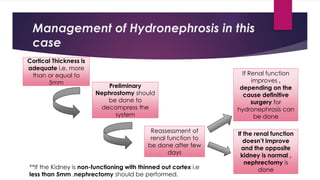
Cortical Thickness is
adequate i.e. more
than or equal to
5mm
Preliminary
Nephrostomy should
be done to
decompress the
system
Reassessment of
renal function to
be done after few
days
If Renal function
improves ,
depending on the
cause definitive
surgery for
hydronephrosis can
be done
If the renal function
doesn’t improve
and the opposite
kidney is normal ,
nephrectomy is
done**If the Kidney is non-functioning with thinned out cortex i.e
less than 5mm ,nephrectomy should be performed.
Management of Renal Stones
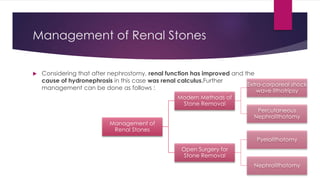
 Considering that after nephrostomy, renal function has improved and the
cause of hydronephrosis in this case was renal calculus.Further
management can be done as follows :
Management of
Renal Stones
Modern Methods of
Stone Removal
Extra-corporeal shock
wave lithotripsy
Percutaneous
Nephrolithotomy
Open Surgery for
Stone Removal
Pyelolithotomy
Nephrolithotomy
Management of Congenital
Hydronephrosis
 Patients with Congenital PUJ dysfunction ,present with congenital
Hydronephrosis.
 Congenital Hydronephrosis can be defined as more than 10mm antero-
posterior diameter of renal pelvis at 20 weeks of gestation.
 Management differs according to the grade of hydronephrosis,which is
based on renal pelvic diameter.
 Grading is as follows, Mild 11-20mm ,Moderate 21-35mm, Severe >35mm.
 Mild hydronephrosis is managed conservatively with serial monitoring of
pelvic diameter by ultrasound and of renal function
 Moderate hydronephrosis is also managed by serial monitoring. Any
deterioration of renal function is an indication for surgical intervention.
 Severe Hydronephrosis should be treated early-Anderson Hynes
Pyeloplasty to prevent permanent damage to kidney.
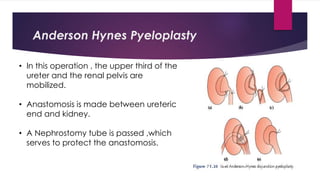
Anderson Hynes Pyeloplasty
• In this operation , the upper third of the
ureter and the renal pelvis are
mobilized.
• Anastomosis is made between ureteric
end and kidney.
• A Nephrostomy tube is passed ,which
serves to protect the anastomosis.
Management of hydronephrosis

Management of hydronephrosis

  • 1.
    Management of Hydronephrosis BRAJESH LAHRI FINALPROFESSIONAL MBBS ALL INDIA INSTITUTE OF MEDICAL SCIENCES (AIIMS),BHOPAL
  • 2.
    Definition  Hydronephrosis isdefined as aseptic dilatation of the whole or a part of the pelvi-calyceal system of the kidney due to partial or intermittent interruption to the outflow of urine.
  • 3.
    Aetiology of Hydronephrosis Hydronephrosis Congenital Hydronephrosis(due to pelvi-ureteric junction dysfunction) Hydronephrosis due to a secondary cause
  • 4.
    Treatment of Hydronephrosissecondary to a cause  Stones  Pyelolithotomy, Ureterolithotomy  Stricture  Stricturoplasty or excision and end to end anastomosis  Aberrant Vessel  Transection of the ureter and anastomosis in front of the vessel  Benign Prostatic Hyperplasia  Transurthral resection of Prostate (TURP)  Carcinoma of Prostate  TURP+ Hormonal Therapy  Urethral Stricture  Urethroplasty  Meatal Stenosis  Meatoplasty  Phimosis  Circumcision
  • 5.
    A Case ofHydronephrosis  Middle aged female presented with symptoms of loin pain, ??  Ultrasonography of abdomen revealed dilatation of pelvic-calyceal system and renal cortical thickness as 5mm.  Indications for Surgery in case of Hydronephrosis are  Pain  Atrophy of kidney (Cortical thinning)  Infection  Nephrosis (Increasing Hydronephrosis) **Indications can be remembered by mnemonic ‘PAIN’
  • 6.
    Management of Hydronephrosisin this case Cortical Thickness is adequate i.e. more than or equal to 5mm Preliminary Nephrostomy should be done to decompress the system Reassessment of renal function to be done after few days If Renal function improves , depending on the cause definitive surgery for hydronephrosis can be done If the renal function doesn’t improve and the opposite kidney is normal , nephrectomy is done**If the Kidney is non-functioning with thinned out cortex i.e less than 5mm ,nephrectomy should be performed.
  • 7.
    Management of RenalStones  Considering that after nephrostomy, renal function has improved and the cause of hydronephrosis in this case was renal calculus.Further management can be done as follows : Management of Renal Stones Modern Methods of Stone Removal Extra-corporeal shock wave lithotripsy Percutaneous Nephrolithotomy Open Surgery for Stone Removal Pyelolithotomy Nephrolithotomy
  • 8.
    Management of Congenital Hydronephrosis Patients with Congenital PUJ dysfunction ,present with congenital Hydronephrosis.  Congenital Hydronephrosis can be defined as more than 10mm antero- posterior diameter of renal pelvis at 20 weeks of gestation.  Management differs according to the grade of hydronephrosis,which is based on renal pelvic diameter.
  • 9.
     Grading isas follows, Mild 11-20mm ,Moderate 21-35mm, Severe >35mm.  Mild hydronephrosis is managed conservatively with serial monitoring of pelvic diameter by ultrasound and of renal function  Moderate hydronephrosis is also managed by serial monitoring. Any deterioration of renal function is an indication for surgical intervention.  Severe Hydronephrosis should be treated early-Anderson Hynes Pyeloplasty to prevent permanent damage to kidney.
  • 10.
    Anderson Hynes Pyeloplasty •In this operation , the upper third of the ureter and the renal pelvis are mobilized. • Anastomosis is made between ureteric end and kidney. • A Nephrostomy tube is passed ,which serves to protect the anastomosis.