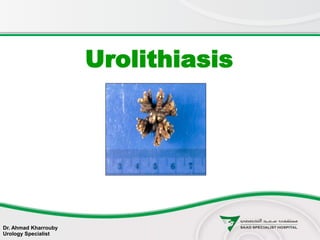
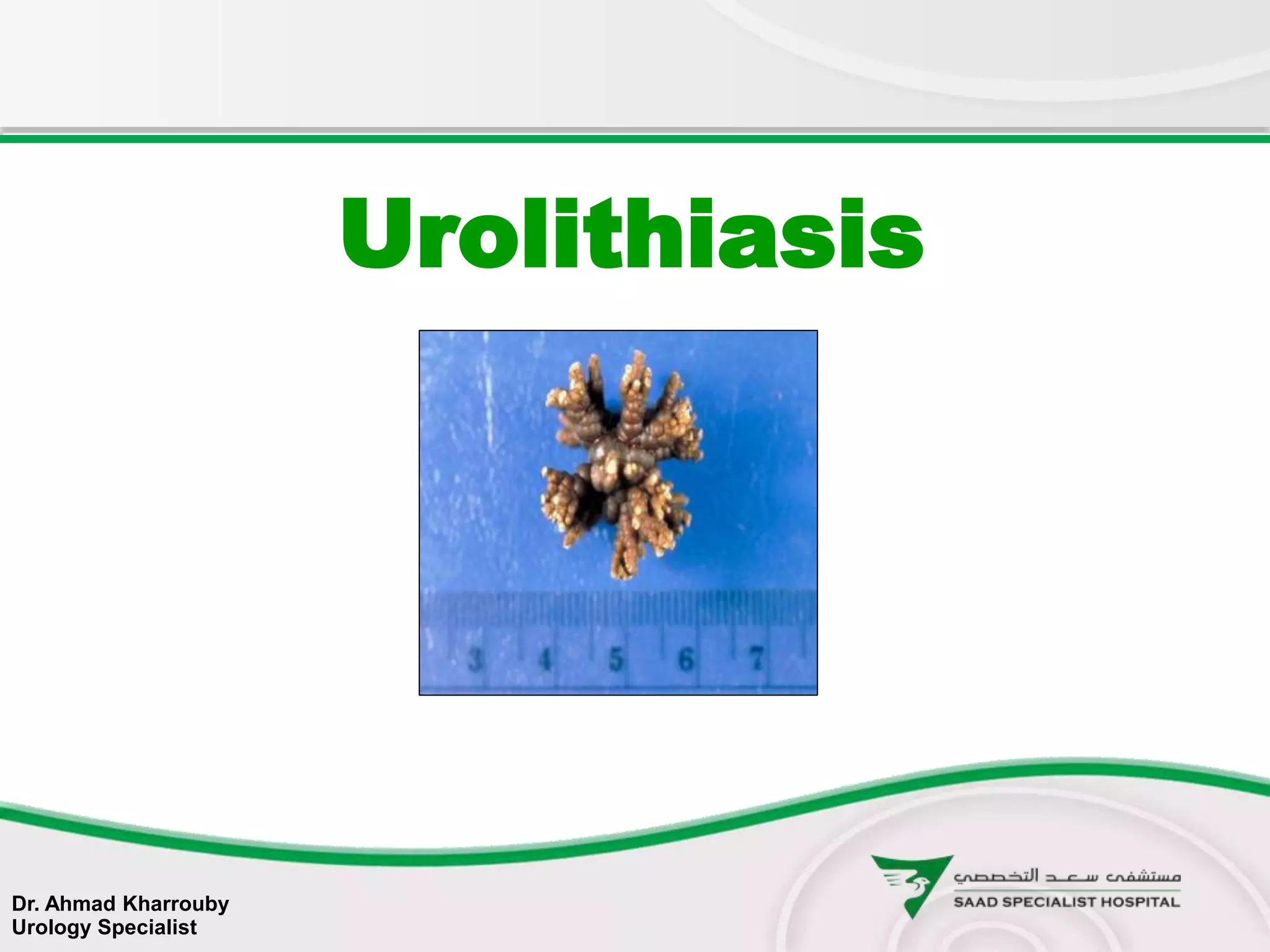
Urolithiasis
Dr. Ahmad Kharrouby
Urology Specialist
Urolithiasis (from Greek oûron-urine and lithos-stone) is
the condition where urinary stones are formed or located
anywhere in the urinary system.
Urolithiasis
Background
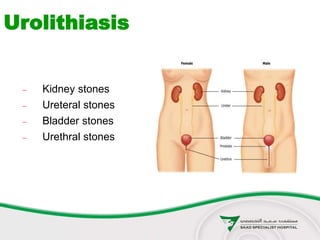
 Kidney stones
 Ureteral stones
 Bladder stones
 Urethral stones
Urolithiasis
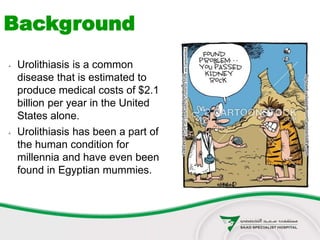
 Urolithiasis is a common
disease that is estimated to
produce medical costs of $2.1
billion per year in the United
States alone.
 Urolithiasis has been a part of
the human condition for
millennia and have even been
found in Egyptian mummies.
Background
 Renal colic affects approximately 1.2 million people
each year in USA and accounts for approximately 1% of
all hospital admissions.
 Most active emergency departments (EDs) manage
patients with acute renal colic every day
Background
Epidemiology
 Urolithiasis occurs in all parts of the world
 A lifetime risk:
 2-5% for Asia
 8-15% for the West
 20% for the Kingdom of Saudi Arabia
 Hot Climate
 Dietary habits
 Hereditary factors
Epidemiology
 The lower the economic status, the lower the likelihood
of renal stones
 Most at 20-49 years
 Peak incidence at 35-45 years
 Male-to-female ratio of 3:1
Epidemiology
Chemical types and etiology
 Four main chemical types:
 Calcium stones
 Struvite (magnesium ammonium phosphate) stones
 Uric acid stones
 Cystine stones
Chemical Types
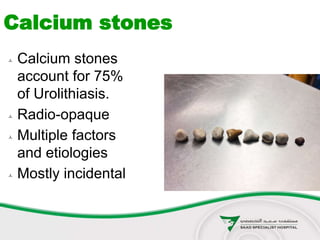
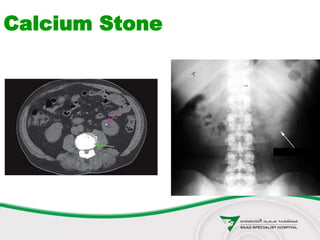
 Calcium stones
account for 75%
of Urolithiasis.
 Radio-opaque
 Multiple factors
and etiologies
 Mostly incidental
Calcium stones
 Incidental
 Hyperparathyroidism
 Increased gut absorption of calcium
 Renal calcium leak
 Renal phosphate leak
 Hperuricosuria
 Hperoxaluria
 Hypocitraturia
 Hypomagnesuria
Calcium Stone Known
etiologies
Calcium Stone
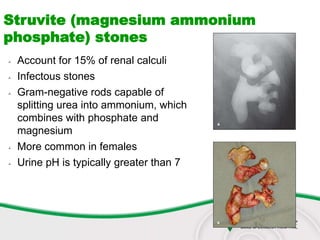
 Account for 15% of renal calculi
 Infectous stones
 Gram-negative rods capable of
splitting urea into ammonium, which
combines with phosphate and
magnesium
 More common in females
 Urine pH is typically greater than 7
Struvite (magnesium ammonium
phosphate) stones
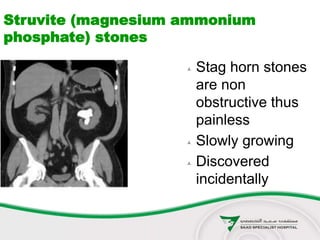
 Stag horn stones
are non
obstructive thus
painless
 Slowly growing
 Discovered
incidentally
Struvite (magnesium ammonium
phosphate) stones
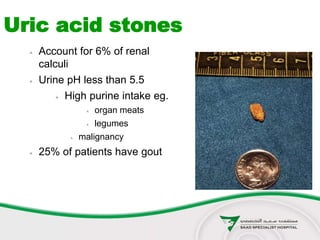
 Account for 6% of renal
calculi
 Urine pH less than 5.5
 High purine intake eg.
 organ meats
 legumes
 malignancy
 25% of patients have gout
Uric acid stones
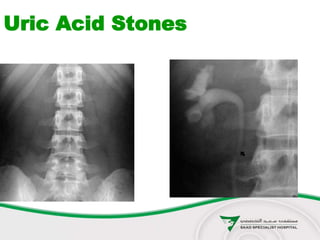
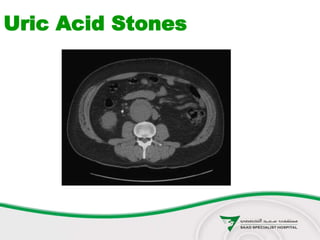
Uric Acid Stones
Uric Acid Stones
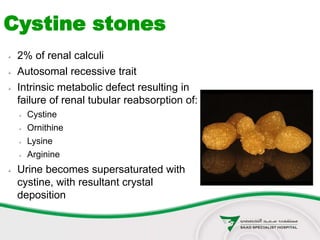
 2% of renal calculi
 Autosomal recessive trait
 Intrinsic metabolic defect resulting in
failure of renal tubular reabsorption of:
 Cystine
 Ornithine
 Lysine
 Arginine
 Urine becomes supersaturated with
cystine, with resultant crystal
deposition
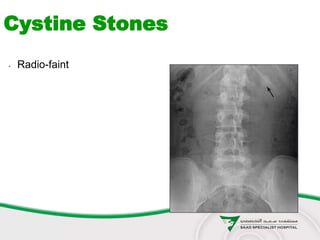
Cystine stones
 Radio-faint
Cystine Stones
Prognosis
 80 % pass spontaneously
 20% require hospital admission or intervention because
of:
 unrelenting pain
 inability to retain enteral fluids
 proximal UTI
 inability to pass the stone
 renal failure
Prognosis
Prognosis
 Recurrence rates after an initial episode of
ureterolithiasis:
 14% at 1 year
 35% at 5 years
 52% at 10 years
History
History
The presentation is variable.
 Patients with urinary calculi may report
 Pain
 Infection
 Hematuria
 Asymptomatic
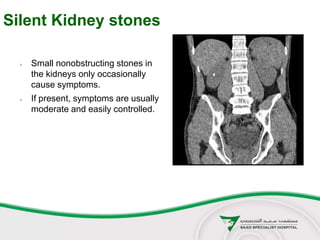
Silent Kidney stones
 Small nonobstructing stones in
the kidneys only occasionally
cause symptoms.
 If present, symptoms are usually
moderate and easily controlled.
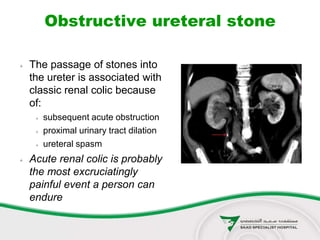
 The passage of stones into
the ureter is associated with
classic renal colic because
of:
 subsequent acute obstruction
 proximal urinary tract dilation
 ureteral spasm
 Acute renal colic is probably
the most excruciatingly
painful event a person can
endure
Obstructive ureteral stone
Classic Renal Colic
 Acute onset of severe flank pain radiating to the groin
 Gross or microscopic hematuria
 Nausea, and vomiting not associated with an acute abdomen in
50%
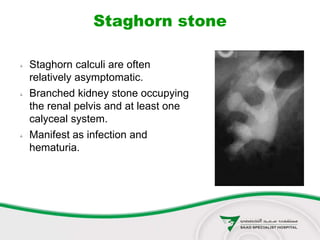
 Staghorn calculi are often
relatively asymptomatic.
 Branched kidney stone occupying
the renal pelvis and at least one
calyceal system.
 Manifest as infection and
hematuria.
Staghorn stone
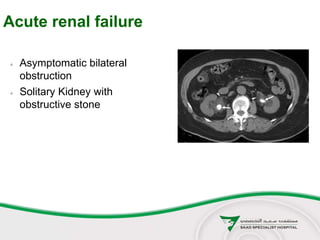
Acute renal failure
 Asymptomatic bilateral
obstruction
 Solitary Kidney with
obstructive stone
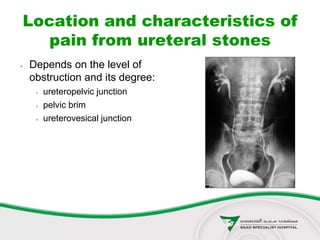
Location and characteristics of
pain from ureteral stones
 Depends on the level of
obstruction and its degree:
 ureteropelvic junction
 pelvic brim
 ureterovesical junction
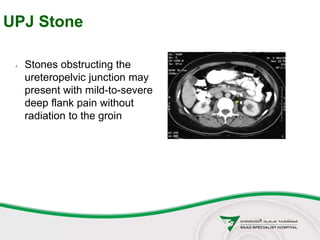
UPJ Stone
 Stones obstructing the
ureteropelvic junction may
present with mild-to-severe
deep flank pain without
radiation to the groin
Ureteral Stone
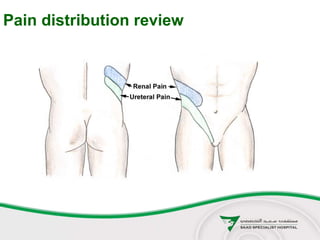
 Cause abrupt, severe, colicky pain in the flank and
ipsilateral lower abdomen
 with radiation to the testicles or the vulvar area.
 Intense nausea, with or without vomiting, usually is
present.
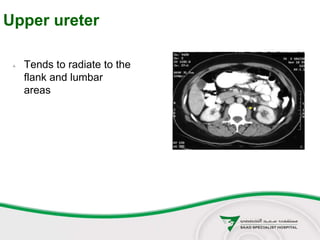
Upper ureter
 Tends to radiate to the
flank and lumbar
areas
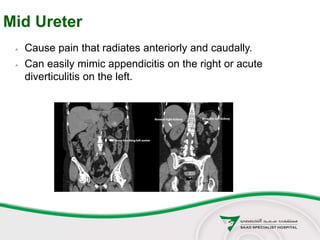
Mid Ureter
 Cause pain that radiates anteriorly and caudally.
 Can easily mimic appendicitis on the right or acute
diverticulitis on the left.
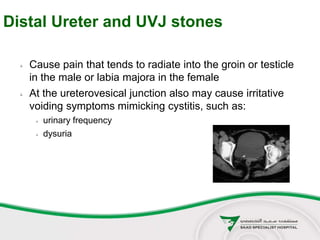
Distal Ureter and UVJ stones
 Cause pain that tends to radiate into the groin or testicle
in the male or labia majora in the female
 At the ureterovesical junction also may cause irritative
voiding symptoms mimicking cystitis, such as:
 urinary frequency
 dysuria
Pain distribution review
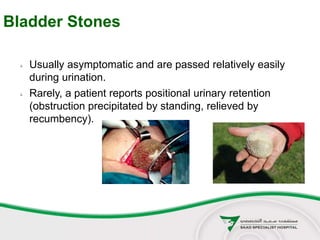
Bladder Stones
 Usually asymptomatic and are passed relatively easily
during urination.
 Rarely, a patient reports positional urinary retention
(obstruction precipitated by standing, relieved by
recumbency).
Phases of an attack
Phases of an attack
The entire process typical lasts 3-18 hours
Acute phase: peak in most patients within 2 hours of onset (30 min to 6
hours)
Constant Phase 1- 4 hours maximum 12 hours
Relief phase 1.5-3 hours
Physical exam
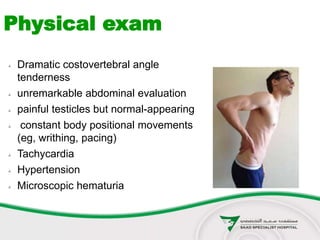
 Dramatic costovertebral angle
tenderness
 unremarkable abdominal evaluation
 painful testicles but normal-appearing
 constant body positional movements
(eg, writhing, pacing)
 Tachycardia
 Hypertension
 Microscopic hematuria
Physical exam
Diagnosis
 The diagnosis of nephrolithiasis is often made on the
basis of clinical symptoms alone, although confirmatory
tests are usually performed.
Diagnosis
Laboratory tests
 The recommended based on EUA recommendations:
 Urinary sediment/dipstick test: To demonstrate blood cells
 Serum creatinine level: To measure renal function
Labarotary Testing
 May be helpful:
 CBC in febrile patients
 Serum electrolyte assessment in vomiting patients
 24-Hour urine profile on outpatient basis
Additional Lab Tests
Imaging studies
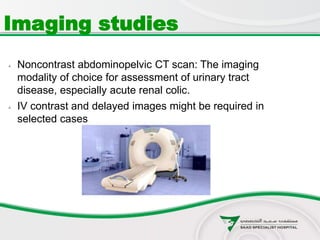
 Noncontrast abdominopelvic CT scan: The imaging
modality of choice for assessment of urinary tract
disease, especially acute renal colic.
 IV contrast and delayed images might be required in
selected cases
Imaging studies
 Renal ultrasonography:
 Renal stone
 Hydronephrosis or ureteral dilation
 Misses 30 % of stones
 Plain abdominal radiograph (flat plate or KUB) misses
40 % of stones
Imaging studies
Imaging studies
 IVP (urography) historically, the criterion standard
 In rare select situations:
 Plain renal tomography
 Retrograde pyelography
 Nuclear renal scanning
Management
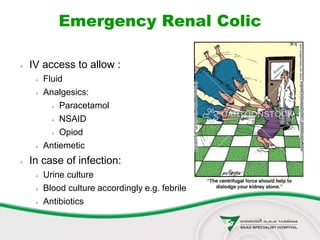
Emergency Renal Colic
 IV access to allow :
 Fluid
 Analgesics:
 Paracetamol
 NSAID
 Opiod
 Antiemetic
 In case of infection:
 Urine culture
 Blood culture accordingly e.g. febrile
 Antibiotics
Approach Considerations
 In emergency settings what should be kept in mind is the
small percentage suffering renal damage or sepsis.
 These include:
 Evident infection with obstruction
 A solitary functional kidney
 Bilateral ureteral obstruction
 Renal failure
Important
 The most morbid and potentially dangerous aspect of
stone disease is the combination of urinary tract
obstruction and upper urinary tract infection.
 Pyelonephritis
 Pyonephrosis
 Urosepsis
 Early recognition and immediate surgical drainage are
necessary in these situations
Approach Considerations
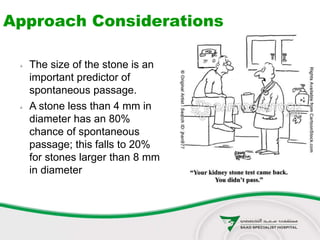
 The size of the stone is an
important predictor of
spontaneous passage.
 A stone less than 4 mm in
diameter has an 80%
chance of spontaneous
passage; this falls to 20%
for stones larger than 8 mm
in diameter
Approach Considerations
 Hospital admission is clearly necessary when any of the
following is present:
 Oral analgesics are insufficient to manage the pain.
 Intractable vommiting
 Ureteral obstruction from a stone occurs in a solitary or
transplanted kidney.
 Bilateral ureteral obstruction
 Ureteral obstruction from a stone occurs in the presence of
 a urinary tract infection (UTI)
 Fever
 Sepsis
 Pyonephrosis
Approach Considerations
 Relative indications to consider for a possible admission
include comorbid conditions
 diabetes
 dehydration
 renal failure
 immunocompromised state
 perinephric urine extravasation
 pregnancy
Approach Considerations
Most patients with acute renal colic can be treated on an
ambulatory basis.
Approach Considerations
 Aggressive medical therapy has shown promise in
increasing the spontaneous stone passage rate and
relieving discomfort while minimizing narcotic usage
Clinic Follow up
 Patients who do not meet admission criteria to be
discharged on medical expulsive therapy from the ED in
anticipation that the stone will pass spontaneously at
home.
 Arrangements should be made for follow-up with a
urologist in 2-3 days.
Active medical expulsive therapy
 Paracetamol PRN for pain with or without Codeine
 NSAID PRN for pain
 Oral opiod analogue for severe pain
 Alpha blockers
 Antiemetic PRN for nausea and/or vommiting
 Prednisone 20 mg twice daily for 6 days
 With MET, stones 5-8 mm in size often pass, especially if
located in the distal ureter.
Approach Considerations
 An important aspect of medical and preventive therapy is
maintaining a good fluid intake and subsequent high
urinary volume.
Emergency Advice
 Patients should be told to return for :
 fever
 uncontrolled pain
 uncontrolled vomiting
 Patients should be discharged with a urine strainer and
encouraged to submit any recovered calculi to a urologist
for chemical analysis
 General recommendation not to wait longer than 4
weeks for a stone to pass spontaneously before
considering intervention.
Approach Considerations
 Larger stones (ie, ≥ 7 mm) that are unlikely to pass
spontaneously require some type of surgical procedure.
 Such patients require mandatory urology follow up
Approach Considerations
 About 15-20% of patients require invasive intervention
eventually as emergency or electively due to:
 stone size
 continued obstruction
 Infection
 intractable pain
Indications for Surgery
 The primary indications for surgical treatment include:
 Pain
 Infection
 Obstruction
 Indications for urgent intervention:
 Obstruction complicated by evident infection
 Obstruction complicated by acute renal failure
 Solitary kidney
 Bilateral obstruction
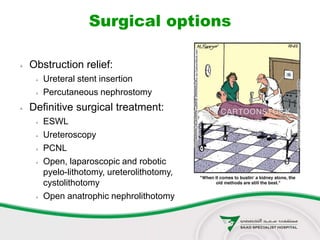
Surgical options
 Obstruction relief:
 Ureteral stent insertion
 Percutaneous nephrostomy
 Definitive surgical treatment:
 ESWL
 Ureteroscopy
 PCNL
 Open, laparoscopic and robotic
pyelo-lithotomy, ureterolithotomy,
cystolithotomy
 Open anatrophic nephrolithotomy
Surgical options
 For an obstructed and infected collecting system
secondary to stone disease
 Emergency surgical relief is required with no contraindications:
 percutaneous nephrostomy for critical patients
 ureteral stent placement for stable patients
Surgical options
 The vast majority of symptomatic urinary tract calculi are
now treated with noninvasive or minimally invasive
techniques
 Open surgical excision of a stone from the urinary tract is
now limited to isolated atypical cases
Surgical options
 ESWL and ureteroscopy are internationaly recognized as
first-line treatments for ureteral stones.
 The 2005 American Urological Association (AUA)
staghorn calculus guidelines recommend percutaneous
nephrostolithotomy as the cornerstone for management
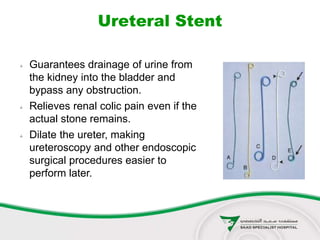
Ureteral Stent
 Guarantees drainage of urine from
the kidney into the bladder and
bypass any obstruction.
 Relieves renal colic pain even if the
actual stone remains.
 Dilate the ureter, making
ureteroscopy and other endoscopic
surgical procedures easier to
perform later.
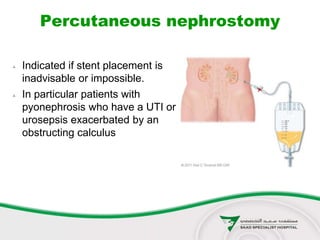
Percutaneous nephrostomy
 Indicated if stent placement is
inadvisable or impossible.
 In particular patients with
pyonephrosis who have a UTI or
urosepsis exacerbated by an
obstructing calculus
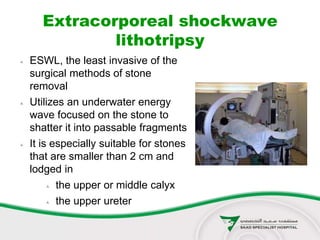
Extracorporeal shockwave
lithotripsy
 ESWL, the least invasive of the
surgical methods of stone
removal
 Utilizes an underwater energy
wave focused on the stone to
shatter it into passable fragments
 It is especially suitable for stones
that are smaller than 2 cm and
lodged in
 the upper or middle calyx
 the upper ureter
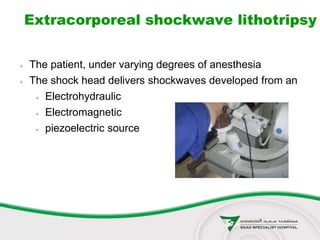
Extracorporeal shockwave lithotripsy
 The patient, under varying degrees of anesthesia
 The shock head delivers shockwaves developed from an
 Electrohydraulic
 Electromagnetic
 piezoelectric source
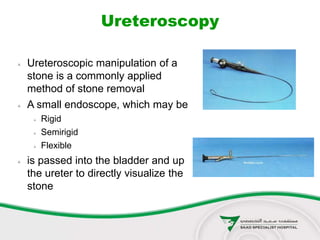
Ureteroscopy
 Ureteroscopic manipulation of a
stone is a commonly applied
method of stone removal
 A small endoscope, which may be
 Rigid
 Semirigid
 Flexible
 is passed into the bladder and up
the ureter to directly visualize the
stone
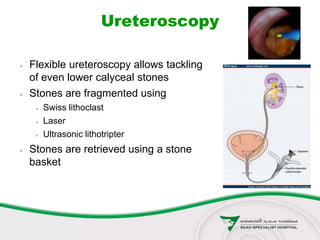
Ureteroscopy
 Flexible ureteroscopy allows tackling
of even lower calyceal stones
 Stones are fragmented using
 Swiss lithoclast
 Laser
 Ultrasonic lithotripter
 Stones are retrieved using a stone
basket
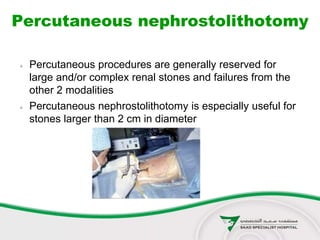
Percutaneous nephrostolithotomy
 Percutaneous procedures are generally reserved for
large and/or complex renal stones and failures from the
other 2 modalities
 Percutaneous nephrostolithotomy is especially useful for
stones larger than 2 cm in diameter
Percutaneous nephrostolithotomy
 In some cases, a combination
of SWL and a percutaneous
technique is necessary to
completely remove all stone
material from a kidney.
Open Surgery
 Open surgery has been used less
and less often since the
development of the previously
mentioned techniques
 It now constitutes less than 1% of
all interventions.
 Disadvantages include
 longer hospitalization
 longer convalescence
 increased requirements for blood
transfusion.
Approach Considerations
 Metabolic evaluation and treatment at clinic are indicated
for patients at greater risk for recurrence, including:
 multiple stones
 personal or family history of previous stone formation
 stones at a younger age
 residual stones after treatment
Medical Therapy for Stone Disease
 Urinary calculi composed predominantly of calcium
cannot be dissolved
 medical therapy is important in the long-term
chemoprophylaxis of further calculus growth or formation
Medical Therapy for Stone Disease
 Uric acid and cystine calculi can be dissolved with
medical therapy.
 Suitable option in patients with uric acid stones who do
not require urgent surgical intervention
 Is based on alkalization of the urine.
Medical Therapy for Stone Disease
 Sodium bicarbonate can be used as the alkalizing agent
 But potassium citrate is usually preferred because of the
availability of slow-release tablets and the avoidance of a
high sodium load
Medical Therapy for Stone Disease
 The dosage of the alkalizing agent should be adjusted to
maintain the urinary pH between 6.5 and 7.0.
Chemoprophylaxis
 Prophylactic therapy might include:
 most importantly, augmentation of fluid intake.
 limitation of dietary components
 addition of stone-formation inhibitors or intestinal calcium binders
 avoid excessive salt and protein intake
Chemoprophylaxis
Better to base medical therapy for long-term
chemoprophylaxis of urinary calculi on the results of a
24-hour urinalysis for chemical constituents
Long-Term Monitoring
 Metabolic evaluation is done by a typical 24-hour urine
determination of:
 urinary volume
 pH
 specific gravity
 Calcium
 Citrate
 Magnesium
 Oxalate
 Phosphate
 uric acid.
Long-Term Monitoring
 Most common findings are
 Hypercalciuria
 Hyperuricosuria
 Hyperoxaluria
 Hypocitraturia
 low urinary volume
Chemoprophylaxis
 Chemoprophylaxis of uric acid and cystine calculi
consists primarily of long-term alkalinization of urine.
Chemoprophylaxis
If hyperuricosuria or hyperuricemia is documented in
patients with pure uric acid stones, allopurinol (300 mg
qd) is recommended
Chemoprophylaxis
 Pharmaceuticals that can bind free cystine in the urine:
 D-penicillamine
 2-alpha-mercaptopropionyl-glycine
 Help reduce stone formation in cystinuria.
 Captopril has been shown to be effective in some trials
Dietary Measures
 In almost all patients in whom stones form, an increase in
fluid intake and, therefore, an increase in urine output is
recommended.
 This is likely the single most important aspect of stone
prophylaxis
 The goal is a total urine volume in 24 hours in excess of
2 liters.
Dietary Measures
 The only other general dietary guidelines are to avoid
excessive salt and protein intake.
 Moderation of calcium and oxalate intake is also
reasonable
 Beware to advice moderation not avoid calcium intake as
it will result in calcium deficiency disorders, most
importantly osteoperosis.
Thank you
References
• Main references:
• Medscape article nephrolithiasis by J Stuart Wolf Jr, MD, FACS updated
feb 11, 2013
• Campbell-Walsh Urology 10th edition
• Smith and Tanagho's General Urology, Eighteenth Edition
• Images used in this presentation are from different web
based resources
• N.B. The presentation is directed to general medical
audience in the hospital mainly nurses and physicians
with special focus on the acute management.

Urolithiasis (urinary stones disease) presentation

  • 1.
  • 2.
    Urolithiasis (from Greekoûron-urine and lithos-stone) is the condition where urinary stones are formed or located anywhere in the urinary system. Urolithiasis
  • 3.
  • 4.
     Kidney stones Ureteral stones  Bladder stones  Urethral stones Urolithiasis
  • 5.
     Urolithiasis isa common disease that is estimated to produce medical costs of $2.1 billion per year in the United States alone.  Urolithiasis has been a part of the human condition for millennia and have even been found in Egyptian mummies. Background
  • 6.
     Renal colicaffects approximately 1.2 million people each year in USA and accounts for approximately 1% of all hospital admissions.  Most active emergency departments (EDs) manage patients with acute renal colic every day Background
  • 7.
  • 8.
     Urolithiasis occursin all parts of the world  A lifetime risk:  2-5% for Asia  8-15% for the West  20% for the Kingdom of Saudi Arabia  Hot Climate  Dietary habits  Hereditary factors Epidemiology
  • 9.
     The lowerthe economic status, the lower the likelihood of renal stones  Most at 20-49 years  Peak incidence at 35-45 years  Male-to-female ratio of 3:1 Epidemiology
  • 10.
  • 11.
     Four mainchemical types:  Calcium stones  Struvite (magnesium ammonium phosphate) stones  Uric acid stones  Cystine stones Chemical Types
  • 12.
     Calcium stones accountfor 75% of Urolithiasis.  Radio-opaque  Multiple factors and etiologies  Mostly incidental Calcium stones
  • 13.
     Incidental  Hyperparathyroidism Increased gut absorption of calcium  Renal calcium leak  Renal phosphate leak  Hperuricosuria  Hperoxaluria  Hypocitraturia  Hypomagnesuria Calcium Stone Known etiologies
  • 14.
  • 15.
     Account for15% of renal calculi  Infectous stones  Gram-negative rods capable of splitting urea into ammonium, which combines with phosphate and magnesium  More common in females  Urine pH is typically greater than 7 Struvite (magnesium ammonium phosphate) stones
  • 16.
     Stag hornstones are non obstructive thus painless  Slowly growing  Discovered incidentally Struvite (magnesium ammonium phosphate) stones
  • 17.
     Account for6% of renal calculi  Urine pH less than 5.5  High purine intake eg.  organ meats  legumes  malignancy  25% of patients have gout Uric acid stones
  • 18.
  • 19.
  • 20.
     2% ofrenal calculi  Autosomal recessive trait  Intrinsic metabolic defect resulting in failure of renal tubular reabsorption of:  Cystine  Ornithine  Lysine  Arginine  Urine becomes supersaturated with cystine, with resultant crystal deposition Cystine stones
  • 21.
  • 22.
  • 23.
     80 %pass spontaneously  20% require hospital admission or intervention because of:  unrelenting pain  inability to retain enteral fluids  proximal UTI  inability to pass the stone  renal failure Prognosis
  • 24.
    Prognosis  Recurrence ratesafter an initial episode of ureterolithiasis:  14% at 1 year  35% at 5 years  52% at 10 years
  • 25.
  • 26.
    History The presentation isvariable.  Patients with urinary calculi may report  Pain  Infection  Hematuria  Asymptomatic
  • 27.
    Silent Kidney stones Small nonobstructing stones in the kidneys only occasionally cause symptoms.  If present, symptoms are usually moderate and easily controlled.
  • 28.
     The passageof stones into the ureter is associated with classic renal colic because of:  subsequent acute obstruction  proximal urinary tract dilation  ureteral spasm  Acute renal colic is probably the most excruciatingly painful event a person can endure Obstructive ureteral stone
  • 29.
    Classic Renal Colic Acute onset of severe flank pain radiating to the groin  Gross or microscopic hematuria  Nausea, and vomiting not associated with an acute abdomen in 50%
  • 30.
     Staghorn calculiare often relatively asymptomatic.  Branched kidney stone occupying the renal pelvis and at least one calyceal system.  Manifest as infection and hematuria. Staghorn stone
  • 31.
    Acute renal failure Asymptomatic bilateral obstruction  Solitary Kidney with obstructive stone
  • 32.
    Location and characteristicsof pain from ureteral stones  Depends on the level of obstruction and its degree:  ureteropelvic junction  pelvic brim  ureterovesical junction
  • 33.
    UPJ Stone  Stonesobstructing the ureteropelvic junction may present with mild-to-severe deep flank pain without radiation to the groin
  • 34.
    Ureteral Stone  Causeabrupt, severe, colicky pain in the flank and ipsilateral lower abdomen  with radiation to the testicles or the vulvar area.  Intense nausea, with or without vomiting, usually is present.
  • 35.
    Upper ureter  Tendsto radiate to the flank and lumbar areas
  • 36.
    Mid Ureter  Causepain that radiates anteriorly and caudally.  Can easily mimic appendicitis on the right or acute diverticulitis on the left.
  • 37.
    Distal Ureter andUVJ stones  Cause pain that tends to radiate into the groin or testicle in the male or labia majora in the female  At the ureterovesical junction also may cause irritative voiding symptoms mimicking cystitis, such as:  urinary frequency  dysuria
  • 38.
  • 39.
    Bladder Stones  Usuallyasymptomatic and are passed relatively easily during urination.  Rarely, a patient reports positional urinary retention (obstruction precipitated by standing, relieved by recumbency).
  • 40.
  • 41.
    Phases of anattack The entire process typical lasts 3-18 hours Acute phase: peak in most patients within 2 hours of onset (30 min to 6 hours) Constant Phase 1- 4 hours maximum 12 hours Relief phase 1.5-3 hours
  • 42.
  • 43.
     Dramatic costovertebralangle tenderness  unremarkable abdominal evaluation  painful testicles but normal-appearing  constant body positional movements (eg, writhing, pacing)  Tachycardia  Hypertension  Microscopic hematuria Physical exam
  • 44.
  • 45.
     The diagnosisof nephrolithiasis is often made on the basis of clinical symptoms alone, although confirmatory tests are usually performed. Diagnosis
  • 46.
  • 47.
     The recommendedbased on EUA recommendations:  Urinary sediment/dipstick test: To demonstrate blood cells  Serum creatinine level: To measure renal function Labarotary Testing
  • 48.
     May behelpful:  CBC in febrile patients  Serum electrolyte assessment in vomiting patients  24-Hour urine profile on outpatient basis Additional Lab Tests
  • 49.
  • 50.
     Noncontrast abdominopelvicCT scan: The imaging modality of choice for assessment of urinary tract disease, especially acute renal colic.  IV contrast and delayed images might be required in selected cases Imaging studies
  • 51.
     Renal ultrasonography: Renal stone  Hydronephrosis or ureteral dilation  Misses 30 % of stones  Plain abdominal radiograph (flat plate or KUB) misses 40 % of stones Imaging studies
  • 52.
    Imaging studies  IVP(urography) historically, the criterion standard  In rare select situations:  Plain renal tomography  Retrograde pyelography  Nuclear renal scanning
  • 53.
  • 54.
    Emergency Renal Colic IV access to allow :  Fluid  Analgesics:  Paracetamol  NSAID  Opiod  Antiemetic  In case of infection:  Urine culture  Blood culture accordingly e.g. febrile  Antibiotics
  • 55.
    Approach Considerations  Inemergency settings what should be kept in mind is the small percentage suffering renal damage or sepsis.  These include:  Evident infection with obstruction  A solitary functional kidney  Bilateral ureteral obstruction  Renal failure
  • 56.
    Important  The mostmorbid and potentially dangerous aspect of stone disease is the combination of urinary tract obstruction and upper urinary tract infection.  Pyelonephritis  Pyonephrosis  Urosepsis  Early recognition and immediate surgical drainage are necessary in these situations
  • 57.
    Approach Considerations  Thesize of the stone is an important predictor of spontaneous passage.  A stone less than 4 mm in diameter has an 80% chance of spontaneous passage; this falls to 20% for stones larger than 8 mm in diameter
  • 58.
    Approach Considerations  Hospitaladmission is clearly necessary when any of the following is present:  Oral analgesics are insufficient to manage the pain.  Intractable vommiting  Ureteral obstruction from a stone occurs in a solitary or transplanted kidney.  Bilateral ureteral obstruction  Ureteral obstruction from a stone occurs in the presence of  a urinary tract infection (UTI)  Fever  Sepsis  Pyonephrosis
  • 59.
    Approach Considerations  Relativeindications to consider for a possible admission include comorbid conditions  diabetes  dehydration  renal failure  immunocompromised state  perinephric urine extravasation  pregnancy
  • 60.
    Approach Considerations Most patientswith acute renal colic can be treated on an ambulatory basis.
  • 61.
    Approach Considerations  Aggressivemedical therapy has shown promise in increasing the spontaneous stone passage rate and relieving discomfort while minimizing narcotic usage
  • 62.
    Clinic Follow up Patients who do not meet admission criteria to be discharged on medical expulsive therapy from the ED in anticipation that the stone will pass spontaneously at home.  Arrangements should be made for follow-up with a urologist in 2-3 days.
  • 63.
    Active medical expulsivetherapy  Paracetamol PRN for pain with or without Codeine  NSAID PRN for pain  Oral opiod analogue for severe pain  Alpha blockers  Antiemetic PRN for nausea and/or vommiting  Prednisone 20 mg twice daily for 6 days  With MET, stones 5-8 mm in size often pass, especially if located in the distal ureter.
  • 64.
    Approach Considerations  Animportant aspect of medical and preventive therapy is maintaining a good fluid intake and subsequent high urinary volume.
  • 65.
    Emergency Advice  Patientsshould be told to return for :  fever  uncontrolled pain  uncontrolled vomiting  Patients should be discharged with a urine strainer and encouraged to submit any recovered calculi to a urologist for chemical analysis
  • 66.
     General recommendationnot to wait longer than 4 weeks for a stone to pass spontaneously before considering intervention. Approach Considerations
  • 67.
    Approach Considerations  Largerstones (ie, ≥ 7 mm) that are unlikely to pass spontaneously require some type of surgical procedure.  Such patients require mandatory urology follow up
  • 68.
    Approach Considerations  About15-20% of patients require invasive intervention eventually as emergency or electively due to:  stone size  continued obstruction  Infection  intractable pain
  • 69.
    Indications for Surgery The primary indications for surgical treatment include:  Pain  Infection  Obstruction  Indications for urgent intervention:  Obstruction complicated by evident infection  Obstruction complicated by acute renal failure  Solitary kidney  Bilateral obstruction
  • 70.
    Surgical options  Obstructionrelief:  Ureteral stent insertion  Percutaneous nephrostomy  Definitive surgical treatment:  ESWL  Ureteroscopy  PCNL  Open, laparoscopic and robotic pyelo-lithotomy, ureterolithotomy, cystolithotomy  Open anatrophic nephrolithotomy
  • 71.
    Surgical options  Foran obstructed and infected collecting system secondary to stone disease  Emergency surgical relief is required with no contraindications:  percutaneous nephrostomy for critical patients  ureteral stent placement for stable patients
  • 72.
    Surgical options  Thevast majority of symptomatic urinary tract calculi are now treated with noninvasive or minimally invasive techniques  Open surgical excision of a stone from the urinary tract is now limited to isolated atypical cases
  • 73.
    Surgical options  ESWLand ureteroscopy are internationaly recognized as first-line treatments for ureteral stones.  The 2005 American Urological Association (AUA) staghorn calculus guidelines recommend percutaneous nephrostolithotomy as the cornerstone for management
  • 74.
    Ureteral Stent  Guaranteesdrainage of urine from the kidney into the bladder and bypass any obstruction.  Relieves renal colic pain even if the actual stone remains.  Dilate the ureter, making ureteroscopy and other endoscopic surgical procedures easier to perform later.
  • 75.
    Percutaneous nephrostomy  Indicatedif stent placement is inadvisable or impossible.  In particular patients with pyonephrosis who have a UTI or urosepsis exacerbated by an obstructing calculus
  • 76.
    Extracorporeal shockwave lithotripsy  ESWL,the least invasive of the surgical methods of stone removal  Utilizes an underwater energy wave focused on the stone to shatter it into passable fragments  It is especially suitable for stones that are smaller than 2 cm and lodged in  the upper or middle calyx  the upper ureter
  • 77.
    Extracorporeal shockwave lithotripsy The patient, under varying degrees of anesthesia  The shock head delivers shockwaves developed from an  Electrohydraulic  Electromagnetic  piezoelectric source
  • 78.
    Ureteroscopy  Ureteroscopic manipulationof a stone is a commonly applied method of stone removal  A small endoscope, which may be  Rigid  Semirigid  Flexible  is passed into the bladder and up the ureter to directly visualize the stone
  • 79.
    Ureteroscopy  Flexible ureteroscopyallows tackling of even lower calyceal stones  Stones are fragmented using  Swiss lithoclast  Laser  Ultrasonic lithotripter  Stones are retrieved using a stone basket
  • 80.
    Percutaneous nephrostolithotomy  Percutaneousprocedures are generally reserved for large and/or complex renal stones and failures from the other 2 modalities  Percutaneous nephrostolithotomy is especially useful for stones larger than 2 cm in diameter
  • 81.
    Percutaneous nephrostolithotomy  Insome cases, a combination of SWL and a percutaneous technique is necessary to completely remove all stone material from a kidney.
  • 82.
    Open Surgery  Opensurgery has been used less and less often since the development of the previously mentioned techniques  It now constitutes less than 1% of all interventions.  Disadvantages include  longer hospitalization  longer convalescence  increased requirements for blood transfusion.
  • 83.
    Approach Considerations  Metabolicevaluation and treatment at clinic are indicated for patients at greater risk for recurrence, including:  multiple stones  personal or family history of previous stone formation  stones at a younger age  residual stones after treatment
  • 84.
    Medical Therapy forStone Disease  Urinary calculi composed predominantly of calcium cannot be dissolved  medical therapy is important in the long-term chemoprophylaxis of further calculus growth or formation
  • 85.
    Medical Therapy forStone Disease  Uric acid and cystine calculi can be dissolved with medical therapy.  Suitable option in patients with uric acid stones who do not require urgent surgical intervention  Is based on alkalization of the urine.
  • 86.
    Medical Therapy forStone Disease  Sodium bicarbonate can be used as the alkalizing agent  But potassium citrate is usually preferred because of the availability of slow-release tablets and the avoidance of a high sodium load
  • 87.
    Medical Therapy forStone Disease  The dosage of the alkalizing agent should be adjusted to maintain the urinary pH between 6.5 and 7.0.
  • 88.
    Chemoprophylaxis  Prophylactic therapymight include:  most importantly, augmentation of fluid intake.  limitation of dietary components  addition of stone-formation inhibitors or intestinal calcium binders  avoid excessive salt and protein intake
  • 89.
    Chemoprophylaxis Better to basemedical therapy for long-term chemoprophylaxis of urinary calculi on the results of a 24-hour urinalysis for chemical constituents
  • 90.
    Long-Term Monitoring  Metabolicevaluation is done by a typical 24-hour urine determination of:  urinary volume  pH  specific gravity  Calcium  Citrate  Magnesium  Oxalate  Phosphate  uric acid.
  • 91.
    Long-Term Monitoring  Mostcommon findings are  Hypercalciuria  Hyperuricosuria  Hyperoxaluria  Hypocitraturia  low urinary volume
  • 92.
    Chemoprophylaxis  Chemoprophylaxis ofuric acid and cystine calculi consists primarily of long-term alkalinization of urine.
  • 93.
    Chemoprophylaxis If hyperuricosuria orhyperuricemia is documented in patients with pure uric acid stones, allopurinol (300 mg qd) is recommended
  • 94.
    Chemoprophylaxis  Pharmaceuticals thatcan bind free cystine in the urine:  D-penicillamine  2-alpha-mercaptopropionyl-glycine  Help reduce stone formation in cystinuria.  Captopril has been shown to be effective in some trials
  • 95.
    Dietary Measures  Inalmost all patients in whom stones form, an increase in fluid intake and, therefore, an increase in urine output is recommended.  This is likely the single most important aspect of stone prophylaxis  The goal is a total urine volume in 24 hours in excess of 2 liters.
  • 96.
    Dietary Measures  Theonly other general dietary guidelines are to avoid excessive salt and protein intake.  Moderation of calcium and oxalate intake is also reasonable  Beware to advice moderation not avoid calcium intake as it will result in calcium deficiency disorders, most importantly osteoperosis.
  • 97.
  • 98.
    References • Main references: •Medscape article nephrolithiasis by J Stuart Wolf Jr, MD, FACS updated feb 11, 2013 • Campbell-Walsh Urology 10th edition • Smith and Tanagho's General Urology, Eighteenth Edition • Images used in this presentation are from different web based resources • N.B. The presentation is directed to general medical audience in the hospital mainly nurses and physicians with special focus on the acute management.