Examination of Thyroid Gland
Brajesh Lahri
Surgical Anatomy of Thyroid
Gland
• Endocrine gland,situated in lower part of the front and
sides on neck.
• Consists of right and left lobes, joined by isthmus.
• Lobule is functional unit,supplied by an arteriole.
• Each lobule consists of 25-40 follicles,lined by
cuboidal epithelium
•Development :
•The thyroid gland arises initially as a midline diverticulum
in the floor of the pharynx.
•Endodermal in Origin
•Situation and Extent :
Each lobe extends from middle of thyroid cartilage to
fourth or fifth tracheal ring.
Isthmus extends from second to fourth tracheal ring
•Blood Supply :
Supplied by Superior and Inferior Thyroid Arteries.
 Drained by Superior, Middle and Inferior Thyroid Veins.
In some individuals, Fourth thyroid vein (of Kocher) may
emerge between middle and inferior thyroid veins.
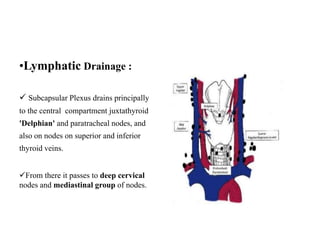
•Lymphatic Drainage :
 Subcapsular Plexus drains principally
to the central compartment juxtathyroid
'Delphian' and paratracheal nodes, and
also on nodes on superior and inferior
thyroid veins.
From there it passes to deep cervical
nodes and mediastinal group of nodes.
History Taking
Socio-Demographic Details
Gender
Majority of thyroid disorders are
commoner in females.( Example : Simple
Goitres, Thyrotoxicosis andThyroid
carcinomas )
• Age :
 Pubertal Girls : Endemic Goitre
 Young Age : Primary Toxic Goitre , Papillary Carcinoma
 Women in 20s - 30s : Solitary Nodular, Multinodular
Goitre and Colloid Goitre
 Middle aged Women : Follicular Carcinoma , Hashimoto
Disease
 Old aged Women : Anaplastic Carcinoma
Occupation : Thyrotoxicosis is common in patients
working under stress and strain
Residence : Places endemic to goitre due to iodine
deficiency. Eg – Areas near rocky mountains like
Himalayas, vindhyas and satpura ranges.
Swelling
Onset – Duration – Progression – association with pain
Fast growing swelling is seen in anaplastic carcinoma
Slow growing swelling is associated with papillary and follicular
carcinoma
History of sleepless nights (primary toxic goitre)
 History of Loss of weight inspite good appetite, preference for
cold, Irritatbility, Excitability , Insomnia, Tremor of hands and
weakness of muscles (Primary thyrotoxicosis)
 History of palpitations, Dyspnoea on exertion, Chest Pain
(Secondary thyrotoxicosis)
 Sudden increase in Size , associated with Pain indicates
Hemorrhage
•Pain
 Goitre - painless
 Inflammatory conditions – painful
 Malignancies – painless-> painful (infiltration of
surrounding structures)
Pressure effects
 Trachea – dyspnea, stridor
 Oesophagus – dysphagia
 Recurrent laryngeal nerve – hoarseness of voice
•Symptoms of primary thyrotoxicosis
 Loss of weight despite good appetite
 Preference for cold and heat intolerance.
 Nervous excitability, insomnia, tremor, muscle weakness
 Staring eyes, difficulty closing eyelids, double vision.
 Palpitation, tachycardia, dyspnea (Less marked)
• Symptoms of secondary thyrotoxicosis
 Palpitations
 Ectopic beats
 Dyspnea on exertion
 Chest pain
 CHF(swelling around ankles)
Symptoms of Hypothyroidism
Increase in weight in spite of poor appetite
Cold intolerance/preference of warm climate
Muscle fatigue, lethargy, failing memory, mild
hoarseness of voice, constipation, oligomenorrhea
Past history
Drug history for goitrogens (PAS, sulphonylurea, antithyroid drugs)
Past response to treatment
Personal history
Consumption of vegetables of brassica family (goitrogens)
Family history
Enzyme deficiencies, primary thyrotoxicosis,and thyroid cancers
Physical Examination
General survey
Build and state of nutrition
Lean and thin – thyrotoxicosis
Obese – hypothyroidism
Anemia and Cachexia - Ca thyroid
Facies
 Excitement,tension, nervousness,
exophthalmos (Hyperthyroidism)
 Puffy face without expression -
hypothyroidism
– Mental state and intelligence
 Dull and low intelligence – In hypothyroidism
– Pulse
• Tachycardia – secondary thyrotoxicosis
– Skin
• Moist – primary thyrotoxicosis
• Dry and inelastic - hypothyroidism
Primary toxic manifestations (To be assessed during
general examination)
Eye signs
Lid retraction
Exophthalmos
 Von Graefe’s Sign (lid lag)
 Joffroy’s Sign (Absence of wrinkling on forehead
when patient is asked to look up with face inclined
downwards)
 Stellwag sign(staring look, infrequent blinking)
 Moebius’ Sign (Inability or failure to converge
eyeballs)
Dalrympte’s Sign (Upper sclera is visible due to
retraction of upper eyelid)
– Ophthalmoplegia
• Patient can’t look upwards and outwards
– Chemosis
• Edema of conjunctiva : Venous and lymphatic
drainage of conjunctiva is obstructed due to
increased retro orbital pressure
Tachycardia
Tremor of the hands (fine tremors are observed on
outstretched hand or tongue)
Moist skin
Thyroid bruit
Search for metastasis
Bony(skull, spine, pelvis) and lungs.
Local Examination
•Inspection
– Normal gland is not visible
– Pizzillo’s method
 Patient’s hands behind the head, and is asked to push against clasped
hands on the occiput.
 Uniform enlargement of whole gland – physiological goitre, colloid
goitre, Hashimoto’s disease
 Isolated nodules of different sizes – nodular goitre
 Swelling lateral to thyroid – aberrant gland or lymph node from Ca
Movement with deglutition :
Thyroid moves on deglutition (thyroglossal cyst,
sub hyoid bursitis, pretracheal/prelarynngeal lymph
nodes)
Look for lower border of the gland, not possible to
see in retrosternal enlargement
– Pemberton’s test
 Raising hands above head,
with arms touching ears
Facial distress due to
thoracic inlet obstruction
• Tongue protrusion test
 Differentiate between thyroglossal
cyst and thyroid swelling
Palpation
Position
Patient is sitting, physician stands
behind/in front of the patient
Neck slightly flexed, thumb behind
the neck, other four fingers on each
lobes and the gland palpated in its
entirety.
• Lahey’s method
 Examiner stands in front of the
patient
 Gland is pushed to one side, ideal for
palpating margins
• Crile’s method
 Thumb on the gland, patient is asked
to swallow (To look for nodularity)
Points to be assessed during
palpation
•Whether the whole gland is enlarged ?
– If yes
Surface – smooth (primary thyrotoxicosis ,colloid
goitre and bosselated (multinodular goitre)
Consistency –
 Firm - primary thyrotoxicosis or Hashimoto’s disease
 Soft – colloid goitre
 Hard – Riedel’s thyroiditis
 Variable – carcinoma
• Is the enlargement localized?
 Position, size, shape, extent, consistency
• Is the gland mobile?
 To be checked in all directions
 Fixed – Carcinomas or Chronic conditions
Can you get below the gland?
Are there any pressure effects?
Kocher’s test – Pushing lateral lobes of gland will cause
stridor, positive in multinodular goitre and carcinoma
thyroid. Position of trachea should be noted. Confirmed
by X-ray.
 Carotic pulsations for involvement of carotid sheath
 Sympathetic trunk – Horner's syndrome(enophthalmos,
psudoptosis, miosis, anhidrosis)
 Venous obstruction – Pemberton’s sign
 Are there any toxic manifestations?
 Are there any evidence of hypothyroidism?
• Is the swelling benign or malignant?
• Are there any pulsations or thrill?
• Are there cervical lymph nodes palpable?
– Early lymphatic metastasis in papillary carcinoma of
thyroid “aberrant thyroid”
Percussion
Over manubrium sterni to look for retrosternal
extension
Auscultation
Primary toxic goitre – systolic bruit over the gland
Measurement of neck circumference to monitor growth
of the swelling
Investigations
Thyroid function test (TSH and T3,T4 )
Euthyroid (Normal TSH,T3 and T4)
Thyrotoxic (↓TSH, ↑T3 and T4)
Myxoedema ( ↑TSH, ↓T3 and T4 )
Thyroid autoantibodies (Antibodies against
Thyroperoxidase and Thyroglobulin )
>25 units/mL for TPO and titre of greater than 1:100 for
antithyroglobulin are considered significant
Serum Calcitonin / CEA as screening test for medullary
carcinoma
Thyroid Imaging
Chest and Thoracic Inlet X-Rays : Retrosternal Goitre, and
clinically significant tracheal devation and compression.
Ultrasound Scanning : Important in identification of nodes
involved in thyroid cancers. (May reveal clinically irrelevant
swellings )
CT,MRI and PET: Reserved for assessment of known
malignancy, and status of extent of retrosternal goitre
 Isotope Scanning : Routine isotope scanning not indicated.
Investigation of Choice in toxic patient with nodule or
nodularity of gland.
• FNAC :
 Investigation of Choice in
Discrete Thyroid
Swellings.
 Should be reported using
standard terminologies
Thy1 Non-diagnostic
Thy1c Non-diagnostic cystic
Thy2 Non-neoplastic
Thy3 Follicular
Thy4 Suspicious of malignancy
Thy5 Malignant
Treatment
• Selection of Thyroid Procedure:
 Diagnosis (If known pre-operatively)
 Risk of thyroid failure
 Risk of recurrent laryngeal nerve injury
 Risk of recurrence
 Grave's disease
 Multinodular goitre
 Differentiated thyroid cancer
 Risk of Hypoparathyroidism
Thyroid Operations
• All thyroid operations can be assembled
by three basic elements
• Total lobectomy
• Isthumectomy
• Subtotal lobectomy
•Total Thyroidectomy = 2*total lobectomy
+Isthumectomy
•Sub-Total thyroidectomy = 2*subtotal lobectomy +
Isthumectomy
•Near Total Thyroidectomy = Total Lobectomy +
Isthumectomy +Subtotal Lobectomy (Dunhill
Procedure)
•Lobectomy = Total lobectomy + Isthumectomy
Thank You

Thyroid gland123

  • 1.
    Examination of ThyroidGland Brajesh Lahri
  • 2.
    Surgical Anatomy ofThyroid Gland • Endocrine gland,situated in lower part of the front and sides on neck. • Consists of right and left lobes, joined by isthmus. • Lobule is functional unit,supplied by an arteriole. • Each lobule consists of 25-40 follicles,lined by cuboidal epithelium
  • 4.
    •Development : •The thyroidgland arises initially as a midline diverticulum in the floor of the pharynx. •Endodermal in Origin •Situation and Extent : Each lobe extends from middle of thyroid cartilage to fourth or fifth tracheal ring. Isthmus extends from second to fourth tracheal ring
  • 5.
    •Blood Supply : Suppliedby Superior and Inferior Thyroid Arteries.  Drained by Superior, Middle and Inferior Thyroid Veins. In some individuals, Fourth thyroid vein (of Kocher) may emerge between middle and inferior thyroid veins.
  • 6.
    •Lymphatic Drainage : Subcapsular Plexus drains principally to the central compartment juxtathyroid 'Delphian' and paratracheal nodes, and also on nodes on superior and inferior thyroid veins. From there it passes to deep cervical nodes and mediastinal group of nodes.
  • 7.
    History Taking Socio-Demographic Details Gender Majorityof thyroid disorders are commoner in females.( Example : Simple Goitres, Thyrotoxicosis andThyroid carcinomas )
  • 8.
    • Age : Pubertal Girls : Endemic Goitre  Young Age : Primary Toxic Goitre , Papillary Carcinoma  Women in 20s - 30s : Solitary Nodular, Multinodular Goitre and Colloid Goitre  Middle aged Women : Follicular Carcinoma , Hashimoto Disease  Old aged Women : Anaplastic Carcinoma
  • 9.
    Occupation : Thyrotoxicosisis common in patients working under stress and strain Residence : Places endemic to goitre due to iodine deficiency. Eg – Areas near rocky mountains like Himalayas, vindhyas and satpura ranges.
  • 10.
    Swelling Onset – Duration– Progression – association with pain Fast growing swelling is seen in anaplastic carcinoma Slow growing swelling is associated with papillary and follicular carcinoma History of sleepless nights (primary toxic goitre)
  • 11.
     History ofLoss of weight inspite good appetite, preference for cold, Irritatbility, Excitability , Insomnia, Tremor of hands and weakness of muscles (Primary thyrotoxicosis)  History of palpitations, Dyspnoea on exertion, Chest Pain (Secondary thyrotoxicosis)  Sudden increase in Size , associated with Pain indicates Hemorrhage
  • 12.
    •Pain  Goitre -painless  Inflammatory conditions – painful  Malignancies – painless-> painful (infiltration of surrounding structures)
  • 13.
    Pressure effects  Trachea– dyspnea, stridor  Oesophagus – dysphagia  Recurrent laryngeal nerve – hoarseness of voice
  • 14.
    •Symptoms of primarythyrotoxicosis  Loss of weight despite good appetite  Preference for cold and heat intolerance.  Nervous excitability, insomnia, tremor, muscle weakness  Staring eyes, difficulty closing eyelids, double vision.  Palpitation, tachycardia, dyspnea (Less marked)
  • 15.
    • Symptoms ofsecondary thyrotoxicosis  Palpitations  Ectopic beats  Dyspnea on exertion  Chest pain  CHF(swelling around ankles)
  • 16.
    Symptoms of Hypothyroidism Increasein weight in spite of poor appetite Cold intolerance/preference of warm climate Muscle fatigue, lethargy, failing memory, mild hoarseness of voice, constipation, oligomenorrhea
  • 17.
    Past history Drug historyfor goitrogens (PAS, sulphonylurea, antithyroid drugs) Past response to treatment Personal history Consumption of vegetables of brassica family (goitrogens) Family history Enzyme deficiencies, primary thyrotoxicosis,and thyroid cancers
  • 18.
    Physical Examination General survey Buildand state of nutrition Lean and thin – thyrotoxicosis Obese – hypothyroidism Anemia and Cachexia - Ca thyroid Facies  Excitement,tension, nervousness, exophthalmos (Hyperthyroidism)  Puffy face without expression - hypothyroidism
  • 19.
    – Mental stateand intelligence  Dull and low intelligence – In hypothyroidism – Pulse • Tachycardia – secondary thyrotoxicosis – Skin • Moist – primary thyrotoxicosis • Dry and inelastic - hypothyroidism
  • 20.
    Primary toxic manifestations(To be assessed during general examination) Eye signs Lid retraction Exophthalmos  Von Graefe’s Sign (lid lag)  Joffroy’s Sign (Absence of wrinkling on forehead when patient is asked to look up with face inclined downwards)  Stellwag sign(staring look, infrequent blinking)
  • 21.
     Moebius’ Sign(Inability or failure to converge eyeballs) Dalrympte’s Sign (Upper sclera is visible due to retraction of upper eyelid) – Ophthalmoplegia • Patient can’t look upwards and outwards
  • 22.
    – Chemosis • Edemaof conjunctiva : Venous and lymphatic drainage of conjunctiva is obstructed due to increased retro orbital pressure
  • 23.
    Tachycardia Tremor of thehands (fine tremors are observed on outstretched hand or tongue) Moist skin Thyroid bruit Search for metastasis Bony(skull, spine, pelvis) and lungs.
  • 24.
    Local Examination •Inspection – Normalgland is not visible – Pizzillo’s method  Patient’s hands behind the head, and is asked to push against clasped hands on the occiput.  Uniform enlargement of whole gland – physiological goitre, colloid goitre, Hashimoto’s disease  Isolated nodules of different sizes – nodular goitre  Swelling lateral to thyroid – aberrant gland or lymph node from Ca
  • 25.
    Movement with deglutition: Thyroid moves on deglutition (thyroglossal cyst, sub hyoid bursitis, pretracheal/prelarynngeal lymph nodes) Look for lower border of the gland, not possible to see in retrosternal enlargement
  • 26.
    – Pemberton’s test Raising hands above head, with arms touching ears Facial distress due to thoracic inlet obstruction • Tongue protrusion test  Differentiate between thyroglossal cyst and thyroid swelling
  • 27.
    Palpation Position Patient is sitting,physician stands behind/in front of the patient Neck slightly flexed, thumb behind the neck, other four fingers on each lobes and the gland palpated in its entirety.
  • 28.
    • Lahey’s method Examiner stands in front of the patient  Gland is pushed to one side, ideal for palpating margins • Crile’s method  Thumb on the gland, patient is asked to swallow (To look for nodularity)
  • 29.
    Points to beassessed during palpation •Whether the whole gland is enlarged ? – If yes Surface – smooth (primary thyrotoxicosis ,colloid goitre and bosselated (multinodular goitre) Consistency –  Firm - primary thyrotoxicosis or Hashimoto’s disease  Soft – colloid goitre  Hard – Riedel’s thyroiditis  Variable – carcinoma
  • 30.
    • Is theenlargement localized?  Position, size, shape, extent, consistency • Is the gland mobile?  To be checked in all directions  Fixed – Carcinomas or Chronic conditions
  • 31.
    Can you getbelow the gland? Are there any pressure effects? Kocher’s test – Pushing lateral lobes of gland will cause stridor, positive in multinodular goitre and carcinoma thyroid. Position of trachea should be noted. Confirmed by X-ray.
  • 32.
     Carotic pulsationsfor involvement of carotid sheath  Sympathetic trunk – Horner's syndrome(enophthalmos, psudoptosis, miosis, anhidrosis)  Venous obstruction – Pemberton’s sign  Are there any toxic manifestations?  Are there any evidence of hypothyroidism?
  • 33.
    • Is theswelling benign or malignant? • Are there any pulsations or thrill? • Are there cervical lymph nodes palpable? – Early lymphatic metastasis in papillary carcinoma of thyroid “aberrant thyroid”
  • 34.
    Percussion Over manubrium sternito look for retrosternal extension Auscultation Primary toxic goitre – systolic bruit over the gland Measurement of neck circumference to monitor growth of the swelling
  • 35.
    Investigations Thyroid function test(TSH and T3,T4 ) Euthyroid (Normal TSH,T3 and T4) Thyrotoxic (↓TSH, ↑T3 and T4) Myxoedema ( ↑TSH, ↓T3 and T4 ) Thyroid autoantibodies (Antibodies against Thyroperoxidase and Thyroglobulin ) >25 units/mL for TPO and titre of greater than 1:100 for antithyroglobulin are considered significant Serum Calcitonin / CEA as screening test for medullary carcinoma
  • 36.
    Thyroid Imaging Chest andThoracic Inlet X-Rays : Retrosternal Goitre, and clinically significant tracheal devation and compression. Ultrasound Scanning : Important in identification of nodes involved in thyroid cancers. (May reveal clinically irrelevant swellings ) CT,MRI and PET: Reserved for assessment of known malignancy, and status of extent of retrosternal goitre  Isotope Scanning : Routine isotope scanning not indicated. Investigation of Choice in toxic patient with nodule or nodularity of gland.
  • 37.
    • FNAC : Investigation of Choice in Discrete Thyroid Swellings.  Should be reported using standard terminologies Thy1 Non-diagnostic Thy1c Non-diagnostic cystic Thy2 Non-neoplastic Thy3 Follicular Thy4 Suspicious of malignancy Thy5 Malignant
  • 38.
    Treatment • Selection ofThyroid Procedure:  Diagnosis (If known pre-operatively)  Risk of thyroid failure  Risk of recurrent laryngeal nerve injury  Risk of recurrence  Grave's disease  Multinodular goitre  Differentiated thyroid cancer  Risk of Hypoparathyroidism
  • 40.
    Thyroid Operations • Allthyroid operations can be assembled by three basic elements • Total lobectomy • Isthumectomy • Subtotal lobectomy
  • 41.
    •Total Thyroidectomy =2*total lobectomy +Isthumectomy •Sub-Total thyroidectomy = 2*subtotal lobectomy + Isthumectomy •Near Total Thyroidectomy = Total Lobectomy + Isthumectomy +Subtotal Lobectomy (Dunhill Procedure) •Lobectomy = Total lobectomy + Isthumectomy
  • 42.

Editor's Notes

  • #7 Delphian Lymph Node : The Delphian (DL) node, also called the prelaryngeal or cricothyroid node, is a lymph node located on the fascia above the cricothyroid membrane. The DL node receives afferent lymphatic drainage from the larynx (supraglottis and subglottis via the anterior commissure) and the thyroid gland (upper and anterior portions of both lobes and isthmus).
  • #42 Dunhill Procedure : TL+I+STL