HEMATURIA MANAGEMENT
Dr. Vipin Sharma mch 1st yr.
REFERENCES; CAMPBELL - WALSH UROLOGY
THE MANAGEMENT OF INTRACTABLE HEMATURIA ;BUJINTERNATIONAL (2000),86,951-959
TREATMENT OPTIONS
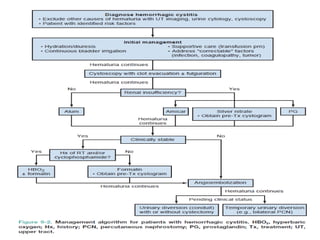
• Intravesical alum irrigation.
• Intravesical formalin.
• Hydrostatic pressure.
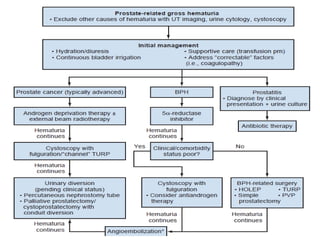
• Embolization.
• Hyperbaric oxygen for radiation cystitis.
• Sodium pentosanpolysulphate for chronic gross hematuria.
• Intravesical PG for cyclophosphamide-induced hematuria.
• First step— ABC of life support ,clot evacuation.
INTRA VESICAL ALUM
• It was first introduced by Floyd Csir in 1982.
• Continuous closed irrigation with a 1% alum solution in
sterile water through three-way foley catheter at bedside,
with no general or regional anaesthesia.
• Aluminium ammonium sulphate or potassium sulphate.
• Astringent action of protein precipitation at the cell surface
leads to
• Decreased Capillary permeability, contraction of
intercellular space,
• Vasoconstriction, hardening of the capillary endothelium
• And a reduction in edema, inflammation and exudate.
PROTOCOLS FOR ALUM IRRIGATION
• Using a 1% alum solution
• 50 g of alum is dissolved in 5 L sterile water and used to
irrigate the bladder at 250±30 ml/h.
• other method ; -Using the 1% solution or a stock solution of
400 g of potash of alum (McCarthy's) in 4 L hot sterile water.
• 300 ml of the stock solution is added to 3 L of 0.9% saline
and the bladder irrigated with up to 30 L of this solution in
24 h.
SIDE EFFECTS
• Suprapubic discomfort.
• Colloid-like precipitation occurred with slow irrigation.
• Pathological accumulation may occur.
• Toxicity of aluminium causes neurofibrillary degeneration in the CNS
- manifests as
• Encephalopathy, malaise, speech disorder, dementia, convulsions and
vomiting.
INTRAVESICAL HELMSTEIN'S HYDROSTATIC
PRESSURE
• Epidural anaesthetic
• Simply filling the bladder with normal saline via a foley
catheter, or by using a balloon attached to a cut foley catheter
through which a steel tube was advanced and specially
designed balloons.
• Used a pressure of 10±20 cm H2O above diastolic pressure
was maintained for 6 hrs.
INTRAVESICAL HYDROSTATIC PRESSURE
• Side effects
 Nausea and vomiting.
 Temporary incontinence.
 Severe abdominal pain.
 Pyrexia.
 Bladder rupture.
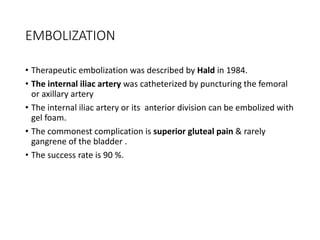
EMBOLIZATION
• Therapeutic embolization was described by Hald in 1984.
• The internal iliac artery was catheterized by puncturing the femoral
or axillary artery
• The internal iliac artery or its anterior division can be embolized with
gel foam.
• The commonest complication is superior gluteal pain & rarely
gangrene of the bladder .
• The success rate is 90 %.
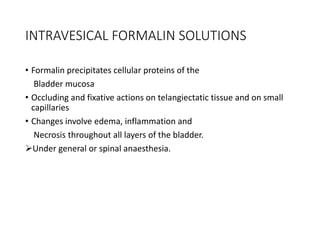
INTRAVESICAL FORMALIN SOLUTIONS
• Formalin precipitates cellular proteins of the
Bladder mucosa
• Occluding and fixative actions on telangiectatic tissue and on small
capillaries
• Changes involve edema, inflammation and
Necrosis throughout all layers of the bladder.
Under general or spinal anaesthesia.
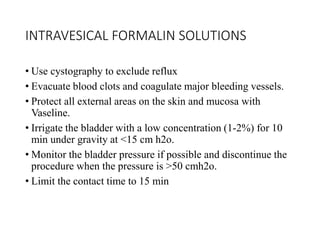
INTRAVESICAL FORMALIN SOLUTIONS
• Use cystography to exclude reflux
• Evacuate blood clots and coagulate major bleeding vessels.
• Protect all external areas on the skin and mucosa with
Vaseline.
• Irrigate the bladder with a low concentration (1-2%) for 10
min under gravity at <15 cm h2o.
• Monitor the bladder pressure if possible and discontinue the
procedure when the pressure is >50 cmh2o.
• Limit the contact time to 15 min
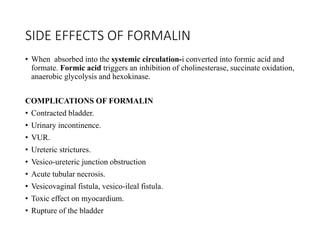
SIDE EFFECTS OF FORMALIN
• When absorbed into the systemic circulation-i converted into formic acid and
formate. Formic acid triggers an inhibition of cholinesterase, succinate oxidation,
anaerobic glycolysis and hexokinase.
COMPLICATIONS OF FORMALIN
• Contracted bladder.
• Urinary incontinence.
• VUR.
• Ureteric strictures.
• Vesico-ureteric junction obstruction
• Acute tubular necrosis.
• Vesicovaginal fistula, vesico-ileal fistula.
• Toxic effect on myocardium.
• Rupture of the bladder
PROTOCOL FOR HYPERBARIC OXYGEN THERAPY
• Hyperbaric oxygen therapy causes neovascularization of
bladder wall & increase the oxygen tension in the bladder.
• Therapy use for Radiation cystitis.
• Twenty sessions of 100% oxygen inhalation at 0.3 MPa in a
multiplace hyperbaric chamber (90 min/session).
• Daily sessions five or six times a week sessions may be
increased to 40.
• Decompression sickness may occur rarely.
• Success rate is 75 %.
SODIUM PENTOSANPOLYSULPHATE
• 100 mg of oral sodium pentosanpolysulphate three times per
day.
• Time to control bleeding was 4 to7 weeks of therapy.
• Increase the natural defense of the bladder-urine interface
by coating the lining of the bladder, which may have been
damaged by irradiation.
CYCLOPHOSPHAMIDE CYSTITIS
• Cyclophosphamide results in acrolein (a hepatic metabolite) being
excreted in the urine.
• causes hemorrhage, edema, ulceration and necrosis of the
urothelium.
• PGE1, E2 and F2a have been used to treat.
PROTOCOLS FOR INTRAVESICAL PGs.
• Protocol 1
• Cystoscopy and clot evacuation.
• Instill 50 ml of 4 mg/L carboprost tromethamine in
the bladder and maintain for 1 h.
• Drain the bladder, instill another 50 ml and maintain for 1 h.
• Unclamp the catheter and irrigate the bladder with normal saline.
• Repeat the instillation four times a day.
• The dosage is increased to 10 mg/l.
Protocol 2
• Irrigate the bladder continuously with 8-10 mg/L carboprost tromethamine
at 100 ml/h for 10 h.
Haematuria management new

Haematuria management new

  • 1.
    HEMATURIA MANAGEMENT Dr. VipinSharma mch 1st yr. REFERENCES; CAMPBELL - WALSH UROLOGY THE MANAGEMENT OF INTRACTABLE HEMATURIA ;BUJINTERNATIONAL (2000),86,951-959
  • 2.
    TREATMENT OPTIONS • Intravesicalalum irrigation. • Intravesical formalin. • Hydrostatic pressure. • Embolization. • Hyperbaric oxygen for radiation cystitis. • Sodium pentosanpolysulphate for chronic gross hematuria. • Intravesical PG for cyclophosphamide-induced hematuria. • First step— ABC of life support ,clot evacuation.
  • 3.
    INTRA VESICAL ALUM •It was first introduced by Floyd Csir in 1982. • Continuous closed irrigation with a 1% alum solution in sterile water through three-way foley catheter at bedside, with no general or regional anaesthesia. • Aluminium ammonium sulphate or potassium sulphate. • Astringent action of protein precipitation at the cell surface leads to • Decreased Capillary permeability, contraction of intercellular space, • Vasoconstriction, hardening of the capillary endothelium • And a reduction in edema, inflammation and exudate.
  • 4.
    PROTOCOLS FOR ALUMIRRIGATION • Using a 1% alum solution • 50 g of alum is dissolved in 5 L sterile water and used to irrigate the bladder at 250±30 ml/h. • other method ; -Using the 1% solution or a stock solution of 400 g of potash of alum (McCarthy's) in 4 L hot sterile water. • 300 ml of the stock solution is added to 3 L of 0.9% saline and the bladder irrigated with up to 30 L of this solution in 24 h.
  • 5.
    SIDE EFFECTS • Suprapubicdiscomfort. • Colloid-like precipitation occurred with slow irrigation. • Pathological accumulation may occur. • Toxicity of aluminium causes neurofibrillary degeneration in the CNS - manifests as • Encephalopathy, malaise, speech disorder, dementia, convulsions and vomiting.
  • 6.
    INTRAVESICAL HELMSTEIN'S HYDROSTATIC PRESSURE •Epidural anaesthetic • Simply filling the bladder with normal saline via a foley catheter, or by using a balloon attached to a cut foley catheter through which a steel tube was advanced and specially designed balloons. • Used a pressure of 10±20 cm H2O above diastolic pressure was maintained for 6 hrs.
  • 7.
    INTRAVESICAL HYDROSTATIC PRESSURE •Side effects  Nausea and vomiting.  Temporary incontinence.  Severe abdominal pain.  Pyrexia.  Bladder rupture.
  • 8.
    EMBOLIZATION • Therapeutic embolizationwas described by Hald in 1984. • The internal iliac artery was catheterized by puncturing the femoral or axillary artery • The internal iliac artery or its anterior division can be embolized with gel foam. • The commonest complication is superior gluteal pain & rarely gangrene of the bladder . • The success rate is 90 %.
  • 9.
    INTRAVESICAL FORMALIN SOLUTIONS •Formalin precipitates cellular proteins of the Bladder mucosa • Occluding and fixative actions on telangiectatic tissue and on small capillaries • Changes involve edema, inflammation and Necrosis throughout all layers of the bladder. Under general or spinal anaesthesia.
  • 10.
    INTRAVESICAL FORMALIN SOLUTIONS •Use cystography to exclude reflux • Evacuate blood clots and coagulate major bleeding vessels. • Protect all external areas on the skin and mucosa with Vaseline. • Irrigate the bladder with a low concentration (1-2%) for 10 min under gravity at <15 cm h2o. • Monitor the bladder pressure if possible and discontinue the procedure when the pressure is >50 cmh2o. • Limit the contact time to 15 min
  • 11.
    SIDE EFFECTS OFFORMALIN • When absorbed into the systemic circulation-i converted into formic acid and formate. Formic acid triggers an inhibition of cholinesterase, succinate oxidation, anaerobic glycolysis and hexokinase. COMPLICATIONS OF FORMALIN • Contracted bladder. • Urinary incontinence. • VUR. • Ureteric strictures. • Vesico-ureteric junction obstruction • Acute tubular necrosis. • Vesicovaginal fistula, vesico-ileal fistula. • Toxic effect on myocardium. • Rupture of the bladder
  • 12.
    PROTOCOL FOR HYPERBARICOXYGEN THERAPY • Hyperbaric oxygen therapy causes neovascularization of bladder wall & increase the oxygen tension in the bladder. • Therapy use for Radiation cystitis. • Twenty sessions of 100% oxygen inhalation at 0.3 MPa in a multiplace hyperbaric chamber (90 min/session). • Daily sessions five or six times a week sessions may be increased to 40. • Decompression sickness may occur rarely. • Success rate is 75 %.
  • 13.
    SODIUM PENTOSANPOLYSULPHATE • 100mg of oral sodium pentosanpolysulphate three times per day. • Time to control bleeding was 4 to7 weeks of therapy. • Increase the natural defense of the bladder-urine interface by coating the lining of the bladder, which may have been damaged by irradiation.
  • 14.
    CYCLOPHOSPHAMIDE CYSTITIS • Cyclophosphamideresults in acrolein (a hepatic metabolite) being excreted in the urine. • causes hemorrhage, edema, ulceration and necrosis of the urothelium. • PGE1, E2 and F2a have been used to treat.
  • 15.
    PROTOCOLS FOR INTRAVESICALPGs. • Protocol 1 • Cystoscopy and clot evacuation. • Instill 50 ml of 4 mg/L carboprost tromethamine in the bladder and maintain for 1 h. • Drain the bladder, instill another 50 ml and maintain for 1 h. • Unclamp the catheter and irrigate the bladder with normal saline. • Repeat the instillation four times a day. • The dosage is increased to 10 mg/l. Protocol 2 • Irrigate the bladder continuously with 8-10 mg/L carboprost tromethamine at 100 ml/h for 10 h.