UPJ OBSTRUCTION
BY
HASSAAN ALI GAD
UPJ OBSTRUCTION
-Most common site of urinary tract
obstruction in children
-Majority are discovered antenatally
-1:800-1500 pregnancies
-80% antenatal hydronephrosis
-2:1 boys : girls
-2/3 on the left
-10-40% bilateral
ETIOLOGY
-Extrinsic compression by an aberrant
accessory or early branching vessel to the
lower pole
-15-52% of the cases in children
*Most common cause in adults
-Secondary UPJ obstruction
-Severe VUR or lower urinary tract obstruction
-permanent kink at the UPJ due to tortuosity
high inserting ureter
PATHOLOGICAL CHANGES
Intrinsic lesion with the ureteropelvic wall
Inefficient drainage through an aperistaltic segment
Over distention of the pelvis leads to hypertrophy and
decreased GFR
If high grade obstruction, penal parenchymal changes
and impaired function result
Histology shows loss of normal smooth muscle,
hypertrophy, and fibrosis
Less commonly: valvular mucosal folds, persistant
fetal convolutions, upper ureteral polyps
ASSOCIATED ANOMALIES
-Another urologic abnormality-50%
-Contralateral UPJ 10-40%
-Renal dysplasia, aplasia,
-VUR up to 40%
PRESENTATION
Historically presented as a palpable mass
*Newborn
Antenatal hydronephrosis 80%
UTI, hematuria, failure to thrive, feeding difficulties,
sepsis, azotemia
*Later in life
-30% diagnosed after UTI
-25% diagnosed after hematuria
-Episodic abdominal pain and vomiting due to
intermittent obstruction
DIAGNOSIS
-Most are diagnosed antenatally
-Hydronephrosis on prenatal ultrasound
-Most are asymptomatic at birth
*The major question:
-Is the obstruction clinically significant?
-Radiologic evaluation helps to determine this,
however there is no perfect way to diagnose
obstruction
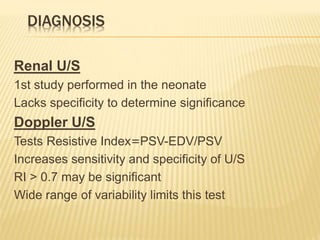
DIAGNOSIS
Renal U/S
1st study performed in the neonate
Lacks specificity to determine significance
Doppler U/S
PSV-EDV/PSV=Tests Resistive Index
Increases sensitivity and specificity of U/S
RI > 0.7 may be significant
Wide range of variability limits this test
DIAGNOSIS
Diuretic Renal Scan
Standardized protocol in children
Catheterization
Measure urine output every 10 minutes
Renogram acquisition for 20 minutes or until pelvis full
Lasix 1 mg/kg
Diuresis renogram acquisition for 20 minutes
Gives good differential function and drainage
pattern
DIAGNOSIS
Disadvantages
Variable response to Lasix
Variable timing of Lasix administration
Variable renal pelvic compliance
Do not correlate well with pressure-flow studies
Not as helpful with equivocal results
DIAGNOSIS
IVP
-functional study
-usually wait until 4 wks. Old
-pelviectasis after drainage
Retrograde pyelograms
-mainly in cases of non-functioning kidneys
-can r/o distal obstruction
DIAGNOSIS
Pressure-flow (Whitaker)
fill pelvis at 10ml/min normal saline
difference between pelvis and bladder
invasive
questionable accuracy if compliant pelvis
injection at non-physiologic rates
obstruction if pressure difference > 15-22 cm
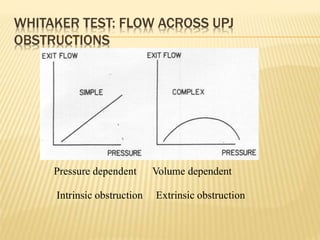
WHITAKER TEST: FLOW ACROSS UPJ
OBSTRUCTIONS
Pressure dependent Volume dependent
Intrinsic obstruction Extrinsic obstruction
FOLLOW-UP
U/S on day 2 - 3 of life
Persistent hydronephrosis
VCUG to evaluate PUV or VUR
Prophylactic antibiotics if VUR present
No PUV or VUR - repeat U/S and diuretic renal scan at
1 month
Continued hydro - surgery vs. observation
observation - U/S and/or renal scan every 3-4 months
for 1 year and then every 4-6 months
surgery - open/endopyelotomy/laparoscopy
CONSERVATIVE MANAGEMENT
Principles:
50% of antenatal hydro resolved postpartum
unable to accurately diagnose true obstruction
observations that asymptomatic hydronephrosis
can resolve spontaneously
Studies with infants with renal function >35-
40% in the affected kidney and variable
washout patterns
“Rule of 1/3” - 1/3 stay the same, 1/3 improve, 1/3
worsen
INDICATIONS FOR SURGICAL
INTERVENTION
-Presence of symptoms associated with the
obstruction
-Impairment of overall renal function
-Progressive impairment of ipsilateral function
-Development of stones or infection
Hypertension
SURGICAL MANAGEMENT
Open Pyeloplasty
Gold Standard
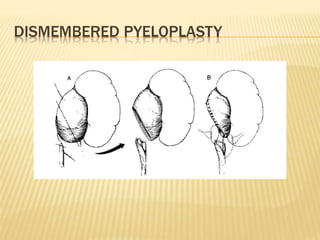
Dismembered pyeloplasty is the most common
removal of stenotic or adynamic segment
proximal ureter is mobilized, spatulated
posteriorlaterally
reanastomosed to the pelvis
pelvic reduction may be necessary is large and
redundant
stent or nephrostomy tube if desired
Foley for 24 hours (48 - 72 if VUR present)
Penrose for 3 - 5 days
Prevents urinoma formation
DISMEMBERED PYELOPLASTY
SURGICAL OPTIONS
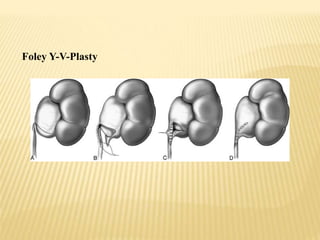
Foley V-Y-Plasty
Good for 1-2 cm obstruction
Best for high inserting ureter
Best with relatively small pelvis
Foley Y-V-Plasty
SURGICAL OPTIONS
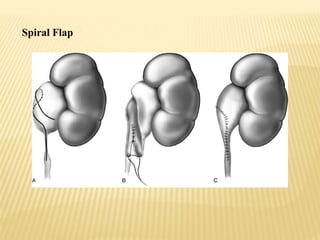
Spiral flap
Good for long obstructions (better in adults)
Length of flap limited only by size of pelvis
(keep length: width at 3:1)
good when UPJ angle > 90
Spiral Flap
SURGICAL MANAGEMENT
Endopyelotomy
Antegrade or retrograde
Cold knife or electric current
Acucise is very popular
dilation balloon with hot wire
86% success in adults
Slightly less effective in children
Direct vision antegrade approach is most common
retrograde less useful due to small ureteral caliber
primary success - 62-94% secondary success 66-100%
less successful if associated with a crossing vessel
SURGICAL MANAGEMENT
Laparoscopic pyeloplasty
Same indications as open or endourologic
procedures
Dismembered pyeloplasty is most common
procedure performed
Without crossing vessels, may do any number of flap
procedures
Up to 94% success rate, similar to open pyeloplasty
CONCLUSIONS
More children are diagnosed with antenatal
U/S
Current diagnostic tests do not differentiate
between kidneys that will need surgery and
those that will improve spontaneously
Solitary kidney, bilateral UPJ, or poorly
functioning kidneys should be considered for
earlier surgery
THANKS

UPJ Obstruction

  • 1.
  • 2.
    UPJ OBSTRUCTION -Most commonsite of urinary tract obstruction in children -Majority are discovered antenatally -1:800-1500 pregnancies -80% antenatal hydronephrosis -2:1 boys : girls -2/3 on the left -10-40% bilateral
  • 3.
    ETIOLOGY -Extrinsic compression byan aberrant accessory or early branching vessel to the lower pole -15-52% of the cases in children *Most common cause in adults -Secondary UPJ obstruction -Severe VUR or lower urinary tract obstruction -permanent kink at the UPJ due to tortuosity high inserting ureter
  • 4.
    PATHOLOGICAL CHANGES Intrinsic lesionwith the ureteropelvic wall Inefficient drainage through an aperistaltic segment Over distention of the pelvis leads to hypertrophy and decreased GFR If high grade obstruction, penal parenchymal changes and impaired function result Histology shows loss of normal smooth muscle, hypertrophy, and fibrosis Less commonly: valvular mucosal folds, persistant fetal convolutions, upper ureteral polyps
  • 5.
    ASSOCIATED ANOMALIES -Another urologicabnormality-50% -Contralateral UPJ 10-40% -Renal dysplasia, aplasia, -VUR up to 40%
  • 6.
    PRESENTATION Historically presented asa palpable mass *Newborn Antenatal hydronephrosis 80% UTI, hematuria, failure to thrive, feeding difficulties, sepsis, azotemia *Later in life -30% diagnosed after UTI -25% diagnosed after hematuria -Episodic abdominal pain and vomiting due to intermittent obstruction
  • 7.
    DIAGNOSIS -Most are diagnosedantenatally -Hydronephrosis on prenatal ultrasound -Most are asymptomatic at birth *The major question: -Is the obstruction clinically significant? -Radiologic evaluation helps to determine this, however there is no perfect way to diagnose obstruction
  • 8.
    DIAGNOSIS Renal U/S 1st studyperformed in the neonate Lacks specificity to determine significance Doppler U/S PSV-EDV/PSV=Tests Resistive Index Increases sensitivity and specificity of U/S RI > 0.7 may be significant Wide range of variability limits this test
  • 9.
    DIAGNOSIS Diuretic Renal Scan Standardizedprotocol in children Catheterization Measure urine output every 10 minutes Renogram acquisition for 20 minutes or until pelvis full Lasix 1 mg/kg Diuresis renogram acquisition for 20 minutes Gives good differential function and drainage pattern
  • 10.
    DIAGNOSIS Disadvantages Variable response toLasix Variable timing of Lasix administration Variable renal pelvic compliance Do not correlate well with pressure-flow studies Not as helpful with equivocal results
  • 11.
    DIAGNOSIS IVP -functional study -usually waituntil 4 wks. Old -pelviectasis after drainage Retrograde pyelograms -mainly in cases of non-functioning kidneys -can r/o distal obstruction
  • 12.
    DIAGNOSIS Pressure-flow (Whitaker) fill pelvisat 10ml/min normal saline difference between pelvis and bladder invasive questionable accuracy if compliant pelvis injection at non-physiologic rates obstruction if pressure difference > 15-22 cm
  • 13.
    WHITAKER TEST: FLOWACROSS UPJ OBSTRUCTIONS Pressure dependent Volume dependent Intrinsic obstruction Extrinsic obstruction
  • 14.
    FOLLOW-UP U/S on day2 - 3 of life Persistent hydronephrosis VCUG to evaluate PUV or VUR Prophylactic antibiotics if VUR present No PUV or VUR - repeat U/S and diuretic renal scan at 1 month Continued hydro - surgery vs. observation observation - U/S and/or renal scan every 3-4 months for 1 year and then every 4-6 months surgery - open/endopyelotomy/laparoscopy
  • 15.
    CONSERVATIVE MANAGEMENT Principles: 50% ofantenatal hydro resolved postpartum unable to accurately diagnose true obstruction observations that asymptomatic hydronephrosis can resolve spontaneously Studies with infants with renal function >35- 40% in the affected kidney and variable washout patterns “Rule of 1/3” - 1/3 stay the same, 1/3 improve, 1/3 worsen
  • 16.
    INDICATIONS FOR SURGICAL INTERVENTION -Presenceof symptoms associated with the obstruction -Impairment of overall renal function -Progressive impairment of ipsilateral function -Development of stones or infection Hypertension
  • 17.
    SURGICAL MANAGEMENT Open Pyeloplasty GoldStandard Dismembered pyeloplasty is the most common removal of stenotic or adynamic segment proximal ureter is mobilized, spatulated posteriorlaterally reanastomosed to the pelvis pelvic reduction may be necessary is large and redundant stent or nephrostomy tube if desired Foley for 24 hours (48 - 72 if VUR present) Penrose for 3 - 5 days Prevents urinoma formation
  • 18.
  • 19.
    SURGICAL OPTIONS Foley V-Y-Plasty Goodfor 1-2 cm obstruction Best for high inserting ureter Best with relatively small pelvis
  • 20.
  • 21.
    SURGICAL OPTIONS Spiral flap Goodfor long obstructions (better in adults) Length of flap limited only by size of pelvis (keep length: width at 3:1) good when UPJ angle > 90
  • 22.
  • 23.
    SURGICAL MANAGEMENT Endopyelotomy Antegrade orretrograde Cold knife or electric current Acucise is very popular dilation balloon with hot wire 86% success in adults Slightly less effective in children Direct vision antegrade approach is most common retrograde less useful due to small ureteral caliber primary success - 62-94% secondary success 66-100% less successful if associated with a crossing vessel
  • 24.
    SURGICAL MANAGEMENT Laparoscopic pyeloplasty Sameindications as open or endourologic procedures Dismembered pyeloplasty is most common procedure performed Without crossing vessels, may do any number of flap procedures Up to 94% success rate, similar to open pyeloplasty
  • 25.
    CONCLUSIONS More children arediagnosed with antenatal U/S Current diagnostic tests do not differentiate between kidneys that will need surgery and those that will improve spontaneously Solitary kidney, bilateral UPJ, or poorly functioning kidneys should be considered for earlier surgery
  • 26.