
Renal Physiology
Brajesh Lahri
Final Professional MBBS ,
All India Institute of Medical Sciences(AIIMS),Bhopal
General Functionsď‚— Produce urine
ď‚— Glomerular Filtration
ď‚— Regulation of GFR
ď‚— Tubular Reabsorption
ď‚— Tubular Secretion
ď‚— Regulate the volume and composition of the extracellular fluid
ď‚— Control pH
ď‚— Control blood volume & blood pressure
ď‚— Controls osmolarity
ď‚— Controls ion balance
ď‚— Production of hormones
ď‚— Renin
ď‚— EPO
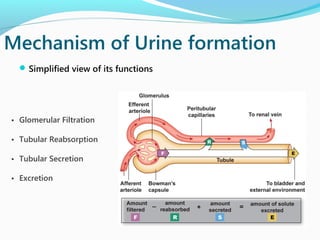
Mechanism of Urine formation
ď‚—Simplified view of its functions
• Glomerular Filtration
• Tubular Reabsorption
• Tubular Secretion
• Excretion
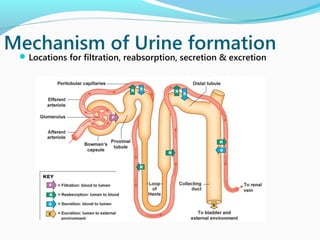
Mechanism of Urine formation
ď‚—Locations for filtration, reabsorption, secretion & excretion
Filtration
ď‚—First step in urine formation
ď‚—Occurs in the glomerulus due to
ď‚—Filtration membrane &
ď‚— Capillary hydrostatic pressure
ď‚— Colloid osmotic pressure
ď‚— Capsular hydrostatic pressure
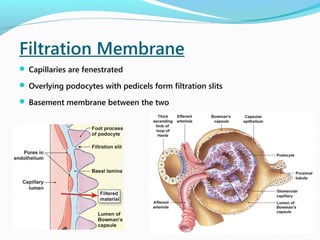
Filtration Membrane
ď‚— Capillaries are fenestrated
ď‚— Overlying podocytes with pedicels form filtration slits
ď‚— Basement membrane between the two
Glomerular Filtration
ď‚—Barriers
ď‚— Mesangial cells can alter blood flow through capillaries
ď‚— Basal lamina alters filtration as well by
ď‚— Containing negatively charged glycoproteins
ď‚— Act to repel negatively charged plasma proteins
 Podocytes form the final barrier to filtration by forming “filtration slits”
Glomerular Filtration
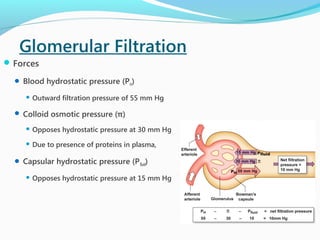
ď‚—Forces
ď‚— Blood hydrostatic pressure (PH)
ď‚— Outward filtration pressure of 55 mm Hg
ď‚— Colloid osmotic pressure (Ď€)
ď‚— Opposes hydrostatic pressure at 30 mm Hg
ď‚— Due to presence of proteins in plasma,
ď‚— Capsular hydrostatic pressure (Pfluid)
ď‚— Opposes hydrostatic pressure at 15 mm Hg
Glomerular Filtration
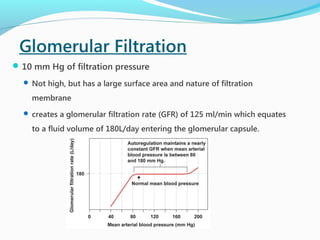
ď‚—10 mm Hg of filtration pressure
ď‚— Not high, but has a large surface area and nature of filtration
membrane
ď‚— creates a glomerular filtration rate (GFR) of 125 ml/min which equates
to a fluid volume of 180L/day entering the glomerular capsule.
Glomerular Filtration
ď‚—10 mm Hg of filtration pressure
ď‚— Not high, but has a large surface area and nature of filtration
membrane
ď‚— creates a glomerular filtration rate (GFR) of 125 ml/min which equates
to a fluid volume of 180L/day entering the glomerular capsule.
ď‚— How does GFR remain relatively constant despite changing mean arterial
pressure?
1. Myogenic response
ď‚— Typical response to stretch of arteriolar smooth muscle due to increased blood pressure:
ď‚— increase stretch results in smooth muscle contraction and decreased arteriole diameter
ď‚— Causes a reduction in GFR
ď‚— If arteriole blood pressure decreases slightly, GFR only increases slightly as arterioles dilate
ď‚— Due to the fact that the arterioles are normally close to maximal dilation
ď‚— Further drop in bp (below 80mmHg) reduced GFR and conserves plasma volume
2. Tubulooglomerular feedback at the JGA
3. Hormones & ANS
Regulation of GFR
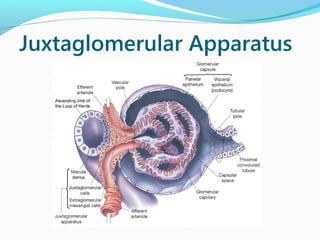
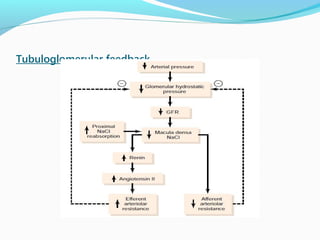
2. Tubuloglomerular feedback at the JGA
ď‚—Fluid flow is monitored in the tubule where it comes back
between the afferent and efferent arterioles
ď‚— Forms the juxtaglomerular apparatus
ď‚— Specialized tubular cells in the JGA form the macula densa
ď‚— Specialized contractile cells in the afferent arteriole in the JGA are called granular
cells or juxtaglomerular cells
Regulation of GFR
Juxtaglomerular Apparatus
Tubuloglomerular feedback
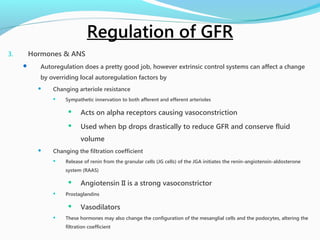
3. Hormones & ANS
ď‚— Autoregulation does a pretty good job, however extrinsic control systems can affect a change
by overriding local autoregulation factors by
ď‚— Changing arteriole resistance
ď‚— Sympathetic innervation to both afferent and efferent arterioles
ď‚— Acts on alpha receptors causing vasoconstriction
ď‚— Used when bp drops drastically to reduce GFR and conserve fluid
volume
ď‚— Changing the filtration coefficient
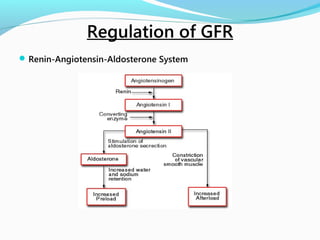
ď‚— Release of renin from the granular cells (JG cells) of the JGA initiates the renin-angiotensin-aldosterone
system (RAAS)
ď‚— Angiotensin II is a strong vasoconstrictor
ď‚— Prostaglandins
ď‚— Vasodilators
ď‚— These hormones may also change the configuration of the mesanglial cells and the podocytes, altering the
filtration coefficient
Regulation of GFR
ď‚—Renin-Angiotensin-Aldosterone System
Regulation of GFR
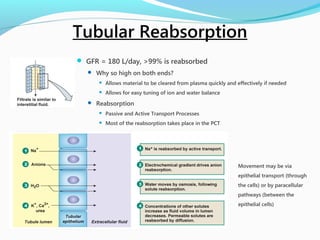
ď‚— GFR = 180 L/day, >99% is reabsorbed
ď‚— Why so high on both ends?
ď‚— Allows material to be cleared from plasma quickly and effectively if needed
ď‚— Allows for easy tuning of ion and water balance
ď‚— Reabsorption
ď‚— Passive and Active Transport Processes
ď‚— Most of the reabsorption takes place in the PCT
Movement may be via
epithelial transport (through
the cells) or by paracellular
pathways (between the
epithelial cells)
Tubular Reabsorption
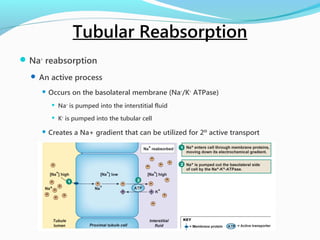
ď‚—Na+
reabsorption
ď‚— An active process
ď‚— Occurs on the basolateral membrane (Na+
/K+
ATPase)
ď‚— Na+
is pumped into the interstitial fluid
ď‚— K+
is pumped into the tubular cell
ď‚— Creates a Na+ gradient that can be utilized for 2Âş active transport
Tubular Reabsorption
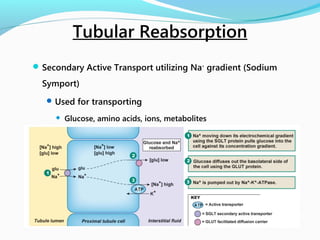
ď‚—Secondary Active Transport utilizing Na+
gradient (Sodium
Symport)
ď‚—Used for transporting
ď‚— Glucose, amino acids, ions, metabolites
Tubular Reabsorption
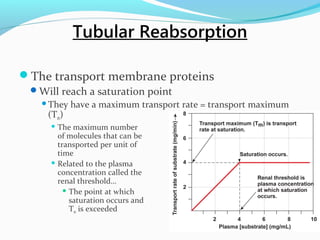
ď‚—The transport membrane proteins
ď‚—Will reach a saturation point
ď‚—They have a maximum transport rate = transport maximum
(Tm)
ď‚— The maximum number
of molecules that can be
transported per unit of
time
ď‚— Related to the plasma
concentration called the
renal threshold…
ď‚— The point at which
saturation occurs and
Tm is exceeded
Tubular Reabsorption
ď‚—Glucose Reabsorption
ď‚—Glucose is filtered and reabsorbed hopefully 100%
 Glucose excreted = glucose filtered – glucose reabsorbed
Tubular Reabsorption
ď‚—Where does filtered material go?
ď‚—Into peritubular capillaries because in the capillaries there exists
ď‚— Low hydrostatic pressure
ď‚— Higher colloid osmotic pressure
Tubular Reabsorption
ď‚—Tubular secretion is the movement of material from the peritubular
capillaries and interstitial space into the nephron tubules
ď‚— Depends mainly on transport systems
ď‚— Enables further removal of unwanted substances
ď‚— Occurs mostly by secondary active transport
 If something is filtered, not reabsorbed, and secreted… the clearance
rate from plasma is greater than GFR!
 Ex. penicillin – filtered and secreted, not reabsorbed
ď‚— 80% of penicillin is gone within 4 hours after administration
Tubular Secretion
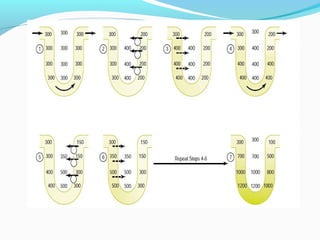
ď‚—Urine normally exits the nephron in a dilute state, however under
hormonal controls, water reabsorption occurs and can create an
extremely concentrated urine.
ď‚— Aldosterone & ADH are the two main hormones that drive this water
reabsorption
ď‚— Aldosterone creates an obligatory response
 Aldosterone increases Na+/K+ ATPase activity and therefore reabsorption of Na+…
where Na+ goes, water is obliged to follow
ď‚— ADH creates a facultative response
ď‚— Opens up water channels in the collecting duct, allowing for the reabsorption of water
via osmosis
Urine Concentration & Dilution
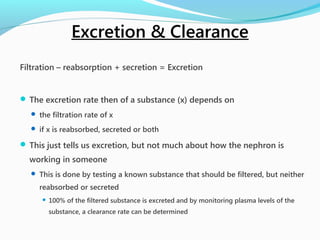
Filtration – reabsorption + secretion = Excretion
ď‚— The excretion rate then of a substance (x) depends on
ď‚— the filtration rate of x
ď‚— if x is reabsorbed, secreted or both
ď‚— This just tells us excretion, but not much about how the nephron is
working in someone
ď‚— This is done by testing a known substance that should be filtered, but neither
reabsorbed or secreted
ď‚— 100% of the filtered substance is excreted and by monitoring plasma levels of the
substance, a clearance rate can be determined
Excretion & Clearance
ď‚—Inulin
ď‚— A plant product that is
filtered but not
reabsorbed or secreted
ď‚— Used to determine
clearance rate and
therefore nephron
function
Excretion & Clearance
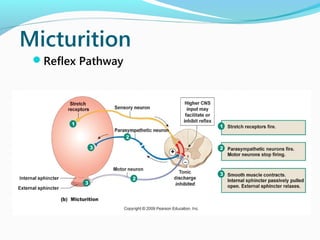
Micturition
ď‚—Reflex Pathway
Thank You !!!Thank You !!!

Renal phsyiology edited

  • 1.
    Renal Physiology Brajesh Lahri FinalProfessional MBBS , All India Institute of Medical Sciences(AIIMS),Bhopal
  • 2.
    General Functionsď‚— Produceurine ď‚— Glomerular Filtration ď‚— Regulation of GFR ď‚— Tubular Reabsorption ď‚— Tubular Secretion ď‚— Regulate the volume and composition of the extracellular fluid ď‚— Control pH ď‚— Control blood volume & blood pressure ď‚— Controls osmolarity ď‚— Controls ion balance ď‚— Production of hormones ď‚— Renin ď‚— EPO
  • 3.
    Mechanism of Urineformation Simplified view of its functions • Glomerular Filtration • Tubular Reabsorption • Tubular Secretion • Excretion
  • 4.
    Mechanism of Urineformation ď‚—Locations for filtration, reabsorption, secretion & excretion
  • 5.
    Filtration ď‚—First step inurine formation ď‚—Occurs in the glomerulus due to ď‚—Filtration membrane & ď‚— Capillary hydrostatic pressure ď‚— Colloid osmotic pressure ď‚— Capsular hydrostatic pressure
  • 6.
    Filtration Membrane ď‚— Capillariesare fenestrated ď‚— Overlying podocytes with pedicels form filtration slits ď‚— Basement membrane between the two
  • 7.
    Glomerular Filtration Barriers  Mesangialcells can alter blood flow through capillaries  Basal lamina alters filtration as well by  Containing negatively charged glycoproteins  Act to repel negatively charged plasma proteins  Podocytes form the final barrier to filtration by forming “filtration slits”
  • 8.
    Glomerular Filtration ď‚—Forces ď‚— Bloodhydrostatic pressure (PH) ď‚— Outward filtration pressure of 55 mm Hg ď‚— Colloid osmotic pressure (Ď€) ď‚— Opposes hydrostatic pressure at 30 mm Hg ď‚— Due to presence of proteins in plasma, ď‚— Capsular hydrostatic pressure (Pfluid) ď‚— Opposes hydrostatic pressure at 15 mm Hg
  • 9.
    Glomerular Filtration ď‚—10 mmHg of filtration pressure ď‚— Not high, but has a large surface area and nature of filtration membrane ď‚— creates a glomerular filtration rate (GFR) of 125 ml/min which equates to a fluid volume of 180L/day entering the glomerular capsule.
  • 10.
    Glomerular Filtration ď‚—10 mmHg of filtration pressure ď‚— Not high, but has a large surface area and nature of filtration membrane ď‚— creates a glomerular filtration rate (GFR) of 125 ml/min which equates to a fluid volume of 180L/day entering the glomerular capsule.
  • 11.
    ď‚— How doesGFR remain relatively constant despite changing mean arterial pressure? 1. Myogenic response ď‚— Typical response to stretch of arteriolar smooth muscle due to increased blood pressure: ď‚— increase stretch results in smooth muscle contraction and decreased arteriole diameter ď‚— Causes a reduction in GFR ď‚— If arteriole blood pressure decreases slightly, GFR only increases slightly as arterioles dilate ď‚— Due to the fact that the arterioles are normally close to maximal dilation ď‚— Further drop in bp (below 80mmHg) reduced GFR and conserves plasma volume 2. Tubulooglomerular feedback at the JGA 3. Hormones & ANS Regulation of GFR
  • 12.
    2. Tubuloglomerular feedbackat the JGA ď‚—Fluid flow is monitored in the tubule where it comes back between the afferent and efferent arterioles ď‚— Forms the juxtaglomerular apparatus ď‚— Specialized tubular cells in the JGA form the macula densa ď‚— Specialized contractile cells in the afferent arteriole in the JGA are called granular cells or juxtaglomerular cells Regulation of GFR
  • 13.
  • 14.
  • 15.
    3. Hormones &ANS ď‚— Autoregulation does a pretty good job, however extrinsic control systems can affect a change by overriding local autoregulation factors by ď‚— Changing arteriole resistance ď‚— Sympathetic innervation to both afferent and efferent arterioles ď‚— Acts on alpha receptors causing vasoconstriction ď‚— Used when bp drops drastically to reduce GFR and conserve fluid volume ď‚— Changing the filtration coefficient ď‚— Release of renin from the granular cells (JG cells) of the JGA initiates the renin-angiotensin-aldosterone system (RAAS) ď‚— Angiotensin II is a strong vasoconstrictor ď‚— Prostaglandins ď‚— Vasodilators ď‚— These hormones may also change the configuration of the mesanglial cells and the podocytes, altering the filtration coefficient Regulation of GFR
  • 16.
  • 17.
    ď‚— GFR =180 L/day, >99% is reabsorbed ď‚— Why so high on both ends? ď‚— Allows material to be cleared from plasma quickly and effectively if needed ď‚— Allows for easy tuning of ion and water balance ď‚— Reabsorption ď‚— Passive and Active Transport Processes ď‚— Most of the reabsorption takes place in the PCT Movement may be via epithelial transport (through the cells) or by paracellular pathways (between the epithelial cells) Tubular Reabsorption
  • 18.
    ď‚—Na+ reabsorption ď‚— An activeprocess ď‚— Occurs on the basolateral membrane (Na+ /K+ ATPase) ď‚— Na+ is pumped into the interstitial fluid ď‚— K+ is pumped into the tubular cell ď‚— Creates a Na+ gradient that can be utilized for 2Âş active transport Tubular Reabsorption
  • 19.
    ď‚—Secondary Active Transportutilizing Na+ gradient (Sodium Symport) ď‚—Used for transporting ď‚— Glucose, amino acids, ions, metabolites Tubular Reabsorption
  • 20.
    The transport membraneproteins Will reach a saturation point They have a maximum transport rate = transport maximum (Tm)  The maximum number of molecules that can be transported per unit of time  Related to the plasma concentration called the renal threshold…  The point at which saturation occurs and Tm is exceeded Tubular Reabsorption
  • 21.
    Glucose Reabsorption Glucose isfiltered and reabsorbed hopefully 100%  Glucose excreted = glucose filtered – glucose reabsorbed Tubular Reabsorption
  • 22.
    ď‚—Where does filteredmaterial go? ď‚—Into peritubular capillaries because in the capillaries there exists ď‚— Low hydrostatic pressure ď‚— Higher colloid osmotic pressure Tubular Reabsorption
  • 23.
    Tubular secretion isthe movement of material from the peritubular capillaries and interstitial space into the nephron tubules  Depends mainly on transport systems  Enables further removal of unwanted substances  Occurs mostly by secondary active transport  If something is filtered, not reabsorbed, and secreted… the clearance rate from plasma is greater than GFR!  Ex. penicillin – filtered and secreted, not reabsorbed  80% of penicillin is gone within 4 hours after administration Tubular Secretion
  • 24.
    Urine normally exitsthe nephron in a dilute state, however under hormonal controls, water reabsorption occurs and can create an extremely concentrated urine.  Aldosterone & ADH are the two main hormones that drive this water reabsorption  Aldosterone creates an obligatory response  Aldosterone increases Na+/K+ ATPase activity and therefore reabsorption of Na+… where Na+ goes, water is obliged to follow  ADH creates a facultative response  Opens up water channels in the collecting duct, allowing for the reabsorption of water via osmosis Urine Concentration & Dilution
  • 26.
    Filtration – reabsorption+ secretion = Excretion  The excretion rate then of a substance (x) depends on  the filtration rate of x  if x is reabsorbed, secreted or both  This just tells us excretion, but not much about how the nephron is working in someone  This is done by testing a known substance that should be filtered, but neither reabsorbed or secreted  100% of the filtered substance is excreted and by monitoring plasma levels of the substance, a clearance rate can be determined Excretion & Clearance
  • 27.
    ď‚—Inulin ď‚— A plantproduct that is filtered but not reabsorbed or secreted ď‚— Used to determine clearance rate and therefore nephron function Excretion & Clearance
  • 28.
  • 29.