Atypical Anti-depressants
Brajesh Lahri
Final Professional MBBS Student
All India Institute of Medical
Sciences (AIIMS), Bhopal
By the end of discussion you should be able to…
• Classify anti-depressants
• Enlist atypical anti-depressants
• Know about the mechanism of action of atypical anti-depressants
• Know about the indications of atypical anti-depressants
• Know about the side effects of atypical anti-depressants
Introduction
• Major Depression and Mania are two extremes of affective disorders,
referring to pathological change in mood state.
• Depression is characterized by symptoms like sad mood, loss of
interest and pleasure in activities, low energy, feeling of guilt,
agitation, change in appetite, sleep disturbances, suicidal thoughts
etc.
• Anti-Depressants are drugs which help to elevate mood in depressive
illness.
Pathophysiology of depression
• Many theories are given, most accepted is Monoamine Hypothesis.
• It states that deficiencies in various monoamine neurotransmitters
are responsible for corresponding symptoms of depression.
• According to the monoamine hypothesis, Serotonin, norepinephrine,
and dopamine are the neuro-transmitters associated in
pathophysiology of depression.
**(Serotonin, Nor-epinephrine and Dopamine levels are decreased in
depression)
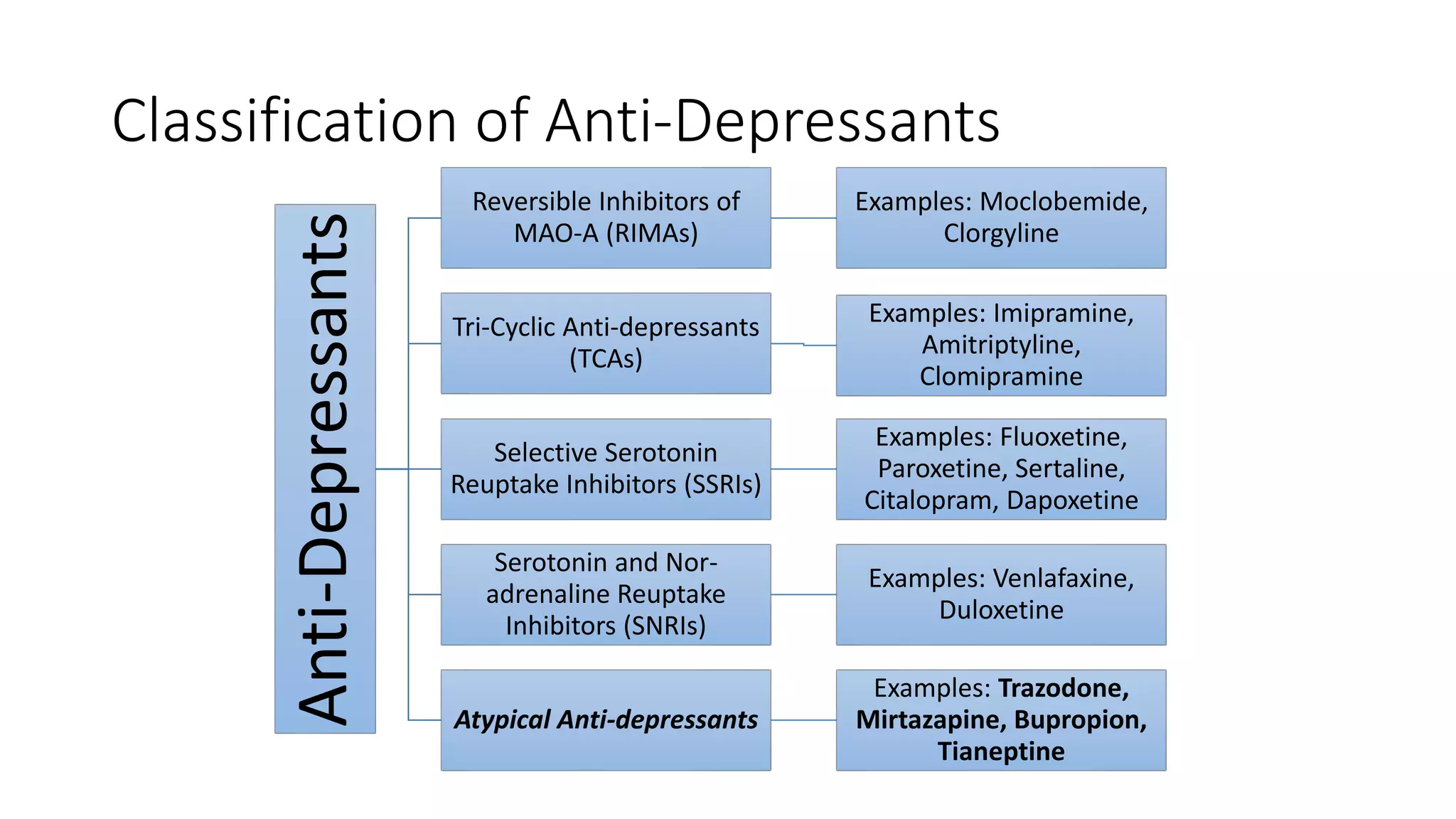
Classification of Anti-Depressants
Anti-Depressants
Reversible Inhibitors of
MAO-A (RIMAs)
Examples: Moclobemide,
Clorgyline
Tri-Cyclic Anti-depressants
(TCAs)
Examples: Imipramine,
Amitriptyline,
Clomipramine
Selective Serotonin
Reuptake Inhibitors (SSRIs)
Examples: Fluoxetine,
Paroxetine, Sertaline,
Citalopram, Dapoxetine
Serotonin and Nor-
adrenaline Reuptake
Inhibitors (SNRIs)
Examples: Venlafaxine,
Duloxetine
Atypical Anti-depressants
Examples: Trazodone,
Mirtazapine, Bupropion,
Tianeptine
Atypical Anti-depressants
• Mirtazapine
• Trazodone
• Bupropion
• Tianeptine
• Agomelatine
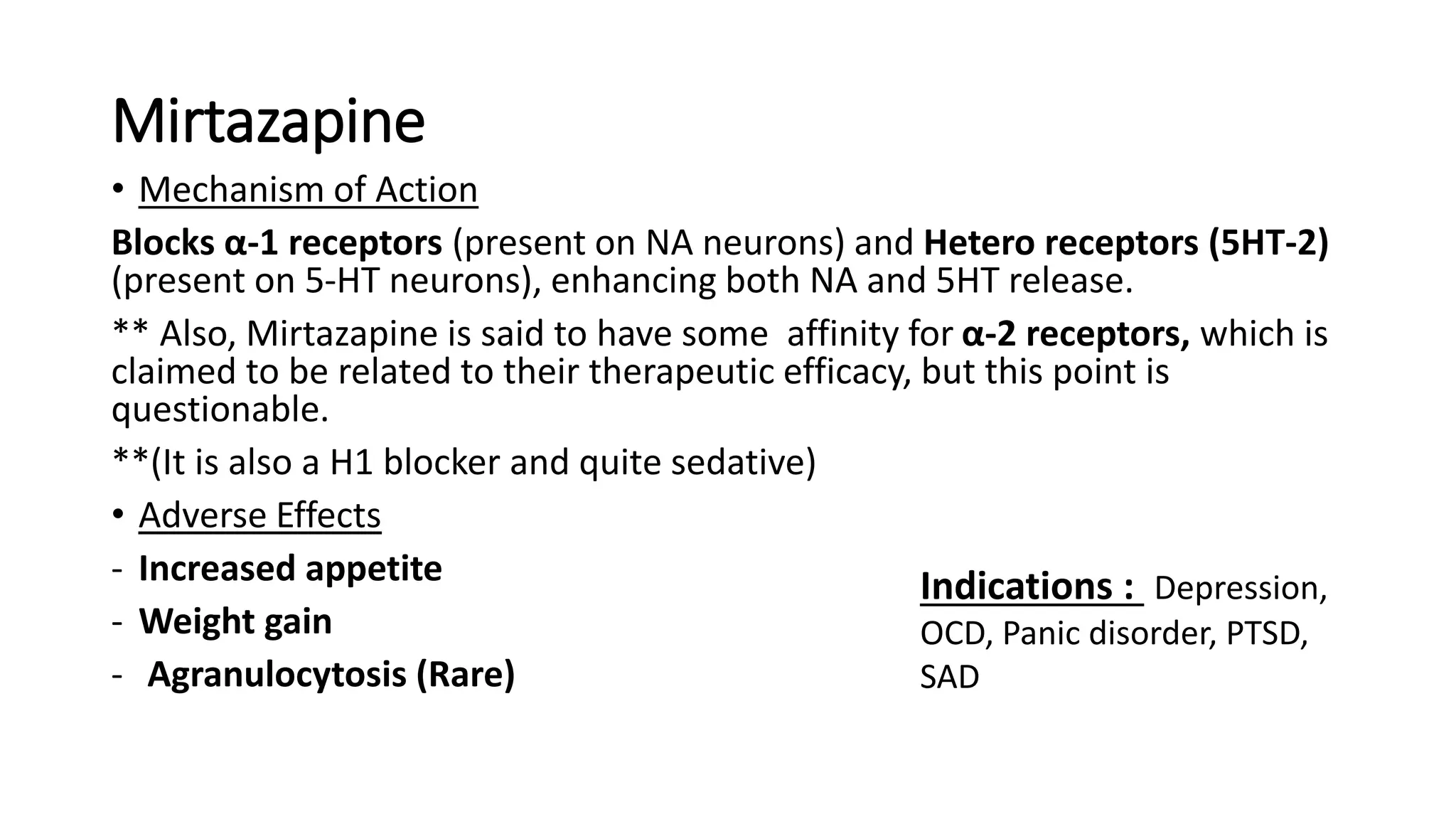
Mirtazapine
• Mechanism of Action
Blocks α-1 receptors (present on NA neurons) and Hetero receptors (5HT-2)
(present on 5-HT neurons), enhancing both NA and 5HT release.
** Also, Mirtazapine is said to have some affinity for α-2 receptors, which is
claimed to be related to their therapeutic efficacy, but this point is
questionable.
**(It is also a H1 blocker and quite sedative)
• Adverse Effects
- Increased appetite
- Weight gain
- Agranulocytosis (Rare)
Indications : Depression,
OCD, Panic disorder, PTSD,
SAD
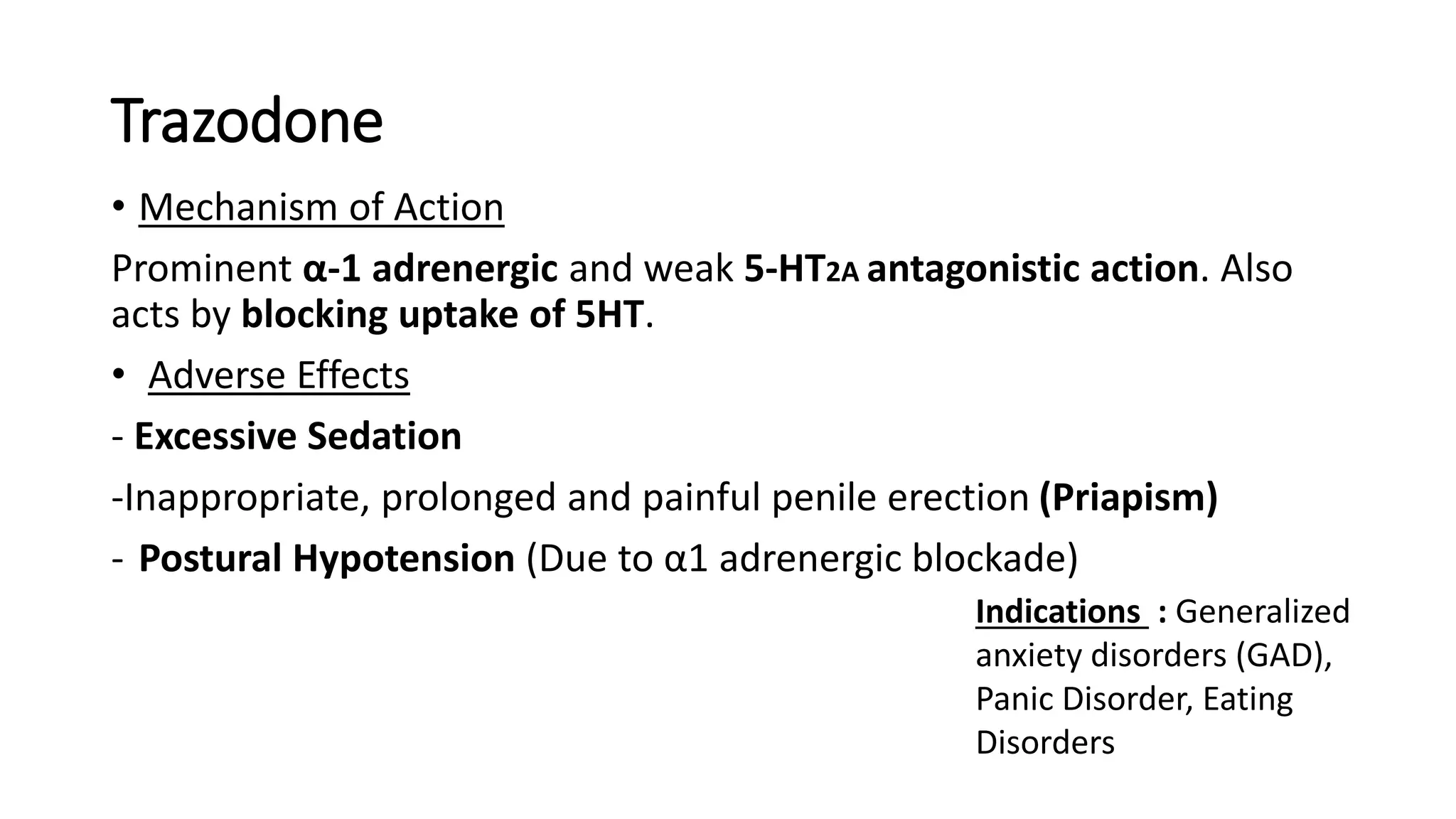
Trazodone
• Mechanism of Action
Prominent α-1 adrenergic and weak 5-HT2A antagonistic action. Also
acts by blocking uptake of 5HT.
• Adverse Effects
- Excessive Sedation
-Inappropriate, prolonged and painful penile erection (Priapism)
- Postural Hypotension (Due to α1 adrenergic blockade)
Indications : Generalized
anxiety disorders (GAD),
Panic Disorder, Eating
Disorders
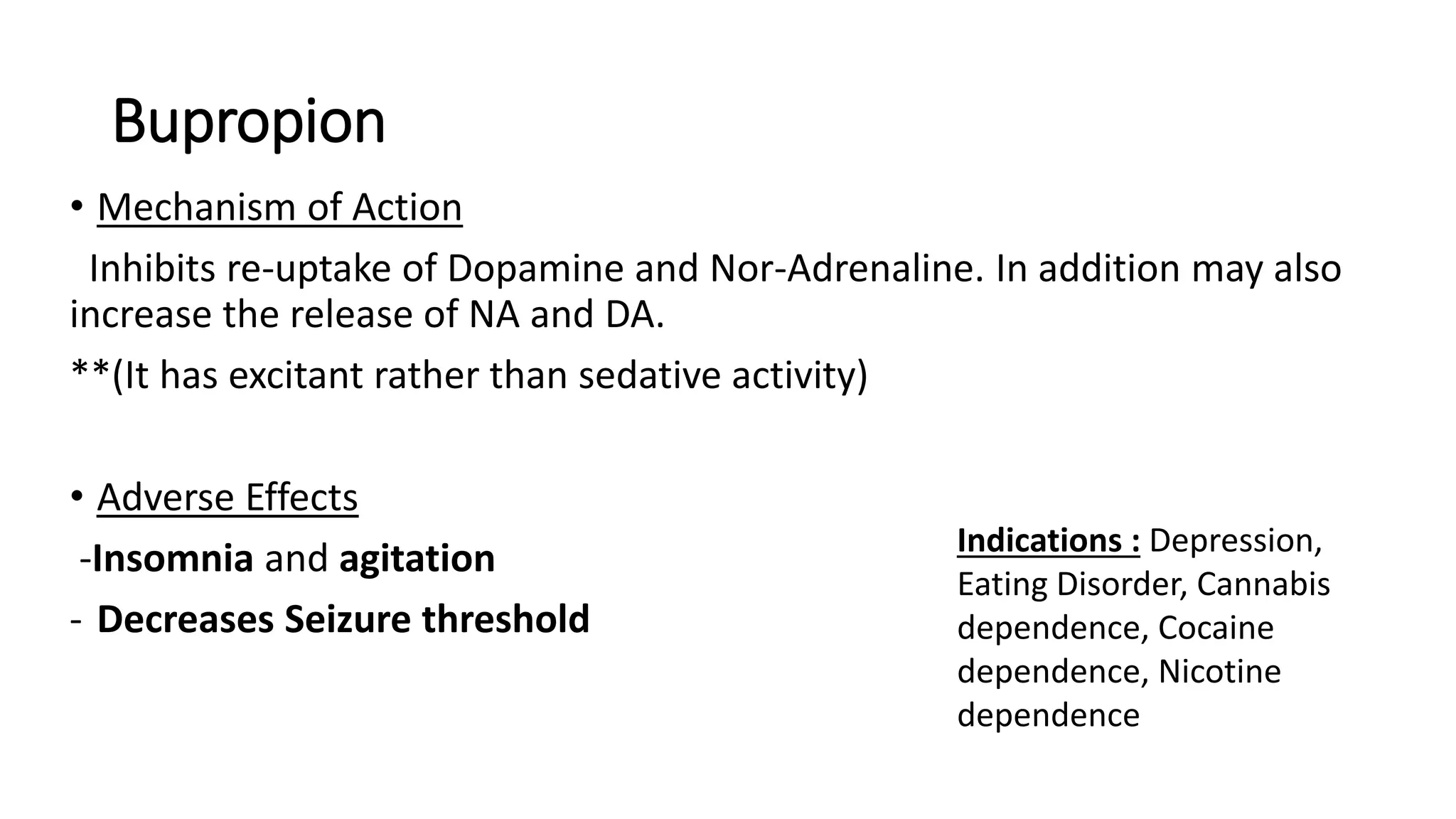
Bupropion
• Mechanism of Action
Inhibits re-uptake of Dopamine and Nor-Adrenaline. In addition may also
increase the release of NA and DA.
**(It has excitant rather than sedative activity)
• Adverse Effects
-Insomnia and agitation
- Decreases Seizure threshold
Indications : Depression,
Eating Disorder, Cannabis
dependence, Cocaine
dependence, Nicotine
dependence
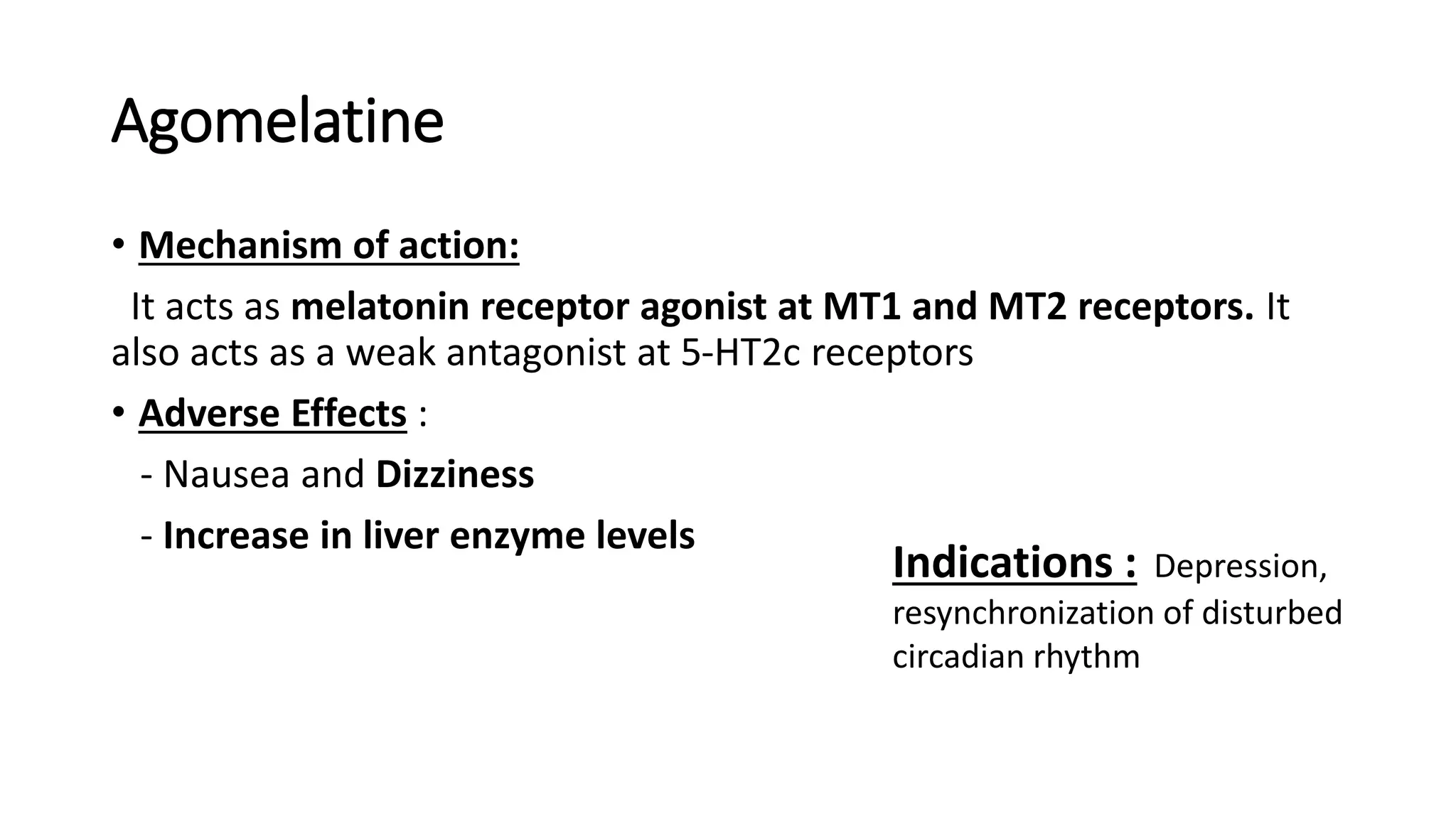
Agomelatine
• Mechanism of action:
It acts as melatonin receptor agonist at MT1 and MT2 receptors. It
also acts as a weak antagonist at 5-HT2c receptors
• Adverse Effects :
- Nausea and Dizziness
- Increase in liver enzyme levels
Indications : Depression,
resynchronization of disturbed
circadian rhythm
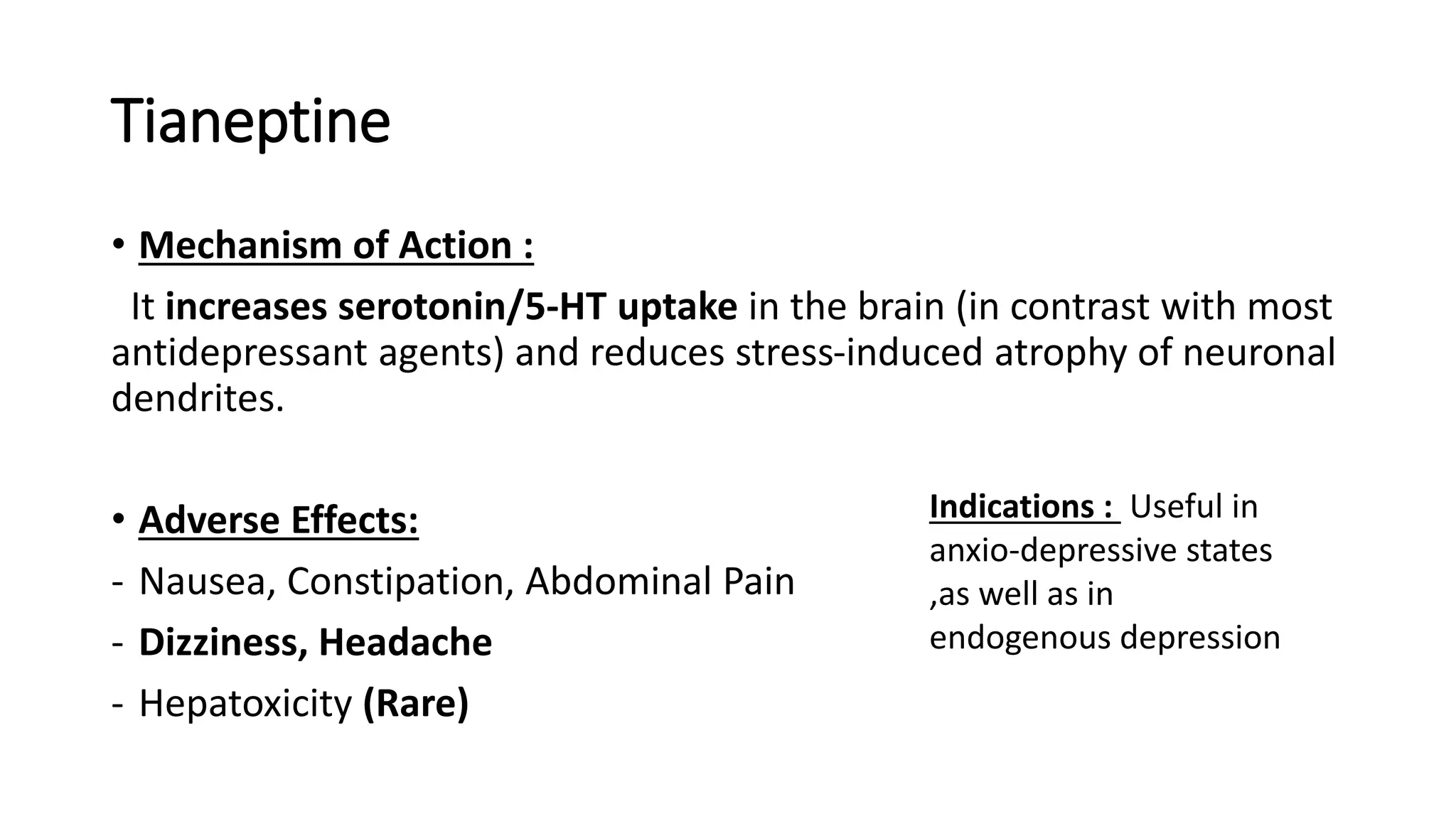
Tianeptine
• Mechanism of Action :
It increases serotonin/5-HT uptake in the brain (in contrast with most
antidepressant agents) and reduces stress-induced atrophy of neuronal
dendrites.
• Adverse Effects:
- Nausea, Constipation, Abdominal Pain
- Dizziness, Headache
- Hepatoxicity (Rare)
Indications : Useful in
anxio-depressive states
,as well as in
endogenous depression
Serotonin and Nor-Adrenaline reuptake
inhibitors (SNRIs)
• Venlafaxine
• Duloxetine
Mechanism of Action : Inhibit uptake of both Nor-adrenaline and
Serotonin, but do not interact with cholinergic, adrenergic or histaminergic
receptors.
Adverse Effects :
- Dizziness ,Insomnia
- Rise in BP (More common with Venlafaxine )
- Associated with increased risk of
Cardiac arrhythmias(Clinical significance is still unclear)
Indications:
-Depression (Both)
-Neuropathic pain
(Duloxetine)
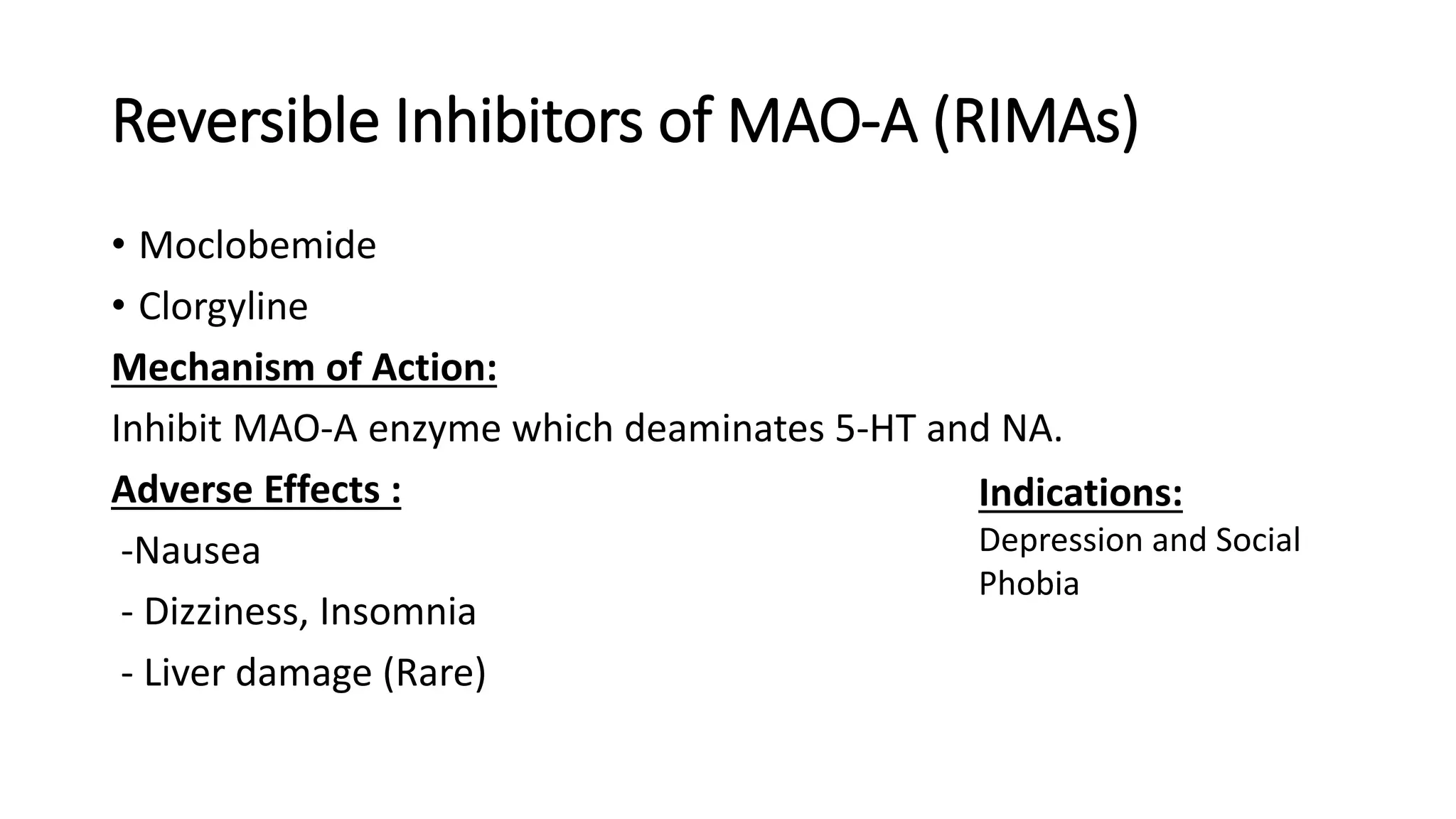
Reversible Inhibitors of MAO-A (RIMAs)
• Moclobemide
• Clorgyline
Mechanism of Action:
Inhibit MAO-A enzyme which deaminates 5-HT and NA.
Adverse Effects :
-Nausea
- Dizziness, Insomnia
- Liver damage (Rare)
Indications:
Depression and Social
Phobia
References
• Clinical Pharmacology-11th Edition - Bennett, Brown and Sharma
• Goodman-Gilman’s -The Pharmacologic basis of Therapeutics- 12th
Edition – Brunton, Chabner, Knollmann
• Essential Medical Pharmacology-7th Edition - K.D. Tripathi
• Essential Evidence based Psychopharmacology- 2nd Edition- Stein ,
Lerer and Stahl
Thank You

An overview of atypical anti depressants

  • 1.
    Atypical Anti-depressants Brajesh Lahri FinalProfessional MBBS Student All India Institute of Medical Sciences (AIIMS), Bhopal
  • 2.
    By the endof discussion you should be able to… • Classify anti-depressants • Enlist atypical anti-depressants • Know about the mechanism of action of atypical anti-depressants • Know about the indications of atypical anti-depressants • Know about the side effects of atypical anti-depressants
  • 3.
    Introduction • Major Depressionand Mania are two extremes of affective disorders, referring to pathological change in mood state. • Depression is characterized by symptoms like sad mood, loss of interest and pleasure in activities, low energy, feeling of guilt, agitation, change in appetite, sleep disturbances, suicidal thoughts etc. • Anti-Depressants are drugs which help to elevate mood in depressive illness.
  • 4.
    Pathophysiology of depression •Many theories are given, most accepted is Monoamine Hypothesis. • It states that deficiencies in various monoamine neurotransmitters are responsible for corresponding symptoms of depression. • According to the monoamine hypothesis, Serotonin, norepinephrine, and dopamine are the neuro-transmitters associated in pathophysiology of depression. **(Serotonin, Nor-epinephrine and Dopamine levels are decreased in depression)
  • 5.
    Classification of Anti-Depressants Anti-Depressants ReversibleInhibitors of MAO-A (RIMAs) Examples: Moclobemide, Clorgyline Tri-Cyclic Anti-depressants (TCAs) Examples: Imipramine, Amitriptyline, Clomipramine Selective Serotonin Reuptake Inhibitors (SSRIs) Examples: Fluoxetine, Paroxetine, Sertaline, Citalopram, Dapoxetine Serotonin and Nor- adrenaline Reuptake Inhibitors (SNRIs) Examples: Venlafaxine, Duloxetine Atypical Anti-depressants Examples: Trazodone, Mirtazapine, Bupropion, Tianeptine
  • 6.
    Atypical Anti-depressants • Mirtazapine •Trazodone • Bupropion • Tianeptine • Agomelatine
  • 7.
    Mirtazapine • Mechanism ofAction Blocks α-1 receptors (present on NA neurons) and Hetero receptors (5HT-2) (present on 5-HT neurons), enhancing both NA and 5HT release. ** Also, Mirtazapine is said to have some affinity for α-2 receptors, which is claimed to be related to their therapeutic efficacy, but this point is questionable. **(It is also a H1 blocker and quite sedative) • Adverse Effects - Increased appetite - Weight gain - Agranulocytosis (Rare) Indications : Depression, OCD, Panic disorder, PTSD, SAD
  • 8.
    Trazodone • Mechanism ofAction Prominent α-1 adrenergic and weak 5-HT2A antagonistic action. Also acts by blocking uptake of 5HT. • Adverse Effects - Excessive Sedation -Inappropriate, prolonged and painful penile erection (Priapism) - Postural Hypotension (Due to α1 adrenergic blockade) Indications : Generalized anxiety disorders (GAD), Panic Disorder, Eating Disorders
  • 9.
    Bupropion • Mechanism ofAction Inhibits re-uptake of Dopamine and Nor-Adrenaline. In addition may also increase the release of NA and DA. **(It has excitant rather than sedative activity) • Adverse Effects -Insomnia and agitation - Decreases Seizure threshold Indications : Depression, Eating Disorder, Cannabis dependence, Cocaine dependence, Nicotine dependence
  • 10.
    Agomelatine • Mechanism ofaction: It acts as melatonin receptor agonist at MT1 and MT2 receptors. It also acts as a weak antagonist at 5-HT2c receptors • Adverse Effects : - Nausea and Dizziness - Increase in liver enzyme levels Indications : Depression, resynchronization of disturbed circadian rhythm
  • 11.
    Tianeptine • Mechanism ofAction : It increases serotonin/5-HT uptake in the brain (in contrast with most antidepressant agents) and reduces stress-induced atrophy of neuronal dendrites. • Adverse Effects: - Nausea, Constipation, Abdominal Pain - Dizziness, Headache - Hepatoxicity (Rare) Indications : Useful in anxio-depressive states ,as well as in endogenous depression
  • 12.
    Serotonin and Nor-Adrenalinereuptake inhibitors (SNRIs) • Venlafaxine • Duloxetine Mechanism of Action : Inhibit uptake of both Nor-adrenaline and Serotonin, but do not interact with cholinergic, adrenergic or histaminergic receptors. Adverse Effects : - Dizziness ,Insomnia - Rise in BP (More common with Venlafaxine ) - Associated with increased risk of Cardiac arrhythmias(Clinical significance is still unclear) Indications: -Depression (Both) -Neuropathic pain (Duloxetine)
  • 13.
    Reversible Inhibitors ofMAO-A (RIMAs) • Moclobemide • Clorgyline Mechanism of Action: Inhibit MAO-A enzyme which deaminates 5-HT and NA. Adverse Effects : -Nausea - Dizziness, Insomnia - Liver damage (Rare) Indications: Depression and Social Phobia
  • 14.
    References • Clinical Pharmacology-11thEdition - Bennett, Brown and Sharma • Goodman-Gilman’s -The Pharmacologic basis of Therapeutics- 12th Edition – Brunton, Chabner, Knollmann • Essential Medical Pharmacology-7th Edition - K.D. Tripathi • Essential Evidence based Psychopharmacology- 2nd Edition- Stein , Lerer and Stahl
  • 15.