HYDRONEPHROSIS
DR RANJIT SINGH RATHORE
Asso. Proff (Urology)
Dept of General surgery, ASCOMS
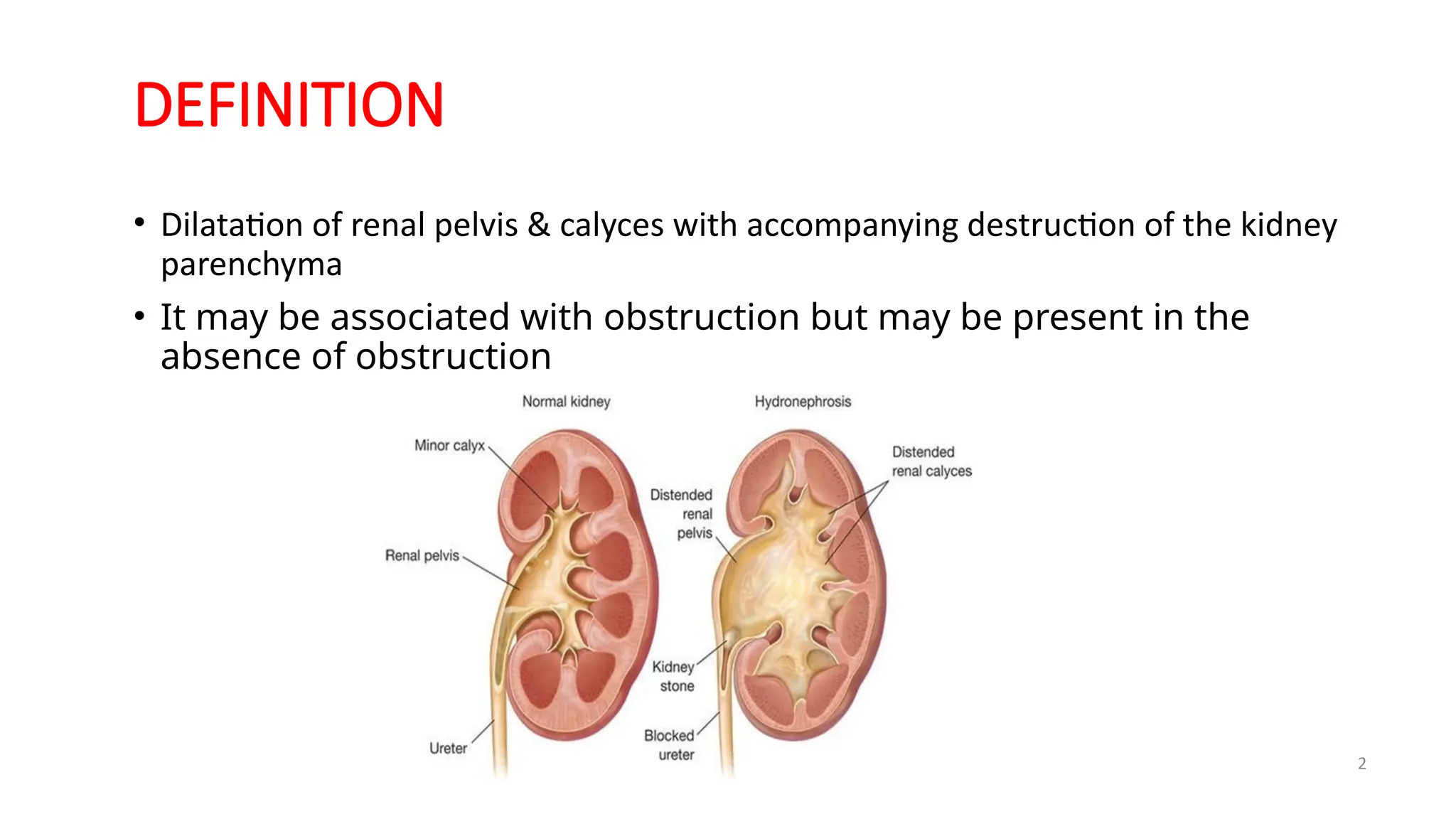
DEFINITION
• Dilatation of renal pelvis & calyces with accompanying destruction of the kidney
parenchyma
• It may be associated with obstruction but may be present in the
absence of obstruction
2
HYDRONEPHROSIS
3
4
ETIOLOGY
SECONDARY
UNILATERA
L
BILATERAL
PRIMARY IDIOPATHIC
UNILATERAL
CAUSES
EXTRAMURAL
INTRAMURAL
INTRALUMINAL
6
UNILATERAL HYDRONEPHROSIS- EXTRAMURAL
• Pressure on the ureter by loaded sigmoid colon, gravid
uterus, uterine & ovarian tumors
• Involvement of the ureter by malignant neoplasm outside
it e.g. carcinoma of the cervix, uterus, colon, rectum,
prostate
• Aberrant renal vessels
• Idiopathic retroperitoneal fibrosis
7
UNILATERAL HYDRONEPHROSIS- INTRAMURAL
•Intramural:
• Congenital stenosis or achalasia
of the PUJ
• Ureterocele
• Stricture
• Neoplasm of ureter
8
UNILATERAL HYDRONEPHROSIS- INTRA LUMINAL
•Intraluminal:
• Calculus
• Congenital folds at the upper
end of the ureter
9
CAUSES OF BILATERAL HYDRONEPHROSIS
• Due to pathologies in the urethra or the urinary bladder
• Causes in the urethra:
• Meatal stenosis
• Posterior urethral valve
• BPH & carcinoma of prostate
• Stricture
• Carcinoma of cervix & uterus
10
CAUSES OF BILATERAL HYDRONEPHROSIS
•Causes in the bladder:
• Calculus
• Neoplasms
• Sphincter dysfunction
11
14
CLINICAL FEATURES
• May depend on unilateral, intermittent or
bilateral hydronephrosis
• Dull ache & sense of weight on the affected side of
the loin
• Causes of the hydronephrosis
• Dietl’s crisis
• Features of the causes
• Bilateral renal swelling
15
EVALUATION
Depending upon the presentation and
whether there is acute onset of symptoms,
•Physical examination - tenderness in the flank or
where the kidneys are located.
•The bladder - distended when the abdomen is
examined.
•PR for males shows the size of the prostate. 50
•Urine analysis to look for blood, infection or
abnormal cells
•Complete blood count (CBC) may reveal anemia
or potential infection
•Electrolyte analysis may be helpful in chronic
hydronephrosis since the kidneys are responsible
for maintaining and balancing their concentrations
in the blood stream.
51
X RAY KUB
KUB X-rays (an X-ray that shows the kidney,
ureter, and bladder) are used to classify a
kidney stone as radiodense or
radiolucent.
KUB X-rays are used to determine if the
stone is able to migrate down the ureter
into the bladder.
52
NORMAL KIDNEY HYDRONEPHROSIS
20
IVP
• IVP : Dilatation of renal
pelvis decreasing
concavity and then
flattening of minor
calyces with dilatation
of major calyces a
portion of pelvis
becomes more
dependant part below
the level of PVJ 53
NORMAL INTRAVENOUS PYELOGRAM (IVP) 19
SPECIAL
INVESTIGATIONS
•Excretory urography
•Retrograde urography
•Ultrasound
54
Excretory Urogram
Retrograde Pyelogram (RP)
• Retrograde pyelogram is used to determine
whether stone or other thing that is obstructing the
urinary pathway.
• This is used in Some people with contra indictions
for IVP in which dye is introduced into the veins.
•CT scan of the abdomen can be done to
evaluate the kidney anatomy and it will help
in making the diagnosis of hydronephrosis.
•It also may allow look for the underlying cause
including kidney stones or structures that are
compressing the urinary collecting system.
CT scan
For patients with ureteral
strictures or stones that are
difficult to remove, stent may
be placed into the ureter that
bypasses the obstruction and
allows urine to flow from the
kidney.
63
PRINCIPLES OF TREATMENT
In adults, the aims of treatment are to:
•Remove the build-up of urine and relieve
tthe pressure on kidneys.
•Prevent permanent kidney damage.
•Treat the underlying cause
•Most people with hydronephrosis should have
catheterisation to drain the urine from their
kidneys.
•Depending on the underlying cause, medication
or surgery may be needed afterwards to correct
the problem.
•If the condition is severe or causing problems such
as a urinary tract infection (UTI), it may be treated
soon after it is diagnosed.
TREATMENT GOAL
•
•
•
•
The goal of treatment for hydronephrosis is to restart the
free flow of urine from the kidney and decrease the
swelling and pressure that builds up and decreases
kidney function.
The initial care for the patient is aimed at minimizing
pain and preventing urinary tract infections.
The timing of the procedure depends upon
the :underlying cause of hydronephrosis and
hydroureter and the associated medical conditions
that may be present. 60
For patients with urinary retention and an
enlarged bladder as a cause of hydronephrosis,
bladder catheterization may be all that is
needed for initial treatment.
When a stent cannot be placed, an alternative
is inserting a percutaneous nephrostomy
tube. A urologist or interventional radiologist
uses fluoroscopy to insert a tube through the
flank directly into the kidney to allow urine to
drain.
61
Per cutaneous Nephrostomy :
Shock wave lithotripsy(SWL )
Shock wave lithotripsy(SWL or
extracorporeal shock wave
lithotripsy) is the most common
treatment for kidney stones.
Shock waves from outside the
body are targeted at a kidney
stone causing the stone to
fragment into tiny pieces that
are able to be passed out of the
urinary tract in the urine. 62
For patients with ureteral
strictures or stones that are
difficult to remove, stent may
be placed into the ureter that
bypasses the obstruction and
allows urine to flow from the
kidney.
63
Using a ureteroscope inserted through the urethra
into the bladder, can visualize where the ureter
enters and can thread the stent through the ureter
into the kidney pelvis bypassing any obstruction.
Treating hydronephrosis in
babies
Most babies diagnosed with hydronephrosis before they're born (antenatal
hydronephrosis) won't need any treatment because the condition will improve
before they're born or within a few months of their birth.
Investgiations are done for babies like:
• An ultrasound scan
• Micturating cystourethrogram (MCUG) – where a thin tube is used
to pass a special type of liquid that shows up clearly on X-rays into
thebaby's bladder while a series of X-rays are taken.
• Dimercaptosuccinic acid (DMSA) scan or MAG-3 scan –
where they are injected with a substance that shows up on a special device
called a gamma camera; the camera is then used to take pictures of child's
kidneys
•In most children, hydronephrosis will get better as they get older.
•If hydronephrosis doesn't get better by itself, child may need to keep taking
antibiotics.
•Occasionally, surgery may be recommended to treat the underlying cause
of the condition
INDICATIONS OF OPERATIONS :
•Increasing renal pain increasing hydronephrosis
•When hydronephrosis is complicated by
infection/parenchymal damage.
PROCEDURES :
Nephrectomy
•Plastic operations
•Endoscopic pyelolysis / endoscopic pyelotomy
•Endoscopic ballon dilatation
Principles of pyeloplasty
•To reduce the size of the renal pelvis
•Excision of the PUJ
•The ureter is attached to the most dependent part of
the pelvis
67
Extraperitoneal flank approach,
bed of the 12th rib
TREATMENT
•Secondary hydronephrosis: treatment of the
cause
•Primary hydronephrosis:
• Pyeloplasty:
• Anderson- Hynes
• Culp
• Foley
• Nephrectomy 69
PROCEDURES FOR PRIMARY
HYDRONEPHROSIS
70
Anderson- Hynes Pyeloplasty
(Dismembered) :
• In this procedure , upper one third of ureter and
Renal pelvis are mobilised
• Anastamosis is made between ureteric end and
kidney
• A Nephrostomy tube was placed in order to
protect the anastamosis
Stitches are placed on the renal pelvis superior to the
obstruction and the lateral aspect of the proximal ureter
below the level of the obstruction.
b The ureteropelvic junction tissue is then excised and an
anastomosis is created with fine interrupted or running
absorption sutures.
c The sutures are placed in a watertight manner over an
internal ureteral stent, which remains in situ.
72
73
A spiral incision is made in the enlarged renal pelvis
and extended an equal distance into the ureter.
b | The tissue flap is turned down and stitched into
the adjacent ureter.
c | The flap is closed with fine interrupted or
running absorption sutures.
74
a | The ureter is pulled with a stitch while a Y-
shaped incision is made in the renal pelvis and
ureter.
b | A V-shaped flap is opened in the ureteropelvic
junction tissue.
c | The V-shaped flap is sutured to the apex of the
COMPLICATIONS
• Development of a urinary tract infection (UTI).
• When the UTI is associated with a high fever, a
kidney infection is (pyelonephritis) is suspected.
This is caused by bacteria spreading from the
bladder to the kidney and invading the kidney
tissue.
• If pyelonephritis is severe or not treated in a timely
manner, or if it affects both kidneys, complications
such as permanent kidney damage (kidney scarring)
can lead to problems such as high blood pressure
and sometimes kidney failure. 77
ROBOT-ASSISTED
PYELOPLASTY
• A robot-assisted pyeloplasty is a minimally
invasive laparoscopic procedure. With the use
of a tiny camera, surgeons operate using very
thin instruments inserted into three or four
small incisions.
• Robot-assisted pyeloplasty removes an
obstructed section of the ureter and reattaches
the healthy portion to the kidney's drainage
system.
78
Thank you

HYDRONEPHROSIS clinical evaluation and management - DR RANJIT.pptx

  • 1.
    HYDRONEPHROSIS DR RANJIT SINGHRATHORE Asso. Proff (Urology) Dept of General surgery, ASCOMS
  • 2.
    DEFINITION • Dilatation ofrenal pelvis & calyces with accompanying destruction of the kidney parenchyma • It may be associated with obstruction but may be present in the absence of obstruction 2
  • 3.
  • 4.
  • 5.
  • 6.
  • 7.
    UNILATERAL HYDRONEPHROSIS- EXTRAMURAL •Pressure on the ureter by loaded sigmoid colon, gravid uterus, uterine & ovarian tumors • Involvement of the ureter by malignant neoplasm outside it e.g. carcinoma of the cervix, uterus, colon, rectum, prostate • Aberrant renal vessels • Idiopathic retroperitoneal fibrosis 7
  • 8.
    UNILATERAL HYDRONEPHROSIS- INTRAMURAL •Intramural: •Congenital stenosis or achalasia of the PUJ • Ureterocele • Stricture • Neoplasm of ureter 8
  • 9.
    UNILATERAL HYDRONEPHROSIS- INTRALUMINAL •Intraluminal: • Calculus • Congenital folds at the upper end of the ureter 9
  • 10.
    CAUSES OF BILATERALHYDRONEPHROSIS • Due to pathologies in the urethra or the urinary bladder • Causes in the urethra: • Meatal stenosis • Posterior urethral valve • BPH & carcinoma of prostate • Stricture • Carcinoma of cervix & uterus 10
  • 11.
    CAUSES OF BILATERALHYDRONEPHROSIS •Causes in the bladder: • Calculus • Neoplasms • Sphincter dysfunction 11
  • 13.
  • 14.
    CLINICAL FEATURES • Maydepend on unilateral, intermittent or bilateral hydronephrosis • Dull ache & sense of weight on the affected side of the loin • Causes of the hydronephrosis • Dietl’s crisis • Features of the causes • Bilateral renal swelling 15
  • 15.
    EVALUATION Depending upon thepresentation and whether there is acute onset of symptoms, •Physical examination - tenderness in the flank or where the kidneys are located. •The bladder - distended when the abdomen is examined. •PR for males shows the size of the prostate. 50
  • 16.
    •Urine analysis tolook for blood, infection or abnormal cells •Complete blood count (CBC) may reveal anemia or potential infection •Electrolyte analysis may be helpful in chronic hydronephrosis since the kidneys are responsible for maintaining and balancing their concentrations in the blood stream. 51
  • 17.
    X RAY KUB KUBX-rays (an X-ray that shows the kidney, ureter, and bladder) are used to classify a kidney stone as radiodense or radiolucent. KUB X-rays are used to determine if the stone is able to migrate down the ureter into the bladder. 52
  • 19.
  • 20.
    IVP • IVP :Dilatation of renal pelvis decreasing concavity and then flattening of minor calyces with dilatation of major calyces a portion of pelvis becomes more dependant part below the level of PVJ 53
  • 21.
  • 23.
  • 24.
  • 25.
    Retrograde Pyelogram (RP) •Retrograde pyelogram is used to determine whether stone or other thing that is obstructing the urinary pathway. • This is used in Some people with contra indictions for IVP in which dye is introduced into the veins.
  • 26.
    •CT scan ofthe abdomen can be done to evaluate the kidney anatomy and it will help in making the diagnosis of hydronephrosis. •It also may allow look for the underlying cause including kidney stones or structures that are compressing the urinary collecting system. CT scan
  • 27.
    For patients withureteral strictures or stones that are difficult to remove, stent may be placed into the ureter that bypasses the obstruction and allows urine to flow from the kidney. 63
  • 28.
    PRINCIPLES OF TREATMENT Inadults, the aims of treatment are to: •Remove the build-up of urine and relieve tthe pressure on kidneys. •Prevent permanent kidney damage. •Treat the underlying cause
  • 29.
    •Most people withhydronephrosis should have catheterisation to drain the urine from their kidneys. •Depending on the underlying cause, medication or surgery may be needed afterwards to correct the problem. •If the condition is severe or causing problems such as a urinary tract infection (UTI), it may be treated soon after it is diagnosed.
  • 30.
    TREATMENT GOAL • • • • The goalof treatment for hydronephrosis is to restart the free flow of urine from the kidney and decrease the swelling and pressure that builds up and decreases kidney function. The initial care for the patient is aimed at minimizing pain and preventing urinary tract infections. The timing of the procedure depends upon the :underlying cause of hydronephrosis and hydroureter and the associated medical conditions that may be present. 60
  • 31.
    For patients withurinary retention and an enlarged bladder as a cause of hydronephrosis, bladder catheterization may be all that is needed for initial treatment. When a stent cannot be placed, an alternative is inserting a percutaneous nephrostomy tube. A urologist or interventional radiologist uses fluoroscopy to insert a tube through the flank directly into the kidney to allow urine to drain. 61
  • 32.
  • 33.
    Shock wave lithotripsy(SWL) Shock wave lithotripsy(SWL or extracorporeal shock wave lithotripsy) is the most common treatment for kidney stones. Shock waves from outside the body are targeted at a kidney stone causing the stone to fragment into tiny pieces that are able to be passed out of the urinary tract in the urine. 62
  • 34.
    For patients withureteral strictures or stones that are difficult to remove, stent may be placed into the ureter that bypasses the obstruction and allows urine to flow from the kidney. 63
  • 35.
    Using a ureteroscopeinserted through the urethra into the bladder, can visualize where the ureter enters and can thread the stent through the ureter into the kidney pelvis bypassing any obstruction.
  • 36.
    Treating hydronephrosis in babies Mostbabies diagnosed with hydronephrosis before they're born (antenatal hydronephrosis) won't need any treatment because the condition will improve before they're born or within a few months of their birth. Investgiations are done for babies like: • An ultrasound scan • Micturating cystourethrogram (MCUG) – where a thin tube is used to pass a special type of liquid that shows up clearly on X-rays into thebaby's bladder while a series of X-rays are taken.
  • 37.
    • Dimercaptosuccinic acid(DMSA) scan or MAG-3 scan – where they are injected with a substance that shows up on a special device called a gamma camera; the camera is then used to take pictures of child's kidneys •In most children, hydronephrosis will get better as they get older. •If hydronephrosis doesn't get better by itself, child may need to keep taking antibiotics. •Occasionally, surgery may be recommended to treat the underlying cause of the condition
  • 38.
    INDICATIONS OF OPERATIONS: •Increasing renal pain increasing hydronephrosis •When hydronephrosis is complicated by infection/parenchymal damage. PROCEDURES : Nephrectomy •Plastic operations •Endoscopic pyelolysis / endoscopic pyelotomy •Endoscopic ballon dilatation
  • 39.
    Principles of pyeloplasty •Toreduce the size of the renal pelvis •Excision of the PUJ •The ureter is attached to the most dependent part of the pelvis
  • 40.
  • 41.
    TREATMENT •Secondary hydronephrosis: treatmentof the cause •Primary hydronephrosis: • Pyeloplasty: • Anderson- Hynes • Culp • Foley • Nephrectomy 69
  • 42.
  • 43.
    Anderson- Hynes Pyeloplasty (Dismembered): • In this procedure , upper one third of ureter and Renal pelvis are mobilised • Anastamosis is made between ureteric end and kidney • A Nephrostomy tube was placed in order to protect the anastamosis
  • 46.
    Stitches are placedon the renal pelvis superior to the obstruction and the lateral aspect of the proximal ureter below the level of the obstruction. b The ureteropelvic junction tissue is then excised and an anastomosis is created with fine interrupted or running absorption sutures. c The sutures are placed in a watertight manner over an internal ureteral stent, which remains in situ. 72
  • 47.
    73 A spiral incisionis made in the enlarged renal pelvis and extended an equal distance into the ureter. b | The tissue flap is turned down and stitched into the adjacent ureter. c | The flap is closed with fine interrupted or running absorption sutures.
  • 48.
    74 a | Theureter is pulled with a stitch while a Y- shaped incision is made in the renal pelvis and ureter. b | A V-shaped flap is opened in the ureteropelvic junction tissue. c | The V-shaped flap is sutured to the apex of the
  • 50.
    COMPLICATIONS • Development ofa urinary tract infection (UTI). • When the UTI is associated with a high fever, a kidney infection is (pyelonephritis) is suspected. This is caused by bacteria spreading from the bladder to the kidney and invading the kidney tissue. • If pyelonephritis is severe or not treated in a timely manner, or if it affects both kidneys, complications such as permanent kidney damage (kidney scarring) can lead to problems such as high blood pressure and sometimes kidney failure. 77
  • 51.
    ROBOT-ASSISTED PYELOPLASTY • A robot-assistedpyeloplasty is a minimally invasive laparoscopic procedure. With the use of a tiny camera, surgeons operate using very thin instruments inserted into three or four small incisions. • Robot-assisted pyeloplasty removes an obstructed section of the ureter and reattaches the healthy portion to the kidney's drainage system. 78
  • 53.