Short Review Of The Discovery of the
Katipunan
MALOLOS
REPUBLIC
-the first Philippine Republic
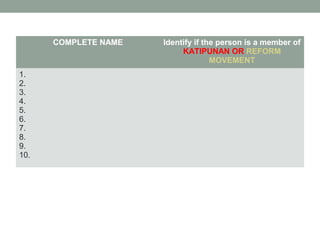
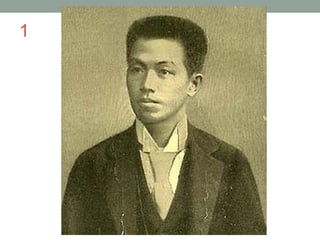
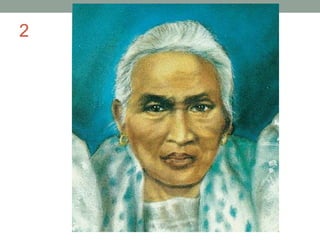
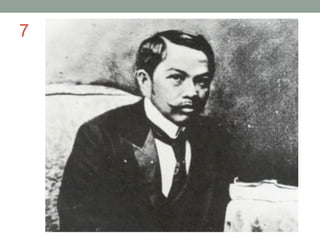
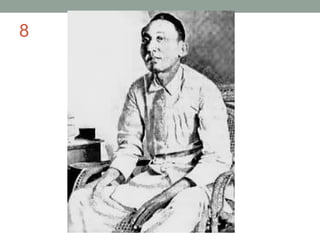
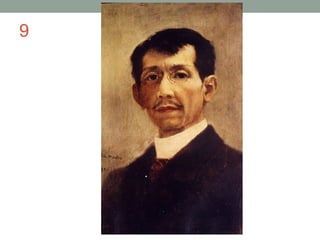
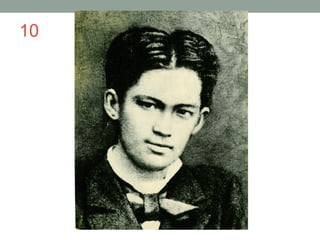
COMPLETE NAME Identify if the person is a member of
KATIPUNAN OR REFORM
MOVEMENT
1.
2.
3.
4.
5.
6.
7.
8.
9.
10.
1
2
3
4
5
6
7
8
9
10
Blue Eagle Eye
• Try to decipher the secret message as you go through
each slides.
• There are letters marked in red that you must write down
for it will form the secret message
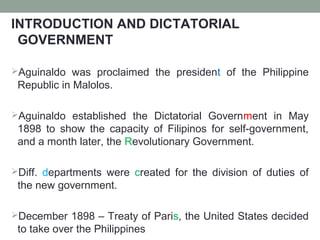
INTRODUCTION AND DICTATORIAL
GOVERNMENT
Aguinaldo was proclaimed the president of the Philippine
Republic in Malolos.
Aguinaldo established the Dictatorial Government in May
1898 to show the capacity of Filipinos for self-government,
and a month later, the Revolutionary Government.
Diff. departments were created for the division of duties of
the new government.
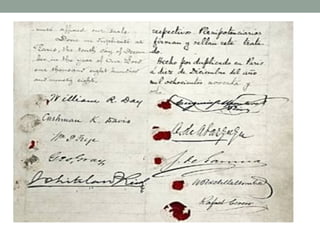
December 1898 – Treaty of Paris, the United States decided
to take over the Philippines
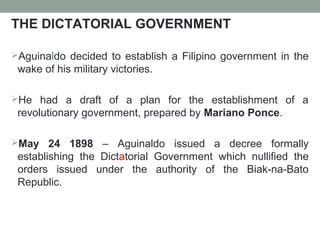
THE DICTATORIAL GOVERNMENT
Aguinaldo decided to establish a Filipino government in the
wake of his military victories.
He had a draft of a plan for the establishment of a
revolutionary government, prepared by Mariano Ponce.
May 24 1898 – Aguinaldo issued a decree formally
establishing the Dictatorial Government which nullified the
orders issued under the authority of the Biak-na-Bato
Republic.
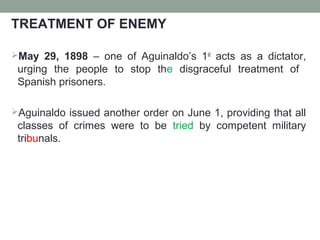
TREATMENT OF ENEMY
May 29, 1898 – one of Aguinaldo’s 1st
acts as a dictator,
urging the people to stop the disgraceful treatment of
Spanish prisoners.
Aguinaldo issued another order on June 1, providing that all
classes of crimes were to be tried by competent military
tribunals.
DECLARATION OF INDEPENDENCE
Julian Felipe – composer from Cavite, who showed the draft
of Composition entitled Marcha Filipina Magdalo which was
later changed to Marcha Nacional Filipana.
Jose Palma – The Lyrics was adapted from his Poem
Filipinas.
June 12, 1898 – proclamation of the independence of the
Philippines at Cavite el Viejo (Kawit).
Philippine National Flag – made in HongKong by Marcela
Agoncillo, Lorenza Agoncillo, and Delfina Herboza.
Act of Declaration of Independence – prepared by
Ambrosio Riamzares Bautista, signed by 98 people,
however was promulgated on August 1.
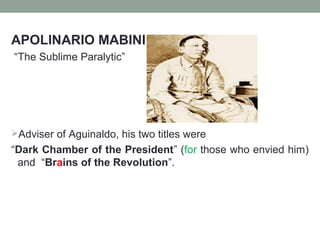
APOLINARIO MABINI
“The Sublime Paralytic”
Adviser of Aguinaldo, his two titles were
“Dark Chamber of the President” (for those who envied him)
and “Brains of the Revolution”.
Who is Apolinario Mabini?
• Apolinario Mabini was a Filipino political philosopher who
served as the first Philippine Prime Minister.
• In history books, he was commonly referred to as “The
Brains of the Revolution” for valiantly trying to stop the
American army from taking over the Philippines.
• These actions included rallying the Filipinos and showed
deep support to the media about the revolution. He was
also the chief advisor of Emilio Aguinaldo.
Basic Background…
• Mabini was born on July 23, 1864 in Barangay
Talaga in Tanauan, Batangas. He was the second of eight
children of Dionisia Maranan, a vendor in the Tanauan
market, and Inocencio Mabini, a Beggar.
• In 1881 Mabini received a scholarship to go to the Colegio
de San Juan de Letran in Manila. A professor there decided
to pick on him because his shabby clothing clearly showed
he was poor. Mabini amazed the professor by answering a
series of very difficult questions with ease.
• Mabini's mother had wanted him to take up the priesthood,
but his desire to defend the poor made him decide to take up
Law instead.
• A year after receiving his Bachilles en Artes with highest
honors and the title Professor of Latin from Letran, he moved
on to the University of Santo Tomas, where he received his
law degree in 1894.
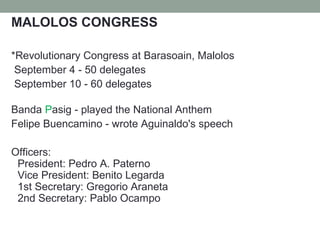
MALOLOS CONGRESS
*Revolutionary Congress at Barasoain, Malolos
September 4 - 50 delegates
September 10 - 60 delegates
Banda Pasig - played the National Anthem
Felipe Buencamino - wrote Aguinaldo's speech
Officers:
President: Pedro A. Paterno
Vice President: Benito Legarda
1st Secretary: Gregorio Araneta
2nd Secretary: Pablo Ocampo
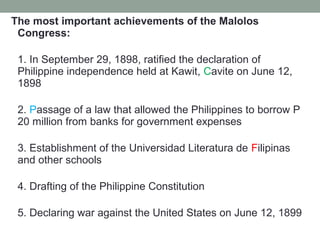
The most important achievements of the Malolos
Congress:
1. In September 29, 1898, ratified the declaration of
Philippine independence held at Kawit, Cavite on June 12,
1898
2. Passage of a law that allowed the Philippines to borrow P
20 million from banks for government expenses
3. Establishment of the Universidad Literatura de Filipinas
and other schools
4. Drafting of the Philippine Constitution
5. Declaring war against the United States on June 12, 1899
The Malolos Constitution
• Mabini envisioned the Congress to be an advisory body of
the President.
• Nevertheless, Mabini submitted his Constitutional Plane of
the Philippine Republic, but Congress, for the second time,
overruled him.
• With the advice of Cayettano Arellano, Calderon drew up his
plans for a constitution, deriving inspiration from the
constitutions of Mexico, Belgium, Guatemala, Costa Rica,
Brazil and France
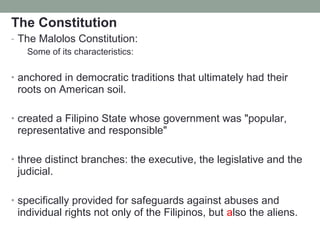
The Constitution
- The Malolos Constitution:
Some of its characteristics:
• anchored in democratic traditions that ultimately had their
roots on American soil.
• created a Filipino State whose government was "popular,
representative and responsible"
• three distinct branches: the executive, the legislative and the
judicial.
• specifically provided for safeguards against abuses and
individual rights not only of the Filipinos, but also the aliens.
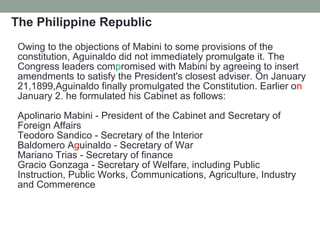
The Philippine Republic
Owing to the objections of Mabini to some provisions of the
constitution, Aguinaldo did not immediately promulgate it. The
Congress leaders compromised with Mabini by agreeing to insert
amendments to satisfy the President's closest adviser. On January
21,1899,Aguinaldo finally promulgated the Constitution. Earlier on
January 2. he formulated his Cabinet as follows:
Apolinario Mabini - President of the Cabinet and Secretary of
Foreign Affairs
Teodoro Sandico - Secretary of the Interior
Baldomero Aguinaldo - Secretary of War
Mariano Trias - Secretary of finance
Gracio Gonzaga - Secretary of Welfare, including Public
Instruction, Public Works, Communications, Agriculture, Industry
and Commerence
Revolutionary Periodicals
El Heraldo de la Revolucion - The revolutionary Government
founded its official organ, whose first number came out on
September 29, 1898.
La Independencia- edited and partly owned by General
Antonio Luna. Its first number came out on September 3,
1898.
Some Great Filipino writers in Spanish and their Pennames:
Cecilio Apostol(Catullo)
Jose Palma
Rafael Palma(Dapit Hapon)
Fernando Ma. Guerrero(Fulvio Gil)
Epifanio de Los Santos(G. Solon)
Jose G. Abreu (Kaibigan)
Mariano V. Del Rosario (Tito-Tato)
Salvador V. Del Rosario (Juan Tagalo)
Rosa Sevilla
Florentina Arellano
January 23,1899 - Philippine Republic's Inauguration at
Malolos
Aguinaldo took his oath of the officer after having been
informed that he had been proclaimed President of the
Republic.The Malolos Constitution was read article by article,
and the army took its oath of loyalty before the president
Aguinaldo issued a decree granting pardon to all Spanish
prisoners of war who were not members of the Spanish
regular army and at the same time, granting the Spaniards
and other aliens the right to engage in business within the
limits of the Republic.
Education
On October 24, a decree was issued outlining the
curriculum of the Burgos Institute. Higher education was
provided for when, in a decree of October 19, 1898, Aguinaldo
created the Literary University of the Philippines.
The first appointed president of the University was Dr. Joaquin
Gonzalez. He was succeeded by Dr. Leon Ma. Guerrero, who
delivered the commencement address on September 29, 1899.
The University did not live long, for the conflict with the
Americans led its faculty and students to disperse.
Diplomatic Activities
In order to persuade the foreign Powers to recognize
Philippine independence, Aguinaldo created diplomatic
positions abroad.
• Subsequently, the diplomatic agents were appointed:
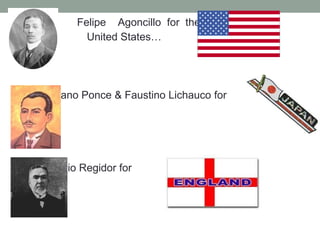
Felipe Agoncillo for the
United States…
Mariano Ponce & Faustino Lichauco for
Antonio Regidor for
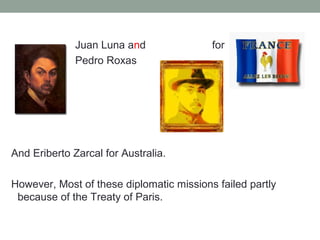
Juan Luna and for
Pedro Roxas
And Eriberto Zarcal for Australia.
However, Most of these diplomatic missions failed partly
because of the Treaty of Paris.
TREATY OF PARIS
The Treaty of Paris was Signed on December 10,
1898.
It provided that Spain would cede the Philippines to
the United States in return for 20,000,000 USD from
United States for the improvements made in the
colony. Which, the United States, agreed to give the
Spaniards the right to commodities to the Philippines
for 10 years on the same terms as those of the
United States.
Ratification of the Treaty
 The Treaty of Paris did not go into effect until after the
American Senate has ratified it.
The proponents of of ratification did not command a majority
in the Senate. They believe that the treaty was unfair to the
Filipinos.
 February 4, 1899 - The unfortunate rupture of Filipino-
American hostilities led many opponents of ratification to vote
affirmatively.
February 6, 1899 - The treaty was ratified by 2/3 majority.
American Propaganda
After the ratification, the American propaganda made it
appear that the Filipinos fired the first shots that led to the
Filipino-American Hostilities.
Consequently, the American senators voted for the belief that
the Filipinos caused the Rupture of Filipino-American
relations.
It directed mainly by the instruments of imperialists, won and
thereafter the Philippines became a territory of the United
States
Cushman Davis
George Gray
William Day
William Frye
Religious Schism
• Because of the discrimination even under the Catholic
Church, Mabini Urged the Filipinos to establish their own
church.
• The Iglesia Filipina Independencia or the Philippine
Independent Church was formed. Commonly called as the
Aglipayan Church.
• Through the support of Mabini, it was founded on Oct
23,1899.
• Its head is Gregorio Aglipay.
They want me do, but do not want me
how
• Everyone says to vote wisely,
• But How can you vote wisely?
• In a ½ crosswise, write your own criteria or characteristics
that politicians must satisfy to win your vote.
Short Quote
• Vote wisely! Weigh each candidate's qualifications, track
record in public service or as a private citizen, over-all
personal competencies and dedication to the common
good, and proposed programs if elected.
• -Anonymous Source.
Hidden Word
Hidden Word
•Mabuhay Ang Pilipinas
References
• History of the Filipino People by Teodoro Agoncillo
• Wikimedia Commons
• Filipino-know.Net

Malolos republic

  • 1.
    Short Review OfThe Discovery of the Katipunan
  • 5.
  • 6.
    COMPLETE NAME Identifyif the person is a member of KATIPUNAN OR REFORM MOVEMENT 1. 2. 3. 4. 5. 6. 7. 8. 9. 10.
  • 7.
  • 8.
  • 9.
  • 10.
  • 11.
  • 12.
  • 13.
  • 14.
  • 15.
  • 16.
  • 17.
    Blue Eagle Eye •Try to decipher the secret message as you go through each slides. • There are letters marked in red that you must write down for it will form the secret message
  • 18.
    INTRODUCTION AND DICTATORIAL GOVERNMENT Aguinaldowas proclaimed the president of the Philippine Republic in Malolos. Aguinaldo established the Dictatorial Government in May 1898 to show the capacity of Filipinos for self-government, and a month later, the Revolutionary Government. Diff. departments were created for the division of duties of the new government. December 1898 – Treaty of Paris, the United States decided to take over the Philippines
  • 19.
    THE DICTATORIAL GOVERNMENT Aguinaldodecided to establish a Filipino government in the wake of his military victories. He had a draft of a plan for the establishment of a revolutionary government, prepared by Mariano Ponce. May 24 1898 – Aguinaldo issued a decree formally establishing the Dictatorial Government which nullified the orders issued under the authority of the Biak-na-Bato Republic.
  • 20.
    TREATMENT OF ENEMY May29, 1898 – one of Aguinaldo’s 1st acts as a dictator, urging the people to stop the disgraceful treatment of Spanish prisoners. Aguinaldo issued another order on June 1, providing that all classes of crimes were to be tried by competent military tribunals.
  • 21.
    DECLARATION OF INDEPENDENCE JulianFelipe – composer from Cavite, who showed the draft of Composition entitled Marcha Filipina Magdalo which was later changed to Marcha Nacional Filipana. Jose Palma – The Lyrics was adapted from his Poem Filipinas. June 12, 1898 – proclamation of the independence of the Philippines at Cavite el Viejo (Kawit). Philippine National Flag – made in HongKong by Marcela Agoncillo, Lorenza Agoncillo, and Delfina Herboza. Act of Declaration of Independence – prepared by Ambrosio Riamzares Bautista, signed by 98 people, however was promulgated on August 1.
  • 22.
    APOLINARIO MABINI “The SublimeParalytic” Adviser of Aguinaldo, his two titles were “Dark Chamber of the President” (for those who envied him) and “Brains of the Revolution”.
  • 23.
    Who is ApolinarioMabini? • Apolinario Mabini was a Filipino political philosopher who served as the first Philippine Prime Minister. • In history books, he was commonly referred to as “The Brains of the Revolution” for valiantly trying to stop the American army from taking over the Philippines. • These actions included rallying the Filipinos and showed deep support to the media about the revolution. He was also the chief advisor of Emilio Aguinaldo.
  • 24.
    Basic Background… • Mabiniwas born on July 23, 1864 in Barangay Talaga in Tanauan, Batangas. He was the second of eight children of Dionisia Maranan, a vendor in the Tanauan market, and Inocencio Mabini, a Beggar. • In 1881 Mabini received a scholarship to go to the Colegio de San Juan de Letran in Manila. A professor there decided to pick on him because his shabby clothing clearly showed he was poor. Mabini amazed the professor by answering a series of very difficult questions with ease. • Mabini's mother had wanted him to take up the priesthood, but his desire to defend the poor made him decide to take up Law instead. • A year after receiving his Bachilles en Artes with highest honors and the title Professor of Latin from Letran, he moved on to the University of Santo Tomas, where he received his law degree in 1894.
  • 25.
    MALOLOS CONGRESS *Revolutionary Congressat Barasoain, Malolos September 4 - 50 delegates September 10 - 60 delegates Banda Pasig - played the National Anthem Felipe Buencamino - wrote Aguinaldo's speech Officers: President: Pedro A. Paterno Vice President: Benito Legarda 1st Secretary: Gregorio Araneta 2nd Secretary: Pablo Ocampo
  • 27.
    The most importantachievements of the Malolos Congress: 1. In September 29, 1898, ratified the declaration of Philippine independence held at Kawit, Cavite on June 12, 1898 2. Passage of a law that allowed the Philippines to borrow P 20 million from banks for government expenses 3. Establishment of the Universidad Literatura de Filipinas and other schools 4. Drafting of the Philippine Constitution 5. Declaring war against the United States on June 12, 1899
  • 28.
    The Malolos Constitution •Mabini envisioned the Congress to be an advisory body of the President. • Nevertheless, Mabini submitted his Constitutional Plane of the Philippine Republic, but Congress, for the second time, overruled him. • With the advice of Cayettano Arellano, Calderon drew up his plans for a constitution, deriving inspiration from the constitutions of Mexico, Belgium, Guatemala, Costa Rica, Brazil and France
  • 29.
    The Constitution - TheMalolos Constitution: Some of its characteristics: • anchored in democratic traditions that ultimately had their roots on American soil. • created a Filipino State whose government was "popular, representative and responsible" • three distinct branches: the executive, the legislative and the judicial. • specifically provided for safeguards against abuses and individual rights not only of the Filipinos, but also the aliens.
  • 30.
    The Philippine Republic Owingto the objections of Mabini to some provisions of the constitution, Aguinaldo did not immediately promulgate it. The Congress leaders compromised with Mabini by agreeing to insert amendments to satisfy the President's closest adviser. On January 21,1899,Aguinaldo finally promulgated the Constitution. Earlier on January 2. he formulated his Cabinet as follows: Apolinario Mabini - President of the Cabinet and Secretary of Foreign Affairs Teodoro Sandico - Secretary of the Interior Baldomero Aguinaldo - Secretary of War Mariano Trias - Secretary of finance Gracio Gonzaga - Secretary of Welfare, including Public Instruction, Public Works, Communications, Agriculture, Industry and Commerence
  • 31.
    Revolutionary Periodicals El Heraldode la Revolucion - The revolutionary Government founded its official organ, whose first number came out on September 29, 1898. La Independencia- edited and partly owned by General Antonio Luna. Its first number came out on September 3, 1898.
  • 32.
    Some Great Filipinowriters in Spanish and their Pennames: Cecilio Apostol(Catullo) Jose Palma Rafael Palma(Dapit Hapon) Fernando Ma. Guerrero(Fulvio Gil) Epifanio de Los Santos(G. Solon) Jose G. Abreu (Kaibigan) Mariano V. Del Rosario (Tito-Tato) Salvador V. Del Rosario (Juan Tagalo) Rosa Sevilla Florentina Arellano
  • 33.
    January 23,1899 -Philippine Republic's Inauguration at Malolos Aguinaldo took his oath of the officer after having been informed that he had been proclaimed President of the Republic.The Malolos Constitution was read article by article, and the army took its oath of loyalty before the president Aguinaldo issued a decree granting pardon to all Spanish prisoners of war who were not members of the Spanish regular army and at the same time, granting the Spaniards and other aliens the right to engage in business within the limits of the Republic.
  • 34.
    Education On October 24,a decree was issued outlining the curriculum of the Burgos Institute. Higher education was provided for when, in a decree of October 19, 1898, Aguinaldo created the Literary University of the Philippines. The first appointed president of the University was Dr. Joaquin Gonzalez. He was succeeded by Dr. Leon Ma. Guerrero, who delivered the commencement address on September 29, 1899. The University did not live long, for the conflict with the Americans led its faculty and students to disperse.
  • 35.
    Diplomatic Activities In orderto persuade the foreign Powers to recognize Philippine independence, Aguinaldo created diplomatic positions abroad. • Subsequently, the diplomatic agents were appointed:
  • 36.
    Felipe Agoncillo forthe United States… Mariano Ponce & Faustino Lichauco for Antonio Regidor for
  • 37.
    Juan Luna andfor Pedro Roxas And Eriberto Zarcal for Australia. However, Most of these diplomatic missions failed partly because of the Treaty of Paris.
  • 38.
    TREATY OF PARIS TheTreaty of Paris was Signed on December 10, 1898. It provided that Spain would cede the Philippines to the United States in return for 20,000,000 USD from United States for the improvements made in the colony. Which, the United States, agreed to give the Spaniards the right to commodities to the Philippines for 10 years on the same terms as those of the United States.
  • 40.
    Ratification of theTreaty  The Treaty of Paris did not go into effect until after the American Senate has ratified it. The proponents of of ratification did not command a majority in the Senate. They believe that the treaty was unfair to the Filipinos.  February 4, 1899 - The unfortunate rupture of Filipino- American hostilities led many opponents of ratification to vote affirmatively. February 6, 1899 - The treaty was ratified by 2/3 majority.
  • 41.
    American Propaganda After theratification, the American propaganda made it appear that the Filipinos fired the first shots that led to the Filipino-American Hostilities. Consequently, the American senators voted for the belief that the Filipinos caused the Rupture of Filipino-American relations. It directed mainly by the instruments of imperialists, won and thereafter the Philippines became a territory of the United States
  • 42.
  • 43.
    Religious Schism • Becauseof the discrimination even under the Catholic Church, Mabini Urged the Filipinos to establish their own church. • The Iglesia Filipina Independencia or the Philippine Independent Church was formed. Commonly called as the Aglipayan Church. • Through the support of Mabini, it was founded on Oct 23,1899. • Its head is Gregorio Aglipay.
  • 44.
    They want medo, but do not want me how • Everyone says to vote wisely, • But How can you vote wisely? • In a ½ crosswise, write your own criteria or characteristics that politicians must satisfy to win your vote.
  • 45.
    Short Quote • Votewisely! Weigh each candidate's qualifications, track record in public service or as a private citizen, over-all personal competencies and dedication to the common good, and proposed programs if elected. • -Anonymous Source.
  • 46.
  • 47.
  • 48.
    References • History ofthe Filipino People by Teodoro Agoncillo • Wikimedia Commons • Filipino-know.Net