THE CELL
THEORY
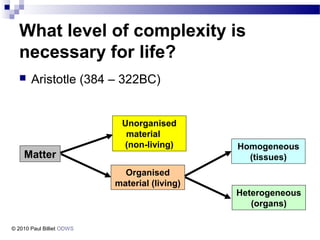
What level of complexity is
necessary for life?
 Aristotle (384 – 322BC)
Matter
Organised
material (living)
Unorganised
material
(non-living)
Heterogeneous
(organs)
Homogeneous
(tissues)
© 2010 Paul Billiet ODWS
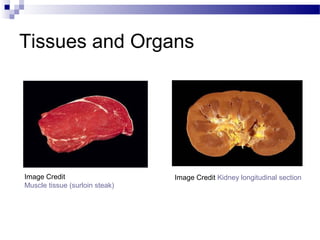
Tissues and Organs
Image Credit
Muscle tissue (surloin steak)
Image Credit Kidney longitudinal section
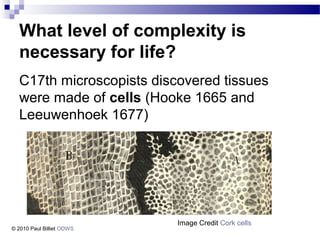
What level of complexity is
necessary for life?
C17th microscopists discovered tissues
were made of cells (Hooke 1665 and
Leeuwenhoek 1677)
Image Credit Cork cells
© 2010 Paul Billiet ODWS
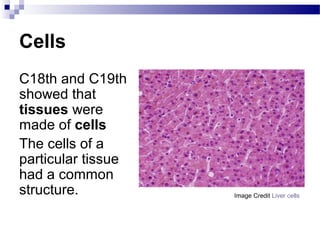
Cells
C18th and C19th
showed that
tissues were
made of cells
The cells of a
particular tissue
had a common
structure. Image Credit Liver cells
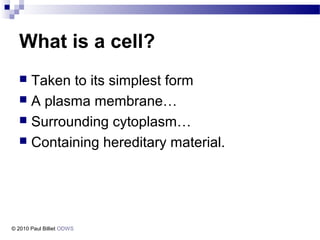
What is a cell?
 Taken to its simplest form
 A plasma membrane…
 Surrounding cytoplasm…
 Containing hereditary material.
© 2010 Paul Billiet ODWS
What level of complexity is
necessary for life?
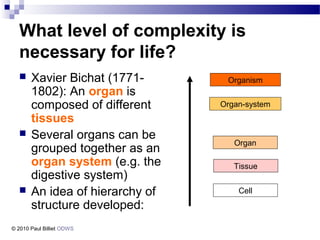
 Xavier Bichat (1771-
1802): An organ is
composed of different
tissues
 Several organs can be
grouped together as an
organ system (e.g. the
digestive system)
 An idea of hierarchy of
structure developed:
Organism
Organ-system
Organ
Tissue
Cell
© 2010 Paul Billiet ODWS
What level of complexity is
necessary for life?
 Purkinje (1835) Observed a fertilised hen's
egg (a single cell) could develop into an
embryo (many specialised cells in a
compact mass)
 C19th botanists showed that plant tissues
consist of many different types of cells.
© 2010 Paul Billiet ODWS
THE CELL THEORY
 Matthias Schleiden (1838) & Theodor
Schwann (1839)
“The cell is the basic unit of living
tissue”
 The cell is an autonomous unit (“a citizen”)
grouped together to form an organism
(“the society”).
© 2010 Paul Billiet ODWS
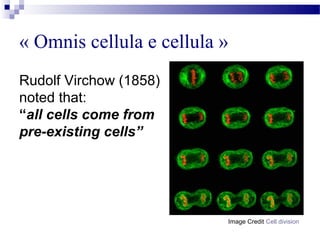
« Omnis cellula e cellula »
Rudolf Virchow (1858)
noted that:
“all cells come from
pre-existing cells”
Image Credit Cell division
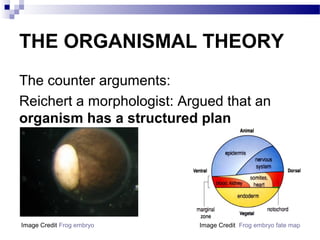
THE ORGANISMAL THEORY
The counter arguments:
Reichert a morphologist: Argued that an
organism has a structured plan
Image Credit Frog embryo Image Credit Frog embryo fate map
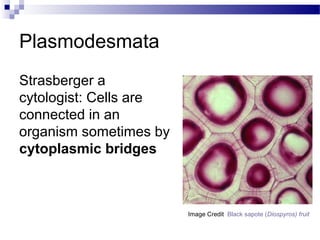
Plasmodesmata
Strasberger a
cytologist: Cells are
connected in an
organism sometimes by
cytoplasmic bridges
Image Credit Black sapote (Diospyros) fruit
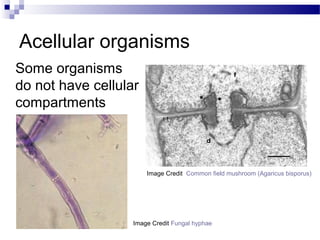
Acellular organisms
Some organisms
do not have cellular
compartments
Image Credit Common field mushroom (Agaricus bisporus)
Image Credit Fungal hyphae
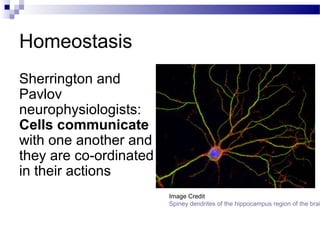
Homeostasis
Sherrington and
Pavlov
neurophysiologists:
Cells communicate
with one another and
they are co-ordinated
in their actions
Image Credit
Spiney dendrites of the hippocampus region of the brai
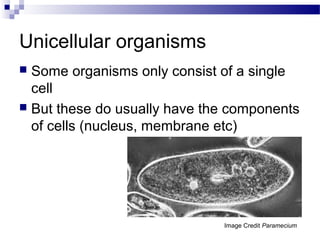
Unicellular organisms
 Some organisms only consist of a single
cell
 But these do usually have the components
of cells (nucleus, membrane etc)
Image Credit Paramecium
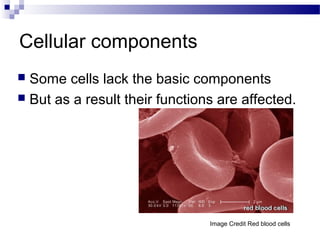
Cellular components
 Some cells lack the basic components
 But as a result their functions are affected.
Image Credit Red blood cells
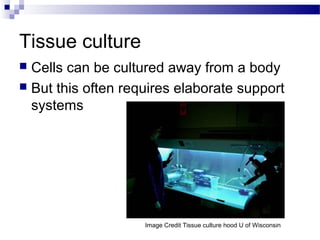
Tissue culture
 Cells can be cultured away from a body
 But this often requires elaborate support
systems
Image Credit Tissue culture hood U of Wisconsin
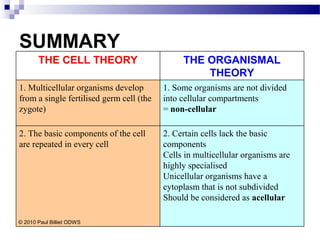
SUMMARY
2. Certain cells lack the basic
components
Cells in multicellular organisms are
highly specialised
Unicellular organisms have a
cytoplasm that is not subdivided
Should be considered as acellular
2. The basic components of the cell
are repeated in every cell
1. Some organisms are not divided
into cellular compartments
= non-cellular
1. Multicellular organisms develop
from a single fertilised germ cell (the
zygote)
THE ORGANISMAL
THEORY
THE CELL THEORY
© 2010 Paul Billiet ODWS
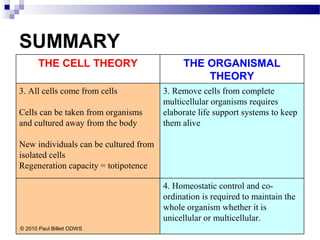
SUMMARY
4. Homeostatic control and co-
ordination is required to maintain the
whole organism whether it is
unicellular or multicellular.
3. Remove cells from complete
multicellular organisms requires
elaborate life support systems to keep
them alive
3. All cells come from cells
Cells can be taken from organisms
and cultured away from the body
New individuals can be cultured from
isolated cells
Regeneration capacity = totipotence
THE ORGANISMAL
THEORY
THE CELL THEORY
© 2010 Paul Billiet ODWS
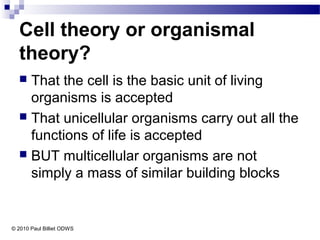
Cell theory or organismal
theory?
 That the cell is the basic unit of living
organisms is accepted
 That unicellular organisms carry out all the
functions of life is accepted
 BUT multicellular organisms are not
simply a mass of similar building blocks
© 2010 Paul Billiet ODWS
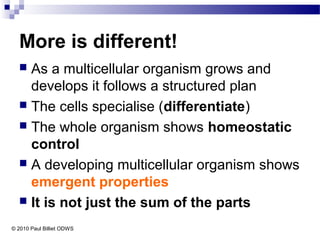
More is different!
 As a multicellular organism grows and
develops it follows a structured plan
 The cells specialise (differentiate)
 The whole organism shows homeostatic
control
 A developing multicellular organism shows
emergent properties
 It is not just the sum of the parts
© 2010 Paul Billiet ODWS

01 the cell_theory

  • 1.
  • 2.
    What level ofcomplexity is necessary for life?  Aristotle (384 – 322BC) Matter Organised material (living) Unorganised material (non-living) Heterogeneous (organs) Homogeneous (tissues) © 2010 Paul Billiet ODWS
  • 3.
    Tissues and Organs ImageCredit Muscle tissue (surloin steak) Image Credit Kidney longitudinal section
  • 4.
    What level ofcomplexity is necessary for life? C17th microscopists discovered tissues were made of cells (Hooke 1665 and Leeuwenhoek 1677) Image Credit Cork cells © 2010 Paul Billiet ODWS
  • 5.
    Cells C18th and C19th showedthat tissues were made of cells The cells of a particular tissue had a common structure. Image Credit Liver cells
  • 6.
    What is acell?  Taken to its simplest form  A plasma membrane…  Surrounding cytoplasm…  Containing hereditary material. © 2010 Paul Billiet ODWS
  • 7.
    What level ofcomplexity is necessary for life?  Xavier Bichat (1771- 1802): An organ is composed of different tissues  Several organs can be grouped together as an organ system (e.g. the digestive system)  An idea of hierarchy of structure developed: Organism Organ-system Organ Tissue Cell © 2010 Paul Billiet ODWS
  • 8.
    What level ofcomplexity is necessary for life?  Purkinje (1835) Observed a fertilised hen's egg (a single cell) could develop into an embryo (many specialised cells in a compact mass)  C19th botanists showed that plant tissues consist of many different types of cells. © 2010 Paul Billiet ODWS
  • 9.
    THE CELL THEORY Matthias Schleiden (1838) & Theodor Schwann (1839) “The cell is the basic unit of living tissue”  The cell is an autonomous unit (“a citizen”) grouped together to form an organism (“the society”). © 2010 Paul Billiet ODWS
  • 10.
    « Omnis cellula e cellula » Rudolf Virchow (1858) notedthat: “all cells come from pre-existing cells” Image Credit Cell division
  • 11.
    THE ORGANISMAL THEORY Thecounter arguments: Reichert a morphologist: Argued that an organism has a structured plan Image Credit Frog embryo Image Credit Frog embryo fate map
  • 12.
    Plasmodesmata Strasberger a cytologist: Cellsare connected in an organism sometimes by cytoplasmic bridges Image Credit Black sapote (Diospyros) fruit
  • 13.
    Acellular organisms Some organisms donot have cellular compartments Image Credit Common field mushroom (Agaricus bisporus) Image Credit Fungal hyphae
  • 14.
    Homeostasis Sherrington and Pavlov neurophysiologists: Cells communicate withone another and they are co-ordinated in their actions Image Credit Spiney dendrites of the hippocampus region of the brai
  • 15.
    Unicellular organisms  Someorganisms only consist of a single cell  But these do usually have the components of cells (nucleus, membrane etc) Image Credit Paramecium
  • 16.
    Cellular components  Somecells lack the basic components  But as a result their functions are affected. Image Credit Red blood cells
  • 17.
    Tissue culture  Cellscan be cultured away from a body  But this often requires elaborate support systems Image Credit Tissue culture hood U of Wisconsin
  • 18.
    SUMMARY 2. Certain cellslack the basic components Cells in multicellular organisms are highly specialised Unicellular organisms have a cytoplasm that is not subdivided Should be considered as acellular 2. The basic components of the cell are repeated in every cell 1. Some organisms are not divided into cellular compartments = non-cellular 1. Multicellular organisms develop from a single fertilised germ cell (the zygote) THE ORGANISMAL THEORY THE CELL THEORY © 2010 Paul Billiet ODWS
  • 19.
    SUMMARY 4. Homeostatic controland co- ordination is required to maintain the whole organism whether it is unicellular or multicellular. 3. Remove cells from complete multicellular organisms requires elaborate life support systems to keep them alive 3. All cells come from cells Cells can be taken from organisms and cultured away from the body New individuals can be cultured from isolated cells Regeneration capacity = totipotence THE ORGANISMAL THEORY THE CELL THEORY © 2010 Paul Billiet ODWS
  • 20.
    Cell theory ororganismal theory?  That the cell is the basic unit of living organisms is accepted  That unicellular organisms carry out all the functions of life is accepted  BUT multicellular organisms are not simply a mass of similar building blocks © 2010 Paul Billiet ODWS
  • 21.
    More is different! As a multicellular organism grows and develops it follows a structured plan  The cells specialise (differentiate)  The whole organism shows homeostatic control  A developing multicellular organism shows emergent properties  It is not just the sum of the parts © 2010 Paul Billiet ODWS