White Team Group. 2
Navarro, Andrew
Roa,Joseph A
 The First Philippine Republic was inaugurated
in Malolos, Bulacan
 Emilio Aguinaldo was proclaimed the
President of the Philippine Republic in
Malolos.
 Aguinaldo established the Dictatorial
Government in May 1898 to show the capacity
of Filipinos for self-government.
 Diff. departments were created for the division
of duties of the new government.
 Aguinaldo decided to establish a Filipino government
in the wake of his military victories.
 He had a draft of a plan for the establishment of a
revolutionary government, prepared by Mariano
Ponce.
 Consul Wildman – advised Aguinaldo to establish a
dictatorial government in which could lead to a
republican government similar to that of the united
States.
 Ambrosio Rianzares Bautista – Aguinaldo’s 1st
adviser, who also told him to form a dictatorial
government.
 May 24 1898 – Aguinaldo issued a decree formally
establishing the Dictatorial Government which
nullified the orders issued under the authority of the
Biak-na-Bato Republic.
 June 12, 1898 – proclamation of the independence of
the Philippines at Cavite el Viejo (Kawit).
 Philippine National Flag – made in HongKong by
Marcela Agoncillo, Lorenza Agoncillo, and Delfina
Herboza.
 June 5, 1898 – Aguinaldo issued a decree setting aside
June 12 as the day for proclamation of Philippine
Independence.
 Julian Felipe – composer from Cavite, who showed
the draft of Composition entitled Marcha Filipina
Magdalo which was later changed to Marcha
Nacional Filipana.
 Act of Declaration of Independence – prepared by Ambrosio
Riamzares Bautista, signed by 98 people, however was
promulgated on August 1.
 Came after 1 month of Dictatorial Government through
decree on June 23, 1898.
 4 Departments were created: 1) Dept. of Foreign Affairs,
Navy and Commerce, 2) Dept. of War and Public Works, 3)
Dept. of Police and Internal Order, Justice, Education and
Hygiene, and
4) Dept. of Finance, Agriculture and Manufacturing
Industry.
 July 15, 1898 – 1st Cabinet Appointments
*Baldomero Aguinaldo – war and public works
*Leandro Ibarra – interior *Mariano Trias – finance
 foreign affairs was first offered to Mariano Ponce but he
declined, so it was given to Mabini instead.
 September 28 – 6 departments: Foreign Affairs, War,
Interior, Welfare, Justice & Treasury.
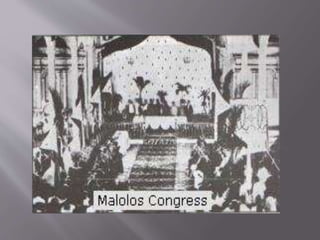
MALOLOS CONGRESS
*Revolutionary Congress at Barasoain, Malolos
September 4 - 50 delegates
September 10 - 60 delegates
Banda Pasig - played the National Anthem
Felipe Buencamino - wrote Aguinaldo's speech
Officers:
President: Pedro A. Paterno
Vice President: Benito Legarda
1st Secretary: Gregorio Araneta
2nd Secretary: Pablo Ocampo
 Mabini envisioned the Congress to be an advisory
body of the President.
 But his idea was contradicted by Congress when it
opposed to draft a constitution. Congress advanced the
opinion that a modern constitution
 was imperative in order to secure the recognition of the
Philippine independence by foreign powers. Mabini,
on the other hand argued that a delicate task as the
framing of the constitution should be done in a
peaceful and quiet mood
 Mabini added that Congress was convoked not to
frame a constitution, but to advise the President and to
give him popular support.
 although his arguments were unassailable he was
defeated by majority under the leadership of
Paterno.
 Nevertheless, Mabini submitted his Constitutional
Plane of the Philippine Republic, but Congress, for
the second time, overruled him.
 A committee to draft the constitution was created,
with Felipe G. Calderon as its mort prominent
member.
 the committee, under the influence of Calderon,
also set aside, but in a subtle manner, Paterno's
constitutional plan
 With the advice of Cayettano Arellano, Calderon
drew up his plans for a constitution, deriving
inspiration from the constitutions of Mexico,
Belgium, Guatemala, Costa Rica, Brazil and
France.
 A few other amendments were inserted in the draft
constitution before it was sent to Aguinaldo for
approval. On January 21, 1899, Aguinaldo
promulgated what is now known as the Malolos
Constitution.
 The protracted discussions that characterized the
Congress sessions on the subject of whether or not
Church and State should be united showed:
 Filipinos as a people, though up in arms against
Catholic Spain, were not anti-Catholic but merely anti-
clerical, and second,
 many of the delegates learned from the bitter lesson of
the Philippine history in voting against the union of
Church and State which, under Spain, was the
fundamental basis of Spanish colonial system.
 That decision became the cornerstone of Philippine
democracy and showed not only the nationalism and
democratic orientation of those who voted for the
separation of Church and State, but also their keen
sense of history.
- The Malolos Constitution:
Some of its characteristics:
 anchored in democratic traditions that ultimately had their
roots on American soil.
 created a Filipino State whose government was "popular,
representative and responsible"
 three distinct branches: the executive, the legislative and the
judicial.
 specifically provided for safeguards against abuses and
individual rights not only of the Filipinos, but also the
aliens.
 The legislative powers were exercised by the Assembly
of Representatives composed of delegates elected
according to law.
 To make the function of Congress constitutions
 sit as a law-making body when Congress was not in
session
 The Assembly elected the President of the Republic.
 The Cabinet, composed of the Secretaries of
different departments of the government.
 administration of justice was vested in the Supreme
Court
 inferior courts to be established according to law.
 Chief Justice of the Supreme Court was elected by the
Assembly with the concurrence of the President and
theCabinet.
The most important achievements of the Malolos
Congress:
1. In September 29, 1898, ratified the declaration of
Philippine independence held at Kawit, Cavite on
June 12, 1898
2. Passage of a law that allowed the Philippines to
borrow P 20 million from banks for government
expenses
3. Establishment of the Universidad Literatura de
Filipinas and other schools
4. Drafting of the Philippine Constitution
5. Declaring war against the United States on June
12, 1899

The revolutionary Government founded its official
organ El Heraldo de la Revolucion, whose first
number came out on September 29, 1898. Its name
was subsequently changed to Heraldo Filipino, then
to Indice Official, and finally to Graceta de Filipinas,
whose last number came out on October
14,1899.These newspaper published the official texts
of the decrees of the governmentand, of course, some
news items and tagalog poems, all nationalistic in
content. Most famous of these periodicals was La
Independencia,edited and partly owned by General
Antonio Luna.Its first number came out on
September 3, 1898.
Other nationalistic newspaper were La Republica
Filipina, founded in Mandaluyong by Pedro A.
Paterno, whose first number came out on
September 15,1898, La Libertad, which came out in
June 20, 1898 under the editorship of Clemente
Jose Zulueta; Ang Kaibigan nang Bayan (The
People’s Friend), Malolos, 1898; Columnas
Volantes(Fly Sheets), Lipa,Batangas,1899;La
Federacion, Kabatuan, Iloilo,1899; La Revolucion,
Jaro, Iloilo,1898; Patria, Jaro, Iloilo 1899;La
Oportunidad, Tagbilaran, Bohol,1899 and few
others.
Owing to the objections of Mabini to some provisions of
the constitution, Aguinaldo did not immediately
promulgate it. The Congress leaders compromised with
Mabini by agreeing to insert amendments to satisfy the
President's closest adviser. On January 21,1899,Aguinaldo
finally promulgated the Constitution. Earlier on January
2. he formulated his Cabinet as follows:
Apolinario Mabini - President of the Cabinet and
Secretary of Foreign Affairs
Teodoro Sandico - Secretary of the Interior
Baldomero Aguinaldo - Secretary of War
Mariano Trias - Secretary of finance
Gracio Gonzaga - Secretary of Welfare, including Public
Instruction, Public Works, Communications, Agriculture,
Industry and Commerence
January 23,1899 - Philippine Republic's Inauguration
at Malolos
Aguinaldo took his oath of the officer after having
been informed that he had been proclaimed
President of the Republic.The Malolos Constitution
was read article by article, and the army took its
oath of loyalty before the president
Aguinaldo issued a decree granting pardon to all
Spanish prisoners of war who were not members
of the Spanish regular army and at the same time,
granting the Spaniards and other aliens the right to
engage in business within the limits of the
Republic.
On October 24, a decree was issued outlining the
curriculum of the Burgos Institute. Higher education
was provided for when, in a decree of October 19, 1898,
Aguinaldo created the Literary University of the
Philippines.
The first appointed president of the University was
Dr. Joaquin Gonzalez. He was succeeded by Dr. Leon
Ma. Guerrero, who delivered the commencement
address on September 29, 1899. The University did not
live long, for the conflict with the Americans led its
faculty and students to disperse.
In order to persuade the foreign Powers to
recognize Philippine independence, Aguinaldo
created diplomatic positions abroad.
 Subsequently, the diplomatic agents were
appointed:
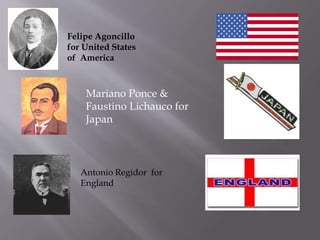
Felipe Agoncillo
for United States
of America
Mariano Ponce &
Faustino Lichauco for
Japan
Antonio Regidor for
England
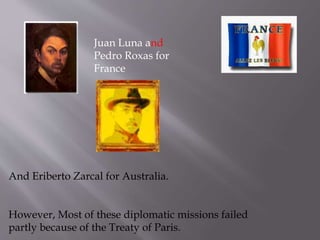
Juan Luna and
Pedro Roxas for
France
And Eriberto Zarcal for Australia.
However, Most of these diplomatic missions failed
partly because of the Treaty of Paris.
 References
 History of the Filipino People by Teodoro Agoncillo
 www.philippine-history.org/malolos-
congress.htm

National institute (1997)

  • 1.
    White Team Group.2 Navarro, Andrew Roa,Joseph A
  • 2.
     The FirstPhilippine Republic was inaugurated in Malolos, Bulacan  Emilio Aguinaldo was proclaimed the President of the Philippine Republic in Malolos.  Aguinaldo established the Dictatorial Government in May 1898 to show the capacity of Filipinos for self-government.  Diff. departments were created for the division of duties of the new government.
  • 3.
     Aguinaldo decidedto establish a Filipino government in the wake of his military victories.  He had a draft of a plan for the establishment of a revolutionary government, prepared by Mariano Ponce.  Consul Wildman – advised Aguinaldo to establish a dictatorial government in which could lead to a republican government similar to that of the united States.  Ambrosio Rianzares Bautista – Aguinaldo’s 1st adviser, who also told him to form a dictatorial government.  May 24 1898 – Aguinaldo issued a decree formally establishing the Dictatorial Government which nullified the orders issued under the authority of the Biak-na-Bato Republic.
  • 4.
     June 12,1898 – proclamation of the independence of the Philippines at Cavite el Viejo (Kawit).  Philippine National Flag – made in HongKong by Marcela Agoncillo, Lorenza Agoncillo, and Delfina Herboza.  June 5, 1898 – Aguinaldo issued a decree setting aside June 12 as the day for proclamation of Philippine Independence.  Julian Felipe – composer from Cavite, who showed the draft of Composition entitled Marcha Filipina Magdalo which was later changed to Marcha Nacional Filipana.  Act of Declaration of Independence – prepared by Ambrosio Riamzares Bautista, signed by 98 people, however was promulgated on August 1.
  • 5.
     Came after1 month of Dictatorial Government through decree on June 23, 1898.  4 Departments were created: 1) Dept. of Foreign Affairs, Navy and Commerce, 2) Dept. of War and Public Works, 3) Dept. of Police and Internal Order, Justice, Education and Hygiene, and 4) Dept. of Finance, Agriculture and Manufacturing Industry.  July 15, 1898 – 1st Cabinet Appointments *Baldomero Aguinaldo – war and public works *Leandro Ibarra – interior *Mariano Trias – finance  foreign affairs was first offered to Mariano Ponce but he declined, so it was given to Mabini instead.  September 28 – 6 departments: Foreign Affairs, War, Interior, Welfare, Justice & Treasury.
  • 6.
    MALOLOS CONGRESS *Revolutionary Congressat Barasoain, Malolos September 4 - 50 delegates September 10 - 60 delegates Banda Pasig - played the National Anthem Felipe Buencamino - wrote Aguinaldo's speech Officers: President: Pedro A. Paterno Vice President: Benito Legarda 1st Secretary: Gregorio Araneta 2nd Secretary: Pablo Ocampo
  • 8.
     Mabini envisionedthe Congress to be an advisory body of the President.  But his idea was contradicted by Congress when it opposed to draft a constitution. Congress advanced the opinion that a modern constitution  was imperative in order to secure the recognition of the Philippine independence by foreign powers. Mabini, on the other hand argued that a delicate task as the framing of the constitution should be done in a peaceful and quiet mood  Mabini added that Congress was convoked not to frame a constitution, but to advise the President and to give him popular support.
  • 9.
     although hisarguments were unassailable he was defeated by majority under the leadership of Paterno.  Nevertheless, Mabini submitted his Constitutional Plane of the Philippine Republic, but Congress, for the second time, overruled him.  A committee to draft the constitution was created, with Felipe G. Calderon as its mort prominent member.  the committee, under the influence of Calderon, also set aside, but in a subtle manner, Paterno's constitutional plan  With the advice of Cayettano Arellano, Calderon drew up his plans for a constitution, deriving inspiration from the constitutions of Mexico, Belgium, Guatemala, Costa Rica, Brazil and France.
  • 10.
     A fewother amendments were inserted in the draft constitution before it was sent to Aguinaldo for approval. On January 21, 1899, Aguinaldo promulgated what is now known as the Malolos Constitution.  The protracted discussions that characterized the Congress sessions on the subject of whether or not Church and State should be united showed:  Filipinos as a people, though up in arms against Catholic Spain, were not anti-Catholic but merely anti- clerical, and second,  many of the delegates learned from the bitter lesson of the Philippine history in voting against the union of Church and State which, under Spain, was the fundamental basis of Spanish colonial system.  That decision became the cornerstone of Philippine democracy and showed not only the nationalism and democratic orientation of those who voted for the separation of Church and State, but also their keen sense of history.
  • 11.
    - The MalolosConstitution: Some of its characteristics:  anchored in democratic traditions that ultimately had their roots on American soil.  created a Filipino State whose government was "popular, representative and responsible"  three distinct branches: the executive, the legislative and the judicial.  specifically provided for safeguards against abuses and individual rights not only of the Filipinos, but also the aliens.
  • 12.
     The legislativepowers were exercised by the Assembly of Representatives composed of delegates elected according to law.  To make the function of Congress constitutions  sit as a law-making body when Congress was not in session  The Assembly elected the President of the Republic.  The Cabinet, composed of the Secretaries of different departments of the government.  administration of justice was vested in the Supreme Court  inferior courts to be established according to law.  Chief Justice of the Supreme Court was elected by the Assembly with the concurrence of the President and theCabinet.
  • 13.
    The most importantachievements of the Malolos Congress: 1. In September 29, 1898, ratified the declaration of Philippine independence held at Kawit, Cavite on June 12, 1898 2. Passage of a law that allowed the Philippines to borrow P 20 million from banks for government expenses 3. Establishment of the Universidad Literatura de Filipinas and other schools 4. Drafting of the Philippine Constitution 5. Declaring war against the United States on June 12, 1899
  • 14.
     The revolutionary Governmentfounded its official organ El Heraldo de la Revolucion, whose first number came out on September 29, 1898. Its name was subsequently changed to Heraldo Filipino, then to Indice Official, and finally to Graceta de Filipinas, whose last number came out on October 14,1899.These newspaper published the official texts of the decrees of the governmentand, of course, some news items and tagalog poems, all nationalistic in content. Most famous of these periodicals was La Independencia,edited and partly owned by General Antonio Luna.Its first number came out on September 3, 1898.
  • 15.
    Other nationalistic newspaperwere La Republica Filipina, founded in Mandaluyong by Pedro A. Paterno, whose first number came out on September 15,1898, La Libertad, which came out in June 20, 1898 under the editorship of Clemente Jose Zulueta; Ang Kaibigan nang Bayan (The People’s Friend), Malolos, 1898; Columnas Volantes(Fly Sheets), Lipa,Batangas,1899;La Federacion, Kabatuan, Iloilo,1899; La Revolucion, Jaro, Iloilo,1898; Patria, Jaro, Iloilo 1899;La Oportunidad, Tagbilaran, Bohol,1899 and few others.
  • 16.
    Owing to theobjections of Mabini to some provisions of the constitution, Aguinaldo did not immediately promulgate it. The Congress leaders compromised with Mabini by agreeing to insert amendments to satisfy the President's closest adviser. On January 21,1899,Aguinaldo finally promulgated the Constitution. Earlier on January 2. he formulated his Cabinet as follows: Apolinario Mabini - President of the Cabinet and Secretary of Foreign Affairs Teodoro Sandico - Secretary of the Interior Baldomero Aguinaldo - Secretary of War Mariano Trias - Secretary of finance Gracio Gonzaga - Secretary of Welfare, including Public Instruction, Public Works, Communications, Agriculture, Industry and Commerence
  • 17.
    January 23,1899 -Philippine Republic's Inauguration at Malolos Aguinaldo took his oath of the officer after having been informed that he had been proclaimed President of the Republic.The Malolos Constitution was read article by article, and the army took its oath of loyalty before the president Aguinaldo issued a decree granting pardon to all Spanish prisoners of war who were not members of the Spanish regular army and at the same time, granting the Spaniards and other aliens the right to engage in business within the limits of the Republic.
  • 18.
    On October 24,a decree was issued outlining the curriculum of the Burgos Institute. Higher education was provided for when, in a decree of October 19, 1898, Aguinaldo created the Literary University of the Philippines. The first appointed president of the University was Dr. Joaquin Gonzalez. He was succeeded by Dr. Leon Ma. Guerrero, who delivered the commencement address on September 29, 1899. The University did not live long, for the conflict with the Americans led its faculty and students to disperse.
  • 19.
    In order topersuade the foreign Powers to recognize Philippine independence, Aguinaldo created diplomatic positions abroad.  Subsequently, the diplomatic agents were appointed:
  • 20.
    Felipe Agoncillo for UnitedStates of America Mariano Ponce & Faustino Lichauco for Japan Antonio Regidor for England
  • 21.
    Juan Luna and PedroRoxas for France And Eriberto Zarcal for Australia. However, Most of these diplomatic missions failed partly because of the Treaty of Paris.
  • 22.
     References  Historyof the Filipino People by Teodoro Agoncillo  www.philippine-history.org/malolos- congress.htm