
Long before the Spaniards came to the
Philippines, Filipinos had a civilization of
their own. This civilization partly came
from the Malay settlers and partly from
their response to the new environment.
Many of these customs and traditions,
government and way of life, have come
down to the present day, despite the
changes brought about by westernization
and modernization. This is why it is
possible to know about our distant past by
simply observing some customs and
practices that have resisted change and
modernization.

Philippine pre-colonial society is both different and the
same as in the present. Some aspects of the pre-colonial
period have survived into our time. The following is a
description of the way of life of pre-colonial Filipinos.
Society

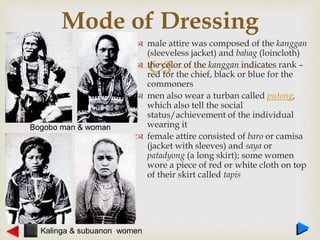
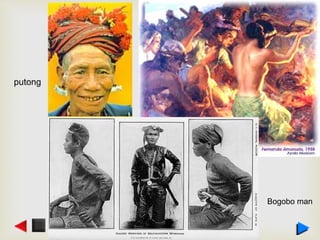
 male attire was composed of the kanggan
(sleeveless jacket) and bahag (loincloth)
 the color of the kanggan indicates rank –
red for the chief, black or blue for the
commoners
 men also wear a turban called putong,
which also tell the social
status/achievement of the individual
wearing it
 female attire consisted of baro or camisa
(jacket with sleeves) and saya or
patadyong (a long skirt); some women
wore a piece of red or white cloth on top
of their skirt called tapis
Mode of Dressing
Bogobo man & woman
Kalinga & subuanon women
Bogobo man
putong

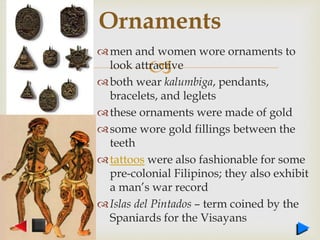
men and women wore ornaments to
look attractive
both wear kalumbiga, pendants,
bracelets, and leglets
these ornaments were made of gold
some wore gold fillings between the
teeth
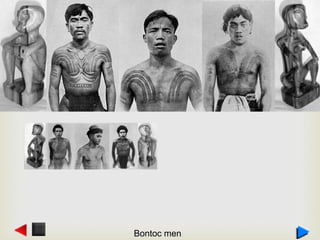
tattoos were also fashionable for some
pre-colonial Filipinos; they also exhibit
a man’s war record
Islas del Pintados – term coined by the
Spaniards for the Visayans
Ornaments

Bontoc men
Houses
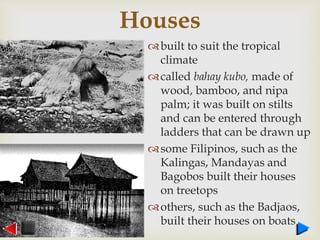
built to suit the tropical
climate
called bahay kubo, made of
wood, bamboo, and nipa
palm; it was built on stilts
and can be entered through
ladders that can be drawn up
some Filipinos, such as the
Kalingas, Mandayas and
Bagobos built their houses
on treetops
others, such as the Badjaos,
built their houses on boats
Social Classes
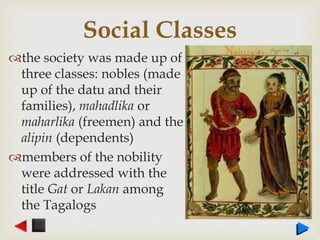
the society was made up of
three classes: nobles (made
up of the datu and their
families), mahadlika or
maharlika (freemen) and the
alipin (dependents)
members of the nobility
were addressed with the
title Gat or Lakan among
the Tagalogs
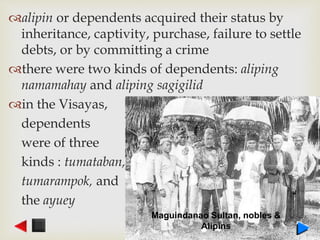
alipin or dependents acquired their status by
inheritance, captivity, purchase, failure to settle
debts, or by committing a crime
there were two kinds of dependents: aliping
namamahay and aliping sagigilid
in the Visayas,
dependents
were of three
kinds : tumataban,
tumarampok, and
the ayuey
Maguindanao Sultan, nobles &
Alipins

 women in pre-colonial Philippine society had the right
to inherit property, engage in trade and industry, and
succeed to the chieftainship of the barangay in the
absence of a male heir
 had the exclusive right to name their children
 men walked behind them as a sign of respect
Status of Women

 men were in general, monogamous; while their wives
are called asawa, while concubines are called “friends”
 in order to win the hand of his lady, the man has to
show his patience and dedication to both the lady and
her parents
 courtship usually begins with paninilbihan
 if the man wins the trust of the parents, he does not
immediately marry the woman, but he has to satisfy
several conditions:
- give a dowry or bigay-kaya
- pay the panghihimuyat
- pay the wet nurse bigay-suso
- pay the parents himaraw
- bribe for the relatives called sambon (among the
Zambals)
Marriage customs

he brings his parents to meet with the bride-to-
be’s parents to haggle and make the final
arrangements; this is called pamamalae or
pamamanhikan or pamumulungan
the wedding ceremonies vary depending on the
status of the couple; but normally, those from
the upper class, a go-between was employed
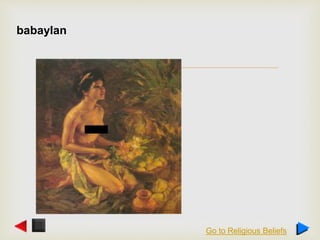
weddings are officiated by the priestess or
babaylan
uncooked rice is thrown on the couple after the
wedding ceremony

Go to Religious Beliefs
babaylan

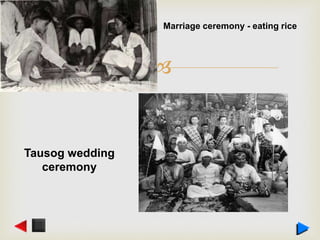
Marriage ceremony - eating rice
Tausog wedding
ceremony

Muslim Filipinos have similar marriage customs; the
first stage was called pananalanguni or bethrothal; it
was followed by the consultation with the girl’s
parents, who relays their decision to the village chief,
who in turn informed the suitor’s parents of the
decision
dowry was also settled by the chief (pedsungud).
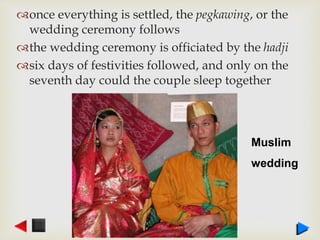
once everything is settled, the pegkawing, or the
wedding ceremony follows
the wedding ceremony is officiated by the hadji
six days of festivities followed, and only on the
seventh day could the couple sleep together
Muslim
wedding

mixed marriages were allowed in pre-colonial
society
the status of children were dependent upon the
status of the parents
often, the status of children in mixed marriages
is divided evenly between the parents
single children of mixed marriage were half-free
and half-dependent
legitimate children inherited their parents’
property even without any written will and was
divided equally among the children
Mixed Marriages, Inheritance and Succession
Politics

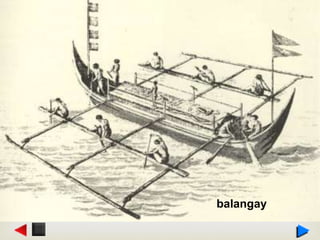
 unit of government was the barangay, which consisted
of from 30 to 100 families. The term came from the
Malay word balangay, meaning boat
 barangays were headed by chieftains called datu
 the subjects served their chieftain during wars, voyages,
planting and harvest, and when his house needs to be
built or repaired; they also paid tributes called buwis
Government
balangay
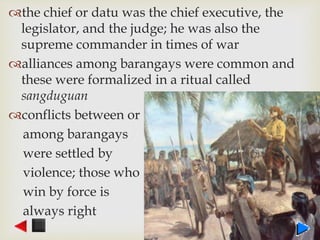
the chief or datu was the chief executive, the
legislator, and the judge; he was also the
supreme commander in times of war
alliances among barangays were common and
these were formalized in a ritual called
sangduguan
conflicts between or
among barangays
were settled by
violence; those who
win by force is
always right

were either customary (handed down from
generation to generation orally) or written
(promulgated from time to time as necessity
arose)
dealt with various subjects such as inheritance,
property rights, divorce, usury, family relations,
divorce, adoption, loans, etc.
those found guilty of crimes were punished
either by fine or by death; some punishments can
be considered as torture by modern standards
however, it must be noted that ancients did not
believe in endangering society by letting loose a
gang of thieves of recidivists who are incapable
of reform
Laws

 before laws are made, the chief consults with a council
of elders who approved of his plan
 they are not immediately enforced until the new
legislation is announced to the village by the umalohokan,
who also explains the law to everyone
Legislation

disputes between individuals were settled by a
court made up of the village chief and the
council of elders; between barangays, a board
made up of elders from neutral barangays acted
as arbiter
the accused and the accuser faced each other in
front of the “court” with their respective
witnesses
both took an oath to tell the truth; most of the
time, the one who presents the most witnesses
wins the case
if the losing party contests the decision, he is
bound to lose in the end because the chief
always take the side of the winner
Judicial Process

 to determine the innocence of an accused, he is made to go
through a number of ordeals which he must pass
 examples include dipping one’s hand in boiling water,
holding a lighted candle that must not be extinguished,
plunging into a river and staying underwater for as long as
possible, chewing uncooked rice and spitting, etc.
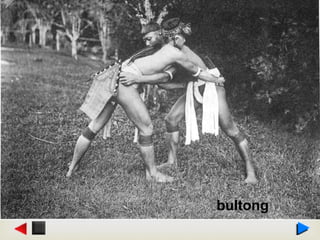
 among the Ifugaos, ordeal by combat was common, i.e.
bultong (wrestling), alaw (duel)
Trial by Ordeal
bultong
Religion

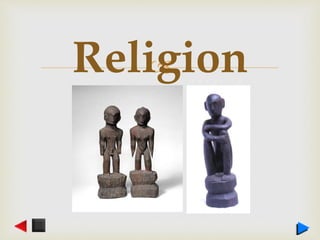
pre-colonial Filipinos believed in the
immortality of the soul and in life after death
they also believed in the existence of a number
of gods whom they worship and made offerings
to according to rank
i.e. Bathalang Maykapal (Creator), Idinayale (god
of agriculture), Sidapa (god of death), Balangaw
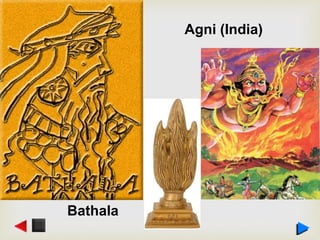
(rainbow god), Mandarangan (war god), Agni
(fire god) Lalahon (goddess of harvest),
Siginarugan (god of hell), Diyan Masalanta
(goddess of love), etc.
Religious Beliefs
Agni (India)
Bathala

 adored idols called anitos or diwatas to whom they made
offerings
 some anitos were considered bad; however, they made
offerings to them too in order to appease them or placate
their anger
 priestesses such as the babaylan/ baylana or katalona acted
as mediums to communicate with these spirits

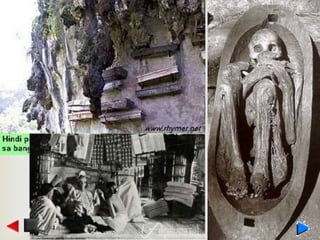
 the dead was placed in a wooden coffin and buried
under the house complete with cloth, gold and other
valuable things
 upon the death of the person, fires were made under the
house and armed men acted as sentinels to guard the
corpse from sorcerers
 professional mourners were hired to accentuate the
depth of mourning
Burial

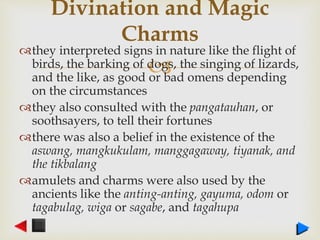
they interpreted signs in nature like the flight of
birds, the barking of dogs, the singing of lizards,
and the like, as good or bad omens depending
on the circumstances
they also consulted with the pangatauhan, or
soothsayers, to tell their fortunes
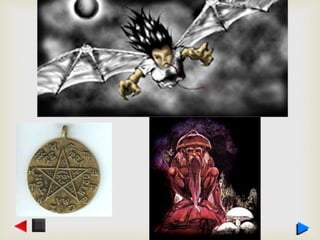
there was also a belief in the existence of the
aswang, mangkukulam, manggagaway, tiyanak, and
the tikbalang
amulets and charms were also used by the
ancients like the anting-anting, gayuma, odom or
tagabulag, wiga or sagabe, and tagahupa
Divination and Magic
Charms
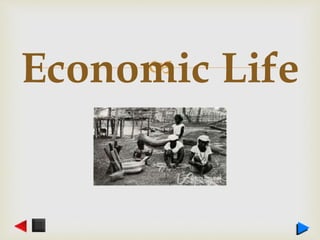
Economic Life

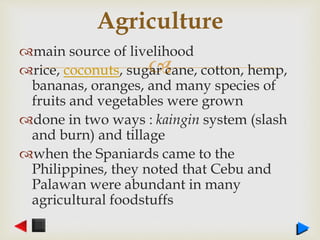
main source of livelihood
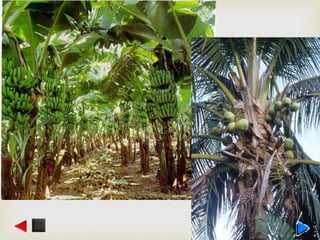
rice, coconuts, sugar cane, cotton, hemp,
bananas, oranges, and many species of
fruits and vegetables were grown
done in two ways : kaingin system (slash
and burn) and tillage
when the Spaniards came to the
Philippines, they noted that Cebu and
Palawan were abundant in many
agricultural foodstuffs
Agriculture

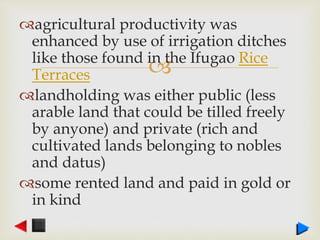
agricultural productivity was
enhanced by use of irrigation ditches
like those found in the Ifugao Rice
Terraces
landholding was either public (less
arable land that could be tilled freely
by anyone) and private (rich and
cultivated lands belonging to nobles
and datus)
some rented land and paid in gold or
in kind

the daily fare consisted of rice and boiled
fish, or sometimes pork or venison,
carabao or wild buffalo meat
fermented the sap of palm trees and
drank it as liquor called tuba
Livestock
• Pre-colonial Filipinos raised chickens,
pigs, goats, carabaos, and small native
ponies

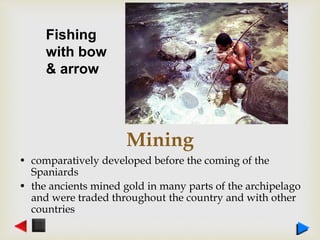
was a thriving industry for those who live
in the coast or near rivers and lakes
various tools for fishing such as nets, bow
and arrow, spear, wicker basket, hooks
and lines, corrals and fish poisons were
used
pearls fisheries also abound in Sulu
Fishing
Mining
• comparatively developed before the coming of the
Spaniards
• the ancients mined gold in many parts of the archipelago
and were traded throughout the country and with other
countries
Fishing
with bow
& arrow
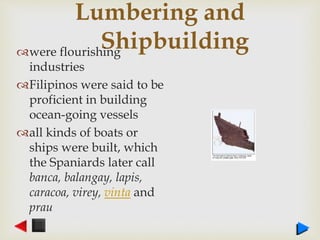
Lumbering and
Shipbuildingwere flourishing
industries
Filipinos were said to be
proficient in building
ocean-going vessels
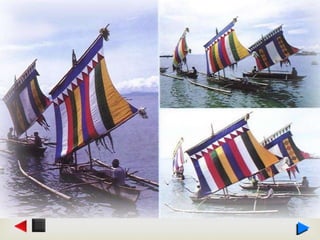
all kinds of boats or
ships were built, which
the Spaniards later call
banca, balangay, lapis,
caracoa, virey, vinta and
prau
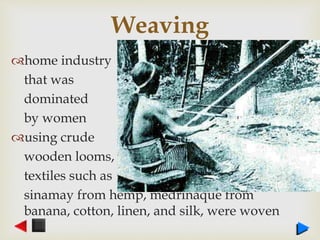
Weaving
home industry
that was
dominated
by women
using crude
wooden looms,
textiles such as
sinamay from hemp, medrinaque from
banana, cotton, linen, and silk, were woven

was conducted between or among barangays, or
even among the islands
there was trade too with other countries such as
China, Siam, Japan, Cambodia, Borneo,
Sumatra, Java, and other islands of old Malaysia
did not use any currency but conducted trade
through barter
sometimes, goods were priced in terms of gold
or metal gongs
Chinese traders noted that Filipinos were very
honest in their commercial transactions
Trade

Philippine pre-colonial culture was basically Malayan in
structure and form. They had written language which
was used not just for communication but also for literary
expression. They also had music and dances for almost
all occasions and a wide variety of musical instruments
that shows their ingenuity.
Culture

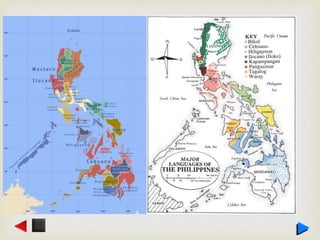
there are more than one hundred
languages in the Philippines, eight of
which are considered major
languages. They are: Tagalog, Iloko,
Pangasinan, Pampangan,
Sugbuhanon, Hiligaynon, Samarnon
or Samar-Leyte, and Magindanao
Languages


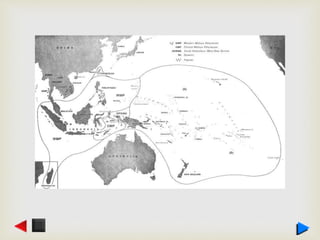
these languages are descended from
Austronesian or Malayo-Polynesian
language
the differences might be accounted
for the need to forming new words
and phrases to fit the new
environment
many of the words or terms in
Filipino languages were derived from
Malayan

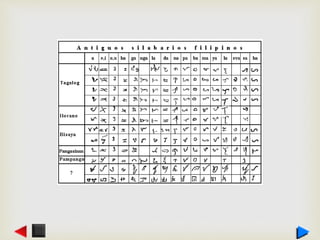
before the arrival of the Spaniards,
Filipinos used a syllabary which was
probably of Sanskrit or Arabic provenance
the syllabary consisted of seventeen
symbols, of which three were vowels and
fourteen consonants
no one is certain about the direction of
writing
Fr. Pedro Chirino’s theory is that the
ancients wrote from top to bottom and
from left to right
System of Writing

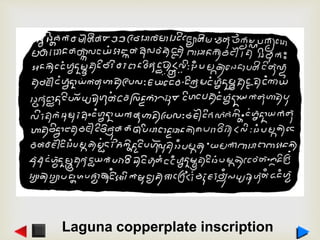
pre-colonial Filipinos wrote on bark of
trees, on leaves and bamboo tubes, using
their knives and daggers, pointed sticks or
iron as pens and the colored saps of trees
as ink
only a few of this writings survive into
the present because early Spanish
missionaries destroyed many manuscripts
on the ground that they are the work of
the Devil himself
some pieces of literature, however, have
been handed down to us orally
Laguna copperplate inscription

pre-colonial literature may be classified into :
floating or oral and written literature
Tagalogs have the bugtong (riddle), suliranin and
indulanin (street songs), sabi (maxim), sawikain
(saying), talindaw (boat songs), diyuna (song of
revelry), kumintang (war song which evolved
into a love song), dalit and umbay (dirge),
tagumpay, balikungkong, dupayinin and hiliraw
(war songs), uyayi and hele (lullabies), ihiman
(bridal song), tagulaylay (mournful song),
tigpasin (rowing song), tingad (household song),
and kutang-kutang (couplets usually chanted by
the blind)
Literature

Maranaw literature, inspired by Islam,
consisted of tutul (folk tale), tubad-tubad
(short love poems), pananaro-on (sayings
and proverbs), sowa-sowa-i (drama), antoka
(riddle or puzzle), and darangan (epic
poetry)
Ilocano literature, for its part, has many
kinds of songs sung on different
occasions; this include dal-ot (song during
baptismal party, wedding, or a feast),
badeng (love song sung in a serenade), and
dung-aw (dirge)
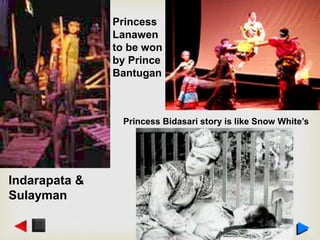
Princess Bidasari story is like Snow White’s
Princess
Lanawen
to be won
by Prince
Bantugan
Indarapata &
Sulayman

 wikipedia.org
 tribo.org
 apat-na-alon-tribe.com
 aenet.org
 elaput.org
 filipiniana.net
 veimages.gsfc.nasa.gov
 phivolcs.dost.gov.ph
 kheper.net
 msuiit.edu.ph
 seasite.niu.edu
 philippines.hvu.nl
 kabayancentral.com
 filipinoheritage.com
 malignosrealm.netfirms.com
 sinemamalaysia.com.my
 sacred-texts.com/hin/iml/iml07.htm
 reflectionsofasia.com/anting_anting.htm
 gutenberg.org/files/12849/12849-h/12849-h.htm
 isanghamahal.blogspot.com/2006_03_01_archive.html
 geocities.com/sanduguan/maharlika/maharlika.htm
 skyinet.net/~taomusic/gracenono/taofoundation.html
Sources

pre-colonial period

  • 2.
     Long before theSpaniards came to the Philippines, Filipinos had a civilization of their own. This civilization partly came from the Malay settlers and partly from their response to the new environment. Many of these customs and traditions, government and way of life, have come down to the present day, despite the changes brought about by westernization and modernization. This is why it is possible to know about our distant past by simply observing some customs and practices that have resisted change and modernization.
  • 3.
     Philippine pre-colonial societyis both different and the same as in the present. Some aspects of the pre-colonial period have survived into our time. The following is a description of the way of life of pre-colonial Filipinos. Society
  • 4.
      male attirewas composed of the kanggan (sleeveless jacket) and bahag (loincloth)  the color of the kanggan indicates rank – red for the chief, black or blue for the commoners  men also wear a turban called putong, which also tell the social status/achievement of the individual wearing it  female attire consisted of baro or camisa (jacket with sleeves) and saya or patadyong (a long skirt); some women wore a piece of red or white cloth on top of their skirt called tapis Mode of Dressing Bogobo man & woman Kalinga & subuanon women
  • 5.
  • 6.
     men and womenwore ornaments to look attractive both wear kalumbiga, pendants, bracelets, and leglets these ornaments were made of gold some wore gold fillings between the teeth tattoos were also fashionable for some pre-colonial Filipinos; they also exhibit a man’s war record Islas del Pintados – term coined by the Spaniards for the Visayans Ornaments
  • 7.
  • 8.
    Houses built to suitthe tropical climate called bahay kubo, made of wood, bamboo, and nipa palm; it was built on stilts and can be entered through ladders that can be drawn up some Filipinos, such as the Kalingas, Mandayas and Bagobos built their houses on treetops others, such as the Badjaos, built their houses on boats
  • 9.
    Social Classes the societywas made up of three classes: nobles (made up of the datu and their families), mahadlika or maharlika (freemen) and the alipin (dependents) members of the nobility were addressed with the title Gat or Lakan among the Tagalogs
  • 10.
    alipin or dependentsacquired their status by inheritance, captivity, purchase, failure to settle debts, or by committing a crime there were two kinds of dependents: aliping namamahay and aliping sagigilid in the Visayas, dependents were of three kinds : tumataban, tumarampok, and the ayuey Maguindanao Sultan, nobles & Alipins
  • 11.
      women inpre-colonial Philippine society had the right to inherit property, engage in trade and industry, and succeed to the chieftainship of the barangay in the absence of a male heir  had the exclusive right to name their children  men walked behind them as a sign of respect Status of Women
  • 12.
      men werein general, monogamous; while their wives are called asawa, while concubines are called “friends”  in order to win the hand of his lady, the man has to show his patience and dedication to both the lady and her parents  courtship usually begins with paninilbihan  if the man wins the trust of the parents, he does not immediately marry the woman, but he has to satisfy several conditions: - give a dowry or bigay-kaya - pay the panghihimuyat - pay the wet nurse bigay-suso - pay the parents himaraw - bribe for the relatives called sambon (among the Zambals) Marriage customs
  • 13.
     he brings hisparents to meet with the bride-to- be’s parents to haggle and make the final arrangements; this is called pamamalae or pamamanhikan or pamumulungan the wedding ceremonies vary depending on the status of the couple; but normally, those from the upper class, a go-between was employed weddings are officiated by the priestess or babaylan uncooked rice is thrown on the couple after the wedding ceremony
  • 14.
     Go to ReligiousBeliefs babaylan
  • 15.
     Marriage ceremony -eating rice Tausog wedding ceremony
  • 16.
     Muslim Filipinos havesimilar marriage customs; the first stage was called pananalanguni or bethrothal; it was followed by the consultation with the girl’s parents, who relays their decision to the village chief, who in turn informed the suitor’s parents of the decision dowry was also settled by the chief (pedsungud).
  • 17.
    once everything issettled, the pegkawing, or the wedding ceremony follows the wedding ceremony is officiated by the hadji six days of festivities followed, and only on the seventh day could the couple sleep together Muslim wedding
  • 18.
     mixed marriages wereallowed in pre-colonial society the status of children were dependent upon the status of the parents often, the status of children in mixed marriages is divided evenly between the parents single children of mixed marriage were half-free and half-dependent legitimate children inherited their parents’ property even without any written will and was divided equally among the children Mixed Marriages, Inheritance and Succession
  • 19.
  • 20.
      unit ofgovernment was the barangay, which consisted of from 30 to 100 families. The term came from the Malay word balangay, meaning boat  barangays were headed by chieftains called datu  the subjects served their chieftain during wars, voyages, planting and harvest, and when his house needs to be built or repaired; they also paid tributes called buwis Government
  • 21.
  • 22.
    the chief ordatu was the chief executive, the legislator, and the judge; he was also the supreme commander in times of war alliances among barangays were common and these were formalized in a ritual called sangduguan conflicts between or among barangays were settled by violence; those who win by force is always right
  • 23.
     were either customary(handed down from generation to generation orally) or written (promulgated from time to time as necessity arose) dealt with various subjects such as inheritance, property rights, divorce, usury, family relations, divorce, adoption, loans, etc. those found guilty of crimes were punished either by fine or by death; some punishments can be considered as torture by modern standards however, it must be noted that ancients did not believe in endangering society by letting loose a gang of thieves of recidivists who are incapable of reform Laws
  • 24.
      before lawsare made, the chief consults with a council of elders who approved of his plan  they are not immediately enforced until the new legislation is announced to the village by the umalohokan, who also explains the law to everyone Legislation
  • 25.
     disputes between individualswere settled by a court made up of the village chief and the council of elders; between barangays, a board made up of elders from neutral barangays acted as arbiter the accused and the accuser faced each other in front of the “court” with their respective witnesses both took an oath to tell the truth; most of the time, the one who presents the most witnesses wins the case if the losing party contests the decision, he is bound to lose in the end because the chief always take the side of the winner Judicial Process
  • 26.
      to determinethe innocence of an accused, he is made to go through a number of ordeals which he must pass  examples include dipping one’s hand in boiling water, holding a lighted candle that must not be extinguished, plunging into a river and staying underwater for as long as possible, chewing uncooked rice and spitting, etc.  among the Ifugaos, ordeal by combat was common, i.e. bultong (wrestling), alaw (duel) Trial by Ordeal
  • 27.
  • 28.
  • 29.
     pre-colonial Filipinos believedin the immortality of the soul and in life after death they also believed in the existence of a number of gods whom they worship and made offerings to according to rank i.e. Bathalang Maykapal (Creator), Idinayale (god of agriculture), Sidapa (god of death), Balangaw (rainbow god), Mandarangan (war god), Agni (fire god) Lalahon (goddess of harvest), Siginarugan (god of hell), Diyan Masalanta (goddess of love), etc. Religious Beliefs
  • 30.
  • 31.
      adored idolscalled anitos or diwatas to whom they made offerings  some anitos were considered bad; however, they made offerings to them too in order to appease them or placate their anger  priestesses such as the babaylan/ baylana or katalona acted as mediums to communicate with these spirits
  • 32.
      the deadwas placed in a wooden coffin and buried under the house complete with cloth, gold and other valuable things  upon the death of the person, fires were made under the house and armed men acted as sentinels to guard the corpse from sorcerers  professional mourners were hired to accentuate the depth of mourning Burial
  • 35.
     they interpreted signsin nature like the flight of birds, the barking of dogs, the singing of lizards, and the like, as good or bad omens depending on the circumstances they also consulted with the pangatauhan, or soothsayers, to tell their fortunes there was also a belief in the existence of the aswang, mangkukulam, manggagaway, tiyanak, and the tikbalang amulets and charms were also used by the ancients like the anting-anting, gayuma, odom or tagabulag, wiga or sagabe, and tagahupa Divination and Magic Charms
  • 37.
  • 38.
     main source oflivelihood rice, coconuts, sugar cane, cotton, hemp, bananas, oranges, and many species of fruits and vegetables were grown done in two ways : kaingin system (slash and burn) and tillage when the Spaniards came to the Philippines, they noted that Cebu and Palawan were abundant in many agricultural foodstuffs Agriculture
  • 40.
     agricultural productivity was enhancedby use of irrigation ditches like those found in the Ifugao Rice Terraces landholding was either public (less arable land that could be tilled freely by anyone) and private (rich and cultivated lands belonging to nobles and datus) some rented land and paid in gold or in kind
  • 41.
     the daily fareconsisted of rice and boiled fish, or sometimes pork or venison, carabao or wild buffalo meat fermented the sap of palm trees and drank it as liquor called tuba Livestock • Pre-colonial Filipinos raised chickens, pigs, goats, carabaos, and small native ponies
  • 42.
     was a thrivingindustry for those who live in the coast or near rivers and lakes various tools for fishing such as nets, bow and arrow, spear, wicker basket, hooks and lines, corrals and fish poisons were used pearls fisheries also abound in Sulu Fishing
  • 43.
    Mining • comparatively developedbefore the coming of the Spaniards • the ancients mined gold in many parts of the archipelago and were traded throughout the country and with other countries Fishing with bow & arrow
  • 44.
    Lumbering and Shipbuildingwere flourishing industries Filipinoswere said to be proficient in building ocean-going vessels all kinds of boats or ships were built, which the Spaniards later call banca, balangay, lapis, caracoa, virey, vinta and prau
  • 46.
    Weaving home industry that was dominated bywomen using crude wooden looms, textiles such as sinamay from hemp, medrinaque from banana, cotton, linen, and silk, were woven
  • 47.
     was conducted betweenor among barangays, or even among the islands there was trade too with other countries such as China, Siam, Japan, Cambodia, Borneo, Sumatra, Java, and other islands of old Malaysia did not use any currency but conducted trade through barter sometimes, goods were priced in terms of gold or metal gongs Chinese traders noted that Filipinos were very honest in their commercial transactions Trade
  • 48.
     Philippine pre-colonial culturewas basically Malayan in structure and form. They had written language which was used not just for communication but also for literary expression. They also had music and dances for almost all occasions and a wide variety of musical instruments that shows their ingenuity. Culture
  • 49.
     there are morethan one hundred languages in the Philippines, eight of which are considered major languages. They are: Tagalog, Iloko, Pangasinan, Pampangan, Sugbuhanon, Hiligaynon, Samarnon or Samar-Leyte, and Magindanao Languages
  • 50.
  • 51.
     these languages aredescended from Austronesian or Malayo-Polynesian language the differences might be accounted for the need to forming new words and phrases to fit the new environment many of the words or terms in Filipino languages were derived from Malayan
  • 53.
     before the arrivalof the Spaniards, Filipinos used a syllabary which was probably of Sanskrit or Arabic provenance the syllabary consisted of seventeen symbols, of which three were vowels and fourteen consonants no one is certain about the direction of writing Fr. Pedro Chirino’s theory is that the ancients wrote from top to bottom and from left to right System of Writing
  • 55.
     pre-colonial Filipinos wroteon bark of trees, on leaves and bamboo tubes, using their knives and daggers, pointed sticks or iron as pens and the colored saps of trees as ink only a few of this writings survive into the present because early Spanish missionaries destroyed many manuscripts on the ground that they are the work of the Devil himself some pieces of literature, however, have been handed down to us orally
  • 56.
  • 57.
     pre-colonial literature maybe classified into : floating or oral and written literature Tagalogs have the bugtong (riddle), suliranin and indulanin (street songs), sabi (maxim), sawikain (saying), talindaw (boat songs), diyuna (song of revelry), kumintang (war song which evolved into a love song), dalit and umbay (dirge), tagumpay, balikungkong, dupayinin and hiliraw (war songs), uyayi and hele (lullabies), ihiman (bridal song), tagulaylay (mournful song), tigpasin (rowing song), tingad (household song), and kutang-kutang (couplets usually chanted by the blind) Literature
  • 58.
     Maranaw literature, inspiredby Islam, consisted of tutul (folk tale), tubad-tubad (short love poems), pananaro-on (sayings and proverbs), sowa-sowa-i (drama), antoka (riddle or puzzle), and darangan (epic poetry) Ilocano literature, for its part, has many kinds of songs sung on different occasions; this include dal-ot (song during baptismal party, wedding, or a feast), badeng (love song sung in a serenade), and dung-aw (dirge)
  • 59.
    Princess Bidasari storyis like Snow White’s Princess Lanawen to be won by Prince Bantugan Indarapata & Sulayman
  • 60.
      wikipedia.org  tribo.org apat-na-alon-tribe.com  aenet.org  elaput.org  filipiniana.net  veimages.gsfc.nasa.gov  phivolcs.dost.gov.ph  kheper.net  msuiit.edu.ph  seasite.niu.edu  philippines.hvu.nl  kabayancentral.com  filipinoheritage.com  malignosrealm.netfirms.com  sinemamalaysia.com.my  sacred-texts.com/hin/iml/iml07.htm  reflectionsofasia.com/anting_anting.htm  gutenberg.org/files/12849/12849-h/12849-h.htm  isanghamahal.blogspot.com/2006_03_01_archive.html  geocities.com/sanduguan/maharlika/maharlika.htm  skyinet.net/~taomusic/gracenono/taofoundation.html Sources