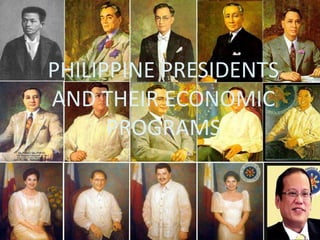
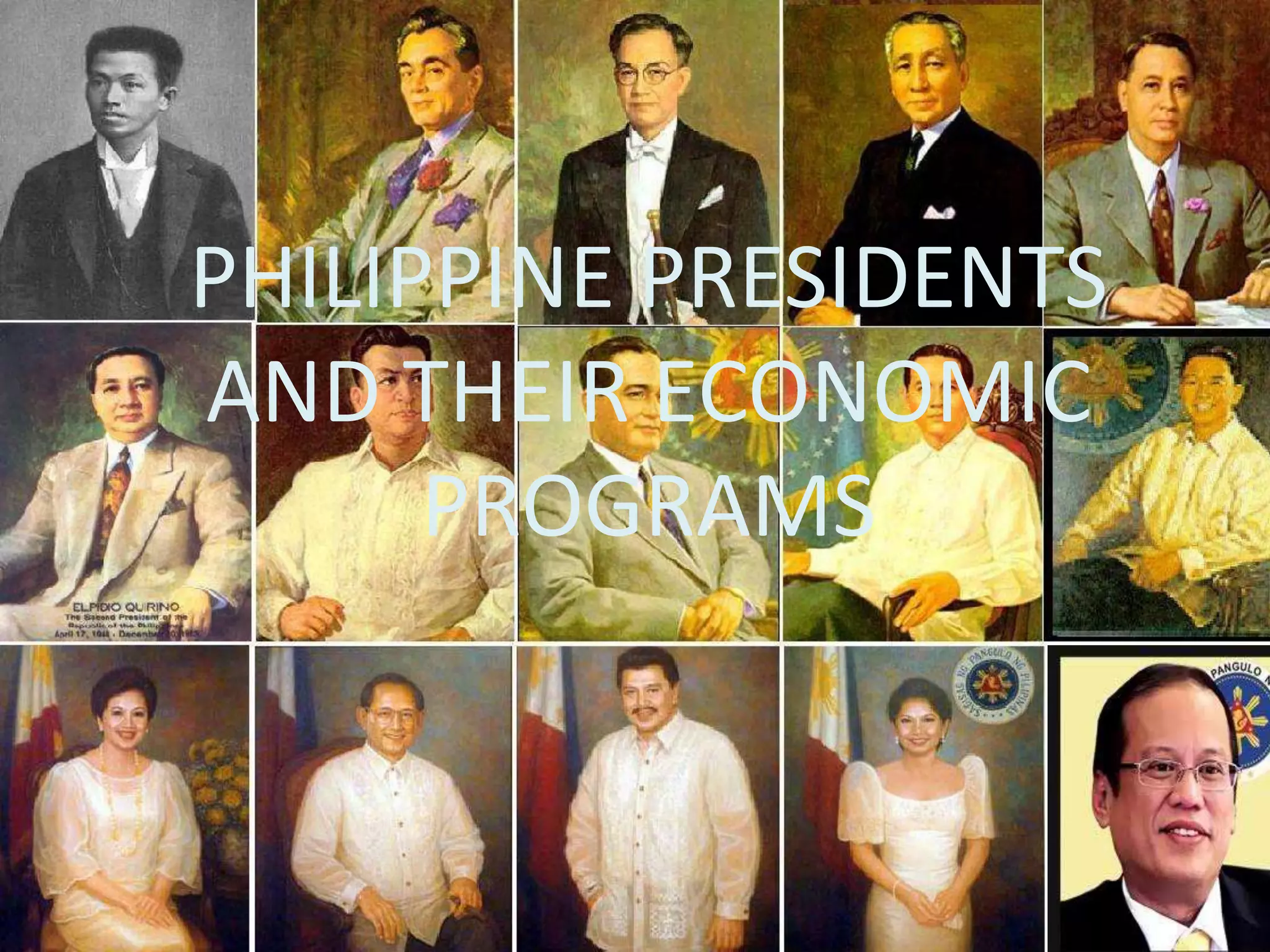
PHILIPPINE PRESIDENTS
AND THEIR ECONOMIC
      PROGRAMS
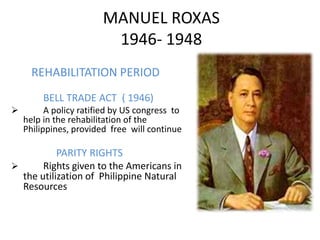
MANUEL ROXAS
                         1946- 1948
      REHABILITATION PERIOD
         BELL TRADE ACT ( 1946)
         A policy ratified by US congress to
    help in the rehabilitation of the
    Philippines, provided free will continue

           PARITY RIGHTS
      Rights given to the Americans in
  the utilization of Philippine Natural
  Resources
MANUEL ROXAS
               1946- 1948
• Financial Package of $620 M from
  the US for Philippine Rehabilitation
  Programs
• REHABILITATION FINANCE
  CORPORATION ( RF C )
To manage the distribution of loan
  and assistance from the US
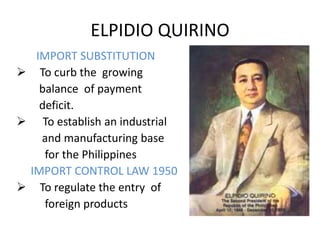
ELPIDIO QUIRINO
  IMPORT SUBSTITUTION
 To curb the growing
   balance of payment
   deficit.
 To establish an industrial
   and manufacturing base
    for the Philippines
 IMPORT CONTROL LAW 1950
 To regulate the entry of
    foreign products
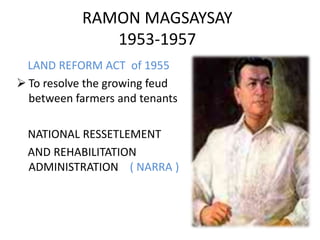
RAMON MAGSAYSAY
              1953-1957
  LAND REFORM ACT of 1955
 To resolve the growing feud
  between farmers and tenants

  NATIONAL RESSETLEMENT
  AND REHABILITATION
  ADMINISTRATION ( NARRA )
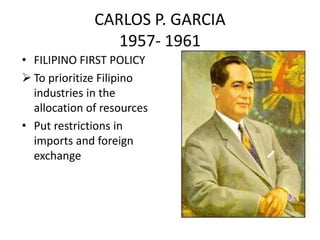
CARLOS P. GARCIA
                 1957- 1961
• FILIPINO FIRST POLICY
 To prioritize Filipino
  industries in the
  allocation of resources
• Put restrictions in
  imports and foreign
  exchange
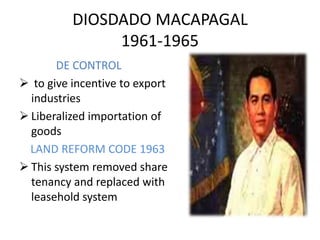
DIOSDADO MACAPAGAL
               1961-1965
       DE CONTROL
 to give incentive to export
  industries
 Liberalized importation of
  goods
  LAND REFORM CODE 1963
 This system removed share
  tenancy and replaced with
  leasehold system
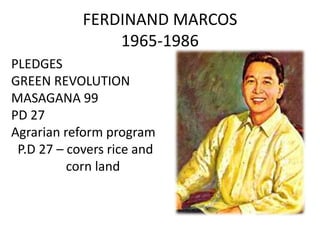
FERDINAND MARCOS
                1965-1986
PLEDGES
GREEN REVOLUTION
MASAGANA 99
PD 27
Agrarian reform program
 P.D 27 – covers rice and
          corn land
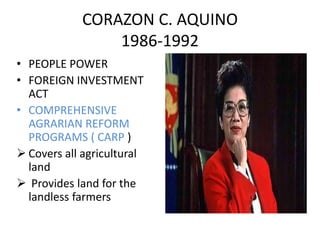
CORAZON C. AQUINO
                1986-1992
• PEOPLE POWER
• FOREIGN INVESTMENT
  ACT
• COMPREHENSIVE
  AGRARIAN REFORM
  PROGRAMS ( CARP )
 Covers all agricultural
  land
 Provides land for the
  landless farmers
CORAZON C. AQUINO
                1986-1992
• PRESIDENTIAL COMMISSION ON GOOD
  GOVERNMENT ( PCGG)
 To recover the ill-gotten wealth of the Marcoses

• PRIVATIZATION PROGRAM
• Dismantling of the US BASES
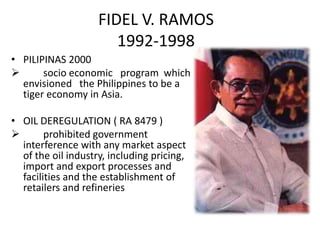
FIDEL V. RAMOS
                       1992-1998
• PILIPINAS 2000
      socio economic program which
  envisioned the Philippines to be a
  tiger economy in Asia.

• OIL DEREGULATION ( RA 8479 )
       prohibited government
  interference with any market aspect
  of the oil industry, including pricing,
  import and export processes and
  facilities and the establishment of
  retailers and refineries
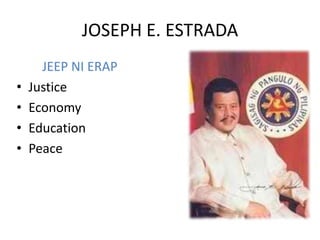
JOSEPH E. ESTRADA
      JEEP NI ERAP
•   Justice
•   Economy
•   Education
•   Peace
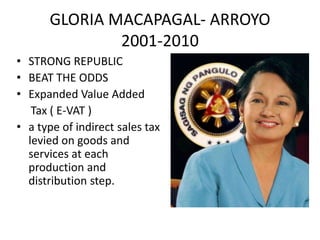
GLORIA MACAPAGAL- ARROYO
              2001-2010
• STRONG REPUBLIC
• BEAT THE ODDS
• Expanded Value Added
   Tax ( E-VAT )
• a type of indirect sales tax
  levied on goods and
  services at each
  production and
  distribution step.
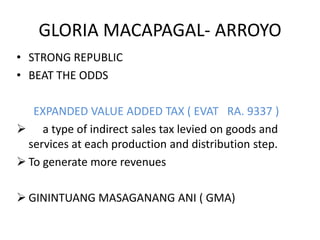
GLORIA MACAPAGAL- ARROYO
• STRONG REPUBLIC
• BEAT THE ODDS

   EXPANDED VALUE ADDED TAX ( EVAT RA. 9337 )
 a type of indirect sales tax levied on goods and
  services at each production and distribution step.
 To generate more revenues

 GININTUANG MASAGANANG ANI ( GMA)
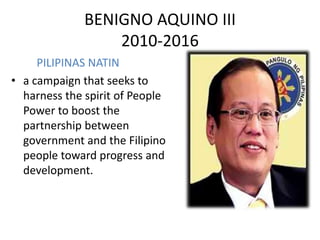
BENIGNO AQUINO III
                  2010-2016
     PILIPINAS NATIN
• a campaign that seeks to
  harness the spirit of People
  Power to boost the
  partnership between
  government and the Filipino
  people toward progress and
  development.
AQUINOMICS
“economics of business confidence”
 aims to create an environment that will  give the private
sector confidence to put in their money, generate jobs,
accelerate economic growth and sustain it.

                 FOUR PILLARS
 1. Fiscal sustainability and macroeconomic stability
 2. Private and Public Partnership ( PPP )
 3. Ease in doing business, for both local and foreign
     investors
 4. Investment in people – giving Filipinos health care,
    education and the skills necessary to become
    “productive participants in the economy
PROGRAMS IN AGRICULTURE
POINTERS FOR REVIEW
I. ECONOMICS AS A SOCIAL SCIENCE
    a. Definition of economics
    b. Relation of economics with other sciences
    c. Concepts about scarcity and choice
    d. Division of economics
II. DIFFERENT ECONOMIC THOUGHTS
    a. Physiocrats
    b. Mercantilists
    c. Classicists
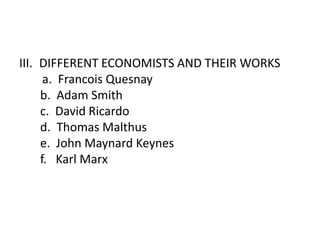
III. DIFFERENT ECONOMISTS AND THEIR WORKS
      a. Francois Quesnay
     b. Adam Smith
     c. David Ricardo
     d. Thomas Malthus
     e. John Maynard Keynes
     f. Karl Marx
III. DIFFERENT ECONOMISTS AND THEIR WORKS
      a. Francois Quesnay
     b. Adam Smith
     c. David Ricardo
     d. Thomas Malthus
     e. John Maynard Keynes
     f. Karl Marx
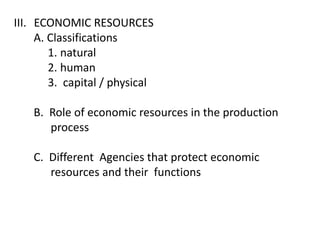
III. ECONOMIC RESOURCES
     A. Classifications
        1. natural
        2. human
        3. capital / physical

    B. Role of economic resources in the production
       process

    C. Different Agencies that protect economic
       resources and their functions
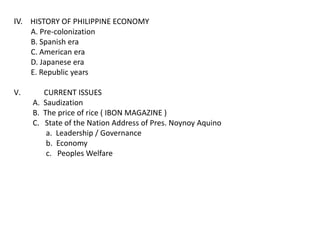
IV. HISTORY OF PHILIPPINE ECONOMY
     A. Pre-colonization
     B. Spanish era
     C. American era
     D. Japanese era
     E. Republic years

V.      CURRENT ISSUES
     A. Saudization
     B. The price of rice ( IBON MAGAZINE )
     C. State of the Nation Address of Pres. Noynoy Aquino
         a. Leadership / Governance
         b. Economy
         c. Peoples Welfare
THANK YOU.

Philippine president

  • 1.
  • 2.
    MANUEL ROXAS 1946- 1948 REHABILITATION PERIOD BELL TRADE ACT ( 1946)  A policy ratified by US congress to help in the rehabilitation of the Philippines, provided free will continue PARITY RIGHTS  Rights given to the Americans in the utilization of Philippine Natural Resources
  • 3.
    MANUEL ROXAS 1946- 1948 • Financial Package of $620 M from the US for Philippine Rehabilitation Programs • REHABILITATION FINANCE CORPORATION ( RF C ) To manage the distribution of loan and assistance from the US
  • 4.
    ELPIDIO QUIRINO IMPORT SUBSTITUTION  To curb the growing balance of payment deficit.  To establish an industrial and manufacturing base for the Philippines IMPORT CONTROL LAW 1950  To regulate the entry of foreign products
  • 5.
    RAMON MAGSAYSAY 1953-1957 LAND REFORM ACT of 1955  To resolve the growing feud between farmers and tenants NATIONAL RESSETLEMENT AND REHABILITATION ADMINISTRATION ( NARRA )
  • 6.
    CARLOS P. GARCIA 1957- 1961 • FILIPINO FIRST POLICY  To prioritize Filipino industries in the allocation of resources • Put restrictions in imports and foreign exchange
  • 7.
    DIOSDADO MACAPAGAL 1961-1965 DE CONTROL  to give incentive to export industries  Liberalized importation of goods LAND REFORM CODE 1963  This system removed share tenancy and replaced with leasehold system
  • 8.
    FERDINAND MARCOS 1965-1986 PLEDGES GREEN REVOLUTION MASAGANA 99 PD 27 Agrarian reform program P.D 27 – covers rice and corn land
  • 9.
    CORAZON C. AQUINO 1986-1992 • PEOPLE POWER • FOREIGN INVESTMENT ACT • COMPREHENSIVE AGRARIAN REFORM PROGRAMS ( CARP )  Covers all agricultural land  Provides land for the landless farmers
  • 10.
    CORAZON C. AQUINO 1986-1992 • PRESIDENTIAL COMMISSION ON GOOD GOVERNMENT ( PCGG)  To recover the ill-gotten wealth of the Marcoses • PRIVATIZATION PROGRAM • Dismantling of the US BASES
  • 11.
    FIDEL V. RAMOS 1992-1998 • PILIPINAS 2000  socio economic program which envisioned the Philippines to be a tiger economy in Asia. • OIL DEREGULATION ( RA 8479 )  prohibited government interference with any market aspect of the oil industry, including pricing, import and export processes and facilities and the establishment of retailers and refineries
  • 12.
    JOSEPH E. ESTRADA JEEP NI ERAP • Justice • Economy • Education • Peace
  • 13.
    GLORIA MACAPAGAL- ARROYO 2001-2010 • STRONG REPUBLIC • BEAT THE ODDS • Expanded Value Added Tax ( E-VAT ) • a type of indirect sales tax levied on goods and services at each production and distribution step.
  • 14.
    GLORIA MACAPAGAL- ARROYO •STRONG REPUBLIC • BEAT THE ODDS EXPANDED VALUE ADDED TAX ( EVAT RA. 9337 )  a type of indirect sales tax levied on goods and services at each production and distribution step.  To generate more revenues  GININTUANG MASAGANANG ANI ( GMA)
  • 15.
    BENIGNO AQUINO III 2010-2016 PILIPINAS NATIN • a campaign that seeks to harness the spirit of People Power to boost the partnership between government and the Filipino people toward progress and development.
  • 16.
    AQUINOMICS “economics of businessconfidence”  aims to create an environment that will give the private sector confidence to put in their money, generate jobs, accelerate economic growth and sustain it. FOUR PILLARS 1. Fiscal sustainability and macroeconomic stability 2. Private and Public Partnership ( PPP ) 3. Ease in doing business, for both local and foreign investors 4. Investment in people – giving Filipinos health care, education and the skills necessary to become “productive participants in the economy
  • 17.
  • 18.
    POINTERS FOR REVIEW I.ECONOMICS AS A SOCIAL SCIENCE a. Definition of economics b. Relation of economics with other sciences c. Concepts about scarcity and choice d. Division of economics II. DIFFERENT ECONOMIC THOUGHTS a. Physiocrats b. Mercantilists c. Classicists
  • 19.
    III. DIFFERENT ECONOMISTSAND THEIR WORKS a. Francois Quesnay b. Adam Smith c. David Ricardo d. Thomas Malthus e. John Maynard Keynes f. Karl Marx
  • 20.
    III. DIFFERENT ECONOMISTSAND THEIR WORKS a. Francois Quesnay b. Adam Smith c. David Ricardo d. Thomas Malthus e. John Maynard Keynes f. Karl Marx
  • 21.
    III. ECONOMIC RESOURCES A. Classifications 1. natural 2. human 3. capital / physical B. Role of economic resources in the production process C. Different Agencies that protect economic resources and their functions
  • 22.
    IV. HISTORY OFPHILIPPINE ECONOMY A. Pre-colonization B. Spanish era C. American era D. Japanese era E. Republic years V. CURRENT ISSUES A. Saudization B. The price of rice ( IBON MAGAZINE ) C. State of the Nation Address of Pres. Noynoy Aquino a. Leadership / Governance b. Economy c. Peoples Welfare
  • 23.