F. Constructing the
National
Consciousness
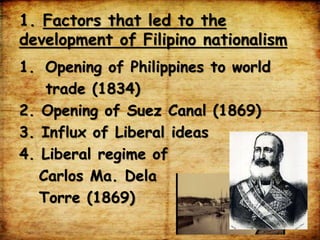
1. Factors that led to the
development of Filipino nationalism
1. Opening of Philippines to world
trade (1834)
2. Opening of Suez Canal (1869)
3. Influx of Liberal ideas
4. Liberal regime of
Carlos Ma. Dela
Torre (1869)
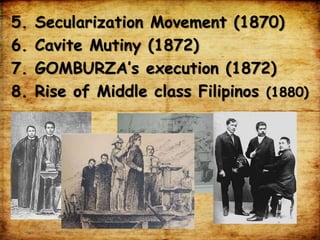
5. Secularization Movement (1870)
6. Cavite Mutiny (1872)
7. GOMBURZA’s execution (1872)
8. Rise of Middle class Filipinos (1880)
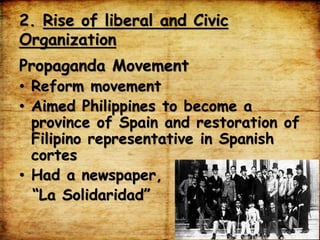
2. Rise of liberal and Civic
Organization
Propaganda Movement
• Reform movement
• Aimed Philippines to become a
province of Spain and restoration of
Filipino representative in Spanish
cortes
• Had a newspaper,
“La Solidaridad”
*La Solidaridad
-first issued on February 15,
1889 until October 1889 in
Barcelona
-first issued on November 15,
1889 in Madrid
-contributed by
Ferdinand Blumentritt
and Miguel Morayta
*La Solidaridad writers:
-Jose Rizal
-Marcelo H. Del Pilar
-Mariano Ponce
-Jose Ma. Panganiban
-Dominador Gomez
-Antonio Luna
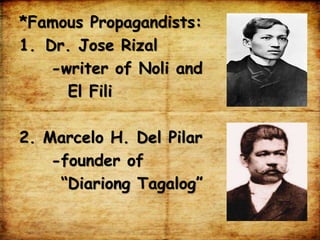
*Famous Propagandists:
1. Dr. Jose Rizal
-writer of Noli and
El Fili
2. Marcelo H. Del Pilar
-founder of
“Diariong Tagalog”
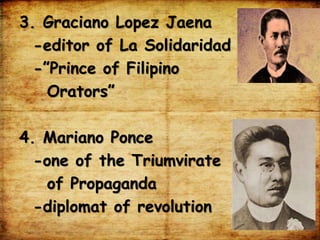
3. Graciano Lopez Jaena
-editor of La Solidaridad
-”Prince of Filipino
Orators”
4. Mariano Ponce
-one of the Triumvirate
of Propaganda
-diplomat of revolution
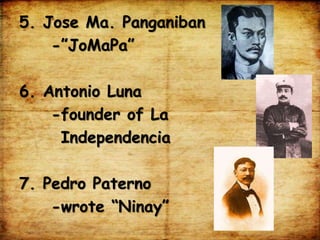
5. Jose Ma. Panganiban
-”JoMaPa”
6. Antonio Luna
-founder of La
Independencia
7. Pedro Paterno
-wrote “Ninay”
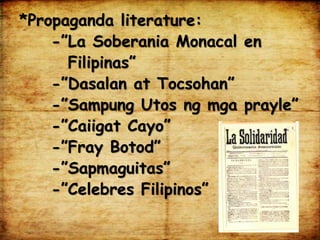
*Propaganda literature:
-”La Soberania Monacal en
Filipinas”
-”Dasalan at Tocsohan”
-”Sampung Utos ng mga prayle”
-”Caiigat Cayo”
-”Fray Botod”
-”Sapmaguitas”
-”Celebres Filipinos”
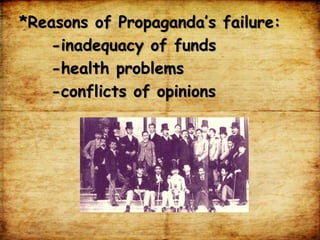
*Reasons of Propaganda’s failure:
-inadequacy of funds
-health problems
-conflicts of opinions
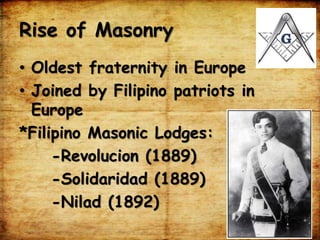
Rise of Masonry
• Oldest fraternity in Europe
• Joined by Filipino patriots in
Europe
*Filipino Masonic Lodges:
-Revolucion (1889)
-Solidaridad (1889)
-Nilad (1892)
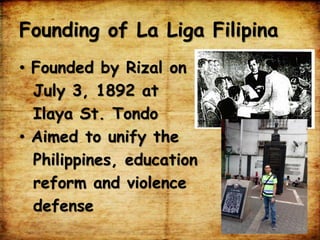
Founding of La Liga Filipina
• Founded by Rizal on
July 3, 1892 at
Ilaya St. Tondo
• Aimed to unify the
Philippines, education
reform and violence
defense
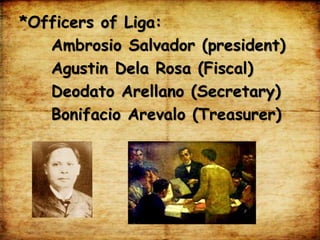
*Officers of Liga:
Ambrosio Salvador (president)
Agustin Dela Rosa (Fiscal)
Deodato Arellano (Secretary)
Bonifacio Arevalo (Treasurer)
• Liga was dissolved when Rizal was
arrested and deported to Dapitan
after 3 days
LA LIGA FILIPINA
“Cuerpo de los “Katipunan”
Compromisarios”
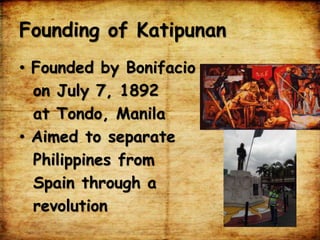
Founding of Katipunan
• Founded by Bonifacio
on July 7, 1892
at Tondo, Manila
• Aimed to separate
Philippines from
Spain through a
revolution
*Political structure:
-Kataas-taasang Sanggunian
-Sangguniang Bayan
-Sangguniang Balangay
-Camara Secreta
*Presidents:
-Deodato Arellano (1893)
-Roman Basa (1893)
-Andres Bonifacio (1895)
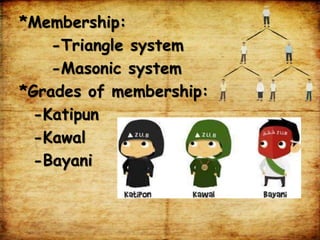
*Membership:
-Triangle system
-Masonic system
*Grades of membership:
-Katipun
-Kawal
-Bayani
“Kung mayroon kang lakas at tatag,
mapatuloy ka.
Kung pag-uusyoso lamang ang sadya
mo rito, humayo ka na.
Kung hindi mo kayang pigilin ang
iyong sarili umais ka na.
Hindi maaaring buksan ang pinto ng
Pinakamataas na Samahan ng mga
Anak ng Bayan para sa inyo.”
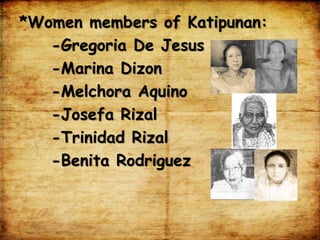
*Women members of Katipunan:
-Gregoria De Jesus
-Marina Dizon
-Melchora Aquino
-Josefa Rizal
-Trinidad Rizal
-Benita Rodriguez
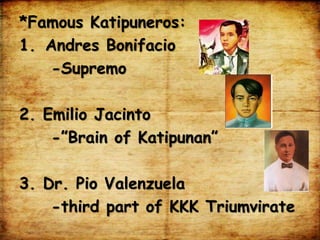
*Famous Katipuneros:
1. Andres Bonifacio
-Supremo
2. Emilio Jacinto
-”Brain of Katipunan”
3. Dr. Pio Valenzuela
-third part of KKK Triumvirate
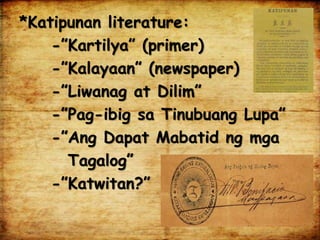
*Katipunan literature:
-”Kartilya” (primer)
-”Kalayaan” (newspaper)
-”Liwanag at Dilim”
-”Pag-ibig sa Tinubuang Lupa”
-”Ang Dapat Mabatid ng mga
Tagalog”
-”Katwitan?”
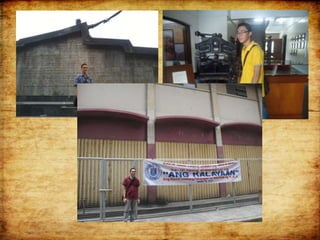
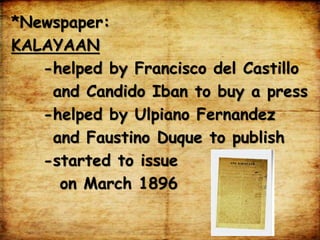
*Newspaper:
KALAYAAN
-helped by Francisco del Castillo
and Candido Iban to buy a press
-helped by Ulpiano Fernandez
and Faustino Duque to publish
-started to issue
on March 1896
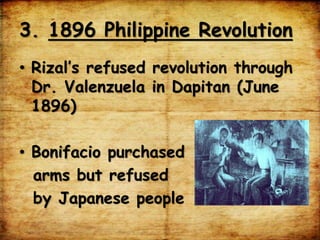
3. 1896 Philippine Revolution
• Rizal’s refused revolution through
Dr. Valenzuela in Dapitan (June
1896)
• Bonifacio purchased
arms but refused
by Japanese people
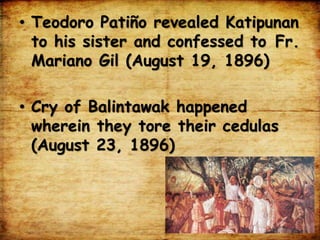
• Teodoro Patiño revealed Katipunan
to his sister and confessed to Fr.
Mariano Gil (August 19, 1896)
• Cry of Balintawak happened
wherein they tore their cedulas
(August 23, 1896)
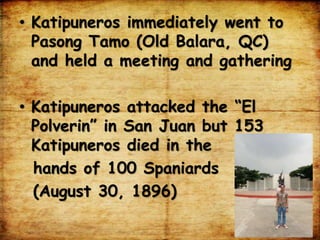
• Katipuneros immediately went to
Pasong Tamo (Old Balara, QC)
and held a meeting and gathering
• Katipuneros attacked the “El
Polverin” in San Juan but 153
Katipuneros died in the
hands of 100 Spaniards
(August 30, 1896)
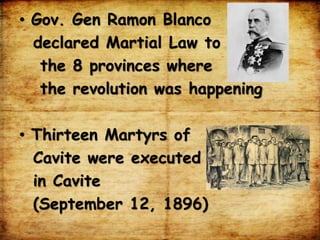
• Gov. Gen Ramon Blanco
declared Martial Law to
the 8 provinces where
the revolution was happening
• Thirteen Martyrs of
Cavite were executed
in Cavite
(September 12, 1896)
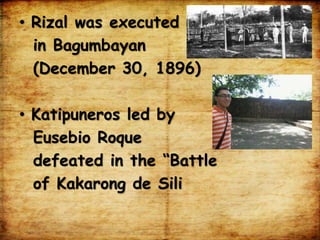
• Rizal was executed
in Bagumbayan
(December 30, 1896)
• Katipuneros led by
Eusebio Roque
defeated in the “Battle
of Kakarong de Sili
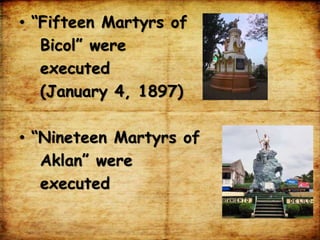
• “Fifteen Martyrs of
Bicol” were
executed
(January 4, 1897)
• “Nineteen Martyrs of
Aklan” were
executed
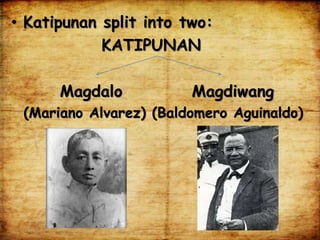
• Katipunan split into two:
KATIPUNAN
Magdalo Magdiwang
(Mariano Alvarez) (Baldomero Aguinaldo)
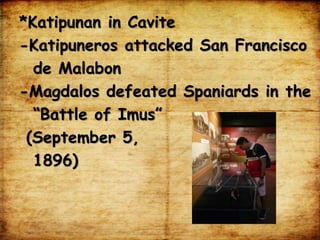
*Katipunan in Cavite
-Katipuneros attacked San Francisco
de Malabon
-Magdalos defeated Spaniards in the
“Battle of Imus”
(September 5,
1896)
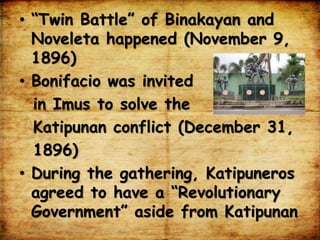
• “Twin Battle” of Binakayan and
Noveleta happened (November 9,
1896)
• Bonifacio was invited
in Imus to solve the
Katipunan conflict (December 31,
1896)
• During the gathering, Katipuneros
agreed to have a “Revolutionary
Government” aside from Katipunan
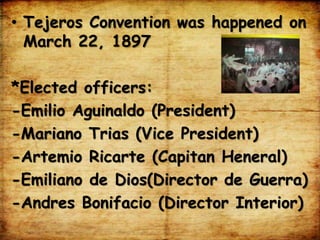
• Tejeros Convention was happened on
March 22, 1897
*Elected officers:
-Emilio Aguinaldo (President)
-Mariano Trias (Vice President)
-Artemio Ricarte (Capitan Heneral)
-Emiliano de Dios(Director de Guerra)
-Andres Bonifacio (Director Interior)
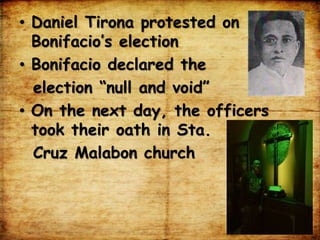
• Daniel Tirona protested on
Bonifacio’s election
• Bonifacio declared the
election “null and void”
• On the next day, the officers
took their oath in Sta.
Cruz Malabon church
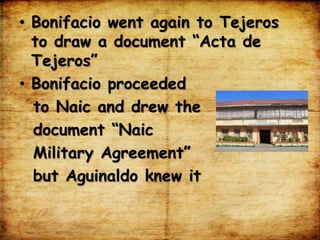
• Bonifacio went again to Tejeros
to draw a document “Acta de
Tejeros”
• Bonifacio proceeded
to Naic and drew the
document “Naic
Military Agreement”
but Aguinaldo knew it
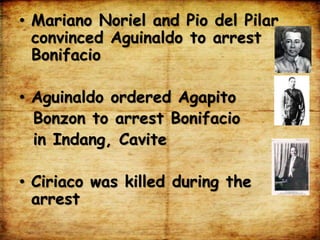
• Mariano Noriel and Pio del Pilar
convinced Aguinaldo to arrest
Bonifacio
• Aguinaldo ordered Agapito
Bonzon to arrest Bonifacio
in Indang, Cavite
• Ciriaco was killed during the
arrest
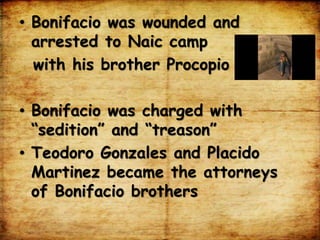
• Bonifacio was wounded and
arrested to Naic camp
with his brother Procopio
• Bonifacio was charged with
“sedition” and “treason”
• Teodoro Gonzales and Placido
Martinez became the attorneys
of Bonifacio brothers
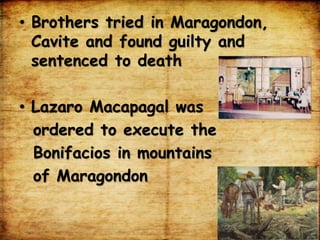
• Brothers tried in Maragondon,
Cavite and found guilty and
sentenced to death
• Lazaro Macapagal was
ordered to execute the
Bonifacios in mountains
of Maragondon
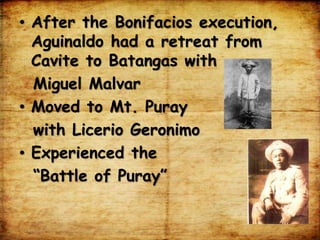
• After the Bonifacios execution,
Aguinaldo had a retreat from
Cavite to Batangas with
Miguel Malvar
• Moved to Mt. Puray
with Licerio Geronimo
• Experienced the
“Battle of Puray”
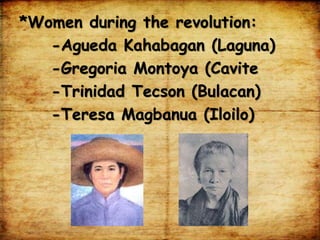
*Women during the revolution:
-Agueda Kahabagan (Laguna)
-Gregoria Montoya (Cavite
-Trinidad Tecson (Bulacan)
-Teresa Magbanua (Iloilo)
• Moved to Biak na Bato and
established a “republic” (October
1897)
*Elected officers:
-Emilio Aguinaldo (President)
-Mariano Trias (Vice President)
-Antonio Montenegro (Foreign Affairs)
-Isabelo Artacho (Interior)
-Emiliano de Dios (War)
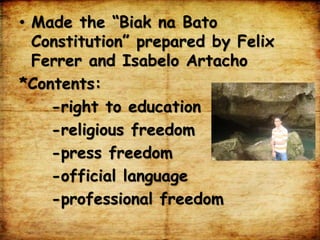
• Made the “Biak na Bato
Constitution” prepared by Felix
Ferrer and Isabelo Artacho
*Contents:
-right to education
-religious freedom
-press freedom
-official language
-professional freedom
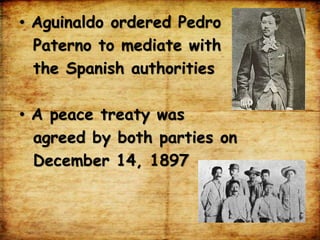
• Aguinaldo ordered Pedro
Paterno to mediate with
the Spanish authorities
• A peace treaty was
agreed by both parties on
December 14, 1897
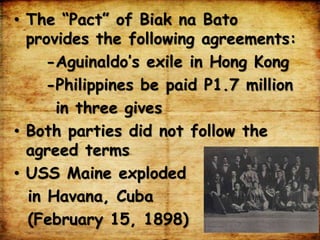
• The “Pact” of Biak na Bato
provides the following agreements:
-Aguinaldo’s exile in Hong Kong
-Philippines be paid P1.7 million
in three gives
• Both parties did not follow the
agreed terms
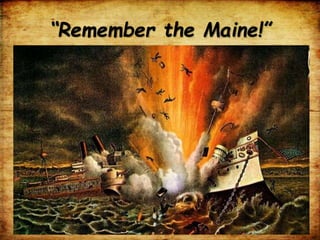
• USS Maine exploded
in Havana, Cuba
(February 15, 1898)
“Remember the Maine!”
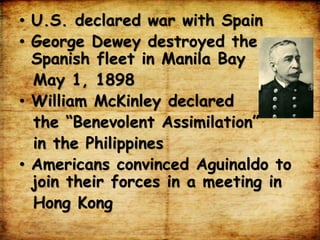
• U.S. declared war with Spain
• George Dewey destroyed the
Spanish fleet in Manila Bay
May 1, 1898
• William McKinley declared
the “Benevolent Assimilation”
in the Philippines
• Americans convinced Aguinaldo to
join their forces in a meeting in
Hong Kong
• Aguinaldo gave money to buy arms
and ammunitions to Rounseville
Wildman
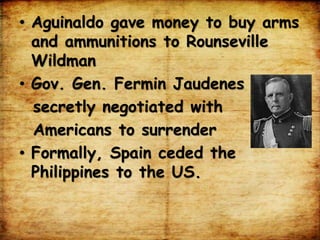
• Gov. Gen. Fermin Jaudenes
secretly negotiated with
Americans to surrender
• Formally, Spain ceded the
Philippines to the US.
• Aguinaldo went back to the
Philippines on May 19, 1898
through steamer McCulloch
• Aguinaldo liberated the 8
provinces under Martial Law
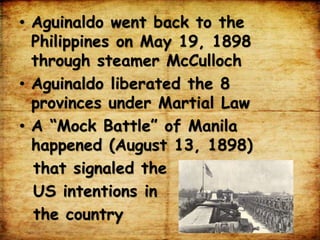
• A “Mock Battle” of Manila
happened (August 13, 1898)
that signaled the
US intentions in
the country
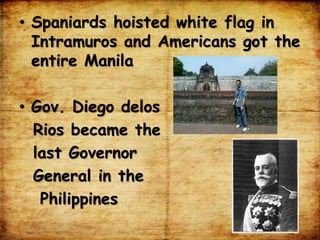
• Spaniards hoisted white flag in
Intramuros and Americans got the
entire Manila
• Gov. Diego delos
Rios became the
last Governor
General in the
Philippines
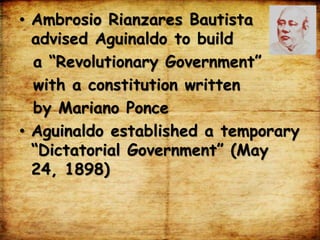
• Ambrosio Rianzares Bautista
advised Aguinaldo to build
a “Revolutionary Government”
with a constitution written
by Mariano Ponce
• Aguinaldo established a temporary
“Dictatorial Government” (May
24, 1898)
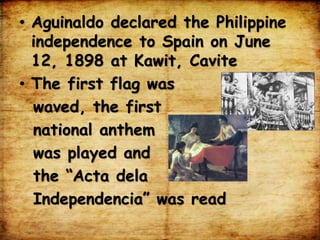
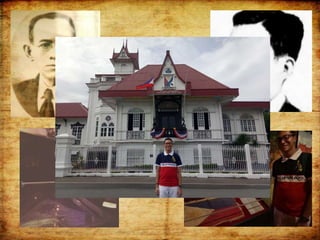
• Aguinaldo declared the Philippine
independence to Spain on June
12, 1898 at Kawit, Cavite
• The first flag was
waved, the first
national anthem
was played and
the “Acta dela
Independencia” was read
• Mabini advised Aguinaldo
to change the Dictatorial
Government into a
Revolutionary Government
• Formally hailed his cabinet:
-Baldomero Aguinaldo (War)
-Mariano Trias (Finance)
-Leandro Ibarra (Interior)
-Apolinario Mabini (Foreign)
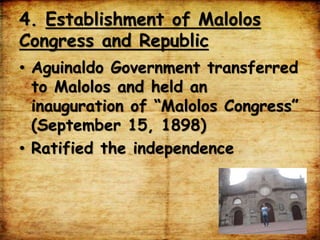
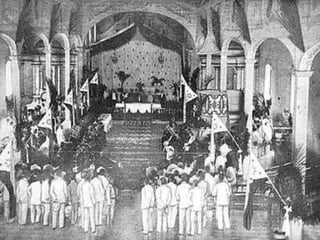
4. Establishment of Malolos
Congress and Republic
• Aguinaldo Government transferred
to Malolos and held an
inauguration of “Malolos Congress”
(September 15, 1898)
• Ratified the independence
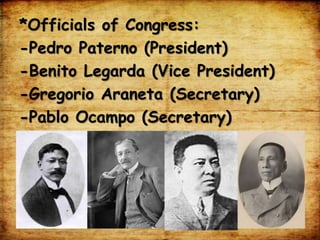
*Officials of Congress:
-Pedro Paterno (President)
-Benito Legarda (Vice President)
-Gregorio Araneta (Secretary)
-Pablo Ocampo (Secretary)
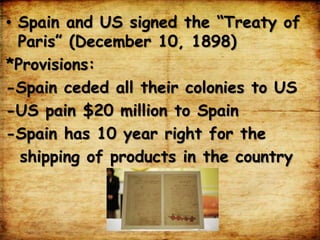
• Spain and US signed the “Treaty of
Paris” (December 10, 1898)
*Provisions:
-Spain ceded all their colonies to US
-US pain $20 million to Spain
-Spain has 10 year right for the
shipping of products in the country
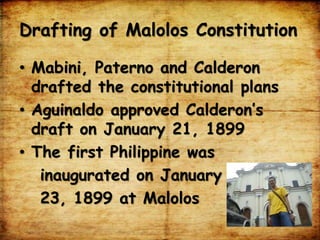
Drafting of Malolos Constitution
• Mabini, Paterno and Calderon
drafted the constitutional plans
• Aguinaldo approved Calderon’s
draft on January 21, 1899
• The first Philippine was
inaugurated on January
23, 1899 at Malolos
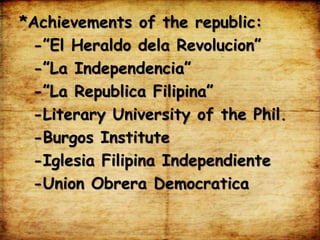
*Achievements of the republic:
-”El Heraldo dela Revolucion”
-”La Independencia”
-”La Republica Filipina”
-Literary University of the Phil.
-Burgos Institute
-Iglesia Filipina Independiente
-Union Obrera Democratica
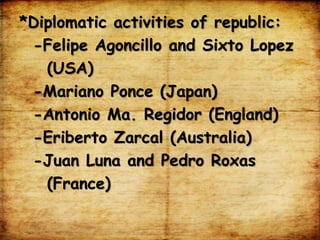
*Diplomatic activities of republic:
-Felipe Agoncillo and Sixto Lopez
(USA)
-Mariano Ponce (Japan)
-Antonio Ma. Regidor (England)
-Eriberto Zarcal (Australia)
-Juan Luna and Pedro Roxas
(France)
Thank you!
Yosef Eric C. Hipolito, LPT, MA
Bachelor of Arts in History
yosefhipolito19@gmail.com

Constructing the national consciousness (1872 1898)

  • 1.
  • 2.
    1. Factors thatled to the development of Filipino nationalism 1. Opening of Philippines to world trade (1834) 2. Opening of Suez Canal (1869) 3. Influx of Liberal ideas 4. Liberal regime of Carlos Ma. Dela Torre (1869)
  • 3.
    5. Secularization Movement(1870) 6. Cavite Mutiny (1872) 7. GOMBURZA’s execution (1872) 8. Rise of Middle class Filipinos (1880)
  • 4.
    2. Rise ofliberal and Civic Organization Propaganda Movement • Reform movement • Aimed Philippines to become a province of Spain and restoration of Filipino representative in Spanish cortes • Had a newspaper, “La Solidaridad”
  • 5.
    *La Solidaridad -first issuedon February 15, 1889 until October 1889 in Barcelona -first issued on November 15, 1889 in Madrid -contributed by Ferdinand Blumentritt and Miguel Morayta
  • 6.
    *La Solidaridad writers: -JoseRizal -Marcelo H. Del Pilar -Mariano Ponce -Jose Ma. Panganiban -Dominador Gomez -Antonio Luna
  • 7.
    *Famous Propagandists: 1. Dr.Jose Rizal -writer of Noli and El Fili 2. Marcelo H. Del Pilar -founder of “Diariong Tagalog”
  • 8.
    3. Graciano LopezJaena -editor of La Solidaridad -”Prince of Filipino Orators” 4. Mariano Ponce -one of the Triumvirate of Propaganda -diplomat of revolution
  • 9.
    5. Jose Ma.Panganiban -”JoMaPa” 6. Antonio Luna -founder of La Independencia 7. Pedro Paterno -wrote “Ninay”
  • 10.
    *Propaganda literature: -”La SoberaniaMonacal en Filipinas” -”Dasalan at Tocsohan” -”Sampung Utos ng mga prayle” -”Caiigat Cayo” -”Fray Botod” -”Sapmaguitas” -”Celebres Filipinos”
  • 12.
    *Reasons of Propaganda’sfailure: -inadequacy of funds -health problems -conflicts of opinions
  • 13.
    Rise of Masonry •Oldest fraternity in Europe • Joined by Filipino patriots in Europe *Filipino Masonic Lodges: -Revolucion (1889) -Solidaridad (1889) -Nilad (1892)
  • 14.
    Founding of LaLiga Filipina • Founded by Rizal on July 3, 1892 at Ilaya St. Tondo • Aimed to unify the Philippines, education reform and violence defense
  • 15.
    *Officers of Liga: AmbrosioSalvador (president) Agustin Dela Rosa (Fiscal) Deodato Arellano (Secretary) Bonifacio Arevalo (Treasurer)
  • 16.
    • Liga wasdissolved when Rizal was arrested and deported to Dapitan after 3 days LA LIGA FILIPINA “Cuerpo de los “Katipunan” Compromisarios”
  • 17.
    Founding of Katipunan •Founded by Bonifacio on July 7, 1892 at Tondo, Manila • Aimed to separate Philippines from Spain through a revolution
  • 18.
    *Political structure: -Kataas-taasang Sanggunian -SangguniangBayan -Sangguniang Balangay -Camara Secreta *Presidents: -Deodato Arellano (1893) -Roman Basa (1893) -Andres Bonifacio (1895)
  • 19.
    *Membership: -Triangle system -Masonic system *Gradesof membership: -Katipun -Kawal -Bayani
  • 20.
    “Kung mayroon kanglakas at tatag, mapatuloy ka. Kung pag-uusyoso lamang ang sadya mo rito, humayo ka na. Kung hindi mo kayang pigilin ang iyong sarili umais ka na. Hindi maaaring buksan ang pinto ng Pinakamataas na Samahan ng mga Anak ng Bayan para sa inyo.”
  • 21.
    *Women members ofKatipunan: -Gregoria De Jesus -Marina Dizon -Melchora Aquino -Josefa Rizal -Trinidad Rizal -Benita Rodriguez
  • 22.
    *Famous Katipuneros: 1. AndresBonifacio -Supremo 2. Emilio Jacinto -”Brain of Katipunan” 3. Dr. Pio Valenzuela -third part of KKK Triumvirate
  • 23.
    *Katipunan literature: -”Kartilya” (primer) -”Kalayaan”(newspaper) -”Liwanag at Dilim” -”Pag-ibig sa Tinubuang Lupa” -”Ang Dapat Mabatid ng mga Tagalog” -”Katwitan?”
  • 25.
    *Newspaper: KALAYAAN -helped by Franciscodel Castillo and Candido Iban to buy a press -helped by Ulpiano Fernandez and Faustino Duque to publish -started to issue on March 1896
  • 26.
    3. 1896 PhilippineRevolution • Rizal’s refused revolution through Dr. Valenzuela in Dapitan (June 1896) • Bonifacio purchased arms but refused by Japanese people
  • 27.
    • Teodoro Patiñorevealed Katipunan to his sister and confessed to Fr. Mariano Gil (August 19, 1896) • Cry of Balintawak happened wherein they tore their cedulas (August 23, 1896)
  • 28.
    • Katipuneros immediatelywent to Pasong Tamo (Old Balara, QC) and held a meeting and gathering • Katipuneros attacked the “El Polverin” in San Juan but 153 Katipuneros died in the hands of 100 Spaniards (August 30, 1896)
  • 29.
    • Gov. GenRamon Blanco declared Martial Law to the 8 provinces where the revolution was happening • Thirteen Martyrs of Cavite were executed in Cavite (September 12, 1896)
  • 30.
    • Rizal wasexecuted in Bagumbayan (December 30, 1896) • Katipuneros led by Eusebio Roque defeated in the “Battle of Kakarong de Sili
  • 31.
    • “Fifteen Martyrsof Bicol” were executed (January 4, 1897) • “Nineteen Martyrs of Aklan” were executed
  • 32.
    • Katipunan splitinto two: KATIPUNAN Magdalo Magdiwang (Mariano Alvarez) (Baldomero Aguinaldo)
  • 33.
    *Katipunan in Cavite -Katipunerosattacked San Francisco de Malabon -Magdalos defeated Spaniards in the “Battle of Imus” (September 5, 1896)
  • 34.
    • “Twin Battle”of Binakayan and Noveleta happened (November 9, 1896) • Bonifacio was invited in Imus to solve the Katipunan conflict (December 31, 1896) • During the gathering, Katipuneros agreed to have a “Revolutionary Government” aside from Katipunan
  • 35.
    • Tejeros Conventionwas happened on March 22, 1897 *Elected officers: -Emilio Aguinaldo (President) -Mariano Trias (Vice President) -Artemio Ricarte (Capitan Heneral) -Emiliano de Dios(Director de Guerra) -Andres Bonifacio (Director Interior)
  • 36.
    • Daniel Tironaprotested on Bonifacio’s election • Bonifacio declared the election “null and void” • On the next day, the officers took their oath in Sta. Cruz Malabon church
  • 37.
    • Bonifacio wentagain to Tejeros to draw a document “Acta de Tejeros” • Bonifacio proceeded to Naic and drew the document “Naic Military Agreement” but Aguinaldo knew it
  • 38.
    • Mariano Norieland Pio del Pilar convinced Aguinaldo to arrest Bonifacio • Aguinaldo ordered Agapito Bonzon to arrest Bonifacio in Indang, Cavite • Ciriaco was killed during the arrest
  • 39.
    • Bonifacio waswounded and arrested to Naic camp with his brother Procopio • Bonifacio was charged with “sedition” and “treason” • Teodoro Gonzales and Placido Martinez became the attorneys of Bonifacio brothers
  • 40.
    • Brothers triedin Maragondon, Cavite and found guilty and sentenced to death • Lazaro Macapagal was ordered to execute the Bonifacios in mountains of Maragondon
  • 41.
    • After theBonifacios execution, Aguinaldo had a retreat from Cavite to Batangas with Miguel Malvar • Moved to Mt. Puray with Licerio Geronimo • Experienced the “Battle of Puray”
  • 42.
    *Women during therevolution: -Agueda Kahabagan (Laguna) -Gregoria Montoya (Cavite -Trinidad Tecson (Bulacan) -Teresa Magbanua (Iloilo)
  • 43.
    • Moved toBiak na Bato and established a “republic” (October 1897) *Elected officers: -Emilio Aguinaldo (President) -Mariano Trias (Vice President) -Antonio Montenegro (Foreign Affairs) -Isabelo Artacho (Interior) -Emiliano de Dios (War)
  • 44.
    • Made the“Biak na Bato Constitution” prepared by Felix Ferrer and Isabelo Artacho *Contents: -right to education -religious freedom -press freedom -official language -professional freedom
  • 45.
    • Aguinaldo orderedPedro Paterno to mediate with the Spanish authorities • A peace treaty was agreed by both parties on December 14, 1897
  • 46.
    • The “Pact”of Biak na Bato provides the following agreements: -Aguinaldo’s exile in Hong Kong -Philippines be paid P1.7 million in three gives • Both parties did not follow the agreed terms • USS Maine exploded in Havana, Cuba (February 15, 1898)
  • 47.
  • 48.
    • U.S. declaredwar with Spain • George Dewey destroyed the Spanish fleet in Manila Bay May 1, 1898 • William McKinley declared the “Benevolent Assimilation” in the Philippines • Americans convinced Aguinaldo to join their forces in a meeting in Hong Kong
  • 49.
    • Aguinaldo gavemoney to buy arms and ammunitions to Rounseville Wildman • Gov. Gen. Fermin Jaudenes secretly negotiated with Americans to surrender • Formally, Spain ceded the Philippines to the US.
  • 50.
    • Aguinaldo wentback to the Philippines on May 19, 1898 through steamer McCulloch • Aguinaldo liberated the 8 provinces under Martial Law • A “Mock Battle” of Manila happened (August 13, 1898) that signaled the US intentions in the country
  • 51.
    • Spaniards hoistedwhite flag in Intramuros and Americans got the entire Manila • Gov. Diego delos Rios became the last Governor General in the Philippines
  • 52.
    • Ambrosio RianzaresBautista advised Aguinaldo to build a “Revolutionary Government” with a constitution written by Mariano Ponce • Aguinaldo established a temporary “Dictatorial Government” (May 24, 1898)
  • 53.
    • Aguinaldo declaredthe Philippine independence to Spain on June 12, 1898 at Kawit, Cavite • The first flag was waved, the first national anthem was played and the “Acta dela Independencia” was read
  • 55.
    • Mabini advisedAguinaldo to change the Dictatorial Government into a Revolutionary Government • Formally hailed his cabinet: -Baldomero Aguinaldo (War) -Mariano Trias (Finance) -Leandro Ibarra (Interior) -Apolinario Mabini (Foreign)
  • 56.
    4. Establishment ofMalolos Congress and Republic • Aguinaldo Government transferred to Malolos and held an inauguration of “Malolos Congress” (September 15, 1898) • Ratified the independence
  • 58.
    *Officials of Congress: -PedroPaterno (President) -Benito Legarda (Vice President) -Gregorio Araneta (Secretary) -Pablo Ocampo (Secretary)
  • 59.
    • Spain andUS signed the “Treaty of Paris” (December 10, 1898) *Provisions: -Spain ceded all their colonies to US -US pain $20 million to Spain -Spain has 10 year right for the shipping of products in the country
  • 60.
    Drafting of MalolosConstitution • Mabini, Paterno and Calderon drafted the constitutional plans • Aguinaldo approved Calderon’s draft on January 21, 1899 • The first Philippine was inaugurated on January 23, 1899 at Malolos
  • 61.
    *Achievements of therepublic: -”El Heraldo dela Revolucion” -”La Independencia” -”La Republica Filipina” -Literary University of the Phil. -Burgos Institute -Iglesia Filipina Independiente -Union Obrera Democratica
  • 62.
    *Diplomatic activities ofrepublic: -Felipe Agoncillo and Sixto Lopez (USA) -Mariano Ponce (Japan) -Antonio Ma. Regidor (England) -Eriberto Zarcal (Australia) -Juan Luna and Pedro Roxas (France)
  • 63.
    Thank you! Yosef EricC. Hipolito, LPT, MA Bachelor of Arts in History yosefhipolito19@gmail.com