STAGES IN THE EVOLUTION OF THE PHILIPPINE
POLITICS AND GOVERNANACE
PRE-COLONIAL (900-1521)
 The barangay was the Filipino's
earliest form of government. It
was an independent settlement
consisting of thirty to one
hundred families usually situated
along a river bank or at the
mouth of a river spilling out to the
sea. The term barangay was
derived from the Malay word
barangay or balangay, which
means sailboat. The barangays
were used to transport the early
Filipinos and their cargoes to the
various sections of the Philippine
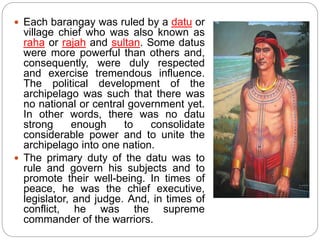
 Each barangay was ruled by a datu or
village chief who was also known as
raha or rajah and sultan. Some datus
were more powerful than others and,
consequently, were duly respected
and exercise tremendous influence.
The political development of the
archipelago was such that there was
no national or central government yet.
In other words, there was no datu
strong enough to consolidate
considerable power and to unite the
archipelago into one nation.
 The primary duty of the datu was to
rule and govern his subjects and to
promote their well-being. In times of
peace, he was the chief executive,
legislator, and judge. And, in times of
conflict, he was the supreme
commander of the warriors.
 The datu usually obtained his position by inheritance.
However, one could also become a datu through display
of his prowess and valor in battle, or by proving his
leadership skills or other traits useful for the barangay's
survival.
In matters of succession in the vent of the datu's death,
the first son usually succeeded him. If the first son died
without leaving an heir, the second son succeeded as
datu. In the absence of any male heir, the eldest
daughter could become a chieftain. This clearly indicates
that women's rights and abilities were recognized during
pre-Spanish times. If a datu died without any heir, the
people of the barangay choose a man to become the
new chieftain on the basis of his wisdom, wealth and
physical strength.
SPANISH COLONY (1521-1898)
 The history of the Philippines from 1521 to
1898, also known as the Spanish colonial period
from 1565, was the period following the arrival of
Magellan in the Philippines and during Spain
financed expeditions to the Philippine islands and
then ruled them as the Captaincy General of the
Philippines within the Spanish East Indies, initially
under New Spain until Mexican independence in
1821, which gave Madrid direct control over the
area. It started with the arrival in 1521 of
European explorer Ferdinand Magellan sailing for
Spain, which heralded the period when the
Philippines was a colony of the Spanish Empire,
and ended with the outbreak of the Philippine
Revolution in 1898, which marked the beginning
of the American colonial era of Philippine history.
SPANISH EAST INDIES
 Head of the State – Queen Regent of the Spain,
King of Spain
 Head of the Government – Spanish Governor-
General
HARING BAYAN KATAGALUGAN(1896-1897)
 Tagalog Republic (Filipino: Republika ng
Katagalugan or Republikang Tagalog) is a term used
to refer to two revolutionary governments involved in
the Philippine Revolution against Spain and the
Philippine–American War. Both were connected to the
Katipunan revolutionary movement.
 Andrés Bonifacio, a founding member of the
Katipunan and later its supreme head (Supremo),
promoted the use of Katagalugan for the Philippine
nation. The term "Filipino" was then reserved for
Spaniards born in the islands. By eschewing "Filipino"
and "Filipinas" which had colonial roots, Bonifacio and
his cohorts "sought to form a national identity."
 Supreme Leader Andres Bonifacio (Kataas-
taasang Sanggunian (Supreme Council)
Tejeros Revolutionary Republic (March
22, 1897 – November 1, 1897)
 The Tejeros Convention (alternate
names include Tejeros Assembly
and Tejeros Congress) was the
meeting held on March 22, 1897
between the Magdiwang and
Magdalo factions of the Katipunan at
San Francisco de Malabon (now
General Trias, but the site is now at
Rosario), Cavite. These are the first
presidential and vice presidential
elections in Philippine history,
although only the Katipuneros
(members of the Katipunan) were
able to take part, and not the general
populace.
 President of the Philippines Emilio
Republic of Biak-na-Bato ( November 1, 1897
– December 14, 1897)
 The Republic of Biak-na-Bato (Tagalog:
Republika ng Biak-na-Bato, Spanish:
República de Biac-na-Bató), officially referred
to in its constitution as the Republic of the
Philippines (Tagalog: Republika ng Pilipinas,
Spanish: República de Filipinas), was the first
republic ever declared in the Philippines by
revolutionary leader Emilio Aguinaldo and his
fellow revolutionaries. Despite its successes,
including the establishment of the Philippines'
first ever constitution, the republic lasted just
over a month. It was disestablished by a
peace treaty signed by Aguinaldo and the
Spanish Governor-General, Fernando Primo
de Rivera which included provision for exile
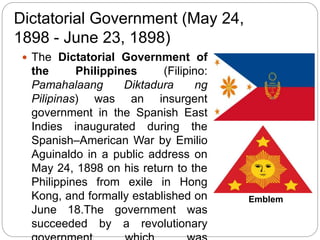
Dictatorial Government (May 24,
1898 - June 23, 1898)
 The Dictatorial Government of
the Philippines (Filipino:
Pamahalaang Diktadura ng
Pilipinas) was an insurgent
government in the Spanish East
Indies inaugurated during the
Spanish–American War by Emilio
Aguinaldo in a public address on
May 24, 1898 on his return to the
Philippines from exile in Hong
Kong, and formally established on
June 18.The government was
succeeded by a revolutionary
Emblem
 In 1896, the Philippine Revolution began. In
December 1897, the Spanish government and the
revolutionaries signed a truce, the Pact of Biak-na-
Bato, requiring that the Spanish pay the
revolutionaries 800,000 pesos and that Aguinaldo and
other leaders go into exile in Hong Kong. In April
1898, at the outbreak of the Spanish–American War,
Commodore George Dewey aboard the U.S.S.
Olympia sailed from Hong Kong to Manila Bay leading
the Asiatic Squadron of the U.S. Navy. On May 1,
1898, the United States defeated the Spanish in the
Battle of Manila Bay. Emilio Aguinaldo decided to
return to the Philippines to help American forces
defeat the Spaniards. The U.S. Navy agreed to
transport him back aboard the USS McCulloch, and
on May 19, he arrived in Cavite.
 On 12 June 1898, Aguinaldo proclaimed the
independence of the Philippines at his house in
Cavite El Viejo. Ambrosio Rianzares Bautista
wrote the Philippine Declaration of Independence,
and read this document in Spanish that day at
Aguinaldo's house. On 18 June, Aguinaldo issued
a decree formally establishing his dictatorial
government. On June 23, Aguinaldo issued
another decree, this time replacing the dictatorial
government with a revolutionary government (and
naming himself as President).
Revolutionary Government of the
Philippines (1898–1899)
 The Revolutionary Government of the
Philippines (Filipino: Pamahalaang
Panghimagsikan ng Pilipinas) was an insurgent
government established in the Spanish East
Indies on June 23, 1898, during the Spanish–
American War, by Emilio Aguinaldo, its initial and
only President. The government succeeded a
dictatorial government which had been
established by Aguinaldo on 18 June, and which
was disestablished and replaced by this
government upon its establishment. This
government endured until January 23, 1899,
when the proclamation of the Malolos
Constitution established an insurgent Philippine
Republic government which replaced it.
 Head of the state – Emilio Aguinaldo
 Head of the government –( Prime Minister)
Apolinario Mabini
 The Prime Minister of the Philippines (Filipino:
Punong Ministro ng Pilipinas) was the official
designation of the head of the government
(whereas the President of the Philippines was the
head of state) of the Philippines from 1978 until the
People Power Revolution in 1986. A limited version
of this office existed temporarily in 1899 during the
First Philippine Republic.
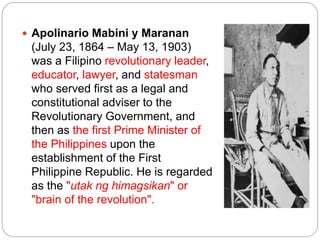
 Apolinario Mabini y Maranan
(July 23, 1864 – May 13, 1903)
was a Filipino revolutionary leader,
educator, lawyer, and statesman
who served first as a legal and
constitutional adviser to the
Revolutionary Government, and
then as the first Prime Minister of
the Philippines upon the
establishment of the First
Philippine Republic. He is regarded
as the "utak ng himagsikan" or
"brain of the revolution".
REPUBLICA FILIPINA (1899 – 1901)
 The Philippine Republic (Spanish: República
Filipina; Filipino: Repúblikáng Pilipino), more
commonly known as the First Philippine Republic
or the Malolos Republic, was a nascent
revolutionary government in the Philippines. It was
formally established with the proclamation of the
Malolos Constitution on January 21, 1899, in
Malolos, Bulacan,and endured until the capture of
President Emilio Aguinaldo by the American forces
on March 23, 1901, in Palanan, Isabela, which
effectively dissolved the First Republic.
TAGALOG REPUBLIC (1902 – 1906)
 PRESIDENT – MACARIO SAKAY
 Macario Sakay y de León (March
1, 1878 – September 13, 1907)
was a Filipino general who took
part in the 1896 Philippine
Revolution against the Spanish
Empire and in the Philippine-
American War. After the war was
declared over by the United States
in 1902, Sakay continued
resistance by leading guerrilla
raids. The following year he
became President of the Tagalog
Republic.
United States Military Government (1902)
 The United States Military Government of
the Philippine Islands (Filipino:
Pamahalaang Militar ng Estados Unidos sa
Kapuluan ng Pilipinas) was a military
government in the Philippines established by
the United States on August 14, 1898, a day
after the capture of Manila, with General
Merritt acting as military governor. During
military rule (1898–1902), the U.S. military
commander governed the Philippines under
the authority of the U.S. president as
Commander-in-Chief of the United States
Armed Forces. After the appointment of a civil
Governor-General, the procedure developed
that as parts of the country were pacified and
placed firmly under American control,
responsibility for the area would be passed to
the civilian
 U.S President – William McKinley (1898 –
Insular Government (1901 – 1935)
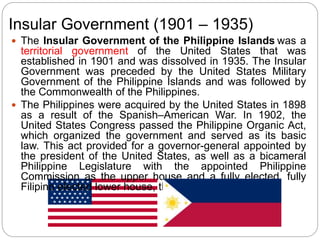
 The Insular Government of the Philippine Islands was a
territorial government of the United States that was
established in 1901 and was dissolved in 1935. The Insular
Government was preceded by the United States Military
Government of the Philippine Islands and was followed by
the Commonwealth of the Philippines.
 The Philippines were acquired by the United States in 1898
as a result of the Spanish–American War. In 1902, the
United States Congress passed the Philippine Organic Act,
which organized the government and served as its basic
law. This act provided for a governor-general appointed by
the president of the United States, as well as a bicameral
Philippine Legislature with the appointed Philippine
Commission as the upper house and a fully elected, fully
Filipino elected lower house, the Philippine Assembly.
Commonwealth (1935 – 1946)
 The Commonwealth of the
Philippines (Spanish:
Commonwealth de Filipinas;Tagalog:
Komonwelt ng Pilipina) was the
administrative body that governed the
Philippines from 1935 to 1946, aside
from a period of exile in the Second
World War from 1942 to 1945 when
Japan occupied the country. It
replaced the Insular Government, a
United States territorial government,
and was established by the Tydings–
McDuffie Act. The Commonwealth
was designed as a transitional
administration in preparation for the
PHILIPPINES
Manuel L.
Quezon –
(1935–1944)
Sergio Osmeña Sr. – (1944-1946)
Manuel Roxas - (1946 – 1948)
Second Philippine Republic(1943 – 1945)
 The Second Philippine Republic, officially
known as the Republic of the Philippines
(Filipino: Republika ng Pilipinas; Spanish:
República de Filipinas) and also known as the
Japanese-sponsored Philippine Republic, was
a puppet state established on October 14, 1943,
during the Japanese occupation.
 President Manuel L. Quezon declared the
national capital Manila an "open city", and left it
under the rule of Jorge B. Vargas, as mayor. The
Japanese entered the city on January 2, 1942,
and established it as the capital. Japan fully
captured the Philippines on May 6, 1942, after the
Battle of Corregidor.
 Head of State – Jose P.
Laurel (President of the
Philippines (1943–1945)
 Head of the Government –
Japanese Military Governor
Shigenori Kudora(1943–
1944)
Tomoyoki Yamashita (1944–
1945)
Jose P. Laurel
THIRD REPUBLIC OF THE
PHILIPPINES – (1946-1965)
 The United States of America granted independence to
the Philippines on July 4, 1946. In accordance with the
Philippine Independence Act (more popularly known as
the "Tydings–McDuffie Act"), President Harry S.
Truman issued Proclamation 2695 of July 4, 1946
officially recognizing the independence of the
Philippines.
 On the same day, representatives of the United States
of America and of the Republic of the Philippines
signed a Treaty of General Relations between the two
governments. The treaty provided for the recognition of
the independence of the Republic of the Philippines as
of July 4, 1946, and the relinquishment of American
sovereignty over the Philippine Islands.
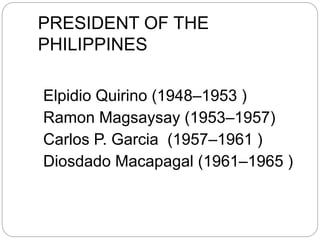
PRESIDENT OF THE
PHILIPPINES
Elpidio Quirino (1948–1953 )
Ramon Magsaysay (1953–1957)
Carlos P. Garcia (1957–1961 )
Diosdado Macapagal (1961–1965 )
Fourth Republic of the
Philippines(1965-1986)
 The history of the Philippines, from 1965–
1986, covers the presidency of Ferdinand
Marcos, also known as Ferdinand Marcos
Administration. The Marcos era includes
the final years of the Third Republic
(1965–72), the Philippines under martial
law (1972–81), and the majority of the
Fourth Republic (1981–86).
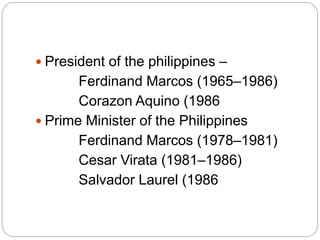
 President of the philippines –
Ferdinand Marcos (1965–1986)
Corazon Aquino (1986
 Prime Minister of the Philippines
Ferdinand Marcos (1978–1981)
Cesar Virata (1981–1986)
Salvador Laurel (1986
Fifth Republic of the
Philippines(1987)
 The history of the Philippines following the 1986
People Power Revolution known as the
contemporary history of the Philippines.
Corazon Aquino administration (1986–1992)
Fidel Ramos administration (1992–199
Joseph Estrada administration (1998–2001)
Gloria Macapagal Arroyo administration (2001–
2010)
Benigno Aquino III administration (2010–2016)
Rodrigo Duterte administration (2016–present)
THANK
YOU!

STAGES_IN_THE_EVOLUTION_OF_THE_PHILIPPINE_POLITICS.pptx

  • 1.
    STAGES IN THEEVOLUTION OF THE PHILIPPINE POLITICS AND GOVERNANACE
  • 2.
    PRE-COLONIAL (900-1521)  Thebarangay was the Filipino's earliest form of government. It was an independent settlement consisting of thirty to one hundred families usually situated along a river bank or at the mouth of a river spilling out to the sea. The term barangay was derived from the Malay word barangay or balangay, which means sailboat. The barangays were used to transport the early Filipinos and their cargoes to the various sections of the Philippine
  • 3.
     Each barangaywas ruled by a datu or village chief who was also known as raha or rajah and sultan. Some datus were more powerful than others and, consequently, were duly respected and exercise tremendous influence. The political development of the archipelago was such that there was no national or central government yet. In other words, there was no datu strong enough to consolidate considerable power and to unite the archipelago into one nation.  The primary duty of the datu was to rule and govern his subjects and to promote their well-being. In times of peace, he was the chief executive, legislator, and judge. And, in times of conflict, he was the supreme commander of the warriors.
  • 4.
     The datuusually obtained his position by inheritance. However, one could also become a datu through display of his prowess and valor in battle, or by proving his leadership skills or other traits useful for the barangay's survival. In matters of succession in the vent of the datu's death, the first son usually succeeded him. If the first son died without leaving an heir, the second son succeeded as datu. In the absence of any male heir, the eldest daughter could become a chieftain. This clearly indicates that women's rights and abilities were recognized during pre-Spanish times. If a datu died without any heir, the people of the barangay choose a man to become the new chieftain on the basis of his wisdom, wealth and physical strength.
  • 5.
    SPANISH COLONY (1521-1898) The history of the Philippines from 1521 to 1898, also known as the Spanish colonial period from 1565, was the period following the arrival of Magellan in the Philippines and during Spain financed expeditions to the Philippine islands and then ruled them as the Captaincy General of the Philippines within the Spanish East Indies, initially under New Spain until Mexican independence in 1821, which gave Madrid direct control over the area. It started with the arrival in 1521 of European explorer Ferdinand Magellan sailing for Spain, which heralded the period when the Philippines was a colony of the Spanish Empire, and ended with the outbreak of the Philippine Revolution in 1898, which marked the beginning of the American colonial era of Philippine history.
  • 6.
    SPANISH EAST INDIES Head of the State – Queen Regent of the Spain, King of Spain  Head of the Government – Spanish Governor- General
  • 7.
    HARING BAYAN KATAGALUGAN(1896-1897) Tagalog Republic (Filipino: Republika ng Katagalugan or Republikang Tagalog) is a term used to refer to two revolutionary governments involved in the Philippine Revolution against Spain and the Philippine–American War. Both were connected to the Katipunan revolutionary movement.  Andrés Bonifacio, a founding member of the Katipunan and later its supreme head (Supremo), promoted the use of Katagalugan for the Philippine nation. The term "Filipino" was then reserved for Spaniards born in the islands. By eschewing "Filipino" and "Filipinas" which had colonial roots, Bonifacio and his cohorts "sought to form a national identity."
  • 8.
     Supreme LeaderAndres Bonifacio (Kataas- taasang Sanggunian (Supreme Council)
  • 9.
    Tejeros Revolutionary Republic(March 22, 1897 – November 1, 1897)  The Tejeros Convention (alternate names include Tejeros Assembly and Tejeros Congress) was the meeting held on March 22, 1897 between the Magdiwang and Magdalo factions of the Katipunan at San Francisco de Malabon (now General Trias, but the site is now at Rosario), Cavite. These are the first presidential and vice presidential elections in Philippine history, although only the Katipuneros (members of the Katipunan) were able to take part, and not the general populace.  President of the Philippines Emilio
  • 10.
    Republic of Biak-na-Bato( November 1, 1897 – December 14, 1897)  The Republic of Biak-na-Bato (Tagalog: Republika ng Biak-na-Bato, Spanish: República de Biac-na-Bató), officially referred to in its constitution as the Republic of the Philippines (Tagalog: Republika ng Pilipinas, Spanish: República de Filipinas), was the first republic ever declared in the Philippines by revolutionary leader Emilio Aguinaldo and his fellow revolutionaries. Despite its successes, including the establishment of the Philippines' first ever constitution, the republic lasted just over a month. It was disestablished by a peace treaty signed by Aguinaldo and the Spanish Governor-General, Fernando Primo de Rivera which included provision for exile
  • 11.
    Dictatorial Government (May24, 1898 - June 23, 1898)  The Dictatorial Government of the Philippines (Filipino: Pamahalaang Diktadura ng Pilipinas) was an insurgent government in the Spanish East Indies inaugurated during the Spanish–American War by Emilio Aguinaldo in a public address on May 24, 1898 on his return to the Philippines from exile in Hong Kong, and formally established on June 18.The government was succeeded by a revolutionary Emblem
  • 12.
     In 1896,the Philippine Revolution began. In December 1897, the Spanish government and the revolutionaries signed a truce, the Pact of Biak-na- Bato, requiring that the Spanish pay the revolutionaries 800,000 pesos and that Aguinaldo and other leaders go into exile in Hong Kong. In April 1898, at the outbreak of the Spanish–American War, Commodore George Dewey aboard the U.S.S. Olympia sailed from Hong Kong to Manila Bay leading the Asiatic Squadron of the U.S. Navy. On May 1, 1898, the United States defeated the Spanish in the Battle of Manila Bay. Emilio Aguinaldo decided to return to the Philippines to help American forces defeat the Spaniards. The U.S. Navy agreed to transport him back aboard the USS McCulloch, and on May 19, he arrived in Cavite.
  • 13.
     On 12June 1898, Aguinaldo proclaimed the independence of the Philippines at his house in Cavite El Viejo. Ambrosio Rianzares Bautista wrote the Philippine Declaration of Independence, and read this document in Spanish that day at Aguinaldo's house. On 18 June, Aguinaldo issued a decree formally establishing his dictatorial government. On June 23, Aguinaldo issued another decree, this time replacing the dictatorial government with a revolutionary government (and naming himself as President).
  • 14.
    Revolutionary Government ofthe Philippines (1898–1899)  The Revolutionary Government of the Philippines (Filipino: Pamahalaang Panghimagsikan ng Pilipinas) was an insurgent government established in the Spanish East Indies on June 23, 1898, during the Spanish– American War, by Emilio Aguinaldo, its initial and only President. The government succeeded a dictatorial government which had been established by Aguinaldo on 18 June, and which was disestablished and replaced by this government upon its establishment. This government endured until January 23, 1899, when the proclamation of the Malolos Constitution established an insurgent Philippine Republic government which replaced it.
  • 15.
     Head ofthe state – Emilio Aguinaldo  Head of the government –( Prime Minister) Apolinario Mabini  The Prime Minister of the Philippines (Filipino: Punong Ministro ng Pilipinas) was the official designation of the head of the government (whereas the President of the Philippines was the head of state) of the Philippines from 1978 until the People Power Revolution in 1986. A limited version of this office existed temporarily in 1899 during the First Philippine Republic.
  • 16.
     Apolinario Mabiniy Maranan (July 23, 1864 – May 13, 1903) was a Filipino revolutionary leader, educator, lawyer, and statesman who served first as a legal and constitutional adviser to the Revolutionary Government, and then as the first Prime Minister of the Philippines upon the establishment of the First Philippine Republic. He is regarded as the "utak ng himagsikan" or "brain of the revolution".
  • 17.
    REPUBLICA FILIPINA (1899– 1901)  The Philippine Republic (Spanish: República Filipina; Filipino: Repúblikáng Pilipino), more commonly known as the First Philippine Republic or the Malolos Republic, was a nascent revolutionary government in the Philippines. It was formally established with the proclamation of the Malolos Constitution on January 21, 1899, in Malolos, Bulacan,and endured until the capture of President Emilio Aguinaldo by the American forces on March 23, 1901, in Palanan, Isabela, which effectively dissolved the First Republic.
  • 18.
    TAGALOG REPUBLIC (1902– 1906)  PRESIDENT – MACARIO SAKAY  Macario Sakay y de León (March 1, 1878 – September 13, 1907) was a Filipino general who took part in the 1896 Philippine Revolution against the Spanish Empire and in the Philippine- American War. After the war was declared over by the United States in 1902, Sakay continued resistance by leading guerrilla raids. The following year he became President of the Tagalog Republic.
  • 19.
    United States MilitaryGovernment (1902)  The United States Military Government of the Philippine Islands (Filipino: Pamahalaang Militar ng Estados Unidos sa Kapuluan ng Pilipinas) was a military government in the Philippines established by the United States on August 14, 1898, a day after the capture of Manila, with General Merritt acting as military governor. During military rule (1898–1902), the U.S. military commander governed the Philippines under the authority of the U.S. president as Commander-in-Chief of the United States Armed Forces. After the appointment of a civil Governor-General, the procedure developed that as parts of the country were pacified and placed firmly under American control, responsibility for the area would be passed to the civilian  U.S President – William McKinley (1898 –
  • 20.
    Insular Government (1901– 1935)  The Insular Government of the Philippine Islands was a territorial government of the United States that was established in 1901 and was dissolved in 1935. The Insular Government was preceded by the United States Military Government of the Philippine Islands and was followed by the Commonwealth of the Philippines.  The Philippines were acquired by the United States in 1898 as a result of the Spanish–American War. In 1902, the United States Congress passed the Philippine Organic Act, which organized the government and served as its basic law. This act provided for a governor-general appointed by the president of the United States, as well as a bicameral Philippine Legislature with the appointed Philippine Commission as the upper house and a fully elected, fully Filipino elected lower house, the Philippine Assembly.
  • 21.
    Commonwealth (1935 –1946)  The Commonwealth of the Philippines (Spanish: Commonwealth de Filipinas;Tagalog: Komonwelt ng Pilipina) was the administrative body that governed the Philippines from 1935 to 1946, aside from a period of exile in the Second World War from 1942 to 1945 when Japan occupied the country. It replaced the Insular Government, a United States territorial government, and was established by the Tydings– McDuffie Act. The Commonwealth was designed as a transitional administration in preparation for the
  • 22.
    PHILIPPINES Manuel L. Quezon – (1935–1944) SergioOsmeña Sr. – (1944-1946) Manuel Roxas - (1946 – 1948)
  • 23.
    Second Philippine Republic(1943– 1945)  The Second Philippine Republic, officially known as the Republic of the Philippines (Filipino: Republika ng Pilipinas; Spanish: República de Filipinas) and also known as the Japanese-sponsored Philippine Republic, was a puppet state established on October 14, 1943, during the Japanese occupation.  President Manuel L. Quezon declared the national capital Manila an "open city", and left it under the rule of Jorge B. Vargas, as mayor. The Japanese entered the city on January 2, 1942, and established it as the capital. Japan fully captured the Philippines on May 6, 1942, after the Battle of Corregidor.
  • 24.
     Head ofState – Jose P. Laurel (President of the Philippines (1943–1945)  Head of the Government – Japanese Military Governor Shigenori Kudora(1943– 1944) Tomoyoki Yamashita (1944– 1945) Jose P. Laurel
  • 25.
    THIRD REPUBLIC OFTHE PHILIPPINES – (1946-1965)  The United States of America granted independence to the Philippines on July 4, 1946. In accordance with the Philippine Independence Act (more popularly known as the "Tydings–McDuffie Act"), President Harry S. Truman issued Proclamation 2695 of July 4, 1946 officially recognizing the independence of the Philippines.  On the same day, representatives of the United States of America and of the Republic of the Philippines signed a Treaty of General Relations between the two governments. The treaty provided for the recognition of the independence of the Republic of the Philippines as of July 4, 1946, and the relinquishment of American sovereignty over the Philippine Islands.
  • 26.
    PRESIDENT OF THE PHILIPPINES ElpidioQuirino (1948–1953 ) Ramon Magsaysay (1953–1957) Carlos P. Garcia (1957–1961 ) Diosdado Macapagal (1961–1965 )
  • 27.
    Fourth Republic ofthe Philippines(1965-1986)  The history of the Philippines, from 1965– 1986, covers the presidency of Ferdinand Marcos, also known as Ferdinand Marcos Administration. The Marcos era includes the final years of the Third Republic (1965–72), the Philippines under martial law (1972–81), and the majority of the Fourth Republic (1981–86).
  • 28.
     President ofthe philippines – Ferdinand Marcos (1965–1986) Corazon Aquino (1986  Prime Minister of the Philippines Ferdinand Marcos (1978–1981) Cesar Virata (1981–1986) Salvador Laurel (1986
  • 29.
    Fifth Republic ofthe Philippines(1987)  The history of the Philippines following the 1986 People Power Revolution known as the contemporary history of the Philippines. Corazon Aquino administration (1986–1992) Fidel Ramos administration (1992–199 Joseph Estrada administration (1998–2001) Gloria Macapagal Arroyo administration (2001– 2010) Benigno Aquino III administration (2010–2016) Rodrigo Duterte administration (2016–present)
  • 30.