Introduction of Some Ensemble Learning Methods
Random Forest, Boosted Trees and so on
Honglin Yu
March 24, 2014
Outline
1 Big Picture: Ensemble Learning
2 Random Forest
3 Boosting
Big Picture: Ensemble Learning Random Forest Boosting
Big Picture
In statistics and machine learning, ensemble methods use
multiple models to obtain better predictive performance than
could be obtained from any of the constituent models.
— Wikipedia
Big Picture: Ensemble Learning Random Forest Boosting
Big Picture
In statistics and machine learning, ensemble methods use
multiple models to obtain better predictive performance than
could be obtained from any of the constituent models.
— Wikipedia
Build house (strong classifier) from bricks (weak classifiers)
Two questions:
1 What are the bricks? How to make them?
2 How to build house from bricks?
Big Picture: Ensemble Learning Random Forest Boosting
Classification and Regression Tree
Big Picture: Ensemble Learning Random Forest Boosting
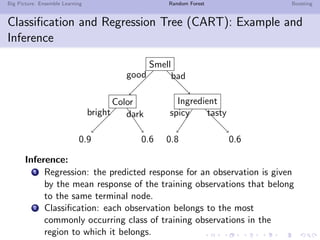
Classification and Regression Tree (CART): Example and
Inference
Smell
Color Ingredient
0.9 0.6 0.60.8
good bad
bright dark tastyspicy
Inference:
1 Regression: the predicted response for an observation is given
by the mean response of the training observations that belong
to the same terminal node.
2 Classification: each observation belongs to the most
commonly occurring class of training observations in the
region to which it belongs.
Big Picture: Ensemble Learning Random Forest Boosting
Classification and Regression Tree (CART): Learning
How to learn or build or grow a tree?
Finding the optimal partitioning of the data is NP-complete
Practical solution: greedy method
Famous Example: C4.5 algorithm
Big Picture: Ensemble Learning Random Forest Boosting
Growing the Tree (1)
Main procedure: (similar to building a kd-tree) recursively
split a node of data {xi } into two nodes (NXj <s,NXj ≥s) by one
dimension of feature Xj and a threshold s (greedy)
Big Picture: Ensemble Learning Random Forest Boosting
Growing the Tree (2)
Split criterion (selecting Xj and s):
Regression: “minimizing RSS”
min
j,s
i:(xi )j <s
(yi − ¯y1)2
+
i:(xi )j ≥s
(yi − ¯y2)2
Classification: minimizing weighted (by number of data in
nodes) sum of
Classification error rate of 1 node: 1 − max
k
(pmk )
Gini index of 1 node:
K
k=1
pmk (1 − pmk )
Cross-entropy of 1 node: −
K
k=1
pmk log pmk
Big Picture: Ensemble Learning Random Forest Boosting
Growing the Tree (3)
“When building a classification tree, either the Gini index or
the cross-entropy are typically used to evaluate the quality of a
particular split, since these two approaches are more sensitive
to node purity than is the classification error rate. Any of
these three approaches might be used when pruning the tree,
but the classification error rate is preferable if prediction
accuracy of the final pruned tree is the goal.”
— ISLR book
Big Picture: Ensemble Learning Random Forest Boosting
Growing the Tree (3)
“When building a classification tree, either the Gini index or
the cross-entropy are typically used to evaluate the quality of a
particular split, since these two approaches are more sensitive
to node purity than is the classification error rate. Any of
these three approaches might be used when pruning the tree,
but the classification error rate is preferable if prediction
accuracy of the final pruned tree is the goal.”
— ISLR book
Stop criterion: for example, until “each terminal node has
fewer than some minimum number of observations”
Big Picture: Ensemble Learning Random Forest Boosting
Pruning the Tree (1)
Why: The growed tree is often too large
Overfitting
Sensitive to data fluctuations
How: Cost complexity pruning or weakest link pruning
min
T
|T|
m=1 i:xi ∈Rm
(yi − ¯yRm )2
+ α|T|
where T is a subtree of the full tree T0. |T| is the number of
nodes of T.
Big Picture: Ensemble Learning Random Forest Boosting
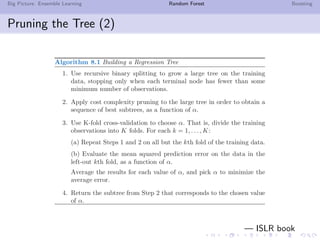
Pruning the Tree (2)
— ISLR book
Big Picture: Ensemble Learning Random Forest Boosting
Example
Big Picture: Ensemble Learning Random Forest Boosting
Example
Big Picture: Ensemble Learning Random Forest Boosting
Example
Big Picture: Ensemble Learning Random Forest Boosting
Example
Big Picture: Ensemble Learning Random Forest Boosting
Example
Big Picture: Ensemble Learning Random Forest Boosting
Example
Big Picture: Ensemble Learning Random Forest Boosting
Example
Big Picture: Ensemble Learning Random Forest Boosting
Example
Big Picture: Ensemble Learning Random Forest Boosting
Example
Big Picture: Ensemble Learning Random Forest Boosting
Example
Big Picture: Ensemble Learning Random Forest Boosting
Example
Big Picture: Ensemble Learning Random Forest Boosting
Example
Big Picture: Ensemble Learning Random Forest Boosting
Example
Big Picture: Ensemble Learning Random Forest Boosting
Pros and Cons of CART
Pros:
1 easier to interpret (easy to convert to logic rules)
2 automatic variable selection
3 scale well
4 insensitive to monotone transformations of the inputs (based
on ranking the data points), no need to scale the data
Cons:
1 performance is not good (greedy)
2 unstable
You can not expect too much on a brick ...
Qustion: what makes a good brick?
Big Picture: Ensemble Learning Random Forest Boosting
Question: Why Binary Split
Big Picture: Ensemble Learning Random Forest Boosting
Question: Why Binary Split
No concrete answer
1 Similar to logic
2 Stable (otherwise, more possibilities, errors on the top will
affect the splitting below)
Big Picture: Ensemble Learning Random Forest Boosting
Let’s begin to build the house!
Big Picture: Ensemble Learning Random Forest Boosting
Bootstrap Aggregation (Bagging): Just average it!
Bagging:
1 Build M decision trees on bootstrap data (randomly
resampled with replacement)
2 Average it:
f (x) =
1
M
M
i=1
fi (x)
Note that, CARTs here do not need pruning (why?)
Big Picture: Ensemble Learning Random Forest Boosting
Two things
1 How many trees to use (M) ? More the better, increase until
converge (CART is very fast, can be trained in parallel)
2 What is the size of bootstrap learning set? Breiman chose
same size as original data, then every bootstrap set leaves out
(1 −
1
n
)n
percentage of data (about 37% when n is large)
Big Picture: Ensemble Learning Random Forest Boosting
Question 1: Why Bagging Works?
Big Picture: Ensemble Learning Random Forest Boosting
Question 1: Why Bagging Works?
1 Bias-Variance Trade off:
E[(F(x) − fi (x))2
] = (F(x) − E[fi (x)])2
+ E[fi (x) − Efi (x)]2
= (Bias[fi (x)])2
+ Var[fi (x)]
2 |Bias(fi (x))| is small but Var(fi (x)) is big
3 Then for f (x), if {fi (x)} are mutually independent
Bias(f (x)) = Bias(fi (x))
Var(f (x)) =
1
n
Var(fi (x))
Variance is reduced by averaging
Big Picture: Ensemble Learning Random Forest Boosting
Question 2: Why Bagging works NOT quite well?
Big Picture: Ensemble Learning Random Forest Boosting
Question 2: Why Bagging works NOT quite well?
Trees are strongly Correlated (repetition, bootstrap)
To improve : random forest (add more randomness!)
Big Picture: Ensemble Learning Random Forest Boosting
Random Forest
Random forests are a combination of tree predictors such that
each tree depends on the values of a random vector sampled
independently and with the same distribution for all trees in
the forest
— LEO BREIMAN
Big Picture: Ensemble Learning Random Forest Boosting
Random Forest
Random forests are a combination of tree predictors such that
each tree depends on the values of a random vector sampled
independently and with the same distribution for all trees in
the forest
— LEO BREIMAN
Where randomness helps!
Big Picture: Ensemble Learning Random Forest Boosting
Random Forest: Learning
Where is the “extra” randomness:
As in bagging, we build a number of decision trees on
bootstrapped training samples. But when building these
decision trees, each time a split in a tree is considered, a
random sample of m predictors is chosen as split candidates
from the full set of p predictors. The split is allowed to use
only one of those m predictors.
— ISLR book
Give more chance on the “single weak” predictor (features)
Decorrelate the trees → reduce the variance of the final
hyperthesis
Big Picture: Ensemble Learning Random Forest Boosting
Random Forest
How many sub-features to choose (not very sensitive, try it
(1, half, int(log2 p + 1)))
Internal test of Random Forest (OOB error)
Interpretation
Big Picture: Ensemble Learning Random Forest Boosting
Out of Bag Error (OOB error)
“By product of bootstraping”: Out-of-bag data
For every training data (xi, yi ), there are about 37% of trees
that does not train on it.
In testing, use the 37% trees to predict the (xi, yi ). Then we
can get a RSS or classification error rate from it.
“proven to be unbiased in many tests.”
Now need to do Cross-validation.
Big Picture: Ensemble Learning Random Forest Boosting
Random Forest: Interpretation (Variable Importance)
By averaging, “Random Forest” lost the ability of “easy
interpretation” of CART. But it is still “interpretable”
Big Picture: Ensemble Learning Random Forest Boosting
Permutation Test (1)
Test correlation by permutation
Figure : Does not correlate
— Ken Rice, Thomas Lumley, 2008
Big Picture: Ensemble Learning Random Forest Boosting
Permutation Test (2)
Test correlation by permutation
Figure : Correlate
— Ken Rice, Thomas Lumley, 2008
Big Picture: Ensemble Learning Random Forest Boosting
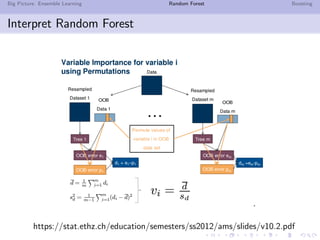
Interpret Random Forest
https://stat.ethz.ch/education/semesters/ss2012/ams/slides/v10.2.pdf
Big Picture: Ensemble Learning Random Forest Boosting
Example
Feature importance: x : y = 0.34038216 : 0.65961784
OOB error: 0.947563375391
Big Picture: Ensemble Learning Random Forest Boosting
Pros and Cons
Pros:
1 Performance is good, a lot of applications
2 not hard to interpret
3 Easy to train in parallel
Cons:
1 Easy to overfit
2 (?) worse than SVM in high dimension learning
Big Picture: Ensemble Learning Random Forest Boosting
Boosting
Main difference between Boosting and Bagging?
1 “Bricks” (CART here) are trained sequentially.
2 Every “brick” is trained on the whole data (with modification
based on training former “bricks”)
Note that, actually, “Boosting” originates before the invention of
“Random Forest”. Though “Boosting” performs better than
“Random forest” and is also more complex than it.
Big Picture: Ensemble Learning Random Forest Boosting
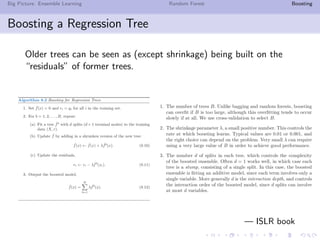
Boosting a Regression Tree
Older trees can be seen as (except shrinkage) being built on the
“residuals” of former trees.
— ISLR book
Big Picture: Ensemble Learning Random Forest Boosting
Boosting a Classification Tree
Train trees sequentially: For new trees, “hard” data from old
trees are given more weights.
Reduce bias (early stage) and the variance (late stage)
Big Picture: Ensemble Learning Random Forest Boosting
Compared with Random Forest
1 Performance is often better
2 Slow to train and test
3 Easier to overfit
Big Picture: Ensemble Learning Random Forest Boosting
Questions
Is Neural Network also Ensemble Learning?
Big Picture: Ensemble Learning Random Forest Boosting
Questions
What is the relationship between Linear Regression and Random
Forest etc.?
Big Picture: Ensemble Learning Random Forest Boosting
Big Picture again
Adaptive basis function models

Introduction to Some Tree based Learning Method

  • 1.
    Introduction of SomeEnsemble Learning Methods Random Forest, Boosted Trees and so on Honglin Yu March 24, 2014
  • 2.
    Outline 1 Big Picture:Ensemble Learning 2 Random Forest 3 Boosting
  • 3.
    Big Picture: EnsembleLearning Random Forest Boosting Big Picture In statistics and machine learning, ensemble methods use multiple models to obtain better predictive performance than could be obtained from any of the constituent models. — Wikipedia
  • 4.
    Big Picture: EnsembleLearning Random Forest Boosting Big Picture In statistics and machine learning, ensemble methods use multiple models to obtain better predictive performance than could be obtained from any of the constituent models. — Wikipedia Build house (strong classifier) from bricks (weak classifiers) Two questions: 1 What are the bricks? How to make them? 2 How to build house from bricks?
  • 5.
    Big Picture: EnsembleLearning Random Forest Boosting Classification and Regression Tree
  • 6.
    Big Picture: EnsembleLearning Random Forest Boosting Classification and Regression Tree (CART): Example and Inference Smell Color Ingredient 0.9 0.6 0.60.8 good bad bright dark tastyspicy Inference: 1 Regression: the predicted response for an observation is given by the mean response of the training observations that belong to the same terminal node. 2 Classification: each observation belongs to the most commonly occurring class of training observations in the region to which it belongs.
  • 7.
    Big Picture: EnsembleLearning Random Forest Boosting Classification and Regression Tree (CART): Learning How to learn or build or grow a tree? Finding the optimal partitioning of the data is NP-complete Practical solution: greedy method Famous Example: C4.5 algorithm
  • 8.
    Big Picture: EnsembleLearning Random Forest Boosting Growing the Tree (1) Main procedure: (similar to building a kd-tree) recursively split a node of data {xi } into two nodes (NXj <s,NXj ≥s) by one dimension of feature Xj and a threshold s (greedy)
  • 9.
    Big Picture: EnsembleLearning Random Forest Boosting Growing the Tree (2) Split criterion (selecting Xj and s): Regression: “minimizing RSS” min j,s i:(xi )j <s (yi − ¯y1)2 + i:(xi )j ≥s (yi − ¯y2)2 Classification: minimizing weighted (by number of data in nodes) sum of Classification error rate of 1 node: 1 − max k (pmk ) Gini index of 1 node: K k=1 pmk (1 − pmk ) Cross-entropy of 1 node: − K k=1 pmk log pmk
  • 10.
    Big Picture: EnsembleLearning Random Forest Boosting Growing the Tree (3) “When building a classification tree, either the Gini index or the cross-entropy are typically used to evaluate the quality of a particular split, since these two approaches are more sensitive to node purity than is the classification error rate. Any of these three approaches might be used when pruning the tree, but the classification error rate is preferable if prediction accuracy of the final pruned tree is the goal.” — ISLR book
  • 11.
    Big Picture: EnsembleLearning Random Forest Boosting Growing the Tree (3) “When building a classification tree, either the Gini index or the cross-entropy are typically used to evaluate the quality of a particular split, since these two approaches are more sensitive to node purity than is the classification error rate. Any of these three approaches might be used when pruning the tree, but the classification error rate is preferable if prediction accuracy of the final pruned tree is the goal.” — ISLR book Stop criterion: for example, until “each terminal node has fewer than some minimum number of observations”
  • 12.
    Big Picture: EnsembleLearning Random Forest Boosting Pruning the Tree (1) Why: The growed tree is often too large Overfitting Sensitive to data fluctuations How: Cost complexity pruning or weakest link pruning min T |T| m=1 i:xi ∈Rm (yi − ¯yRm )2 + α|T| where T is a subtree of the full tree T0. |T| is the number of nodes of T.
  • 13.
    Big Picture: EnsembleLearning Random Forest Boosting Pruning the Tree (2) — ISLR book
  • 14.
    Big Picture: EnsembleLearning Random Forest Boosting Example
  • 15.
    Big Picture: EnsembleLearning Random Forest Boosting Example
  • 16.
    Big Picture: EnsembleLearning Random Forest Boosting Example
  • 17.
    Big Picture: EnsembleLearning Random Forest Boosting Example
  • 18.
    Big Picture: EnsembleLearning Random Forest Boosting Example
  • 19.
    Big Picture: EnsembleLearning Random Forest Boosting Example
  • 20.
    Big Picture: EnsembleLearning Random Forest Boosting Example
  • 21.
    Big Picture: EnsembleLearning Random Forest Boosting Example
  • 22.
    Big Picture: EnsembleLearning Random Forest Boosting Example
  • 23.
    Big Picture: EnsembleLearning Random Forest Boosting Example
  • 24.
    Big Picture: EnsembleLearning Random Forest Boosting Example
  • 25.
    Big Picture: EnsembleLearning Random Forest Boosting Example
  • 26.
    Big Picture: EnsembleLearning Random Forest Boosting Example
  • 27.
    Big Picture: EnsembleLearning Random Forest Boosting Pros and Cons of CART Pros: 1 easier to interpret (easy to convert to logic rules) 2 automatic variable selection 3 scale well 4 insensitive to monotone transformations of the inputs (based on ranking the data points), no need to scale the data Cons: 1 performance is not good (greedy) 2 unstable You can not expect too much on a brick ... Qustion: what makes a good brick?
  • 28.
    Big Picture: EnsembleLearning Random Forest Boosting Question: Why Binary Split
  • 29.
    Big Picture: EnsembleLearning Random Forest Boosting Question: Why Binary Split No concrete answer 1 Similar to logic 2 Stable (otherwise, more possibilities, errors on the top will affect the splitting below)
  • 30.
    Big Picture: EnsembleLearning Random Forest Boosting Let’s begin to build the house!
  • 31.
    Big Picture: EnsembleLearning Random Forest Boosting Bootstrap Aggregation (Bagging): Just average it! Bagging: 1 Build M decision trees on bootstrap data (randomly resampled with replacement) 2 Average it: f (x) = 1 M M i=1 fi (x) Note that, CARTs here do not need pruning (why?)
  • 32.
    Big Picture: EnsembleLearning Random Forest Boosting Two things 1 How many trees to use (M) ? More the better, increase until converge (CART is very fast, can be trained in parallel) 2 What is the size of bootstrap learning set? Breiman chose same size as original data, then every bootstrap set leaves out (1 − 1 n )n percentage of data (about 37% when n is large)
  • 33.
    Big Picture: EnsembleLearning Random Forest Boosting Question 1: Why Bagging Works?
  • 34.
    Big Picture: EnsembleLearning Random Forest Boosting Question 1: Why Bagging Works? 1 Bias-Variance Trade off: E[(F(x) − fi (x))2 ] = (F(x) − E[fi (x)])2 + E[fi (x) − Efi (x)]2 = (Bias[fi (x)])2 + Var[fi (x)] 2 |Bias(fi (x))| is small but Var(fi (x)) is big 3 Then for f (x), if {fi (x)} are mutually independent Bias(f (x)) = Bias(fi (x)) Var(f (x)) = 1 n Var(fi (x)) Variance is reduced by averaging
  • 35.
    Big Picture: EnsembleLearning Random Forest Boosting Question 2: Why Bagging works NOT quite well?
  • 36.
    Big Picture: EnsembleLearning Random Forest Boosting Question 2: Why Bagging works NOT quite well? Trees are strongly Correlated (repetition, bootstrap) To improve : random forest (add more randomness!)
  • 37.
    Big Picture: EnsembleLearning Random Forest Boosting Random Forest Random forests are a combination of tree predictors such that each tree depends on the values of a random vector sampled independently and with the same distribution for all trees in the forest — LEO BREIMAN
  • 38.
    Big Picture: EnsembleLearning Random Forest Boosting Random Forest Random forests are a combination of tree predictors such that each tree depends on the values of a random vector sampled independently and with the same distribution for all trees in the forest — LEO BREIMAN Where randomness helps!
  • 39.
    Big Picture: EnsembleLearning Random Forest Boosting Random Forest: Learning Where is the “extra” randomness: As in bagging, we build a number of decision trees on bootstrapped training samples. But when building these decision trees, each time a split in a tree is considered, a random sample of m predictors is chosen as split candidates from the full set of p predictors. The split is allowed to use only one of those m predictors. — ISLR book Give more chance on the “single weak” predictor (features) Decorrelate the trees → reduce the variance of the final hyperthesis
  • 40.
    Big Picture: EnsembleLearning Random Forest Boosting Random Forest How many sub-features to choose (not very sensitive, try it (1, half, int(log2 p + 1))) Internal test of Random Forest (OOB error) Interpretation
  • 41.
    Big Picture: EnsembleLearning Random Forest Boosting Out of Bag Error (OOB error) “By product of bootstraping”: Out-of-bag data For every training data (xi, yi ), there are about 37% of trees that does not train on it. In testing, use the 37% trees to predict the (xi, yi ). Then we can get a RSS or classification error rate from it. “proven to be unbiased in many tests.” Now need to do Cross-validation.
  • 42.
    Big Picture: EnsembleLearning Random Forest Boosting Random Forest: Interpretation (Variable Importance) By averaging, “Random Forest” lost the ability of “easy interpretation” of CART. But it is still “interpretable”
  • 43.
    Big Picture: EnsembleLearning Random Forest Boosting Permutation Test (1) Test correlation by permutation Figure : Does not correlate — Ken Rice, Thomas Lumley, 2008
  • 44.
    Big Picture: EnsembleLearning Random Forest Boosting Permutation Test (2) Test correlation by permutation Figure : Correlate — Ken Rice, Thomas Lumley, 2008
  • 45.
    Big Picture: EnsembleLearning Random Forest Boosting Interpret Random Forest https://stat.ethz.ch/education/semesters/ss2012/ams/slides/v10.2.pdf
  • 46.
    Big Picture: EnsembleLearning Random Forest Boosting Example Feature importance: x : y = 0.34038216 : 0.65961784 OOB error: 0.947563375391
  • 47.
    Big Picture: EnsembleLearning Random Forest Boosting Pros and Cons Pros: 1 Performance is good, a lot of applications 2 not hard to interpret 3 Easy to train in parallel Cons: 1 Easy to overfit 2 (?) worse than SVM in high dimension learning
  • 48.
    Big Picture: EnsembleLearning Random Forest Boosting Boosting Main difference between Boosting and Bagging? 1 “Bricks” (CART here) are trained sequentially. 2 Every “brick” is trained on the whole data (with modification based on training former “bricks”) Note that, actually, “Boosting” originates before the invention of “Random Forest”. Though “Boosting” performs better than “Random forest” and is also more complex than it.
  • 49.
    Big Picture: EnsembleLearning Random Forest Boosting Boosting a Regression Tree Older trees can be seen as (except shrinkage) being built on the “residuals” of former trees. — ISLR book
  • 50.
    Big Picture: EnsembleLearning Random Forest Boosting Boosting a Classification Tree Train trees sequentially: For new trees, “hard” data from old trees are given more weights. Reduce bias (early stage) and the variance (late stage)
  • 51.
    Big Picture: EnsembleLearning Random Forest Boosting Compared with Random Forest 1 Performance is often better 2 Slow to train and test 3 Easier to overfit
  • 52.
    Big Picture: EnsembleLearning Random Forest Boosting Questions Is Neural Network also Ensemble Learning?
  • 53.
    Big Picture: EnsembleLearning Random Forest Boosting Questions What is the relationship between Linear Regression and Random Forest etc.?
  • 54.
    Big Picture: EnsembleLearning Random Forest Boosting Big Picture again Adaptive basis function models