Machine Learning
Sanjivani Rural Education Society’s
Sanjivani College of Engineering, Kopargaon-423603
(An Autonomous Institute Affiliated to Savitribai Phule Pune University, Pune)
NAAC ‘A’ Grade Accredited
Department of Information Technology
NBAAccredited-UG Programme
Ms. K. D. Patil
Assistant Professor
Contents - Classification
• Sigmoid function, Classification Algorithm in Machine Learning,
Decision Trees, Ensemble Techniques: Bagging and boosting, Adaboost
and gradient boost, Random Forest, Naïve Bayes Classifier, Support
Vector Machines. Performance Evaluation: Confusion Matrix, Accuracy,
Precision, Recall, AUC-ROC Curves, F-Measure
Machine Learning Department of Information Technology
Course Outcome
• CO3: To apply different classification algorithms for various machine
learning applications.
Machine Learning Department of Information Technology
Random Forest
Machine Learning Department of Information Technology
• Random Forest Algorithm widespread popularity stems from its user-
friendly nature and adaptability, enabling it to tackle both classification
and regression problems effectively.
• The algorithm’s strength lies in its ability to handle complex datasets and
mitigate over-fitting, making it a valuable tool for various predictive tasks
in machine learning.
• One of the most important features of the Random Forest Algorithm is
that it can handle the data set containing continuous variables, as in the
case of regression, and categorical variables, as in the case of
classification.
Ensemble Learning Technique
Machine Learning Department of Information Technology
• Before understanding the working of the random forest algorithm in
machine learning, we must look into the Ensemble learning technique.
• Ensemble simply means combining multiple models. Thus a collection of
models is used to make predictions rather than an individual model.
• Ensemble uses two types of methods:
• Bagging
• Boosting
Ensemble Learning Technique
Machine Learning Department of Information Technology
• Bagging:
• It creates a different training subset from sample training data with
replacement & the final output is based on majority voting.
• It is a homogeneous weak learners’ model.
• It learns from each other independently in parallel and combines them
for determining the model average.
• For example, Random Forest.
Ensemble Learning Technique
Machine Learning Department of Information Technology
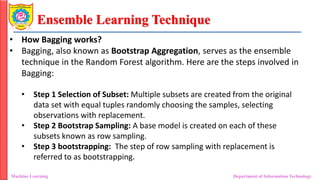
• How Bagging works?
• Bagging, also known as Bootstrap Aggregation, serves as the ensemble
technique in the Random Forest algorithm. Here are the steps involved in
Bagging:
• Step 1 Selection of Subset: Multiple subsets are created from the original
data set with equal tuples randomly choosing the samples, selecting
observations with replacement.
• Step 2 Bootstrap Sampling: A base model is created on each of these
subsets known as row sampling.
• Step 3 bootstrapping: The step of row sampling with replacement is
referred to as bootstrapping.
Ensemble Learning Technique
Machine Learning Department of Information Technology
• How Bagging works?
• Step 4 Independent Model Training: Each model is learned in parallel with
each training set and independent of each other.
• Step 5 Majority Voting: The final predictions are determined by combining
the predictions from all the models through majority voting. The most
commonly predicted outcome among the model is selected.
• Step 6 Aggregation: All results are combined and final output is generated
based on majority voting known as aggregation.
Ensemble Learning Technique
Machine Learning Department of Information Technology
• How Bagging works?
Ensemble Learning Technique
Machine Learning Department of Information Technology
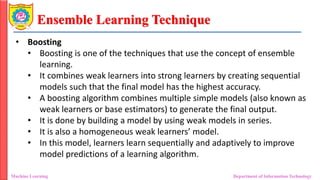
• Boosting
• Boosting is one of the techniques that use the concept of ensemble
learning.
• It combines weak learners into strong learners by creating sequential
models such that the final model has the highest accuracy.
• A boosting algorithm combines multiple simple models (also known as
weak learners or base estimators) to generate the final output.
• It is done by building a model by using weak models in series.
• It is also a homogeneous weak learners’ model.
• In this model, learners learn sequentially and adaptively to improve
model predictions of a learning algorithm.
Ensemble Learning Technique
Machine Learning Department of Information Technology
• Boosting:
• There are several boosting algorithms. For example, ADA BOOST, XG
BOOST.
• AdaBoost was the first really successful boosting algorithm that was
developed for the purpose of binary classification.
• AdaBoost is an abbreviation for Adaptive Boosting and is a prevalent
boosting technique that combines multiple “weak classifiers” into a
single “strong classifier.”
Ensemble Learning Technique
Machine Learning Department of Information Technology
• How Boosting works?
1. Initialize the dataset and assign equal
weight to each of the data point.
2. Provide this as input to the model and
identify the wrongly classified data
points.
3. Increase the weight of the wrongly
classified data points and decrease the
weights of correctly classified data
points. And then normalize the weights
of all data points.
4. if (got required results) Goto step 5
else Goto step 2
5. End
Ensemble Learning Technique
Machine Learning Department of Information Technology
Random Forest
Machine Learning Department of Information Technology
• How Random Forest Works?
• Step 1: In the Random forest model, a subset of data points and a
subset of features is selected for constructing each decision tree.
Simply n random records and m features are taken from the data set
having k number of records.
• Step 2: Individual decision trees are constructed for each sample.
• Step 3: Each decision tree will generate an output.
• Step 4: Final output is considered based on Majority Voting or
Averaging for Classification and regression, respectively.
Random Forest
Machine Learning Department of Information Technology
• Features of Random Forest:
• Diversity: Not all attributes/variables/features are considered while making
an individual tree; each tree is different.
• Immune to the curse of dimensionality: Since each tree does not consider
all the features, the feature space is reduced.
• Parallelization: Each tree is created independently out of different data and
attributes. This means we can fully use the CPU to build random forests.
• Train-Test split: In a random forest, we don't have to segregate the data for
train and test as there will always be 30% of the data which is not seen by
the decision tree.
• Stability: Stability arises because the result is based on majority voting/
averaging.
Random Forest
Machine Learning Department of Information Technology
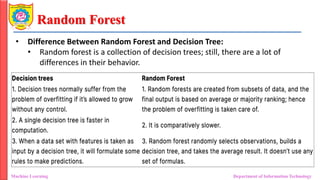
• Difference Between Random Forest and Decision Tree:
• Random forest is a collection of decision trees; still, there are a lot of
differences in their behavior.
Random Forest
Machine Learning Department of Information Technology
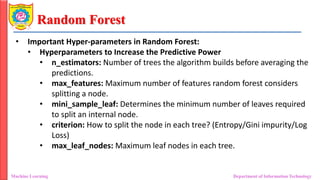
• Important Hyper-parameters in Random Forest:
• Hyperparameters to Increase the Predictive Power
• n_estimators: Number of trees the algorithm builds before averaging the
predictions.
• max_features: Maximum number of features random forest considers
splitting a node.
• mini_sample_leaf: Determines the minimum number of leaves required
to split an internal node.
• criterion: How to split the node in each tree? (Entropy/Gini impurity/Log
Loss)
• max_leaf_nodes: Maximum leaf nodes in each tree.
Random Forest
Machine Learning Department of Information Technology
• Important Hyper-parameters in Random Forest:
• Hyperparameters to Increase the Speed
• n_jobs: it tells the engine how many processors it is allowed to use. If the
value is 1, it can use only one processor, but if the value is -1, there is no
limit.
• random_state: controls randomness of the sample. The model will
always produce the same results if it has a definite value of random state
and has been given the same hyperparameters and training data.
• oob_score: OOB means out of the bag. It is a random forest cross-
validation method. In this, one-third of the sample is not used to train
the data; instead used to evaluate its performance. These samples are
called out-of-bag samples.
Random Forest
Machine Learning Department of Information Technology
Random Forest using Python:
# Data Processing
import pandas as pd
import numpy as np
# Modelling
from sklearn.ensemble import RandomForestClassifier
from sklearn.metrics import accuracy_score, confusion_matrix,
precision_score, recall_score, ConfusionMatrixDisplay
from sklearn.model_selection import train_test_split
Random Forest
Machine Learning Department of Information Technology
Random Forest using Python:
# Split the data into training and test sets
X_train, X_test, y_train, y_test = train_test_split(X, y, test_size=0.2)
rf = RandomForestClassifier()
rf.fit(X_train, y_train)
y_pred = rf.predict(X_test)
accuracy = accuracy_score(y_test, y_pred)
print("Accuracy:", accuracy)
Adaboost (Adaptive Boosting) Algorithm
Machine Learning Department of Information Technology
• Adaboost (short for Adaptive Boosting) is a popular boosting algorithm
used in machine learning to improve the accuracy of binary classification
models.
• Boosting is a technique that combines multiple weak learning algorithms
to create a strong learner that can make accurate predictions.
• Adaboost works by sequentially training a series of weak classifiers on
weightedversions of the training data.
• The weights are adjusted after each iteration to give more importance to
misclassified data points.
• The final model combines the weak classifiers using a weighted sum to
make predictions on new data.
Adaboost (Adaptive Boosting) Algorithm
Machine Learning Department of Information Technology
• It focuses on misclassified examples and adjusts the weights of the
training data to prioritize these examples.
• By doing so, the algorithm can learn from the mistakes made by the weak
classifiers and produce a strong model that can generalize well on new
data.
• Each weak classifier is trained to classify the examples as either positive or
negative.
• After each iteration, the weights of the misclassified examples are
increased to give them more importance in the next iteration.
• This process continues until a predetermined number of weak classifiers
are trained or a specified threshold is reached.
Adaboost (Adaptive Boosting) Algorithm
Machine Learning Department of Information Technology
• The key idea is to choose weak classifiers that perform slightly better than
random guessing.
• The biggest advantage of this algorithm is its ability to handle noisy data
and outliers.
• It is also less prone to overfitting than other algorithms such as support
vector machines.
• Additionally, the algorithm is easy to interpret and can be used to
generate insights about the data.
Adaboost (Adaptive Boosting) Algorithm
Machine Learning Department of Information Technology
• Step by Step Process:
• Step 1 - Initialize the weights of the training examples:
• The first step is to assign equal weights to all the training examples.
• These weights are used to emphasize the misclassified examples in the
subsequent iterations.
• Step 2 - Train a weak classifier:
• A weak classifier is trained on the weighted training data in each
iteration.
• The weak classifier aims to classify the examples as positive or
negative.
• A variety of weak classifiers can be used, such as decision trees, linear
models, or support vector machines.
Adaboost (Adaptive Boosting) Algorithm
Machine Learning Department of Information Technology
• Step 3 - Evaluate the performance of the weak classifier:
• Once the weak classifier is trained, its performance is evaluated on the
training data.
• The misclassified examples are given higher weights to prioritize them
in the next iteration.
• Step 4 - Update the weights of the training examples:
• The weights of the training examples are updated based on their
classification by the weak classifier.
• The weights of the misclassified examples are increased, while the
weights of the correctly classified examples are decreased.
• This ensures that the weak classifier focuses on the challenging
examples.
Adaboost (Adaptive Boosting) Algorithm
Machine Learning Department of Information Technology
• Step 5 - Repeat steps 2-4 for a predetermined number of iterations:
• Previous steps are repeated for a specified number of iterations, or
until a threshold is reached.
• The weights of the training examples are adjusted in each iteration to
prioritize the misclassified examples and learn from the mistakes made
by the weak classifier.
• Step 6 - Combine the weak classifiers into a strong model:
• After the specified number of iterations, the weak classifiers are
combined into a strong model using a weighted sum of their outputs.
• The final model can make accurate predictions on new, unseen data.
Adaboost (Adaptive Boosting) Algorithm
Machine Learning Department of Information Technology
• Applications:
• Image classification
• Text classification
• Medical Diagnosis
Adaboost (Adaptive Boosting) Algorithm
Machine Learning Department of Information Technology
• Advantages:
• Accuracy Improvement
• Versatility
• Robustness
• Speed
• Scalability
• Disadvantages:
• Sensitivity to Noisy Data
• Complex Implementation
• Computational Cost
• Bias towards Certain Features
• Vulnerability to Outliers
Gradient Boosting Algorithm:
Machine Learning Department of Information Technology
• Advantages:
• The key idea behind Gradient Boosting is to fit a sequence of weak
learners (e.g., decision trees) to the residuals of the previous learners.
• The algorithm starts by training a weak learner using the original data.
Then compute the residuals (that is, the difference between the
predicted and actual values) and fit another weak learner to the
residuals.
• This process is repeated for a predefined number of iterations, with each
new learner trying to minimize the leftovers of the previous learner.
• The final prediction is the sum of all weak learner predictions.
• Gradient boosting approach can use for both the regression and
classification problems.
Gradient Boosting Algorithm:
Machine Learning Department of Information Technology
• Working:
• Three components are involved in gradient boosting:
• An optimized loss function.
• A lousy indicator learner.
• An additive model that reduces failure cases.
Loss Function:
• The benefit of the gradient booster framework is that for each loss
function you may decide to use, the new booster algorithm does not
need to extract.
• Instead, the framework is general enough to enable any differentiable
loss function.
Gradient Boosting Algorithm:
Machine Learning Department of Information Technology
2. Weak Learner:
• Decision trees are used in gradient boosting as weak learners.
3. Additive Model:
• Trees are introduced one at a time.
• The current trees in the model are not updated.
• A gradient descent technique minimizes losses when adding trees.
• Traditionally, gradient descent minimizes the number of parameters, such
as the regression equation coefficients,
• After measuring the error or loss, the values are updated to minimize the
error.
Machine Learning Department of Information Technology
Thank You!!!
Happy Learning!!!

Unit 3_Classification - Random Forest_Adaboost.pdf

  • 1.
    Machine Learning Sanjivani RuralEducation Society’s Sanjivani College of Engineering, Kopargaon-423603 (An Autonomous Institute Affiliated to Savitribai Phule Pune University, Pune) NAAC ‘A’ Grade Accredited Department of Information Technology NBAAccredited-UG Programme Ms. K. D. Patil Assistant Professor
  • 2.
    Contents - Classification •Sigmoid function, Classification Algorithm in Machine Learning, Decision Trees, Ensemble Techniques: Bagging and boosting, Adaboost and gradient boost, Random Forest, Naïve Bayes Classifier, Support Vector Machines. Performance Evaluation: Confusion Matrix, Accuracy, Precision, Recall, AUC-ROC Curves, F-Measure Machine Learning Department of Information Technology
  • 3.
    Course Outcome • CO3:To apply different classification algorithms for various machine learning applications. Machine Learning Department of Information Technology
  • 4.
    Random Forest Machine LearningDepartment of Information Technology • Random Forest Algorithm widespread popularity stems from its user- friendly nature and adaptability, enabling it to tackle both classification and regression problems effectively. • The algorithm’s strength lies in its ability to handle complex datasets and mitigate over-fitting, making it a valuable tool for various predictive tasks in machine learning. • One of the most important features of the Random Forest Algorithm is that it can handle the data set containing continuous variables, as in the case of regression, and categorical variables, as in the case of classification.
  • 5.
    Ensemble Learning Technique MachineLearning Department of Information Technology • Before understanding the working of the random forest algorithm in machine learning, we must look into the Ensemble learning technique. • Ensemble simply means combining multiple models. Thus a collection of models is used to make predictions rather than an individual model. • Ensemble uses two types of methods: • Bagging • Boosting
  • 6.
    Ensemble Learning Technique MachineLearning Department of Information Technology • Bagging: • It creates a different training subset from sample training data with replacement & the final output is based on majority voting. • It is a homogeneous weak learners’ model. • It learns from each other independently in parallel and combines them for determining the model average. • For example, Random Forest.
  • 7.
    Ensemble Learning Technique MachineLearning Department of Information Technology • How Bagging works? • Bagging, also known as Bootstrap Aggregation, serves as the ensemble technique in the Random Forest algorithm. Here are the steps involved in Bagging: • Step 1 Selection of Subset: Multiple subsets are created from the original data set with equal tuples randomly choosing the samples, selecting observations with replacement. • Step 2 Bootstrap Sampling: A base model is created on each of these subsets known as row sampling. • Step 3 bootstrapping: The step of row sampling with replacement is referred to as bootstrapping.
  • 8.
    Ensemble Learning Technique MachineLearning Department of Information Technology • How Bagging works? • Step 4 Independent Model Training: Each model is learned in parallel with each training set and independent of each other. • Step 5 Majority Voting: The final predictions are determined by combining the predictions from all the models through majority voting. The most commonly predicted outcome among the model is selected. • Step 6 Aggregation: All results are combined and final output is generated based on majority voting known as aggregation.
  • 9.
    Ensemble Learning Technique MachineLearning Department of Information Technology • How Bagging works?
  • 10.
    Ensemble Learning Technique MachineLearning Department of Information Technology • Boosting • Boosting is one of the techniques that use the concept of ensemble learning. • It combines weak learners into strong learners by creating sequential models such that the final model has the highest accuracy. • A boosting algorithm combines multiple simple models (also known as weak learners or base estimators) to generate the final output. • It is done by building a model by using weak models in series. • It is also a homogeneous weak learners’ model. • In this model, learners learn sequentially and adaptively to improve model predictions of a learning algorithm.
  • 11.
    Ensemble Learning Technique MachineLearning Department of Information Technology • Boosting: • There are several boosting algorithms. For example, ADA BOOST, XG BOOST. • AdaBoost was the first really successful boosting algorithm that was developed for the purpose of binary classification. • AdaBoost is an abbreviation for Adaptive Boosting and is a prevalent boosting technique that combines multiple “weak classifiers” into a single “strong classifier.”
  • 12.
    Ensemble Learning Technique MachineLearning Department of Information Technology • How Boosting works? 1. Initialize the dataset and assign equal weight to each of the data point. 2. Provide this as input to the model and identify the wrongly classified data points. 3. Increase the weight of the wrongly classified data points and decrease the weights of correctly classified data points. And then normalize the weights of all data points. 4. if (got required results) Goto step 5 else Goto step 2 5. End
  • 13.
    Ensemble Learning Technique MachineLearning Department of Information Technology
  • 14.
    Random Forest Machine LearningDepartment of Information Technology • How Random Forest Works? • Step 1: In the Random forest model, a subset of data points and a subset of features is selected for constructing each decision tree. Simply n random records and m features are taken from the data set having k number of records. • Step 2: Individual decision trees are constructed for each sample. • Step 3: Each decision tree will generate an output. • Step 4: Final output is considered based on Majority Voting or Averaging for Classification and regression, respectively.
  • 15.
    Random Forest Machine LearningDepartment of Information Technology • Features of Random Forest: • Diversity: Not all attributes/variables/features are considered while making an individual tree; each tree is different. • Immune to the curse of dimensionality: Since each tree does not consider all the features, the feature space is reduced. • Parallelization: Each tree is created independently out of different data and attributes. This means we can fully use the CPU to build random forests. • Train-Test split: In a random forest, we don't have to segregate the data for train and test as there will always be 30% of the data which is not seen by the decision tree. • Stability: Stability arises because the result is based on majority voting/ averaging.
  • 16.
    Random Forest Machine LearningDepartment of Information Technology • Difference Between Random Forest and Decision Tree: • Random forest is a collection of decision trees; still, there are a lot of differences in their behavior.
  • 17.
    Random Forest Machine LearningDepartment of Information Technology • Important Hyper-parameters in Random Forest: • Hyperparameters to Increase the Predictive Power • n_estimators: Number of trees the algorithm builds before averaging the predictions. • max_features: Maximum number of features random forest considers splitting a node. • mini_sample_leaf: Determines the minimum number of leaves required to split an internal node. • criterion: How to split the node in each tree? (Entropy/Gini impurity/Log Loss) • max_leaf_nodes: Maximum leaf nodes in each tree.
  • 18.
    Random Forest Machine LearningDepartment of Information Technology • Important Hyper-parameters in Random Forest: • Hyperparameters to Increase the Speed • n_jobs: it tells the engine how many processors it is allowed to use. If the value is 1, it can use only one processor, but if the value is -1, there is no limit. • random_state: controls randomness of the sample. The model will always produce the same results if it has a definite value of random state and has been given the same hyperparameters and training data. • oob_score: OOB means out of the bag. It is a random forest cross- validation method. In this, one-third of the sample is not used to train the data; instead used to evaluate its performance. These samples are called out-of-bag samples.
  • 19.
    Random Forest Machine LearningDepartment of Information Technology Random Forest using Python: # Data Processing import pandas as pd import numpy as np # Modelling from sklearn.ensemble import RandomForestClassifier from sklearn.metrics import accuracy_score, confusion_matrix, precision_score, recall_score, ConfusionMatrixDisplay from sklearn.model_selection import train_test_split
  • 20.
    Random Forest Machine LearningDepartment of Information Technology Random Forest using Python: # Split the data into training and test sets X_train, X_test, y_train, y_test = train_test_split(X, y, test_size=0.2) rf = RandomForestClassifier() rf.fit(X_train, y_train) y_pred = rf.predict(X_test) accuracy = accuracy_score(y_test, y_pred) print("Accuracy:", accuracy)
  • 21.
    Adaboost (Adaptive Boosting)Algorithm Machine Learning Department of Information Technology • Adaboost (short for Adaptive Boosting) is a popular boosting algorithm used in machine learning to improve the accuracy of binary classification models. • Boosting is a technique that combines multiple weak learning algorithms to create a strong learner that can make accurate predictions. • Adaboost works by sequentially training a series of weak classifiers on weightedversions of the training data. • The weights are adjusted after each iteration to give more importance to misclassified data points. • The final model combines the weak classifiers using a weighted sum to make predictions on new data.
  • 22.
    Adaboost (Adaptive Boosting)Algorithm Machine Learning Department of Information Technology • It focuses on misclassified examples and adjusts the weights of the training data to prioritize these examples. • By doing so, the algorithm can learn from the mistakes made by the weak classifiers and produce a strong model that can generalize well on new data. • Each weak classifier is trained to classify the examples as either positive or negative. • After each iteration, the weights of the misclassified examples are increased to give them more importance in the next iteration. • This process continues until a predetermined number of weak classifiers are trained or a specified threshold is reached.
  • 23.
    Adaboost (Adaptive Boosting)Algorithm Machine Learning Department of Information Technology • The key idea is to choose weak classifiers that perform slightly better than random guessing. • The biggest advantage of this algorithm is its ability to handle noisy data and outliers. • It is also less prone to overfitting than other algorithms such as support vector machines. • Additionally, the algorithm is easy to interpret and can be used to generate insights about the data.
  • 24.
    Adaboost (Adaptive Boosting)Algorithm Machine Learning Department of Information Technology • Step by Step Process: • Step 1 - Initialize the weights of the training examples: • The first step is to assign equal weights to all the training examples. • These weights are used to emphasize the misclassified examples in the subsequent iterations. • Step 2 - Train a weak classifier: • A weak classifier is trained on the weighted training data in each iteration. • The weak classifier aims to classify the examples as positive or negative. • A variety of weak classifiers can be used, such as decision trees, linear models, or support vector machines.
  • 25.
    Adaboost (Adaptive Boosting)Algorithm Machine Learning Department of Information Technology • Step 3 - Evaluate the performance of the weak classifier: • Once the weak classifier is trained, its performance is evaluated on the training data. • The misclassified examples are given higher weights to prioritize them in the next iteration. • Step 4 - Update the weights of the training examples: • The weights of the training examples are updated based on their classification by the weak classifier. • The weights of the misclassified examples are increased, while the weights of the correctly classified examples are decreased. • This ensures that the weak classifier focuses on the challenging examples.
  • 26.
    Adaboost (Adaptive Boosting)Algorithm Machine Learning Department of Information Technology • Step 5 - Repeat steps 2-4 for a predetermined number of iterations: • Previous steps are repeated for a specified number of iterations, or until a threshold is reached. • The weights of the training examples are adjusted in each iteration to prioritize the misclassified examples and learn from the mistakes made by the weak classifier. • Step 6 - Combine the weak classifiers into a strong model: • After the specified number of iterations, the weak classifiers are combined into a strong model using a weighted sum of their outputs. • The final model can make accurate predictions on new, unseen data.
  • 27.
    Adaboost (Adaptive Boosting)Algorithm Machine Learning Department of Information Technology • Applications: • Image classification • Text classification • Medical Diagnosis
  • 28.
    Adaboost (Adaptive Boosting)Algorithm Machine Learning Department of Information Technology • Advantages: • Accuracy Improvement • Versatility • Robustness • Speed • Scalability • Disadvantages: • Sensitivity to Noisy Data • Complex Implementation • Computational Cost • Bias towards Certain Features • Vulnerability to Outliers
  • 29.
    Gradient Boosting Algorithm: MachineLearning Department of Information Technology • Advantages: • The key idea behind Gradient Boosting is to fit a sequence of weak learners (e.g., decision trees) to the residuals of the previous learners. • The algorithm starts by training a weak learner using the original data. Then compute the residuals (that is, the difference between the predicted and actual values) and fit another weak learner to the residuals. • This process is repeated for a predefined number of iterations, with each new learner trying to minimize the leftovers of the previous learner. • The final prediction is the sum of all weak learner predictions. • Gradient boosting approach can use for both the regression and classification problems.
  • 30.
    Gradient Boosting Algorithm: MachineLearning Department of Information Technology • Working: • Three components are involved in gradient boosting: • An optimized loss function. • A lousy indicator learner. • An additive model that reduces failure cases. Loss Function: • The benefit of the gradient booster framework is that for each loss function you may decide to use, the new booster algorithm does not need to extract. • Instead, the framework is general enough to enable any differentiable loss function.
  • 31.
    Gradient Boosting Algorithm: MachineLearning Department of Information Technology 2. Weak Learner: • Decision trees are used in gradient boosting as weak learners. 3. Additive Model: • Trees are introduced one at a time. • The current trees in the model are not updated. • A gradient descent technique minimizes losses when adding trees. • Traditionally, gradient descent minimizes the number of parameters, such as the regression equation coefficients, • After measuring the error or loss, the values are updated to minimize the error.
  • 32.
    Machine Learning Departmentof Information Technology Thank You!!! Happy Learning!!!