Bias-variance decomposition 
in Random Forests 
Gilles Louppe @glouppe 
Paris ML S02E04, December 8, 2014 
1 / 14
Motivation 
In supervised learning, combining the predictions of several 
randomized models often achieves better results than a single 
non-randomized model. 
Why ? 
2 / 14
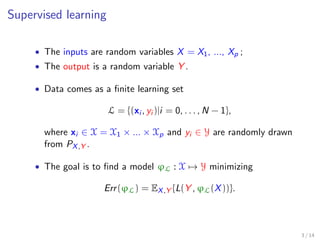
Supervised learning 
 The inputs are random variables X = X1, ..., Xp ; 
 The output is a random variable Y . 
 Data comes as a
nite learning set 
L = f(xi , yi )ji = 0, . . . ,N - 1g, 
where xi 2 X = X1  ...  Xp and yi 2 Y are randomly drawn 
from PX,Y . 
 The goal is to
nd a model 'L : X7! Y minimizing 
Err ('L) = EX,Y fL(Y ,'L(X))g. 
3 / 14
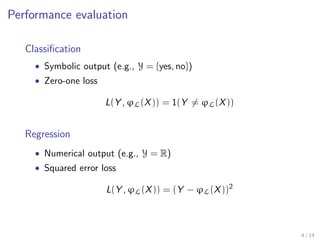
Performance evaluation 
Classi
cation 
 Symbolic output (e.g., Y = fyes, nog) 
 Zero-one loss 
L(Y ,'L(X)) = 1(Y6= 'L(X)) 
Regression 
 Numerical output (e.g., Y = R) 
 Squared error loss 
L(Y ,'L(X)) = (Y - 'L(X))2 
4 / 14
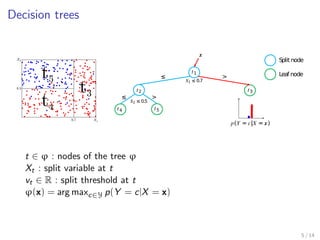
Decision trees 
0.7 
0.5 
X1 
X2 
t5 t3 t4 
푡2 
푡1 
푋1 ≤ 0.7 
푡3 
푡4 푡5 
풙 
푝(푌 = 푐|푋 = 풙) 
Split node 
≤  Leaf node 
푋2 ≤ 0.5 ≤  
t 2 ' : nodes of the tree ' 
Xt : split variable at t 
vt 2 R : split threshold at t 
'(x) = arg maxc2Y p(Y = cjX = x) 
5 / 14
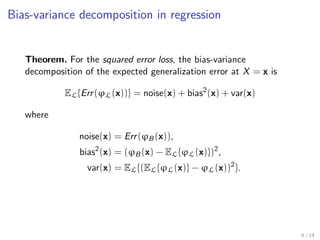
Bias-variance decomposition in regression 
Theorem. For the squared error loss, the bias-variance 
decomposition of the expected generalization error at X = x is 
ELfErr ('L(x))g = noise(x) + bias2(x) + var(x) 
where 
noise(x) = Err ('B(x)), 
bias2(x) = ('B(x) - ELf'L(x)g)2, 
var(x) = ELf(ELf'L(x)g - 'L(x))2g. 
6 / 14
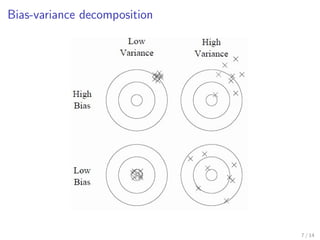
Bias-variance decomposition 
7 / 14
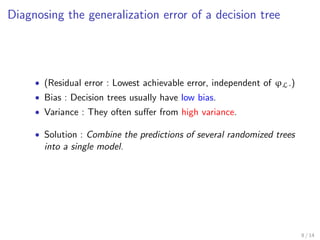
Diagnosing the generalization error of a decision tree 
 (Residual error : Lowest achievable error, independent of 'L.) 
 Bias : Decision trees usually have low bias. 
 Variance : They often suer from high variance. 
 Solution : Combine the predictions of several randomized trees 
into a single model. 
8 / 14
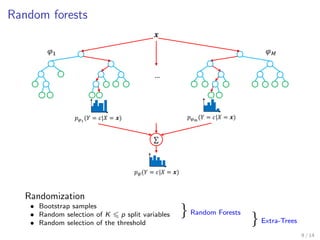
Random forests 
풙 
휑1 휑푀 
푝휑1 (푌 = 푐|푋 = 풙) 
… 
푝휑푚 (푌 = 푐|푋 = 풙) 
Σ 
푝휓(푌 = 푐|푋 = 풙) 
Randomization 
 Bootstrap samples  Random selection of K 6 p split variables g Random Forests  Random selection of the threshold g Extra-Trees 
9 / 14
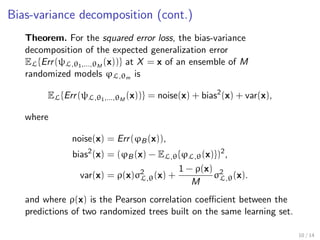
Bias-variance decomposition (cont.) 
Theorem. For the squared error loss, the bias-variance 
decomposition of the expected generalization error 
ELfErr ( L,1,...,M (x))g at X = x of an ensemble of M 
randomized models 'L,m is 
ELfErr ( L,1,...,M (x))g = noise(x) + bias2(x) + var(x), 
where 
noise(x) = Err ('B(x)), 
bias2(x) = ('B(x) - EL,f'L,(x)g)2, 
var(x) = (x)2 
L,(x) + 
1 - (x) 
M 
2 
L,(x). 
and where (x) is the Pearson correlation coecient between the 
predictions of two randomized trees built on the same learning set. 
10 / 14
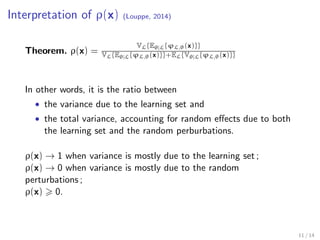
Interpretation of (x) (Louppe, 2014) 
Theorem. (x) = 
VLfEjLf'L,(x)gg 
VLfEjLf'L,(x)gg+ELfVjLf'L,(x)gg 
In other words, it is the ratio between 
 the variance due to the learning set and 
 the total variance, accounting for random eects due to both 
the learning set and the random perburbations. 
(x) ! 1 when variance is mostly due to the learning set ; 
(x) ! 0 when variance is mostly due to the random 
perturbations ; 
(x)  0. 
11 / 14

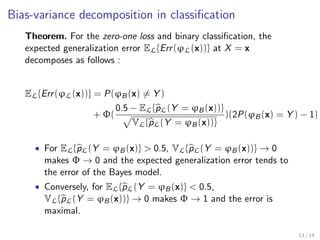
Bias-variance decomposition in Random Forests

  • 1.
    Bias-variance decomposition inRandom Forests Gilles Louppe @glouppe Paris ML S02E04, December 8, 2014 1 / 14
  • 2.
    Motivation In supervisedlearning, combining the predictions of several randomized models often achieves better results than a single non-randomized model. Why ? 2 / 14
  • 3.
    Supervised learning The inputs are random variables X = X1, ..., Xp ; The output is a random variable Y . Data comes as a
  • 4.
    nite learning set L = f(xi , yi )ji = 0, . . . ,N - 1g, where xi 2 X = X1 ... Xp and yi 2 Y are randomly drawn from PX,Y . The goal is to
  • 5.
    nd a model'L : X7! Y minimizing Err ('L) = EX,Y fL(Y ,'L(X))g. 3 / 14
  • 6.
  • 7.
    cation Symbolicoutput (e.g., Y = fyes, nog) Zero-one loss L(Y ,'L(X)) = 1(Y6= 'L(X)) Regression Numerical output (e.g., Y = R) Squared error loss L(Y ,'L(X)) = (Y - 'L(X))2 4 / 14
  • 8.
    Decision trees 0.7 0.5 X1 X2 t5 t3 t4 푡2 푡1 푋1 ≤ 0.7 푡3 푡4 푡5 풙 푝(푌 = 푐|푋 = 풙) Split node ≤ Leaf node 푋2 ≤ 0.5 ≤ t 2 ' : nodes of the tree ' Xt : split variable at t vt 2 R : split threshold at t '(x) = arg maxc2Y p(Y = cjX = x) 5 / 14
  • 9.
    Bias-variance decomposition inregression Theorem. For the squared error loss, the bias-variance decomposition of the expected generalization error at X = x is ELfErr ('L(x))g = noise(x) + bias2(x) + var(x) where noise(x) = Err ('B(x)), bias2(x) = ('B(x) - ELf'L(x)g)2, var(x) = ELf(ELf'L(x)g - 'L(x))2g. 6 / 14
  • 10.
  • 11.
    Diagnosing the generalizationerror of a decision tree (Residual error : Lowest achievable error, independent of 'L.) Bias : Decision trees usually have low bias. Variance : They often suer from high variance. Solution : Combine the predictions of several randomized trees into a single model. 8 / 14
  • 12.
    Random forests 풙 휑1 휑푀 푝휑1 (푌 = 푐|푋 = 풙) … 푝휑푚 (푌 = 푐|푋 = 풙) Σ 푝휓(푌 = 푐|푋 = 풙) Randomization Bootstrap samples Random selection of K 6 p split variables g Random Forests Random selection of the threshold g Extra-Trees 9 / 14
  • 13.
    Bias-variance decomposition (cont.) Theorem. For the squared error loss, the bias-variance decomposition of the expected generalization error ELfErr ( L,1,...,M (x))g at X = x of an ensemble of M randomized models 'L,m is ELfErr ( L,1,...,M (x))g = noise(x) + bias2(x) + var(x), where noise(x) = Err ('B(x)), bias2(x) = ('B(x) - EL,f'L,(x)g)2, var(x) = (x)2 L,(x) + 1 - (x) M 2 L,(x). and where (x) is the Pearson correlation coecient between the predictions of two randomized trees built on the same learning set. 10 / 14
  • 14.
    Interpretation of (x)(Louppe, 2014) Theorem. (x) = VLfEjLf'L,(x)gg VLfEjLf'L,(x)gg+ELfVjLf'L,(x)gg In other words, it is the ratio between the variance due to the learning set and the total variance, accounting for random eects due to both the learning set and the random perburbations. (x) ! 1 when variance is mostly due to the learning set ; (x) ! 0 when variance is mostly due to the random perturbations ; (x) 0. 11 / 14