Comparison Study
of Decision Tree Ensembles
for Regression
SEONHO PARK
Objectives
• Empirical study of Ensemble trees for regression problems
• To verify its performance and time efficiency
• Candidates from open source
• Scikit-Learn
• BaggingRegressor
• RandomForestRegressor
• ExtraTreesRegressor
• AdaBoostRegressor
• GradientBoostingRegressor
• XGBoost
• XGBRegressor
Decision Tree
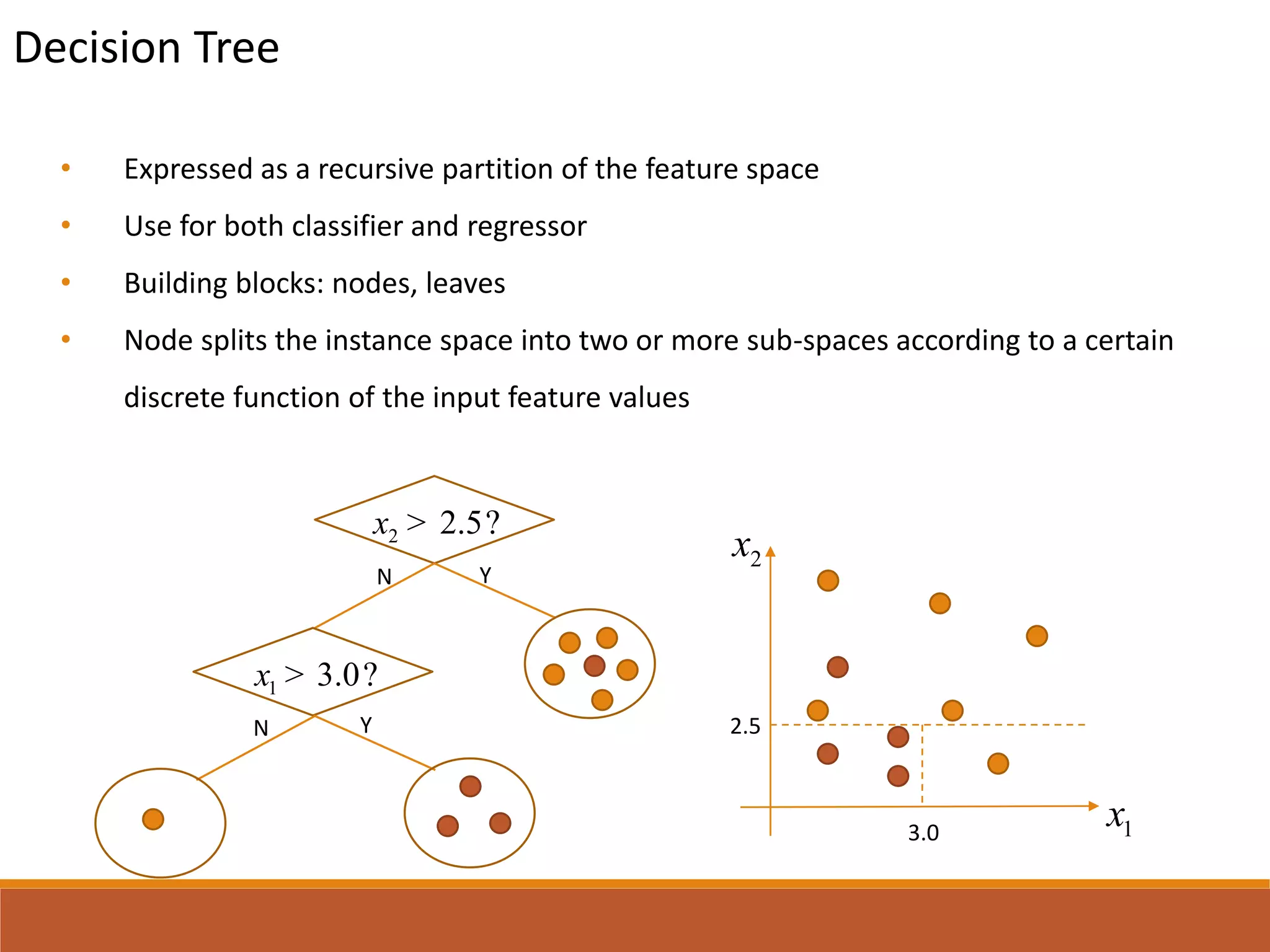
1x
2x2 2.5?x >
1 3.0?x >
N Y
N Y
• Expressed as a recursive partition of the feature space
• Use for both classifier and regressor
• Building blocks: nodes, leaves
• Node splits the instance space into two or more sub-spaces according to a certain
discrete function of the input feature values
2.5
3.0
Decision Tree Inducers
• How to generate decision tree?
• Rule to determine the decision tree is how to split and prune nodes
• Decision trees inducers:
ID3(Quinlan, 1986), C4.5(Quinlan, 1993), CART(Breiman et al., 1984)
• CART is most generable and popular
CART
• CART stands for Classification and Regression Trees
• Has ability to generate regression trees
• Minimization of misclassification costs
• In regression, the costs are represented for least squares between target values and
expected values
• Maximization of change of impurity function:
• For regression,
argmax ( ) ( ( )) ( ( ))
j
R
j p l l r r
x
x i t P i t P i té ù= - -ê úë û
[ ]arg min Var( ) Var( )
j
R
j l r
x
x Y Y= +
CART
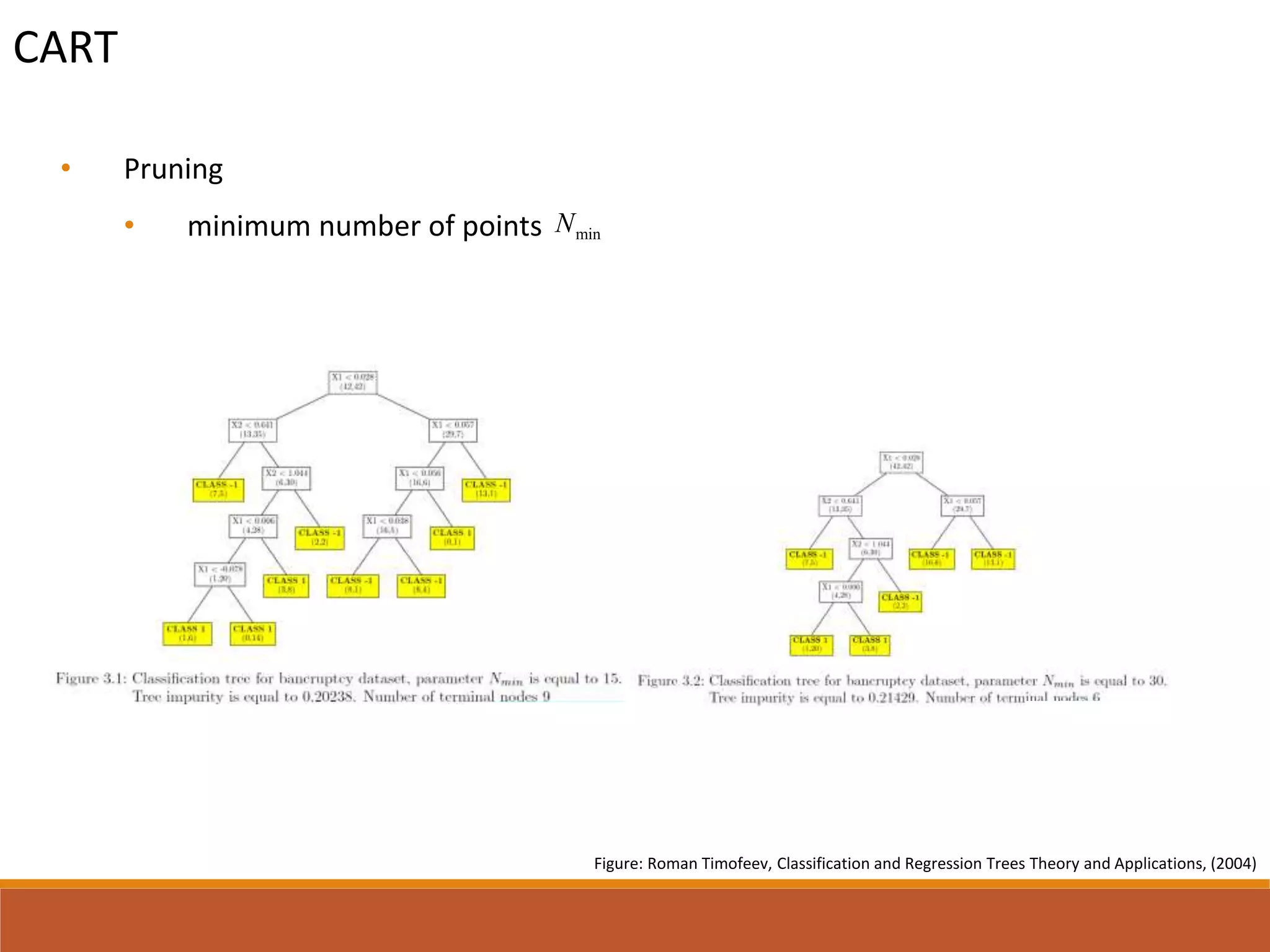
• Pruning
• minimum number of points
Figure: Roman Timofeev, Classification and Regression Trees Theory and Applications, (2004)
minN
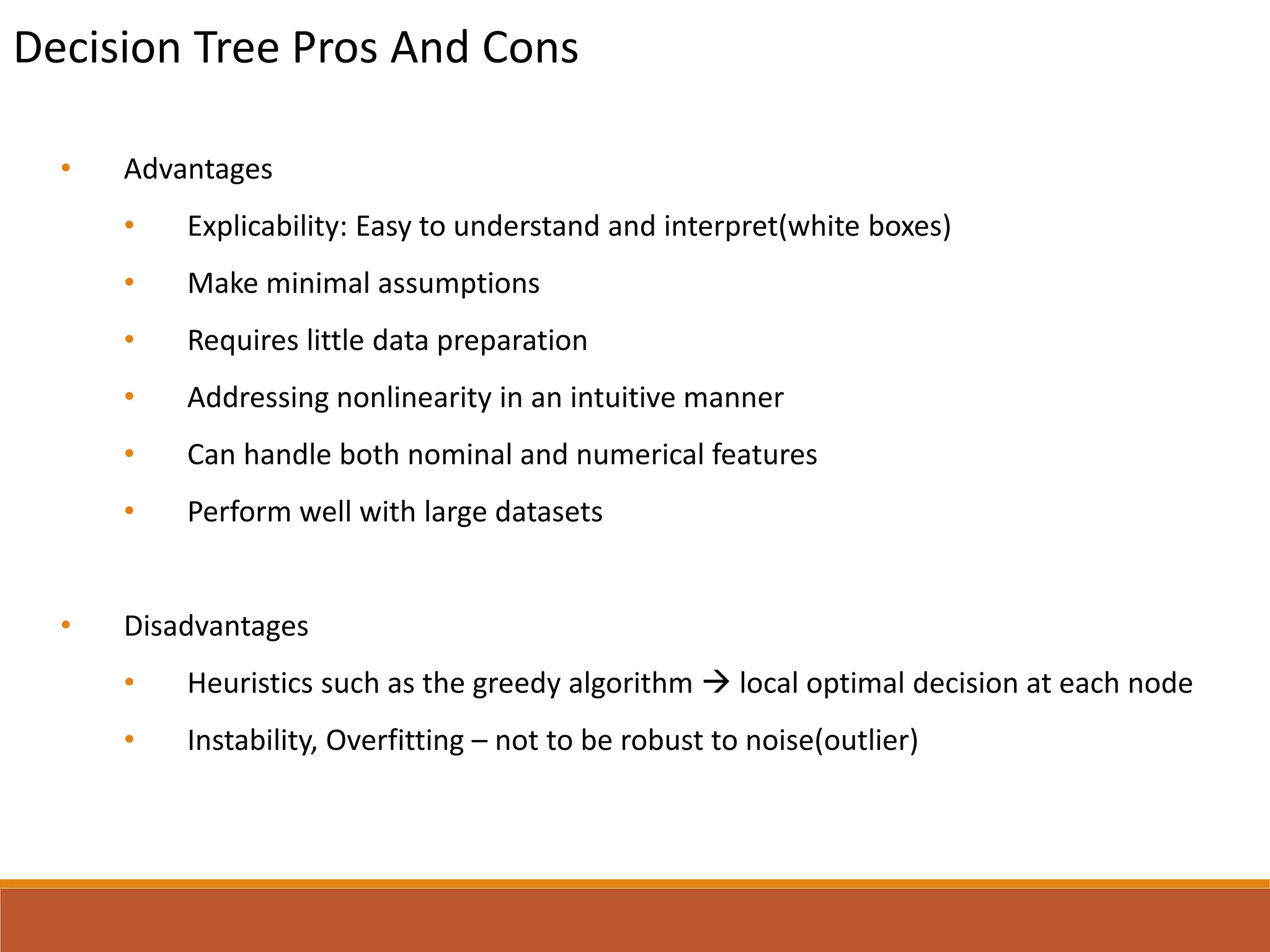
Decision Tree Pros And Cons
• Advantages
• Explicability: Easy to understand and interpret(white boxes)
• Make minimal assumptions
• Requires little data preparation
• Addressing nonlinearity in an intuitive manner
• Can handle both nominal and numerical features
• Perform well with large datasets
• Disadvantages
• Heuristics such as the greedy algorithm  local optimal decision at each node
• Instability, Overfitting – not to be robust to noise(outlier)
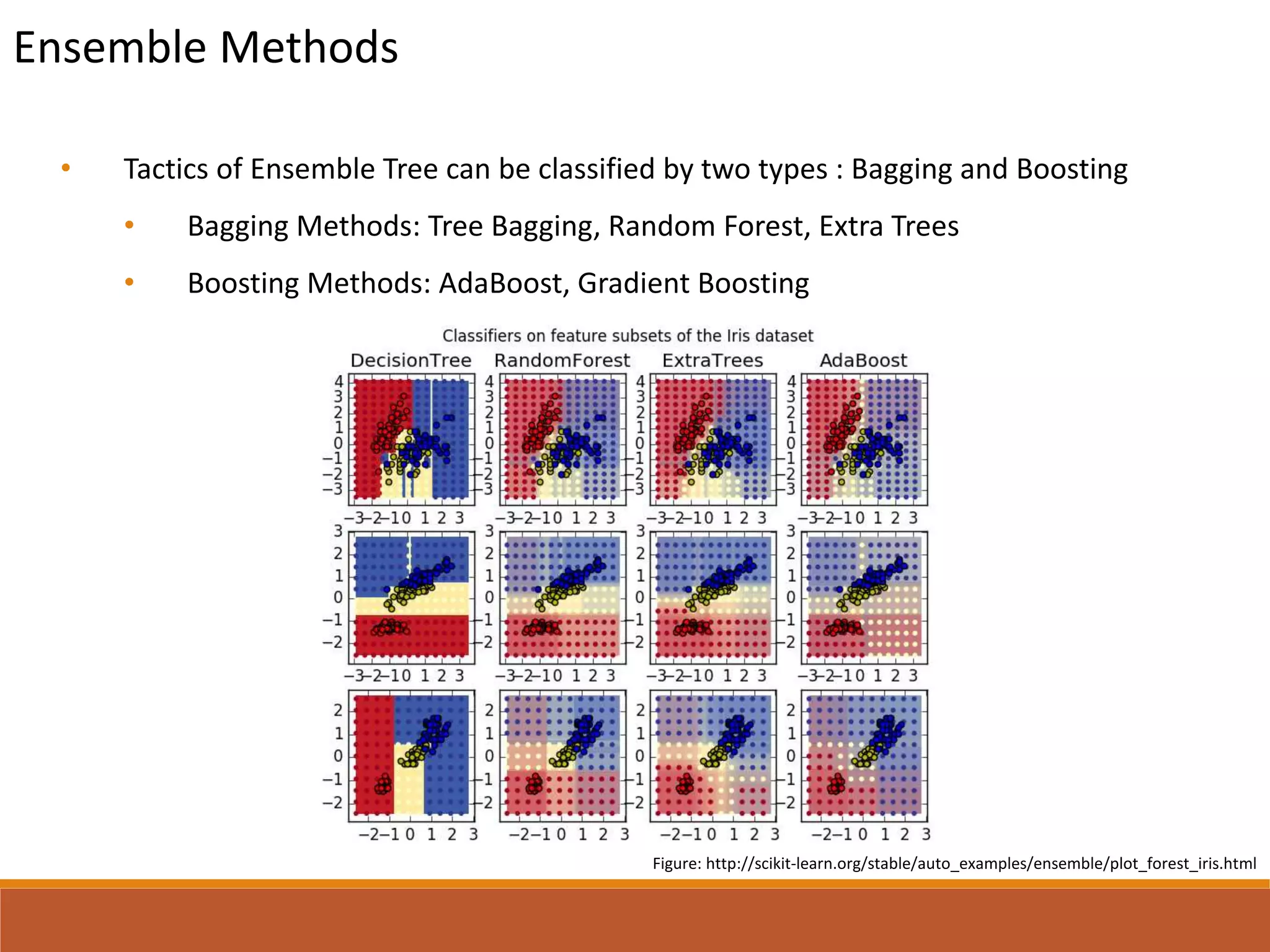
Ensemble Methods
• Tactics of Ensemble Tree can be classified by two types : Bagging and Boosting
• Bagging Methods: Tree Bagging, Random Forest, Extra Trees
• Boosting Methods: AdaBoost, Gradient Boosting
Figure: http://scikit-learn.org/stable/auto_examples/ensemble/plot_forest_iris.html
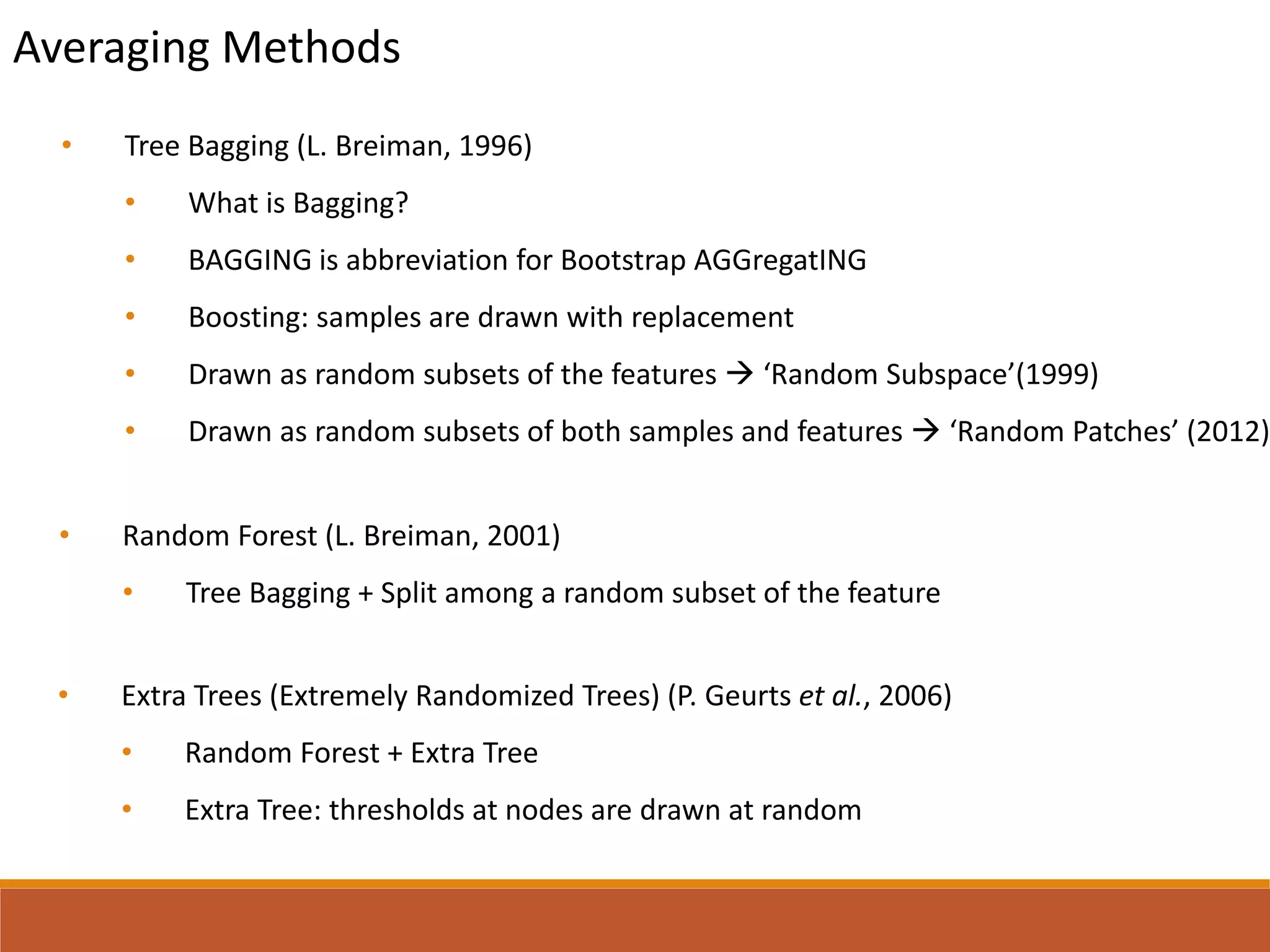
Averaging Methods
• Random Forest (L. Breiman, 2001)
• Tree Bagging + Split among a random subset of the feature
• Extra Trees (Extremely Randomized Trees) (P. Geurts et al., 2006)
• Random Forest + Extra Tree
• Extra Tree: thresholds at nodes are drawn at random
• Tree Bagging (L. Breiman, 1996)
• What is Bagging?
• BAGGING is abbreviation for Bootstrap AGGregatING
• Boosting: samples are drawn with replacement
• Drawn as random subsets of the features  ‘Random Subspace’(1999)
• Drawn as random subsets of both samples and features  ‘Random Patches’ (2012)
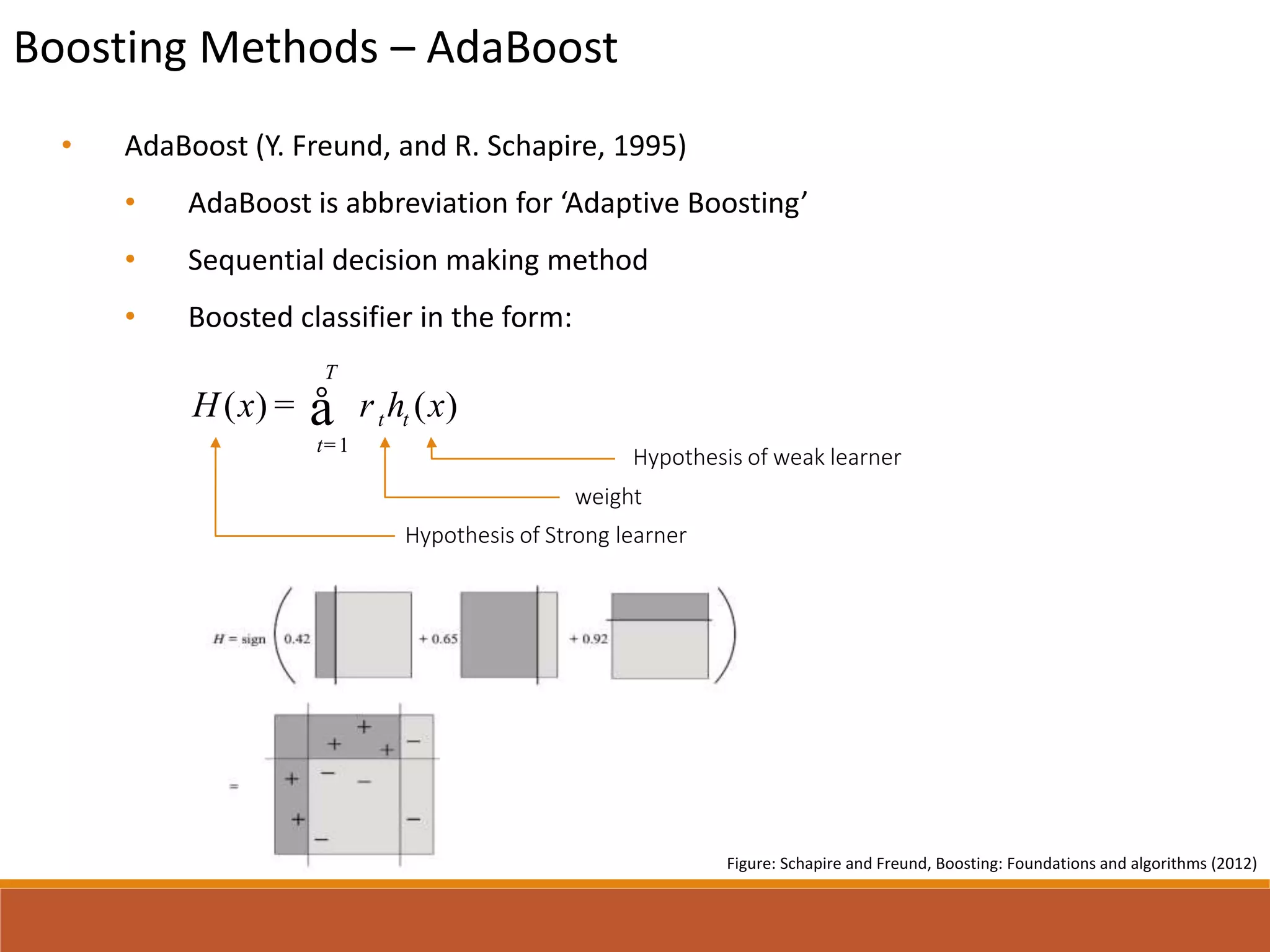
Boosting Methods – AdaBoost
• AdaBoost (Y. Freund, and R. Schapire, 1995)
• AdaBoost is abbreviation for ‘Adaptive Boosting’
• Sequential decision making method
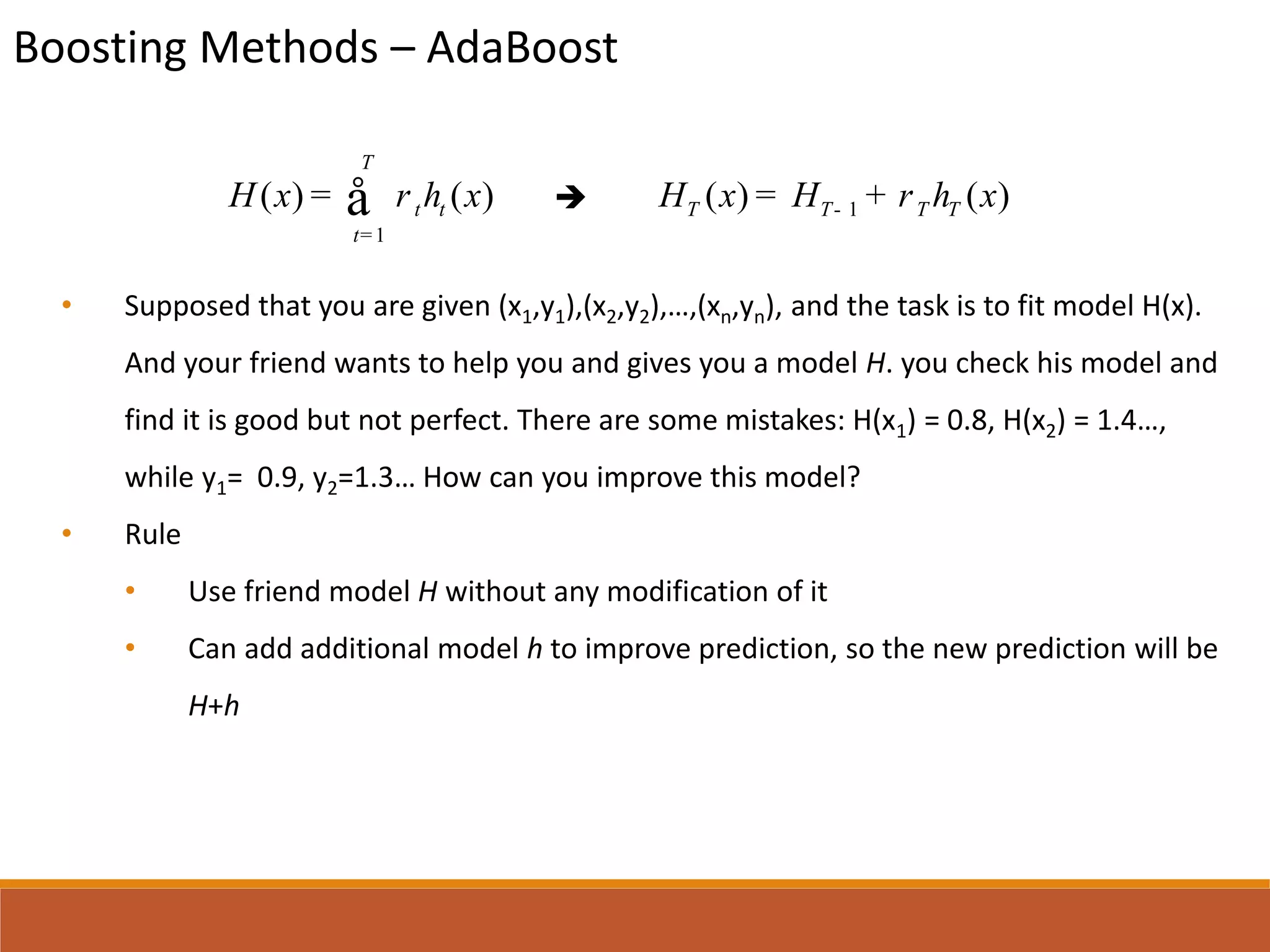
• Boosted classifier in the form:
Hypothesis of weak learner
weight
Hypothesis of Strong learner
Figure: Schapire and Freund, Boosting: Foundations and algorithms (2012)
1
( ) ( )
T
t t
t
H x h xr
=
= å
Boosting Methods – AdaBoost

• Supposed that you are given (x1,y1),(x2,y2),…,(xn,yn), and the task is to fit model H(x).
And your friend wants to help you and gives you a model H. you check his model and
find it is good but not perfect. There are some mistakes: H(x1) = 0.8, H(x2) = 1.4…,
while y1= 0.9, y2=1.3… How can you improve this model?
• Rule
• Use friend model H without any modification of it
• Can add additional model h to improve prediction, so the new prediction will be
H+h
1
( ) ( )
T
t t
t
H x h xr
=
= å 1( ) ( )T T T TH x H h xr-= +
Boosting Methods – AdaBoost
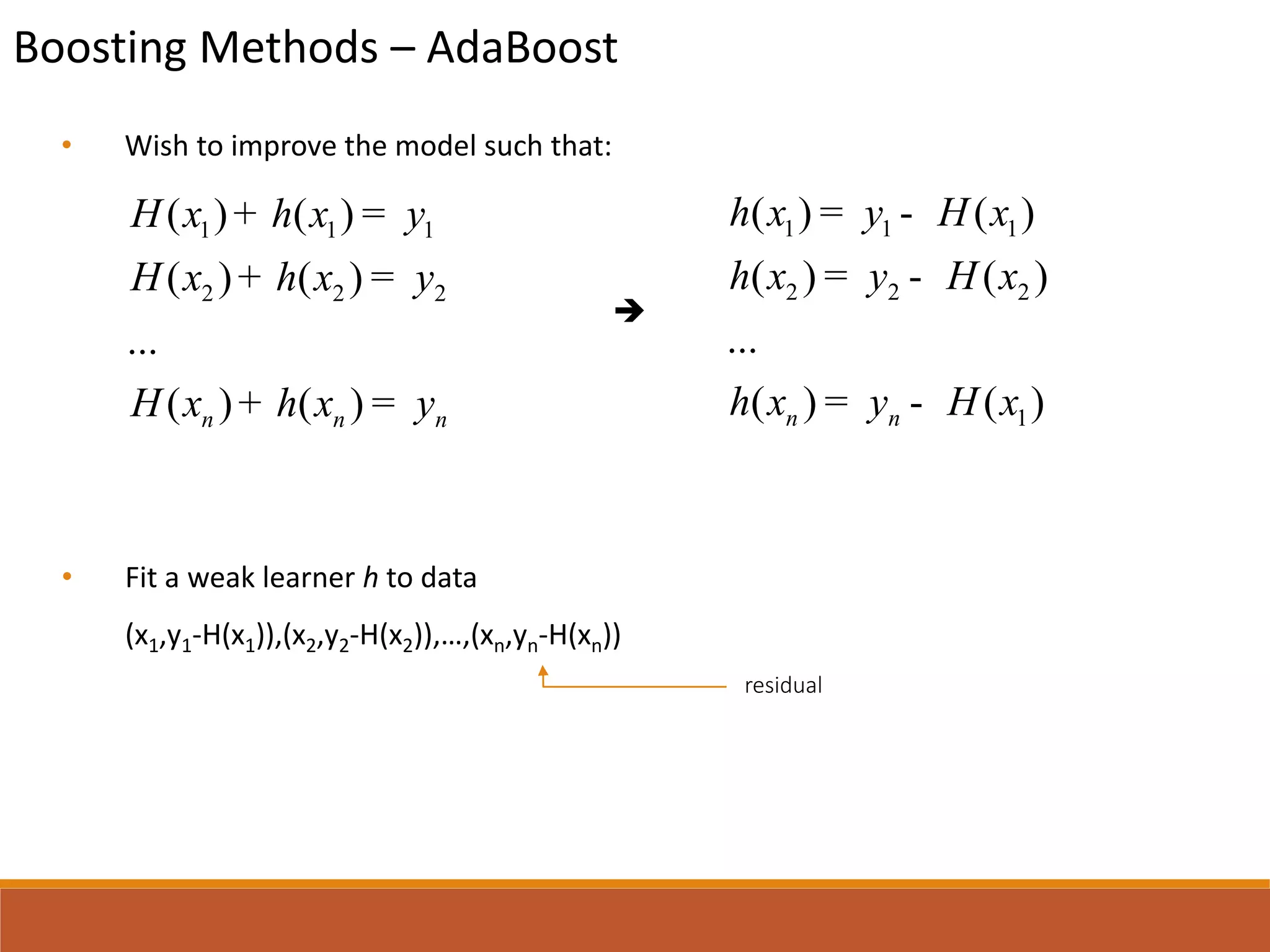
1 1 1
2 2 2
( ) ( )
( ) ( )
...
( ) ( )n n n
H x h x y
H x h x y
H x h x y
+ =
+ =
+ =
• Wish to improve the model such that:

1 1 1
2 2 2
1
( ) ( )
( ) ( )
...
( ) ( )n n
h x y H x
h x y H x
h x y H x
= -
= -
= -
• Fit a weak learner h to data
(x1,y1-H(x1)),(x2,y2-H(x2)),…,(xn,yn-H(xn))
residual
Boosting Methods – Gradient Boosting
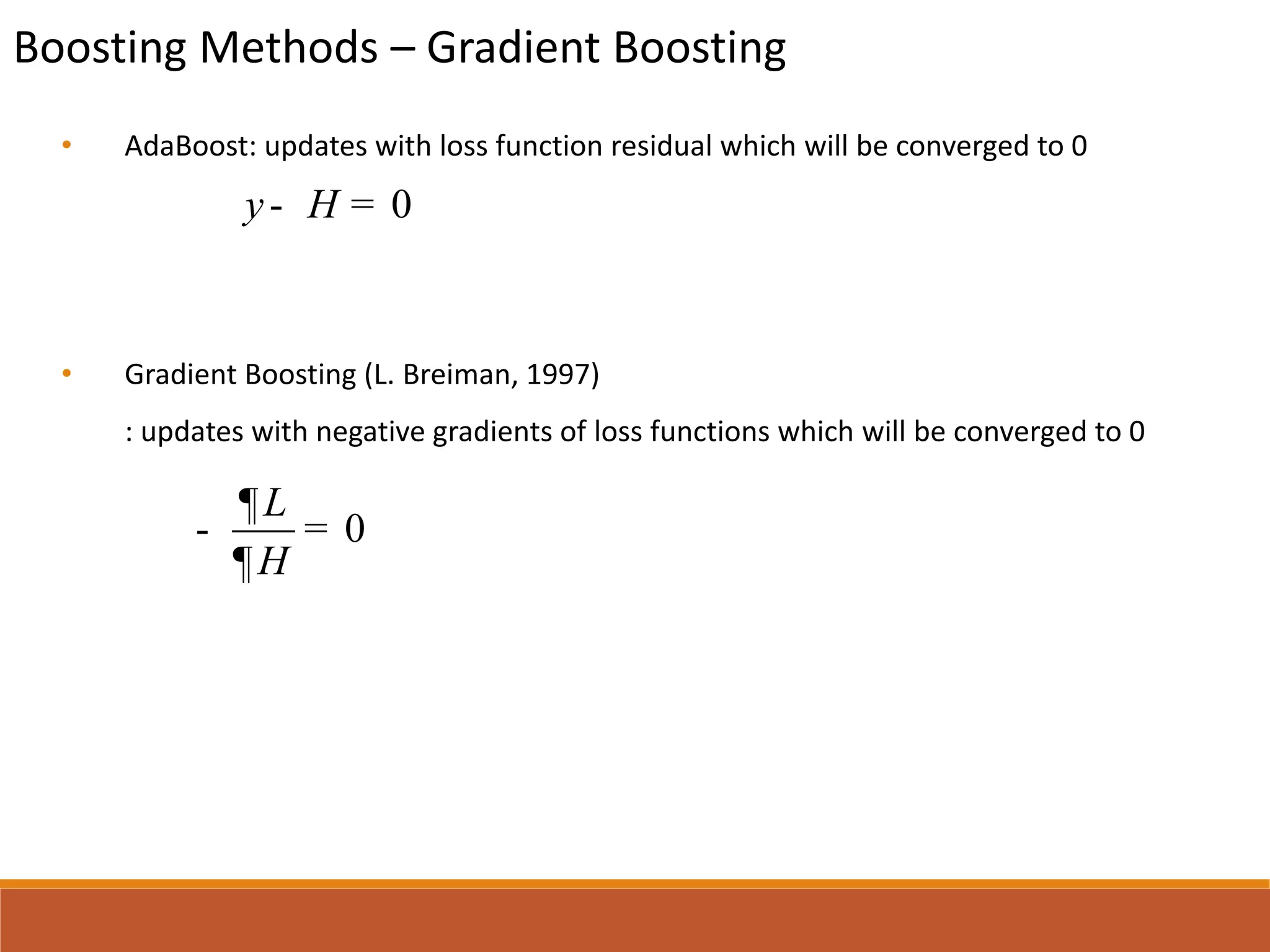
• AdaBoost: updates with loss function residual which will be converged to 0
• In scikit-learn, AdaBoost.R2 algorithm is implemented
• Gradient Boosting (L. Breiman, 1997)
: updates with negative gradients of loss functions which will be converged to 0
0y H- =
0
L
H

- =

*Drucker,H., Improving Regressors using Boosting Techniques (1997)
Boosting Methods – Gradient Boosting
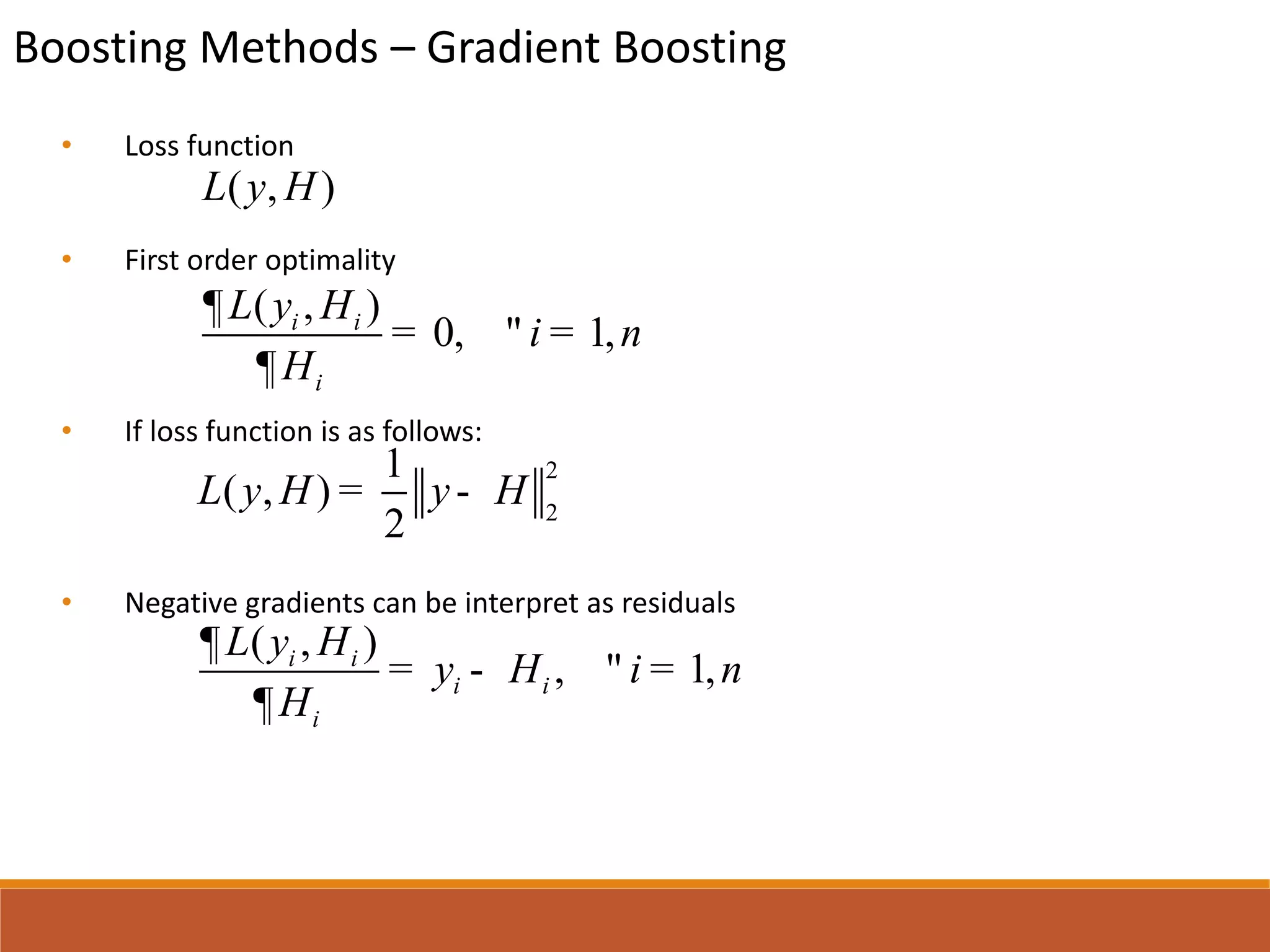
• Loss function
• First order optimality
• If loss function is as follows:
• Negative gradients can be interpret as residuals
( , )L y H
( , )
0, 1,i i
i
L y H
i n
H

= " =

2
2
1
( , )
2
L y H y H= -
( , )
, 1,i i
i i
i
L y H
y H i n
H

= - " =

Boosting Methods – Gradient Boosting
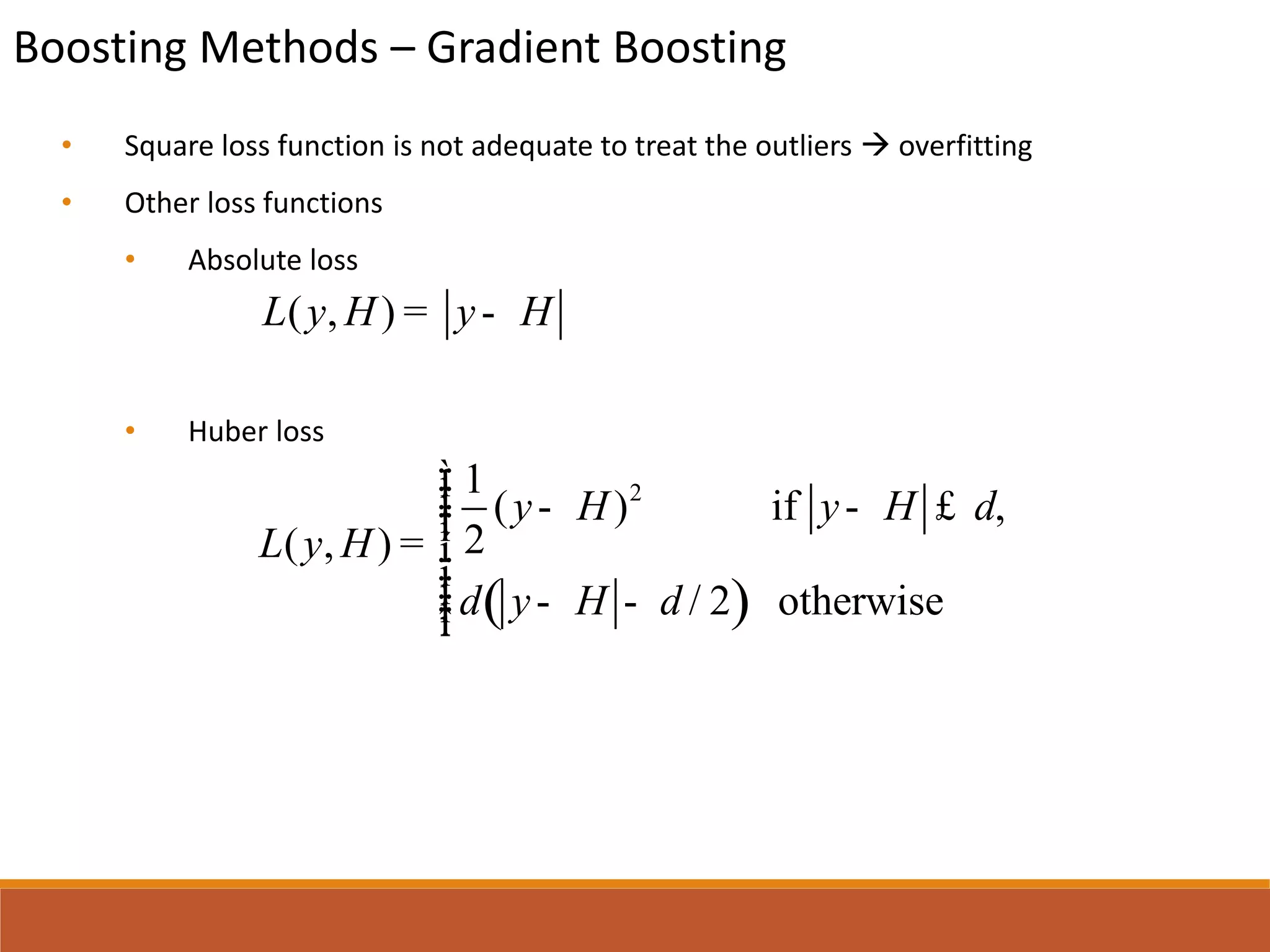
• Square loss function is not adequate to treat the outliers  overfitting
• Other loss functions
• Absolute loss
• Huber loss
( , )L y H y H= -
( )
21
( ) if ,
2( , )
/ 2 otherwise
y H y H
L y H
y H
d
d d
ìïï - - £ïï= í
ïï - -ïïî
• Among the 29 kaggle challenge winning solutions during 2015,
• 17 used XGBoost (Gradient Boosting Trees)
(8 solely used XGBoost, 9 used XGBoost + deep neural nets)
• 11 used deep neural nets
(2 solely used, 9 combined with XGBoost)
• In KDDCup 2015, Ensemble Trees was used in every winning team in the top 10
XGBoost
*Tianqi Chen, XGBoost: A Scalable Tree Boosting System (2016)
Ensemble Method Pros and Cons
• Advantages
• Avoid overfitting
• Fast and scalable  handle large-scale data
• Almost work ‘out-of-the-box’
• Disadvantages
• Overfitting
• ad hoc heuristic
• Not provide probabilistic framework (confidence intervals, posterior
distributions)
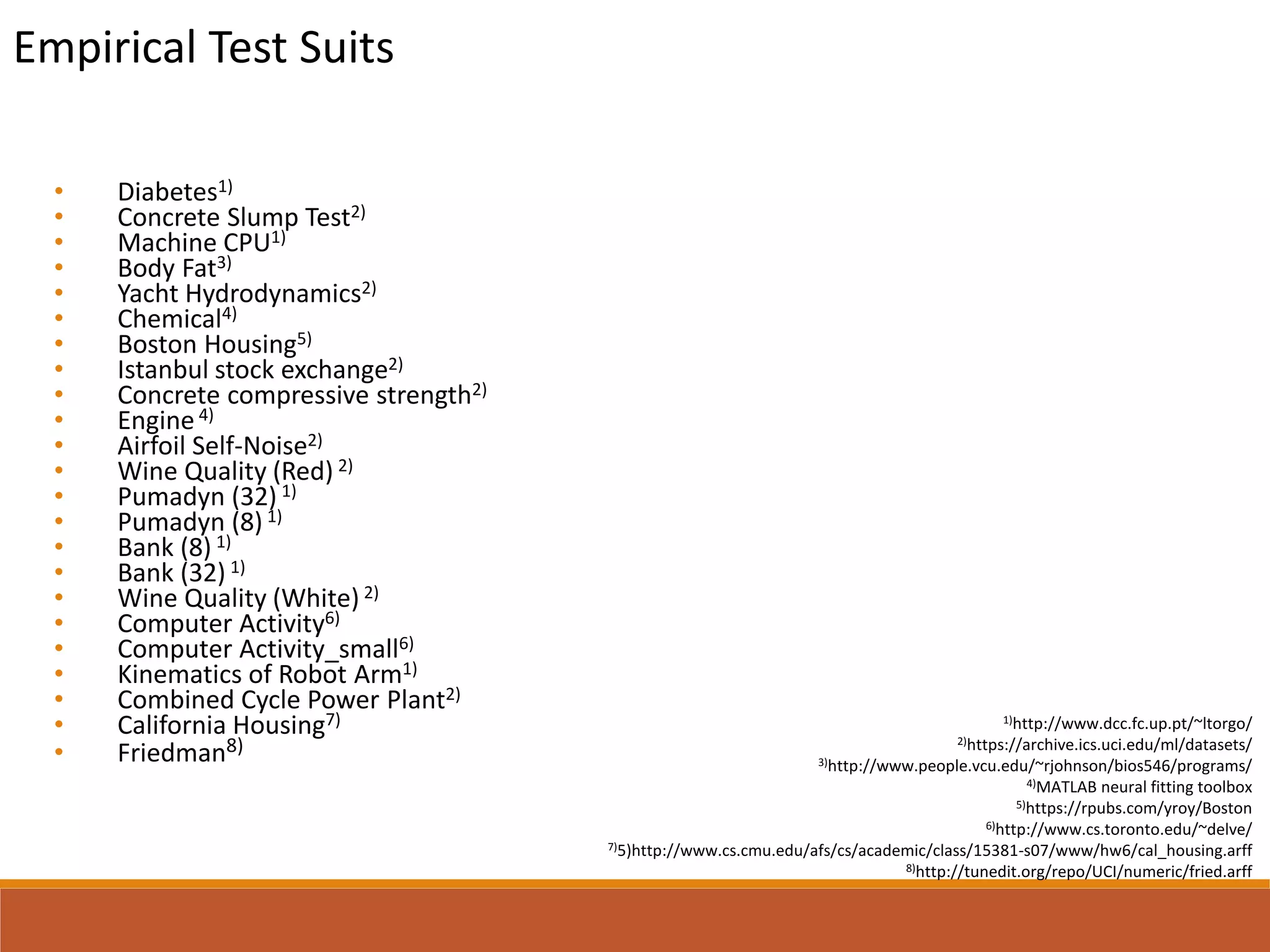
Empirical Test Suits
• Diabetes1)
• Concrete Slump Test2)
• Machine CPU1)
• Body Fat3)
• Yacht Hydrodynamics2)
• Chemical4)
• Boston Housing5)
• Istanbul stock exchange2)
• Concrete compressive strength2)
• Engine4)
• Airfoil Self-Noise2)
• Wine Quality (Red) 2)
• Pumadyn (32) 1)
• Pumadyn (8) 1)
• Bank (8) 1)
• Bank (32) 1)
• Wine Quality (White) 2)
• Computer Activity6)
• Computer Activity_small6)
• Kinematics of Robot Arm1)
• Combined Cycle Power Plant2)
• California Housing7)
• Friedman8)
1)http://www.dcc.fc.up.pt/~ltorgo/
2)https://archive.ics.uci.edu/ml/datasets/
3)http://www.people.vcu.edu/~rjohnson/bios546/programs/
4)MATLAB neural fitting toolbox
5)https://rpubs.com/yroy/Boston
6)http://www.cs.toronto.edu/~delve/
7)5)http://www.cs.cmu.edu/afs/cs/academic/class/15381-s07/www/hw6/cal_housing.arff
8)http://tunedit.org/repo/UCI/numeric/fried.arff
Description of Comparison Methods
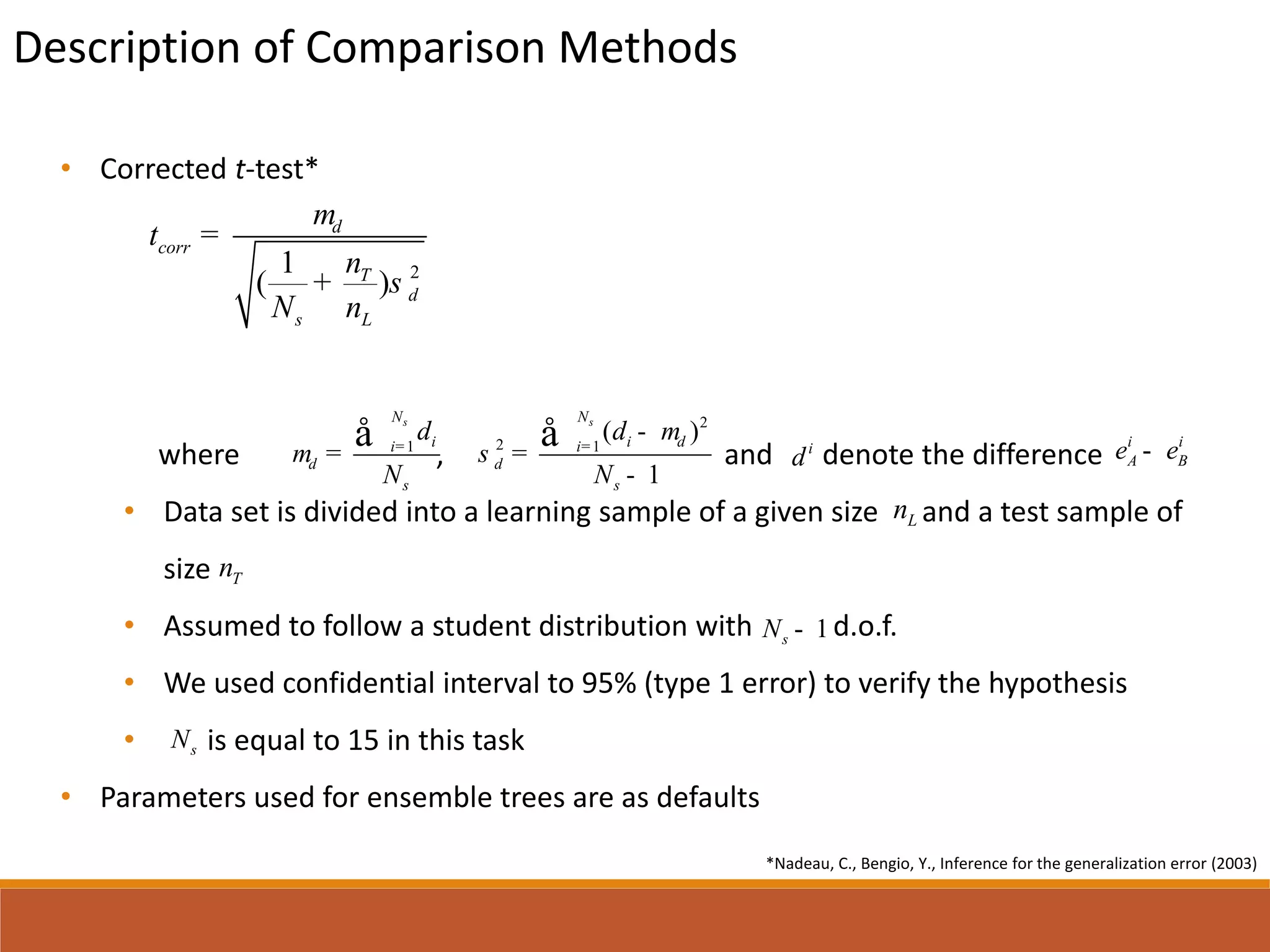
• Corrected t-test*
where , and denote the difference
• Data set is divided into a learning sample of a given size and a test sample of
size
• Assumed to follow a student distribution with d.o.f.
• We used confidential interval to 95% (type 1 error) to verify the hypothesis
• In this task, we repeated 30 times independently ( is 30)
• Parameters used for ensemble trees are as defaults
*Nadeau, C., Bengio, Y., Inference for the generalization error (2003)
i
d
i i
A Be e-
Tn
Ln
sN
21
( )
d
corr
T
d
s L
t
n
N n
m
s
=
+
1
sN
ii
d
s
d
N
m =
=
å
2
2 1
( )
1
sN
i di
d
s
d
N
m
s =
-
=
-
å
1sN -
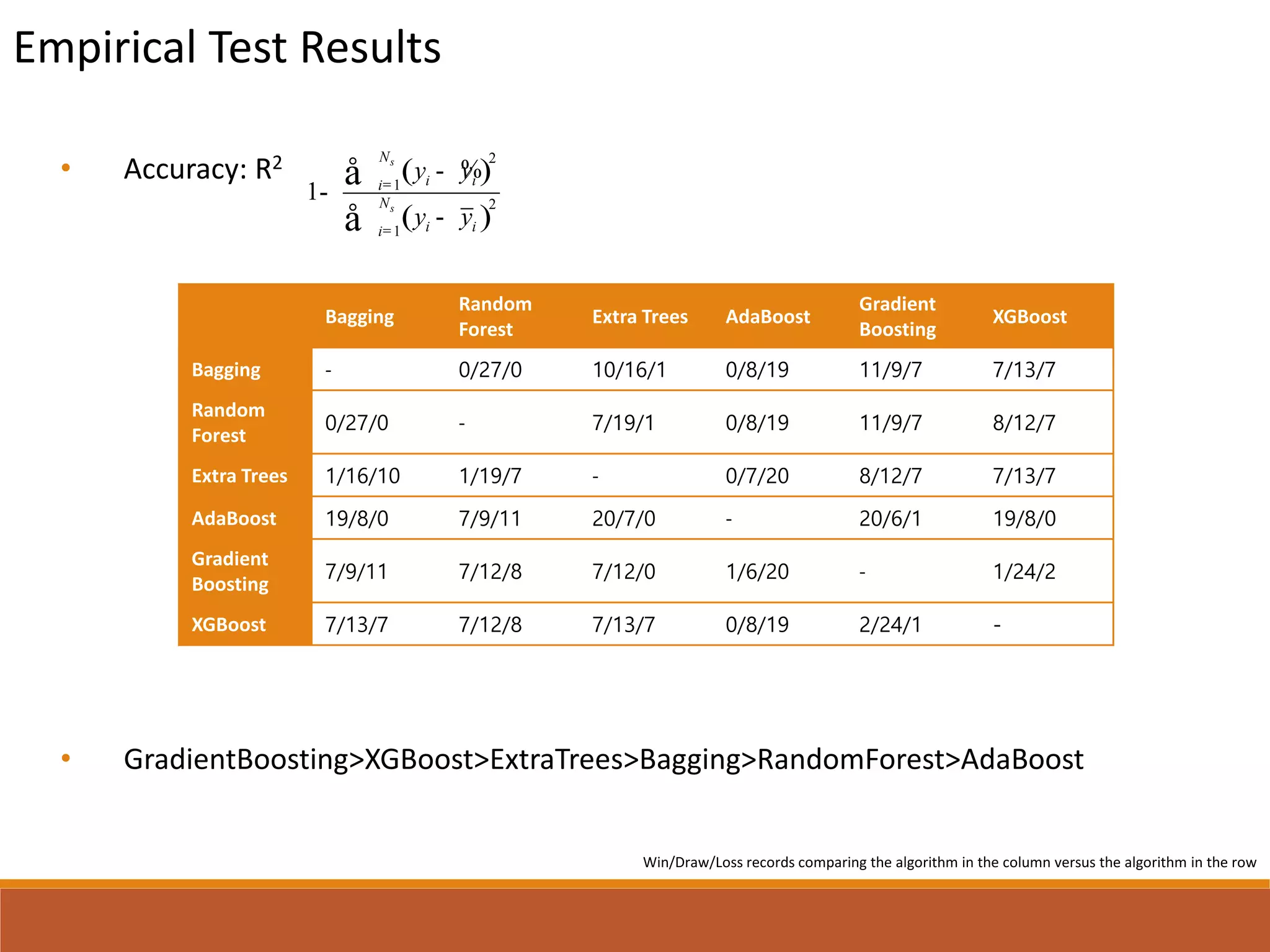
• Accuracy: R2
• GradientBoosting>XGBoost>ExtraTrees>Bagging>RandomForest>AdaBoost
Win/Draw/Loss records comparing the algorithm in the column versus the algorithm in the row
Bagging
Random
Forest
Extra Trees AdaBoost
Gradient
Boosting
XGBoost
Bagging - 0/27/0 10/16/1 0/8/19 11/9/7 7/13/7
Random
Forest
0/27/0 - 7/19/1 0/8/19 11/9/7 8/12/7
Extra Trees 1/16/10 1/19/7 - 0/7/20 8/12/7 7/13/7
AdaBoost 19/8/0 7/9/11 20/7/0 - 20/6/1 19/8/0
Gradient
Boosting
7/9/11 7/12/8 7/12/0 1/6/20 - 1/24/2
XGBoost 7/13/7 7/12/8 7/13/7 0/8/19 2/24/1 -
Empirical Test Results
( )
( )
2
1
2
1
1
s
s
N
i ii
N
i ii
y y
y y
=
=
-
-
-
å
å
%
Empirical Test Results
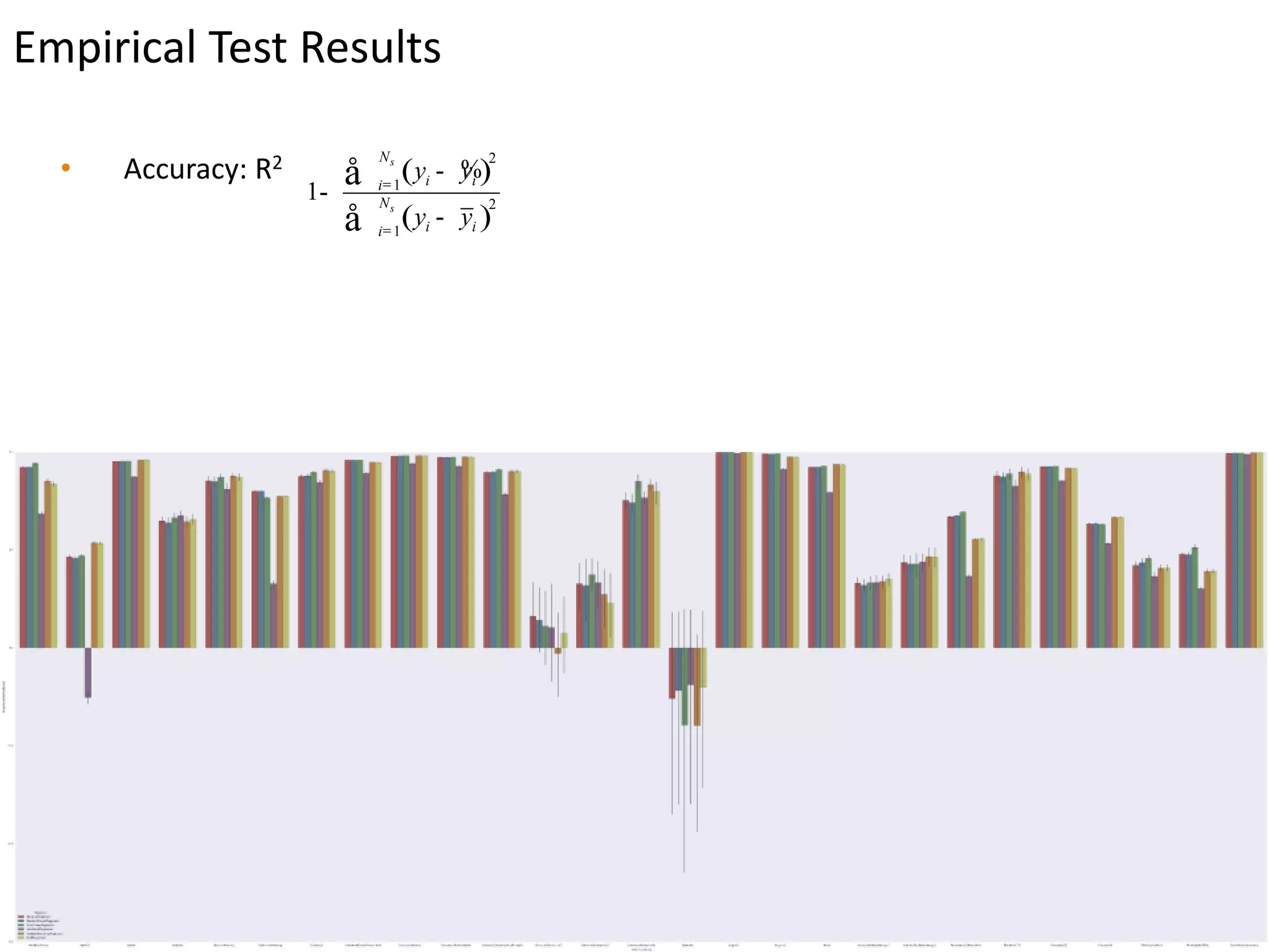
• Accuracy: R2 ( )
( )
2
1
2
1
1
s
s
N
i ii
N
i ii
y y
y y
=
=
-
-
-
å
å
%
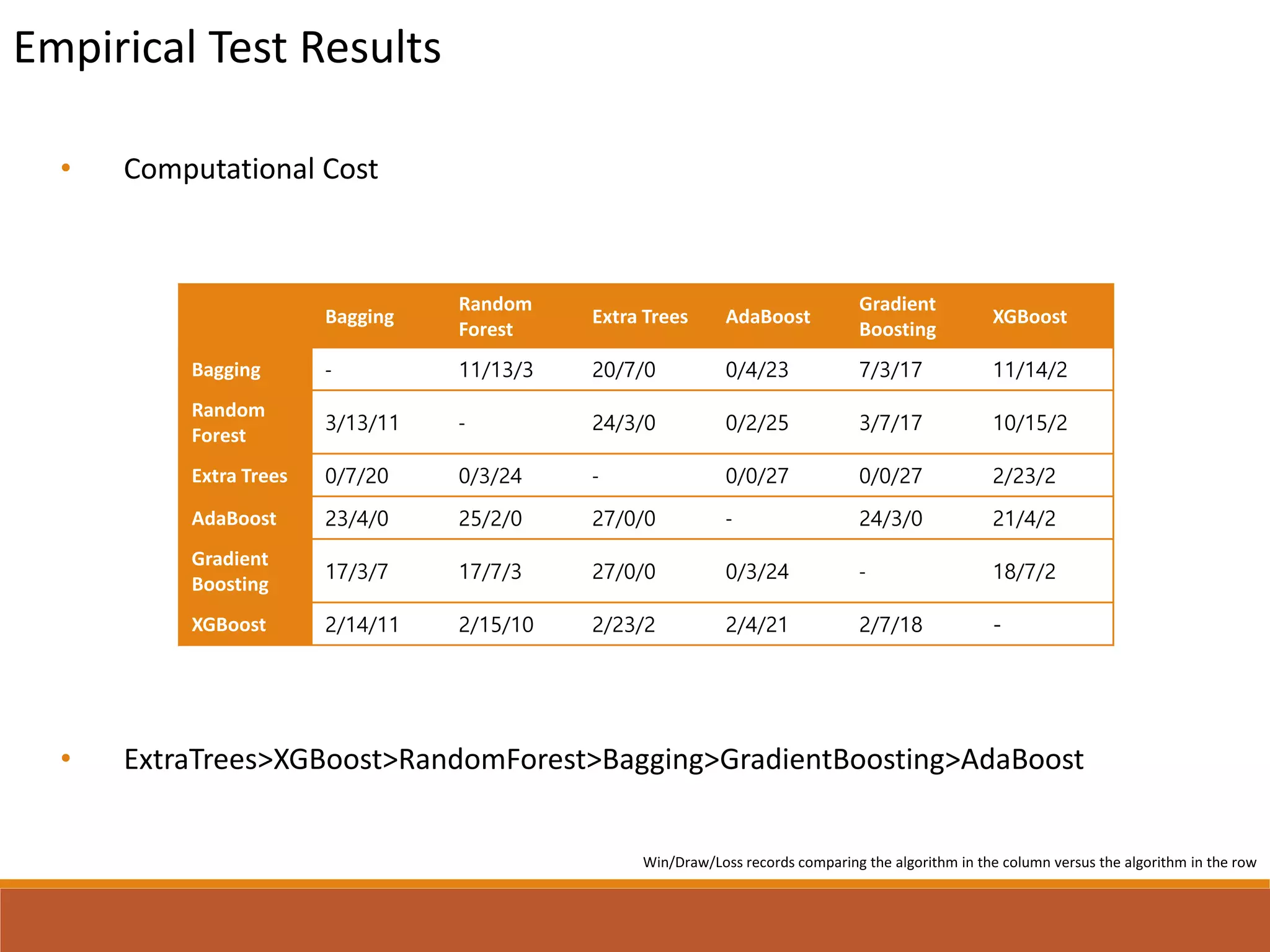
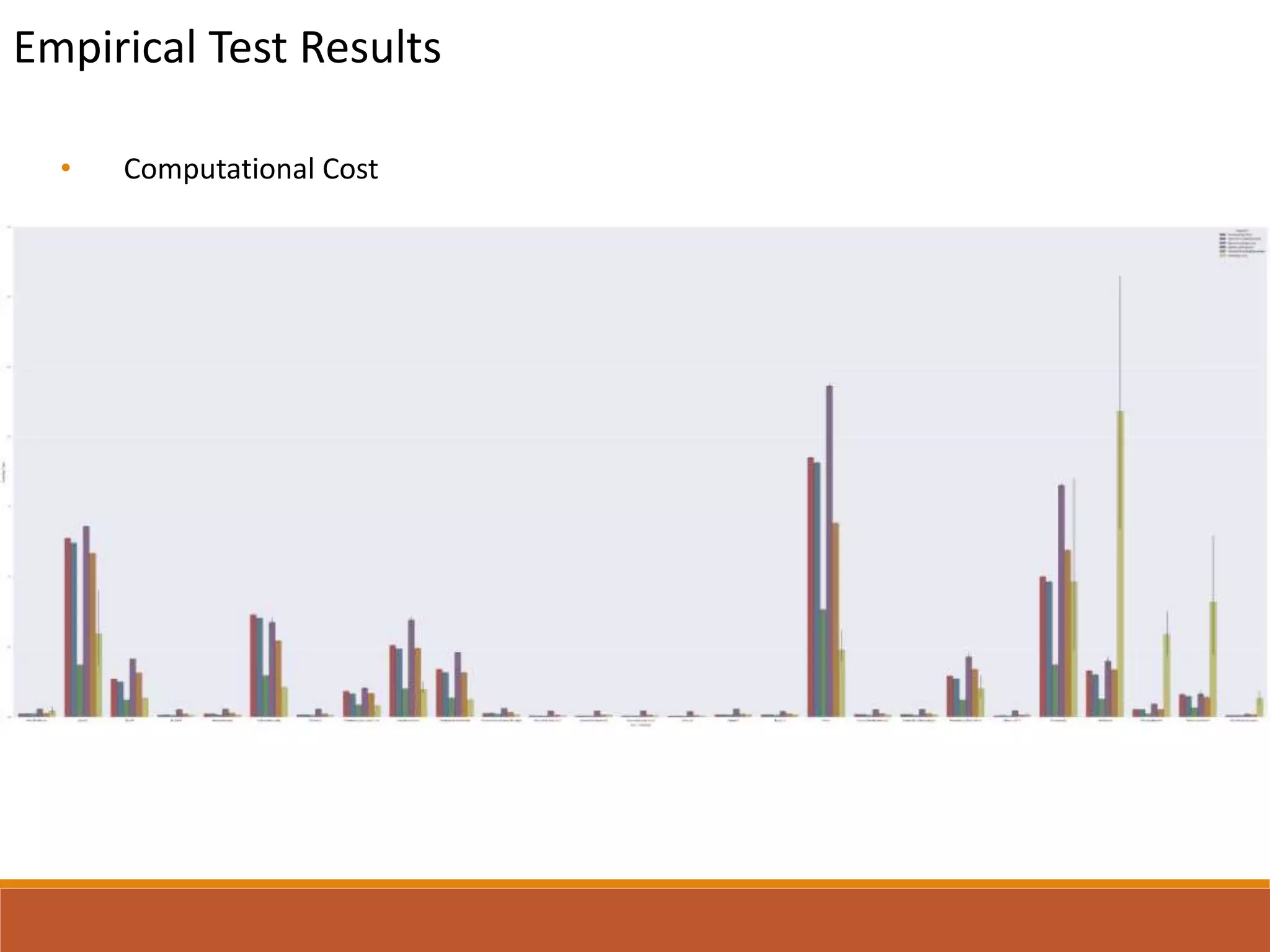
• Computational Cost
• ExtraTrees>XGBoost>RandomForest>Bagging>GradientBoosting>AdaBoost
Bagging
Random
Forest
Extra Trees AdaBoost
Gradient
Boosting
XGBoost
Bagging - 11/13/3 20/7/0 0/4/23 7/3/17 11/14/2
Random
Forest
3/13/11 - 24/3/0 0/2/25 3/7/17 10/15/2
Extra Trees 0/7/20 0/3/24 - 0/0/27 0/0/27 2/23/2
AdaBoost 23/4/0 25/2/0 27/0/0 - 24/3/0 21/4/2
Gradient
Boosting
17/3/7 17/7/3 27/0/0 0/3/24 - 18/7/2
XGBoost 2/14/11 2/15/10 2/23/2 2/4/21 2/7/18 -
Empirical Test Results
Win/Draw/Loss records comparing the algorithm in the column versus the algorithm in the row
Empirical Test Results
• Computational Cost

Comparison Study of Decision Tree Ensembles for Regression

  • 1.
    Comparison Study of DecisionTree Ensembles for Regression SEONHO PARK
  • 2.
    Objectives • Empirical studyof Ensemble trees for regression problems • To verify its performance and time efficiency • Candidates from open source • Scikit-Learn • BaggingRegressor • RandomForestRegressor • ExtraTreesRegressor • AdaBoostRegressor • GradientBoostingRegressor • XGBoost • XGBRegressor
  • 3.
    Decision Tree 1x 2x2 2.5?x> 1 3.0?x > N Y N Y • Expressed as a recursive partition of the feature space • Use for both classifier and regressor • Building blocks: nodes, leaves • Node splits the instance space into two or more sub-spaces according to a certain discrete function of the input feature values 2.5 3.0
  • 4.
    Decision Tree Inducers •How to generate decision tree? • Rule to determine the decision tree is how to split and prune nodes • Decision trees inducers: ID3(Quinlan, 1986), C4.5(Quinlan, 1993), CART(Breiman et al., 1984) • CART is most generable and popular
  • 5.
    CART • CART standsfor Classification and Regression Trees • Has ability to generate regression trees • Minimization of misclassification costs • In regression, the costs are represented for least squares between target values and expected values • Maximization of change of impurity function: • For regression, argmax ( ) ( ( )) ( ( )) j R j p l l r r x x i t P i t P i té ù= - -ê úë û [ ]arg min Var( ) Var( ) j R j l r x x Y Y= +
  • 6.
    CART • Pruning • minimumnumber of points Figure: Roman Timofeev, Classification and Regression Trees Theory and Applications, (2004) minN
  • 7.
    Decision Tree ProsAnd Cons • Advantages • Explicability: Easy to understand and interpret(white boxes) • Make minimal assumptions • Requires little data preparation • Addressing nonlinearity in an intuitive manner • Can handle both nominal and numerical features • Perform well with large datasets • Disadvantages • Heuristics such as the greedy algorithm  local optimal decision at each node • Instability, Overfitting – not to be robust to noise(outlier)
  • 8.
    Ensemble Methods • Tacticsof Ensemble Tree can be classified by two types : Bagging and Boosting • Bagging Methods: Tree Bagging, Random Forest, Extra Trees • Boosting Methods: AdaBoost, Gradient Boosting Figure: http://scikit-learn.org/stable/auto_examples/ensemble/plot_forest_iris.html
  • 9.
    Averaging Methods • RandomForest (L. Breiman, 2001) • Tree Bagging + Split among a random subset of the feature • Extra Trees (Extremely Randomized Trees) (P. Geurts et al., 2006) • Random Forest + Extra Tree • Extra Tree: thresholds at nodes are drawn at random • Tree Bagging (L. Breiman, 1996) • What is Bagging? • BAGGING is abbreviation for Bootstrap AGGregatING • Boosting: samples are drawn with replacement • Drawn as random subsets of the features  ‘Random Subspace’(1999) • Drawn as random subsets of both samples and features  ‘Random Patches’ (2012)
  • 10.
    Boosting Methods –AdaBoost • AdaBoost (Y. Freund, and R. Schapire, 1995) • AdaBoost is abbreviation for ‘Adaptive Boosting’ • Sequential decision making method • Boosted classifier in the form: Hypothesis of weak learner weight Hypothesis of Strong learner Figure: Schapire and Freund, Boosting: Foundations and algorithms (2012) 1 ( ) ( ) T t t t H x h xr = = å
  • 11.
    Boosting Methods –AdaBoost  • Supposed that you are given (x1,y1),(x2,y2),…,(xn,yn), and the task is to fit model H(x). And your friend wants to help you and gives you a model H. you check his model and find it is good but not perfect. There are some mistakes: H(x1) = 0.8, H(x2) = 1.4…, while y1= 0.9, y2=1.3… How can you improve this model? • Rule • Use friend model H without any modification of it • Can add additional model h to improve prediction, so the new prediction will be H+h 1 ( ) ( ) T t t t H x h xr = = å 1( ) ( )T T T TH x H h xr-= +
  • 12.
    Boosting Methods –AdaBoost 1 1 1 2 2 2 ( ) ( ) ( ) ( ) ... ( ) ( )n n n H x h x y H x h x y H x h x y + = + = + = • Wish to improve the model such that:  1 1 1 2 2 2 1 ( ) ( ) ( ) ( ) ... ( ) ( )n n h x y H x h x y H x h x y H x = - = - = - • Fit a weak learner h to data (x1,y1-H(x1)),(x2,y2-H(x2)),…,(xn,yn-H(xn)) residual
  • 13.
    Boosting Methods –Gradient Boosting • AdaBoost: updates with loss function residual which will be converged to 0 • In scikit-learn, AdaBoost.R2 algorithm is implemented • Gradient Boosting (L. Breiman, 1997) : updates with negative gradients of loss functions which will be converged to 0 0y H- = 0 L H ¶ - = ¶ *Drucker,H., Improving Regressors using Boosting Techniques (1997)
  • 14.
    Boosting Methods –Gradient Boosting • Loss function • First order optimality • If loss function is as follows: • Negative gradients can be interpret as residuals ( , )L y H ( , ) 0, 1,i i i L y H i n H ¶ = " = ¶ 2 2 1 ( , ) 2 L y H y H= - ( , ) , 1,i i i i i L y H y H i n H ¶ = - " = 
  • 15.
    Boosting Methods –Gradient Boosting • Square loss function is not adequate to treat the outliers  overfitting • Other loss functions • Absolute loss • Huber loss ( , )L y H y H= - ( ) 21 ( ) if , 2( , ) / 2 otherwise y H y H L y H y H d d d ìïï - - £ïï= í ïï - -ïïî
  • 16.
    • Among the29 kaggle challenge winning solutions during 2015, • 17 used XGBoost (Gradient Boosting Trees) (8 solely used XGBoost, 9 used XGBoost + deep neural nets) • 11 used deep neural nets (2 solely used, 9 combined with XGBoost) • In KDDCup 2015, Ensemble Trees was used in every winning team in the top 10 XGBoost *Tianqi Chen, XGBoost: A Scalable Tree Boosting System (2016)
  • 17.
    Ensemble Method Prosand Cons • Advantages • Avoid overfitting • Fast and scalable  handle large-scale data • Almost work ‘out-of-the-box’ • Disadvantages • Overfitting • ad hoc heuristic • Not provide probabilistic framework (confidence intervals, posterior distributions)
  • 18.
    Empirical Test Suits •Diabetes1) • Concrete Slump Test2) • Machine CPU1) • Body Fat3) • Yacht Hydrodynamics2) • Chemical4) • Boston Housing5) • Istanbul stock exchange2) • Concrete compressive strength2) • Engine4) • Airfoil Self-Noise2) • Wine Quality (Red) 2) • Pumadyn (32) 1) • Pumadyn (8) 1) • Bank (8) 1) • Bank (32) 1) • Wine Quality (White) 2) • Computer Activity6) • Computer Activity_small6) • Kinematics of Robot Arm1) • Combined Cycle Power Plant2) • California Housing7) • Friedman8) 1)http://www.dcc.fc.up.pt/~ltorgo/ 2)https://archive.ics.uci.edu/ml/datasets/ 3)http://www.people.vcu.edu/~rjohnson/bios546/programs/ 4)MATLAB neural fitting toolbox 5)https://rpubs.com/yroy/Boston 6)http://www.cs.toronto.edu/~delve/ 7)5)http://www.cs.cmu.edu/afs/cs/academic/class/15381-s07/www/hw6/cal_housing.arff 8)http://tunedit.org/repo/UCI/numeric/fried.arff
  • 19.
    Description of ComparisonMethods • Corrected t-test* where , and denote the difference • Data set is divided into a learning sample of a given size and a test sample of size • Assumed to follow a student distribution with d.o.f. • We used confidential interval to 95% (type 1 error) to verify the hypothesis • In this task, we repeated 30 times independently ( is 30) • Parameters used for ensemble trees are as defaults *Nadeau, C., Bengio, Y., Inference for the generalization error (2003) i d i i A Be e- Tn Ln sN 21 ( ) d corr T d s L t n N n m s = + 1 sN ii d s d N m = = å 2 2 1 ( ) 1 sN i di d s d N m s = - = - å 1sN -
  • 20.
    • Accuracy: R2 •GradientBoosting>XGBoost>ExtraTrees>Bagging>RandomForest>AdaBoost Win/Draw/Loss records comparing the algorithm in the column versus the algorithm in the row Bagging Random Forest Extra Trees AdaBoost Gradient Boosting XGBoost Bagging - 0/27/0 10/16/1 0/8/19 11/9/7 7/13/7 Random Forest 0/27/0 - 7/19/1 0/8/19 11/9/7 8/12/7 Extra Trees 1/16/10 1/19/7 - 0/7/20 8/12/7 7/13/7 AdaBoost 19/8/0 7/9/11 20/7/0 - 20/6/1 19/8/0 Gradient Boosting 7/9/11 7/12/8 7/12/0 1/6/20 - 1/24/2 XGBoost 7/13/7 7/12/8 7/13/7 0/8/19 2/24/1 - Empirical Test Results ( ) ( ) 2 1 2 1 1 s s N i ii N i ii y y y y = = - - - å å %
  • 21.
    Empirical Test Results •Accuracy: R2 ( ) ( ) 2 1 2 1 1 s s N i ii N i ii y y y y = = - - - å å %
  • 22.
    • Computational Cost •ExtraTrees>XGBoost>RandomForest>Bagging>GradientBoosting>AdaBoost Bagging Random Forest Extra Trees AdaBoost Gradient Boosting XGBoost Bagging - 11/13/3 20/7/0 0/4/23 7/3/17 11/14/2 Random Forest 3/13/11 - 24/3/0 0/2/25 3/7/17 10/15/2 Extra Trees 0/7/20 0/3/24 - 0/0/27 0/0/27 2/23/2 AdaBoost 23/4/0 25/2/0 27/0/0 - 24/3/0 21/4/2 Gradient Boosting 17/3/7 17/7/3 27/0/0 0/3/24 - 18/7/2 XGBoost 2/14/11 2/15/10 2/23/2 2/4/21 2/7/18 - Empirical Test Results Win/Draw/Loss records comparing the algorithm in the column versus the algorithm in the row
  • 23.
    Empirical Test Results •Computational Cost