Introduction to Ensemble Learning Featuring Successes in the Netflix Prize Competition Todd Holloway Two Lecture Series for B551 November 20 & 27, 2007 Indiana University
Outline Introduction Bias and variance problems The Netflix Prize Success of ensemble methods in the Netflix Prize Why Ensemble Methods Work Algorithms AdaBoost BrownBoost Random forests
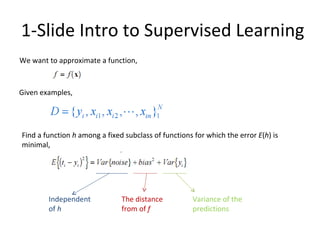
1-Slide Intro to Supervised Learning We want to approximate a function, Find a function  h  among a fixed subclass of functions for which the error  E ( h ) is minimal, Given examples, Independent of  h The distance from of  f Variance of the predictions
Bias Problem The hypothesis space made available by a particular classification method does not include sufficient hypotheses Variance Problem The hypothesis space made available is too large for the training data, and the selected hypothesis may not be accurate on unseen data Bias and Variance
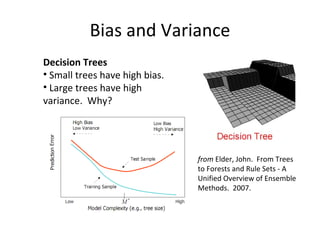
Bias and Variance from  Elder, John.  From Trees to Forests and Rule Sets - A Unified Overview of Ensemble Methods.  2007. Decision Trees Small trees have high bias. Large trees have high variance.  Why?
Definition Ensemble Classification Aggregation of predictions of multiple classifiers with the goal of improving accuracy.
Teaser:  How good are ensemble methods? Let’s look at the Netflix Prize Competition…
Supervised learning task Training data is a set of users and ratings (1,2,3,4,5 stars) those users have given to movies. Construct a classifier that given a user and an unrated movie, correctly classifies that movie as either 1, 2, 3, 4, or 5 stars $1 million prize for a 10% improvement over Netflix’s current movie recommender/classifier  (MSE = 0.9514) Began October 2006
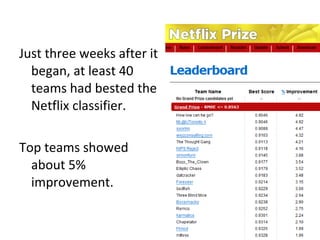
Just three weeks after it began, at least 40 teams had bested the Netflix classifier.  Top teams showed about 5% improvement.
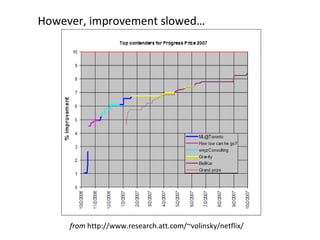
from  http://www.research.att.com/~volinsky/netflix/ However, improvement slowed…
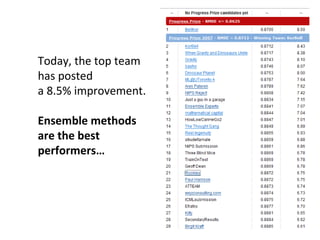
Today, the top team has posted a 8.5% improvement. Ensemble methods are the best performers…
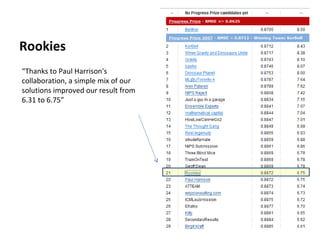
“ Thanks to Paul Harrison's collaboration, a simple mix of our solutions improved our result from 6.31 to 6.75” Rookies
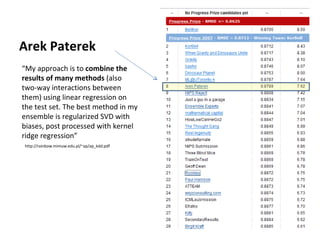
“ My approach is to  combine the results of many methods  (also two-way interactions between them) using linear regression on the test set. The best method in my ensemble is regularized SVD with biases, post processed with kernel ridge regression” Arek Paterek http://rainbow.mimuw.edu.pl/~ap/ap_kdd.pdf
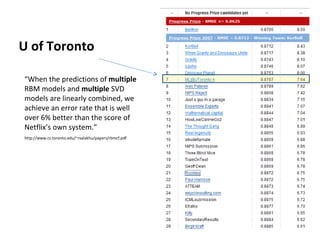
“ When the predictions of  multiple  RBM models and  multiple  SVD models are linearly combined, we achieve an error rate that is well over 6% better than the score of Netflix’s own system.” U of Toronto http://www.cs.toronto.edu/~rsalakhu/papers/rbmcf.pdf
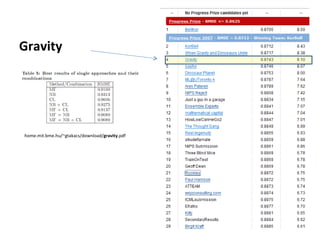
Gravity home.mit.bme.hu/~gtakacs/download/ gravity .pdf
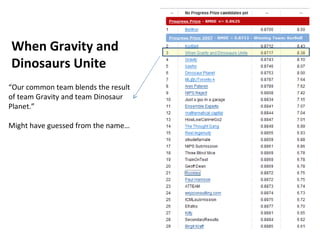
“ Our common team blends the result of team Gravity and team Dinosaur Planet.” Might have guessed from the name… When Gravity and  Dinosaurs Unite
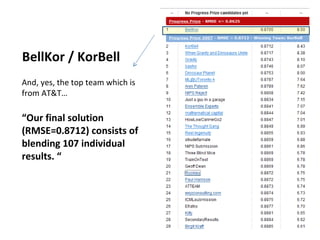
And, yes, the top team which is from AT&T… “ Our final solution (RMSE=0.8712) consists of blending 107 individual results. “ BellKor / KorBell
Some Intuitions on Why Ensemble Methods Work…
Intuitions Utility of combining diverse, independent opinions in human decision-making Protective Mechanism (e.g. stock portfolio diversity) Violation of Ockham’s Razor Identifying the best model requires identifying the proper "model complexity" See  Domingos, P. Occam’s two razors: the sharp and the blunt.  KDD.  1998.
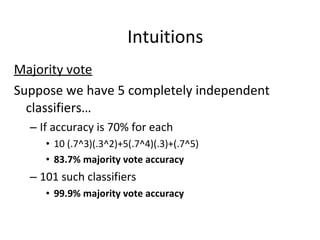
Majority vote Suppose we have 5 completely independent classifiers… If accuracy is 70% for each 10 (.7^3)(.3^2)+5(.7^4)(.3)+(.7^5)  83.7% majority vote accuracy 101 such classifiers 99.9% majority vote accuracy Intuitions
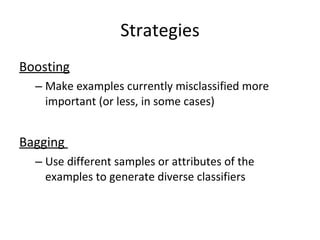
Strategies Boosting Make examples currently misclassified more important (or less, in some cases) Bagging  Use different samples or attributes of the examples to generate diverse classifiers
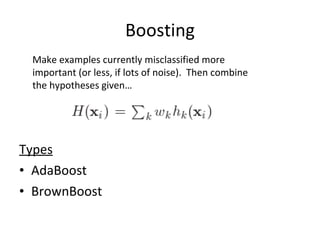
Boosting Types AdaBoost BrownBoost Make examples currently misclassified more important (or less, if lots of noise).  Then combine the hypotheses given…
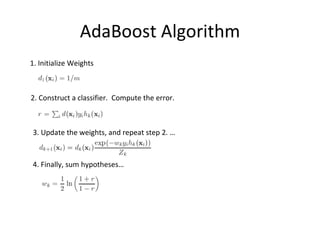
AdaBoost Algorithm 1. Initialize Weights 2. Construct a classifier.  Compute the error. 3. Update the weights, and repeat step 2. … 4. Finally, sum hypotheses…
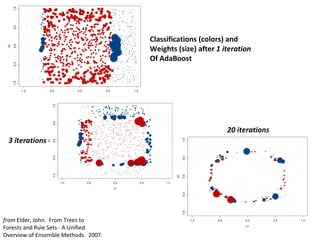
Classifications (colors) and  Weights (size) after  1 iteration Of AdaBoost 3 iterations 20 iterations from  Elder, John.  From Trees to Forests and Rule Sets - A Unified Overview of Ensemble Methods.  2007.
AdaBoost Advantages Very little code Reduces variance Disadvantages Sensitive to noise and outliers.  Why?
BrownBoost Reduce the weight given to misclassified example Good (only) for very noisy data.
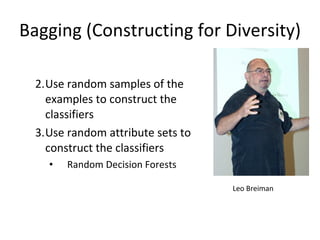
Bagging (Constructing for Diversity) Use random samples of the examples to construct the classifiers Use random attribute sets to construct the classifiers Random Decision Forests Leo Breiman
Random forests At every level, choose a random subset of the attributes (not examples) and choose the best split among those attributes Doesn’t overfit
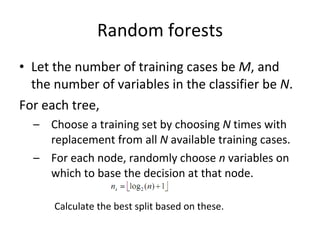
Random forests Let the number of training cases be  M , and the number of variables in the classifier be  N . For each tree, Choose a training set by choosing  N  times with replacement from all  N  available training cases.  For each node, randomly choose  n  variables on which to base the decision at that node.  Calculate the best split based on these.
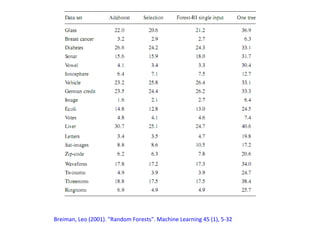
Breiman, Leo (2001). "Random Forests". Machine Learning 45 (1), 5-32
Questions / Comments?
Sources David Mease.  Statistical Aspects of Data Mining.  Lecture.  http://video.google.com/videoplay?docid=-4669216290304603251&q=stats+202+engEDU&total=13&start=0&num=10&so=0&type=search&plindex=8 Dietterich, T. G.  Ensemble Learning. In The Handbook of Brain Theory and Neural Networks, Second edition ,  (M.A. Arbib, Ed.), Cambridge, MA: The MIT Press, 2002.  http://www.cs.orst.edu/~tgd/publications/hbtnn-ensemble-learning.ps.gz Elder, John and Seni Giovanni.  From Trees to Forests and Rule Sets - A Unified Overview of Ensemble Methods.  KDD 2007 http://Tutorial. videolectures.net/kdd07_elder_ftfr/ Netflix Prize.  http://www.netflixprize.com/ Christopher M. Bishop.  Neural Networks for Pattern Recognition.  Oxford University Press.  1995.

ensemble learning

  • 1.
    Introduction to EnsembleLearning Featuring Successes in the Netflix Prize Competition Todd Holloway Two Lecture Series for B551 November 20 & 27, 2007 Indiana University
  • 2.
    Outline Introduction Biasand variance problems The Netflix Prize Success of ensemble methods in the Netflix Prize Why Ensemble Methods Work Algorithms AdaBoost BrownBoost Random forests
  • 3.
    1-Slide Intro toSupervised Learning We want to approximate a function, Find a function h among a fixed subclass of functions for which the error E ( h ) is minimal, Given examples, Independent of h The distance from of f Variance of the predictions
  • 4.
    Bias Problem Thehypothesis space made available by a particular classification method does not include sufficient hypotheses Variance Problem The hypothesis space made available is too large for the training data, and the selected hypothesis may not be accurate on unseen data Bias and Variance
  • 5.
    Bias and Variancefrom Elder, John. From Trees to Forests and Rule Sets - A Unified Overview of Ensemble Methods. 2007. Decision Trees Small trees have high bias. Large trees have high variance. Why?
  • 6.
    Definition Ensemble ClassificationAggregation of predictions of multiple classifiers with the goal of improving accuracy.
  • 7.
    Teaser: Howgood are ensemble methods? Let’s look at the Netflix Prize Competition…
  • 8.
    Supervised learning taskTraining data is a set of users and ratings (1,2,3,4,5 stars) those users have given to movies. Construct a classifier that given a user and an unrated movie, correctly classifies that movie as either 1, 2, 3, 4, or 5 stars $1 million prize for a 10% improvement over Netflix’s current movie recommender/classifier (MSE = 0.9514) Began October 2006
  • 9.
    Just three weeksafter it began, at least 40 teams had bested the Netflix classifier. Top teams showed about 5% improvement.
  • 10.
  • 11.
    Today, the topteam has posted a 8.5% improvement. Ensemble methods are the best performers…
  • 12.
    “ Thanks toPaul Harrison's collaboration, a simple mix of our solutions improved our result from 6.31 to 6.75” Rookies
  • 13.
    “ My approachis to combine the results of many methods (also two-way interactions between them) using linear regression on the test set. The best method in my ensemble is regularized SVD with biases, post processed with kernel ridge regression” Arek Paterek http://rainbow.mimuw.edu.pl/~ap/ap_kdd.pdf
  • 14.
    “ When thepredictions of multiple RBM models and multiple SVD models are linearly combined, we achieve an error rate that is well over 6% better than the score of Netflix’s own system.” U of Toronto http://www.cs.toronto.edu/~rsalakhu/papers/rbmcf.pdf
  • 15.
  • 16.
    “ Our commonteam blends the result of team Gravity and team Dinosaur Planet.” Might have guessed from the name… When Gravity and Dinosaurs Unite
  • 17.
    And, yes, thetop team which is from AT&T… “ Our final solution (RMSE=0.8712) consists of blending 107 individual results. “ BellKor / KorBell
  • 18.
    Some Intuitions onWhy Ensemble Methods Work…
  • 19.
    Intuitions Utility ofcombining diverse, independent opinions in human decision-making Protective Mechanism (e.g. stock portfolio diversity) Violation of Ockham’s Razor Identifying the best model requires identifying the proper "model complexity" See Domingos, P. Occam’s two razors: the sharp and the blunt. KDD. 1998.
  • 20.
    Majority vote Supposewe have 5 completely independent classifiers… If accuracy is 70% for each 10 (.7^3)(.3^2)+5(.7^4)(.3)+(.7^5) 83.7% majority vote accuracy 101 such classifiers 99.9% majority vote accuracy Intuitions
  • 21.
    Strategies Boosting Makeexamples currently misclassified more important (or less, in some cases) Bagging Use different samples or attributes of the examples to generate diverse classifiers
  • 22.
    Boosting Types AdaBoostBrownBoost Make examples currently misclassified more important (or less, if lots of noise). Then combine the hypotheses given…
  • 23.
    AdaBoost Algorithm 1.Initialize Weights 2. Construct a classifier. Compute the error. 3. Update the weights, and repeat step 2. … 4. Finally, sum hypotheses…
  • 24.
    Classifications (colors) and Weights (size) after 1 iteration Of AdaBoost 3 iterations 20 iterations from Elder, John. From Trees to Forests and Rule Sets - A Unified Overview of Ensemble Methods. 2007.
  • 25.
    AdaBoost Advantages Verylittle code Reduces variance Disadvantages Sensitive to noise and outliers. Why?
  • 26.
    BrownBoost Reduce theweight given to misclassified example Good (only) for very noisy data.
  • 27.
    Bagging (Constructing forDiversity) Use random samples of the examples to construct the classifiers Use random attribute sets to construct the classifiers Random Decision Forests Leo Breiman
  • 28.
    Random forests Atevery level, choose a random subset of the attributes (not examples) and choose the best split among those attributes Doesn’t overfit
  • 29.
    Random forests Letthe number of training cases be M , and the number of variables in the classifier be N . For each tree, Choose a training set by choosing N times with replacement from all N available training cases. For each node, randomly choose n variables on which to base the decision at that node. Calculate the best split based on these.
  • 30.
    Breiman, Leo (2001)."Random Forests". Machine Learning 45 (1), 5-32
  • 31.
  • 32.
    Sources David Mease. Statistical Aspects of Data Mining. Lecture. http://video.google.com/videoplay?docid=-4669216290304603251&q=stats+202+engEDU&total=13&start=0&num=10&so=0&type=search&plindex=8 Dietterich, T. G. Ensemble Learning. In The Handbook of Brain Theory and Neural Networks, Second edition , (M.A. Arbib, Ed.), Cambridge, MA: The MIT Press, 2002. http://www.cs.orst.edu/~tgd/publications/hbtnn-ensemble-learning.ps.gz Elder, John and Seni Giovanni. From Trees to Forests and Rule Sets - A Unified Overview of Ensemble Methods. KDD 2007 http://Tutorial. videolectures.net/kdd07_elder_ftfr/ Netflix Prize. http://www.netflixprize.com/ Christopher M. Bishop. Neural Networks for Pattern Recognition. Oxford University Press. 1995.

Editor's Notes

  • #16 Matrix Factorization-SVD (MF), K-Nearest neighbor (NB), Clustering (CL).
  • #20 KDD 1998 Best paper award went to an argument against Ockham’s razor. Complexity is not related to overfiting. Mention use of Ockham’s razor in Naïve Bayes.
  • #24 Note: if weights can’t be used directly, they can be used to generate a weighted sample of the example. Point is that the construction of a classifier
  • #25 Note after 1 iteration the step classes of a single decision tree.
  • #28 Originally rejected (journal of statistics). Can also create multiple NN using different random initial weights for diversity. Owns trademark on Random forests.
  • #30 Grow trees deep to avoid bias.