CrossValidation
By
AbdulRidha Mohammad
content layout
 Introduction
 Methods of CrossValidation
Test set method
Leave one out cross validation (LOOCV)
k-fold cross validation
 Example
 Spss programing
What is CrossValidation?
 CrossValidation is a technique which involves reserving a
particular sample of a dataset on which you do not train the
model. Later, you test your model on this sample before
finalizing it.
 Here are the steps involved in cross validation:
 You reserve a sample data set
 Train the model using the remaining part of the dataset
 Use the reserve sample of the test (validation) set.This will
help you in gauging the effectiveness of your model’s
performance. If your model delivers a positive result on
validation data, go ahead with the current model. It rocks!
Methods of CrossValidation
 A few common methods used for CrossValidation
There are various methods available for performing cross
validation. I’ve discussed a few of them in this section.
 The test set method
 Leave one out cross validation (LOOCV)
 k-fold cross validation
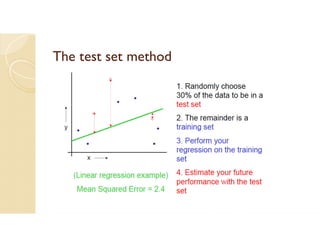
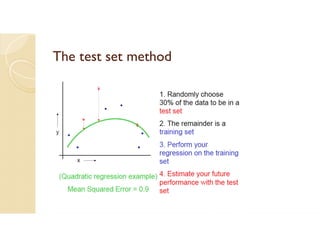
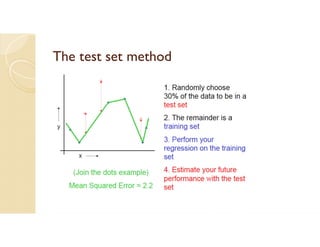
The test set method
 1. Randomly choose 30% of the data to be in a test set
 2.The remainder is a training set
 3. Perform your regression on the training set
 4. Estimate your future performance with the test
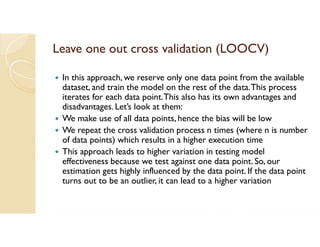
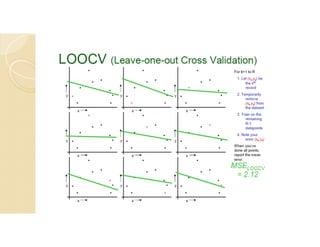
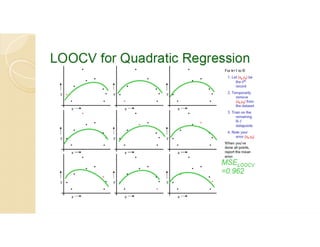
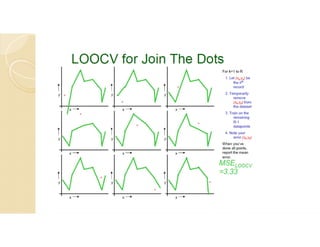
Leave one out cross validation (LOOCV)
 In this approach, we reserve only one data point from the available
dataset, and train the model on the rest of the data.This process
iterates for each data point.This also has its own advantages and
disadvantages. Let’s look at them:
 We make use of all data points, hence the bias will be low
 We repeat the cross validation process n times (where n is number
of data points) which results in a higher execution time
 This approach leads to higher variation in testing model
effectiveness because we test against one data point. So, our
estimation gets highly influenced by the data point. If the data point
turns out to be an outlier, it can lead to a higher variation
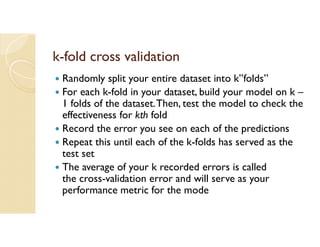
k-fold cross validation
 Randomly split your entire dataset into k”folds”
 For each k-fold in your dataset, build your model on k –
1 folds of the dataset.Then, test the model to check the
effectiveness for kth fold
 Record the error you see on each of the predictions
 Repeat this until each of the k-folds has served as the
test set
 The average of your k recorded errors is called
the cross-validation error and will serve as your
performance metric for the mode
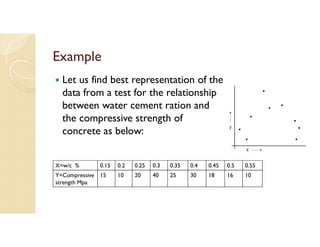
Example
 Let us find best representation of the
data from a test for the relationship
between water cement ration and
the compressive strength of
concrete as below:
X=w/c % 0.15 0.2 0.25 0.3 0.35 0.4 0.45 0.5 0.55
Y=Compressive
strength Mpa
15 10 20 40 25 30 18 16 10
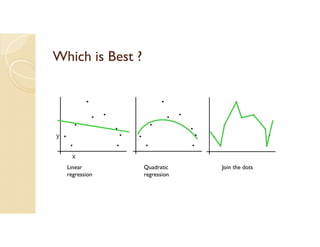
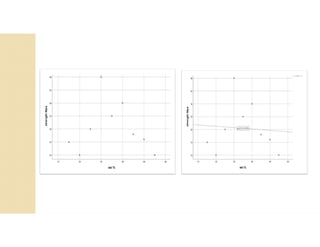
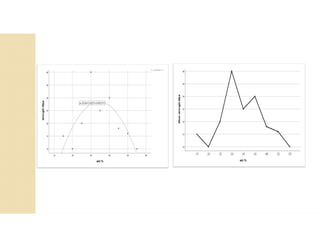
Which is Best ?
Linear
regression
Quadratic
regression
Join the dots
The test set method
The test set method
The test set method
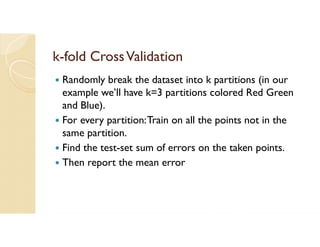
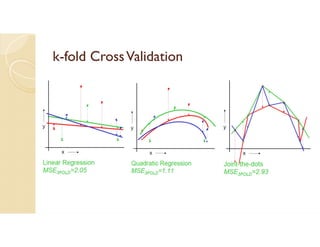
k-fold CrossValidation
 Randomly break the dataset into k partitions (in our
example we’ll have k=3 partitions colored Red Green
and Blue).
 For every partition:Train on all the points not in the
same partition.
 Find the test-set sum of errors on the taken points.
 Then report the mean error
k-fold CrossValidation
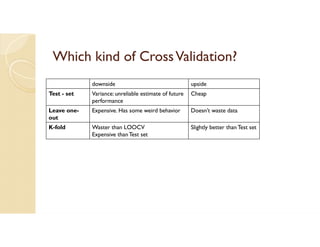
Which kind of CrossValidation?
downside upside
Test - set Variance: unreliable estimate of future
performance
Cheap
Leave one-
out
Expensive. Has some weird behavior Doesn’t waste data
K-fold Waster than LOOCV
Expensive thanTest set
Slightly better than Test set
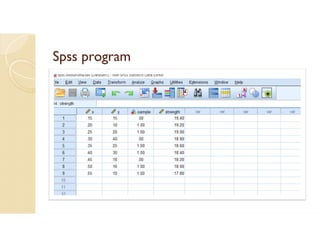
Spss program
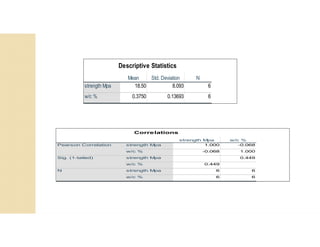
Mean Std. Deviation N
strength Mpa 18.50 8.093 6
w/c % 0.3750 0.13693 6
Descriptive Statistics
strength Mpa w/c %
strength Mpa 1.000 -0.068
w/c % -0.068 1.000
strength Mpa 0.449
w/c % 0.449
strength Mpa 6 6
w/c % 6 6
Correlations
Pearson Correlation
Sig. (1-tailed)
N
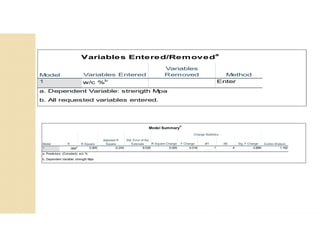
Variables Entered
Variables
Removed Method
1 w/c %b Enter
Variables Entered/Removed
a
Model
a. Dependent Variable: strength Mpa
b. All requested variables entered.
R Square Change F Change df1 df2 Sig. F Change
1 .068
a 0.005 -0.244 9.028 0.005 0.018 1 4 0.899 1.162
a. Predictors: (Constant), w/c %
b. Dependent Variable: strength Mpa
Model Summary
b
Model R R Square
Adjusted R
Square
Std. Error of the
Estimate
Change Statistics
Durbin-Watson
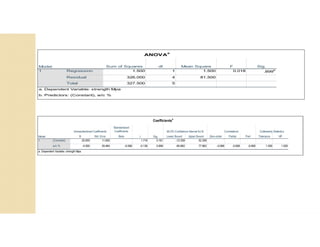
Sum of Squares df Mean Square F Sig.
Regression 1.500 1 1.500 0.018 .899
b
Residual 326.000 4 81.500
Total 327.500 5
ANOVA
a
Model
1
a. Dependent Variable: strength Mpa
b. Predictors: (Constant), w/c %
Standardized
Coefficients
B Std. Error Beta Lower Bound Upper Bound Zero-order Partial Part Tolerance VIF
(Constant) 20.000 11.655 1.716 0.161 -12.359 52.359
w/c % -4.000 29.484 -0.068 -0.136 0.899 -85.862 77.862 -0.068 -0.068 -0.068 1.000 1.000
1
a. Dependent Variable: strength Mpa
Coefficients
a
Model
Unstandardized Coefficients
t Sig.
95.0% Confidence Interval for B Correlations Collinearity Statistics
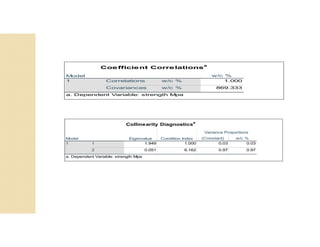
w/c %
Correlations w/c % 1.000
Covariances w/c % 869.333
Coefficient Correlations
a
Model
1
a. Dependent Variable: strength Mpa
(Constant) w/c %
1 1.949 1.000 0.03 0.03
2 0.051 6.162 0.97 0.97
a. Dependent Variable: strength Mpa
Collinearity Diagnostics
a
Model Eigenvalue Condition Index
Variance Proportions
1
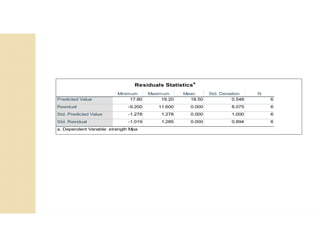
Minimum Maximum Mean Std. Deviation N
Predicted Value 17.80 19.20 18.50 0.548 6
Residual -9.200 11.600 0.000 8.075 6
Std. Predicted Value -1.278 1.278 0.000 1.000 6
Std. Residual -1.019 1.285 0.000 0.894 6
Residuals Statistics
a
a. Dependent Variable: strength Mpa
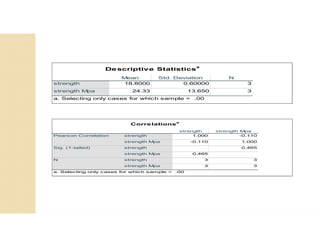
Mean Std. Deviation N
strength 18.8000 0.60000 3
strength Mpa 24.33 13.650 3
Descriptive Statistics
a
a. Selecting only cases for which sample = .00
strength strength Mpa
strength 1.000 -0.110
strength Mpa -0.110 1.000
strength 0.465
strength Mpa 0.465
strength 3 3
strength Mpa 3 3
Correlations
a
Pearson Correlation
Sig. (1-tailed)
N
a. Selecting only cases for which sample = .00
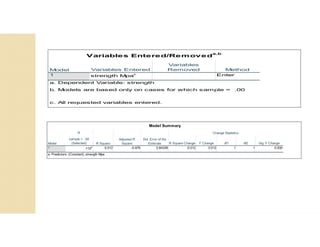
Variables Entered
Variables
Removed Method
1 strength Mpac Enter
Variables Entered/Removed
a,b
Model
a. Dependent Variable: strength
b. Models are based only on cases for which sample = .00
c. All requested variables entered.
R
sample = .00
(Selected) R Square Change F Change df1 df2 Sig. F Change
1 .110a 0.012 -0.976 0.84339 0.012 0.012 1 1 0.930
a. Predictors: (Constant), strength Mpa
Model Summary
Model R Square
Adjusted R
Square
Std. Error of the
Estimate
Change Statistics
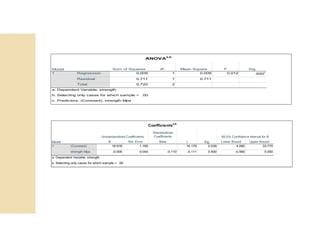
Sum of Squares df Mean Square F Sig.
Regression 0.009 1 0.009 0.012 .930
c
Residual 0.711 1 0.711
Total 0.720 2
ANOVA
a,b
Model
1
a. Dependent Variable: strength
b. Selecting only cases for which sample = .00
c. Predictors: (Constant), strength Mpa
Standardized
Coefficients
B Std. Error Beta Lower Bound Upper Bound
(Constant) 18.918 1.169 16.179 0.039 4.060 33.775
strength Mpa -0.005 0.044 -0.110 -0.111 0.930 -0.560 0.550
1
a. Dependent Variable: strength
b. Selecting only cases for which sample = .00
Coefficients
a,b
Model
Unstandardized Coefficients
t Sig.
95.0% Confidence Interval for B
Cross validation

Cross validation

  • 1.
  • 2.
    content layout  Introduction Methods of CrossValidation Test set method Leave one out cross validation (LOOCV) k-fold cross validation  Example  Spss programing
  • 3.
    What is CrossValidation? CrossValidation is a technique which involves reserving a particular sample of a dataset on which you do not train the model. Later, you test your model on this sample before finalizing it.  Here are the steps involved in cross validation:  You reserve a sample data set  Train the model using the remaining part of the dataset  Use the reserve sample of the test (validation) set.This will help you in gauging the effectiveness of your model’s performance. If your model delivers a positive result on validation data, go ahead with the current model. It rocks!
  • 4.
    Methods of CrossValidation A few common methods used for CrossValidation There are various methods available for performing cross validation. I’ve discussed a few of them in this section.  The test set method  Leave one out cross validation (LOOCV)  k-fold cross validation
  • 5.
    The test setmethod  1. Randomly choose 30% of the data to be in a test set  2.The remainder is a training set  3. Perform your regression on the training set  4. Estimate your future performance with the test
  • 6.
    Leave one outcross validation (LOOCV)  In this approach, we reserve only one data point from the available dataset, and train the model on the rest of the data.This process iterates for each data point.This also has its own advantages and disadvantages. Let’s look at them:  We make use of all data points, hence the bias will be low  We repeat the cross validation process n times (where n is number of data points) which results in a higher execution time  This approach leads to higher variation in testing model effectiveness because we test against one data point. So, our estimation gets highly influenced by the data point. If the data point turns out to be an outlier, it can lead to a higher variation
  • 7.
    k-fold cross validation Randomly split your entire dataset into k”folds”  For each k-fold in your dataset, build your model on k – 1 folds of the dataset.Then, test the model to check the effectiveness for kth fold  Record the error you see on each of the predictions  Repeat this until each of the k-folds has served as the test set  The average of your k recorded errors is called the cross-validation error and will serve as your performance metric for the mode
  • 8.
    Example  Let usfind best representation of the data from a test for the relationship between water cement ration and the compressive strength of concrete as below: X=w/c % 0.15 0.2 0.25 0.3 0.35 0.4 0.45 0.5 0.55 Y=Compressive strength Mpa 15 10 20 40 25 30 18 16 10
  • 9.
    Which is Best? Linear regression Quadratic regression Join the dots
  • 10.
  • 11.
  • 12.
  • 16.
    k-fold CrossValidation  Randomlybreak the dataset into k partitions (in our example we’ll have k=3 partitions colored Red Green and Blue).  For every partition:Train on all the points not in the same partition.  Find the test-set sum of errors on the taken points.  Then report the mean error
  • 17.
  • 18.
    Which kind ofCrossValidation? downside upside Test - set Variance: unreliable estimate of future performance Cheap Leave one- out Expensive. Has some weird behavior Doesn’t waste data K-fold Waster than LOOCV Expensive thanTest set Slightly better than Test set
  • 19.
  • 22.
    Mean Std. DeviationN strength Mpa 18.50 8.093 6 w/c % 0.3750 0.13693 6 Descriptive Statistics strength Mpa w/c % strength Mpa 1.000 -0.068 w/c % -0.068 1.000 strength Mpa 0.449 w/c % 0.449 strength Mpa 6 6 w/c % 6 6 Correlations Pearson Correlation Sig. (1-tailed) N
  • 23.
    Variables Entered Variables Removed Method 1w/c %b Enter Variables Entered/Removed a Model a. Dependent Variable: strength Mpa b. All requested variables entered. R Square Change F Change df1 df2 Sig. F Change 1 .068 a 0.005 -0.244 9.028 0.005 0.018 1 4 0.899 1.162 a. Predictors: (Constant), w/c % b. Dependent Variable: strength Mpa Model Summary b Model R R Square Adjusted R Square Std. Error of the Estimate Change Statistics Durbin-Watson
  • 24.
    Sum of Squaresdf Mean Square F Sig. Regression 1.500 1 1.500 0.018 .899 b Residual 326.000 4 81.500 Total 327.500 5 ANOVA a Model 1 a. Dependent Variable: strength Mpa b. Predictors: (Constant), w/c % Standardized Coefficients B Std. Error Beta Lower Bound Upper Bound Zero-order Partial Part Tolerance VIF (Constant) 20.000 11.655 1.716 0.161 -12.359 52.359 w/c % -4.000 29.484 -0.068 -0.136 0.899 -85.862 77.862 -0.068 -0.068 -0.068 1.000 1.000 1 a. Dependent Variable: strength Mpa Coefficients a Model Unstandardized Coefficients t Sig. 95.0% Confidence Interval for B Correlations Collinearity Statistics
  • 25.
    w/c % Correlations w/c% 1.000 Covariances w/c % 869.333 Coefficient Correlations a Model 1 a. Dependent Variable: strength Mpa (Constant) w/c % 1 1.949 1.000 0.03 0.03 2 0.051 6.162 0.97 0.97 a. Dependent Variable: strength Mpa Collinearity Diagnostics a Model Eigenvalue Condition Index Variance Proportions 1
  • 26.
    Minimum Maximum MeanStd. Deviation N Predicted Value 17.80 19.20 18.50 0.548 6 Residual -9.200 11.600 0.000 8.075 6 Std. Predicted Value -1.278 1.278 0.000 1.000 6 Std. Residual -1.019 1.285 0.000 0.894 6 Residuals Statistics a a. Dependent Variable: strength Mpa
  • 27.
    Mean Std. DeviationN strength 18.8000 0.60000 3 strength Mpa 24.33 13.650 3 Descriptive Statistics a a. Selecting only cases for which sample = .00 strength strength Mpa strength 1.000 -0.110 strength Mpa -0.110 1.000 strength 0.465 strength Mpa 0.465 strength 3 3 strength Mpa 3 3 Correlations a Pearson Correlation Sig. (1-tailed) N a. Selecting only cases for which sample = .00
  • 28.
    Variables Entered Variables Removed Method 1strength Mpac Enter Variables Entered/Removed a,b Model a. Dependent Variable: strength b. Models are based only on cases for which sample = .00 c. All requested variables entered. R sample = .00 (Selected) R Square Change F Change df1 df2 Sig. F Change 1 .110a 0.012 -0.976 0.84339 0.012 0.012 1 1 0.930 a. Predictors: (Constant), strength Mpa Model Summary Model R Square Adjusted R Square Std. Error of the Estimate Change Statistics
  • 29.
    Sum of Squaresdf Mean Square F Sig. Regression 0.009 1 0.009 0.012 .930 c Residual 0.711 1 0.711 Total 0.720 2 ANOVA a,b Model 1 a. Dependent Variable: strength b. Selecting only cases for which sample = .00 c. Predictors: (Constant), strength Mpa Standardized Coefficients B Std. Error Beta Lower Bound Upper Bound (Constant) 18.918 1.169 16.179 0.039 4.060 33.775 strength Mpa -0.005 0.044 -0.110 -0.111 0.930 -0.560 0.550 1 a. Dependent Variable: strength b. Selecting only cases for which sample = .00 Coefficients a,b Model Unstandardized Coefficients t Sig. 95.0% Confidence Interval for B