Cellular Membranes  (macromolecules = background information)
Vocab you need to know: FLASHCARDS:  Monomer: molecule that can be bonded to other identical molecules to form a polymer PREFIX SHEET Mono: one  Poly: many, more than one  Di: two  Hydro: water  Phobic: afraid Philic: love Nucleo: nucleus
FLASH CARD ALERT  MACROMOLECULE:  A molecule containing a large amount of atoms.
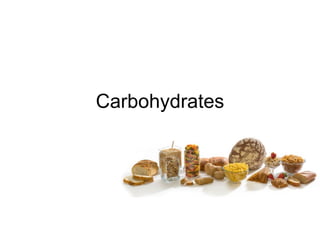
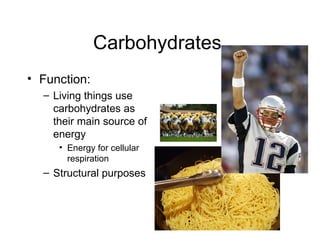
Carbohydrates
Carbohydrates  Function:  Living things use carbohydrates as their main source of energy  Energy for cellular respiration  Structural purposes
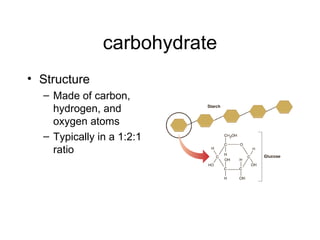
carbohydrate Structure Made of carbon, hydrogen, and oxygen atoms Typically in a 1:2:1 ratio
FLASH CARD ALERT  POLYSACCHARIDE  More than two  MONOSACCHARIDE  combined through dehydration synthesis  MONOSACCHARIDE:  simple sugar. Building blocks of more complex sugars: glucose  DISACCHARIDE:  sugar produced by two monosaccharide molecules as a result of dehydration synthesis
Carbohydrate Monomer:  Monosaccharides: glucose, frutose  Polymer:  Polysaccharides: glycogen (animal starch)  Plants store excess sugar in starch
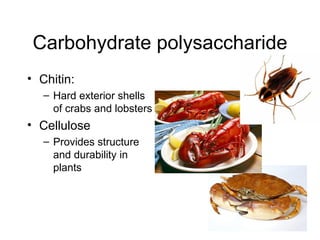
Carbohydrate polysaccharide Chitin:  Hard exterior shells of crabs and lobsters  Cellulose  Provides structure and durability in plants
Fill out chart for carbohydrate
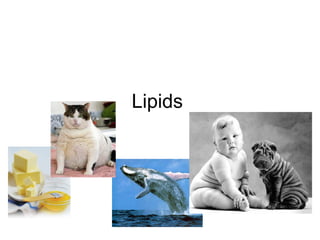
Lipids
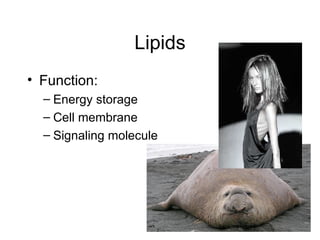
Lipids Function: Energy storage Cell membrane  Signaling molecule
FLASH CARD ALERT HYDROPHOBIC: repels water HYDROPHILIC: loves water
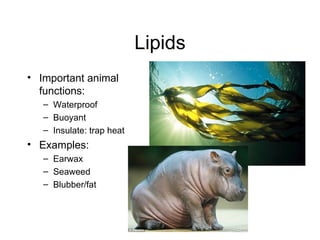
Lipids Important animal functions:  Waterproof  Buoyant  Insulate: trap heat  Examples:  Earwax Seaweed  Blubber/fat
So do you think lipids are hydrophobic or hydrophilic?  (is the oil in the beaker a lipid)
Structure Mostly carbon and hydrogen Many lipids form when a glycerol molecule combines with compounds called fatty acids
 
Monomer/Polymer: None!  Lipid base units are not considered to be monomers
Fill out chart for Lipids
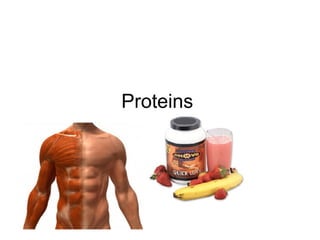
Proteins
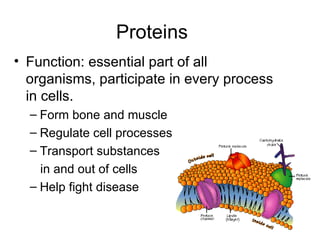
Proteins  Function: essential part of all organisms, participate in every process in cells.  Form bone and muscle Regulate cell processes  Transport substances  in and out of cells  Help fight disease
Protein Monomer: amino acid  Polymer: amino acid chain
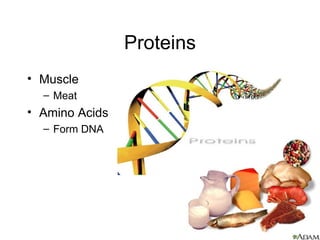
Proteins Muscle  Meat  Amino Acids  Form DNA
Protein Structure: four levels of organization Protein chain Amino acids can be twisted/folded More than one chain folded around each other Made up of Amino Acids that are linked by peptide bonds
Fill out chart for Proteins
Nucleic Acids
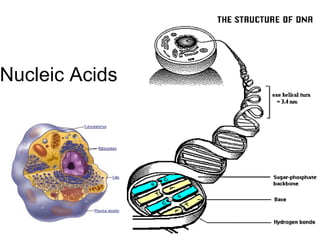
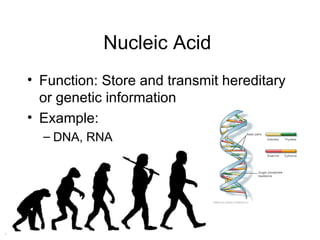
Nucleic Acid  Function: Store and transmit hereditary or genetic information  Example:  DNA, RNA
Nucleic Acid  Structure: consists of 3 parts:  5 carbon sugar, phosphate group, nitrogen base Monomer: nucleotides Polymer: polynucleotide, nucleic acid
Fill out chart for Nucleic Acid
FLASHCARD ALERT THE FOUR MACROMOLECULES ARE: Nucleic acid Proteins  Lipids  Carbohydrate

Macromolecule powerpoint

  • 1.
    Cellular Membranes (macromolecules = background information)
  • 2.
    Vocab you needto know: FLASHCARDS: Monomer: molecule that can be bonded to other identical molecules to form a polymer PREFIX SHEET Mono: one Poly: many, more than one Di: two Hydro: water Phobic: afraid Philic: love Nucleo: nucleus
  • 3.
    FLASH CARD ALERT MACROMOLECULE: A molecule containing a large amount of atoms.
  • 4.
  • 5.
    Carbohydrates Function: Living things use carbohydrates as their main source of energy Energy for cellular respiration Structural purposes
  • 6.
    carbohydrate Structure Madeof carbon, hydrogen, and oxygen atoms Typically in a 1:2:1 ratio
  • 7.
    FLASH CARD ALERT POLYSACCHARIDE More than two MONOSACCHARIDE combined through dehydration synthesis MONOSACCHARIDE: simple sugar. Building blocks of more complex sugars: glucose DISACCHARIDE: sugar produced by two monosaccharide molecules as a result of dehydration synthesis
  • 8.
    Carbohydrate Monomer: Monosaccharides: glucose, frutose Polymer: Polysaccharides: glycogen (animal starch) Plants store excess sugar in starch
  • 9.
    Carbohydrate polysaccharide Chitin: Hard exterior shells of crabs and lobsters Cellulose Provides structure and durability in plants
  • 10.
    Fill out chartfor carbohydrate
  • 11.
  • 12.
    Lipids Function: Energystorage Cell membrane Signaling molecule
  • 13.
    FLASH CARD ALERTHYDROPHOBIC: repels water HYDROPHILIC: loves water
  • 14.
    Lipids Important animalfunctions: Waterproof Buoyant Insulate: trap heat Examples: Earwax Seaweed Blubber/fat
  • 15.
    So do youthink lipids are hydrophobic or hydrophilic? (is the oil in the beaker a lipid)
  • 16.
    Structure Mostly carbonand hydrogen Many lipids form when a glycerol molecule combines with compounds called fatty acids
  • 17.
  • 18.
    Monomer/Polymer: None! Lipid base units are not considered to be monomers
  • 19.
    Fill out chartfor Lipids
  • 20.
  • 21.
    Proteins Function:essential part of all organisms, participate in every process in cells. Form bone and muscle Regulate cell processes Transport substances in and out of cells Help fight disease
  • 22.
    Protein Monomer: aminoacid Polymer: amino acid chain
  • 23.
    Proteins Muscle Meat Amino Acids Form DNA
  • 24.
    Protein Structure: fourlevels of organization Protein chain Amino acids can be twisted/folded More than one chain folded around each other Made up of Amino Acids that are linked by peptide bonds
  • 25.
    Fill out chartfor Proteins
  • 26.
  • 27.
    Nucleic Acid Function: Store and transmit hereditary or genetic information Example: DNA, RNA
  • 28.
    Nucleic Acid Structure: consists of 3 parts: 5 carbon sugar, phosphate group, nitrogen base Monomer: nucleotides Polymer: polynucleotide, nucleic acid
  • 29.
    Fill out chartfor Nucleic Acid
  • 30.
    FLASHCARD ALERT THEFOUR MACROMOLECULES ARE: Nucleic acid Proteins Lipids Carbohydrate